Y o s h i y u k i Yanase 9 Yoshihisa Fujii 9 Shogo O k u m u r a Yuji I m a m u r a 9 Tsuyoshi Y o s h i m u r a
Plate-type waveguides for detecting acoustic emissions generated by
termite attacks
Received: January 27, 1999 / Accepted: July 14, 1999
Abstract
To examine the feasibility of using plate-type waveguides for effective detection of acoustic emissions (AEs) from termite attacks in wood, AEs generated by breaking pencil leads or by termite attacks were detected using an A E sensor with a resonant frequency of 140kHz with steel plates of four different sizes and thickness and three A E sensors without them. The larger plates were associated with larger amplitudes of the artificial AEs. The amplitudes of AEs detected by an A E sensor with a steel plate larger than 30 • 30mm were greater than the average amplitude of the artificial AEs detected by three A E sen- sors. When detecting A E s generated by the feeding activity of workers,Coptoterrnes formosanus
Shiraki, the cumula- tive A E events detected by the sensor with a steel plate were much larger than those of the three A E sensors with- out a plate. Because A E waves are attenuated much less in a steel plate than in wood, it is more effective to attach the A E sensor to wood with a steel plate rather than directly to the wood. These findings suggest that it is feasible to use an A E sensor with a plate-type waveguide for the nondestruc- tive detection of termite attacks in wood.K e y
words
Acoustic emission (AE) monitoring 9 Termite attack 9 Plate-type waveguide 9Coptoterrnes formosanus
ShirakiIntroduction
Considerable attention has been given to methods to con- trol termites using few if any chemicals. To reduce the use of chemicals, a nondestructive technique is needed that can
Y. Yanase ([]) 9 Y. Fujii 9 S. Okumura
Division of Forest and Biomaterials Science, Graduate School of Agriculture, Kyoto University, Kyoto 606-8502, Japan
Tel. +81-75-753-6244; Fax +81-75-753-6245 e-mail: [email protected] Y. Imamura 9 T. Yoshimura
Wood Research Institute, Kyoto University, Uji 611-0011, Japan
detect a termite attack in wood as early as possible. When wood is attacked by termites, microfractures are generated in the wood by the feeding of workers. As a result, elastic waves, or acoustic emissions (AEs), are generated owing to the release of the strain energy stored in the wood)
Fujii and coworkers 24 showed that AEs could be de- tected in wood specimens under termite attack, and the results obtained in their laboratory and field tests suggest that A E monitoring may be an effective nondestructive method for detecting the presence and activity of termites in wood, even if the attack is still in its incipient stage. They also observed the feeding behavior of termites using a microscope and CCD camera to better understand its rela- tion to the generation of AEs. 7,s They showed that the am- plitudes of the AEs generated by termite attack depended on the type of feeding by the workers.
Lewis and coworkers 9'1~ examined resonant frequencies for an A E sensor to determine one that was optimal for detecting AEs generated by termite attack. They also pointed out the need for a waveguide, such as a lag screw attached to the A E sensor that penetrated walls to reach the inner posts or studs, to detect effectively AEs generated inside the house walls. However, a needle- or screw-type waveguide that penetrates walls is disadvantageous in that it leaves a hole on the wall surface. To avoid this problem, a metal plate attached to the wood surface could be used as a waveguide to collect AEs effectively by enlarging the effective sensing area of the A E sensor. In this study, we examined the feasibility of using a steel plate as a waveguide for detecting AEs.
Materials and methods
Fig. 1. Arrangement of acoustic emission
(AE)
sensors and AE measuring system45, 60 • 60 mm; 1, 2, 4, and 8 mm thick) were attached to the surface of the specimen with silicone grease (Fig. 1). AEs were detected by four cylindrical piezoelectric transducers (22ram long, 8mm in diameter; 901U, NF Electric Instru- ments) with a fundamental resonant frequency of 140kHz. One of the sensors was attached to the plate with silicone grease at a pressure load of 2kgf to achieve close contact between the wood, the plate, and the sensor. The other three sensors were attached to the specimen around the steel plate with silicone grease and fixed with a rubber band. As the artificial A E source, a pencil lead (3mm diameter, B hardness) was broken 200mm away from the center of the steel plate. Using this artificial AE, a momentary release of load that exhibits a step function and includes the frequen- cies required for A E measurement can be obtained in a reproducible manner. 1~'12 The elastic waves generated in the specimen and transmitted to the sensor were transformed into a voltage oscillation using an A E measuring system (9640, NF Electric Instruments). Signals from the sensors were amplified by 40dB and discriminated at a threshold voltage of 0.1V to be recognized as an A E event. The characteristic A E data (e.g., generation time, maximum amplitude, rise time of each A E event) were collected, re- corded on magnetic tape, and postprocessed with a com- puter. Signals from the sensors and cumulative A E events were monitored by a digital oscilloscope and a pen recorder, respectively.
Use of a plate-type waveguide to detect AEs generated by termite attack
Western hemlock wood was cut into a specimen 500mm long with a cross section of 105 • 105mm and air-dried. A hole (10mm diameter, 30mm deep) was drilled at the center of the end surface of the specimen. A group of 100 worker and 3_0 soldier termites
(Coptotermes formosanus
Shiraki) that had been given only water for about 2 days was put into the hole, which was then sealed with a silicone p!ug. A steel plate (60 • 60 mm, 4 mm thick) was attached to the surface of the specimen with silicone grease. The distance from the center of the steel plate to the bottom of the hole was 200mm. AEs generated by the feeding activity of the termites were detected by the four sensors and measured under the same conditions as in the previous section, except that the signals from the sensors were amplified by 70dB and discriminated at a threshold voltage of 0.26 V.
Results and discussion
Fig. 2. Relations between the location of artificial AE sources and AE amplitudes
tudes by sensor a were as large as or larger than those detected by sensor c. One possible explanation for this result is that the A E wave detected at sensor c was also transmitted to the plate and detected again by sensor a after it propagated in the steel plate, which has less of a damping effect than wood. Another possibility is that the detection area of sensor a was increased by using the steel plate, which can detect AEs with large amplitudes propagating differently according to the anatomic features of wood. Although A E waves should be attenuated at the boundaries between the plate and the wood, and between the plate and the A E sensor, the above findings showed the feasibil- ity of using a steel plate as a waveguide to detect AEs propagating in wood.
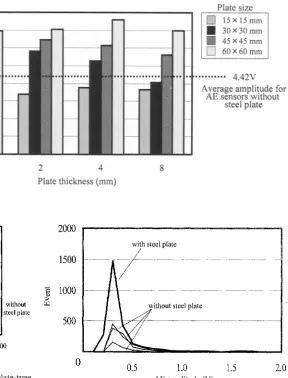
Figure 3 shows the relations between the A E amplitude detected by the sensors with and without a steel plate (60 • 60ram, 4ram thick) and the distance from the artificial A E source to the A E sensor. The A E amplitudes decreased exponentially as the distance increased. At distances of 100-500mm, the A E amplitudes detected by the A E sensor with a steel plate were about two to three times larger than those without it. As the propagation distance increases, the distance that AEs must pass through the plate as a percentage of the total distance decreases, and the steel plate becomes less effective as a waveguide. At a distance of 800ram, the amplitude of the A E detected by the sensor with a steel plate was almost the same as that detected by the other three sensors. Figure 4 shows the average ampli- tudes of artificial AEs detected by an A E sensor attached to 16 various steel plates as waveguides. It shows clearly that the larger the size of the plate the higher is the average amplitude, and that the thickness of the plate has no
14 12 ~" 10
6
< 4
_ _ i - - ~ with steel plate ~ - ' l ~ without steel plate I
2
I r I I
0 200 400 600 800 1000
Distance (mm)
Fig. 3. Relation between the A E propagation distance and AE amplitude
significant effect on the A E amplitude. The average ampli- tude of AEs detected by A E sensors attached directly to the wood was 4.42V, which suggests that an A E sensor with a plate larger than 30 • 30mm can detect AEs more effec- tively than a sensor without a plate.
Use of a plate-type waveguide to detect AEs generated by termite attack
Fig. 4. Relations between thick- ness, size of steel plate, and aver- age A E amplitude
0
3000
t
o
~ 2000 . . . .
m
w i t h o u t steel p l a t e
0 i
0 50 100 150 200
Time (rain)
Fig. 5. Comparison of AEs detected with and without plate-type waveguide during the attack by termites
events increased with time. The A E sensor with a steel plate detected 2.5-10.0 times as many A E events as the A E sensors without a plate.
Figure 6 shows the amplitude distribution of the AEs detected over 180min. The distribution had a peak near a threshold voltage of 0.26 V for both types of A E detection. In the A E sensor with a steel plate, the A E events detected by the A E sensor with a steel plate, especially near the threshold voltage, were larger than those detected without a plate. Using a steel plate that has less damping effect than wood increased the detection area of the A E sensor; and AEs that were attenuated while propagating in wood, and could not be detected by A E sensors without it, could now be detected. Therefore, it was considered that the A E events detected by A E sensors with a steel plate were larger than without it.
2000
1500
1000
500
with steel plate
0
0.5 1.0 !.5 2.0
AE amplitude (V)
Fig. 6. Amplitude distribution of AEs detected with and without steel plate for termite attack
steel plate than in wood. For detection of AEs generated by termite attack, the A E events detected by the A E sensor with a plate-type waveguide were about three times as large as those detected without a plate. To establish the useful- ness of A E sensors using a plate-type waveguide for detect- ing termite attack in wood, it is necessary to confirm the present findings by carrying out A E detection films for other experimental conditions, such as structural members of wooden houses, and to study further the method of fixing large steel plates on wooden constructions.
References
Conclusions
The ability of an A E sensor with a steel plate to detect AEs was greater than that of an A E sensor attached directly to the wood, in part because A E waves are attenuated less in
1, Fujii Y (1997) Application of A E monitoring to forest products research (in Japanese). Mokuzai Gakkaishi 43:809-818
2. Fujii Y, Noguchi M, Imamura Y, Tokoro M (1989) Detection of termite attack in wood using acoustic emissions. I R G Document No. IRG/WP/2331, p 7
4. Fujii Y, Owada M, Noguchi M, Imamura Y, Tokoro M (1990) Detection of termite attack in wood using acoustic emissions. IRG Document No. IRG/WP/2355, p 8
5. Noguchi M, Fujii Y, Owada M, Imamura Y, Tokoro M (1991) A E monitoring to detect termite attack on wood of commercial dimen- sion and posts. For Prod J 41(9):32-36
6. Imamura Y, Tokoro M, Owada M, Fujii Y, Noguchi M (1991) Detection of feeding behavior of termites using A E monitoring. IRG Document No. IRG/WP/1514, p 6
7. Fujii Y, Imamura Y, Yoshimura T (1995) Observation of feeding behavior of termite using CCD camera and its relation to the generation of acoustic emission (AE). Wood Res 82:47-53 8. Matsuoka H, Fujii Y, Okumura S, Imamura Y, Yoshimura T
(1996) Relationship between the type of feeding behavior of
termites and the acoustic emission (AE) generation. Wood Res 83:1-7
9. Lewis VR, Lemaster RL, Beall FC, David LW (1991) Using A E monitoring for detecting economically important species of termites in California. IRG Document No. IRG/WP/2375, p 7
10. Lemaster RL, Beall FC, Lewis VR (1997) Detection of termites with acoustic emission. For Prod J 47(2):75-79
11. Nakao T, Tanaka C, Takahashi A (1986) Source wave analysis of large amplitude acoustic emission in the bending of wood (in Japanese). Mokuzai Gakkaishi 32:591-595