Politikon: IAPSS Political Science Journal Vol. 28
Volume 28: December 2015
Editor-in-Chief
Cait Bagby (USA)
Deputy Editor-in-Chief
Laurens Visser (Australia)
Editorial Board
Politikon: IAPSS Political Science Journal Vol. 28
Table of Contents
Editorial Note 4
Articles
The impact of political trajectories on voting: a study of female candidates
for a state legislature in Brazil 5
Social perception of Risk and Threat of “Cyber Warefare”
in the German speaking blogosphere 27
The return of Turkey to the Western Balkans:
A challenge or an opportunity for the European Union? 58
Misology as a Methodology 74
Religious Affiliation versus Religious Commitment:
What Mattered Most in U.S. Presidential Elections, 2000-2012? 101
We-versus-They: Building a Paradigm Community in Rwanda 121
Realpolitik in Iran
Politikon: IAPSS Political Science Journal Vol. 28
Editorial Note
Dear Reader,
Our Editorial Board is proud to present you Volume 28 of Politikon, an academic journal of the International Association for Political Science Students.
The current issue is once again full of interesting articles. Larissa Peixoto Vale Gomes writes about the impact of political trajectories on voting in Brazil. Henrike Francesca Höpker shows how the German speaking blogs perceive the threat of “cyber warfare”. Liridon Lika discusses issues of the Turkey and EU relationship. Mehran Mazinani brings a unique look at misology and what it means for social-scientific discussions. Elena Sidorova looks at the importance of religion for voters in the US presidential elections. Marobe Wama Marobe offers an approach for the development of a common Rwandan paradigm community. Last but not least, Josef Westermayr argues that it may be possible to come to a limited regional security cooperation leading in the end to a security architecture in the Middle East
We believe that with such a wide variation of topics, every one of you will find something of their interest and maybe also find inspiration for a submission to Politikon of your own.
We are looking forward to receiving it!
Politikon: IAPSS Political Science Journal Vol. 28
The impact of political trajectories on voting: a study of female
candidates for a state legislature in Brazil
1Larissa Peixoto Vale Gomes
Larissa Peixoto Vale Gomes, 29, has recently started in the PhD programme of the Federal University of Minas Gerais’ Political Science Department. She holds a Master’s in Political Science and a Bachelor’s in Social Sciences from the same institution. Her interests are gender studies, electoral reform and legislative studies. She worked, between 2013 and 2014, as a research associate at the João Pinheiro Foundation in Minas Gerais, taking part in several studies on public security. [email protected]
Abstract
The following article uses a section from the survey Female presence in legislative spaces: a study of the 2010 elections for the State Assembly of Minas Gerais to see if those candidates’ political trajectories differ from men’s, and what were the variables with the most impact over voting. Political background has been accepted as an important factor on the amount of resources raised and votes received. This is discussed considering how this can affect newcomers, such as women. The data is comprised of a survey and financial disclosure and a linear regression was conducted to assess the impact of each variable. The article concludes that the women surveyed followed similar trajectories as men and corroborates the current knowledge that the variable with most impact is having held elective office. This can only be indicated, given the overall impact the financial variable and how it overshadowed the role of other variables.
Keywords
Brazil, campaign finance, political trajectories, women
1 A version of this paper was presented at the Quinto Congreso Uruguayo de Ciencia Política, “¿Qué ciencia
Politikon: IAPSS Political Science Journal Vol. 28
Introduction
The following article presents data collected for the Master’s research Female presence in the legislative spaces: a study of the 2010 elections for the State Assembly of Minas Gerais (Gomes 2012). Eighty-one of the 140 female candidates for the State Assembly of Minas Gerais, Brazil, were surveyed on five topics: political history, political circumstances in 2010, political views and ideology, plans for the future and general background. Using several key variables from the survey the articles focuses on the question “What political history variables had a positive impact on voting?”.
Elections demand money, party support, leaderships’ support, being known by the electorate, several competences (such as public speaking), among others. Those demands lay heavily upon minorities, including women, who have recently joined the political arena and are unfamiliar with navigating those waters. They also face added obstacles, such as prejudice, higher expectations, the perception of being a risk, and lacking political experience (Álvares 2008; Murray 2008; 2010; 2014). An investigation into women’s political trajectories may demonstrate if they are following men’s footsteps or if they have a different approach to being elected. If so, that means different pathways, such as careers or involvement with social movements might be more or less relevant to women.
The study conducted here is not an attempt to solve that question, but it is a contribution to its answer. The article will be divided thusly: i) a literature review discussing women’s participation in politics and the impact of political trajectories; iii) a methodological section; iv) an analysis section, presenting the data, tests and discussion; iv) conclusion.
Literature review
Politikon: IAPSS Political Science Journal Vol. 28
characteristics that appear to be relevant when becoming a candidate and, for the case at hand, if there are any particularities when it comes to discussing female candidates.
Are women less inclined to participate in politics?
There are two general reasons for women’s low presence in institutional politics: individual disinterest from women or traditionalism of political parties (Araújo 2006).2 Both are superficial, considering they do not take into account the amount of factors that influence elections, specially a woman’s election. The individual disinterest hypothesis is based on the outcome of there being fewer female candidates and even fewer elected, which is itself a methodological error (Allen 2013a). In addition, it does not account for individual idiosyncrasies, taking women as a somewhat homogenous group.
Phillips (1995) discusses informal obstacles in women’s path towards political activities, arguing women face several other deterrents: being the primary caretaker of children and elderly, lower wages and association with jobs that have less symbolic value. Being newcomers makes them perceived as risky candidacies, which lowers the investment in their campaigns (Murray 2010a). Gender socialisation creates barriers that might affect political ambitions. For instance, marriage in which “women assume the majority of household labor and child care responsibilities”, leaves them without time or financial resources to participate in politics (Lawless 2012 apud Allen 2013a: 150).
Norris, Lovenduski and Campbell (2004) demonstrate women feel their actions will not have an impact, discouraging them when it comes to participating in political activities. The study by Lawless and Fox (2010) discusses how women feel unqualified for political office, despite the fact they have, at least, the same qualifications as men. They argue women tend to underplay their qualifications and by adolescence choose more “feminine” areas, although there are no studies proving an innate gender difference in any abilities. This is also true in the electoral area (idem: 116). Part of the reason women reject entering the political arena is the sexist environment they would face (Allen 2013a; Murray 2014). Additionally, women believe
2 These hypotheses assume a country and culture that is already relatively egalitarian, in which women are free to
Politikon: IAPSS Political Science Journal Vol. 28
politicians should have excellent credentials and overwhelming ability. Men mostly stated personality traits that are crucial to being a good politician (Lawless and Fox 2010). Gender socialisation is part of the informal roadblocks that prevent higher female participation in politics; they feel they need to be above reproach, partially because of how politics is a “boy’s club”.
The first studies conducted on political gender gap in the middle of the 20th century showed a large difference, with women participating and even voting less than men. That gap has now narrowed, but not completely closed (Burns et al 2001; Norris et al 2004). Studies do not show conclusive evidence that women and men participate in different activities, but they indicate women sometimes prevail in protests, individual action and voting. Men tend to find themselves in formal actions, such as being affiliated with a party and being city councillors.
When income brackets are higher, the gap nearly closed in both studies, still with a slight advantage towards men. At higher levels of education, the participation gap closes (Norris et al 2004). A possible explanation is that men are more likely to be affiliated with formal political organisations and tend to hold blue-collar, unionised jobs more often.
Norris et al (2004) reported that feeling the ability to have an impact is an important factor in participation. According to them, women feel they “have lower confidence that they can influence the political process through their own actions” (2004: 44). Men and women have different knowledge about politics, with the first knowing more about international politics and the latter knowing more about social issues. These findings seem to concur with the idea that the socialisation process is differentiated, giving men more confidence and more interest in politics and encouraging women to focus on issues of care (Pinheiro 2007; Murray 2008; Miguel and Feitosa 2009). Burns et al (2001) reported that gender discrimination actually boosts female participation, despite the fact that it hinders their opportunities to get better jobs and higher income.
Politikon: IAPSS Political Science Journal Vol. 28
employment have roughly an equal chance, compared to men, of participating in a political activity. This supports the argument that female exclusion is a composition of structural and cultural constraints, and not an inherent female characteristic. Lawless (2012 apud Allen 2013a), found in the United States there was gender parity in the pool of eligible political candidates, but men were more likely to decide to run. Allen (2013a) found a similar result in the United Kingdom, with male local councillors 10% more likely to run for Parliament than female councillors.
Research has found that income and education being equal, men and women participate in politics, informally and formally. That would account for individual interest, but are parties, political gatekeepers in the path for elective office, interested in electing women? Lawless and Fox (2010: 99-103) and Krook (2009: 36) show that parties avoid risk, and female candidates are perceived as risky. Parties have several ways of supporting women (Norris and Lovenduski 1995), from rhetorical and symbolic gestures to affirmative action and will choose to use those tools when they would benefit the whole party, regardless if ideology. Allen (2013a) found that the two most relevant groups for female councillors when it came to encouraging them to run for higher office were the two least likely to do it: party officials and their families.
According to Araújo (2006), parties are not necessarily guilt of sexism or cultural backwardness. Without excluding the possibility that some parties or social sectors are attached to patriarchal notions, she attributes aspects of the political and electoral system for minorities’ unfavourable electoral results. As Gomes (2012) and Lawless and Fox (2010) show, official party positions on female candidates can vary according to ideology, but parties’ actions are not that different. The “calculations of electoral competition” (Araújo 2006: 4) are the most important aspect when deciding candidacies and that shifts the focus from making a just decision that would reverse female under-representation.
Politikon: IAPSS Political Science Journal Vol. 28
about the selection process. Mostly, party leaders make the decisions, differentiating only in which point of the process they interfere. Women must go through the same process as the men, but are likely to be judged more harshly, with a higher standard. Historic exclusion of women from politics becomes an added barrier because they do not fit the dominant profile (Murray 2010b). This makes them choose not to become affiliated or run. By continuing this behaviour, women never come to fit the profile, maintaining the pattern of exclusion (Álvares 2008: 928).
Araújo (2010: 580) distinguishes motivations that affect individual political careers. She develops two categories: politics from circumstance and politics for a design. The interviews showed that women go into politics through circumstances, whether it is because of family heritage or being active in social movements. Men, on the other hand, set out to be politicians. Her interpretation is that the idea of power is unattractive to outsiders. There is a negative perception that politics affects the choices made by these agents, who enter it unwillingly and as a means to an end. Insiders see politics as an end, an achievement, and plan for it. This is neither bad nor good, but it can mean that men are better prepared to fit the common profile of politician.
What are the characteristics sought in candidates?
Parliaments are becoming more homogenous, housing a political elite that does not represent the majority of the population (Allen 2013b: 687; Murray 2010b: 101). This comes from the development of pathways that facilitate entry in the political arena and/or teach the abilities required to become a politician, including careers such as lawyers, teachers, academics and, more broadly, liberal professionals. Other professions put the individual in direct contact with politics, such as journalism and representatives for unions or interest groups (Cairney 2007). Allen (2013b: 704) also discusses the idea of traditional and direct routes, respectively, “rising up” in the ranks and working directly in politics.
Politikon: IAPSS Political Science Journal Vol. 28
accomplished by women can have an effect on that, either with women combining activism with liberal professions or forgoing activism altogether.
According to Murray (2014) the qualities that are sought in candidate selection are personal characteristics such as charisma, intelligence and rhetoric, as well as visibility, financial resources and networks. Murray found that those are mentioned more often than profession or formal education. Regardless, those attributes are important in that they lead to many of the ones preferred by parties. There is a particular pathway towards becoming a representative, including high-ranking universities, specific careers and “springboard positions” within local or party politics (Murray 2014: 7).
The pursuit of a political career demands the accumulation of several types of resources, which can be done in different combinations and degrees. What majoritarian systems use to define candidates might be used in the Brazilian proportional representation and open-list system to decide which candidates get party support. Miguel (2003) explains that there needs to be cultural capital (knowing how politics works), economic capital (free time to participate in politics, but financial resources can be added to that) and social capital (a network of relationships). Because of the individualised nature of Brazilian politics, candidate selection can be very focused on who can bring their own resources and win without putting stress on the party. This helps incumbents more than newcomers, female incumbents more so than male (Pinto, Moritz and Schulz 2013: 220). Those resources can be different in nature, but within certain parameters of variation.
Politikon: IAPSS Political Science Journal Vol. 28
The traditional route is seen as a path from local political activism, to party affiliation, until political office, the most desired one usually being at the national level. For Brazil, local politics means volunteering or managing NGO’s or associations, being part of an active union, leading collective political action. These are perceived as political training and an interest in politics that is not based on office or reward. Additionally, to a lesser degree, devoting time to a party and creating connections that way. It can also signal to the electorate the issues that are important to the candidate. Soares explains that women’s massive participation against the civil-military dictatorship allowed them to become politically aware and aware of their rights. They became a “new social being” (Soares 1998: 35). By leaving the private sphere and constituting themselves into a collective, they managed to expose it and gradually politicise it (Farah 2004: 50). However, after the dictatorship ended, many of the internal fights that had been suppressed for the greater goal came out. Women’s and feminist movements were not an exception and a lot of them dispersed into other groups (Alvarez 1990: 110-112).
Women have followed men into careers that can springboard into politics, particularly Journalism and Law (Ávila and Portes 2009: 95), which can mean a combination of traditional route and grassroots. Women are overwhelmingly present in teaching fields (UN 2010) and teachers’ unions are very politically active. Women are less present in self-employed or employer categories (DIEESE 2011), which can mean less available time for political activity.
Politikon: IAPSS Political Science Journal Vol. 28
As Miguel (2003) argues, in acquiring political experience, an agent will want an Executive position for visibility and a Legislative position for general experience and peer recognition. In Brazil, political careers mostly follow a specific, hierarchical trajectory, alternating Executive and Legislative positions in municipal, state and federal levels, and including appointed offices along with elective offices. Executive positions are fewer and demand a lot of visibility and funding, which has to be taken into account when leaving the Legislative (Leoni, Pereira and Queiroz 2003).
Pinto et al (2013: 220), shows that women who were successful3 had a traditional route, beginning, in fact as city councillors. They had very structured political careers, which seemed to have been more relevant than other resources, even political activism. The following data will show if the female candidates from the 2010 election in the state of Minas Gerais followed the pattern, and who were the most successful ones.
Conceptualization, operationalization and methodology
In 2010, there were over 15 million voters in the state of Minas Gerais, one of the largest electoral districts in Brazil. It had, in 2010, 77 seats in the State Assembly. There were 1.083 candidates in total, with 14 candidates per seat. Because the focus were female candidates and their political lives, it was decided to survey only them, and to attempt to contact all. Therefore, the sample is one of chance – the difference being parties that declined to give contact information and candidates who were not found. All candidates who were contacted chose to participate. There were 140 female candidates and 943 male; 81 women from 14 parties participated in the survey. Only four women were elected, with one more taking over after someone from her party had to be excused.
The goal is to search for the variable which garnered more. It is clear that with a small case number from a particular year in a state election, this will not answer that question definitively, but it will provide a piece of the puzzle regarding women’s participation in elections. Details
3 They took into account high voting, not election, which is also done here. Pinto et al (2013) also considered
Politikon: IAPSS Political Science Journal Vol. 28
regarding the methodology are explained further with the data analysis. A linear regression analysis was used to determine the impact of each variable, as well as descriptive statistics.
Analysis and findings
There was a high disparity of values for votes and for funds declared. Votes ranged from 3 to 50.620 (standard-deviation of 11.487; mean is 625) and funds4 ranged from R$ 0,00 to R$ 1.351.639,14 (standard-deviation of R$ 228.873,29; mean is R$ 61.884,61). The variance was affecting the statistical tests, so they were normalised using log 10, which has the advantage of allowing the comparisons between those two variables to be in the same unit. Much can be said about the veracity of declared investments and how they are presented. There is a chance funds are shuffled around and declared under different labels. Therefore, for statistical tests and overall analyses, only the total will be used.
The amounts for each variable are actually very small considering how costly an election is. Some candidates (18,5%) did not declare any funds – this happens when they give up; are not elected; had little funds raised; did not mean to run at all.5 Most (43,2%) had four figure values and only two spent more than one million reais. This shows the difficulty in getting funds and how unbalanced the situation is, even when considering women only.
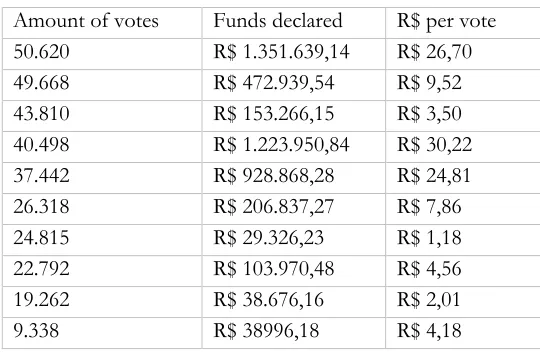
Table 1 shows the top ten candidates in amount of votes, how much each spent, and how much per vote was spent. After the tenth candidate there is a steep decline in votes, but not in money spent; adding to the fact that some spent much less and garnered so many votes demonstrates that other variables are important.
Table 1: Top ten in amount votes (in R$)
4 This variable was extracted from public information from the Superior Electoral Court (TSE). It is possible
that the candidates did not declare the full amount, but there is no way to verify this. However, it is safe to assume that the declaration of funds is not overly exaggerated, given current oversight.
5 There are accusations that parties get women to run to fill the 30% quota and public servants sometimes run
Politikon: IAPSS Political Science Journal Vol. 28
Amount of votes Funds declared R$ per vote 50.620 R$ 1.351.639,14 R$ 26,70 49.668 R$ 472.939,54 R$ 9,52 43.810 R$ 153.266,15 R$ 3,50 40.498 R$ 1.223.950,84 R$ 30,22 37.442 R$ 928.868,28 R$ 24,81 26.318 R$ 206.837,27 R$ 7,86 24.815 R$ 29.326,23 R$ 1,18 22.792 R$ 103.970,48 R$ 4,56 19.262 R$ 38.676,16 R$ 2,01 9.338 R$ 38996,18 R$ 4,18
Source: Author, from data collect from the Superior Electoral Court.
Social background
There was a typical profile: 48,1% had an university degree; 21% were teachers and 16% were business owners; 71,6% made between 1 and 10 minimum wages6; and 51,8% were between the ages of 44 and 56. Other categories in those variables were evenly distributed.
Only education and monthly income had a significant correlation with votes received (Table 2). Spearman’s rho was used because some of the variables were categorised, which is better served by a non-parametric coefficient. All tests were conducted at a 99% level of confidence. It is important to acknowledge that the correlation between education and monthly income with funds declared also presented statistically significant coefficients (Table 3). It was expected that many variables would correlate with both dependent variables and establishing causality may prove difficult. It can be that education and income have an effect on fund-raising which influences voting, but it is also possible that those happen independently.
Table 2: Significant correlations between Amount of votes and social background variables
Amount of
votes Formal education Monthly income Spearman's
rho Amount of votes Correlation Coefficient 1,000 ,390** ,301** Sig. (2-tailed) . ,000 ,006
N 81 81 81
**. Correlation is significant at the 0.01 level (2-tailed).
Source: Author.
Table 3: Significant correlations between Funds declared and social background variables
Politikon: IAPSS Political Science Journal Vol. 28
Funds
declared Formal education Monthly income Spearman's rho Funds declared Correlation
Coefficient 1,000 ,380** ,320** Sig. (2-tailed) . ,002 ,009
N 66 66 66
**. Correlation is significant at the 0.01 level (2-tailed).
Source: Author.
Relationship to the party
The candidates were asked questions about their relationship with their party and how it assisted them in 2010. These are opinions and perceptions from the candidates, so is no measurable impact on the dependent variables. It could be that women who felt they achieved more votes than expected felt better about their parties participation, but the disparity in votes makes that assessment difficult to acertain.
The majority (90,1%) believes that it is the role of the party to take initiatives to assist female affiliates and candidates and 56,8% believe that the most important factor to achieve a high vote count is party support (support from social movements was chosen by 25,9%). Parties have larger platforms; they control how the Free Electoral Advertisement is divided and the coalition formed; may play pivotal roles in getting support, financial and otherwise.
Of the candidates, 61,7% said their parties have training for women who want to run. Considering that only 13,6% said their parties actually had courses in 2010, that number could be inflated. Nonetheless, they believe that women do not run for office for lack of societal support (48,1%); 13,6% said it was because of lack of party support. This could come from a perception that women do not even consider affiliation, that is, societal support comes before party support. Only 28,4% said that party support was the most important during their election; 54,3% stated it was the support of local leaderships (community, unions and/or church leaders).
Politikon: IAPSS Political Science Journal Vol. 28
Most asserted they did not get any kind of material support from their parties. Generic publicity materials are in large supply, but candidates use individualised items also. Services such as day-care, transport, and meetings in cities with easy access have long been a demand of women. Campaign events can be individual, but are usually combined with another candidate running for another office, usually in the Executive, and participating in such an event can make quite a difference. Only five chose to answer that they received a lot of help, but because it was for publicity materials, it is possible they meant the party-wide items.
Political history
This subsection deals with past experiences and political connections established and if they had an impact on voting. Variables that showed a small or no correlation were: the type of political organization they started in; if they participated in social movements in the past two years; if they had (previously or at the time of the survey) relatives who held political office.
Most of the women (43,2%) began their political trajectory in a political party, contradicting the notion that women begin in politics through social movements. A few who began in student organisations (13,6%) and church organisations (11,1%). Many (60,5%) had participated in social movements recently. There was an almost even split between women who had had family members in political office (54,3% had none). The importance of family connections applies to men and women, so it was expected that this variable would present a correlation. The fact that it did not contradicts current beliefs; it is possible that the prominent, traditional, political families that currently exist skewed that perception.
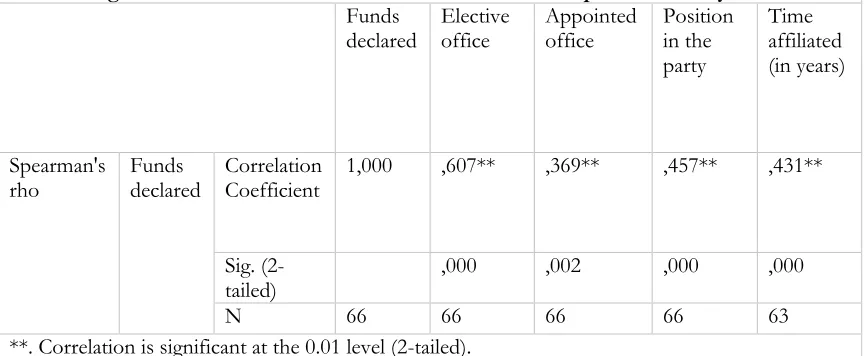
All variables that correlated with the amount of votes also correlated with funds declared, with a positive direction (Tables 4 and 5). Expectations were confirmed: having held an elective and/or appointed position7 are highly correlated, as is having had a position in the party; time of affiliation was also significantly correlated. This confirms the notion that the party is central to succeed in politics, if one is able to have access to its support.
7 Appointed offices are, at the Executive level, secretaries for the city, state or nation or directors of public
Politikon: IAPSS Political Science Journal Vol. 28
Having had elective office is more highly correlated with funds declared, which can indicate that political experience is very important to donors. Appointed office and position in the party are more important for votes, which demonstrates the importance of visibility to connect with voters and how much party support can push a candidate forward.
Table 4: Significant correlations between Amount of votes and political history variables
Amount
of votes Elective office Appointed office Position in the party Time affiliated (in years) Spearman's rho Amount
of votes Correlation Coefficient 1,000 ,544** ,412** ,580** ,441** Sig.
(2-tailed) ,000 ,000 ,000 ,000
N 81 81 81 81 77
**. Correlation is significant at the 0.01 level (2-tailed).
Source: Author.
Table 5: Significant correlations between Funds declared and political history variables
Funds
declared Elective office Appointed office Position in the party Time affiliated (in years) Spearman's rho Funds
declared Correlation Coefficient 1,000 ,607** ,369** ,457** ,431**
Sig.
(2-tailed) ,000 ,002 ,000 ,000
N 66 66 66 66 63
**. Correlation is significant at the 0.01 level (2-tailed).
Source: Author.
Politikon: IAPSS Political Science Journal Vol. 28
Table 6: Correlation between Amount of votes and funds declared
Amount of votes Funds declared Amount of votes Pearson Correlation 1 ,852**
Sig. (2-tailed) ,000
N 81 66
Funds declared Pearson Correlation ,852** 1 Sig. (2-tailed) ,000
N 66 66
**. Correlation is significant at the 0.01 level (2-tailed).
Source: Author.
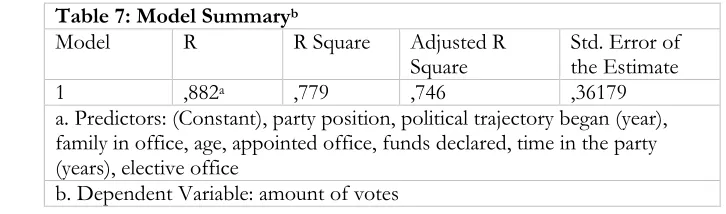
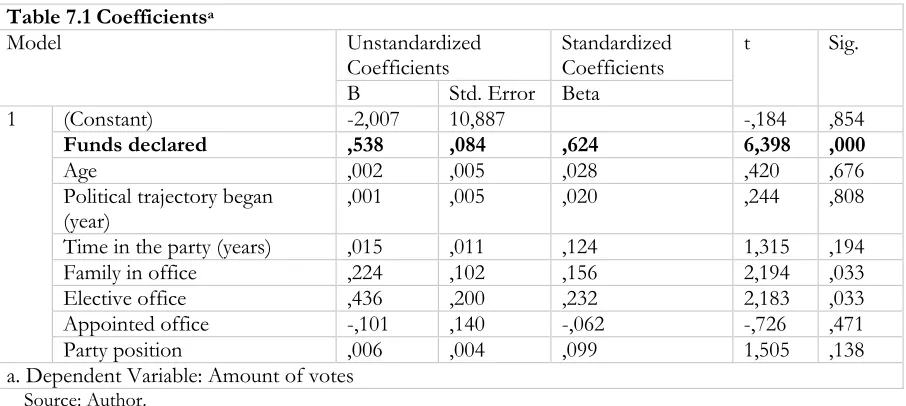
To explore further this relationship, a multiple regression analysis was carried out with the relevant variables. The models below show that once funds declared and having held elective office are included, little else matters. The model with all the variables is shown below. The adjusted square, the preferred measure for small samples, shows that this model explains 74% of the variance of the dependent variable. Variables that did not show any effect were: age, year the political trajectory began, period of affilitation, having had appointed office, and having had a party position. Elective office and family in politics had a small and similar impact. The F-test, which displays the strength of the model, was 23,739.8
Removing all the variables except for funds declared gives an adjusted R square of 0,722, that is, it explains 72,2% of the variance of the dependent variable. The F-test was 170,099.
Table 7: Model Summaryb
Model R R Square Adjusted R
Square Std. Error of the Estimate
1 ,882a ,779 ,746 ,36179
a. Predictors: (Constant), party position, political trajectory began (year), family in office, age, appointed office, funds declared, time in the party (years), elective office
b. Dependent Variable: amount of votes
Politikon: IAPSS Political Science Journal Vol. 28
Table 7.1 Coefficientsa
Model Unstandardized
Coefficients Standardized Coefficients t Sig. B Std. Error Beta
1 (Constant) -2,007 10,887 -,184 ,854
Funds declared ,538 ,084 ,624 6,398 ,000
Age ,002 ,005 ,028 ,420 ,676
Political trajectory began
(year) ,001 ,005 ,020 ,244 ,808
Time in the party (years) ,015 ,011 ,124 1,315 ,194 Family in office ,224 ,102 ,156 2,194 ,033 Elective office ,436 ,200 ,232 2,183 ,033 Appointed office -,101 ,140 -,062 -,726 ,471 Party position ,006 ,004 ,099 1,505 ,138 a. Dependent Variable: Amount of votes
Source: Author.
As Table 1 demonstrated, a lot of money was spent for only a few votes; this could mean that the importance of money is over-expressed. Therefore, the model was adjusted several times, excluding the most important variables one by one, to visualise the impact of variables known to be key from the literature, but that were being overshadowed. This means that the predictability of the model was significantly lowered, however what was being looked for is the impact of a single relationship within the array of variables.
The second model kept having held elective office as the most relevant predictor. For the sake of brevity and clarity, the following table will show a summary of all the models and the relevant results. After the fourth model, the regression lost all significance.
Table 8: Regression models summary (without Funds declared)
Significant
predictors Adjusted R2 F-test
Standardized Coefficients
Beta t value Sig. Model 1 Elective office 0,344 6,700 0,448 3,214 0,002 Model 2 (without
Politikon: IAPSS Political Science Journal Vol. 28
Model 3 (without
appointed office) Time in the party (years) 0,187 4,494 0,393 2, 931 0,005 Model 4 (without
time in the party (years))
Political trajectory
began (year) 0,101 3,212 -0,357 -3,258 0,002
Source: Author.
At no point did having a family member having had political office was a good predictor of the candidates’ votes. Despite the correlation it had previously, and its presence in the first model, it is possible that its overall impact is negligible, contrary to what is believed. It was definitely the case for the group studied. The prejudice against women who achieve through their family can be detrimental instead of helpful, and that should be a future line of enquiry.
Other assumptions were confirmed. Elective office offers the best platform for candidates, making incumbency a high value ambition. Decisions about running for office, therefore, depend on the level of difficulty achieving it, reinforcing the hierarchical nature of political positions in Brazil. Appointed office offers some visibility and experience, but candidates are often criticised when they have not had any electoral experience. The time spent in the same party is an interesting variable: only 22,2% of candidates belonged to the same party for ten years or more. It is possible that in other countries that variable is more significant and a better predictor. When the candidate began her political trajectory had a small impact, but a significant one. With age not being a factor, it indicates that the commitment to a political life could be a key characteristic.
Conclusion
Politikon: IAPSS Political Science Journal Vol. 28
As Walby (1991; 1997) demonstrated, patriarchal notions evolve and become more subtle. When it comes to political participation, women tend to follow topics that are more associated with femininity and participate in less formal ways. Even when they are qualified, women feel they do not have the attributes to be a politician and know that it is a risky endeavour personally, given the amount of financial resources and time and the possibility of discrimination. Parties do not see a need to encourage women to affiliate or run, even left-wing parties who are associated with women’s and feminist issues. This leads women to believe they are not welcome.
It is noticeable that the amount of involvement from a party depends, partially, on institutional rules and what role they play in elections and government. Brazilian candidates are elected individually but govern as parties, creating scattered elections and unusual connections and deals. They have two agendas: getting the most amount of votes collectively, and getting the “right” candidates the most amount of votes. Parties will become more involved in a campaign if it has a chance to bring many votes on its own. The less it has to be involved, the better, which encourages the development of a “successful” candidate, someone who will get votes no matter what.
Authors converge on a traditional route: becoming established with a community before running, while also getting a higher degree in a liberal profession. There are shortcuts, such as working directly with a legislator or even becoming a figurehead in a party.
Candidates are expected to have certain personal traits, some of which come with training. They are also expected to fund-raise individually and run with little party support. Women have been excluded from the construction of this mould and, when they decide to run, lack the necessary skill set and funds. They have lower incomes, less valued jobs and fewer financial holdings (UN, 2010).
Politikon: IAPSS Political Science Journal Vol. 28
Additionally, once finances were removed from the tests, other aspects of an electoral campaign became relevant. Other resources, such as having had an appointed office, a position within the party, and commitment to the party and political life are also essential for electoral success.
Politikon: IAPSS Political Science Journal Vol. 28
References
Allen, Peter. 2013a. “Gendered Candidate Emergence in Britain: Why are More Women Councillors Not Becoming MPs?”. Politics vol. 33.
Allen, Peter. 2013b. ‘Linking Pre-Parliamentary Political Experience and the Career Trajectories of the 1997 General Election Cohort’. Parliamentary Affairs vol. 66.
Álvares, Maria Luiza Miranda. 2008. “Mulheres brasileiras em tempo de competição eleitoral: seleção de candidaturas e degraus de acesso aos cargos parlamentares”. Dados vol. 51 (4).
Alvarez, Sonia. 1990. Engendering democracy in Brazil: women’s movements in transition politics. Princeton: Princeton University Press.
Araújo, Clara. 2001. “As cotas por sexo para a competição legislativa: o caso brasileiro em comparação com experiências internacionais”. Dados vol. 44 (1).
Araújo, Clara. 2005. “Partidos políticos e gênero: mediações nas rotas de ingresso das mulheres na representação política”. Revista Sociologia Política (24).
Araújo, Clara. 2006. Por que as mulheres ainda concorrem pouco no Brasil? Accessible at:
<http://www.maismulheresnopoderbrasil.com.br/pdf/Executivo/Por_que_as_mulheres_ai nda_concorrem_pouco_no_%20Brasil.pdf>. (05/2011)
Araújo, Clara. 2010. “Rotas de ingresso, trajetórias e acesso das mulheres ao legislativo – um estudo comparado entre Brasil e Argentina”. Estudos Feministas vol. 18 (2).
Ávila, Rebeca Contrera & Portes, Écio Antônio. 2009. “Notas sobre a mulher contemporânea no ensino superior”. Mal-Estar e Sociedade Ano II (2).
Burns, Nancy; Scholzman, Kay Lehman; Verba, Sidney. 2001. The private roots of public action. Gender, Equality, and Political Participation. Cambridge: Harvard University Press.
Cairney, P. 2007. “The Professionalisation of MPs: Refining the ‘Politics-Facilitating’ Explanation”. Parliamentary Affairs vol. 60 (2).
DIEESE. 2011. Anuário das mulheres brasileiras. São Paulo.
Farah, Marta Ferreira Santos. 2004. “Gênero e políticas públicas”. Estudos Feministas vol. 16 (1).
Gomes, Larissa. 2012. A presença feminina nos espaços legislativos: um estudo das 2012 eleições de 2010 para a Assembleia Legislativa de Minas Gerais [manuscript]. Belo Horizonte: Federal University of Minas Gerais.
Politikon: IAPSS Political Science Journal Vol. 28
Reform Worldwide. New York: Oxford University Press.
Lawless, Jennifer and Fox, Richard. 2010. It Still Takes a Candidate - Why Women Don’t Run for Office. New York: Cambridge University Press.
Leoni, Eduardo; Pereira, Carlos; Rennó, Lúcio. 2003. “Estratégias para sobreviver politicamente: Escolhas de carreiras na Câmara de Deputados do Brasil”. Opinião Pública vol. IX (1).
Lijphart, Arend. 1999. Patterns of democracy. United States of America: Yale University Press.
Miguel, Luís Felipe. 2003. “Capital político e carreira eleitoral: algumas variáveis na eleição para o Congresso brasileiro”. Revista de Sociologia e Política (20).
Miguel, Luís Felipe e Queiroz, Cristina Monteiro. 2006. “Diferenças regionais e o êxito relativo de mulheres em eleições municipais no Brasil”. Estudos Feministas vol. 14 (2).
Miguel, Luís Felipe e Feitosa, Fernanda. 2009. “O gênero do discurso parlamentar: mulheres e homens na tribuna da Câmara dos Deputados”. Dados vol. 52 (1).
Murray, Rainbow. 2008. “Is the Mere Presence of a Strong Female Candidate Enough to Increase the Substantive Representation of Women?”. Parliamentary Affairs (61).
Murray, Rainbow. 2010a. “Linear Trajectories or Vicious Circles? The Causes and Consequences of Gendered Career Paths in the National Assembly”. Modern & Contemporary France vol. 18 (4).
Murray, Rainbow. 2010b. “Second Among Unequals? A Study of Whether France’s “Quota Women” are Up to the Job”. Politics & Gender (6).
Murray, Rainbow. 2014. “Quotas for Men: Reframing Gender Quotas as a Means of Improving Representation for All”. American Political Science Review.
Nicolau, Jairo. 2004. Sistemas Eleitorais. Rio de Janeiro: FGV.
Nicolau, Jairo. 2006. “O sistema de lista aberta no Brasil”. Dados vol. 49 (4).
Norris, Pippa; Lovenduski, Joni. 1995. Political recruitment. Gender, race and class in the British Parliament. Cambridge: Cambridge University Press.
Norris, Pippa. 2006. “The Impact of Electoral Reform on Women‘s Representation”. Acta Politica (0).
Norris, Pippa; Lovenduski, Joni; Campbell, Rosie. 2004. Gender and political participation. The Electoral Commission, United Kingdom.
Politikon: IAPSS Political Science Journal Vol. 28
Accessible at:
http://unstats.un.org/unsd/demographic/products/Worldswomen/WW2010pub.htm. (06/2012)
Phillips, Anne. 1995. The politics of presence. New York: Oxford University Press.
Pinheiro, Luana Simões. 2007. Vozes femininas na política. Brasília: Secretaria Especial de Política para as Mulheres.
Pinto, Célia; Moritz, Maria Lucia; Schulz, Rosangela M. 2013. “O desempenho das mulheres nas eleições legislativas de 2010 no Rio Grande do Sul”. Revista Brasileira de Ciência Política (10).
Rabat, Márcio Nuno. 2011. O financiamento de campanhas eleitorais no Brasil e a proposta de financiamento público exclusivo.
Accessible at:
<http://bd.camara.gov.br/bd/bitstream/handle/bdcamara/6284/financiamento_campanha s_rabat%20.pdf?sequence=1>. (06/2012)
Samuels, David. 2001a. “Incumbents and Challengers on a Level Playing Field: Assessing the Impact of Campaign Finance in Brazil”. The Journal of Politics vol. 63 (2).
Samuels, David. 2001b. “Money, elections, and democracy in Brazil”. Latin American Politics and Society vol. 43 (2).
Soares, Vera. 1998. “Muitas faces do feminismo no Brasil”. In: Borba, Ângela; Faria, Nalu; Godinho, Tatau (eds.). Mulher e política: Gênero e feminismo no Partidos Trabalhadores. Fundação Perseu Abramo.
Walby, Sylvia. 1991. Theorizing patriarchy. Cambridge: Basil Blackwell.
Politikon: IAPSS Political Science Journal Vol. 28
Social perception of Risk and Threat of “Cyber Warefare” in the
German speaking blogosphere
Henrike Francesca Höpker
Henrike Francesca Höpker, 26, from Augsburg (Germany), is currently finishing her M.A. degree in "Social and Political Conflict Studies" at the University of Augsburg. She holds a B.A. from the Friedrich-Schiller-University Jena in Sociology and Economic Science. Her master thesis is about the construction of the phenomenon "cyberwarfare" in the German speaking blogosphere. Her research interests are in sociology of risk, security studies, good governance and cyber conflicts.
Abstract
This paper presents some selected findings from a previous study. It aimed at establishing an overview of the discourse on “cyberwar” within the German speaking blogosphere. A profound basis could be established collecting data, to be analyzed with the Sociology of Knowledge Approach to Discourse. Therefore the study combined quantitative comparability with qualitative exploration.
The here presented items were chosen with regard to their relevance for the social perceptions of risk. The latter first introduced by Ulrich Beck were used to analyze the construction of cyberwar in the German blogosphere. Discussed aspects include the perception of threat, the associated state actors as well as the types of debated scenarios. Based on these indicators some well-founded assumptions are made regarding the high diversity of scenarios as well as the commonalities within the blogosphere. Even though the study analyzed 148 blog posts this amount is not sufficient to generalize the results.
Keywords
Politikon: IAPSS Political Science Journal Vol. 28
Introduction
"The global anticipation of catastrophe for the most part resists the methods of scientific calculation. The less calculable risk becomes, however, the more weight cultural shifting perceptions of risk acquire, with the result that the distinction between risk and cultural perception of risk becomes blurred." (Beck 2009: 12)
There are many areas in which we may anticipate catastrophe today. Between cancer risks through chemical by-products and the consequences of climate change, danger originating in the digital world – the world wide web – is just one of many risks. But as (digital) interconnectedness is growing and no longer only links people, but also objects, from the digital scale that posts your weight-loss directly on Facebook to the air condition of your office, the area has been of increasing importance: With the advent of the "internet of things" the first infection of for example a freezer with malicious software was only a matter of time.9 In a world where freezers are part of botnets the all-encompassing dangers emerging from the brave new digital world are up to debate – and nowhere more so than in cyberspace itself. The digital arena has since been dubbed as the “fifth domain of warfare” (War in the fifth domain’ 2010).
This paper focuses on the social construction of “cyberwarfare” within the German speaking blogosphere. Academics have yet to agree on the question what exactly a "cyberwar" would look like or if the term is applicable at all. But while this academic debate is going on, the term has reached the public discourse. While widely used, there is nevertheless no common definition of the term. As varied as the academic opinions on “cyberwar” are, as diverse is its use in public discourse.
The analysis will not be focused on the discourse in newspapers, but on the seemingly anarchic blogosphere, populated by potentially anyone with access to a computer. While there is an array of studies on the English speaking blogosphere, which is considerably larger than any other, there are only few studies on the much smaller German speaking blogosphere.
9In 2014 a botnet was discovered which consisted to approximately 25 percent of “things”, including a freezer
Politikon: IAPSS Political Science Journal Vol. 28
Therefore this paper is going to cast a glance at the way “risk” is constructed and perceived in this elusive arena of discourse in connection to "cyberwarfare".
As in the initial quote an objective quantification of risks is not necessarily possible, as it may blur with its cultural perception and hence become something more fluid and changing. Ulrich Beck stresses, that "the dynamic of society rests less on the assumption that now and in the future we must live in a world of unprecedented dangers; rather we live in a world that has to make decisions concerning its future under the conditions of manufactured, self-inflicted insecurity." (Beck 2009: 8)
Consequently, in order to understand the social consequences to risks, you must not only try to gauge the objective "amount" of risk, but its cultural perception as well.
And while the blogosphere might still be a niche discursive field, especially in German speaking regions, it is steadily growing. It cannot be assumed that the well-established theories of communication valid for the "traditional media" are automatically applying to bloggers, too. The lack of adequate theories not only attracted my interest in this area but also gives relevance to the research. The analysis however, only scratches the surface of the matter and can merely be viewed as a starting point for further research into the subject. Focusing on one linguistic area can be legitimated with Beck’s design of a world risk society which assumes that cultures may differ in their perception of risk. Hence, it does not seem sufficient to just assume that findings for the English speaking blogosphere can be applied one-to-one to the German speaking arena.
Politikon: IAPSS Political Science Journal Vol. 28
Literature Review
CyberwarAs already pointed out, there is quite a bit of academic literature on "cyberwar". Amongst the most popular is Thomas Rid's explanation as to why "cyberwar will not take place" (2012). In this paper Rid draws on the definition of war, as it was put forward by Clausewitz (Kapitel 1; Definition). According to this a war is marked by being
a) violent
b) goal-oriented and c) political in nature
Arguably, no actions in the past, that are limited to the digital sphere, do satisfy all of these requirements, ergo cannot to be classified as “war”. Regardless, Rid does not deny threats in general coming from cyberspace – he merely takes exception to the use of the term “war”. He amends even: „Yet such mediated destruction [like an attack on critical infrastructure such as a power grid] caused by a cyber offense could, without doubt, be an act of war, even if the means were not violent, only the consequences.“ (Rid 2012: 9)
Some scholars disagree with Rid's point of view: "Cyberwar is not only a new dimension of war or a new type of weapon. It is a new type of war."10 (Gaycken 2012: 69)
This however is not just a matter of semantics.
„The absence of clear cyber terminology contributes to conceptual vagueness and inaccuracy. [...] Different classifications have different meanings and consequences. [...] [Defining those is] crucially important, since differences in threat assessment can make national and international cooperation efforts difficult.“ (Hegenbert 2014: 6)
The full scope of implications on the spectrum of social perception regarding the difference between cyberwar or cyber threats will not be gauged in the context of this study, as this work
10 "Cyberwar ist nicht nur eine neue Dimension des Krieges oder eine neue Waffengattung. Es ist eine ganz neue
Politikon: IAPSS Political Science Journal Vol. 28
aims to merely explore the conception of cyberwar. Future research however might focus on determining reasons for and differences in the social construction of the former and the latter.
This work aims at the social reality – not the academic conception – of "cyberwar". Therefore the work is done exploratively, meaning the justification of using the term “cyberwar” will not be examined. If a blogger chooses to describe a phenomenon as "cyberwar" it is treated as such, even though it might not fit with certain constructions of the concept.
Blogosphere
When it comes to the blogosphere, matters are quite different: For all the differences in terminology, the issue of “cyberwar” is though possibly not defined in HD clarity, at least sketched out in pencil. The same cannot be said about the blogosphere at all. Appropriately Lovink explains the dilemma of the subject:
"Blogs are the proxy of our time. It is a techno-affect that cannot be reduced to the character of the individual blogger. There are possibly as many blogs as there are voices and topics. [...] How can you do research when your object is in a state of hyper-growth and permanent transformation?“ (Lovink 2008: xxiii)
This is precisely the issue to face when researching "the" blogosphere: we have no way of actually knowing, how many blogs are out there or how many people are blogging, much less in which intervals. There is no comprehensive register of the Internet to look up those things. Consequently research into this area necessarily has to deal with assumptions, guesses and incomplete data.
This starts out with the very definition of what a weblog actually is. Generally it is understood to be an online publication, that is marked by having reverse chronologically structured postings as well as being oriented towards a dialog and being especially expressive and authentic in form (Zerfass 2005: 20).11 The name is a composition of "Web" short for the
Politikon: IAPSS Political Science Journal Vol. 28
"World Wide Web" and "Log" as a form of record or diary, the shorthand "blog" has widely replaced the actual term and is synonymous. "Blogging" is the act of writing in a blog, the author is referred to as a "blogger".12 What differentiates blogs from other websites is partially that they are created by the use of a Content Management System (CMS), which also factors in the popularity of blogs, as those are mostly easy to use for the layman and require very little skills. Additionally, many allow commenting and embedding into other blogs in real time (Zerfass 2005: 20). In this paper the blogosphere will be understood as a tight knit linkage of content, comments and automatic references that create a global network in its totality (Zerfass 2005: 20).13
The concept dates back to 1997 when the US-American Jon Barger named his online diary a weblog. This was followed by the development of software and online tools such as CMSes. The concept gained traction when the Harvard University held the first "Bloggercon"-conference in 2003 and the medium was of central importance in the US-presidential elections of 2004 (Schmutte 2013).
As fragmented as the research on the subject is, some statements can still be concluded from it. The annual study on usage of the Internet in Germany conducted by ARD and ZDF found that usage of weblogs was distributed in the following way across the age groups:
12 As the analysis focuses on the German language area it should be noted that the term "blog" was imported as well as "blogger", "blogging" however is inflicted in German as "bloggen", forming a "denglisch" term that integrates more naturally into speech. The term was officially adopted by being incorporated in 2006 into the "Duden" the German reference guide (Duden 2014). This may be viewed as further proof of the novelty of blogs on the on hand, but also of the growing importance of the medium on the other hand.
13 “Als "Blogosphäre" bezeichnet man das durch "die enge und dichte Verknüpfung von Inhalten, Kommentaren und automatischen Referenzen [gebildete] globale Netzwerk in seiner Gesamtheit."
Politikon: IAPSS Political Science Journal Vol. 28
Chart 1. Weblog usage14 divided by age groups (in percent)
Source: ARD/ZDF Online Studie 2012, displayed by author
Unsurprisingly the usage is focused on the younger population. More interesting is, that blogging is not actually a teenage phenomenon, but is used almost twice as much by "twenty-somethings". Still, in this context it should not be withheld, that blogs are still a rather niche medium, though gaining importance. Over the last years the following usage tendencies could be observed:
Chart 2. Usage of Weblogs from 2007-2013 (in percent)
Source: ARD/ZDF Online Studie 2012, Display by Author
14 Usage (ger. "Nutzung") can imply active blogging or just reading as well.
0 5 10 15 20 25 30 35
14-19 years 20-29 years 30-39 years 40-49 years 50-59 years 60-69 years 70 + years
Percent Ag e gr oup 0 2 4 6 8 10 12 14 16 18
2007 2008 2009 2010 2011 2012 2013
Politikon: IAPSS Political Science Journal Vol. 28
The most commonly used CMS is without a doubt "wordpress", with according to their own testimony have a market share of 66% with over 66 million downloads (Schmutte 2013). This of course, does not imply that there are 100 million bloggers in the world as some people may have several blogs and many who downloaded the software may have never used the tool after all. Beyond that not all webpages that use “wordpress” can be technically considered as blogs, seeing as it is one of the simplest tools to create a website. “Wordpress” itself estimates that 15 % of all Webpages are based on “wordpress” (Schmutte 2013).
The online platform wordpress.org15 noted 42 million new blog posts in May 2014 alone. This can give at least an idea of the scope of the blogosphere. The analysis tries not to superimpose too many assumptions on the material in order to ensure the explorative character of the study.
Theoretical framework
This paper draws on my research, which was designed to accumulate a comprehensive overview of the scenarios associated with "cyberwarfare" in the German speaking blogosphere. The overview was put together in order to provide data from which a theoretical sample for an in-depth discourse analysis could be selected.16 The subsequent analysis took a theoretical frame into account while at the same time this frame was only to be used as a supportive tool – a tool which does not interfere with the explorative nature of the study. Due to the purpose of the research design the items, which showed a high variety of features, were sampled quantitatively. In the context of this paper only a few selected aspects can be discussed. The items discussed were those most relevant to (gaining a deeper understanding of) the social perception of risk, as introduced by Beck.
The first question to be addressed would deal with the relevance of understanding the construction of risk. Beck explains that, "in dealing with catastrophic risks, the present of the future planetary state of exception, which can no longer be contained and managed at the national level, is being negotiated." (Beck 2009: 76) To understand that this is not merely, or
15 Which relies on “wordpress” but is distinct from the software.
16 The discourse analysis is based on the Sociology of Knowledge Approach as defined by Reiner Keller (2011).
Politikon: IAPSS Political Science Journal Vol. 28
even mainly, a matter of defining whether or not there is a threat coming from or through cyberspace and if it should be dubbed a "war" or not, the concept of "securitization" shall be mentioned:
"When states or nations securitize an issue – “correctly” or not – it is a political fact that has consequences, because this securitization will cause the actor to operate in a different mode than he or she would have otherwise." (Buzan et al 1998: 30)
Hence, the social perception of risk or as Beck put it “the anticipation of the catastrophe” is a reality, be it scientifically “right” or “wrong”. And as such a reality will always have real consequences, which is why this paper focuses on those “social realities”.
While the concept of securitization is defined much clearer than the question of the social perception of risk, the idea stems from the same root: The fact that risks or dangers are coloured painted in one way or another, will lead to the manner in which they are treated and the real physical consequences they generate.
Methodology
The applied methodology was inspired by the methodology utilized by Beverly Silver (2003: 182-204) to establish a database of labour unrest. It has however been adapted and modified generously to fit the purpose of the research.
Given the limited amount of research regarding the German speaking blogosphere and the varied outlook on cyberwarfare in general several issues had to be taken into account in the analysis: on the one hand the analysis is quantitatively oriented and thus standardized, to get a broad overview on the subject, but on the other hand it needed to be explorative, as to not preliminary exclude insights based on insufficient information. So the research was conducted in two phases.
Politikon: IAPSS Political Science Journal Vol. 28
explore the field and set up an overview. One big advantage at this stage was the possibility to analyse a much larger number of blog posts, as would have been possible in purely qualitative study. Due to the novelty and in accordance with keeping the research as open as possible to new data there were a number of non-standardized categories from which some were also converted to standardized categories after the analysis.
Data
As mentioned the study was conducted in two phases:
Phase 1 was the pre-test and the exploration and phase 2 a more standardized quantitative survey. The Pre-Test contained a sample of 56 blogposts on cyberwarfare. Compiled aspects included:
1) the title of the post 2) the date of the post 3) the URL
4) the topic – this was coded openly and later condensed to a set used in the survey of the second phase. Focus was being laid on the main elements and subjects in context to cyberwarfare so a quantitative comparison was possible.
5) the name of the blog
6) the amount of comments to the post
7) the type of blog using adapting the ideal types introduced by Eikmann (2006) 8) the amount of pictures used in the post
9) the Sense of threat – as well as the topic; this was incorporated in an open form and later condensed to categorizes.
Most of the cases included in the pre-test were transformed and taken into the standardized survey.
Politikon: IAPSS Political Science Journal Vol. 28
for the words "cyberwar" and "Cyberkrieg" (German: cyberwar)17. The aim of this first step was to gather especially relevant blogs, which means in this case especially popularly received ones.
To introduce a larger variety of blog (post) types into the sample in a next step the blog search engine "Meltwarter Icerocket" was applied, which allowed for a reliable language filter. This engine was applied to find less optimized and professional blogs. It only scans the rather recent past. In contrast to this the "Google Blog Search" was searched only for "cyberkrieg" as it predefines the language very effectively. Google is the most relevant search engine and could not be ignored for the analysis, even though the algorithms, which it uses, are rather mysterious. As a third step relevant posts, which were linked in sampled posts, were also incorporated. The aim of this sophisticated approach was to obtain a sample as diverse as possible. The reason for the application of search methods was to limit the distortion by the algorithm of a single search engine.18
The sample used for analysis contained 148 cases.
Limitations of the analysis
„How can you do research when your object is in a state of hyper-growth and permanent transformation?“ (Lovink 2008: xxiii)
The results of this analysis are necessarily very limited. That is not least due to the temporal and financial constraints of a student. The size of the parent population is unknown, thus we cannot make probable assumptions about the representativeness of the sample. We can however speculate, that due to the diversity of the analysed materials representativeness cannot
17 The use of "Internetkrieg" (german: Internet-War) was dropped after the first part of the survey, because it
wasn't rendering results. While possible as a term for any such construct it is not popularly used in the online community.
18 Not surprisingly, not all results found by the described methods were actually relevant to the answer of the
Politikon: IAPSS Political Science Journal Vol. 28
be assumed. To alter the relevance and generalizability of the survey multiple means of selection were applied. Yet the current analysis has to be viewed as giving a foundation to educated guesses, more than concluding facts.
The reliability of the purely quantitative factors in the sample is solid, but as this is a mixed-methods approach, those parts that are of a more qualitative nature rely on interpretation and can be seen as more vulnerable. Most prominently this would be true for the "threat perception" category, which ultimately is based on a decision by the researcher, who has to classify the kind of threat perception that is expressed in a post. While done with a lot of care and aimed to be as objective as possible, the reliability for qualitative research is always limited.
Another problem is the "Logic of Google": What has been clicked, linked and shared a lot is listed on top of the results list and thus again is most often clicked. This makes the process effectively self-enforcing (Keller 2012: 41). Therefore we can expect a high impact of Google even on the not “googled” results. At the same time a complete blindness to the social reality of a numeric-statistic perception of knowledge would not have been desirable. As the objective of the analysis is to depict the discourse, one thing has to be kept in mind: everybody may be able to speak on the Internet, but in no way is everybody actually heard.
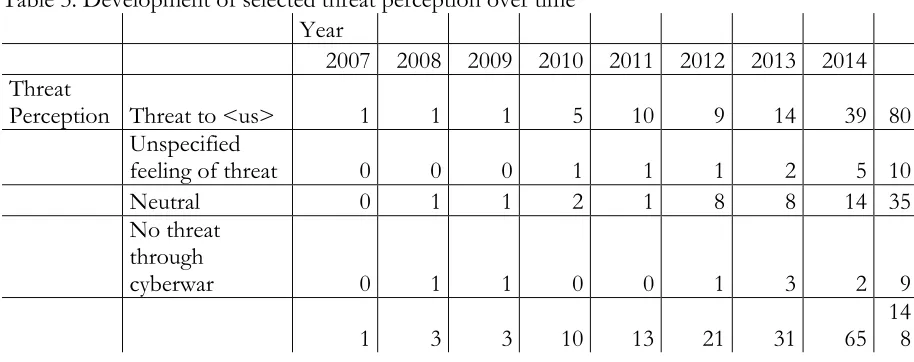
For the here-portrayed findings it is very relevant to note that there is a certain temporal bias in the sampled data. As can be seen in the chart, the closer to the present, the more data was found19.
Chart 3. Years of publication of analysed blog posts20
Source: Author.
19 Do note that the data collection took place between March and August of 2014. 20 Table with numbers can be found in Appendix Table 1.
missing 0%
2007
1% 20082% 2009 2% 2010
7% 2011
9% 2012
14% 2013 21% 2014
Politikon: IAPSS Political Science Journal Vol. 28
There are four feasible reasons for this: Firstly, quite possibly the algorithms of the utilized search engines gave higher relevance to newer posts. Secondly, blogging per se is very new, and has only recently started to become a mass phenomenon, as was shown. Therefore it does seem likely to be representative that there is a prevalence of recent posts. Thirdly, in contrast to the often-stated platitude "the web never forgets" the web does forget quite a lot. Users as well as service providers often delete inactive blogs. The longer it has not been used, the more likely it is to be "axed" for one reason or another. The fourth reason is rooted in the topic itself: Cyberwar as a concept is not new in itself, but constantly gained attention in the German public sphere over the last few years.
Intentionally, nothing was done to correct this tendency to prefer newer posts, as it is not possible to discern whether it is due to a bias in methodology or actually to the research question and founded naturally in the data.
The used form had a rather large number of items on it and there is only space to review some of those here. Particularly those items that considered especially the nature of the blogosphere in context of the discussion of "cyberwarfare" will not be discussed here. Instead this paper shows a review of the threat scenarios, the state actors and the types and topics of "cyberwarfare".
Analysis and findings
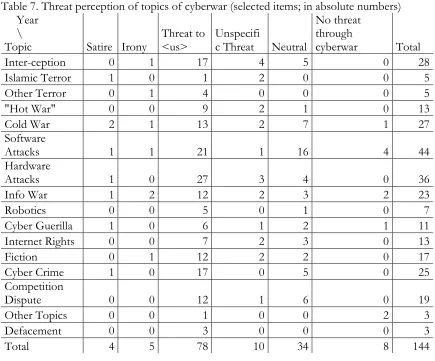
Not really surprising are the findings regarding threat perception. This category is not a real quantitative category, but has to be viewed rather as a mixed category. In the latter the perception of threat expressed by the blogger was analysed. The distilled categories are "threat to <us>", "threat from <us>", "threat to and from <us>" with <us> being an unspecified group to which the blogger is counting her or himself to, explicitly or implicitly.21 Further, a "neutral" and a "no threat through cyberwar" item are designed as well as another item
21 An example for this would be a blogger talking about a danger to (or) from „Germany“ and express worry