THE STRUCTURE AND YIELD LEVEL OF SWEET CORN DEPENDING
ON THE TYPE OF WINTER CATCH CROPS AND WEED CONTROL METHOD
Robert Rosa1
1 Department of Vegetables Crop, Siedlce University of Natural Sciences and Humanities, B. Prusa 14, 08-110 Siedlce, Poland, e-mail: [email protected]
INTRODUCTION
Sweet corn can be successfully cultivated in almost entire Poland [Michałojć et al. 1996, Kunicki 1998, Wierzbicka 1998, Waligóra and Kruczek 2003, Waligóra and Weber 2010, Rosa et al. 2012a]. Fertilising and weed control are important factors affecting the success of its cultivation. The application of farmyard ma -nure is recommended in autumn [Haghighat et Journal of Ecological Engineering
Volume 15, No. 4, Oct. 2014, pages 118–130
DOI: 10.12911/22998993.1125466 Research Article
ABSTRACT
Organic manuring is suggested to be necessary in sweet corn cultivation. It is not always possible to use farmyard manure due to economic, production or technical reasons. Catch crops used as green manures can be an alternative source of organic matter. The experiment was carried out in central-east Poland (52°06’N, 22°55’E), in years 2008–2011. The successive effect of winter catch crops (hairy vetch, white clover, winter rye, Italian ryegrass, winter turnip rape) and the type of weed control on the growth and yielding of sweet corn was examined. The catch crops were sown in early September, incorporated in early May. The effect of the winter catch crops on yield was compared to the effect of FYM at a rate of 30 t·ha-1 and the control without organic manuring. The sweet corn was grown directly after organic fertilization. Three methods of weed control was used: Hw – hand weeding, twice during the growing period, GCM – herbicide Guardian CompleteMix 664 SE, immediately after sowing the seed corn, Z+T – a mixture of herbicides Zeagran 340 SE + Titus 25 WG, in the 3–4 leaf stage sweet corn. The highest yields of biomass were found for winter rye (35.5 t·ha-1 FM and 7.3 t·ha-1 DM), the most of macroelements accumulated winter turnip rape (480.2 kg N+P+K+Ca+Mg·ha-1). Generally, leguminous catch crops had similar to the FYM and better than non-leguminous catch crops yield-forming effect. The highest yield of marketable ears of sweet corn was obtained after FYM (14.4 t·ha-1) and after hairy vetch catch crop (14.0 t·ha-1). A similar yield-forming effect also had white clover and Italian ryegrass. The most of ears from 1 ha was achieved after white clover catch crop (59.3 tausend), similar after FYM and hairy vetch catch crop. The highest kernel yields were found after FYM (10.7 t·ha-1). The yields of kernel after hairy vetch and white clover catch crops were significantly higher than after non-leguminous catch crops. Z+T weed control method increase marketable yield of sweet corn (by 25–30%) and a number of ears (by 17–22%), compared to hand weeding and GCM weed control method.
Keywords: green manure, organic fertilization, weed control method, yielding, Zea mays L. var saccharata,
Received: 2014.06.11 Accepted: 2014.08.05 Published: 2014.10.07
2005, Clark et al. 2007, Salmerón et al. 2011, Kramberger et al. 2009, Dolijanovic et al. 2012]. In the climatic conditions of Poland a positive effect of forecrop green manures was demon-strated [Jabłońska-Ceglarek and Rosa 2005] and summer catch crops [Rosa et al. 2010, Zanie-wicz-Bajkowska et al. 2011, Rosa et al. 2012b] on the growth and yield level of sweet corn. The study on the use of living mulches was also carried out [Jędrszczyk and Poniedziałek 2007] and cover crops in the cultivation of sweet corn [Konopiński and Kęsik 2000]. There is a scar-city of reports regarding the possibility of ap-plying a winter catch crops in a form of green manures in sweet corn cultivation.
Catch crops also have a many-sided effect on biological, physical and chemical soil properties. They reduce erosion, decrease soil compaction, and build soil organic matter, as well as influence soil organisms [Snapp et al. 2005]. Catch crops protect the forms of nutrients that are easily avail-able for plants from leaching into deeper layers of the soil profile and groundwater [Collins et al. 2007]. During the process of catch crop mineral-ization the biomass nitrogen is gradually released and becomes available for the subsequent plants [Vos and van der Putten 2001]. The increase of winter catch crops importance is due to their huge ecological value, which includes N seques-tration to reduce the need for N fertilization, N leaching, and N2O emissions [Sainju et al. 2008]. Among winter catch crops, legumes are known to improve soil fertility and symbiotic N fixa-tion, whereas non-legumes are very effective in soil mineral N depletion during late autumn, mild winter periods, and early spring [Kramberger et al. 2009].
Sweet corn in the initial period of growth is very sensitive to the action of competitive weeds. Weed infestation can cause a decrease yields of ear by up to 85% [Williams 2010]. Whereas it is prevention of weed infestation from the begin-ning of growing sweet corn. The most effective method of weed control is to use herbicides on the plant or field surface. In Poland there is a scarcity of herbicides recommended for sweet corn and many farmers apply them at their own risk. How-ever, some producers of herbicides indicate their phytotoxic influence on the sweet corn plants.
The aim of this study was to determine the effect of winter catch crops and method of weed control on the growth and yielding of sweet corn (Zea mays L. var saccharata).
MATERIALS AND METHODS
A field experiment, carried out over 2008– 2011, was located at the Experimental Farm in Zawady, belonging to the Siedlce University of Natural Sciences and Humanities (52°06’N, 22°55’E). According to the international system of FAO classification, the soil was classified as a Luvisol [WRB 1998]. An average organic car-bon content amounted to 0.97%, the humus layer reaching the depth of 30–40 cm, and pHKCl was 6.0. In the years of the experiment, the average content of nitrogen (NO3 + NH4) was 47, phos-phorus 73, potassium 85 mg·dm-3 of soil.
The experiment was established as a split-block design with three replications. As winter catch crops (factor A) the following plants were grown: VV – hairy vetch (Vicia villosa Roth.), TR – white clover (Trifolium repens L.), SC – winter rye (Secale cereale L.), LM – Italian ryegrass (Lolium
multiflorum L.), BRT – winter turnip rape (
Bras-sica rapa var. typica Posp.). Their seeds were sown in early September in the amount: hairy vetch – 70 kg, white clover – 20 kg, white rye – 180 kg, Ital-ian ryegrass – 35 kg, winter turnip rape – 12 kg per 1 ha. The effect of winter catch crops on yield was compared to the effect of farmyard manure (FYM) at a rate of 30 t·ha-1 and the control without organic manuring (NOM). Green mass of the catch crops and FYM were incorporated in early May. Direct-ly before catch crop incorporation the samples of plant material (roots + above ground) were taken to assess fresh and dry matter yields and perform chemical analyses to determine macroelements content. The dry matter content in the catch crops and farmyard manure were determined using the oven-drying gravimetric method. Total Kjeldahl N of all plants were determined with a Tecator Kjeltec System 1026 analyzer. Phosphorus con-tent was measured by colorimetry with a spectro-photometer SPEKOL 221. Potassium and calcium were determined by means of a flame photometer FLAPHO 41. Magnesium was determined with an atomic absorption spectrophotometer SOLAR 929 ATI UNICAM.
Journal of Ecological Engineering vol. 15(3), 2014
120
kg N·ha-1. The dose of phosphorus and potassium under all catch crop plants was 40 kg P2O5·ha-1, 80 kg K2O·ha-1. In the sweet corn cultivation mineral fertilizers in the quantity of 60 kg N (before sow-ing) + 60 kg N (top dressing, when plants have high of 20 cm), 50 kg P2O5, 180 kg K2O na 1 ha was applied. Mineral fertilizers were applied in a form of urea (before sowing), ammonium nitrate (top dressing), triple superphosphate and 60% po-tassium salt. On the suitable combinations of ex-periments different methods of weeds control in the sweet corn was applied: (factor B): Hw – hand weeding (twice during the growing period), GCM – herbicide Guardian CompleteMix 664 SE (ace-tochlor + terbuthylazine) immediately after sow-ing the seed corn, in the quantity of 3.5 l·ha-1 on 250 l water, Z+T – a mixture of herbicides Zea-gran 340 SE (bromoxynil + terbuthylazine) (1.6 l∙ha-1) + Titus 25 WG (rimsulfuron) (40 g∙ha-1) + adjuvant Trend 90 EC (0.1%) on 250 l water, in the 3–4 leaf stage sweet corn. Herbicide treat-ments were performed by a knapsack sprayer.
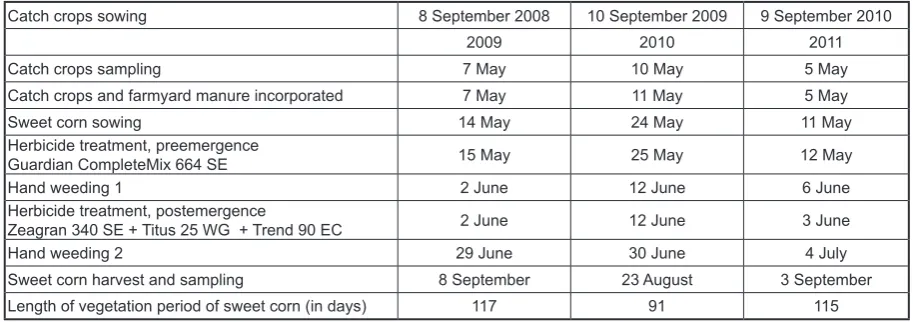
The schedule of the main works on the exper-iment is shown in Table 1. Other, cultivation and care treatments were performed in accordance with the principles of proper agricultural technol-ogy. The ears were harvested at the stage of milk maturity of kernels, which was at the end of Au-gust or the beginning of September (Table 1). The whole plot area for harvest was 16 m2. During the harvest the following variables were determined: • yield of marketable leafless ears (t·ha-1)
ac-cording to the norm PN-R-75377:1996, • number of ears per 1 ha,
• mean mass of marketable ears (g) • yield of kernels (t·ha-1),
• yield of total biomass (t·ha-1) – mass of roots + mass of stalk and leaves + mass of ears with cover leaves.
In the current paper there was also calculated the percentage of marketable yield of cobs in the total yield, biological productivity of corn ears (Wb) and harvest index of marketable ears (HIme) and kernels (HIk), which were calculated accord-ing to the followaccord-ing model:
flame photometer FLAPHO 41. Magnesium was determined with an atomic absorption spectrophotometer SOLAR 929 ATI UNICAM.
Sweet corn ‘Sweet Nugget F1’ cv. (Agri-Saaten) in the study was sown between 11 and 24
May, in the amount of 12 kg·ha-1. The seeds were sown at the spacing of 60 × 25 cm. Before
sowing of catch crops plants (autumn) and sweet corn (spring) mineral fertilization was applied. Nitrogen fertilization was differentiated: for VV and TR it was 30, for SC, LM and
BRT it was 60 kg N·ha-1. The dose of phosphorus and potassium under all catch crop plants
was 40 kg P2O5·ha-1, 80 kg K2O·ha-1. In the sweet corn cultivation mineral fertilizers in the
quantity of 60 kg N (before sowing) + 60 kg N (top dressing, when plants have high of 20 cm), 50 kg P2O5, 180 kg K2O na 1 ha was applied. Mineral fertilizers were applied in the form
of urea (before sowing), ammonium nitrate (top dressing), triple superphosphate and 60%
potassium salt. On the suitable combinations of experiments different methods of weeds
control in the sweet corn was applied: (factor B): Hw – hand weeding (twice during the
growing period), GCM – herbicide Guardian CompleteMix 664 SE (acetochlor +
terbuthylazine)immediately after sowing the seed corn, in the quantity of 3.5 l·ha-1on 250 l
water, Z+T –a mixture of herbicides Zeagran 340 SE (bromoxynil + terbuthylazine) (1.6 l∙ha
-1) + Titus 25 WG (rimsulfuron) (40 g∙ha-1) + adjuvant Trend 90 EC (0.1%) on 250 l water, in the 3–4 leaf stage sweet corn.Herbicide treatments were performed by knapsack sprayer.
Schedule of the main works on the experiment are shown in Table 1. Other, cultivation and
care treatments were performed in accordance with the principles of proper agricultural
technology. The ears were harvested at the stage of milk maturity of kernels, which was at the
end of August or the beginning of September (Table1).The whole plot area for harvest was
16 m2. During the harvest there was determined:
-yield of marketable leafless ears (t·ha-1) according to the norm PN-R-75377:1996,
-number of ears per 1 ha,
-mean mass of marketable ears (g)
-yield of kernels (t·ha-1),
-yield of total biomass (t·ha-1) – mass of roots + mass of stalk and leaves + mass of ears
with cover leaves.
In the current paper there was also calculated the percentage of marketable yield of cobs in the total yield, biological productivity of corn ears (Wb) and harvest index of marketable ears (HIme) and kernels (HIk), which were calculated according to the following model:
(%) 100
mc mp
mc
W b
where: mc – mass of a ear without cover leaves (g), mp – mass of a core (g).
where:
mc –mass of a ear without cover leaves (g),
mp –mass of a core (g).
(%) 100 BioY MEY HIme (%) 100 BioY KY HIk where:
MEY – yield of marketable leafless ears,
KY – yield of kernels,
BioY – yield of total biomass sweet corn.
The results of the experiment were statistically analysed by ANOVA at F ≤ 0.05 following
the mathematical model for the split-block design. Significance of differences was determined
by the Tukey test at the significance level of P≤0.05.
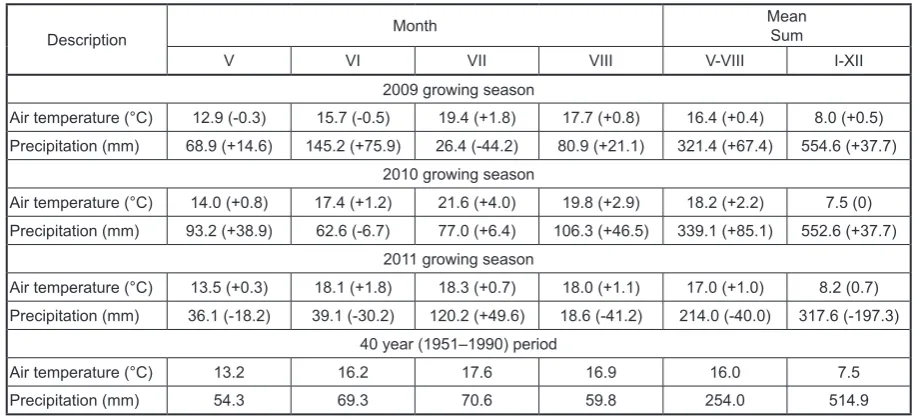
Mean air temperature in the growing period of sweet corn (May–August) in years 2009–
2011 exceeded mean long-term by 0.4ºC to 2.2ºC (Table 2). Air temperature in the highest
degree influence on the growth and development of sweet corn [Stone et al. 1999]. In the years of the study thermal conditions for sweet corn were generally favourable. The warmest was growing season in 2010, the coolest in 2009. In the growing period of sweet corn in 2011 was noted by 40.0 mm less of rainfall compared to long-term 1951-1990. In the years 2009 and 2010 the quantity of rainfall in that period was exceeded long-term mean by 67.4 and 85.1 mm. The most regular rainfall distribution was found in 2010. Water needs of sweet corn depend on its development phase. The lower are in the beginning of growing period (about
100 mm), the highest (150-200 mm) in the period of flowering and ears formation. During
ears maturation water needs are lower again and amounted to 50-100 mm [Niedziółka et al.
2004, Szulc and Kruczek 2008]. Michałojć et al. [1996] and Waligóra and Kruczek [2003]
indicate that the critical periods in term of water demand are seeds germination and plants flowering. The least rainfall at the beginning of growing period of sweet corn was observed in 2011. More favourable in term of quantity of rainfall was two first years of the study. In June 2010 the part of the cultivation area was destroyed by heavy rain and hail. However, left on the field weak plants formed less ears and as a result gave lower yield.
where:
mc –mass of a ear without cover leaves (g),
mp –mass of a core (g).
(%) 100 BioY MEY HIme (%) 100 BioY KY HIk where:
MEY – yield of marketable leafless ears,
KY – yield of kernels,
BioY – yield of total biomass sweet corn.
The results of the experiment were statistically analysed by ANOVA at F ≤ 0.05 following
the mathematical model for the split-block design. Significance of differences was determined
by the Tukey test at the significance level of P≤0.05.
Mean air temperature in the growing period of sweet corn (May–August) in years 2009–
2011 exceeded mean long-term by 0.4ºC to 2.2ºC (Table 2). Air temperature in the highest
degree influence on the growth and development of sweet corn [Stone et al. 1999]. In the years of the study thermal conditions for sweet corn were generally favourable. The warmest was growing season in 2010, the coolest in 2009. In the growing period of sweet corn in 2011 was noted by 40.0 mm less of rainfall compared to long-term 1951-1990. In the years 2009 and 2010 the quantity of rainfall in that period was exceeded long-term mean by 67.4 and 85.1 mm. The most regular rainfall distribution was found in 2010. Water needs of sweet corn depend on its development phase. The lower are in the beginning of growing period (about
100 mm), the highest (150-200 mm) in the period of flowering and ears formation. During
ears maturation water needs are lower again and amounted to 50-100 mm [Niedziółka et al.
2004, Szulc and Kruczek 2008]. Michałojć et al. [1996] and Waligóra and Kruczek [2003] indicate that the critical periods in term of water demand are seeds germination and plants flowering. The least rainfall at the beginning of growing period of sweet corn was observed in 2011. More favourable in term of quantity of rainfall was two first years of the study. In June 2010 the part of the cultivation area was destroyed by heavy rain and hail. However, left on the field weak plants formed less ears and as a result gave lower yield.
where: MEY – yield of marketable leafless ears, KY – yield of kernels,
BioY – yield of total biomass sweet corn. The results of the experiment were statistical-ly anastatistical-lysed by ANOVA at F ≤ 0.05 following the mathematical model for the split-block design. Significance of differences was determined by the Tukey test at the significance level of P ≤ 0.05.
Mean air temperature in the growing period of sweet corn (May–August) in years 2009–2011 exceeded mean long-term temperature by 0.4ºC to 2.2 ºC (Table 2). Air temperature in the high-est degree influence on the growth and develop-ment of sweet corn [Stone et al. 1999]. In the years of the study thermal conditions for sweet corn were generally favourable. The warmest was the growing season in 2010 whereas the coolest – in 2009. In the growing period of sweet corn in 2011 was noted by 40.0 mm less of rainfall compared to long-term 1951–1990. In the years 2009 and 2010 the quantity of rainfall in that
pe-Table 1. Chronology of field operations and length of vegetation period of sweet corn
Catch crops sowing 8 September 2008 10 September 2009 9 September 2010
2009 2010 2011
Catch crops sampling 7 May 10 May 5 May
Catch crops and farmyard manure incorporated 7 May 11 May 5 May
Sweet corn sowing 14 May 24 May 11 May
Herbicide treatment, preemergence
Guardian CompleteMix 664 SE 15 May 25 May 12 May
Hand weeding 1 2 June 12 June 6 June
Herbicide treatment, postemergence
Zeagran 340 SE + Titus 25 WG + Trend 90 EC 2 June 12 June 3 June
Hand weeding 2 29 June 30 June 4 July
Sweet corn harvest and sampling 8 September 23 August 3 September
riod exceeded long-term mean by 67.4 and 85.1 mm. The most regular rainfall distribution was found in 2010. Water needs of sweet corn depend on its development phase. The lower are at the beginning of growing period (about 100 mm), the highest (150–200 mm) in the period of flowering and ears formation. During ears maturation water needs are lower again and amounted to 50–100 mm [Niedziółka et al. 2004, Szulc and Kruczek 2008]. Michałojć et al. [1996] and Waligóra and Kruczek [2003] indicate that the critical periods in term of water demand are seeds germination and plants flowering. The least rainfall at the beginning of growing period of sweet corn was observed in 2011. More favourable conditions in term of quan-tity of rainfall was the first two years of the study. In June 2010 the part of the cultivation area was destroyed by heavy rain and hail. However, the weak plants that were left on the field formed less ears and, as a result, gave lower yield.
RESULTS
The highest yields of fresh matter were found winter rye (35.5 t·ha-1) and winter turnip rape (29.1 t·ha-1), the lowest of white clover and Ital-ian ryegrass (Table 3). The amount of dry mat-ter (DM) incorporated with winmat-ter rye catch crop (7.3 t·ha-1) was similar to the amount of DM in the farmyard manure (FYM). The least DM pro-duced white clover (TR), Italian ryegrass (LM) and hairy vetch (VV) catch crops. A significantly highest amount of nitrogen was incorporated with
winter rye catch crop (SC). Nitrogen amounts ac-cumulated by hairy vetch (VV) and winter turnip rape (BRT) catch crops were similar, whereas in TR and LM they were significantly lower than in FYM. Incorporation of BRT catch crop intro-duced the most phosphorus into soil. Phosphorus quantity accumulated by SC was similar to that of FYM. Non-leguminous catch crops and FYM contained significantly more potassium than le-guminous catch crops. BRT accumulated sig-nificantly the most calcium whereas LM, TR and VV had significantly the least Ca. Incorporation of FYM introduced the most magnesium into the soil. Winter rye was the most abundant source of magnesium. In total, the most macronutrients (N+P+K+Ca+Mg) were incorporated with winter rye and winter turnip rape catch crops as well as farmyard manure.
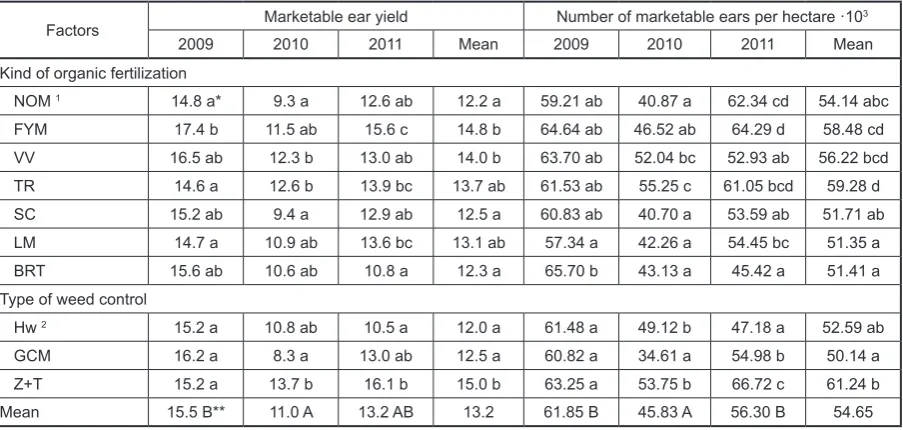
Weather conditions in the successive study years had a significant influence on the yield of marketable ears, number of marketable ears per hectare, yield of kernels and mass of marketable ear of sweet corn (Tables 4–6). Marketable ear yield produced in 2010 was significantly lower than in 2009. Moreover, marketable ear number and kernel yield were significantly lower than in 2009 or 2011 (Tables 4–5). Farmyard manure and leguminous catch crops were the best stimu-lants of crop performance in terms of yield. When averaged across years, the highest ear yield was obtained following an incorporation of FYM and VV catch crop (14.8 and 14.0 t·ha-1). Simi-lar yields were associated with TR and LM. The greatest number of ears was harvested from TR Table 2. Mean temperature and the sum of rainfall at the Weather Station in Zawady during the seasons 2009, 2010, and 2011 in comparison to the 40-year average (+ or −)
Description Month
Mean Sum
V VI VII VIII V-VIII I-XII
2009 growing season
Air temperature (°C) 12.9 (-0.3) 15.7 (-0.5) 19.4 (+1.8) 17.7 (+0.8) 16.4 (+0.4) 8.0 (+0.5)
Precipitation (mm) 68.9 (+14.6) 145.2 (+75.9) 26.4 (-44.2) 80.9 (+21.1) 321.4 (+67.4) 554.6 (+37.7)
2010 growing season
Air temperature (°C) 14.0 (+0.8) 17.4 (+1.2) 21.6 (+4.0) 19.8 (+2.9) 18.2 (+2.2) 7.5 (0)
Precipitation (mm) 93.2 (+38.9) 62.6 (-6.7) 77.0 (+6.4) 106.3 (+46.5) 339.1 (+85.1) 552.6 (+37.7)
2011 growing season
Air temperature (°C) 13.5 (+0.3) 18.1 (+1.8) 18.3 (+0.7) 18.0 (+1.1) 17.0 (+1.0) 8.2 (0.7)
Precipitation (mm) 36.1 (-18.2) 39.1 (-30.2) 120.2 (+49.6) 18.6 (-41.2) 214.0 (-40.0) 317.6 (-197.3)
40 year (1951–1990) period
Air temperature (°C) 13.2 16.2 17.6 16.9 16.0 7.5
Journal of Ecological Engineering vol. 15(3), 2014
plots (59 280); it was similar to ear numbers as-sociated with FYM and VV catch crops.
The yield-forming effect of winter catch crops and FYM depended on weather conditions in the study years. The greatest marketable ear yields were harvested in FYM plots in 2009 and 2011 (17.4 and 15.6 t·ha-1, respectively). In 2009, when precipitation from May to June was higher than in the remaining years, the highest yields were harvested after VV, SC and BRT incorporation,
that is the catch crops which produced the great-est biomass. The lowgreat-est precipitation in the spring of 2011 resulted in ear yields being the same for FYM, TR and LM, the catch crops producing the lowest biomass. The highest marketable ear yields in 2010 were harvested from VV and TR-manured plots (12.3 and 12.6 t·ha-1, respectively); they were significantly lower for NOM control and SC plots. In 2009, the most ears per 1 ha (65 700) were pro-duced by sweet corn cultivated after BRT, signifi-Table 3. The quantity of fresh and dry matter and the amount of macroelements incorporated with farmyard manure and catch crops (mean for years 2009–2011)
Kind of organic manure Fresh matter (FM) t·ha-1
Dry matter (DM) t·ha-1
Macroelements
Concetration (% DM)
Accumulation (kg·ha-1)
N P K Ca Mg N P K Ca MgTotal
Farmyard manure (FYM) 30.0 cd* 7.6 c 106.0 b1.40 49.7 b0.66 133.2 b1.75 64.1 b0.85 39.1 c0.52 392.1 b
Hairy vetch (VV) 18.1 b 3.0 a 108.7 b3.63 11.6 a0.38 40.5 a1.36 26.4 a0.89 6.1 a0.21 193.2 a
White clover (TR) 11.6 a 2.1 a 64.3 a2.99 9.6 a0.46 54.2 a2.51 22.4 a1.05 6.2 a0.29 156.7 a
Winter rye (SC) 35.5 d 7.3 c 134.7 c1.83 55.0 b0.75 154.0 b2.08 55.5 b0.76 26.5 b0.36 425.7 b
Italian ryegrass (LM) 13.2 ab 2.9 a 49.2 a1.69 15.0 a0.53 131.2 b4.58 18.0 a0.63 9.4 a0.33 222.8 a
Winter turnip rape (BRT) 29.1 c 4.9 b 105.4 b2.15 81.8 c1.63 195.7 b3.96 87.1 c1.76 10.2 a0.21 480.3 b
* Values followed by the same letters in columns do not differ significantly at P ≤ 0.05.
Table 4. Marketable leafless ear yield (t•ha-1)
Factors Marketable ear yield Number of marketable ears per hectare ·103
2009 2010 2011 Mean 2009 2010 2011 Mean
Kind of organic fertilization
NOM 1 14.8 a* 9.3 a 12.6 ab 12.2 a 59.21 ab 40.87 a 62.34 cd 54.14 abc
FYM 17.4 b 11.5 ab 15.6 c 14.8 b 64.64 ab 46.52 ab 64.29 d 58.48 cd
VV 16.5 ab 12.3 b 13.0 ab 14.0 b 63.70 ab 52.04 bc 52.93 ab 56.22 bcd
TR 14.6 a 12.6 b 13.9 bc 13.7 ab 61.53 ab 55.25 c 61.05 bcd 59.28 d
SC 15.2 ab 9.4 a 12.9 ab 12.5 a 60.83 ab 40.70 a 53.59 ab 51.71 ab
LM 14.7 a 10.9 ab 13.6 bc 13.1 ab 57.34 a 42.26 a 54.45 bc 51.35 a
BRT 15.6 ab 10.6 ab 10.8 a 12.3 a 65.70 b 43.13 a 45.42 a 51.41 a
Type of weed control
Hw 2 15.2 a 10.8 ab 10.5 a 12.0 a 61.48 a 49.12 b 47.18 a 52.59 ab
GCM 16.2 a 8.3 a 13.0 ab 12.5 a 60.82 a 34.61 a 54.98 b 50.14 a
Z+T 15.2 a 13.7 b 16.1 b 15.0 b 63.25 a 53.75 b 66.72 c 61.24 b
Mean 15.5 B** 11.0 A 13.2 AB 13.2 61.85 B 45.83 A 56.30 B 54.65
1 NOM – control without organic manure, FYM – farmyard manure, VV – hairy vetch catch crop, TR – white clo
-ver catch crop, SC – winter rye catch crop, LM – italian ryegrass catch crop, BRT – winter turnip rape catch crop
2 Hw – hand weeding, GCM – Guardian CompleteMix 664 SE, Z+T – Zeagran 340 SE + Titus 25 WG + Trend
90 EC
cantly less (-12%) for LM-manured plots. In 2010, the most ears were produced after an incorporation of all the legumes, whereas in 2011 the same effect was observed in FYM plots, and a similar influ-ence – in NOM and TR plots (Table 4).
Regardless of the study years or weed con-trol methods, the greatest share of marketable ear yield in the total ear yield was obtained from SC crops (88%); it was the lowest (81%) for NOM control (Figure 1). Weed control was the most effective for GCM (86%) and the least effective for hand weeding (83%). The highest share of marketable ear yield in the total yield (96%) was obtained for sweet corn cultivated after SC and treated with GCM.
When averaged across the study years, the highest kernel yield (10.7 t·ha-1) was harvested from FYM plots (Table 5). Yields in plots where leguminous catch crops had been applied were significantly higher compared with non-legumi-nous catch crops or NOM control. The lowest yield was recorded after BRT.
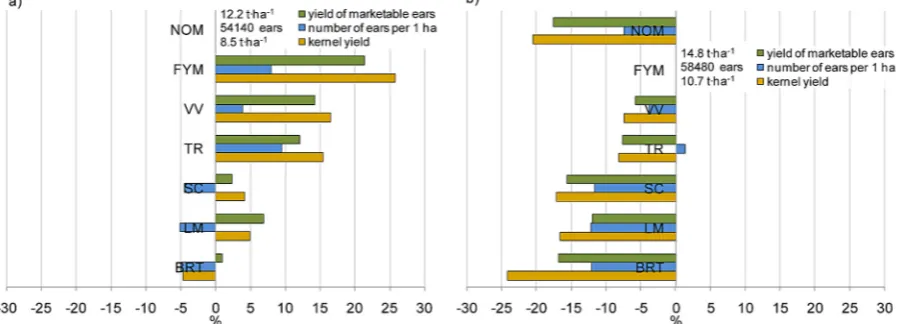
Figure 2 demonstrates percentage increases or declines in ear and kernel yields, as well as marketable ear number of sweet corn cultivated after winter catch crops versus no catch crop or FYM-based cultivation.
Post-emergence application of Z+T to control weeds had the most beneficial effect on sweet corn yields (Tables 4–5). The respective marketable Table 5. Yield of sweet corn kernels (t•ha-1)
Factors 2009 2010 2011 Mean
Kind of organic fertilization
NOM 1 10.0 a* 6.2 a 9.4 a 8.5 ab
FYM 12.7 a 8.0 a 11.5 a 10.7 d
VV 12.1 a 8.5 a 9.1 a 9.9 c
TR 10.5 a 9.0 a 10.1 a 9.8 c
SC 11.0 a 6.7 a 9.0 a 8.9 b
LM 10.4 a 7.6 a 8.8 a 8.9 b
BRT 11.1 a 6.6 a 6.7 a 8.1 a
Type of weed control
Hw 2 11.1 a 7.5 ab 7.4 a 8.7 a
GCM 11.3 a 5.8 a 9.5 ab 8.9 a
Z+T 10.9 a 9.3 b 10.9 b 10.4 b
Mean 11.1 C** 7.5 A 9.3 B 9.3
1 , 2 ,* , ** Explanations as in table 4.
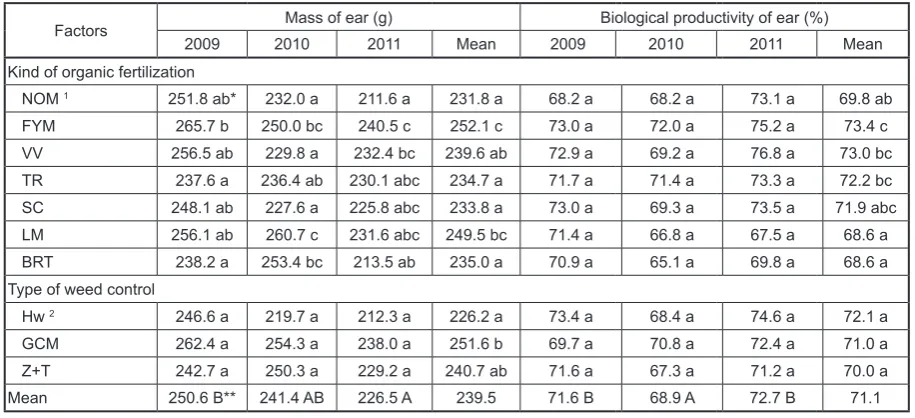
Table 6. Mass and biological productivity of sweet corn ear
Factors Mass of ear (g) Biological productivity of ear (%)
2009 2010 2011 Mean 2009 2010 2011 Mean
Kind of organic fertilization
NOM 1 251.8 ab* 232.0 a 211.6 a 231.8 a 68.2 a 68.2 a 73.1 a 69.8 ab
FYM 265.7 b 250.0 bc 240.5 c 252.1 c 73.0 a 72.0 a 75.2 a 73.4 c
VV 256.5 ab 229.8 a 232.4 bc 239.6 ab 72.9 a 69.2 a 76.8 a 73.0 bc
TR 237.6 a 236.4 ab 230.1 abc 234.7 a 71.7 a 71.4 a 73.3 a 72.2 bc
SC 248.1 ab 227.6 a 225.8 abc 233.8 a 73.0 a 69.3 a 73.5 a 71.9 abc
LM 256.1 ab 260.7 c 231.6 abc 249.5 bc 71.4 a 66.8 a 67.5 a 68.6 a
BRT 238.2 a 253.4 bc 213.5 ab 235.0 a 70.9 a 65.1 a 69.8 a 68.6 a
Type of weed control
Hw 2 246.6 a 219.7 a 212.3 a 226.2 a 73.4 a 68.4 a 74.6 a 72.1 a
GCM 262.4 a 254.3 a 238.0 a 251.6 b 69.7 a 70.8 a 72.4 a 71.0 a
Z+T 242.7 a 250.3 a 229.2 a 240.7 ab 71.6 a 67.3 a 71.2 a 70.0 a
Mean 250.6 B** 241.4 AB 226.5 A 239.5 71.6 B 68.9 A 72.7 B 71.1
Journal of Ecological Engineering vol. 15(3), 2014
ear yields were by 25 and 20% higher, and kernel yields were by 20 and 16% higher than the yields harvested from plots where weeds were removed by hand (Hw) and GCM-treated plots. Also, sig-nificantly less ears (-18%) were harvested from GCM-treated plots compared with Z+T. In 2009, weed control methods did not affect ears number, marketable ear yield levels or kernel yields.
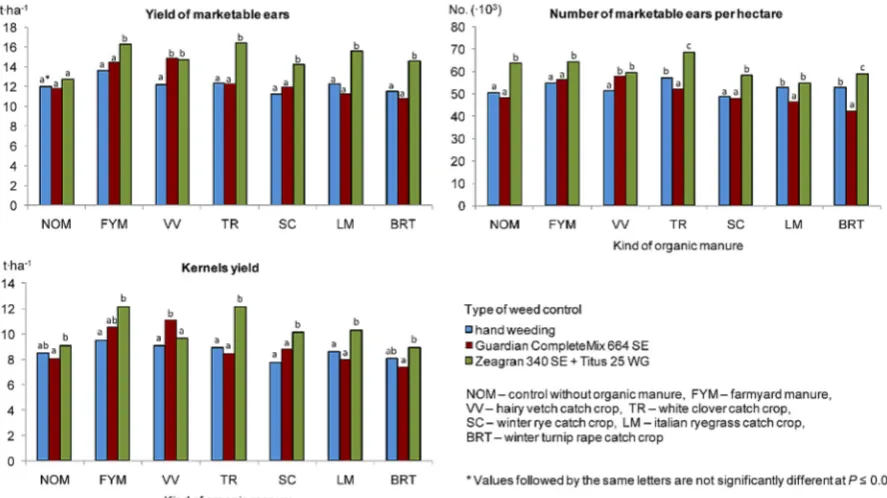
Statistical analysis of the results revealed a significant catch crop-by-weed control method interaction (Figure 3). The highest ear and ker-nel yields harvested from most catch crop treat-ments were associated with the Z+T-based weed control method. In the NOM control, the weed control method had no effect on the ear yield.
Similar marketable ear yields and numbers were found for the VV treatment with GCM and Z+T application. What is more, GCM application was associated with significantly higher kernel yield compared with Z+T and Hw. TR, LM and BRT treatments coupled with hand weeding favour-ably affected ear numbers compared with GCM-based weed control method.
Ears with significantly highest mass (250.6 g) were harvested in 2009 (Table 6). In 2010 the mass of marketable cobs was by 3.7%, and in 2011 by 9.6% lower. Marketable ears harvested in 2009 and 2011 were more biologically produc-tive than in 2010. The heaviest ears were obtained from corn plants in FYM plots in 2009 and 2011,
Figure 1. Share marketable yield in the total yield of ear (%)
Figure 2. The procentage increase / decrease the yields of sweet corn in comparison to control without organic manure NOM (a) and combination with FYM (b) depending on the kind of winter catch crops (mean for years
and in LM plots in 2010. Also, when averaged across the study years, the heaviest ears were har-vested from FYM treatment, similar results being recorded for LM catch crop. The highest biologi-cal productivity of ears was obtained for FYM (73.4%) and legumes (72.2–73.4%); it was simi-lar for SC (71.9%). An application of GCM had the best effect on marketable ear weight which, when averaged, was by 11% higher compared with hand weeding. By contrast, weed control methods did not affect ear biological productivity.
Significantly the highest total biomass yield (46.8 t·ha-1) was obtained for sweet corn after FYM (Figure 4). Moreover, the biomass yield was significantly higher in the control and the
plots where FYM, VV, TR, and SC had been ap-plied compared with LM and BRT. Regardless of organic manuring, an application of Z+T had the most beneficial effect on the total biomass yield.
The greatest share of ear and kernel yields in the total biomass yield was associated with sweet corn cultivated after LM (Figure 4). The harvest index of marketable ears (HIme) and harvest in-dex of kernels (HIk) were 35.0 and 24.5, respec-tively. HIme and HIk following VV, TR, LM and BRT catch crops were higher than FYM. Sweet corn from FYM, TR, LM and BRT treatments had the highest harvest index when Z+T-based weed control method had been applied. Similar HIme and HIk values were obtained for NOM, FYM,
Figure 3. Yielding of sweet corn depending kind of organic manure × method of weed control (mean for 2009–2011)
Journal of Ecological Engineering vol. 15(3), 2014
VV and TR treatments when either hand weeding or GCM-based weed control had been applied. What is more, sweet corn had higher HIkvalues in VV-incorporated plots where weeds had been controlled by hand or using GCM compared with Z+T-treated plants.
DISCUSSION
Of the winter catch crops examined in this study, rye produced most DM, the amount be-ing similar to the quantity supplied with 30 t·ha-1 FYM. The DM amount supplied by winter turnip rape corresponded to app. 19 t·ha-1 FYM while an incorporation of white clover, Italian ryegrass and hairy vetch supplied the DM quantity corre-sponding to 8–12 t·ha-1 FYM. Schmid and Klay [1984] report that the amount of incorporated dry matter range between 4.5 and 5.5 t·ha-1. Ac-cording to O’Reilly et al. [2011] and Dolijano-wic et al. [2012], the biomass produced by rye and hairy vetch may correspond to as much as 30 t·ha-1 FYM. In the study reported here, the total amount of macronutrients accumulated by the catch crops corresponded to 40-122% the quanti-ty introduced with 30 t·ha-1 FYM. Nitrogen is the element which exerts the greatest effect on yield. It should be emphasised that only Italian ryegrass and white clover were sources of nitrogen in the soil in this study. The remaining elements taken up by these crops, and all the elements taken up from the soil by rye, Italian ryegrass and winter turnip rape were returned to the soil after an in-corporation of the catch crops. As a result, a bene-ficial effect of the catch crops followed from them temporarily immobilising and thus protecting nu-trients from leaching out into deeper soil strata. Thorup-Kristensen [2001] and Kramberger et al. [2009] reported that rye and turnip rape were one of the most effective catch crop plants recover-ing nutrients from deeper soil strata. The quan-tity of macronutrients accumulated by the catch crops depends on a number of factors, including catch crop species, soil type, climatic conditions and timing of cultivation. N accumulated by hairy vetch may range from 52 to72 kg·ha-1 [Franczuk 2006, Salmerón et al. 2011] but it can be as much as 181–227 kg·ha-1 [Caporali et al. 2004]. White clover, which formed a well-developed stand, can fix from 100 to 240 N·ha-1 [Kärner and Kärner 1996, Kramberger et al. 2014]. In turn, rye may supply 40–143 kg N·ha-1 [Thorup-Kristensen
According to Brzeski et al. [1993], the quan-tity of biomass incorporated into the soil is one of the main factors determining the secondary effect of catch crops on yields. However, the impact is not always positive in the year following incor-poration and sometimes it may take two or even three years for the effect to become visible. In the present study, an increase in the catch crop bio-mass quantity (especially non-leguminous plants) was followed by a decline in sweet corn ear and kernel yields, which was particularly noticeable in 2010 and 2011 when precipitation in the first part of the growing season was lower compared with 2009. In 2010, marketable ear yield of plants cultivated after rye and ear number after rye and winter turnip rape were significantly lower, com-pared with hairy vetch and white clover. The mar-ketable ear yield and ear number per 1 ha of corn following winter turnip rape were significantly lower compared with white clover. A large quan-tity of rye and winter turnip rape biomass incor-porated may be a barrier in making it more dif-ficult for water to infiltrate into deeper soil strata. This, coupled with lower precipitation, resulted in corn producing poorer yields.
Moreover, rye and turnip rape catch crops needed more nutrients and water to produce more biomass, which led to more soil resources being used by these catch crops compared with hairy vetch, white clover and Italian ryegrass. A similar relationship was reported by authors ex-amining the utilisation of non-leguminous green manures preceding the main crop of white head-ed cabbage and sweet corn [Jabłońska-Ceglarek and Rosa 2001, 2005]. Also Kuo and Jellum [2002] claimed that incorporation of green ma-nures may have a negative effect on the crops that follow. However, the direct effect on plants cultivated after catch crops does not have to be negative as reported by Tejada et al. [2008] who found that an increase in the amount of biomass introduced into the soil with incorporation of white clover and oilseed rape catch crops was followed by an increase in corn yields. The au-thors stressed that the effect of green manures on the yields of plants which followed them depended mainly on chemical composition of the catch crop, the time between incorporation and sowing of the main crop and weather condi-tions. Studies conducted in eastern Poland dem-onstrated that the greater biomass of sunflower, serradella and faba bean summer catch crops was incorporated, the higher sweet corn yields
were produced [Rosa et al. 2010, Zaniewicz-Bajkowska et al. 2011].
Poorer sweet corn yields after rye and win-ter turnip rape may have been caused by a slower mineralisation rate of the catch crops compared with leguminous catch crops [Abdin et al. 2000]. The mineralisation rate of organic matter incor-porated into the soil is affected by weather condi-tions, soil type and, predominantly, by the carbon/ nitrogen (C/N) ratio. The ratio is lower for legumi-nous versus non-legumilegumi-nous plants. It means they mineralise and release mineral components (par-ticularly N), which are then used by the follow-ing crop, more rapidly. Jensen et al. [2005] stated that the majority of plant materials whose C/N ratio is higher than 45 tend to immobilise min-eral nitrogen in soil. As a result, the crop plants that follow suffer from N deficiency. In the study reported here, the C/N ratio was not determined. However, other authors mentioned that the C/N ratio in non-leguminous and leguminous plants is 21.6–54.4 and 8.8–27.8, respectively, depend-ing on the plant species and growth stage [Tejada et al. 2008, DuPont et al. 2009, Kramberger et al. 2009, Janušauskaitė et al. 2013]. In the study by Jabłońska-Ceglarek and Rosa [2005], higher sweet corn yields were harvested after common vetch and field pea catch crops compared with oats. Caporali et al. [2004] obtained significantly higher yields of corn following hairy vetch green manure compared with Italian ryegrass.
Journal of Ecological Engineering vol. 15(3), 2014
always statistically significant compared with cultivation after leguminous catch crops or with-out organic manures. It mainly depended on pre-cipitation distribution in the study years. Accord-ing to Raimbault et al. [1990], a negative direct effect of rye catch crop on corn yield was also due to the cereal’s allelopathic activity.
Hairy vetch and white clover cultivated as winter catch crops preceding sweet corn main crop may successfully replace farmyard manure. Many authors point to a direct yield-forming effect of catch crops but they should not be the sole factor taken into account while making a decision as to whether include catch crops into rotations. Catch crops should be planted due to ecological reasons, such as reduction of weed infestation and herbi-cide use, limiting soil erosion, recovery of nutri-ents from deeper soil strata and protection against them being leached out into groundwater, increase in the amount of organic matter as well as micro- and mesofauna in the soil [Hartwig and Ammon 2002, Snapp et al. 2005]. It is also stressed that, de-spite the fact that yields of main crop immediately following some catch crops may be reduced, the performance will increase in the subsequent years [Jabłońska-Ceglarek and Rosa 2001, Hartwig and Ammon 2002, Franczuk 2006].
In the present study, increased sweet corn yields were observed after a mixture of Zeagran 340 SE + Titus 25 WG had been applied to con-trol weeds compared with hand weeding (Hw) or pre-emergence application of Guardian Com-pleteMix 664 SE (PRE-herbicide GCM). Corn yields after Hw and PRE-herbicide GCM were similar but the marketable ear weight of GCM-treated sweet corn was by 11% higher compared with Hw. Johnson et al. [2010] applied PRE-her-bicide (s-metolachlor and atrazine) and found that sweet corn ear yields were by 33–55% higher com-pared with mechanical weed control (a cultivator used twice). In the study by Abdin et al. [2000] no significant differences were found between kernel yield of corn with chemical weed control and hand weeding. Also Sowiński and Liszka-Podkowa [2007] reported similar corn yields, regardless of weed control method (chemical and mechanical).
CONCLUSIONS
1. Rye catch crop incorporated into the soil sup-plied the most biomass. Dry matter amount produced by rye was similar to 30 t farmyard
manure. DM quantity incorporated with turnip rape was by 36% higher compared with FYM. The DM values incorporated with clover, vetch and ryegrass catch crops were by 60-72% higher than FYM. The greatest amount of nutrients (N+P+K+Ca+Mg) was accumulated by winter turnip rape and winter rye.
2. Hairy vetch (Vicia villosa Roth.,) and white clover (Trifolium repens L.) winter catch crops had the most positive effect on yield of corn which was similar to treatment with farmyard manure at a rate of 30 t·ha-1. They can provide in success an alternative for FYM kind of or-ganic manuring in sweet corn cultivation. 3. Leguminous catch crops had higher directly
yield-forming effect than non-leguminous catch crops (Secale cereale L., Lolium
multi-florum L., Brassica rapa var. typica Posp.). An increase in the quantity of catch crop biomass incorporated was followed by a decline in a marketable ear yield and number. It was most pronounced for non-leguminous catch crops and in the study years with lower precipitation in May and June.
4. Ear and kernel yields of sweet corn cultivated after winter catch crops were higher or similar to values for corn crop grown without mineral manures.
5. The highest biological productivity was fund for ears of corn following farmyard manure and leguminous catch crops.
6. Post-emergence application of a mixture of Zeagran 340 SE (bromoxynil + terbuthyla-zine) + Titus 25 WG (rimsulfuron) had the most beneficial effect on sweet corn ear and kernel yields. The effects of hand weeding and pre-emergence application of Guardian Com-pleteMix 664 SE (acetochlor + terbuthylazine) were similar. Weed control methods had no ef-fect of sweet corn yields in the year character-ised by wet spring.
7. GCM-based weed control had the most ben-eficial effect on marketable ear weight. Weed control methods did not affect the ear biologi-cal productivity.
Acknowledgments
REFERENCES
1. Abdin O.A., Zhou X.M., Cloutier D., Coulman D.C., Faris M.A., Smith D.L., 2000. Cover crops and interrow tillage for weed control in short season maize (Zea mays L.). Eur. J. Agron., 12, 93–102.
2. Brzeski M. W., Smolińska U., Szczech M., Paul M., Ostrzycka J., 1993. Short term effect of green
manuring on soil inhabiting nematodes and micro
-organisms. Nematologia medit., 21, 169–176. 3. Caporali, F., Campiglia, E., Mancinelli, R., Paolini,
R., 2004. Maize performances as influenced by winter cover crop green manuring. Ital. J. Agron., 8, 1, 37–45.
4. Clark A.J., Meisinger J.J., Decker A.M., Mulford F.R., 2007. Effects of a grass-selective herbicide in a vetch-rye cover crop system on corn grain yield and soil moisture. Agron. J., 99, 43–48.
5. Collins H.P., Delgado J.A., Alva A.K., Follett, R.F., 2007. Use of nitrogen – 15 isotopic techniques to estimate nitrogen cycling from a mustard cover crop to potatoes. Agron. J., 99, 27–35.
6. Dolijanovic Z., Momirovic N., Mihajlovic V., Simic M., Oljaca S., Kovacevic D., Kaitovic Z., 2012. Cover crops effects on the yield of sweet corn. Third Int. Sci. Sym. “Agrosym Jahorina 2012”, 104–110.
7. DuPont T.S., Ferris H., Van Horn M., 2009. Effects of cover crop quality and quantity on nematode-based soil food webs and nutrient cycling. Appl. Soil Ecology, 41, 157–167.
8. Franczuk J., 2006. Efekty stosowania nawozów zielonych w postaci międzyplonów ozimych oraz słomy żytniej w uprawie warzyw. Wydawnictwo Akademii Podlaskiej w Siedlcach, Rozprawa Nauk. 84, 122 p.
9. Griffin T., Liebman M., Jemison Jr. J., 2000. Cover crops for sweet corn production in a short-season environment. Agron. J., 92, 144–151.
10. Haghighat A., Shirani Rad A.H., Seyfzadeh S., Yousefi M., 2012. Effect of cattle manure and plant
density on sweet corn yield grown different crop
-ping methods. Intl. J. Agron. Plant. Prod., 3 (S), 696–699.
11. Hanly J.A., Gregg P.E.H., 2004. Green-manure
impacts on nitrogen availability to organic sweet
-corn (Zea mays). New Zeal. J. Crop Hort. Sci., 32,
295–307.
12. Hartwig N., Ammon H., 2002. Cover crops and liv
-ing mulches. Weed Sci., 50, 688–699.
13. Jabłońska-Ceglarek R., Rosa R., 2001. Production effects of green fertilizers in the form of forecrops in vegetable cultivation. Electron. J. Pol. Agric. Univ., Hort. 4, 2.
14. Jabłońska-Ceglarek R., Rosa R., 2005. The effect of forecrop green fertilizers on the yielding and
growth of sugar maize ‘Landmark F1’. Electron. J.
Pol. Agric. Univ., Hort. 8, 4.
15. Janušauskaitė D., Arlauskienė A., Maikštėnienė S.,
2013. Soil mineral nitrogen and microbial param
-eters as influenced by catch crops and straw man
-agement. Zemdirbyste-Agriculture 100, 1, 9–18. 16. Jędrszczyk E., Poniedziałek M., 2007. The impact
of the living much on plant growth and selected features of sweet corn yield. Folia Hort., Ann. 19/1, 3–13.
17. Jensen L.S., Salo T., Palamson F., Breland T.A.,
Henriksen T.M., Stenberg B., Pedersen A., Lund
-ström C., Esala M., 2005. Influence of biochemi
-cal quality on C and N mineralisation from a broad variety of plant materials in soil. Plant and Soil, 273, 307–326.
18. Johnson H.J, Colquhoun J.B., Bussan A.J., Rit
-tmeyer R.A., 2010. Feasibility of organic weed
management in sweet corn and snap bean for pro
-cessing. Weed Technology, 24, 4, 544–550. 19. Kärner M., Kärner E., 1996. White clover as a
source of nitrogen on Estonian grassland on acid soils poor in humus. REUR Technical Series, 42, 104–106.
20. Konopiński M., Kęsik T., 2000. Wpływ roślin okrywowych i siewu bezpośredniego na wschody, wzrost i plonowanie kukurydzy cukrowej. Ann. UMCS, sec. EEE, VIII, Supp., 423–428.
21. Kramberger B., Gselman A., Janzekovic M., Ka
-ligaric M., Bracko B., 2009. Effects of cover crops
on soil mineral nitrogen and on the yield and ni
-trogen content of maize. Europ. J. Agronomy, 31, 103–109.
22. Kramberger B., Gselman A., Kristl J., Lešnik M.,
Šuštar V., Muršec M., Podvršnik M., 2014. Win
-ter cover crop: the effects of grass–clover mixture proportion and biomass management on maize and
the apparent residual N in the soil. Europ. J. Agron
-omy, 55, 63–71.
23. Kunicki E., 1998. Wpływ metody uprawy na wczesność i wielkość plonu kukurydzy cukrowej. Zesz. Nauk. Akad. Tech.-Rol. w Bydgoszczy 215, Rol. 42, 131–134.
24. Kuo S., Jellum E.J., 2002. Influence of winter cov
-er crop and residue management on soil nitrogen availability and corn. Agron. J., 94, 501–508.
25. Liedgens M., Soldati A., Stamp P., 2004. Inter
-actions of maize and Italian ryegrass in a living
mulch system: (1) Shoot growth and rooting pat
-terns. Plant and Soil, 262, 191–203.
26. Mazur T., Sądej W., Mazur Z., 2003. Nawożenie or
Journal of Ecological Engineering vol. 15(3), 2014
27. Michałojć Z., Nurzyński, J., Kossowski J.M., 1996.
Wpływ nawożenia azotowo-potasowego na plo
-nowanie i skład chemiczny kukurydzy cukrowej. Annal. UMCS, sec. EEE, IV, 13, 95–103.
28. Niedziółka I., Szymanek M., Rybczyński R., 2004. Technologia produkcji kukurydzy cukrowej. Acta Agrophys., Rozprawy i Monografie 114, 8, 83 p. 29. O’Reilly K.A., Robinson D.E., Vyn R.J., Van Eerd
L.L., 2011. Weed populations, sweet corn yield, and economics following fall cover crops. Weed Technology 25, 374–384.
30. PN-R-75377:1996. Kukurydza cukrowa.
31. Raimbault B.A., Vyn T.J., Tollenaar M., 1990. Corn response to rye cover crop management and spring tillage systems. Agron. J., 82, 6, 1088–1093. 32. Rosa R., Zaniewicz-Bajkowska A., Kosterna E,
Franczuk J., 2010. The secondary effect of sun
-flower (Helianthus annuus L.) catch crop in sweet
corn (Zea mays L. var. saccharata) cultivation. Fo
-lia Hort., 22, 2, 15–23.
33. Rosa R., Zaniewicz-Bajkowska A., Kosterna E.
2012a. Wpływ warunków pogodowych wschod
-niej Polski na plonowanie i długość okresu wege
-tacji kukurydzy cukrowej. Nauka Przyr. Technol., 6, 3, #58.
34. Rosa R., Zaniewicz-Bajkowska A., Kosterna E., Franczuk J. 2012b. Phacelia and amaranth catch crops in sweet corn cultivation. Part I. Corn yields. Acta Sci. Pol., Hort. Cultus, 11, 1, 145–159.
35. Sainju U.M., Senwo Z.N., Nyakatawa E.Z., Ta
-zisong I.A., Reddy K.C. 2008. Soil carbon and nitrogen sequestration as affected by long-term tillage, cropping systems, and nitrogen fertilizer sources. Agric. Ecosyst. Environ., 127, 234–240. 36. Salmerón M., Isla R., Cavero., 2011. Effect of
winter cover crop species and planting methods on maize yield and N availability under irrigated Mediterranean conditions. Field Crops Res., 123, 89–99.
37. Schmid O., Klay R., 1984. Green manuring, princi
-ples and practice. Woods end Agricultural Institute, Mt. Vernon, Maine. Translated by W. F. Brinton, Jr., from a publication of the Research Institute for Biological Husbandry. Switzerland, 50 p.
38. Snapp S.S., Swinton S.M., Labarta R., Mutch D., Black J.R., Leep R., Nyiraneza J., O’Neil K., 2005.
Evaluating cover crops for benefits, costs and per
-formance within cropping system niches. Agron. J., 97, 322–332.
39. Sowiński J., Liszka-Podkowa A., 2007. Wpływ sposobu odchwaszczania a wysokość plonu ziarna trzech mieszańców kukurydzy uprawianych na glebie lekkiej. Fragm. Agronom.,4(96), 184–191. 40. Stone P.J., Sorensen I. B., Jamieson P.D., 1999.
Effect of soil temperature on phenology, canopy,
development, biomass and yield of maize in a cool-temperate climate. Field Crops Res., 63, 169–178. 41. Szulc P., Kruczek A., 2008. Wpływ wielkości
opadów i temperatury na gromadzenie suchej masy i pobieranie składników mineralnych przez kukurydzę w początkowym okresie rozwoju w zależności od sposobu nawożenia. Acta Agrophys., 11, 3, 753–766.
42. Talgre L., Lauringson E., Makke A., Lauk R., 2011. Biomass production and nutrient binding of catch crops. Zemdirbyste–Agriculture, 98, 3, 251–258. 43. Tejada M., Gonzales J.L., García-Martínez A.M.,
Parado J., 2008. Effects of different green manures
on soil biological properties and maize yield. Bio
-res. Technol., 99, 1758–1767.
44. Thorup-Kristensen K., 1994. The effect of nitrogen
catch crop species on the nitrogen nutrition of suc
-ceding crops. Fertilizer Res., 37, 227–234.
45. Thorup-Kristensen, K., 2001. Are differences in root growth of nitrogen catch crops important for their ability to reduce soil nitrate-N content, and how can this be measured? Plant and Soil, 230, 185–195.
46. Turgut I., Bilgili U., Duman A., Acikgoz E., 2005. Effect of green manuring on the yield of sweet corn. Agron. Sustain. Dev., 25, 433–438.
47. Vos J., van der Putten P.E.L., 2001. Field observa
-tions on nitrogen catch crops. III. Transfer of nitro
-gen to the succeeding main crop. Plant and Soil, 236, 263–273.
48. Waligóra H., Kruczek A., 2003. Wpływ zróżnicowanego nawożenia azotem i nawozami wieloskładnikowymi na plon i jakość surowca kukurydzy cukrowej. Acta Sci. Pol., Agric., 2, 1, 57–65.
49. Waligóra H., Weber A., 2010. Effect of weather
conditions on sugar maize yield (Zea mays ssp.
saccharata Koern.). Acta Sci. Pol., Agric., 9, 3, 75–82.
50. Wierzbicka B., 1998. Efektywność ekonomiczna produkcji kukurydzy cukrowej. Zesz. Nauk. AR Kraków, 330, 54, 589–591.
51. Williams M.M. II, 2010. Biological significance of low weed population densities on sweet corn. Agron. J., 102, 464–468.
52. World Reference Base for Soil Resources. 1998. World Soil Resource Reports FAO, ISRIC, ISSS, Rome.
53. Zaniewicz-Bajkowska A., Rosa R., Kosterna E., Franczuk J., 2011. Serradella and faba bean catch crops as a kind of organic manuring in sweet corn
cultvaton. (in:) Nowoczesne metody analizy surow