Volume-5 Issue-2
International Journal of Intellectual Advancements and
Research in Engineering Computations
Robust partial face recognition using hog feature points matching
and minimum distance classifier
1. Ms. S.Kavitha Bharathi MCA.,MPhil., 2. Ms. S.N.Kiruthika
Department of Computer Applications-PG, Kongu Engineering College, Perundurai. [email protected]
Abstract - The most successful applications of the image processing, face recognition has a vital role in technical field especially in the field of security purpose. Face Recognition is the technique to verify whether the entered image or input is exactly similar to the available images present in the databases. The technique comes under the Artificial Intelligence. Updating to the existing technique and also new technique is introduced day by day. Different types of facial recognition techniques are Finding faces in images with controlled background, Finding faces by color, Finding faces by motion, Finding faces in unconstrained scenes etc. Each and every approach has its different techniques. Subsequently various algorithms are also exist which gives us result based as per our expectation. We are implementing Partial face recognition approach by using Viola Jones method, Histogram Of Gradient features (HOG) and Minimum Distance Classifier. The advantage of this algorithm is that we can apply it on partial or incomplete faces also, even if the given input is partial, then also we can use this method. Facial recognition or face recognition as it is often referred to as, analyses characteristics of a person's face image input through a camera. It measures overall facial structure, distances between eyes, nose, mouth, and jaw edges. These measurements are retained in a database and used as a comparison when a user stands before the camera. One of the strongest positive aspects of facial recognition is that it is non-intrusive. Verification or identification can be accomplished from two feet away or more, without requiring the user to wait for long periods of time or do anything more than look at the camera.
Index Terms—Face recognition, partial face recognition, feature set matching, feature alignment, image matching, biometrics.
I. INTRODUCTION
To recognize a probe partial face (either an occluded partial face or an arbitrary facial patch), it’s vital to align it to a holistic/partial
gallery facial images accurately, as well as to devise an appropriate similarity measure to compute their similarity. For instance, the occluded facial region should be excluded to compute face similarity. To achieve this, an intuitive idea is to first detect facial landmarks in both the gallery and probe images, and then align them with the detected landmarks and remove the occluded face parts. However, it remains an open problem for facial landmark detection from arbitrary facial patch. In this work, we propose a new partial face recognition approach by aligning the probe partial face to gallery faces using the geometrical and textural information of the extracted local features. Our basic intuition is that if the probe partial face patch and the gallery face image are from the same person, the cost function of our alignment procedure should be minimized. Furthermore, we present a point-set distance metric to compute the similarity of the partial probe patch and the gallery images over the detected face feature points. Experimental results on four widely used face datasets show the effectiveness of the proposed approach.
A variety of face recognition approaches have been proposed over the past three decades [3, 4, 5]. While most of them have achieved promising performance, they only work well under well-controlled conditions. Moreover, most of them use holistic face images to recognize people, where face images in both the gallery and probe sets have to be pre-aligned and normalized to the same size before recognition. In many real-world applications such as smart surveillance systems in crowded scenes, human faces are easily occluded by other objects in such scenarios and it is difficult to obtain fully holistic face images for recognition. Therefore, it is desirable to develop a face
recognition system which is able to recognize partial faces directly without manual alignment and also robust to occlusions in these applications.
In today’s information technology world, security for systems is becoming more and more important. The number of systems that have been compromised is ever increasing and authentication plays a major role as a first line of defense against intruders. In the present scenario, fast growth in online application results in data security problem. In order to get secure internet, users need secure communication method for sending secret messages and data through internet. Partial Face Recognition and Cryptography technology is an efficient way to provide a secure internet. The three main types of authentication are password, a card or token, and biometric. Passwords are notorious for being weak and easily crack able due to human nature and our tendency to make passwords easy to remember or write them down somewhere easily accessible. Cards and tokens can be presented by anyone and although the token or card is recognizable, there is no way of knowing if the person presenting the card is the actual owner.
2. RELATED WORK
2.1Geometrical Feature Matching
Geometrical feature matching techniques are based on the computation of a set of geometrical features from the picture of a face. The fact that face recognition is possible even at coarse resolution as low as 8x6 pixels [4] when the single facial features are hardly revealed in detail, implies that the overall geometrical configuration of the face features is sufficient for recognition. The overall configuration can be described by a vector representing the position and size of the main facial features, such as eyes and eyebrows, nose, mouth, and the shape of face outline. One of the pioneering works on automated face recognition by using geometrical features was done by [7] in 1973. Their system achieved a peak performance of 75% recognition rate on a database of 20 people using two images per person, one as the model and the other as the test image. References [5] showed that a face recognition program provided with features extracted manually could perform recognition apparently with satisfactory results. Reference [3] automatically extracted a set of geometrical features from the picture of a face, such as nose
width and length, mouth position, and chin shape. There were 35 features extracted form a 35 dimensional vector. The recognition was then performed with a Bayes classifier. They reported a recognition rate of 90% on a database of 47 people.
Reference [2] introduced a mixture-distance technique which achieved 95% recognition rate on a query database of 685 individuals. Each face was represented by 30 manually extracted distances.
2.2 Template Matching
A simple version of template matching is that a test image represented as a two-dimensional array of intensity values is compared using a suitable metric, such as the Euclidean distance, with a single template representing the whole face. There are several other more sophisticated versions of template matching on face recognition. One can use more than one face template from different viewpoints to represent an individual's face. A face from a single viewpoint can also be represented by a set of multiple distinctive smaller templates [3,8]. The face image of gray levels may also be properly processed before matching [9]. In [3], Bruneli and Poggio automatically selected a set of four features templates, i.e., the eyes, nose, mouth, and the whole face, for all of the available faces. They compared the performance of their geometrical matching algorithm and template matching algorithm on the same Database of faces which contains 188 images of 47 individuals. The template matching was superior in recognition (100 percent recognition rate) to geometrical matching (90 percent recognition rate) and was also simpler. Since the principal components (also known as Eigen faces) are linear combinations of the templates in the data basis, the technique cannot achieve better results than correlation [9], but it may be less computationally expensive. One drawback of template matching is its computational complexity. Another problem lies in the description of these templates. Since the recognition system has to be tolerant to certain discrepancies between the template and the test image, this tolerance might average out the differences that make individual faces unique.
3. PROPOSED WORK
spatial contiguousness nature of occlusions and other local deformations. This idea where many observers will feel that both the person and the horse are similar to the centaur, but the person and the horse are not similar to each other at all. Why? One possible reason is that when comparing two images, human beings tend to “focus on the portions that are very similar and are willing to pay less attention to regions of great dissimilarity”. Inspired by this, one goal of this paper is to design an effective mechanism to support such a robust perception of similarity by humans in face recognition systems, i.e., automatically detecting and capturing the significant partial similarities between two face images while ignoring the unreliable and unimportant features due to expression changes, occlusions or disguises.
IMAGE CROPPING AND FILTERING
The first step in image pre-processing is image cropping. Some irrelevant parts of the image can be removed and the image region of interest is focused. This tool provides a user with the size information of the cropped image. MatLab function for image cropping realizes this operation interactively waiting for an user to specify the crop rectangle with the mouse and operates on the current axes. The output image is of the same class as the input image. The two-dimensional convolution operation is fundamental to the analysis of images. A new value is ascribed to a given pixel based on the evaluation of a weighted average of pixel values in a k × k neighborhood of the central pixel. Convolution kernel or the filter mask is represented with weights supplied in a square matrix. It is applied to each pixel in an image. Discrete form of the 2D convolution operator is defined by the following relationship between the elements (x, y) of the input image, the elements h(α, β) of the convolution kernel, and the elements g(x, y) of the output image by the following master formula
x, y, α and β are integers . Coefficients of the kernel H represent a discrete approximation of the analytical form of the response function characterizing the desired filter. In practical cases,
the kernel is a square array and kx = ky = k, where k is odd and much smaller than the linear image dimension. The following steps, realized for each pixel P represented by (x, y):
• Placement of H on P
• Multiplication of each pixel in the k × k neighborhood by the appropriate filter mask
• Summation of all products
• Placement of the normalized sum into position P of the output image.
This tool for pre-processing lets an user explores 2-D Finite Impulse Response filters. By changing the cut-off frequency and filter order, the user can design filter and can see the designed filter’s coefficients and frequency response.
Median filtering is a non-linear smoothing method that reduces the blurring of edges and significantly eliminates impulse noise. It suppresses image noise without reducing the image sharpness and can be applied iteratively. The brightness value of the current pixel in the image is replaced by the median brightness of either 3-by-3 or 4-by-4 neighborhood.
INTENSITY ADJUSTEMENT AND HISTOGRAM EQUALIZATION
A gray-scale transformation T of the original brightness p from scale [p0, pk] into brightness q from a new scale [q0, qk] is given by q = T(p). It does not depend on the position of the pixel in the image. Values below p0 and above pk are clipped. Values below p0 map to q0, and those above pk map to qk. Alpha argument specifies the shape of the curve describing the relationship between the values in the input image and output image. If alpha is less than 1, the mapping is weighted toward brighter output values. If alpha is greater than 1, the mapping is weighted toward lower darker output values. If the argument is omitted its default value is 1. Graphical controls enable an user to increase and decrease the brightness, contrast and alpha correction.
• T(r) is single valued and monotonically increasing in the interval [0, 1];
• 0 ≤ T(r) ≤ 1 for any r ∈ [0, 1].
The original and transformed gray levels can be characterized by their probability density functions. Contrast is the local change in brightness and is defined as the ratio between average brightness of an object and the background brightness. Histogram equalization technique is based on modifying the appearance of an image by controlling the probability density function of its gray levels by the transformation function T(r). This technique enhances the contrast in the image.
METHODOLOGY AND ALGORITHM
The pseudo-code for PCA is as follows:
Set image resolution parameter 4 (imres) Set PCA dimensionality parameter
(PCADIM )
Read training images
Form training data matrix (Mtraindata ) Form training class labels matrix
(Mtrainlabels )
Calculate PCA transformation matrix (t matrix)
Calculate feature vectors of all training images using t matrix
Store training feature vectors in a matrix
Read test faces
For each test face do
Calculate the feature vector of a test face using t matrix
Compute the distances between test feature vector and all training vectors
Store the distances together with the training class labels
Initialize error count to zero.
For each test face do
Using the distance data, determine the person ID of the most similar training vector
If the found ID is not equal to the ID of the test image increment error count
VIOLA–JONES OBJECT DETECTION FRAMEWORK
The Viola–Jones object detection framework is the first object detection framework to provide competitive object detection rates in real-time proposed in 2001 by Paul Viola and Michael Jones. Although it can be trained to detect a variety of object classes, it was motivated primarily by the problem of face detection. This
algorithm is implemented in Open CV as
cvHaarDetectObjects ().
FEATURE TYPES AND EVALUATION
The features employed by the detection framework universally involve the sums of image pixels within rectangular areas. As such,
they bear some resemblance to Haar basis
functions, which have been used previously in the realm of image-based object detection. However, since the features used by Viola and Jones all rely on more than one rectangular area, they are generally more complex. The value of any given feature is always simply the sum of the pixels within clear rectangles subtracted from the sum of the pixels within shaded rectangles. As is to be expected, rectangular features of this sort are rather primitive when compared to alternatives such as steerable filters.
HAMMING DISTANCE
The Hamming distance gives a measure of how many bits are the same between two bit patterns. In comparing the bit patterns X and Y, the Hamming distance (HD) is defined as the sum of disagreeing bits (sum of the exclusive-OR between X and Y) over N, the total number of bits in the bit pattern. Since an individual Face region contains features with high degrees of freedom, each Face region produce a bit- pattern which is independent to that produced by another Face. On the other hand, two Face codes produced from the same Face will be highly correlated. If two patterns are derived from the same Face, the Hamming distance between them is close to 0.0, since they are highly correlated and the bits should agree between the two Face codes.
Step 1
Ensure the two strings are of equal length. The Hamming distance can only be calculated between two strings of equal length. String 1: "1001 0010 1101" String 2: "1010 0010 0010"
Step 2
Compare the first two bits in each string. If they are the same, record a "0" for that bit. If they are different, record a "1" for that bit. In this case, the first bit of both strings is "1," so record a "0" for the first bit.
Step 3
Compare each bit in succession and record either "1" or "0" as appropriate. String 1: "1001 0010 1101" String 2: "1010 0010 0010" Record: "0011 0000 1111"
Step 4
Add all the ones and zeros in the record together to obtain the Hamming distance.
Hamming distance =
0+0+1+1+0+0+0+0+1+1+1+1 = 6
Bit shifts
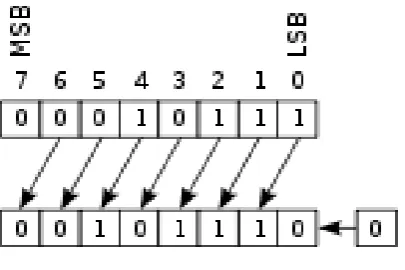
The bit shifts are sometimes considered bitwise operations, because they treat a value as a series of bits rather than as a numerical quantity. In these operations the digits are moved,
or shifted, to the left or right. Registers in a computer processor have a fixed width, so some bits will be "shifted out" of the register at one end, while the same number of bits is "shifted in" from the other end; the differences between bit shift operators lie in how they determine the values of the shifted-in bits.
Figure 4.3: shift bits
In an arithmetic shift, the bits that are shifted out of either end are discarded. In a left arithmetic shift, zeros are shifted in on the right; in a right arithmetic shift, the sign bit (the MSB in two's complement) is shifted in on the left, thus preserving the sign of the operand.
IV. CONCLUSIONS
Registration is a method used to determine the geometrical transformation that aligns points in one view of an object with corresponding points in another view of that object or another object. We have successfully developed a new Face recognition system using phase correlation technique and further comparison of two digital eye-images has been done. These techniques have been independently studied for several different applications, resulting in a large body of research. Experimental results show that the proposed algorithm has an encouraging performance.
REFERENCES
[1] J. Lu, Y.-P. Tan, and G. Wang, “Discriminative multimanifold analysisfor face recognition from a single training sample per person,” PAMI, vol. 35, no. 1, pp. 39–51, 2013.
[2] E. Elhamifar and R. Vidal, “Robust classification using structured sparse representation,” in CVPR, 2011, pp. 1873– 1879.
[4] H. Li, G. Hua, Z. Lin, J. Brandt, and J. Yang, “Probabilistic elastic matching for pose variant face verification,” in CVPR, 2013, pp. 3499–3650.
[5] S. Yan, D. Xu, B. Zhang, H.-J. Zhang, Q. Yang, and S. Lin, “Graph embedding and extensions: a general framework for dimensionality reduction,” PAMI, vol. 29, no. 1, pp. 40–51, 2007.
[6] L. Juan and O. Gwun, “A comparison of sift, pca-sift and surf,” IJIP, vol. 3, no. 4, pp. 143–152, 2009.
[7] Z. Li, G. Liu, Y. Yang, and J. You, “Scale-and rotation-invariant local binary pattern using scale-adaptive texton and subuniform-based circular shift,” TIP, vol. 21, no. 4, pp. 2130– 2140, 2012.
[8] D. G. Lowe, “Distinctive image features from scale-invariant keypoints,”IJCV, vol. 60, no. 2, pp. 91–110, 2004.
[9] Y. Tang, R. Salakhutdinov, and G. Hinton, “Robust boltzmann machines for recognition and denoising,” in CVPR, 2012, pp. 2264–2271.
[10] M. Yang, L. Zhang, S. C.-K. Shiu, and D. Zhang, “Robust kernel representation with statistical local features for face recognition,” NNLS, vol. 24, no. 6, pp. 900–912, 2013.
[11] D. Chen, X. Cao, L. Wang, F. Wen, and J. Sun, “Bayesian face revisited:A joint formulation,” in ECCV, 2012, pp. 566– 579.