COLLABORATIVE LEARNING: USE OF
THE JIGSAW TECHNIQUE IN MAPPING
CONCEPTS OF PHYSICS
Luis Manuel Tobaja Márquez Colegio Salesiano "María Auxiliadora", Spain
E-mail: [email protected]
Julia Gil Llinás University of Extremadura, Spain E-mail: [email protected]
Francisco Solano Macías IES Santa Eulalia, Mérida, Spain E-mail: fsm37agmail.com
Abstract
The aim of the present research was to compare two methodological tools with two groups of pre-university secondary education students (17-18 years old). The experimental group worked constructing concept maps using the jigsaw technique (experimental teaching approach, ETA) on the topic of radioactivity in five sessions of their physics course. The control group worked on the same subject in a traditional teaching method (lecture-based teaching approach, LTA). The research design was quasi-experimental, with 28 students of a school in Extremadura (Spain). The results of a pre-test and a post-test were compared for the two groups. The working hypotheses were: (a) students who work collaboratively in constructing concept maps using the jigsaw technique perform better in learning the topic of radioactivity; and (b) this method fosters a positive attitude of the students towards how the topic is taught. With respect to Hypothesis (a), the results appeared to show an improvement in learning in the experimental group, although without reaching statistical significance. Neither were there any statistically significant differences between the post-test results of the two groups. With respect to Hypothesis (b), most of the experimental group students found the method to be very encouraging; despite the insecurity they felt with something new that they were not used to. The experimental group's pre-test and post-test results were strongly correlated (r=0.707), so that the ETA can be regarded as fairly effective since the students learnt more meaningfully and with less effort.
Keywords: collaborative learning, concept map, jigsaw technique, teaching radioactivity, physics education.
Introduction
Students are often unmotivated toward learning physics and have great difficulty in gaining meaningful learning on these subjects because lecturing-based instruction is the most common method of instruction at most levels of education (Tanel & Erol, 2008).
IN THE 21 CENTURY Vol. 75, No. 1, 2017
93
has shown that learners' active involvement promotes their assimilation and recall of concepts to a greater extent than their passive involvement (Lord, 2007), and that it leads to meaningful learning.
Meaningful learning (Moreira 2006, p.14) is the process by which new information is related, substantively (not literally) and non-arbitrarily, to some specifically relevant aspect of the individual's cognitive structure. The new information (new ideas, concepts, propositions) can be learnt (and retained) meaningfully when other relevant and inclusive ideas, concepts, propositions are adequately clear and available in the subject's cognitive structure, and function interactively as a point of anchorage for the new information. From that standpoint, the use of concept maps presents itself as a suitable tool for analysing students' knowledge since they are hierarchical diagrams intended to reflect the conceptual organization of all or part of some specific discipline or content (Moreira, 2006).
Novak & Gowin (1986) argue that, since the concept map technique allows concepts and propositions to be set out explicitly, this in turn allows teachers and students to present, negotiate, and change their views on the validity of some given propositional relationship, or to recognize when there lack relationships between concepts, suggesting the need for new learning.
Poveda & Zaballo (2008) note that work with concept maps not only benefits novice learners, but also the "specialist" students whose peers want them to verbalize what they know. To do this, they have to structure cognitively the information they are going to transmit, and then to play the role of teacher, helping their peers to develop cognitive processes of attention. Another advantage is that it favours important skills for situations of learning, such as teamwork, generating synergy and empathy among group members, and oral and written communication (San Martín Echeverría, Albisu García & González García, 2008). Differences have been observed in the quality of the concept maps produced in small groups from those produced individually (Marques, Moreira & Cabral da Costa, 2010), with the former being better (Iraizoz Sanzol & González García, 2008).
Research results indicated that lecture-based teaching approach (LTA) hardly improves principle concepts of physics. In debates concerning how to increase the learning of physics concepts claimed that students need to take part in social interaction. It is also essential to allow students reflecting their own ideas and prepare an environment giving them a chance to discuss their learning with other students and their teachers (Crouch & Mazur, 2001). On the other hand, Johnson & Johnson (1987) indicate that if active teaching is used more widely and more frequently, students would learn to be more scientific and more to feel better about themselves as science students.
Taking all these points into account, the aim of this research is to analyse effect of collaborative learning on academic achievement and the students' perception about this technique in teaching physics subjects. This paper describes a didactic experience with an active methodological approach – collaborative group learning using the jigsaw technique through concept mapping (ETA) with the CMapTools program (IHMC, 2016) in teaching radioactivity, in the final-year, pre-university, curriculum of Spain's education system.
Methodology of Research
General Background of Research
IN THE 21 CENTURY Vol. 75, No. 1, 2017
94 made, there is still a need for inquiry into effective teaching methods and their implementation
in classroom.
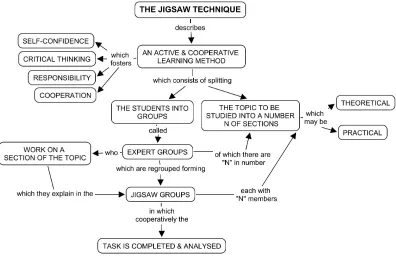
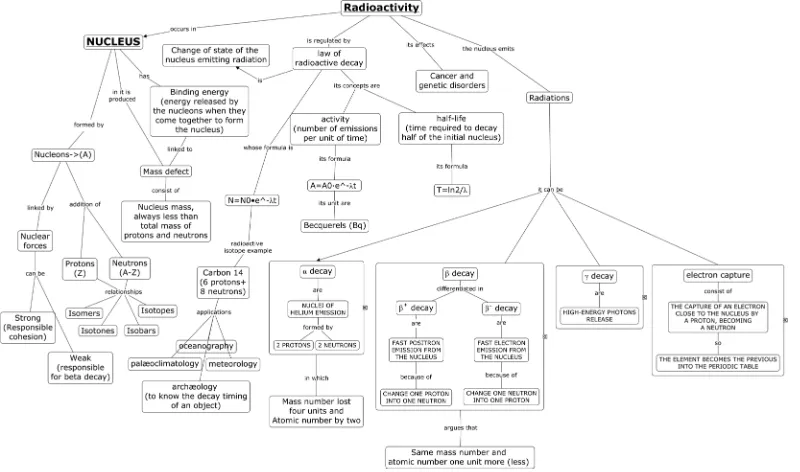
The jigsaw technique (Aronson & Patnoe, 1997) proves to be very effective at covering certain broad themes. It is a socio-constructivist technique which is very simple to apply in such areas as social sciences, humanities, biology, etc. However, it can also been applied in the physical sciences, showing advantages over the traditional teaching approach, e.g., for magnetic fields (Tanel & Erol, 2008) and electric fields (Sandoval & Mora, 2009). As can be seen in the map of Figure 1 (Gil, Solano & Tobaja, 2014), the technique consists in dividing the topic being studied into sections and the students in groups (called "jigsaw group") with the same number of participants as sections. Each member of the group receives one, and only one, section which they study for a time that will depend on the extent of that section. Then another group will be composed of students with the same section (called group of experts) will be formed. Each expert group will study its section and construct a corresponding concept map. Then, the students return to their jigsaw groups where each of them will explain the concept map what was prepared in the group of experts starting those of section 1 followed by that having section 2 and so on. Thus, all the students are required to participate in group discussions. As the end result, each jigsaw group constructs a concept map of the entire topic. An example is shown in Figure 2 which can be found with more quality in http://grupoorion.unex.es:8001/Others.
Figure 1: Concept map of the jigsaw technique.
The combination of the two techniques – jigsaw groups and concept maps – fosters the factors that are most influential in academic improvement in collaborative learning techniques: incentives (situation where the success of one learner is tied to the success of others) and the structure of the task, i.e., its specialization, in which each member of the jigsaw group is responsible for a portion of the task (Camilli, López & Barceló, 2012).
IN THE 21 CENTURY Vol. 75, No. 1, 2017
95
a) Students who follow ETA, supported by their construction of concept maps, learn better than those who follow the LTA.
b) ETA will foster the students' more positive attitude towards how the topic is taught. The research consists of a quasi-experimental design with pre-test and post-test measurements.
Figure 2: Concept map of one of the jigsaw groups.
Sample of Research
The 28 students who participated in the experiment were divided into two natural groups of 14 students each. They were 17 or 18 years in age, in the 2nd, and final, year of pre-university secondary education ("Bachillerato" in Spanish). The experimental group worked with ETA and of the 14 students who began the experiment, 12 completed it. The other group worked according to LTA, and served as a control group. The topic studied on was that of radioactivity in the physics curriculum.
Instrument and Procedures
Working with concept maps in this experiment had the dual purpose of constituting an environment for the students' conceptual understanding of the topic and of being an end in itself given the aforementioned virtues of these maps in helping to achieve meaningful learning. During the preceding school year and the year of the experiment, the students in both groups had received instruction in concept mapping and in the use of the CMapTools program, and they had already attained a certain level of skill in the use of this metacognitive tool.
The topic chosen for the experiment is part of Spain's 2nd year Bachillerato curriculum within the Modern Physics block. It was chosen for two reasons:
IN THE 21 CENTURY Vol. 75, No. 1, 2017
96 final knowledge of the topic. For this same reason, it was chosen the marks the students had
already obtained in the course as the pre-test instead of a questionnaire on their prior knowledge. b) The topic has a high-level theoretical component that can easily be divided into several autonomous fractions that are well suited to the application of the jigsaw technique.
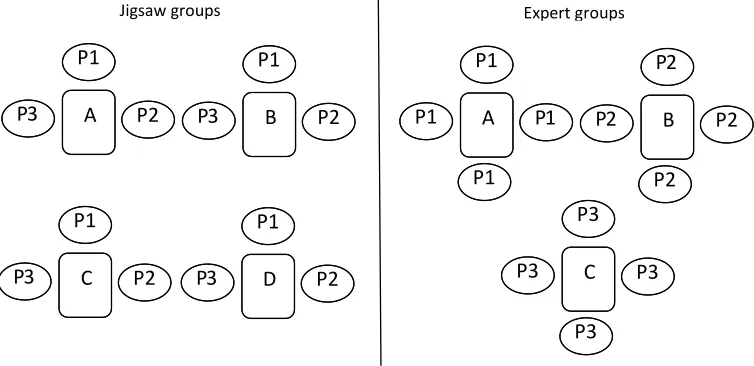
In the present research, the topic of radioactivity was split into three sections (P1, P2, P3) of similar academic load and difficulty. Therefore, four jigsaw groups (A, B, C, D) were formed of three students each. To ensure that the groups were heterogeneous, the students were assigned to the jigsaw groups according to their pre-test scores in the sense that each group had one student with a high mark, one with an average mark, and one with a low mark. Figure 3 – adapted from the figure shown in other studies (Maftei & Popescu, 2012) – illustrates the organization of the groups.
The teaching sequence of the experimental research (ETA) was developed over the course of 5 classroom sessions as described below:
Session 1. The teacher divided students into jigsaw groups. Each group was provided with the material setting out the content of the topic divided into three sections. Each group member was free to choose one section. After about five minutes, the expert groups (1, 2, 3) were set up. The initial task of each expert group was to select the most important concepts in their section of the topic.
Jigsaw groups Expert groups
P1
B P2 P 3
P1
A P2 P 3
P1
C P2 P 3
P1
D P2 P 3
P1
A P 1
P1 P1
P 2
B P2
P2 P 2
P3
C P3
P3 P3
Figure 3: Organization of the jigsaw and expert groups.
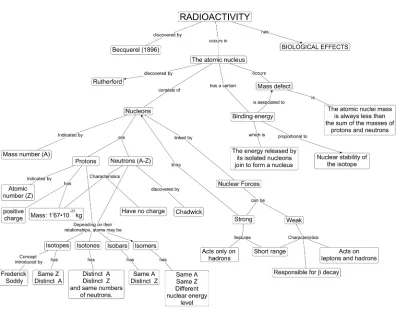
Sessions 2 and 3. The expert groups each discussed together their section, and constructed on the basis of consensus their corresponding concept map (Figure 4). During these sessions, as well as answering any questions that arose about the topic, the teacher checked how the maps were being prepared and corrected details of some of them.
Session 4. The students returned to their respective jigsaw groups. Each student explained to the others in the jigsaw group the section of the topic worked on, using as basis the conceptual map elaborated in the corresponding expert group. Then, each jigsaw group prepared a concept map of the whole topic from the different expert group maps.
IN THE 21 CENTURY Vol. 75, No. 1, 2017
97
Figure 4: Concept map constructed by one of the expert groups for their section of the topic.
The control group during the same class sessions studied the topic of radioactivity following the LTA.
To test Hypothesis (a), it was followed a quasi-experimental design with pre-test and post-test measurements. As pre-test, it was taken the average mark each student obtained in the last evaluation before starting the experiment. As post-test, it was taken the results of a 15-item questionnaire prepared by the teacher of the subject. Each item was given with four possible responses, only one of which was correct. To test Hypothesis (b), the participants responded to a six-item, open-ended questionnaire on their satisfaction with the experiment. Both the post-test and the satisfaction questionnaires were completed one week after finishing the topic, without the students receiving any prior warning of the test.
Of the two groups that participated in the experiment, it was chosen as the experimental group which had the lower average pre-test score, and was thus in the more unfavourable situation. This group worked with ETA. Of the 14 students who began the experiment, 12 completed it. The other group worked on the topic following LTA, and served as a control group.
Data Analysis
IN THE 21 CENTURY Vol. 75, No. 1, 2017
98 1. The sample drawn from the population is random.
2. Independence within the samples and mutual independence is assumed.
This test that is used for equal sample sizes, it is used to compare two population means that come from the same population and it is also used to test whether two population means are equal or not.
To evaluate the degree of learning that the students had achieved, it was calculated each group's normalized mean gain (G) using the following expression (Gil, Pérez, Suero, Solano & Pardo, 2010):
To determine if there is a relationship between the pre-test and post-test results, a linear correlation analysis of both sets scores for the control and experimental groups is performed. It was calculated the Pearson correlation coefficient with IBM SPSS Statistics software.
Results of Research
The experimental group students had worked at a good pace, doing their assigned tasks conscientiously, especially so in the case of the expert groups. As can be seen in figure 4, the expert group' maps contained many, generally relevant, concepts arranged in various hierarchical levels. However the jigsaw group maps had very few cross references, being generally a little more than a superposition of the three expert group maps (Figure 2). As the teacher asked, three of the jigsaw groups focused their activity on explaining the sections of the topic for each other. However, the other group used all the time available to construct the concept map of the whole topic, thus confusing the means with the end.
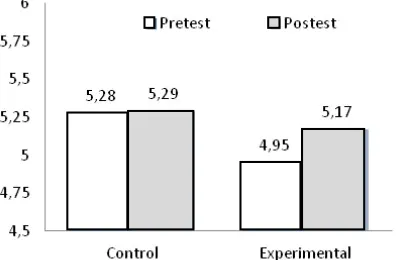
The mean values of the pre-test and post-test scores for the two groups are shown in Figure 5. As noted previously, the experimental group was chosen as that having the lower pre-test values (mean=4.95 out of 10). A Mann-Whitney U-test showed there to be no statistically significant difference between the distributions of the experimental and control group pre-test scores (p-value= 0.597, i.e., p-value > 0.05), so that the two groups can be considered as being homogeneous at the start of the experiment.
Figure 5: Mean values of the pre-test and post-test results of both groups.
IN THE 21 CENTURY Vol. 75, No. 1, 2017
99
The gain was higher for the experimental group (G = 4.4%) than for the control group, for whom it was practically zero, as can be seen from Figure 5.
Pearson correlation coefficient between the pre-test and post-test results were obtained of r = 0.431 (p = 0.707) for the control group and r = 0.707 (p = 0.010) for the experimental group. This means that there was a strong positive correlation that was statistically significant at the 0.05% level between the marks obtained by the students in the experimental group before and after ETA. Such was not the case for the control group.
With respect to the satisfaction questionnaire, 75% of the students felt that the activity had been motivating, with half of the students giving it a notable evaluation. The attitude towards the work in the (expert and jigsaw) groups was positive in all cases. The students considered the groups to have functioned properly, regardless of the difficulties they encountered in the activity (they thought that the topic had a high conceptual level, and it was one about which they had no prior knowledge, apart from the difficulties in completing the concept map for which they felt there had been little time to prepare properly, ). However, to the question of whether they would have preferred the teacher to have explained the topic in the traditional way, there was unanimity in their affirmative responses. Some remarked that they were happy with the section they had prepared in the expert group, but that they had not really comprehended well the other sections explained by their peers. To the question as to whether they considered they had learnt enough with the work they had done, only a third said yes.
Discussion
As it can be seen from the results, there is an improvement in academic achievement of the students of experimental group. Although no statistically significant differences were found between the post-test results of both groups, the experimental group showed a learning gain G of 4.4% as against the practically zero gain of the control group
Within mind the pre-test values were the marks students had obtained in traditional evaluations prior to the experiment, and consequently there would have been preparation for that evaluation, it can say in the case of the experimental group, that the pre-test and post-test distributions were correlated means that there had been significant learning and with less effort. I.e., students who had good pre-test scores continued to get good marks in the post-test, but without the specific preparation for that test, while the control group students still needed a study time in addition to the lecturing sessions for their results to be concordant with those of the pre-test.
With respect to the concept maps made in the jigsaw groups included most of the main concepts of the topic. Although initially there were few cross-links in the maps, more were brought out by the students when the full concept map was being explained and discussed in class. It is evident, therefore, that the quality of concept maps constructed in groups is an improvement over that of those prepared individually. This is in line with the results reported by Camilli, López & Barceló (2012) and Iraizoz Sanzol & González García (2008).
IN THE 21 CENTURY Vol. 75, No. 1, 2017
100 Conclusions
This research has shown that, with ETA, students are able to learn a topic autonomously, and thereby improve their performance. The methodology proposed was able to get better the experimental group's learning. Since the students received no advance warning of the post-test, they did not do any special preparation for that examination, so that the post-test measured the knowledge they had gained (and retained) as a result of the classroom activities. This means that there was more meaningful learning with less individual effort in the case of the experimental group students.
The attitude displayed by the students was always very positive. This was reflected in the results of the satisfaction questionnaire with most of the experimental group students having felt motivated by the experience.
References
Aronson, E., & Patnoe, S. (1997). The jigsaw classroom: building cooperation in the classroom. New York, NY: Addison Wesley Longman.
Camilli, C, López, E., & Barceló, M.L. (2012). Eficacia del aprendizaje cooperativo en comparación con situaciones competitivas o individuales. Su aplicación en la tecnología: una revisión sistemática [Effectiveness of cooperative learning compared to competitive or individual situations and its application to technology: a systematic review]. Enseñanza & Teaching, 30 (2), 81-103.
Crouch, C. H., & Mazur, E. (2001). Peer Instruction: Ten years of experience and results. American Journal of Physics, (69), 970-977.
Gil, J., Pérez, A. L., Suero, M. I., Solano, F., & Pardo, P. J. (2010). Evaluation of the effectiveness of a method of active learning based on Reigeluth and Stein's Elaboration Theory. International Journal of Engineering Education,26 (3), 628-641.
Gil, J., Solano, F., & Tobaja, L. (2012). Aplicación de metodologías colaborativas para conseguir un aprendizaje significativo. La técnica jigsaw en el aprendizaje de problemas de Física [Application of collaborative methodologies to achieve meaningful learning. The jigsaw technique in learning physics problems]. Paper presented at the 23th Encuentro Ibérico para la enseñanza de la Física (pp. 916-917). Valencia, Spain.
Gil, J., Solano, F., & Tobaja, L. (2014). Enseñar física en la educación superior. La técnica Jigsaw en el laboratorio de física [Teach physics in higher education. The Jigsaw technique in the physics lab].
Journal of Science Education, 2 (15), 104-106.
IBM. (2016). IBM SPSS Statistics Standard. Retrieved from https://www-01.ibm.com/software/. Institute for Human & Machine Cognition (IHMC). (2016). CmapTools program. Retrieved from http://
cmap.ihmc.us/products.
Iraizoz Sanzol, N., & González García, F. (2008). The concept map as an aid to cooperative learning in primary education. A practical experiment. In A.J. Cañas, P. Reiska, M.K. Åhlberg, & J.D. Novak (Eds.), Proceedings ofThird International Conference on Concept Mapping (pp. 230-233). Põltsamaa: OÜ Vali Press.
Jhonson, D. V., & Jhonson, R. T. (1987). Learning together and alone (2nded.).Englewood Cliffs, NJ: Prentice Hall.
Lord, T. (2007). Revisiting the cone of learning: Is it a reliable way to link instruction method with knowledge recall? Journal of College Science Teaching, 37 (2), 14-17.
IN THE 21 CENTURY Vol. 75, No. 1, 2017
101
Moreira, M.A. (2006). A teoria da aprendizagem significativa e sua implementação na sala de aula [The theory of meaningful learning and its implementation in the classroom]. Brasília, Brasil: Editora da Universidade de Brasília.
Novak, J.D., & Gowin, D.B. (1986). Learning how to learn. New York, NY: Cambridge University Press. Oliver-Hoyo, M. T., Alconchel, F., & Pinto, G. (2012). Metodologías activas para el aprendizaje de la física: Un caso de hidrostática para su introducción en la práctica docente [Active methodologies for learning physics: A case of hydrostatics for introduction into teaching practice]. Revista Española de Física, 26 (1), 45-50.
Poveda, M.R.F., & Zabalo, M.J.I. (2008). Expert/novice pairs working together on concept maps. In A.J. Cañas, P. Reiska, M.K. Åhlberg &, J.D. Novak (Eds.), Proceedings of Third International Conference on Concept Mapping (pp. 167-170). Põltsamaa: OÜ Vali Press,
San Martín Echeverría, I., Albisu García, S., & González García, F. (2008). Constructing knowledge models. Cooperative autonomous learning using concept maps and V diagrams. In A.J. Cañas, P. Reiska, M.K. Åhlberg &, J.D. Novak (Eds.), Proceedings of the Third International Conference on Concept Mapping (pp. 140-143). Põltsamaa: OÜ Vali Press.
Sandoval, M., & Mora, C. (2009). Modelos erróneos sobre la comprensión del campo eléctrico en estudiantes universitarios [Wrong models on understanding the electrical field in college students]. Latin-American Journal of Physics Education, 3 (3), 647-655.
Tanel, Z., & Erol, M. (2008). Effects of cooperative learning on instructing magnetism: analysis of an experimental teaching sequence. Latin-American Journal of Physics Education, 2 (2), 124-136. Grupo Orión. Universidad de Extremadura (2016). RadiactividadcompletoIIENG.cmap. Retrieved from
http://grupoorion.unex.es:8001/Others.
Received: November 07, 2016 Accepted: February 05, 2017
Luis Manuel Tobaja
Márquez High School Teacher, Colegio Salesiano "María Auxiliadora", Avda. Reina Sofía, 50, 06800 Merida, Spain.
E-mail: [email protected]
Julia Gil Llinás PhD, Senior Lecturer, University of Extremadura, Centro Universitario de
Mérida, Avda. Santa Teresa de Jornet, 38, 06800 Mérida (Badajoz), Spain. E-mail: [email protected]
Francisco Solano Macías PhD, High School Teacher, IES Santa Eulalia, Avda. Reina Sofía, S/N, 06800
Mérida, Spain.