R E S E A R C H
Open Access
Generation of diffuse large B cell
lymphoma-associated antigen-specific V
a
6/V
b
13+T cells by
TCR gene transfer
Qingsong Yin
1, Xianfeng Zha
1, Lijian Yang
1, Shaohua Chen
1, Yubing Zhou
2, Xiuli Wu
1, Yangqiu Li
1,3*Abstract
Background:Our previous study had amplified antigen-specific full-length TCRa andb genes of clonally expanded T cells in the peripheral blood (PB) of patients with diffuse large B-cell lymphoma (DLBCL). The transfer of T cell receptor (TCR) genes endows T cells with new antigen specificity. Therefore, the aim of this study is to generate diffuse large B cell lymphoma (DLBCL)-specific T cells by T cell receptor (TCR) gene transfer.
Materials and methods:Two different eukaryotic expression plasmids harboring TCR Va6 and TCR Vb13 genes specific for DLBCL-associated antigens were constructed and subsequently transferred into human T cells using Nucleofector™technique. The expression of targeted genes in TCR gene-modified cells was detected by real-time PCR, and western blot using TCR Vbantibody. The specific cytotoxicity of TCR gene-transferred T cells in vitrowas estimated using a lactate dehydrogenase (LDH) release assay.
Results:Two different eukaryotic expression plasmids harboring TCR Va6 and TCR Vb13 genes specific for DLBCL-associated antigens were constructed and subsequently transferred into T cells from healthy donors. Specific anti-DLBCL cytotoxic T lymphocytes (CTL) could be induced by transduction of specific TCR gene to modify healthy T cells. The transgene cassette of TCR Vb13-IRES-TCR Va6 was superior to the other in the function of TCR-redirected T cells.
Conclusions:Specific anti-DLBCL cytotoxic T lymphocyte (CTL) could be inducted by transduction of specific TCR gene to modify healthy T cells.
Background
In the past two decades, fundamental advances in immunology have introduced cellular-based therapies for cancer patients [1,2]. Donor lymphocyte infusion (DLI) has rendered or induced remission in relapsed patients [3-5]. Autologous tumor-infiltrating lympho-cytes (TILs) have been found to mediate objective can-cer regression [6-8]. In recent years, specific adoptive immunotherapy with tumor-specific cytotoxic T lym-phocyte (CTL) has been considered a promising treat-ment in malignancy, which might eradicate minimal residual disease without increasing toxicity [9,10]. how-ever, the generation of tumor-specific T cells in this mode of immunotherapy is often limiting. The isolation
andin vitro expansion of antigen-specific T cell clones remains time-consuming and labor-intensive, such that this treatment is only available to a limited number of patients. To overcome this limitation, another approach has been developed for cancer immunotherapy based on the genetic modification of normal T lymphocytes [11].
Because the molecular basis of CTL specificity is dic-tated solely by its TCR, which consists of a heterodi-meric pair of a- and b-chains (TCRab), the molecular transfer of TCR genes from donor to recipient T cells using transgenic technology will result in a transfer of CTL specificity [11,12]. Thus, TCR gene transfer is an attractive strategy for the rapid in vitrogeneration of a high number of antigen-specific T cells [13]. The first TCR gene transfer into primary human T lymphocytes was accomplished with work on melanoma antigen [14] and CD8+T cells transduced with a TCR specific for MART-1 were able to lyse an HLA-A2+melanoma cell * Correspondence: [email protected]
1
Institute of Hematology, Medical College, Jinan University; Guangzhou, 510632, PR China
Full list of author information is available at the end of the article
line in vitro. Subsequently, several other tumor-asso-ciated antigens (TAAs) have been selected as targets, such as WT1 protein [15] and P53 protein [16]. In addi-tion, TCR genes specific for HIV and EBV antigens have also been transferred successfully into CD8+T cells from patients [17,18]. In the first clinical trial of TCR gene therapy [19] T cells that had been transduced with a TCR specific for MART-1 mediated some degree of cytotoxicity in 15 patients, demonstrating the feasibility and potential of the anti-tumor effect of TCR gene-modified T cells.
Diffuse large B cell lymphoma (DLBCL) is one of the most common and highly aggressive lymphoid malig-nancies whose clinical outcomes vary widely. Recently, novel therapeutic strategies, including the incorporation of immunotherapy and combined chemotherapy, have improved the outcome for patients with DLBCL; e.g., the combination of rituximab (anti-CD20 antibody) and CHOP regimen (R-CHOP) has been demonstrated to be more effective [20]. Nonetheless, the increased toxicity suggested that novel regimens should be developed to improve long-term disease-free survival. The potential for T cells to contribute to the eradication of B cell malignancies in humans has been illustrated by the abil-ity of allogeneic hematopoietic stem cell transplantation to cure advanced lymphoma, which can be attributed in part to a T cell mediated graft-versus-tumor (GVT) effect. Therefore, much research has focused on the generation of effective antigen-specific T cells. At pre-sent, the successful transfer of TCR genes specific for a variety of virus-specific and tumor-associated antigens, such as MART-1/WT1 TCR-modified T cells, has been shown to have specific cytotoxicity on melanoma or
leukemia cells [19,21]. However, little is known about the TCR gene-modified T cells specific for lymphoma-associated antigen.
Previously, we found specific TCR gene sequences associated with DLBCL-associated antigen [22] and sub-mitted them to GenBank (Accession numbers: EU369627, EU368854, and so on). In the current study, we developed two types of recombinant constructs con-taining the HLA-A2-restricted TCR a6 and TCRb13 genes specific for DLBCL-associated antigens with TCR
a at either the IRES 5’ position or 3’position, which may induce DLBCL-specific T cells by TCR gene trans-duction. TCR gene-transferred T cells exhibited specific cytotoxicity in response to the DLBCL cell line. Using this approach, we concluded that it is feasible to prepare human tumor-specific T cells from polyclonally acti-vated T cells if we could obtain MHC class I-restricted TCR genes. This strategy will likely lead to individua-lized immunotherapy based on lymphoma expressing certain proteins in DLBCL.
Materials and methods
Construction of recombinant plasmids
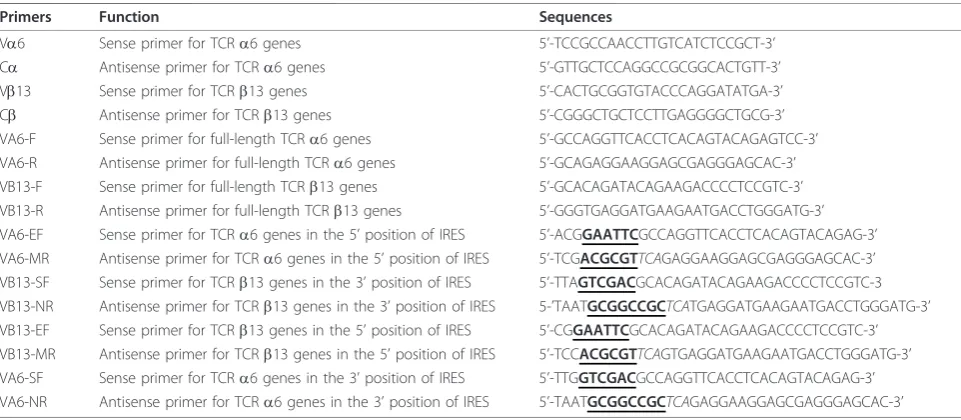
DLBCL associated-TCR Va6 and TCR Vb13 chain genes, which had been identified in peripheral blood T cells from one DLBCL case were used [22]. Different approaches were applied to construct two recombinant plasmids containing the TCR Va6- and TCR Vb 13-chain genes specific for DLBCL-associated antigen. Briefly, the full-length TCR a6 and b13 genes specific for DLBCL-associated antigens were amplified by PCR using forward primers (VA6-F, VB13-F) and reverse pri-mers (VA6-R, VB13-R), respectively (Table 1), and
Table 1 The sequence of primers for PCR
Primers Function Sequences
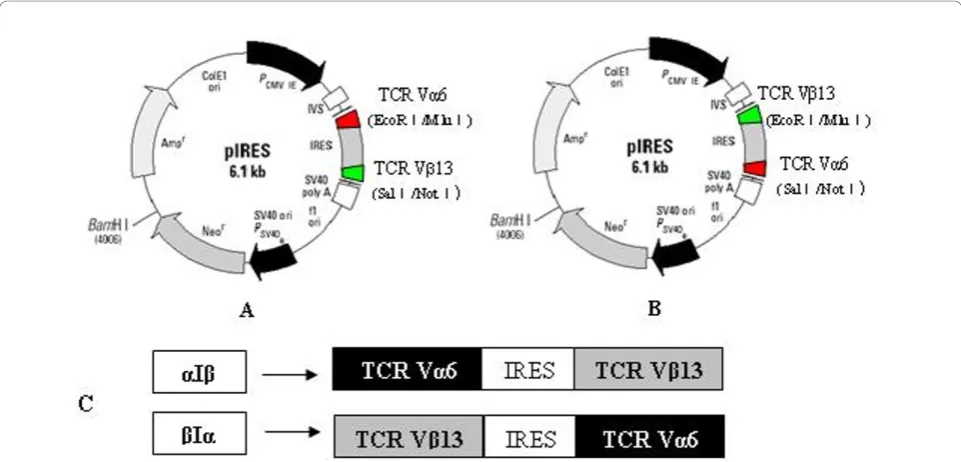
subsequently cloned into the eukaryotic expression vec-tor pIRES, respectively, in which the TCR a6- and b 13-chain genes were linked by an internal ribosomal entry site (IRES) to construct two different bicistronic eukar-yotic expression plasmids (a6-IRES-b13, b13-IRES-a6) with the a- or theb-chain gene in the 5’ position and the other gene in the 3’position. The full-length TCRa -and b-chain genes were ligated via EcoR I and Mlu I restriction sites in the 5’position of IRES, and via Sal I and Not I restriction sites in the 3’position. Two kinds of TCR cassettes (Figure 1) were verified by restriction analysis and sequencing.
Human CD3+T cell isolation and culture
Peripheral blood mononuclear cells (PBMCs) obtained from three healthy donors (HLA-A2, DP restricted) were isolated from heparinized venous blood by Ficoll-Paque gradient centrifugation. All procedures were con-ducted according to the guidelines of the Medical Ethics Committee of the Health Bureau of Guangdong Pro-vince of China. Cells were collected and washed twice in Hank’s balanced salt solution, and then finally resus-pended at a final concentration of 2 × 10⁶ cells/mL in complete RPMI 1640 medium (Invitrogen, Grand Island, NY) supplemented with 10% heat-inactivated fetal calf serum (FCS; HyClone, Logan, UT), 100 U/mL penicillin, 100 μg/mL streptomycin, 2 mM L-glutamine, and 50
μM 2-mercaptoethanol. CD3+T cells were positively purified from freshly isolated PBMCs using CD3
+microbeads (Miltenyi Biotec, Bergisch Gladbach, Ger-many) according to the manufacturer’s protocol. The purity of collected CD3+T cells was assessed by flow cytometry. More than 95% of CD3+T cells were col-lected by this technique. Initial stimulation was per-formed at a concentration of 2 × 10⁶ cells per well in 1 mL T cell complete medium (+200 IU/mL IL-2 and 2μg/mL PHA [Sigma, USA]) for 24 h in non-tissue cul-ture 12-well plates. Cells were washed once with med-ium on the following day and then added to fresh complete RPMI 1640 medium supplemented with 200 IU/ml IL-2. The culture medium was replaced every 2-3 days and the cells were cultured for 5-6 days before transfection to achieve a high transfection efficiency.
Cell lines and culture
Toledo cells (human diffuse large B cell lymphomas cell line, expressed DLBCL-associated antigen), Molt-4 cells (human acute lymphoblastic leukemia cell line), Raji cells (human Burkitt lymphoma cell line), all from ATCC, were cultured in complete RPMI 1640 medium supplemented with 10% heat-inactivated FBS and main-tained at 37°C in a 5% CO2incubator. The medium was
replaced every 2-3 days.
Transduction of TCR genes in T cells
Human CD3+T cells at 6 days after stimulation were transfected using the Nucleofector™technology (Amaxa, Cologne, Germany). In brief, cells (5 × 10⁶) were
resuspended into 0.1 mL supplemented Nucleofector solution at room temperature from the human T cell Nucleofector™ kit. Each plasmid (2 μg; including TCR Va6-IRES-TCR Vb13 recombinant plasmid, TCR Vb13-IRES-TCR Va6 recombinant plasmid, TCR unloaded plasmid as a negative control, and maxGFP as a positive control) was mixed with 0.1 mL cell sus-pension and then transferred to a 2.0 mm electropora-tion cuvette and nucleofected using an Amaxa Nucleofector II apparatus according to the manufac-turer’s guidelines. Storage of the cell suspension in human T cell Nucleofector solution for longer than 20 min was avoided, as this reduces cell viability and gene transfer efficiency. The cells were transfected using the program T-020. The transfected T cells were trans-ferred immediately to pre-warmed complete culture medium and cultured in 12-well plates in a humidified incubator at 37°C and 5% CO2. The culture medium
was changed 8 h after transfection to medium contain-ing 200 IU/mL IL-2.
Determination of transfection efficiency
The transfection efficiency was estimated in each experi-ment by scoring the number of GFP-positive cells (maxGFP expression) 24 h after transfection. Immuno-phenotyping analysis was performed using a TCR Vb13 monoclonal antibody (mAb) with laser confocal micro-scopy (LCM; 510 META DuoScan, Carl Zeiss, Germany) and by flow cytometry (FCM) 48 h after transfection. Cells were stained with fluorescein isothiocyanate (FITC)-conjugated mAbs. Antibodies were purchased from Beckman Coulter, California, USA (mouse-anti-human TCR Vb13).
RNA extraction and cDNA synthesis
Total RNA was extracted from the TCR CD3+T cells that were either gene-transduced or not gene-trans-duced, according to the manufacturer’s recommenda-tions (TRIzol®reagent; Invitrogen, USA). The quality of RNA was analyzed by 0.8% agarose gel electrophoresis with ethidium bromide staining. The RNA (2 μg) was reverse-transcribed into first single-strand cDNA using random hexamer primers, reverse transcriptase, and the Superscript II kit (PowerScript™ Reverse, BD, USA) according to the manufacturer’s instructions. The qual-ity of cDNA was confirmed by reverse transcriptase polymerase chain reaction (RT-PCR) forb2 microglubin gene amplification.
Real-time PCR
The mRNA expressions of antigen-specific TCR Va6 and TCR Vb13 genes were detected by real-time PCR using SYBR® Green I with the Real Master Mix kit (Tiangen, Beijing, China). Reactions were run in
triplicate and repeated in three independent experiments using the MJ Research real-time PCR system (Bio-Rad, USA) with a cDNA template in a 25 μL reaction under the following conditions: 95°C for 2 min, followed by 45 cycles of 95°C for 15 s and 62°C for 1 min. The primers used in the real-time PCR are listed in Table 1. Similar manipulation was performed with RNA as the template to exclude the presence of plasmid DNA.
Western blot analysis
CD3+T cells at 2 × 10⁶were harvested 3 days after trans-fection, mixed with RIPA lysis buffer (1 × PBS, 1% Noni-det P-40, 0.5% sodium deoxycholate, 0.1% sodium dodecyl sulfate [SDS], 10 mmol/L phenylmethylsulfonyl fluoride, 1μg/mL aprotinin, and 100 mmol/L sodium orthovanadate), and incubated on ice for 30 min to iso-late total proteins. Proteins (100μg) were separated by 7.5% SDS-PAGE and transferred to nitrocellulose mem-branes (Invitrogen, USA) using a damp-dry transfer device (Bio-rad, USA). After blocking for 1 h in 5% defatted milk powder in PBS, the membrane was washed and then probed with 1:300 mouse-anti-human TCR Vb13 monoclonal antibody (Beckman Coulter, USA). Similar studies were performed with 1:500 mouse-anti-humanbactin (BOSTER, Wuhan, China). The antibodies were detected using 1:10000 horseradish peroxidase-conjugated rabbit-anti-mouse IgG (Tiangen, Beijing, China). A Western blotting luminol reagent (Tiangen, Beijing, China) was used to visualize the bands corre-sponding to each antibody.
Cytotoxicity assay
TCR gene-transferred CD3+T cells (effector cells) or TCR CD3+T cells that were not gene-transduced were incubated with Toledo cells (DLBCL cell line, ATCC, target cells), Molt-4 cells, or Raji cells in U-bottomed, 96-well microplates at 10:1 effector-target ratios for 10 h at 37°C and 5% CO2 in culture media containing
cytotoxicity assays. Statistical significance was defined as
P< 0.05. Results
TCR plasmid construction
In our previous study, expanded TCR Vaand TCR Vb subfamily T cells were identified in the PB of patients with DLBCL, which was presumed to have been driven by the stimulation of epitopes in DLBCL [22]. The full-length TCRVa6- and Vb13-chain genes specific for DLBCL-associated antigen had been amplified for the construction of bicistronic recombinant plasmids. Because a gene inserted downstream of the IRES will be expressed at a significantly lower level than one intro-duced upstream [23] and the two chains may play none-quivalent roles in antigen selection, we integrated the TCRa gene into either the IRES 5’position (TCR Va 6-IRES-TCR Vb13) or the 3’position (TCR Vb 13-IRES-TCR Va6), generating two types of recombinant plas-mids. Subsequently, their sequence and reading frame were confirmed by restriction enzyme digestion analysis and sequencing (data not shown).
TCR gene-modified CD3+T cells
The CD3+T cells were transfected with the respective TCR-encoding expression plasmids using Nucleofector™ technology. After gene transfection, higher V expression levels of Va6 and Vb13 gene were detected by real-time PCR respectively(data not shown), and the correspond-ing protein of TCR Vb13 chain was detected by SDS-PAGE (Figure 2), because it is difficult to purchase the human TCR Vasubfamily antibodies in China, in this study, we used the Vb13 antibody to confirm the expression of transfected recombinant plasmid, by com-bining the results from real-time PCR, it could be con-cluded that antigen-specific TCR a6 and b13 genes
were well expressed in both types of transgene cassettes, indicating that the recombinant plasmids had been con-structed successfully and that the expression of exogen-ous TCR a and b genes could be detected in the transduced cells.
Influence of the transgene cassette on TCR expression level in CD3+T cells
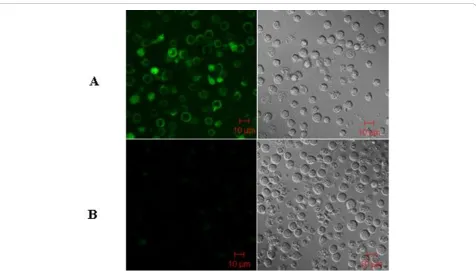
Human CD3+T cells were transduced with the recombi-nant plasmids harboring the two transgenic cassettes. Immunophenotyping analysis 48 h after transduction was performed by LSM using TCR Vb13 mAbs (Figure 3). The gene transfer efficiency was assessed by CD3+T cell staining with antibodies directed against TCR Vb13 by FCM 2 days after transduction (Figure 4). TCRa-chain expression was not detected due to the lack of a Va 6-specific antibody. TCR CD3+T cells that were not trans-duced served as a negative control. The percentage of TCR gene-transduced cells revealed differences in gene expression levels between theaIbtransgene cassette and the bIatransgene cassette. The surface expression of exogenous TCRbfrom cassette bIa(48.5%; Figure 4B) was superior to that of cassetteaIb(39.4%; Figure 4C), compared to ~1% in the control cells (Figure 4A). This is most likely due to the poor expression of the TCR
b-chain gene in the 3’position of the IRES linker relative to the insertion in the 5’position, although there was no statistical significance between the gene expression in the 3’and 5’positions of the IRES (P= 0.21). Nevertheless, this still indicates that the 3’position of an IRES element is an unprivileged position leading to suboptimal TCR chain expression levels.
Functional tests of TCR transductants
Finally, we analyzed whether the surface expression levels of exogenous TCRa orb achieved by the differ-ent vector cassettes influence TCR function. Cassette
bIaachieved a higher transduction efficiency than did cassette aIb. However, the positive cell populations of about 48.5% (TCR Vb13 single-positive cells) with cas-sette bIa cannot exclude the presence of mixed TCR heterodimers having formed as the transgenic TCR chains mispaired with endogenous chains. To further characterize the function of TCR, we evaluated the impact of these two different transgene cassettes on the specific cytotoxicity of TCR gene-transduced CD3+T cells. The cytotoxicity of TCR gene-transduced CD3+T cells was determined using a nonradioactive LDH release assay. The LDH level was analyzed following the cocultivation of effector cells (TCR gene-transduced CD3+T cells or CD3+T cells transduced with empty plasmid) with target cells (Toledo, Molt-4, and Raji cells). The specific cytotoxicity of the TCR gene-trans-duced CD3+T cells against Toledo cells by cassette bIa
was higher than that observed with cassetteaIb (P = 0.014), suggesting that the TCR transgene vector bIa yielded a better function of human antigen-specific TCR-redirected T cells than did vectoraIb. Cytotoxicity of TCR gene-transduced CD3+T cells against Toledo cells by two types of TCR transgene cassettes (aIb, P=
0.008;bIa,P = 0.000) was significantly higher than that of CD3+T cells transduced with empty vector. From these cocultivations of effector cells with target cells, we found that the cocultivation of TCR gene-transduced CD3+T cells with the Toledo cell line achieved the highest LDH level (Figure 5), indicating that TCR
Figure 3Antigen-specific TCR gene-transduced CD3+T cells from PB of healthy individuals stained with TCR Vb13-specific antibody and imaged by LSM (×630). A) CD3+T cells transduced with Vb13-IRES-TCR Va6 recombinant plasmid and stained by FITC-TCR Vb 13-specific antibody. B) CD3+T cells transferred with empty vector as a negative control for exogenous TCR Vb13 expression.
Figure 4The use of two TCR vector cassettes results in differential expression in human CD3+T cells. TCR gene-transduced CD3+T cells were stained with a TCR Vb13-specific antibody and analyzed by flow cytometry. The numbers indicate the percentage of TCR Vb13-positive cells. A) Human CD3+T cells transferred with empty vector as a negative control for exogenous TCR Vb13 expression. B) Human CD3+T cells transferred with TCR Vb13-IRES-TCR Va6 recombinant plasmid were stained with a TCR Vb13-specific antibody 48 h after transduction. C) Human CD3+T cells transferred with TCR Va6-IRES-TCR Vb13 recombinant plasmid were stained with a TCR Vb13-specific antibody 48 h after
genes-transduced CD3+T cells were specifically directed against the DLBCL cell line.
Discussion
The successful transfer of genes encoding TCRab chains, which recognize a variety of virus-specific and tumor-associated antigens, into primary T cells was demonstrated previously [11,12,24,25]. For clinical applications of TCR-redirected T cells, the efficient functional expression of the transgenic TCR is a prere-quisite. The selection of an optimal transgenic cassette offers a simple option to enhance functional TCR expression, as well as a means to explore more com-plex modifications of TCR chain genes to obtain pre-ferential pairing (murinization, additional cysteine bonds) [26,27] or enhanced expression through codon modification [28].
In general, TCR a- and b-chain genes can be com-monly linked by an IRES. Because a gene inserted downstream of the IRES will be expressed at signifi-cantly lower levels than one introduced to the upstream position,23and the two chains may play nonequivalent roles in antigen selection, we integrated TCRa into either the IRES 5’position (TCRVa6-IRES-Vb13) or the 3’ position (TCRVb13-IRES-Va6), and generated two types of recombinant plasmids. Subsequently, we
compared the influence of the transgenic cassettes on the expression and function of the TCR specific for DLBCL-associated antigen and found that the applica-tion of cassettebIa resulted in higher expression and functionality of a human TCR when compared to that observed with the use of cassette aIb. Yet, if the P2A element (2A element of porcine teschovirus) [29,30], instead of the IRES element, were employed to link a single TCRa- andb-chain-encoding mRNA, then plas-mid TCRb-P2A-TCRa may achieve higher TCR chain expression and T cell function compared to the TCRb -IRES-TCRa plasmid [31]. A potential problem with using the P2A linker is that parts of the virus-derived sequence might be presented by MHC I molecules, making the transferred T cells a target for elimination by the host’s immune system [31]. These findings may have serious consequences for the design of TCR expression cassettes, which are used to change the anti-gen specificity of T cells employed for adoptive T cell therapy.
Most of the known T cell-recognized epitopes are those presented by MHC class I molecules to CD8+T cells, and relatively few MHC class II tumor epitopes have been identified. Thus, to date, most adoptive immunotherapy approaches have focused on CD8+ CTL. However, the ability to transfer TCR genes between
Figure 5Specific cytotoxicity of TCR gene-transduced CD3+T cells directed against Toledo cells as determined by LDH release assay. Three days after transduction, TCR gene-transduced CD3+T cells by two different TCR transgene cassettes were cocultured with Toledo, Raji, or Molt-4 cells at a 10:1 ratio for 10 h. Then, the LDH level in the supernatant was determined. The spontaneous release of LDH from both target and effector cells was subtracted from the measured values and the final results are expressed as the percentage of specific cytotoxicity. *Mann-Whitney test of two independent samples was used to determine differences between the various groups. Statistical significance was defined as
T cells now means that both CD4+and CD8+ lympho-cytes can be generated against the same specific targets, offering concerted therapeutic strategies that can fully utilize adoptive transfer [32-34]. Thus, in the current study, we screened CD3+T lymphocytes (including CD3 +CD4+and CD3+CD8+T cells) as the recipient cells of TCR gene transduction. In human subjects, normal autologous T lymphocytes, transducedex vivowith anti-tumor associated antigen (TAA) and the TCR genes, which were re-infused into cancer patients, persist and express the transgene for a prolonged timein vivo and mediate the durable regression of large established tumors [19]. Ideally, TCR genes specific for DLBCL-associated antigen should be transduced into autologous T lymphocytes, which aim directly at autologous lym-phoma cells. It is a pity that we were unable to obtain patients’autologous lymphoma cells as target cells. With respect to the most commonly distributed human MHC I molecule HLA-A2, we selected an HLA-A2-positive DLBCL cell line (Toledo cell line) as the target cells. Antigen-specific TCR gene-modified T cells acquired the ability for DLBCL-specific cytotoxic capacity accord-ing toin vivocytotoxicity assays. The effect of the TCR Vb13-IRES-TCR Va6 recombinant plasmid-transferred T cells was superior to that of the TCR Va6-IRES-TCR Vb13-transferred T cells; specifically, the cytotoxicity of TCR-transferred T cells with cassettebIa directed to the DLBCL cell line arrived at 30% 72 h after transduc-tion, however, the TCR-modified T cells showed lower cytotoxicity for Molt-4 and Raji cells, which do not express DLBCL-associated antigen; the specific anti-DLBCL activity might be confirmed in this study. As tumor cells possess more than one TAA, it is possible that there are multiple T cell clones specific for tumor cells. Further genetic modification of PBLs with a few specific TCRs may be beneficial.
This study suggests the therapeutic potential of geneti-cally engineered cells for the biologic therapy of cancer. However, in the present study, as first step to investigate the expression and the effect of TCR Va6/Vb13 recom-binant vectors in vitro, we used the transient expression technique, in which the genes could expression only few day after transfection, and we could conform that speci-fic anti-DLBCL cytotoxic T lymphocyte (CTL) could be induced by transduction of specific TCR gene to modify healthy T cells. For the clinical application in future, stable expression of transduced genes in T cells is necessary and should be optimized the transfection technique, maybe using different viral vectors.
In summary, to our knowledge, this is the first demonstration of DLBCL-associated antigen-specific TCR gene-modified T cells having acquired specific cytotoxicity. However, the present study should be fol-lowed by a large cohort of cytotoxicity assays for
different DLBCL cell lines to confirm its common anti-DLBCL cytotoxicity, which was thought to target the TAA of DLBCL. This study provides substantial new data for a better understanding of the strategy of adop-tive immunotherapy in DLBCL.
Acknowledgements
This work was sponsored by grants from the National“863”projects of China (2006AA02Z114) and the National Natural Science Foundation of Guangdong Province (No. 05103293, 9251063201000001).
Author details
1Institute of Hematology, Medical College, Jinan University; Guangzhou,
510632, PR China.2Department of Biochemistry of Medical College, Jinan
University, Guangzhou, 510632, PR China.3Key Laboratory for Regenerative
Medicine of Ministry of Education, Jinan University, Guangzhou, 510632, PR China.
Authors’contributions
QSY performed TCR gene cloning and transfer and data management, LJY performed T-cells culture, SHC performed the RT-PCR and genescan analysis, YBZ performed the western blot, XLW and XFZ performed the real-time PCR, YQL were responsible for the study design and data management. All authors read and approved the final manuscript.
Competing interests
The authors declare that have no competing interests.
Received: 18 November 2010 Accepted: 11 January 2011 Published: 11 January 2011
References
1. Rosenberg SA:A new era for cancer immunotherapy based on the genes that encode cancer antigens.Immunity1999,10:281-287.
2. Blattman JN, Greenberg PD:Cancer immunotherapy: A treatment for the masses.Science2004,305:200-205.
3. Levine JE, Barrett AJ, Zhang MJ, Arora M, Pulsipher MA, Bunin N, Fort J, Loberiza F, Porter D, Giralt S, Drobyski W, Wang D, Pavletic S, Ringden O, Horowitz MM, Collins RJ:Donor leukocyte infusions to treat hematologic malignancy relapse following allo-SCT in a pediatric population.Bone Marrow Transplant2008,42:201-205.
4. Schmid C, Labopin M, Nagler A, Bornhäuser M, Finke J, Fassas A, Volin L, Gürman G, Maertens J, Bordigoni P, Holler E, Ehninger G, Polge E, Gorin NC, Kolb HJ, Rocha V:Donor lymphocyte infusion in the treatment of first hematological relapse after allogeneic stem-cell transplantation in adults with acute myeloid leukemia: A retrospective risk factors analysis and comparison with other strategies by the EBMT Acute Leukemia Working Party.J Clin Oncol2007,25:4938-4945.
5. Porter DL, Collins RH Jr, Hardy C, Kernan NA, Drobyski WR, Giralt S, Flowers ME, Casper J, Leahey A, Parker P, Mick R, Bate-Boyle B, King R, Antin JH:Treatment of relapsed leukemia after unrelated donor marrow transplantation with unrelated donor leukocyte infusions.Blood2000, 95:1214-1221.
6. Rosenberg SA, Spiess P, Lafreniere R:A new approach to the adoptive immunotherapy of cancer with tumor-infiltrating lymphocytes.Science
1986,233:1318-1321.
7. Dudley ME, Wunderlich JR, Yang JC, Sherry RM, Topalian SL, Restifo NP, Royal RE, Pelletier MM, Gea-Banacloche J, Robinson MR, Berman DM, Filie AC, Abati A, Rosenberg SA:Adoptive cell transfer therapy following non-myeloablative but lymphodepleting chemotherapy for the treatment of patients with refractory metastatic melanoma.J Clin Oncol
2005,23:2346-2357.
9. Popescu MC, Robb RJ, Batenjany MM, Boni LT, Neville ME, Pennington RW, Neelapu SS, Kwak LW:A novel proteoliposomal vaccine elicits potent antitumor immunity in mice.Blood2007,109:5407-5410.
10. Mackensen A, Meidenbauer N, Vogl S, Laumer M, Berger J, Andreesen R: Phase I study of adoptive T-cell therapy using antigen-specific CD8+T cells for the treatment of patients with metastatic melanoma.J Clin Oncol2006,24:5060-5069.
11. Kessels HW, Wolkers MC, van den Boom MD, van der Valk MA, Schumacher TN:Immunotherapy through TCR gene transfer.Nat Immunol2001,2:957-61.
12. Heemskerk MHM:T-cell receptor gene transfer for the treatment of leukemia and other tumors.Haematologica2010,95:15-19. 13. Griffioen M, van Egmond HM, Barnby-Porritt H, van der Hoorn MA,
Hagedoorn RS, Kester MG, Schwabe N, Willemze R, Falkenburg JH, Heemskerk MH:Genetic engineering of virus-specific T cells with T-cell receptors recognizing minor histocompatibility antigens for clinical application.Haematologica2008,93:1535-1543.
14. Clay TM, Custer MC, Sachs J, Hwu P, Rosenberg SA, Nishimura MI:Efficient transfer of a tumor antigen-reactive TCR to human peripheral blood lymphocytes confers anti-tumor reactivity.J Immunol1999,163:507-513. 15. Xue SA, Gao L, Hart D, Gillmore R, Qasim W, Thrasher A, Apperley J,
Engels B, Uckert W, Morris E, Stauss H:Elimination of human leukemia cells in NOD/SCID mice by WT1-TCR gene-transduced human T cells.
Blood2005,106:3062-3067.
16. Kuball J, Schmitz FW, Voss RH, Ferreira EA, Engel R, Guillaume P, Strand S, Romero P, Huber C, Sherman LA, Theobald M:Cooperation of human tumor-reactive CD4+ and CD8+T cells after redirection of their specificity by a high-affinity p53A2.1-specific TCR.Immunity2005, 22:117-129.
17. Cooper LJ, Kalos M, Lewinsohn DA, Riddell SR, Greenberg PD:Transfer of specificity for human immunodeficiency virus type 1 into primary human T lymphocytes by introduction of T-cell receptor genes.J Virol
2000,74:8207-8212.
18. Orentas RJ, Bircher LA, Roskopf S:Retroviral transfer of T-cell receptor genes produces cells with a broad range of lytic activity.Scand J Immunol2003,58:33-42.
19. Morgan RA, Dudley ME, Wunderlich JR, Hughes MS, Yang JC, Sherry RM, Royal RE, Topalian SL, Kammula US, Restifo NP, Zheng Z, Nahvi A, de Vries CR, Rogers-Freezer LJ, Mavroukakis SA, Rosenberg SA:Cancer regression in patients after transfer of genetically engineered lymphocytes.Science2006,314:126-129.
20. Habermann TM, Weller EA, Morrison VA, Gascoyne RD, Cassileth PA, Cohn JB, Dakhil SR, Woda B, Fisher RI, Peterson BA, Horning SJ: Rituximab-CHOP versus Rituximab-CHOP alone or with maintenance rituximab in older patients with diffuse large B-cell lymphoma.J Clin Oncol2006, 24:3121-3127.
21. Xue SA, Gao L, Thomas S, Hart DP, Xue JZ, Gillmore R, Voss RH, Morris E, Stauss HJ:Development of a Wilms’tumor antigen-specific T-cell receptor for clinical trials: Engineered patient’s T cells can eliminate autologous leukemia blasts in NOD/SCID mice.Haematologica2010, 95:126-134.
22. Yin Q, Tan H, Chen S, Yang L, Ye J, Li Y:Characterization of conserved CDR3 sequence of TCRα- andβ-chain genes in peripheral blood T cells from patients with diffuse large B-cell lymphoma.Hematology2010, 15:48-57.
23. Mizuguchi H, Xu Z, Ishii-Watabe A, Uchida E, Hayakawa T:IRES-dependent second gene expression is significantly lower than cap-dependent first gene expression in a bicistronic vector.Mol Ther2000,1:376-382. 24. Xue S, Gillmore R, Downs A, Tsallios A, Holler A, Gao L, Wong V, Morris E,
Stauss HJ:Exploiting T cell receptor genes for cancer immunotherapy.
Clin Exp Immunol2005,139:167-172.
25. Engels B, Uckert W:Redirecting T lymphocyte specificity by T cell receptor gene transfer - a new era for immunotherapy.Mol Aspects Med
2007,28:115-142.
26. Cohen CJ, Zhao Y, Zheng Z, Rosenberg SA, Morgan RA:Enhanced anti-tumor activity of murine-human hybrid T-cell receptor (TCR) in human lymphocytes is associated with improved pairing and TCR/CD3 stability.
Cancer Res2006,66:8878-886.
27. Cohen CJ, Li YF, El-Gamil M, Robbins PF, Rosenberg SA, Morgan RA: Enhanced antitumor activity of T cells engineered to express T cell receptors with a second disulfide bond.Cancer Res2007,67:3898-3903.
28. Heitzer M, Eckert A, Fuhrmann M, Griesbeck C:Influence of codon bias on the expression of foreign genes in microalgae.Adv Exp Med Biol2007, 616:46-53.
29. Scholten KB, Kramer D, Kueter EW, Graf M, Schoedl T, Meijer CJ, Schreurs MW, Hooijberg E:Codon modification of T cell receptors allows enhanced functional expression in transgenic human T cells.Clin Immunol2006,119:135-145.
30. Holst J, Vignali KM, Burton AR, Vignali DA:Rapid analysis of T-cell selection in vivousing T cell-receptor retrogenic mice.Nat Methods2006, 3:191-197.
31. Leisegang M, Engels B, Meyerhuber P, Kieback E, Sommermeyer D, Xue SA, Reuss S, Stauss H, Uckert W:Enhanced functionality of T cell receptor-redirected T cells is defined by the transgene cassette.J Mol Med2008, 86:573-583.
32. Kuball J, Schmitz FW, Voss RH, Ferreira EA, Engel R, Guillaume P, Strand S, Romero P, Huber C, Sherman LA, Theobald M:Cooperation of human tumor-reactive CD4+ and CD8+T cells after redirection of their specificity by a high-affinity p53A2.1-specific TCR.Immunity2005, 22:117-129.
33. Tsuji T, Yasukawa M, Matsuzaki J, Ohkuri T, Chamoto K, Wakita D, Azuma T, Niiya H, Miyoshi H, Kuzushima K, Oka Y, Sugiyama H, Ikeda H, Nishimura T: Generation of tumor-specific, HLA class I-restricted human Th1 and Tc1 cells by cell engineering with tumor peptide-specific T-cell receptor genes.Blood2005,106:470-476.
34. Fujiki F, Oka Y, Kawakatsu M, Tsuboi A, Nakajima H, Elisseeva OA, Harada Y, Li Z, Tatsumi N, Kamino E, Shirakata T, Nishida S, Taniguchi Y, Kawase I, Oji Y, Sugiyama HA:WT1 protein-derived, naturally processed 16-mer peptide, WT1 (332), is a promiscuous helper peptide for induction of WT1-specific Th1-type CD4 (+) T cells.Microbiol Immunol2008, 52:591-600.
doi:10.1186/1756-8722-4-2
Cite this article as:Yinet al.:Generation of diffuse large B cell
lymphoma-associated antigen-specific Va6/Vb13+T cells by TCR gene
transfer.Journal of Hematology & Oncology20114:2.
Submit your next manuscript to BioMed Central and take full advantage of:
• Convenient online submission
• Thorough peer review
• No space constraints or color figure charges
• Immediate publication on acceptance
• Inclusion in PubMed, CAS, Scopus and Google Scholar
• Research which is freely available for redistribution