Ethnobotany of dye plants in Dong communities
of China
Liu
et al.
Liuet al. Journal of Ethnobiology and Ethnomedicine2014,10:23 http://www.ethnobiomed.com/content/10/1/23
JOURNAL OF ETHNOBIOLOGY
R E S E A R C H
Open Access
Ethnobotany of dye plants in Dong communities
of China
Yujing Liu
1, Selena Ahmed
2, Bo Liu
1, Zhiyong Guo
1, Weijuan Huang
1, Xianjin Wu
3, Shenghua Li
3, Jiangju Zhou
4,
Qiyi Lei
4and Chunlin Long
1,3,5*Abstract
Background:Dyes derived from plants have an extensive history of use for coloring food and clothing in Dong communities and other indigenous areas in the uplands of China. In addition to use as coloring agents, Dong communities have historically utilized dye plants for their value for enhancing the nutritive, medicinal and preservative properties of foods. However, the persistence of plant-derived dyes and associated cultural practices and traditional knowledge is threatened with rapid socio-economic change in China. Research is needed to docu-ment the ethnobotany of dye plants in indigenous communities towards their conservation and potential commercialization as a sustainable means of supporting local development initiatives.
Methods:Semi-structured surveys on plants used for coloring agents and associated traditional knowledge were conducted in fifteen Dong villages of Tongdao County in Hunan Province of South Central China during 2011–2012. Transect walks were carried out with key informants identified from semi-structured surveys to collect samples and voucher specimens for each documented plant species for taxonomic identification.
Results:Dong households at the study sites utilize the flowers, bark, stems, tubers and roots of 13 plant species from 9 families as dyes to color their customary clothing and food. Out of the documented plants, a total of 7 are used for coloring food, 3 for coloring clothing and 3 for both food and clothing. Documented plants consist of 3 species that yield black pigments, 3 for brownish red/russet pigments, 3 for red pigments, 2 for dark blue pigments and 2 for yellow pigments. In addition to dyes, the plants have multiple uses including medicinal, ornamental, sacrificial, edible, and for timber.
Conclusions:The use of dyes derived from plants persists at the study sites for their important role in expressing Dong cultural identity through customary clothing and food. Further research is needed to evaluate the safety of dye plants, their efficacy in enhancing food items and their commercial potential. Conservation policies and management plans are called for to preserve these ethnobotanical resources in a sustainable manner that supports local livelihoods while maintaining cultural practices.
Keywords:Dong people, Dye plant, Ethnobotany, Medicinal value
Background
Dyes derived from plants have an extensive history of use for enhancing food and clothing in communities worldwide. Natural pigments have almost been com-pletely replaced with synthetic dyes since the production of artificial dyes started in 1856 following synthesis by
William Henry Perkin [1]. Artificial dyes are valued for their relatively cheaper prices, abundance and bright colors. However, artificial dyes are also recognized for their toxicity, contribution to environmental pollution and for their carcinogenic properties and can cause aller-gic reactions in humans [2]. Natural dyes on the other hand are recognized for their lower toxicity for both humans and the environment as well as being resilient to washing and fading [2,3]. Furthermore, some natural dyes are recognized for their positive health benefits * Correspondence: [email protected]
1
College of Life and Environmental Sciences, Minzu University of China, Beijing 100081, China
3
Key Laboratory of Hunan Province for Study and Utilization of
Ethnomedicinal Plant Resources, Huaihua University, Hunan 418000, China Full list of author information is available at the end of the article
such as the pigment uranidin fromCarthamus tinctorius [2] and curcumin from the dried rhizomes ofCurcuma longa [4]. The uranidin has been shown to accelerate blood circulation and promote skin metabolism [2], while curcumin is with antitumor, anti-inflammatory and antioxidant effects and it has been used for the treatment of rheumatism and prevent the generation of gallstones [4].
Some indigenous communities in remote areas con-tinue to utilize dye plants for coloring food products and clothing as well as for other cultural uses. A literature review reveals that 88 patents have been filed for natural pigments from plants and that indigenous communities throughout the world utilized most of these resources [5]. Ethnobotanical research is needed to compile a com-prehensive database of dye plants as well as to record associated knowledge and cultural practices for the pres-ervation of these ethnobotanical resources. The present study seeks to address the knowledge gap through re-search in indigenous Dong communities in the uplands of South Central China.
Dong communities in the uplands of Central China have historically colored their cultural clothing and food products with dye plants and also used dye plants for adding medicinal and nutritive value to foods. The Dong linguistic group is one of the 55 minority socio-linguistic groups of China. They primarily live in China’s Guizhou, Hunan and Guangxi Provinces. According to their language, Dong means “people who live inside of the fence”. The Dong people are polytheism and ani-mism. They worship natural objects including ancient trees and rocks as well as manmade objects including wells and bridges. Many Dong communities live in remote areas where there traditional practices persist. However, with expanded infrastructure and commercialization into China’s rural montane areas, traditional use of plants in-cluding dye plants is decreasing along with their associ-ated knowledge base. The present study seeks to document dye plants in Dong communities and associated traditional knowledge towards cultural and ecological conservation.
Methods Study sites
Research was conducted in Tongdao Dong Autonomous County in southwest Hunan Province of China. Tongdao County is one of the main settlements for the Dong that account for 78.3% of the total population of approxi-mately 220,000 people. The county is 2,239 square kilo-meters in size with a total of 218 villages. The remaining population of Tongdao County includes 21.7% Han Chinese and small percentage of members from 13 other minority socio-linguistic groups. The mountains of Tongdao have historically served to create barriers
restricting the supply and transport of goods and tural exchange and enabled the persistence of Dong cul-tural practices. China’s recent efforts to expand infrastructure into its remote areas is now causing a not-able shift in these communities.
Field research was carried out in Tongdao County in 2011 and 2012 in a total of 15 villages located in four townships including: Yutou, Yazhai, Ganzi, Tangchong, Jili, Luowu, Pipa, Qiaotou, Majia, Dazhai, Changzhai, Zhaishang, Hongxiang, Shangtuan and Lanyang villages. The population of these villages varies from 242 to 1,187. Two of the villages are close to a town (within five kilometers) while the others are far from township sites (25–35 kilometers).
Field research
Semi-structured interviews were carried out at the study sites. A total of 80 informants including 36 males and 44 females were interviewed. Informants were be-tween the ages of 16 and 70 years old. The interviews consisted of the following questions adapted from Wang and Long (1995) [6]: (1) What plants in your community have been traditionally used for dyeing products? (2) Who in your household and community uses dye plants? (3) What season/time of the year do you collect dye plants? (4) How are each of these dye plants collected? (5) Where do dye plants grow in your community and surroundings? (6) How are dye plants processed for prepared for coloring food and clothing? (7) Do you prefer your clothing to be from natural dyed cloth or artificially dyed cloth?
Fifteen key informants were identified on the basis of semi-structured interviews for transect walks through the surrounding mountains and fields to collect docu-mented dye plants for samples and voucher specimens. Picture cards with dye plants were shown to informants to document local knowledge of these species.
Data analysis
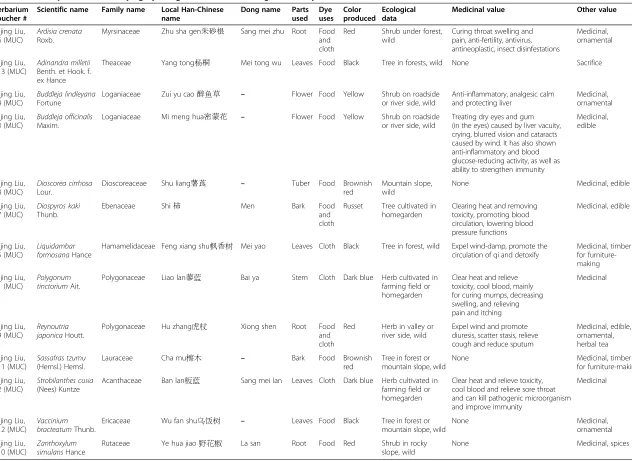
Dye plants reported from interviews were organized into a database (Table 1) with the following informa-tion: (1) Latin name, (2) family name, (3) parts used, (4) dye uses, (5) color and, (6) medicinal value. All the specimens were identified according to the Flora of China. Voucher specimens of plants available during field investigations were collected and deposited in the herbarium of Minzu University of China.
Results
Women are the primary users of dye plants at the study sites and utilize these species to dye customary clothing and food products. Knowledge of species used for dying and prepartion of dyes is orally transferred from mother to daughter. A total of 50, 69, 46, 63, 38, 41, 62, 80, 56, 29
Liuet al. Journal of Ethnobiology and Ethnomedicine2014,10:23 Page 2 of 8
Yujing Liu, D6 (MUC)
Ardisia crenata
Roxb.
Myrsinaceae Zhu sha gen朱砂根 Sang mei zhu Root Food and cloth
Red Shrub under forest, wild
Curing throat swelling and pain, anti-fertility, antivirus, antineoplastic, insect disinfestations
Medicinal, ornamental
Yujing Liu, D13 (MUC)
Adinandra milletii
Benth. et Hook. f. ex Hance
Theaceae Yang tong杨桐 Mei tong wu Leaves Food Black Tree in forests, wild None Sacrifice
Yujing Liu, D4 (MUC)
Buddleja lindleyana
Fortune
Loganiaceae Zui yu cao醉鱼草 – Flower Food Yellow Shrub on roadside or river side, wild
Anti-inflammatory, analgesic calm and protecting liver
Medicinal, ornamental Yujing Liu, D3 (MUC) Buddleja officinalis Maxim.
Loganiaceae Mi meng hua密蒙花 – Flower Food Yellow Shrub on roadside or river side, wild
Treating dry eyes and gum (in the eyes) caused by liver vacuity, crying, blurred vision and cataracts caused by wind. It has also shown anti-inflammatory and blood glucose-reducing activity, as well as ability to strengthen immunity
Medicinal, edible Yujing Liu, D8 (MUC) Dioscorea cirrhosa Lour.
Dioscoreaceae Shu liang薯莨 – Tuber Food Brownish red
Mountain slope, wild
None Medicinal, edible
Yujing Liu, D7 (MUC)
Diospyros kaki
Thunb.
Ebenaceae Shi柿 Men Bark Food
and cloth
Russet Tree cultivated in homegarden
Clearing heat and removing toxicity, promoting blood circulation, lowering blood pressure functions Medicinal, edible Yujing Liu, D5 (MUC) Liquidambar formosanaHance
Hamamelidaceae Feng xiang shu枫香树 Mei yao Leaves Cloth Black Tree in forest, wild Expel wind-damp, promote the circulation of qi and detoxify
Medicinal, timber for furniture-making Yujing Liu, D1 (MUC) Polygonum tinctoriumAit.
Polygonaceae Liao lan蓼蓝 Bai ya Stem Cloth Dark blue Herb cultivated in farming field or homegarden
Clear heat and relieve toxicity, cool blood, mainly for curing mumps, decreasing swelling, and relieving pain and itching
Medicinal
Yujing Liu, D9 (MUC)
Reynoutria japonicaHoutt.
Polygonaceae Hu zhang虎杖 Xiong shen Root Food and cloth
Red Herb in valley or river side, wild
Expel wind and promote diuresis, scatter stasis, relieve cough and reduce sputum
Medicinal, edible, ornamental, herbal tea Yujing Liu, D11 (MUC) Sassafras tzumu (Hemsl.) Hemsl.
Lauraceae Cha mu檫木 – Bark Food Brownish
red
Tree in forest or mountain slope, wild
None Medicinal, timber
for furniture-making
Yujing Liu, D2 (MUC)
Strobilanthes cusia
(Nees) Kuntze
Acanthaceae Ban lan板蓝 Sang mei lan Leaves Cloth Dark blue Herb cultivated in farming field or homegarden
Clear heat and relieve toxicity, cool blood and relieve sore throat and can kill pathogenic microorganism and improve immunity
Medicinal
Yujing Liu, D12 (MUC)
Vaccinium bracteatumThunb.
Ericaceae Wu fan shu乌饭树 – Leaves Food Black Tree in forest or mountain slope, wild
None Medicinal, ornamental Yujing Liu, D10 (MUC) Zanthoxylum simulansHance
Rutaceae Ye hua jiao野花椒 La san Root Food Red Shrub in rocky slope, wild
None Medicinal, spices
“–”means these Dong names are not still used any more. Therefore, we could not record their names. Other Dong names are still used.
households reported utilizingArdisia crenata, Adinandra milletii, Buddleja lindleyana, Buddleja officinalis, Dios-corea cirrhosa, Diospyros kaki, Reynoutria japonica, Sassa-fras tzumu, Vaccinium bracteatum and Zanthoxylum simulansfor coloring food respectively and 43, 31, 49, 80, 36, 51 households reported using Ardisia crenata, Dios-pyros kaki, Liquidambar formosana, Polygonum tinctor-ium, Reynoutria japonica and Strobilanthes cusia for dying cloth. The most frequently reported dye plants were Sassafras tzumuandPolygonum tinctorium. In addition to dyes, the plants have multiple uses including medicinal, ornamental, sacrificial, edible, and for timber.
The 13 documented plants belong to 9 botanical fam-ilies (Table 1). The main dyeing use is to color food items followed by dying cloth. A total of 7 species are used for coloring food items, 3 species are used to color clothing and 3 species are used to color both food and clothing. The pigments derived from these plants in-clude black, dark blue, red, brownish red/russet and yel-low. In total, 3 of the documented plants are used for black pigments, 3 are used for brownish red/russet pig-ments, 3 are used for red pigpig-ments, 2 are used for dark blue pigments and 2 are used for yellow pigments. Nat-ural dyes are derived at the study sites from various plant parts including leaves (4 species), roots (3 species), flowers (2 species), bark (2 species), stems (1 species) and tubers (1 species).
Plants used to dye food
Dong communities have a tradition of eating and dying glutinous rice for daily use, festivals and ritual. Commu-nities use edible plant pigments to enhance their rice with color that invokes traditional beliefs of Dong cul-ture. An example of dyed rice in Dong communities is
the colorful glutinous cake known as“festival baba” that is used to celebrate almost all festivals of the Dong people (Figure 1). Festival baba rice cakes are dyed with red, yellow, green and black colors among other colors. Yellow is among the most valued colors for dyeing rice by Dong and is derived from several natural sources. Dong communities primarily derive yellow dye for dye-ing rice from Buddleja officinalis and B. lindleyana (Buddlejaceae). Dye extracted from these plants impart a distinct honey fragrance to rice. Other socio-linguistic groups in China also have a tradition of using this plant to dye rice including the Dai, Zhuang and Yao. Communi-ties harvest the flowers in late spring or early summer. Both dried and fresh flowers can be used for dying. Other plants used to dye food yellow include Gardenia jasmi-noides, Sophora japonica,Curcuma longa, Phellodendron amurense,Myrica rubraandMahonia fortunei[7].
A russet brownish red color for food is derived by local communities from the bark of the persimmon tree (Diospyros kaki) which is widespread in the study area and contains a brown pigment. Red pigments for color-ing rice and other food items in Dong communities are extracted from Ardisia crenata, Reynoutria japonica, and Zanthoxylum simulans, in fact, Reynoutria japonica was also recorded before [8]. Dong people use Vacci-nium bracteatum and Liquidambar formosana for a black pigment to dye their rice and other food items.
In addition to adding color to foods, informants per-ceive that many of their dye plants enhance the edible, medicinal and nutritive value of their food well as impart natural preservatives. For example, the yellow pigment de-rived from Buddleja lindleyana Fortune is locally valued for its medicinal properties including anti-inflammatory, analgesic, calming and liver protecting.
Figure 1Sticky rice cake dyed by plants in Dong community.
Liuet al. Journal of Ethnobiology and Ethnomedicine2014,10:23 Page 4 of 8
Plants used to dye clothing
A total of three species were documented that are used to dye the customary clothing of Dong people (Figures 2, 3 and 4) including the dyes known as ding (jinhin Dong language) andliang (liangcin Dong lan-guage). The dye for dingis extracted from either from Polygonum tinctorium(Polygonaceae) or Strobilanthes cusia (Acanthaceae). Ding results in a dark blue stain that is valued for clothing by Dong informants because it helps hide from prey during hunting. The dye for liang is extracted from Dioscorea cirrhosa (Dioscorea-ceae). The dyeliang results in a stain that is brownish red and is used by Dong communities to dye the hood of their customary clothing. Local Dong women at the study sites use the flesh of this plant to dye cotton and linen fabric. The dye for black is derived from Liquid-ambar formosana (Hamamelidaceae). In addition to dye food, Ardisia crenata and Diospyros kakican dye cloth.
Traditional processing of dying food and clothing
Dying of food plants involves first drying the dye plant in sun and then mixing the plant with cold water. The plant material is filtered and the resulting extract is added to uncooked food items such as glutinous rice. The mixture is left overnight and then cooked.
There are two general methods of dying cloth in Dong communities. One method is a direct process and the other method involves adding mordants to fix the colors. The direct method is primarily used in Dong areas. The general direct method for dying cloth at the study sites involves the following: place a layer of half-dry Tetron-cium magellanicumin dye vat followed with a big bunch of straw ash (from rice straw). Fill the dye vat with clean water fetched from river or well to a level that is below the top of the vat by 12–15 cm. Next, pour 4 kg of dried plant dye material such as ding and 1 kg of rice wine. Pounding the pigment material and allow to ferment in the vat for 10–12 days. Stir the surface to confirm the
dye is ready which will be indicated by the desired color. The dye is then filtered and utilized. Different glossiness can be obtained by utilizing various materials such as wine and ash.
Discussion
Plant-derived dyes persist at the study sites for their im-portant role in dying food and customary clothing to ex-press Dong cultural identity. The most prevalent use of documented dye plants is to color food, specifically glu-tinous rice, followed by customary clothing. The pig-ments derived from dye plants at the study site include red, dark blue, black, yellow and brownish red/russet. These dyes are derived from various plant parts includ-ing roots, leaves, flowers, stems, bark, and tubers. In addition to their use as coloring agents, communities value many of these species for their medicinal, orna-mental, preservative, edible, and timber uses.
Several of the documented species are recognized for their medicinal value in China. For example,Polygonum tinctoriumis a species used as traditional Chinese medi-cine to clear heat and relieve toxicity, cool blood, mainly for curing mumps, decreasing swelling, and relieve pain and itching [9]. Strobilanthes cusia is used for its anti-influenza viral activity [10] and to clear heat, relieve toxicity, cool blood, relieve sore throat, kill pathogenic microorgan-isms and improve immunity [9]. Buddleja officinalis is a medicinal beverage recorded in Chinese Pharmacopoeia [11] that is sometimes consumed instead of tea in Yunnan Province with a cool and refreshing taste as well as honey fragrance [12]. It is used clinically as a medicine for treating dry eyes caused by liver vacuity, blurred vision and cata-racts. It has also shown to have anti-inflammatory and blood glucose-reducing activity and has the ability to
strengthen immunity [13-15]. Buddleja lindleyana has Figure 4Little Dong girls wearing clothes dyed by plants.
Figure 3Dong women wearing clothes dyed by plants.
Liuet al. Journal of Ethnobiology and Ethnomedicine2014,10:23 Page 6 of 8
antibacterial, anti-inflammatory, analgesic calm and liver protecting properties [16]. The persimmon tree (Diospyros kaki) is popular in Japan as a medicinal tea with a wide range of pharmacological effects including allaying thirst, clearing heat, removing toxicity, promoting blood circula-tion and lowering blood pressure funccircula-tions [9]. It also rec-ognized to have cytotoxic, anti-human immunodeficiency virus (HIV) and anti-Helicobacter pylori activities [17]. Ardisia crenata is widely distributed in the world and is shown to have many pharmacological functions and clinical applications [18-20] including for curing throat swelling, pain, anti-fertility, antivirus, antineoplastic and insect disin-festation.Reynoutria japonicais an antioxidant plant that is used to treat bacteriostasis [8]. In addition, it is used in Traditional Chinese Medicine to expel wind and promote diuresis, scatter stasis, relieve cough and reduce sputum [21]. The black pigment extracted from Liquidambar for-mosanais used to expel wind-damp, promote the circula-tion ofqiand detoxify [22].
As society becomes more aware of the toxicity caused by synthetic dyes for both the environment and humans [23,24], plant-derived dyes offer a promising alternative that are gradually attracting global attention [25-28], some ethnobotanical surveys were conducted in Iraq [1], Turkey [2], Argentina [29], Sierra Leone [30] and Peru [31]. Natural plant dyes are particularly appeal to the current trend of sustainability in food and clothing choices. However, it remains difficult to implement plant dyes into industrial production because of their relative low yield, and expensive labor costs. Local small-scale initiatives are feasible to supply the current demand for the high-end niche market of natural dyes and provide a price premium to local communities. Unfortunately, traditional dye resources and their associated knowledge based are being threatened by globalization [28,30]. However, interest in the use of plant dyes has revived due to new market demands and the growth of rural tourism, maybe such traditional knowledge will provide an alternative for the diversification and quality of exist-ing crafts [29].
Traditionally, knowledge of dye plants and their pro-cessing in Dong communities was transferred from mother to daughters. As many young Dong people look for jobs outside of their communities, this knowledge base is failing to be transferred as synthetic dyes are be-come more easily available along with a shift in prefer-ence of clothing. Community-based marketing efforts are needed to develop a viable market for the production and sale of dye plants for local communities in order to provide market incentives for their preservation and sus-tainable use. Future studies are needed to evaluate the phytochemical profiles, bioactivity, stability and safety of plant pigments. In addition, market studies are also needed to develop new uses for dye plants beyond for
coloring food and clothing such as for making crafts. These future studies would help to provide guidelines for community-based production and ultimately ethno-botanical preservation.
Conclusion
The use of dyes derived from plants persists at the study sites for their important role in expressing Dong cultural identity through customary clothing and food. These species are utilized for a range of other uses including medicinal, edible, ornamental, preservative and timber. As globalization and rapid socio-economic change im-pacts indigenous communities in China, research is needed to investigate these resources and associated cul-ture towards their preservation and sustainable use to support livelihoods.
Consent
Written informed consent was obtained from the pa-tient’s guardian/parent/next of kin for the publication of this report and any accompanying images.
Permissions were provided by all participants in this study, including the Dong women and girls shown in the photos (Figures 3 and 4). They have declared that they have no objection to the publication of their pictures in the journal. The consent was obtained from the partici-pants prior to this study being carried out. The photog-rapher (Mr. Junhua Wu) transferred the copyrights to the authors.
Competing interests
The authors declare that they have no competing interests.
Authors’contributions
Conceived of the study: YL and CL; Conducted surveys: YL, CL, BL, XW, SL, ZG, JZ, QL; Identified plant species: CL, BL; Analyzed data: YL and SA; Wrote the manuscript: YL and SA; Edited the manuscript: CL, BL, ZG, YL, WH. All authors read and approved the final manuscript.
Acknowledgements
This study was supported by the State Administration of Traditional Chinese Medicine of China (Cai-She 2011–76), the Hunan Provincial Department of Science & Technology of China (2012SK2008), the Ministry of Education of China through its 111 and 985 projects (B08044, MUC 985), the National Natural Science Foundation of China (31070288 & 31161140345), the Japan Society for the Promotion of Science (JSPS/AP/109080), the Ministry of Science and Technology of China (2008FY110400 & 2012FY110300). We thank Changyan Yang for helping the fieldwork as an interpreter, guide and assistant and Junhua Wu for taking the photos.
Author details
1
College of Life and Environmental Sciences, Minzu University of China, Beijing 100081, China.2Sustainable Food and Bioenergy Systems Program,
Department of Health and Human Development, Montana State University, Bozeman, MT 59717, USA.3Key Laboratory of Hunan Province for Study and
Utilization of Ethnomedicinal Plant Resources, Huaihua University, Hunan 418000, China.4Kaili University, Guizhou 556011, China.5Kunming Institute of
Botany, Chinese Academy of Sciences, Kunming 650201, China.
References
1. Mati E, de Boer H:Contemporary knowledge of dye plant species and natural dye use in Kurdish Autonomous Region, Iraq.Econ Bot2010, 64:137–148.
2. Turkmen N, Kirici S, Özguven M, Inan M, Kaya DA:An investigation of dye plants and their colourant substances in the eastern Mediterranean region of Turkey.Bot J Linn Soc2004,146:71–77.
3. Li W, Li D:Dyeing technology with biological dyes.Silk1996,7:32–34. 4. Zhou DY, Du ZY, Zheng X, Zhang K:Advances in the research of curcumin
biological activity.Guangdong Chem Industry2013,40(261):91–92. 5. Chen JG:The application of national plant pigment in China.Chinese Wild
Plant Resour2000,19:21–24.
6. Wang JR, Long CL:Ethnobotanical study of traditional edible plants of Jinuo nationality.Acta Bot Yunnan1995,17:161–168.
7. Sun YH:Yellow plant dyes and dyeing.Silk2003,1:31–33.
8. Zhang WW, Gao PP, Lü GL, Yu ZC, Yang B, Dai XQ:Natural dye extraction fromReynoutria japonicaand its usage in cotton dyeing.J Zhejiang Sci-Tech Univ2008,4:008.
9. Chinese Pharmacopoeia Commission:Pharmacopoeia of the People’s Republic of China (2010 Edition), Volume I.Beijing: China Medical Science Press; 2010. 10. Liu Y:A brief medical introduction to several Dai edible vegetables.
Chinese J of Ethnomedicine and Ethnopharmacy1998,32:19–20.
11. Chinese Pharmacopoeia Commission:Pharmacopoeia of the People’s Republic of China (2005 Edition), Volume I.Beijing: People’s Medical Publishing House; 2005.
12. Tang SX, Zheng HL:A promising natural edible plant pigment–yellow pigment from Buddleia officinalis.Chinese Wild Plant Resour1991,4:4–8. 13. Li XL, Sun GJ:The effective ingredients fromBuddleja officinalisand
Daphne odorato be bacteriostasis.Northwest Pharm J1996,11:165–166. 14. Cui Y, Zhang YW:The research progress ofBuddleja officinalis.J Gansu
College of TCM2010,27:65–68.
15. Zhu JR, Sang GW:China Pharmacopoeia committee: Pharmacopoeia of the People’s Republic of clinical drug instructions: the volume of chemical medicine and biological products.Beijing: People’s Health Publishing House; 2005. 16. Yang B, Tao L, Li C:Research progress on chemical compositions and pharmacological activities ofBuddleja lindleyana.Chinese Med Modern Distance Educ of China2009,010:144–145.
17. Kawase M, Motohashi N, Satoh K, Sakagami H, Nakashima H, Tani S, Shirataki Y, Kurihara T, Spengler G, Wolfard K, Molnár J:Biological activity of persimmon (Diospyros kaki) peel extracts.Phytother Res2003,17:495–500. 18. Tian ZH:Antibacterial and anti-inflammatory effects ofArdisia creata
Sims.Northwest Pharm J1998,13(003):109–110.
19. Wang HZ, He GB, Sun JQ:The contracting action of total triterpenoid saponins fromArdisia crenataon uterus.Chin Herbal Med1988,19:19–20. 20. Liu DL, Wang NL, Zhang X, Gao H, Yao XS:Two new triterpenoid saponins
fromArdisia crenata.J Asian Nat Prod Res2007,9:119–127.
21. Gao PP, Yu ZC, Zhang WW, Lv GL,Yang B, Dai XQ:The extraction of natural dyes fromReynoutria japonicaand its application in soybean protein fabrics.Silk2009,1:016.
22. Chen ZH:The exploration of extracting black pigment fromLiquidambar formosanaleaves.J Chem Industry of Forest Prod1998,1:20.
23. Akinloye AJ, Illoh HC, Olagoke AO:Screening of some indigenous herbal dyes for use in plant histological staining.J For Res2010,21(1):81–84. 24. Bhuyan R, Saikia CN:Isolation of colour components from native
dye-bearing plants in northeastern India.Bioresour Technol2004, 164(5):873–877.
25. Bechtold T, Mussak R:Handbook of Natural Colorants.Wiley Series in Renewable Resource: New Jesey; 2009.
26. Bechtold T, Turcanu A, Ganglberger E, Geisslerb S:Natural dyes in modern textile dyehouses—how to combine experiences of two centuries to meet the demands of the future?J Clean Prod2003,11:499–509. 27. Bechtold T, Mahmud-Ali A, Mussak R:Natural dyes for textile dyeing: a
comparison of methods to assess the quality of Canadian golden rod plant material.Dyes Pigments2007,75:287–293.
28. Gilbert KG, Cooke DT:Dyes from plants: past usage, present understanding and potential.Plant Growth Regul2001,34:57–69.
29. Lambaré DA, Hilgert NI, Ramos RS:Dyeing plants and knowledge transfer in the Yungas communities of Northwest Argentina.Econ Bot2011, 65(3):315–328.
30. MacFoy C:Ethnobotany and sustainable utilization of natural dye plants in Sierra Leone.Econ Bot2004,58:S66–S76.
31. De Mayolo KKA:Peruvian natural dye plants.Econ Bot1988,43(2):181–191.
doi:10.1186/1746-4269-10-23
Cite this article as:Liuet al.:Ethnobotany of dye plants in Dong communities of China.Journal of Ethnobiology and Ethnomedicine 201410:23.
Submit your next manuscript to BioMed Central and take full advantage of:
• Convenient online submission
• Thorough peer review
• No space constraints or color figure charges
• Immediate publication on acceptance
• Inclusion in PubMed, CAS, Scopus and Google Scholar
• Research which is freely available for redistribution
Submit your manuscript at www.biomedcentral.com/submit
Liuet al. Journal of Ethnobiology and Ethnomedicine2014,10:23 Page 8 of 8