C A S E S T U D Y
Open Access
Developing allied health professional support
policy in Queensland: a case study
Karen E Bell
1, Fiona Hall
2*, Sue Pager
3, Pim Kuipers
4and Hayley Farry
5Abstract
Introduction:Evidence suggests that professional support for allied health professionals contributes to improved clinical practice, better client outcomes, enhanced workplace satisfaction, increased workplace morale and better clinical governance within organizations. Despite these benefits, the uptake of formal professional support is surprisingly low and implementation oftenad hoc. Further, research investigating the development, evaluation and outcomes of implementing policy to establish such support is limited.
Case description:Queensland Health has developed an organization-wide approach to supporting allied health professionals through a Professional Support Policy and guidelines. The processes of development, implementation and the evaluation framework of this State-wide Professional Support Policy are described. An evidence-based Professional Support Policy that is structured, collaborative and well evaluated will have benefits for allied health professions. However, policy introduction cannot occur in isolation. Current practice does not follow current evidence in the area of professional support implementation. This study describes a current practice baseline for participation prior to the mandating of such a policy. There is a need for improvements in participation rates, documentation and capacity building.
Conclusions:A workforce policy with broad scope should increase the access to, and consistency of, professional support to allied health practitioners. Such policy should facilitate a higher quality clinical practice, better client outcomes, enhanced workplace satisfaction and morale. It may also maximize the recruitment and retention of allied health professionals. Mandating policy should see participation commensurate with that policy. A future step will be a Post Policy Implementation Review to determine the success and effectiveness of the Professional Support Framework within Queensland Health.
Keywords:Professional Support, Policy, Evaluation, Retention, Allied Health
Background
Professional support refers to activities that create an envir-onment where personal and professional growth may occur [1] and includes professional supervision. It is described in the literature as contributing to the clinical governance of organizations and enhancing the professional development of individual clinicians [2,3]. Within Queensland, two re-views of a high profile incident resulting from a breakdown of standards and safety of hospital care were highly crit-ical of clincrit-ical governance and culture within the orga-nization. This resulted in organizational restructure and the
establishment of a new multifaceted clinical governance framework described as a ‘web of policies, processes and accountabilities’[4]. One aspect of the resulting changes was a substantial improvement to the provision of profes-sional support for the allied health (AH) workforce within Queensland Health.
The literature contributing to our understanding of professional support within the workplace predomin-antly focuses on one aspect - supervision. In their litera-ture review of AH clinical supervision policy in Australia, Fitzpatricket al. argued that clarity of definition is an essen-tial first step in policy development [5]. Therefore, gaining an understanding of what high quality clinical supervision is, and how it is best put into practice, is the first step in developing supervision policy [5]. As such, the need was identified for policy characterized by a collaborative, * Correspondence:[email protected]
2Allied Health Professional Leader (Workforce) Allied Health Professions
Office, Australian Service and Clinical Innovation Division, Queensland Health, Brisbane, QLD, Australia
Full list of author information is available at the end of the article
supportive approach, with well-defined criteria and a ‘whole of health’model. Such policy reflects an‘agreed aim and definition of supervision; a consensual under-standing of what constitutes effective clinical supervi-sion; high-quality training for clinical supervisors; and, clear implementation mechanisms and a united model of clinical supervision’([5] p 464).
The ideal dimensions of policy implementation in the area of professional support (including supervision) na-tionally and internana-tionally are not clear. In the mental
health nursing context, Rice et al. [6] recommended a
focus on policy that includes the processes of contract-ing, provision of time within the working day, clear managerial commitment to the process, completion of appropriate training as well as a process for monitoring and evaluating the impact. In a recent systematic litera-ture review of strategies to boost recruitment and reten-tion of nurses in aged care, the provision of ongoing supervision and education were identified as essential [7]. The review included several studies which detailed the importance of providing professional support, and, more specifically, mentoring, peer support programmes, and clinical supervision.
To date much of the literature in this area relates to the very large nursing workforce, to single discipline experi-ences, for example, within social work or psychology [8], or to smaller multidisciplinary groups such as occupa-tional therapy, physiotherapy, podiatry, psychology, social work and speech pathology as described by Dawsonet al. [9]. It is generally also confined to supervision as the means of professional support.
Government policy may be seen as an endorsed position evidenced by legislation, formal government documents/ strategies, or industrial agreements [10]. As such ‘policy’ has facilitated effective development and utilization of the health workforce in areas including health promotion and prevention, for example, drug and alcohol use [11] and re-sponsible driving [12]. However, the impact of policy de-velopment in the area of professional support (including supervision) nationally and internationally is not so clear. The current case study seeks to contribute to this litera-ture with a broader focus on the large multidisciplinary AH workforce, and by reporting on the development, im-plementation and evaluation of professional support policy using several types of support.
Case description
This case study describes the development, implementa-tion and evaluaimplementa-tion framework of the Queensland Health State-wide AH Professional Support Policy. Queensland Health employs close to 5,000 professionals from 16 dis-cipline groups including audiology, exercise physiology, clinical measurement sciences, medical radiation pro-fessions, music therapy, dietetics, nutrition, occupational
therapy, orthoptics, pharmacy, physiotherapy, podiatry, prosthetics and orthotics, psychology, rehabilitation engin-eering, social work and speech pathology. It has a geo-graphically dispersed network of more than 178 hospitals and health care facilities, with 15 health service districts covering a range of service models across the continuum of care.
The Professional Support Framework includes profes-sional supervision, peer group supervision, mentoring, in-service training, journal clubs, peer review and work shadowing as potential support activities (definitions con-tained at the end of Additional file 1). It includes policy, supporting guidelines, training materials and resources for implementation. The Professional Support Policy and guidelines recognize that professional support is central to promoting the personal and professional development of AH professionals, and that it has a consequential impact on consumer safety and quality, effectiveness and depend-ability of services, and retention of staff.
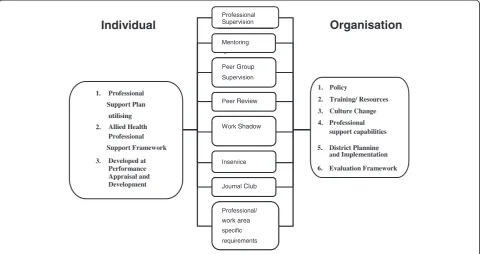
This Professional Support Policy document guides AH professionals and their managers regarding the mini-mum standard of professional support activities in which Queensland Health would expect staff to be engaged. The Professional Support Policy is supported by the Pro-fessional Support Framework to ensure well-developed criteria, an evaluation framework and resources (includ-ing guides and train(includ-ing packages) to support the sustain-able implementation of the Professional Support Policy. A detailed description of the framework is documented elsewhere [13]. In the current case study, the method-ology used in development of the Professional Support Policy and guidelines is described. Figure 1 demonstrates the components of the framework.
Developing the policy
Organizational drivers
Literature review
Historically, the workforce had been supported by a var-iety of district or local approaches to professional support. The first step in developing a state-wide coordinated ap-proach to policy development was a review of the evidence and current practice within the organization. The litera-ture review conducted prior to the development of the policy noted that professional support contributes to high quality clinical practice among AH professionals, better client outcomes, enhanced workplace satisfaction, in-creased workplace morale for individuals [14] and better clinical governance within organizations [4]. It found that despite the well-known benefits, the uptake of professional
support may be low [15,16] and implemented in anad hoc
fashion [14], with many supervisees identifying that they are not given the opportunity to undertake supervision [17]. The review noted that the implementation of super-vision requires organizational support to help market the concepts and benefits of supervision and increase par-ticipation [18]. Indeed, successful implementation of pro-fessional supervision relies on organization time and resources [19], since organizational issues, such as lack of choice around a supervisor, have been found to be key barriers to effective supervision [20]. The literature relat-ing specifically to policy has highlighted the importance of agreed definitions, consensus on elements that contribute to effectiveness, including training and clear implementa-tion mechanisms [5] as well as policy that includes the processes of contracting, organizational commitment to the time required, and a process for monitoring and
evaluating the impact [6]. The literature also highlighted the lack of policy outside those developed by discipline-specific professional bodies, including a lack of policy that discussed means of implementation [5].
Consultation and review
On the basis of the literature review and other orga-nizational policy (including practice supervision in mental health) a draft Professional Support Policy incorporating the elements identified in the literature was developed. Consultation utilizing teleconferenced open-ended feed-back on the policy occurred through an internal steering group. This group was able to widely consult throughout the workforce utilizing extensive state-wide consultation with AH networks, directors of AH in all of the districts, with discipline representatives, unions, workforce deve-lopment officers and training and education staff. This consultation included specific forums and workshops with stakeholders using prepared presentations and gathering of group feedback. Extensive consultation was conducted across more than 12 District Health services, drawing from more than 16 AH professional groups. The diversity of pro-fessions, service models and locations necessitated a broad, but flexible policy. The draft policy and implementation guidelines that supported the policy were then published internally on the Intranet for written feedback from the en-tire AH workforce. A total of 44 individual and group sub-missions were received providing feedback, which was then integrated into the final policy presented for endorsement. This version of the policy is available in Additional file 1.
1. Professional
Support Plan
utilising
2. Allied Health Professional
Support Framework
3. Developed at Performance Appraisal and Development Supervisio n Mentorin g Peer Group Supervisio n Peer Review Work Shadow Inservic e Journal Club Professional/ work area specific requirements Professional Supervision Mentoring Peer Group Supervisio n PeerGroup Supervision Peer Review PeerReview Work Shadow WorkShadow Inservic e Inservice Journal Club JournalClub Professional/ work area specific requirements Professional/ work area specific requirements 1. Policy
2. Training/ Resources
3. Culture Change
4. Professional support capabilities
Individual
Organisation
District Planning Evaluation Framework 5. 6.and Implementation
Early challenges in the policy development process in-cluded the difficulty of developing consensus around the definition of professional support options that would be included, the selection of activities for inclusion, and the establishment of minimum standards across a diverse workforce. The scope of the endorsed policy included 16 AH professional groups participating in at least some professional supervision, peer group supervision and/or mentoring, with other activities encouraged.
Policy essentials
The minimum requirements for participation in profes-sional supervision or peer group supervision or mentor-ing are as follows:
‘Newly graduated’AH professionals (less than two years full time practice since obtaining qualification) shall participate in a minimum of one hour of per week or equivalent
AH professionals who have practiced for the
equivalent of between‘two and five years’in a full time capacity shall participate in a minimum of one hour per fortnight or equivalent
AH professionals who have practiced for the
‘equivalent of five years’or more in a full time capacity shall participate in a minimum of one hour per month or equivalent
AH professionals and their managers are required to jointly determine where additional professional support is required to meet legislative, professional or individual requirements. Furthermore, the policy requires that at least 50% of professional support is to be obtained from an appropriate supervisor or mentor within the same profession. To accommodate the diversity of professional groups, the policy and set of supporting guidelines are written in a way that provides flexible options for profes-sional support. However, they are implemented in a way which was structured and evaluated through the existing mandatory Performance Appraisal and Development Plan or a formalized professional support tool.
The policy outlines responsibilities for providing profes-sional support. That is, where appropriate, all AH staff with greater than two years’ experience are expected to provide professional support. A determination of appro-priate amount is made between the AH staff member and their manager. In addition, profession-specific managers were consulted in determining the appropriateness of staff to undertake professional support provision. All supervi-sors and mentors have access to support in their provision of supervision/mentoring and professional support activ-ities. AH professionals and their managers are required to consult with profession specific managers in determining
the requirement for, and appropriateness of, staff to undertake professional support provision.
The professional support guidelines operationalize the policy and support implementation. The guidelines include definitions of professional support, principles of the Pro-fessional Support Framework, how to set up a ProPro-fessional Support Plan and an overview of the components of pro-fessional support. The guidelines elaborate on the mini-mum requirements for professional support, fully describe the professional support resources available and provide suggestions for undertaking professional support docu-mentation including provision of templates such as super-vision, mentoring and peer group supervision agendas, agreements, records and evaluations. The guidelines also define the role of supervisor/mentors, describe difficulties that may arise and how to deal with them. The guidelines are available from the corresponding author on request.
Baseline survey
A Professional Support Evaluation Framework was devel-oped and used to obtain base-line data to evaluate the up-take and implementation of the State-wide Professional Support Policy. Requests to participate in a pre-policy sur-vey were sent to all directors of AH, professional support ‘champions’, workforce development officers, clinical edu-cator managers and discipline chairs to distribute to their networks. Approximately 5,000 AH Professionals were asked to complete the online questionnaire. The 28-item survey took approximately 5 minutes to complete and re-sponses were anonymous.
Beyond demographic information, the survey assessed current levels of participation in forms of professional support and in the Performance Appraisal and Develop-ment processes. It also looked at docuDevelop-mentation use as well as proportions of discipline-specific support. There were seven questions relating to actual participation in professional support in the preceding three months. The survey ended with questions regarding the amount of supervision of professional support functions and train-ing undertaken. The survey is available from the corre-sponding author.
The policy prescribes participation commensurate with level of experience from professional supervision, peer group supervision and mentoring. At the time of the survey, participation in a minimum of 1 hour per week for those with less than 2 years’experience (14% of the respondents) was 11%, a minimum of 1 hour of formal supervision/mentoring per fortnight for those with 2 to
5 years’ experience (17% of respondents) 14%, and a
minimum of 1 hour per month or equivalent for those who have practiced for the equivalent of at least 5 years (69% of respondents) 48%. Despite the expectation that all staff would participate, 13% of AH staff surveyed did not participate in any professional support activities in the preceding 3 months.
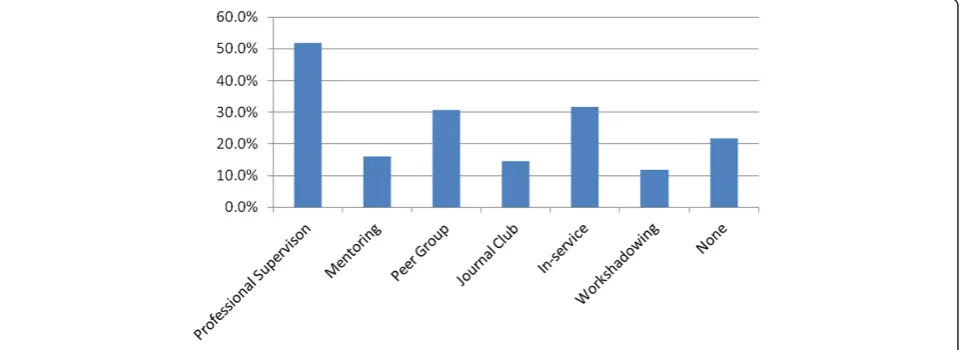
Acknowledging that staff could participate in more than one form of support: in descending order the attended professional support activities were in-service, professional supervision, peer group supervision, journal clubs, peer re-view, mentoring and work shadowing (Figure 4). Most of these activities were discipline-specific and intermittent.
The pre-policy data collection also assessed current levels of participation in Performance Appraisal and Development (PAD) activities. Twenty-eight percent of staff did not have these mandatory plans in place. Further, 57% of staff did not have any formal agreement documen-tation for any kind of supervision, and 52% did not docu-ment their sessions. Twenty-one percent of staff had no training in any of the professional support options. Figure 5 shows that 81% had training in professional supervision and peer group supervision when combined. These were the major foci of the training offered.
Implementing the policy
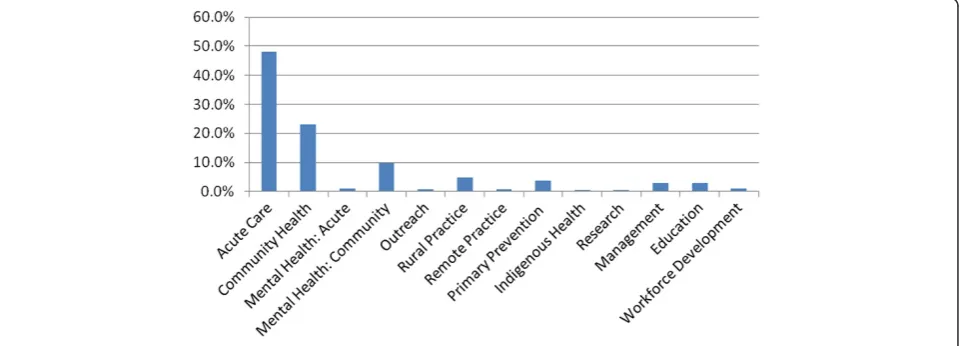
Based on the survey, the project team made recommen-dations to the Allied Health Workforce and Coordin-ation Unit. An ImplementCoordin-ation and CommunicCoordin-ation Plan was developed outlining a clear strategy to imple-ment the Professional Support Policy. This plan pro-vided strategies to engage AH managers, leaders and professionals and included memos, information sheets, Figure 2Survey participants according to profession.
‘frequently asked questions’sheets, state-wide videoconfer-encing, project staff engagement processes that facilitated enablers and address barriers to the local implementation. These strategies targeted those AH professionals and managers that were not aware of the policy requirements. Resources were developed by the training arm of Queens-land Health and included training programmes, profes-sional support policy guidelines, implementation tools and professional support guides. It was recommended that the resources should be actively marketed to support the im-plementation of the policy and that a 12-month post imple-mentation review should focus on evaluating the success and effectiveness of the Professional Support Policy.
To facilitate workplace readiness, a state-wide multi-strategy approach was taken to implement the Profes-sional Support Policy. To reinforce accountability and responsibility for governance, strategic planning, and co-ordination of resources, the assistance of the policy and planning corporate arm of Queensland Health was en-listed. Mandating the policy demonstrates organizational
commitment, supports the provision of ‘within work’
time allocation evidenced by the literature and integrates professional support into workplace culture.
Awareness of the policy and information about profes-sional support and the Profesprofes-sional Support Framework were disseminated through flexible means such as telecon-ferencing, videoconferencing and face-to-face consulta-tions. Leadership was delegated from the organizational level to local team initiatives to build workforce readiness, acceptance and enthusiasm. This facilitated the setting up of professional support plans, recognition of the minimum requirements for professional support, the use of profes-sional support documents, the selecting and supporting of supervisors and mentors, and the capacity to deal with dif-ficulties that arose.
The operational implementation of the policy was over-seen by the State-wide Professional Support Reference Group. This group represented District Health AH direc-tors, discipline direcdirec-tors, AH networks, AH managers, the AH Clinical Education and Training Unit, discipline-Figure 4Current participation in professional support.
specific project officers, district professional support representatives and champions, workforce development officers and non-AH managers. This group facilitated engagement and monitored difficulties across the work-force, fostering local ownership and addressing emer-ging problems.
Professional support project staff supported the imple-mentation of the policy in districts by coordinating train-ing in professional supervision and peer group supervision, supporting district trainers and providing resources. Other learning and development programmes (such as training in the Performance Appraisal and Development planning process) facilitated implementation of the policy for AH staff across Queensland Health.
To support training in these areas, collaboration with State-wide Clinical Education and Training Units and workforce development officers in each district was established. All training, whether externally sourced or developed internally, provided online guides with associ-ated training packages including suggested documenta-tion for supervision, peer group supervision, mentoring, journal club, peer review in-service and work shadowing. Training was offered face-to-face and via videoconfer-encing. The training providing a consistent product throughout the workforce that facilitated ease of move-ment through the organization for staff was delivered through an internal registered training organization that ensured quality, consistency and evaluation.
The Post Implementation Review will include another survey of the workforce as well as interviews with AH pro-fessionals, line managers and clinical educators. Our ex-pectation, following mandating of the policy, is that follow-up surveys will see an increase in total participation rates, with a frequency commensurate with degree of ex-perience, and much improved documentation of profes-sional support activities and participation in PAD. We will expect to see a move away from in-service as our most frequently utilized form of professional support and a move towards the more reflective professional supervision, peer group supervision and mentoring. Building capacity by increasing numbers of trained staff will also be ex-pected. The introduction of this policy is hoped to result in more staff identifying Queensland Health as an em-ployer of choice and to influence both recruitment to and retention within the organization.
Conclusion
Implementation of policy requires significant cultural change, particularly in areas or disciplines where profes-sional support has not previously been consistent. Culture change and mandatory policy in the organization should promote the use of professional support activities as a val-ued (and non-negotiable) part of work roles. In light of the low response rate, a key part of the policy implementation
is about raising awareness of the policy itself. Establishment of the policy required strong organizational leadership to promote understanding of the importance and value of pro-fessional support and ensure its integration into the regular workload. It required support from directors of AH, AH team leaders and line managers, workforce development officers, clinical educators and professional support‘ cham-pions’. In addition to management support, recognition of the extent of culture change is required, as is capacity building through training, the provision of resources, and dedicated staff to drive change, consult, collaborate and evaluate.
There are indications that working in a learning cul-ture improves clinical services [21,22] and that support-ing clinicians maximizes morale and leads to greater retention [8]. However, to date there are no direct mea-sures of the effect of policy implementation on retention rates or clinical outcomes. Our aim in this initiative is to increase the numbers of AH staff who are trained in, participating in, and effectively documenting their pro-fessional support activity. Further research with a Post Implementation Review of the framework, guides, train-ing and policy will be undertaken within Queensland Health. The impact of the Professional Support Frame-work on morale (Frame-work climate), recruitment, retention and better clinical outcomes will also be explored and will be the subject of future publications.
The case study provides a description of our experience within QH of implementing evidence-based professional support policy. It provides details of rare multidisciplinary AH policy development including details of an implemen-tation strategy that provided benchmark data for the provision of professional support prior to the policy imple-mentation and an evaluation framework to assess the im-pact of the policy through the change management process.
Additional file
Additional file 1:Professional support policy.
Abbreviations
AH:allied health; PAD: Performance Appraisal and Development.
Competing interests
The authors declare they have no competing interests.
Authors’contributions
FH led the project team that was responsible for the policy within Queensland Health. FH, SP and KB completed and gained ethics approval including survey design. FH, KB, PK, SP and HF collaboratively analyzed data and drafted and revised the manuscript. All authors read and approved the final manuscript.
Acknowledgements
Queensland who participated and contributed to the development and implementation of this policy.
Author details
1Darling Downs Hospital and Health Service, PO Box 358, Taroom, QLD 4420,
Australia.2Allied Health Professional Leader (Workforce) Allied Health Professions Office, Australian Service and Clinical Innovation Division, Queensland Health, Brisbane, QLD, Australia.3Metro South Hospital and Health Service, PO Box 4096, Loganholme DC, QLD 4129, Australia.4CFAHR, Metro South H&HS and Population and Social Health Research Program, Griffith Health Institute, Griffith University, PO Box 6053, Buranda, QLD 4102, Australia.5Darling Downs Hospital and Health Service, Cunningham Centre, Private Mail Bag No.2, Toowoomba, QLD 4350, Australia.
Received: 23 September 2013 Accepted: 21 September 2014 Published: 8 October 2014
References
1. Steenbergen K, Mackenzie L:Professional support in rural New South Wales: perceptions of new graduate occupational therapists.Aust J Rural Health2004,12:160–165.
2. Winstanley J, White E:Implementation of clinical supervision: educational preparation and subsequent diary accounts of the practicalities involved from and Australian mental health nursing innovation.J Psychiatr Ment Health Nurs2009,6:895–903.
3. Scally G, Donaldson LJ:Clinical governance and the drive for quality improvement in the new NHS in England.BMJ1998,3177150:61–65. 4. Duckett S:A new approach to clinical governance in Queensland.
Aust Health Rev2007,31(S1):16–19.
5. Fitzpatrick S, Smith M, Wilding C:Quality allied health clinical supervision policy in Australia: a literature review.Aust Health Rev2012,36(4):461–465. 6. Rice F, Cullen P, McKenna H, Kelly B:Clinical supervision for mental health
nurses in Northern Ireland: formulating best practice guidelines. J Psychiatr Ment Health Nurs2007,14:516–521.
7. Chenoweth L, Joen Y, Merlyn T, Brodaty H:A systematic review of what factors attract and retain nurses in aged and dementia care.J Clin Nurs
2010,19:156–157.
8. Mitchell DR:Utilising quality clinical supervision as a workforce retention strategy in rural community mental health.J Rural Community Psychol
2009,12(2):1–8.
9. Dawson M, Phillips B, Leggat SG:Effective clinical supervision for regional allied health professionals: the supervisor’s perspective.Aust Health Rev
2013,37:262–267.
10. Althaus C, Bridgman P, Davis G:The Australian Policy Handbook.4th edition. Australia: Allen and Unwin; 2007.
11. Loxley W, Toumbourou JW, Stockwell T, Haines B, Scott K, Godfrey C, Waters E, Patton G, Fordham R, Gray D, Marshall J, Ryder D, Saggers S, Sand L, Williams J:The prevention of substance use, risk and harm in Australia: a review of the evidence. InAustralian Government Department of Communications.Canberra ACT: Information Technology and the Arts; 2004. http://www.health.gov.au/internet/main/publishing.nsf/Content/health-pubhlth-publicat-document-mono_prevention-cnt.htm/$FILE/mono_prevention.pdf. 12. Tay R:Drinking enforcement and publicity campaigns; are the
recommendations sensitive to model specifications?Accid Anal Prev2005,
37(2):259–266.
13. Hall F, Bell K:Professional support framework: improving access to professional support for professionals.Aust Health Rev2013,37(5):560–565. 14. Spence S, Wilson J, Kavanagh D, Strong J, Worral L:Clinical supervision in
four mental health professions: a review of the evidence.Behav Change
2001,18(3):135–155.
15. Butterworth T, Faugier J:Clinical Supervision and Mentorship in Nursing.
London: Chapman and Hall; 1998.
16. Cole A:Someone to watch over you.Nurs Times2002,98:23.
17. Davey B, Desousa C, Robinson S, Murrell T:The policy-practice divide: who has clinical supervision in nursing?J Res Nurs2011,11(3):237–248. 18. McSherry R, Kelly J, Pearse P:Clinical supervision, clinical governance.
Nurs Times2002,98(23):30–32.
19. Bush T:Overcoming the barriers to effective clinical supervision. Nurs Times2005,101(2):38–41.
20. Spence C, Cantrell J, Christie I, Samet W:A collaborative approach to the implementation of clinical supervision.J Nurs Manag2002,10:65–74. 21. Pantouvakis A, Mpogiatzidis P:The impact of internal service quality and
learning organization on clinical leaders’job satisfaction in hospital care services.Leadersh Health Serv2013,26(1):34–49.
22. Halligan A:Implementing clinical governance: turning vision into reality. BJM2001,7314(323):685.
doi:10.1186/1478-4491-12-57
Cite this article as:Bellet al.:Developing allied health professional support policy in Queensland: a case study.Human Resources for Health
201412:57.
Submit your next manuscript to BioMed Central and take full advantage of:
• Convenient online submission
• Thorough peer review
• No space constraints or color figure charges
• Immediate publication on acceptance
• Inclusion in PubMed, CAS, Scopus and Google Scholar
• Research which is freely available for redistribution