VOLUME 7 | ISSUE 1 | 2012 | 321
Differences of functional fitness in adults after 9
months of combined exercise training program
MAR CEPERO GONZÁLEZ1 , DANIEL ROMERO SÁNCHEZ2, F. JAVIER ROJAS RUIZ2, JUAN CARLOS DE LA CRUZ MÁRQUEZ21Department of Didactics of M.P. and Corporal Expression, Faculty of Education Sciences, University of
Granada, Spain
2Department of Physical Education and Sport, Faculty of Sport Sciences, University of Granada, Spain
ABSTRACT
Cepero-González M, Romero-Sánchez D, Rojas-Ruiz FJ, De la Cruz JC. Differences of functional fitness in adults after 9 months of combined exercise training program. J. Hum. Sport Exerc. Vol. 7, No. 1, pp. 321-330, 2012. The main objective of this study was to evaluate the incidence of physical intervention program related quality of life on a set of physical tests that determine the physical condition of adults. 128 adults, aged between 50-70 years old, participated in a combined exercise training program, 3 sessions per week (two Physical Fitness Exercises and one swimming), during a period of 9 months. Their physical condition was assessed at the beginning and at the end of the study by the Senior Fitness Test (SFT). Results show significant improvements in the strength parameters of the legs and arms (p<0.01) and in the range of motion in the shoulders and trunk (p<0.05), no significant differences were found in tests of agility and resistance. These results suggest that participation in regular physical exercise programs, both aerobic and strength training causes a number of favourable responses that contribute to healthy aging and may play a role in the prevention or reduction of functional decline in older adults. Key words: PHYSICAL FITNESS OF ELDERLY, TEST EXERCISE, HEALTHILY ACTIVITY.
1 Corresponding author. Department of Didactics of M.P. and Corporal Expression, Faculty of Education Sciences, University of Granada, Spain.
E-mail:[email protected]
Submitted for publication January 2012. Accepted for publication March 2012.
JOURNAL OF HUMAN SPORT & EXERCISE ISSN 1988-5202 © Faculty of Education. University of Alicante
322 | 2012 | ISSUE 1 | VOLUME 7 © 2012 University of Alicante INTRODUCTION
The aging process, which is which is unavoidable and irreversible, is the last stage of human life. It appears linked to specific biological, physiological, psychological and individual socioeconomic characteristics (Norris et al., 2008). During this period, the elderly face many health problems, among the most common of these are chronic and degenerative diseases such as hypertension, osteoporosis, chronic obstructive pulmonary disease and diabetes mellitus (Fortin et al., 2006; Li et al., 2009). Other health problems such as physical pain, cancer, cardiovascular diseases, dissatisfaction with life and social isolation, although not solely specific to older people, are also common health problems experienced during old age (Yoeme et al.,
2008). Cardiovascular diseases remain the leading cause of death in Spain, followed by tumours and respiratory diseases, data drawn from the statistics of deaths by cause of death, which was issued by the National Statistics Institute (INE, 2009).
The appearance of some of these diseases is inevitable, but through physical activity, the risks can be reduced in order to maintain a good level of health for as long as possible (Landi et al., 2010). The governments have developed programs with the specific aim of achieving these goals (for example Town Hall of Granada, 2011) Over the years, the impact on reducing physical function called basic physical skills such as muscle strength, balance, flexibility, endurance and mobility (Taylor et al., 2004), has had a direct impact on the independence of people undertaking their daily activities and promoting the development of chronic diseases (Baker et al., 2006).
Studies show that a significant percentage of physical weakness, commonly associated with aging, could be avoided if the weakness is detected and treated before giving rise to the deprivation of functional capacity with an adequate system of regular physical activity as well as providing other physical and mental benefits (Nelson et al., 2007). Scientific evidence therefore suggests that physical activity has effects on the patient's functional capacity and cognitive function, thus decreasing the risk of all-cause mortality.
This physical weakness can also bring other problems such as dreaded falls, the cause of the most serious injuries such as hip fractures (Lord et al., 2001). Studies have shown that the risk of such falls increases with decreasing strength of the upper and lower limb muscles, aerobic endurance, agility and dynamic balance performance (Toraman & Yıldırım, 2010). Thus the specific tasks of strength training, mobility and general physical condition must be important components in exercise programs designed to reduce falls in older people (Shimada et al., 2011)
Undertaking an active lifestyle with a moderately high level of aerobic exercise can reduce the chances of getting a chronic disease, especially in women, in which rehabilitation programs to improve physical fitness and functional exercises that increase the level of physical activity and energy and the criteria to reduce the pain play an important role in improving the quality of life (Ozturk at al., 2011).Therefore the performance of physical activity has a direct impact on physical function, but an extra component is needed; mental activity. Studies have shown that physical activity prevents the development of mental illnesses such as depression and neurodegenerative diseases (Rovio et al., 2005).Governments knowing these benefits offered over 20 programs related to physical activity and health-oriented to seniors (Ayuntamiento de Granada, 2011).
VOLUME 7 | ISSUE 1 | 2012 | 323 Results of very recent studies in older people who participated in the European project "best age" confirmed that objective measurements of total energy consumed daily physical activity and the amount of time spent doing the activity are only weakly related to subjective of well-being (Fox et al., 2007).
As stated by different authors, both a high level of physical function may have contributed to a higher level of welfare by reducing the aging process (Cicioglu, 2010). It is equally possible however that people with higher levels of welfare are more able and motivated to be active every day and achieve a higher level of physical function and the strong sense of well-being necessary to comply with a common and intense exercise program (Netz et al., 2005; Fox et al., 2007). Studies by Lobo et al. (2011) show that participation in physical activity programs regularly contribute decisively to achieve "better aging" and may even function as a preventive measure for the onset of disease.
Now a major concern of researchers is to find instruments to assess physical fitness in these age groups and assess the impact on independence and quality of life. To do this, one of the most frequently used tests is the Senior Fitness Test (SFT), a basic physical test battery developed by Rickli and Jones (2001) Researchers at the University of California undertook tests on an adult population of 7183 people between 60 and 94 years old, who were extensively tested in terms of reliability and validity of the data. This test battery is specifically designed to assess the basic functional fitness of adults who develop a consistent fitness program, this being one of the main objectives of this project.
In this context, the main aim of this study was to evaluate the physical condition of a group of people between 50 and 70 years old using the SFT to test the effect of a combined training plan. The hypothesis of the study was that practice of physical activities can systematically improve the quality of life measured by improvement in physical fitness in a sample of adults.
MATERIAL AND METHODS
Participants
324 | 2012 | ISSUE 1 | VOLUME 7 © 2012 University of Alicante
Table 1. Demographic characteristics of participants.
AGE (y) HEIGHT (m) WEIGHT (kg) BMI (kg·m-2)
Experimental Group
n=96 57.6±2.1 1.60± 0.07 73.9±12.8 28.8±4.3
Control Group
n=32 55.2±3.5 1.58±0.07 72.1±14.7 28.9±5.1
BMI=Body Mass Index. Mean±Standard Deviation.
Procedure
Anthropometric measures of body mass index (BMI) were taken as reference to estimate body composition. Height was evaluated within an accuracy of 1 cm, in which the subject stood up and was measured. Body weight was assessed within an accuracy of 0.1 kg with subjects wearing light clothing and socks on a TANITA TMN platform. The body mass index was calculated using the standard formula: mass in kilograms divided by squared body height in meters (m²).
Physical fitness was assessed using the Senior Fitness Test designed by Rikli and Jones (2001), selected because SFT asses functional ability, defined as the physiological capacity to perform normal daily activities safety and independently. Tests are simple, easy to understand by older people, safe for participants, and may be administered without additional medical examination, because the risk is not larger than a moderate physical activity.
Each participant performed the fitness test battery in a one session. Participants performed a 10-minute warm-up led by an instructor and then completed the elements of the SFT (Rikli & Jones, 1999, 2001). The test consists of six measurements of physical fitness: (1) a chair test assesses lower body strength, number of full stands from a seated position that can be completed in 30 seconds (2) a curl test that evaluates upper body strength, numbers completed in 30 seconds holding a hand weight, 5 lbs for women and 8 lbs from men (3) a chair where the subject is sitting and attempting to touch the feet, assess the flexibility of the body in the lower areas, (4) intent to touch the fingers behind the back measuring flexibility in your upper body, (5), agility test, by sitting on the edge of the chair, getting up, going around a cone located at 2.44 m and sitting back as fast as possible, and (6) a 6-minute walk to assess aerobic endurance around a 45.7 m course.
Data were collected organized in a circuit by trained researchers, using the same protocol and in the same sport centre, for all variables at baseline (t0- October) and after 9 months (t9 June). Before each test, subjects made an 8 min warm-up including stretching exercises. Short instructions were given by the instructor, than participants were asked to perform tests as well as possible without exceeding their own limits of abilities.
VOLUME 7 | ISSUE 1 | 2012 | 325 Physical activity plan
The 9 months exercise intervention was held, in the same sport centre, 3 times per week (two sessions on the athletic track and one swimming) for a 36-wk period. The EG was divided in subgroups (groups of 25-35 subjects). Each subgroup was monitored by the same specialist (qualified personnel) led each training session, and at least one trained monitor was always present to verify the correct application of the methodology.
Structure of sessions
1. Design type “track session”
- Warm-up outdoors (on a running track) and joint mobility exercises to complete the warm-up (10-15 minutes), the exercise programs begin with safe range-of-motion activities and muscle strengthening exercises using their own body weight as external load.
- Main Part: this is composed of exercises of increasing intensity in reference to the work of the various physical qualities of endurance, strength, flexibility, speed and agility always subject to the characteristics and limitations of participants (25 minutes). During these sessions the participants developed at least two sets of six exercises (each with 10 to 15 repetitions): leg extension, steps, arms extension, arms abductions, abdominal sit-ups and six minutes running.
- Cool-down: joint mobility exercises (knee, cervical, thoracic and lumbar spine, shoulders, hips etc), ending with stretching and relaxation exercises (15 minutes).
The duration of the session was 50 minutes during the whole period, but the intensity of the main part increased up from 2-3 of the adapted Borg Rating of Perceived Exertion scale (Wilson & Jones, 1991) in the first month, subsequently the intensity was gradually increased up to 5-6 in the adapted Borg RPE.
2. Design of adult swimming session (50 minutes)
- Warm-up (out of the water) (10 minutes). Joint mobility exercises. Shower prior to entering the water.
- Main Part (in the water): warm-up free swimming during 5 minutes. Specific exercises for arms, legs and trunk were developing using the resistance of the water as external load, 15 minutes. 5 minutes swimming freestyle and 5 minutes swimming backstroke.
- Cool down: Relaxation exercises (with support of a float) (3 minutes), and out of the water, stretching exercises (5 minutes), joint mobility exercises (knee, cervical, thoracic and lumbar spine, shoulders, hips,...) (10 minutes) to finish with relaxation and stretching exercises (5 minutes).
Statistical analysis
For the statistical analysis of data Statgraphics Plus 5.1 software was used. Windows XP, was used for the analysis of variance (ANOVA) with repeated measures, determining the effect of continuous exercise on proposed dependent variables that determine fitness. Data is expressed as mean (M), standard deviation (SD) and coefficient of variation (CV). The significance level was set at p<0.05.
RESULTS
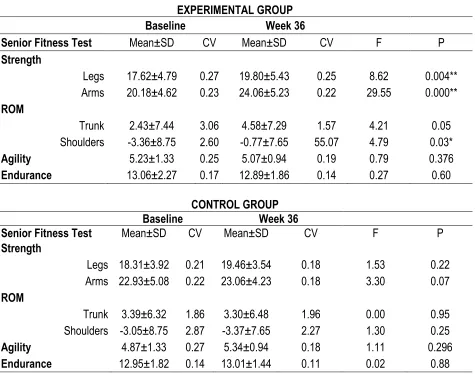
326 | 2012 | ISSUE 1 | VOLUME 7 © 2012 University of Alicante end of the experimental phase (T9). Table 2 shows the central data trend (mean) and dispersion (standard deviation and coefficient of variation).
Table 2. Results of physical fitness tests at the beginning of the experimental protocol at the end of T0 and
T9.
EXPERIMENTAL GROUP
Baseline Week 36
Senior Fitness Test Mean±SD CV Mean±SD CV F P
Strength
Legs 17.62±4.79 0.27 19.80±5.43 0.25 8.62 0.004** Arms 20.18±4.62 0.23 24.06±5.23 0.22 29.55 0.000** ROM
Trunk 2.43±7.44 3.06 4.58±7.29 1.57 4.21 0.05
Shoulders -3.36±8.75 2.60 -0.77±7.65 55.07 4.79 0.03*
Agility 5.23±1.33 0.25 5.07±0.94 0.19 0.79 0.376
Endurance 13.06±2.27 0.17 12.89±1.86 0.14 0.27 0.60
CONTROL GROUP
Baseline Week 36
Senior Fitness Test Mean±SD CV Mean±SD CV F P
Strength
Legs 18.31±3.92 0.21 19.46±3.54 0.18 1.53 0.22 Arms 22.93±5.08 0.22 23.06±4.23 0.18 3.30 0.07 ROM
Trunk 3.39±6.32 1.86 3.30±6.48 1.96 0.00 0.95
Shoulders -3.05±8.75 2.87 -3.37±7.65 2.27 1.30 0.25
Agility 4.87±1.33 0.27 5.34±0.94 0.18 1.11 0.296
Endurance 12.95±1.82 0.14 13.01±1.44 0.11 0.02 0.88
ROM=range of motion. SD=Standard Deviation. CV=coefficient of variation.
The results show significant increases (p<0.001) in the strength values of both legs and arms, with relatively small CVs. The values of range of motion (ROM) have detected significant differences in the values relating to the shoulders (p<0.05) and although it can be seen that the trunk ADM differences have not become statistically significant, this highlights the high value of the coefficient of variation (CV) of the test data of WMD.
VOLUME 7 | ISSUE 1 | 2012 | 327
Figure 1. Graph of means and standard deviations of 6 fitness tests performed for the Experimental Group.
DISCUSSION AND CONCLUSION
The initial values of the physical tests are closed to the standard values provided by Rikli and Jones (2001) for a sample of healthy people aged between 60 and 65. The participants of this study were slightly younger, they do regular physical activity and they have values that are clearly superior in strength of both the legs and the arms, slightly higher in range of motion of trunk and shoulders, and similar values in tests of agility and endurance. The differences between the standard values provided by Rikli and Jones (2001) might be by their age, closed to 60, the normalized values are between 60-64 years, and they were healthy people with experience in physical activity programs and health, in good physical condition, generally higher than –adults of the same age and the same environment.
328 | 2012 | ISSUE 1 | VOLUME 7 © 2012 University of Alicante with age. The fact that there have been no improvements in the endurance test can be justified by these reasons: Firstly, participants are almost a year older in the second test, corroborating studies by Callisaya et al., (2008), and also all are in acceptable physical condition, and therefore, have no incentive to produce greater improvements and from another point of view the stimulus was no enough to improve this physical condition.
The physical activity plan scheduled for this project was based on three hours a week of athletic track exercises and swimming activities of aerobic nature has proven effective in improving the health of strength parameters, an aspect considered as the major determinant of quality of life in older people. It has also improved the range of motion and has maintained the strength and agility of the participants despite them having aged a year.
Several limitations to the current study need to be appreciated. First, our participants were unique; they were physically active and most were above average in fitness for their age group, we suggest that generalization can be done with caution.
The purpose of the current study was to determine the effect of the exercise program after 9 months. The results obtained after the nine months are agree with Skelton and Beyer (2003), and we can consider that the programs of physical activity and health are configured as useful therapeutic tools that reduce the likelihood of older people being dependent and having limitations to their daily routine in addition to preventing cardiovascular disease, which has already been mentioned as the leading cause of death among older people in Western societies.
The results suggest that participation in regular physical exercise programs (aerobic and strength training) causes a number of favourable responses, specially increase in legs and arms strength, that contribute to healthy aging and may play a role in preventing or reducing functional decline in older adults. These findings highlight the importance to motivate the inactive elders to increase independence and quality of life.
ACKNOWLEDGEMENTS
We would like to express our gratitude to Andalusian and Granada Governments, and PulevaBiotech SA for supporting this research.
REFERENCES
1. AYUNTAMIENTO DE GRANADA, SPAIN. Patronato Municipal de Deportes. Retrieved November 28, 2011, from http://pmdgranada.es. [Back to text]
2. BAKER DW, SUDANO J, DURAZO-ARVIZU R, FEINGLASS J, WITT WP, THOMPSON J. Health insurance coverage and the risk of decline in overall health and death among the near elderly, 1992-2002. Medical Care. 2006; 44: 277-282. Back to text]
3. CALLISAYA-MICHELE L, BLIZZARD-LEIGH, SCHMIDT MD. Sex modifies the relationship between age and gait: A population-based study of older adults. Journals of Gerontology Series A-Biological Sciences and Medical Science. 2008; 63(2): 165-170. Back to text]
VOLUME 7 | ISSUE 1 | 2012 | 329 community-dwelling older adults. Journal of Psychosomatic Research. 2008; 66:127-135. Back to text]
5. CICIOGLU I. Assessment of physical fitness levels of elderly Turkish males over 60 years. Collegium Antropologicum. 2010; 34:1323-1327. Back to text]
6. FORREST KY, ZMUDA JM, CAULEY JA. Correlates of decline in lower extremity performance in older women: A 10-year follow-up study. Journals of Gerontology Series A-Biological Sciences and Medical Sciences. 2006; 61(11):1194-1200. Back to text]
7. FORTIN M, BRAVO G, HUDON C, LAPOTINE L, ALMIRALL J. Relationship between multimorbidity and health-related quality of life of patients in primary care. Quality of Life Research. 2006; 15:83-91. Back to text]
8. FOX KR, STATHI A, MCKENNA J, DAVIS MG. Physical activity and mental wellbeing in older people participating in the Better Aging Project. European Journal of Applied Physiology. 2007;
100:591-602. doiBack to text]
9. FRANZEN K, SAVEMAN BI, BLOMQVIST K. Predictors for health related quality of life in persons 65 years or older with chronic heart failure. European Journal of Cardiovascular Nursing. 2007;
6:112-120. doiBack to text]
10. GARACHATEA N, VAL R, CALVO I, DE PAZ JA. Valoración de la condición física funcional. mediante Senior Fitness Test. de un grupo de personas mayores que realizan un programa de actividad física. Apunts. 2004; 76:22-26. Back to text]
11. HENWOOD T. Exercise in later life: the older adults perspective about resistance training. Ageing & Society. 2011; 31:1330-1349. doiBack to text]
12. INE (INSTITUTO NACIONAL DE ESTADÍSTICA). Análisis y estudios demográficos. Retrieved November 29, 2011, froBack to text]
13. LANDI F, ABBATECOLA M, PROVINCIALI M, CORSONELLO A, BUSTACCHINI S, MANIGRASSO L, CHERUBINI A, BERNABEI R, LATTANZIO F. Moving against frailty: does physical activity matter? Biogerontology. 2010; 11:537-545. doiBack to text]
14. LI C, FORD E, ZHAO G, MOKDAD AH. Associations of health risk factors and chronic illness with life dissatisfaction among U.S. adults: the behavioral factor surveillance system. Prevention Medicine. 2009; 49:253-259. doiBack to text]
15. LOBO A, CARVALHO J, SANTOS P. Comparison of functional Fitness in elderly with reference values by Rickli and Jones and after one year of health intervention programs. J Sports Med Phys Fitness. 2011; 51(1):111-120. [Back to text]
16. LORD S, SHERRINGTON C, MENZ HB. Falls in older people: risk factor and strategies of prevention. Cambridge University Press: Cambridge. 2001. [Back to text]
17. NELSON M, REJESKI J, BLAIR S, DUNCAN P, JUDGE J, KING A, MACERA C, CASTANEDA-SCEPPA C. Physical activity and public health in older adults: recommendation from the American College of Sports Medicine and the American Heart Association. Medicine & Science in Sports & Exercise. 2007; 39:1435-1445. doiBack to text]
18. NETZ Y, WU M, BECKER BJ, TENNENBAUM G. Physical activity and psychological well being in advanced age: a meta-analysis of intervention studies. Psychology and Aging. 2005; 20:272-284.
doiBack to text]
19. NORRIS SL, HIGH K, GILL TM, HENNESSY S, KUTNER JS, REUBEN DB, UNU¨TZER J, LANDEFELD CS. Health care for older Americans with multiple chronic conditions: a research agenda. Journal of the American Geriatrics Society. 2008; 56:149-159. do
330 | 2012 | ISSUE 1 | VOLUME 7 © 2012 University of Alicante 20. OZTURK A, TARSUSLU T, TUTUN E, SERTEL M, YUMIN M. The relationship between physical,
functional and quality of life among elderly people with a chronic disease. Archives of Gerontology and Geriatrics. 2011; 53:278-283. doiBack to text]
21. PASCUAL C, REGIDOR E, GUTIÉRREZ-FISAC JL, MARTÍNEZ D, CALLE ME, DOMÍNGUEZ V. Material well being of the province of residence and leisure-time physical inactivity. Gaceta Sanitaria. 2005; 19:424-432. doiBack to text]
22. PHILLIP C, BLISSMER J, GREENE W, LEESD FD, RIEBEB DA, STAMM KE. Maintaining exercise and healthful eating in older adults: the senior project II: study design and methodology. Contemporary Clinical. 2011; 32:129-139. doiBack to text]
23. RIKLI R, JONES C. Senior fitness test manual. Estados Unidos de América: Human Kinetics. 2001. [Back to text]
24. RIKLI RY, JONES C. Functional fitness normative scores for community-residing adults ages 60-94. Journal of Aging and Physical Activity. 1999; 7:160-179. Back to text]
25. ROVIO S, KAREHOLT L, HELKALA EL, VITANEN M, WINBLAD B, TOMILEHTO J, SOININEN H, NISSINEN A, KIVIPLETO M. Leisure-time physical activity at midlife and the risk of dementia and Alzheimer’s disease. Lancet Neurol. 2005; 4:705-711. doiBack to text]
26. SHIMADA H, TIEDEMANN A, STEPHEN R, SUZUKAWA M, MAKIZAKO H, KOBAYASHI K, SUZUKI T. Physical factors underlying the association between lower walking performance and falls in older people: A structural equation model. Archives of Gerontology and Geriatrics. 2011;
53:131-134. doiBack to text]
27. SKELTON DA, BEYER N. Exercise and injury prevention in older people. Scandinavian Journal of Medicine & Science in Sports. 2003; 13:77-85. doiBack to text]
28. TAYLOR AH, CABLE NT, FAULKNER G, HILLSDON M, NARICI M, VAN DER BIJ AK. Physical activity and older adults: a review of health benefits and the effectiveness of interventions. Journal of Sports Sciences. 2004; 22:703-725. Back to text]
29. TORAMAN A, YILDIRIM N. The falling risk and physical fitness in older people. Archives of Gerontology and Geriatrics. 2010; 51:222-226. doiBack to text] 30. WILSON RC, JONES PW. Long-term reproducibility of Borg scale estimates of breathlessness
during exercise. Clinical Science. 1991; 80(4):309-12. Back to text]
31. YOEME HA, FLEURY J, KELLER C. Risk factors for mobility limitation in community-dwelling older adults: a social ecological perspective. Geriatric nursing. 2008; 29:133-140.
doiBack to text]
32. ZUCCARO SM, STEINDLER R, SCENA S, COSTARELLA M. Changes of psychical and physical conditions in the elderly after a four-year follow-up. Archives of Gerontology and Geriatrics. 2011;