Comparative Analysis on Various Compression
Techniques on Map Images
1 Krishna V, 2 Cinly Thomas, 3 Radhakrishnan B
1
PG Student, Department Of Computer Science and Engineering, Baselios Mathews II College Of Engineering Sasthamcotta, Kollam, Kerala, India
2
Assistant Professor, Department Of Computer Science and Engineering, Baselios Mathews II College Of Engineering Sasthamcotta, Kollam, Kerala, India
3
Assistant Professor, Department Of Computer Science and Engineering, Baselios Mathews II College Of Engineering Sasthamcotta, Kollam, Kerala, India
Abstract - Digital images are an important form of data and are used for in almost every applications. Personal navigation is one of the modern field of image compression, where the user needs map in real time. Map images cannot be used directly, because of its huge size. There are various techniques that can be used to compress these images. The basic approach of image compression is to reduce the number of image pixels without affecting the quality of the image. In order to achieve compression, the redundancy present in the image is to be removed. The principle objective of this paper is to analyse various image compression techniques and thereby we are presenting a survey on research papers focused on map image compression.
Keywords - Image Compression, Huffman Coding, Context Tree, LZW Coding, Map Image.
1. Introduction
With the advanced development in internet and multimedia technology, the demand for digital information increases dramatically. The advances in technology make use of digital images prevalent to a large extent. Digital images are comprised of large amount of data. So the reduction in the size of image data for both storage and transmission of digital images are important as they find more applications. Image compression plays an important role in many multimedia applications such as image storage and transmission. The basic goal of image compression is to represent an image with minimum number of bits of an acceptable image quality. Image compression may be lossy or lossless. Lossless compression is preferred for archival purposes and often for medical imaging, technical drawings, clip art, or comics. This is because lossy compression methods, especially when used at low bit rates, introduce compression artifacts. Lossy methods
are especially suitable for natural images such as photographs in applications where minor (sometimes imperceptible) loss of fidelity is acceptable to achieve a substantial reduction in bit rate. The lossy compression that produces imperceptible differences may be called visually lossless. The error metric used to compare various image compression techniques are the Mean Square Error (MSE) and the Peak Signal to Noise Ratio(PSNR). The MSE is the cumulative squared error between the compressed and the original image, whereas PSNR is a measure of the peak error. The mathematical formulae for the two are
= ∑ ∑ , − ,
(1)
= 20 ∗ log10 !255 #$%&' ( (2) where I(x,y) is the original image, I'(x,y) is the decompressed image, and M,N are the dimensions of the images. A lower value for MSE means lesser error, this translates to a high value of PSNR. So a better compression scheme have lower MSE and high PSNR.
2. Techniques
2.1 Run-length Encoding (RLE)
Run-length encoding is a very simple form of lossless data compression in which runs of data are stored as a single data value and count, rather than as the original run. RLE works by reducing the physical size of a repeating string of characters. This repeating string, called a run, is typically encoded into two bytes as shown in figure1 . The first byte represents the number of characters in the run and is called the run count. The second byte is the value of the character in the run, and is called the run value as shown in figure 1. This is most useful on data that contains many such runs, for example, simple graphic images such as icons, line drawings, and animations. It is not useful with files that don't have many runs as it could greatly increase the file size.
12 12 12 22 22 22 22 5 5 5
{12,3} {22,4} {5,3}
Fig.1 Run-Length encoding
2.2 Lempel–Ziv–Welch (LZW)
LZW is a universal lossless data compression algorithm created by Abraham Lempel, Jacob Ziv, and Terry Welch. LZW is a dictionary based coding. Dictionary based coding can be static or dynamic. In static dictionary coding, dictionary won't be changed. In dynamic dictionary coding, dictionary is changed during the encoding and decoding process . The algorithm is simple to implement, and has the potential for very high throughput in hardware implementations. It is the algorithm of the widely used UNIX file compression utility, compress and is used in the GIF image format. LZW compression became the first widely used universal image compression method on computers. A large English text file can typically be compressed via LZW to about half its original size.LZW algorithm can be applied to the compression of digital maps.
2.3 Huffman Coding
Huffman coding is general coding technique for symbols based on their statistical occurrences of frequencies(probabilities).The algorithm for Huffman coding was developed by David A Huffman, and normally used for lossless image data compression. The pixels in the image are treated as symbols. The symbols that occur more frequently are assigned a smaller number of bits, while the symbols that occur less frequently are assigned relatively larger number of bits. Huffman code is prefix code. This means that the (binary) code of any symbol is not the prefix of the code of any other symbol.
2.4 Arithmetic Coding
Arithmetic coding is a form of a entropy coding. Normally a string of characters is represented using a fixed number of bits per character as in the ASCII code. When a string is converted to arithmetic encoding, frequently used characters will be stored with fewer bits and not-so-frequently occurring characters will be stored with more bits, resulting in fewer bits used in total.
2.5 Entropy Coding
Entropy coding is a lossless data compression scheme that is independent of the specific characteristics of the medium . One of the main types of entropy coding creates and assigns a unique prefix code to each unique symbol that occurs in the input. These entropy encoders then compress data by replacing each fixed-length input symbol with the corresponding variable-length prefix-free output codeword.
2.6 Discrete Cosine Transform (DCT) Coding
The key to JPEG baseline compression process is a mathematical transformation known as discrete cosine transform.DCT is in a class of mathematical operations. The basic purpose of these operations is to take a signal and transform it from one type of representation to another. The DCT can be used to convert the signal (spatial information) into numeric data ("frequency" or "spectral" information) so that the image’s information exists in a quantitative form that can be manipulated for compression.
The DCT works by separating images into differing frequencies. During the quantization step less important frequencies are discarded. Then only the most important frequencies remain are used to retrieve the image in the decompression process. As a result, the reconstructed images contain some distortion. The two dimensional DCT equation is defined as follows:
)*, + = 1
√2-*-+ . .
0
1 0
1
2, 34# 5678 9 34# 56:8 9 (3)
DCT equation (Eq.3) computes the i, jth entry of DCT of an image, p(x,y) is the x,yth element of the image represented by the matrix p. N is the size of the block that the DCT is done on.
2.7 Discrete Wavelet Transform Coding
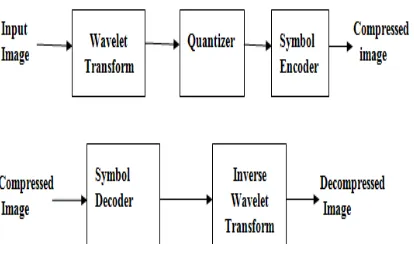
Fig. 2 Wavelet Coding
Wavelets are signals which are local in time and scale and generally have an irregular shape. The term “wavelet” comes from the fact that they integrate to zero; they wave up and down across the axis.DWT firstly decomposes an image into sub bands and then the resulting components are compared with a threshold. The values of coefficients which lie below threshold are set to zero and which lie above threshold are encoded using lossless techniques.
2.8 Vector Quantization
The basic idea in this technique is to develop a dictionary of fixed size vectors, called code vectors .A vector is usually a block of pixel values. A given image is then partitioned into non overlapping blocks called image vectors. Each blocks are added to the dictionary in sequence. Then each block in the dictionary is determined and its index in the dictionary is used as the encoding of the original image vector. Thus, each image is represented by a sequences of indices that can be further entropy encoded, which results in reduced size of the image .
Table 1.Comparison of Techniques
Compression
Techniques Advantages Disadvantages
Runlength Encoding
Symbols of any combinations can be Compressed
Not good for continuous tone images
Huffman Coding
Easy to implement, High Transmission speed
It is not as efficient as RLE for the compression of image that contain long runs of identical pixels
LZW Coding
No need to analyze incoming Text
Good For text files only
DCT Coding Gives Most
efficient results
Compression is lossy
DWT Coding
Good frequency and time scaling
Always stops at some ratio and cannot compress further
Vector quantization
Simple and easy to implement
Not appropriate for low bit rate compression
3. Literature Survey
[1]Saif Zahir et al proposed a fast and highly efficient compression scheme for map images with predefined number of discrete colors. In the proposed scheme, the map image is divided into many layers as the number of colors. The compression scheme is applied on the on the 8X8 blocks of map bi-level layers. The compression method uses a fixed to variable length codebook that is generated using Huffman tree codes. The frequency of occurrences of each block is calculated and all unique blocks in the sample is identified. Then built a codebook that contains high frequency of 8X8 bit blocks and their corresponding Huffman codes. The proposed scheme is simple and fast and can be used for real time applications. The layer separation process can be time consuming and weakens the compression performance.
[2]Alexandre, et al presents a semi-adaptive modification of the LZW algorithm for compressing digital maps that were divided into smaller blocks. In the proposed scheme LZW algorithm is used to built the global dictionary of the entire image. then the dictionary is pruned so that it will contain only most frequently used pixel sequences. The dictionary is stored in the compressed file by using Huffman coding. The blocks size is a compromise between compression ratio and decoding dely. For very small block size the desired part of the image can be reconstructed more accurately and faster. The increased number of blocks lead to overhead is the disadvantage.
[4]Alexander Akimov, et al in 2007 proposed a context tree based compression method to work on color values instead of binary layers. They generated an n- array context tree by constructing a complete tree up to predefined depth, then the node that do not provide compression improvements are pruned out. A fast heuristic pruning algorithm was used for decreasing the time required in the optimization of the tree structure. The memory consumption of images with large number of colors can be solved with this method. The increased processing time of algorithm in case of larger images is the bottleneck for real time applications.
[5]Eugene Ageenko ,et al proposed a fast lossless compression method for large binary images for the application where spatial access to the image is needed. The proposed compression method uses the combination of variable size context modelling [11] in the form of context tree and forward adaptive statistical compression[12].A fast two stage bottom up approach is used for the construction of the context tree. It is possible to utilize the larger context without increasing the learning cost by using the context tree. The method achieves higher compression rates due to the improved prediction caused by utilizing the larger context. The method consumes more memory space to store the large sized context tree.
[6]Pasi Franti, et al proposed a map image storage system that supports compact storage size and decompression of partial images. In this paper they have proposed a storage system to provide map images for real time applications that uses portable devices with low memory and computational resources. The compact storage size is achieved by dividing the map image into binary semantic layers. The binary layers are divided into non-overlapping rectangular blocks before compression. Each block is compressed separately using context modelling and MQ coding algorithm. When the compressed image is accessed , a block index table is constructed. This enable direct access to the compressed image file, that allows to transmit or decompress only necessary part of the image needed. Therefore the transmission time and memory requirements of the user device become reduced. By the use of variable sized context modelling can provide 20% improvement in compression performance. The pixels located outside the block cannot be used in the context template may cause compression inefficiency near the block boundaries.
[7] Soren Forchhammer, et al proposed a new context based technique for the content progressive coding of limited bits/pixel images like maps, company logos etc common on the world wide web. To achieve progressive encoding, the image is encoded in content layers based on color level or other predefined information. When the full layered data set is available at the encoder, the progressive scheme provides more information than the ordinary composite map images. Information from pixels coded in the layers of high priority were
skipped(skip pixels) in the current and all lower layers for efficient coding. In this paper they combined the principle of skip pixel coding with existing template based context bi-level coding ,context collapsing method for multilevel images with arithmetic coding. The proposed lossless scheme achieves good compression performance for limited bits/pixel images of maps. It can be used as flexible tool for efficient progressive coding of digital maps. [8]Eugene Ageenko,et al, introduced a method to estimate optimized context template that are used for conditioning the pixel probabilities in context based image compression. The proposed algorithm optimizes the location of the context pixel within a limited neighborhood area, and produces the ordered template as a result. The ordering can be used to determine the shape of the context template for a given template size. The optimal template size depends on the size of the image, when the template shape depends on the image type. They have applied the method for the compression of multi-component map images consisting of several semantic layers represented as binary images. The shape of the context template for each layer was estimated separately, and compresses the layers using standard JIBIG2 compression technique. The method produced moderate compression improvement for a set of map images.
[9] Srikanth, et al presents a technique for image compression which is use different embedded Wavelet based image coding with Huffman-encoder for further compression. In this paper they implemented the SPIHT and EZW algorithms with Huffman encoding using different wavelet families and after that compare the PSNRs and bit rates of these families. These algorithms were tested on different images, and it is seen that the results obtained by these algorithms have good quality and it provides high compression ratio as compared to the previous exist lossless image compression techniques.
[10] Firas A. Jassim, et al proposed a novel technique for image compression which is called five module method (FMM). In this method converting each pixel value in 8x8 blocks into a multiple of 5 for each of RGB array. After that the value could be divided by 5 to get new values which are bit length for each pixel and it is less in storage space than the original values which is 8 bits. This paper demonstrates the potential of the FMM based image compression techniques. The advantage of their method is, it provided high PSNR (peak signal to noise ratio) although it is low CR (compression ratio). This method is appropriate for bi-level like black and white medical images where the pixel in such images is presented by one byte (8 bit).
4. Applications
images, and less time lost on image viewing and loading. Just as image compression has increased the efficiency of sharing and viewing personal images, it offers the same benefits to just about every industry in existence. The archiving of large numbers of images is required in health industry , where the constant scanning and/or storage of medical images and documents take place. Image compression offers many benefits, as information can be stored without placing large loads on system servers. And conveniently, these images can uncompress when they are ready to be viewed, retaining the original high quality and detail that medical imagery demands. Image compression is also useful to any organization that requires the viewing and storing of images to be standardized, such as a chain of retail stores or a federal government agency. Image compression can be very effectively applied in cases where accurate representations of museum or gallery items are required, such as on a Web site. Regardless of industry, image compression has virtually endless benefits wherever improved storage, viewing and transmission of images are required.
5. Conclusion
We have discussed different compression techniques and papers related to the compression of map images. It is difficult to compare the performance of compression technique, if identical data sets and performance measures are not used. After the study of all the techniques it is found that lossless compression techniques are more effective over lossy compression techniques. Lossy provides higher compression ratio than lossless. From the above discussed papers, we have concluded that the context tree modelling with arithmetic coding provide better compression performance than the other methods, but the decompression performance of dictionary based coding is 10-20 time faster than context tree modelling with arithmetic coding.
References
[1] Saif Zahir and arber Borici,"A Fast Lossless Compression Scheme for Digital Map Image Using Color Separation", IEEE International Conference on Acoustics, Speech and Signal processing, Dallas, Texas, USA ,June 2010
[2] Alexandre Akimov,Pavel Kopylov and Pasi Franti, Semi-Adaptive Dictionary Based Compression of MapImages",Graphicon'2002,Nizhny,Novogorod,Russi a,pp.219-223,September 2002.
[3] Pavel Kopylov and Pasi Franti, "Compression of Map images by Multilayer Context tree Modeling" ,IEEE Transaction on Image Processing,Vol.14,NO.1,January 2005.
[4] Alexandre Akimov,Alexandre Kolesnikov and Pasi Franti,"Lossless Compression of Color map images by Context Tree Modeling",IEEE Transaction on Image Processing,Vol.16,NO.1,Januray 2007.
[5] Ageenkon E and Franti P,"Compression of Large Binary images in Digital Spatial Libraries",Computers &Graphics 24(1):91-98,February 2000.
[6] Pasi Franti, Eugene I Ageenko,Pavel Kopylov,Sami Grohn,Florian Berger,"Compression of Map Images for real time applications",Image and Vision Computing,Vol.22,NO.13,1105-1115,November 2004 [7] Forchhammer, S., & Jensen, "Content Layer
progressive Coding of Digital Maps",IEEE Transaction on Image Processing, 11(12), 1349-1356,2002 [8] Eugene Ageenko,Pavel Kopylov,Pasi Franti,"On the
Size and Shape of Multi-Level Context Templates for Compression of Map Images", in IEEE Conference ,February 2001.
[9] S.Srikanth and Sukadev Meher, "Compression Efficiency for Combining Different Embedded Image Compression Techniques with Huffman Encoding", IEEE, pp. 816-820, 2013.
[10] Firas A. Jassim and Hind E. Qassim,"Five Modulus Method for Image Compression", Signal And Image processing :An International Journal(SIPIJ) Vol.3,pp.19-28,2012.
[11] Ageenko EI,Franti P,"Forward-Adaptiv method for compressing large binary images",Software Practise &Experience 1999;29(11):943}52.
[12] Franti P,Ageenko EI,"On the use of Context tree for binary image compression",IEEE Proceedings of the Franti P,Ageenko EI,"On the use of Context tree for binary image compression",IEEE Proceedings of the
International Conference on Image
Processing(ICIP '99).Japan:Kobe,1999.
[13] P. G. Howard, F. Kossentini, B. Martins, S. Forchhammer, and Rucklidge,"The Emerging JBIG2
Standard",IEEE Trans,Circuit Syst.Video
Technol.Vol.8, pp.838-848,Nov.1998.
[14] B. Martins and S. Forchhammer,"Tree Coding of Bi-level Images",IEEE Trans.Image processing,Vol.7,pp. [15] V. Ratnakar,"RAPP:Lossless Image Compression with
runs of adaptive pixel patterns", in Proc. 32nd
Asilomar Conf. Signals, Systems and
Computers,Nov.1998.
[16] M. J.Weinberger, J. Rissanen, and R. B.
Arps,"Applications of universal context modeling to losseless compression of grey-scale images",IEEE Trans.Image Processing,Vol.5,pp.575-586,April 1996. [17] S.Jayaraman,S.Esaikkirajan and T.Veerakumar,Digital
Image Processing, New Delhi:Tata McGraw- Hill,2011
Krishna. V received her B.Tech Degree in Computer Science & Engg. from University of Kerala in 2007. Currently she is pursuing her Masters in Computer Science & Engineering from University of Kerala. She worked at T.K.M College of Engg, Kollam as lecturer. Her research interests include Image Processing and Networking.
Cinly Thomas is currently working as Asst. Professor in Computer Science Dept, Baselios Mathews II College of Engg, Sasthamcotta, Kollam. Her research interests include Image processing, Networking and Database Technology.