Volume 7, Issue 1 [January 2018] PP: 15-20
Reliability of the generic HPGe detector characterization using
ISOCS™ Software for Absolute verification of fissile Material
*M. Abdelati, K. M. El Kourghly
Department of Nuclear Safeguards and Physical Protection, Egyptian nuclear and Radiological Regulatory Authority (ENRRA) - Cairo, Egypt
Corresponding Author:M. Abdelati
Abstract
: This paper aims to study the validation of the generic detector characterization1 for an HPGe detector companion to ISOCS™ software2to improve the absolute measurements of Nuclear Material (NM) samples for safeguards purposes. Five Standard Nuclear Material (NBS, SNM-969) samples with different enrichment (Depleted, Natural and Low Enriched Uranium) in cylindrical aluminum containers were used for validation of ISOCS™ software. The efficiency calibration for experimental set-up, geometry models were generated for each SNM sample using ISOCS™ software package in conjunction with a generic detector characterization code for the detector model. For the ISOCSTM calculations, the built in circular plane template was used for generating efficiency calibration of the measurement setup. The absolute efficiency calibration curve was generated with and without a cylindrical collimator. Acquiring and analyzing spectra software3 was used to estimate the area under each peak in the spectrum. Activities of the 185.7 KeV gamma rays emitted due to 235U isotope were measured using the detector with and without collimator. Relative difference in the estimated mass with and without collimator was ranging from -1.79 % to 1.52 %.
Keywords
: In Situ Object Counting System Software (ISOCS), Genie 2000, efficiency calibration--- ---
Date of Submission:01-01-2018 Date of acceptance: 22-01-2018 --- ---
I.
INTRODUCTION
In-field safeguards activities; determination the amount or presence of Nuclear Material [NM] in an item is a highly important task for both national and international nuclear safeguards (SG) [1]. Gamma spectrometer is one of the most powerful Non-Destructive Assay [NDA] tools for NM measurements that include an HPGe detector [2]. Detector efficiency depends mainly on configuration setup and measured item characteristics. According to physical standards dependency to calibrate the measuring devices, these techniques may be classified as semi-absolute, absolute or relative ones. In order to get accurate results, standard NM with highly identical characteristics to the measured sample must be used into the device calibration [2]. However, since suitable NMs standard are not always obtainable, sometimes a suitable calibration curve could be constructed utilizing ISOCSTM Software calculation [3].It was used for detectors efficiency calibration.
Quantitative analysis of NMs using gamma-spectroscopy measurements would become possible if the detector absolute efficiency could be established for the gamma-lines of interest. The ISOCS™ software brings the possibility to establish absolute efficiency curve for desired energy range based on numerical simulation with use of known or guessed geometry and chemical composition of a measured item. The software provides variety of geometry templates which covers a wide range of item shapes such as cylinders, pipes, boxes as well as more complex geometries [3]. The ISOCSTM is calibration software that gives the user the ability to produce qualitative and accurate quantitative gamma assay of most any sample type and size [3]. With ISOCSTM, it is now possible to create laboratory quality-efficiency calibration without actually using a radioactive calibration source. Containers and objects of virtually any shape can be modeled using ISOCSTM and the activity of the radioactive sources in them can be determined. Consequently, ISOCSTM calibrations can be performed more quickly and at lower cost than conventional methods that require standards source.
The main purpose of this paper is to validate the generic detector characterization for an HPGe detector (Falcon 5000) companion to ISOCS™ software, to explore the possibilities of combining gamma counting system with ISOCS™ software calculations to improve the absolute measurement of NM samples (i.e., to quantify the uranium mass content).
---
1
supplied by Canberra for a model BE2830 HPGe detector (Falcon 5000) 2
ISOCS™ software: Canberra’s In Situ Object Counting System Software 3
GENIE 2000 software 4
II.
MATERIAL
AND
METHOD
2.1 Materials specification
Four standard point sources4 (22Na, 57Co, 60Co and 137Cs) were used for validation of ISOCS™ software. The sources were prepared as a type D capsule and certified with a 3% activity uncertainty at the 99% confidence level. The type D disk is a 25.4 mm diameter by 6.35 mm thick disk constructed of high strength plastic (Epoxy and Acrylic). Nature of active deposit is evaporated metallic salt. The active diameter is 5 mm. Gamma ray energies and abundances along with the half-lives of these radioactive nuclides are given in Table (1).
Table 1: Specification of the certified point sources [4]
Source Id E (KeV) Iγ % Activity
A (µCi) (σA/A)% Production date
Na-22 1274.5 99.94 4.322 ± 3.1
15/7/2007
Co-57 122.1 85.6 10.57 ± 3.1
136.5 10.68
Co-60 1173.23 99.86 4.430 ± 3.1
1332.5 99.98
Cs-137 661.7 85.1 5.002 ± 3.1
Five Standard Nuclear Material (NBS, SNM-969) samples with different enrichment (Depleted, Natural and Low Enriched Uranium) in cylindrical aluminum container are used for validation of ISOCSTM software for experimental purposes. Characteristics of the assayed SNM are presented in Table (2).
Table 2: Characteristics of the assayed SNM [5]
Samples ID Container Radius (mm) Filling
Height(mm)
U3O8 Mass(g)
235U Enrichment (%)
inner outer
031 35 40 20.8±0.5 200.1±0.2 0.31
071 35 40 20.8±0.5 200.1±0.2 0.71
194 35 40 20.8±0.5 200.1±0.2 1.94
295 35 40 20.8±0.5 200.1±0.2 2.95
446 35 40 15.8±0.5 200.1±0.2 4.46
2.2 Method 2.2.1 Treatment
The specific activity (Ci.gm-1) of a certain gamma energy line for an isotope i [6] is defined as: (1)
Where
Ai (Ci) is the activity of assayed isotope i,
Mi (g) is the mass of the measured isotope in the sample.
The term specific activity is a constant for the measured isotope and can be given by the following equation:
………. (2)
Thus the following equation is used to determine 235U and 238 U masses content in the samples.
2.2.2 Measuring device
F5000N-of 3300 V which is necessary for detector operation, The measuring system combined with In Situ Operating Counting System (ISOCSTM) Software used for efficiency calibration [7].
2.2.3 Efficiency calibration using ISOCS™
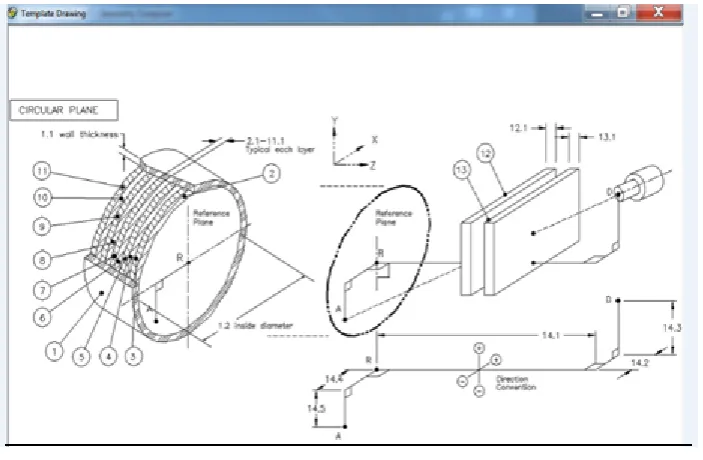
To determine the efficiency calibration for experimental set-up, geometry models were generated for each point source and SNM sample using ISOCS™ software package in conjunction with the generic detector characterization for the detector. For the ISOCSTM calculations, the built in circular plane template illustrated in Fig (1) was used for generating efficiency calibration of the measurement setup. The template input parameters are: collimator material and dimensions, relative position between the detector and container (distance between detector end-cap and container wall), container material and its dimensions as well as nuclear material chemical composition, fill-height and density. Once the efficiency calibration files were generated, absolute calibration could be done. Acquiring and analyzing spectra software was used to estimate the area under each peak in the spectrum. Next the ISOCS™ efficiency calibration file for the sample was applied to the spectrum. The gamma peaks were identified in addition to the isotopes weighted mean activities. Normally, the modeling and numerical calibration takes several minutes.
Fig (1). Built in circular plane template
The absolute efficiency calibration curve was generated for each point source and for SNM sample with and without a cylindrical collimator.
III.
Experimental SETUP
3.1 Point sources activities measurements
Point sources were placed in front of the detector at distances 5, 10 and 15cm. The measuring time was about 600 Second the dead time was less than 2%. The absolute efficiency estimated using ISOCS™ software in conjunction with the generic detector characterization for the detector. To increase the Reliability of the ISOCS™ model one of the point sources (22Na) is counted at a distance of 15 cm away from the centre of the
front face of the detector endcap, at angular locations of 0º, 45º, 90º, 135º and 180º with respect to the symmetry axis of the detector.
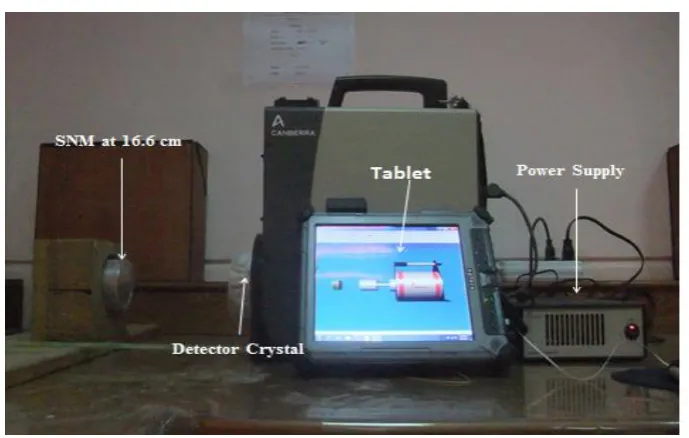
3.2 SNM Activities measurements without collimator
Fig.(2). Experimental setup arrangement for activity measurement without collimator
3.3 SNM Activities measurements with collimator
As shown in Fig. (3) samples were placed inside a collimator aperture 1.1 cm in front of the detector, the samples-to-AL cap of the detector distances were approximately 3.1 cm. The measuring time was about 1800 Sec and the dead time was less than 0.7%. The measured samples were adjusted to be in coincidence with the extended axis of symmetry of the detector.
Fig. (3). Experimental setup arrangement for activity measurement with 1.1 cm aperture collimator
IV.
RESULTS
AND
DISCUSSION
4.1 Point sources activities
The activity for monoenergetic gamma ray sources 22Na, 57Co, 60Co and 137Cs was calculated based on the absolute efficiency estimated using ISOCS™ software in conjunction with the generic detector characterization. The activities (A) with the associated percentage relative uncertainties (σA) are given in Table
(3).
Table 3: Activities estimated by ISOCS™ software in comparison with Point sources reference activities
Isotope E (keV) Distance to
detector (cm)
Activities estimated by ISOCS™ A (µCi) σA
Reference Activities (µCi)
Relative different %
For all data results presented in Table (3) the estimated activity of point source by absolute method were found to be comparable with the reference point source activity. The relative differences between the activities estimated and the reference activities range between 0.477 to 2.51 %. It is clear the agreement between the results with the accuracy and precision. The results of 22Na point source activity estimated by ISOCS™ software at different angle with the associated uncertainties are given in Table (4). It is clear that the estimated activity is in agreement within the uncertainties with reference activity.
Table 4: Activity estimated by ISOCS™ software for 22Na point source at different angle
Isotope E
(keV) Degree
Activities estimated by ISOCS™ A (µCi) σA
Reference Activity (µCi) Relative different % Na-22 1274.5
0 0.408518 ± 0.02460
0.40601 ± 0.0126
0.617
45 0.413192 ± 0.016693 1.769
90 0.410393 ± 0.016753 1.079
135 0.409375 ± 0.016584 0.829
180 0.408494 ± 0.016667 0.612
4.2 Measured Activities of 235U with and without collimator
Activities of 185.7 keV gamma energy line relevant to 235U isotope, were measured using the HPGe spectrometer (falcon5000) with and without collimator. Table (5) presents the measured activity for the most prominent gamma energy line 185.7 with and without collimator. The measurements were performed as described previously in experimental setup section.
Table 5: Activities of 185.7 keV with and without collimator with their uncertainties
Sample Id
Activities estimated by ISOCSTM at 185.7 (keV) energy line
A (µCi) σA
With Collimator Without Collimator
031 0.6208 ± 0.0599 0.6269 ± 0.0548
071 1.4116 0.1292 ± 1.4073 ± 0.1228
194 3.7683 ± 0.3325 3.8871 ± 0.3365
295 5.7889 ± 0.5086 5.7793 ± 0.5001
446 8.7296 ± 0.7645 8.7059 ± 0.7534
4.3 235U mass estimation
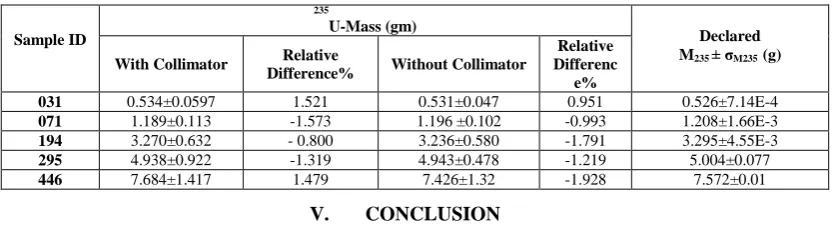
The measured activities at 185.7 keV gamma energy line using ISOCSTM software with and without collimator (Table 5) and the specific activity of the measured gamma energy line were substituted into equation (3) to obtain the 235U mass isotopic content in nuclear materials. Table (6) presents the 235U mass estimated with the associated uncertainties. It is clear the agreement between the estimated masses using ISOCSTM software method and declared 235U isotope mass with the accuracy and precision.
Table 6:235U isotopic mass content estimated using ISOCSTM software with and without collimator and declared values with their associated uncertainties
Sample ID
235
U-Mass (gm)
Declared M235± σM235 (g)
With Collimator Relative
Difference% Without Collimator
Relative Differenc
e%
031 0.534±0.0597 1.521 0.531±0.047 0.951 0.526±7.14E-4
071 1.189±0.113 -1.573 1.196 ±0.102 -0.993 1.208±1.66E-3
194 3.270±0.632 - 0.800 3.236±0.580 -1.791 3.295±4.55E-3
295 4.938±0.922 -1.319 4.943±0.478 -1.219 5.004±0.077
446 7.684±1.417 1.479 7.426±1.32 -1.928 7.572±0.01
V. CONCLUSION
ACKNOWLEDGEMENTS
I would like to express my thanks to Nuclear and Radiological Regulatory Authority of Egypt (ENRRA) for offering me all the facilities to do this work.
REFERENCES
[1]. IAEA Safeguards 2016, Serving Nuclear Non-Proliferation,
[2]. https://www.iaea.org/sites/default/files/16/09/safeguards_brochure.pdf
[3]. Safeguards techniques and equipment. – 2011 edition. – International Atomic Energy Agency, 2011.
[4]. Model S573 ISOCS Calibration SoftwareTechnical Reference Manual
[5]. Eckert and Ziegler Isotope Products certificate IPL Ref. No.:1247-76
[6]. NBS, Uranium Isotopic Standard Reference Material for Gamma Spectroscopy Measurements, 969, NBS-111, Gaithersburg, MD 20891, USA, (1985).
![Table 1: Specification of the certified point sources [4] Activity](https://thumb-us.123doks.com/thumbv2/123dok_us/1366395.1646211/2.595.104.492.336.431/table-specification-certified-point-sources-activity.webp)