THE RELATION BETWEEN ANGULAR DISPLACEMENT OF THE HAMMER IN THE DOUBLE SUPPORT PHASE AND ITS VELOCITY IN THE HAMMER
THROW
F. Javier Rojas-Ruiz 1, Marcos Gutiérrez-Dávila1
1Faculty of Physical Activity and Sport, University of Granada, Spain
Received: 30 June 2009; received in revised form: 17 July 2009; accepted: 22 July 2009
ABSTRACT
The present study arises as a response to the historical controversy about the theoretical model of the hammer throw and performance. It starts from the fluctuations produced in the tangential velocity in the centre of gravity (CG) of the hammer in each turn, accelerating during the double support phase and reducing markedly in the single support phase. Coaches have sought to prolong the double support phase, although other studies have shown that acceleration is also possible during the single support phase. It has recently been proved that to the extent that the velocity of the CG of the hammer increases, the time that the thrower remains in the double support phase tends to reduce. The action of thirty hammer throwers in five national and international competitions has been analysed, utilizing the methodology proposed by Dapena (1984) and Gutiérrez, Soto & Rojas (2002) of 3D photogrammetric techniques. The results show a correlation between the angular displacement of the hammer during the double support phase and its average velocity in the penultimate turn (R=-0.50; p<.005). In the second turn no significant differences were found in the relation between the variables, while for the final action of the throw a certain negative correlation among the variables existed (-0.39; p<0.05). Finally, no relation was found between the angular displacement of the hammer and the change in velocity in the double support phase.
Key words: Biomechanical Analysis, 3D photogrammetry.
Reference Data: Rojas-Ruiz FJ & Gutiérrez-Dávila M. The relation between angular displacement of the hammer in the double support phase and its velocity in the hammer throw. J. Hum. Sport Exerc. 2009; 4(3):254-261.
1 Corresponding author. Universidad de Granada. Departamento de Educación Física y Deportiva. Facultad
de Ciencias de la Actividad Física y el Deporte. Ctra de Alfacar s/n. 18071. Granada (Spain). Phone: +34 958 244370
E-mail: [email protected]
© 2009 University of Alicante. Faculty of Education.
DOI:10.4100/jhse.2009.43.07
Journal of Human Sport and Exercise
online
J. Hum. Sport Exerc.
Official Journal of the Area of Physical Education and Sport. Faculty of Education. University of Alicante. Spain
ISSN 1988-5202 / DOI: 10.4100/jhse An International Electronic Journal Volume 4 Number 3 October 2009
© 2009 University of Alicante. Faculty of Education. ISSN 1988-5202
INTRODUCTION
The hammer throw can be divided into two clearly differentiated periods, according to the positions that the thrower adopts in each turn: double support, where both feet remain in contact with the ground and single support, where the thrower turns maintaining only one supporting foot on the ground. Historically, special attention has been paid to these two phases, based on the behaviour of tangential velocity of the hammer head during the throw, where marked fluctuations of its velocity in each turn are observed, accelerating only in the double support phase and reducing noticeably in the single support phase (Kuznetsov, 1965).
From this behaviour of the velocity-time function of the hammer head, a theory has arisen that states that the hammer can only accelerate in the double support phase and that the thrower has no possibility of actively influencing the velocity of the hammer in the single support phase. Coaches have sought to prolong the double support phase, particularly after the technical changes proposed by Bondartschuk (1979, 1987). To do this, the removal of the foot from the ground must be delayed and the subsequent support anticipated, bringing the hammer forward by turning the hip rapidly in the same direction as the hammer turn, so increasing the double support phase, as well as a torsion in the trunk at the beginning of the double support phase which improves the subsequent application of momentum of force, although it can pose problems such as the reduction of the radius of the turn. To solve this problem, the thrower Yuri Sedykh (Bondartschuk, 1987) introduced certain changes in his technique permitting him to lengthen the double support phase without reducing the radius of the turn. Thus he maintained the anticipation of the support by orienting his foot close to the hammer at that moment and not turning the hip completely.
As has been explained, the theory is based on the belief that the thrower has no possibility of actively influencing the velocity of the hammer in the single support phase; following this theory the technique in the single support phase is that the thrower has to precede the hammer until it reaches the highest point of its trajectory. So important is this aspect of the technique that the technical level of the thrower is dependent on the reduction of tangential velocity produced in the hammer in this phase.
© 2009 University of Alicante. Faculty of Education. ISSN 1988-5202 When the combined effects of gravity and the horizontal movement of the CG of the system of thrower plus hammer are taken into account, the fluctuations of the tangential velocity of the CG of the hammer tend to disappear, although not in all the throwers analysed (Dapena, 1986). The results of the research of Dapena (1984, 1986), Dapena and McDonald (1988) and Brice et al., (2008), revealed that the hammer could also be accelerated in the single support phase by transference of angular momentum, so contradicting the theory put forward by Kuznetsov, (1965) and Bondartschuk, (1987).
The studies carried out with throwers of different levels (Gutiérrez y Soto, 1993, 1994 Gutiérrez, Soto & Rojas, 2002), enabled us to prove how the angular displacement of the hammer in the double support phase tends to be reduced in the better throwers and that the tangential velocity of the CG of the hammer at the end of the throw is more related to the increase in angular velocity of the thrower plus hammer system. Based on these observations and the controversy aroused by the theory expounded, we aim in this study to analyse the relation between the angular displacement of the hammer in the double support phase and the average tangential velocity of the hammer head in each turn.
MATERIAL AND METHODS
Subjects
29 Hammer throwers were analysed during the course of the Spar European Cup- Super League, the World Championships and three Spanish Championships.
Data collection
During the course of the competitions mentioned all valid hammer throw attempts were filmed, and each thrower’s longest throw was selected for analysis.
Three dimensional (3D) photogrammatic techniques were used in this study starting with filming the action with two video cameras at 50 images per second. To obtain the spatial coordinates of the 21 points that define the thrower’s body plus the centre of the hammer head, needed to create the inertial reference system (R1), the methodology proposed by Gutiérrez, Soto & Rojas (2002) was used.
Data analysis
Subsequently, based on the methodology proposed by Dapena (1984), and starting from the spatial coordinates obtained, other spatial coordinates relating to a system of quasi-inertial references (R2) were determined, with an initial location in the centre of gravity of the thrower plus hammer system (CGs) and, therefore, R2 moves with the system throughout the throw, maintaining certain fluctuations.
Selection of the variables
The dependent variables were selected because they had been studied extensively in the literature and/or because coaches focus on them in training sessions to improve the athlete’s technique
Three factors were calculated:
© 2009 University of Alicante. Faculty of Education. ISSN 1988-5202 b) The average velocity of the hammer head in the penultimate and antepenultimate turns
(vM(n-1) y vM(n-2),respectively) and during the final action (vM(F)) and
c) The change of velocity of the hammer head during the double support phase of the penultimate and antepenultimate turns (ΔvDS(n-1) y ΔvDS(n-2),respectively), as well as during the final action of the throw (ΔvF).
To calculate the angular displacement of the hammer during the double support phase and the final action of the throw (δDS y δF, respectively), the concept of the azimuthal angle was used, introduced by Samozvetov (1971), where the throw is seen from above as a graduated circumference where the direction 0-180º bisects the angle that determines the throwing area in accordance with the coordinates in the reference system R2. Through this graduated circumference the angular position of the hammer head is determined at the instant when the foot makes contact with the ground and the instant when contact with the ground is lost for each turn, or release of the hammer in the case of the final action of the throw, δDS, δF being the degrees of displacement recorded in each case.
RESULTS
Table 1 sets out the descriptive statistics of the variables analysed in each turn and in the final action of the throw. In all cases a relatively high typical deviation was observed, from which a great variability among the subjects in regard to the proposed variables could be inferred, which seems logical when we consider that the distance of the throws analysed ranged from a minimum length of 52.12 m to maximum of 80.24 m (M = 67.34; SD = 8.63), and the intrasubject variability as a consequence of the use of an individual style or technique.
Table 1. Descriptive Statistics of the variables analysed in the antepenultimate turn (n-2), penultimate turn (n-1) and during the final action of the throw (n).
VARIABLES TURNS
N = 29 (n-2) (n-1) (n)
M SD M SD M SD
δ (º) 184.24 17.36 171.93 16.08 211.69 18.28
vM (ms-1) 19.39 2.30 21.43 2.45 23.73 2.32
Δv (ms-1) 3.99 1.24 4.11 1.53 5.58 1.54
© 2009 University of Alicante. Faculty of Education. ISSN 1988-5202
Table 2. Summary of the correlation coefficients of the angular displacement of the hammer head in
the double support phase (δ) according to the variation produced in average velocity (vM) and
increase in velocity during the double support phase (Δv) in antepenultimate turn (n-2), penultimate
turn (n-1) and during the final action of the throw (n).
VARIABLES
δ (º)
(n-2) (n-1) (n)
r SE(est.) r SE(est.) r SE(est.)
vM (ms-1) -0.503** 15.28 -0.228 15.95 -0.386* 17.01
Δv (ms-1) -0.268 17.03 -0.04 16.36 -0.049 18.59
* Significant at p<.05; ** Significant at p<0.01; *** Significant at p<.001
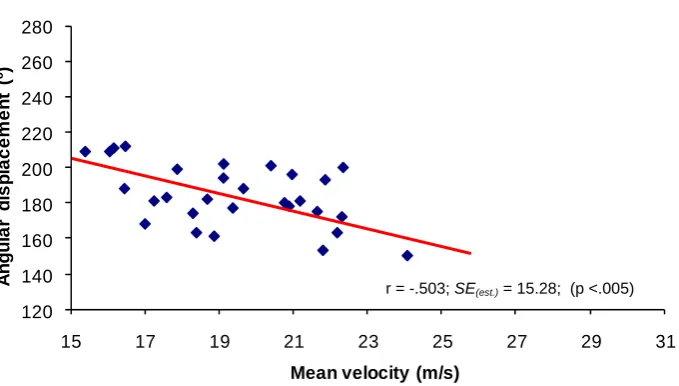
Figure 1. Diagram of dispersion and lineal regression between average velocity of the hammer head
in the antepenultimate turn (vM(n-2)) and its angular displacement during the double support phase
(δDS(n-2)). 120
140 160 180 200 220 240 260 280
15 17 19 21 23 25 27 29 31
A
n
g
u
lar d
isp
la
ceme
n
t (
º)
Mean velocity (m/s)
© 2009 University of Alicante. Faculty of Education. ISSN 1988-5202
Figure 2. Diagram of dispersion and lineal regression between the average velocity of the hammer
head in the penultimate turn (vM(n-1)) and its angular displacement during the double support phase
(δDS(n-1)).
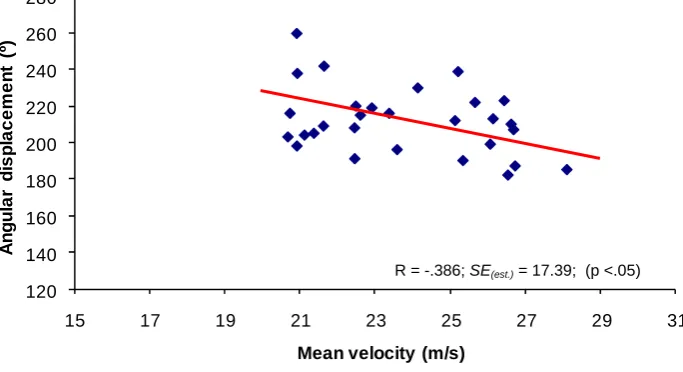
In the final action of the throw an inverse relation between the variables described can be seen (p<.05), although an inverse correlation has been found between the moment of release, expressed in the azimuthal angle, and the average velocity in the final action of the throw (r=0-391; p<.05), which reveals that the negative correlation between the angular displacement in the double support phase (δF) and the average velocity in the final action (vM(F))occurs as a consequence of the fact that in the shorter throws, the athlete tends to catch up with the hammer at the end of the throw when it is already in a tangential trajectory and the possibility of continuing to accelerate it is very reduced. Figure 3 shows the dispersion of the data and the lineal regression between angular displacement (δF) and the average velocity in the final action (vM(F)).
Figure 3. Diagram of dispersion and lineal regression between the average velocity of the hammer
head during the final action of the throw (vM(F)) and its angular displacement (δF)).
120 140 160 180 200 220 240 260 280
15 17 19 21 23 25 27 29 31
A
ngul
a
r dis
pl
aceme
n
t (
º)
Mean velocity (m/s)
r = -.228; SE(est.) = 15.95
120 140 160 180 200 220 240 260 280
15 17 19 21 23 25 27 29 31
A
n
g
u
la
r d
isp
lacemen
t
(º
)
Mean velocity (m/s)
© 2009 University of Alicante. Faculty of Education. ISSN 1988-5202 No correlation coefficients have been found in relation to the angular displacement of the hammer head (δ) and the change in velocity (Δv) in the double support phase that would entitle us to confirm the existence of a sure relation between the variables, thus showing that the angular displacement of the hammer head in the double support phase is not related to the acceleration produced in this phase.
DISCUSSION
The data do not give any statistically significant values that permit us to confirm the existence of a relation between the angular displacement of the hammer head and the change of velocity produced in the double support phases (table 2) and, therefore, we cannot state that prolonging this phase is a significant contributing factor in the result of the throw, as historically coaches had believed after the findings of Kuznetsov (1965) and Bondartschuk (1987).
The relation found between angular displacement of the hammer head in the double support phase (δ) and the average velocity of the hammer head (vM) in the antepenultimate turn (n-2), demonstrates that those throwers who reach a higher average velocity in this turn tend to reduce the double support phase. Therefore it may be correct at slow velocities to prolong this phase although, when the average velocity is increased, as happens in the penultimate turn (M=21.43; SD=2.45), the angular displacement is significantly reduced from the previous turn (F=19.58; p<.001) and its correlation with average velocity ceases to be statistically significant. This makes us think that when the hammer reaches a certain velocity its angular displacement in the double support phase tends to be less than those achieved when the average velocity of the hammer is slower.
Prolonging the double support phase, so bringing the hammer forward to achieve greater acceleration in this phase, as proposed by Kuznetsov (1965) and Bondartschuk (1987), is a good solution in the first turns when the tangential velocity of the CG of the hammer is relatively low. But, as the tangential velocity of the CG increases, bringing the support excessively forward could produce a certain reduction of the angular velocity of the thrower plus hammer system, and some momentum of force contrary to its angular displacement appears, so prejudicing the throw.
© 2009 University of Alicante. Faculty of Education. ISSN 1988-5202 or double support phases. Even when the reaction force is decreasing in the singles support phases, the cable´s tension is growing (Murofushi, 2007).
REFERENCES
1. BONDARTSCHUK AP. Die moderne technik bein hammerwerfen. Leichtathletic, österreich. 1979; 2(3):22-23. [Back to text]
2. BONDARTSCHUK AP. La técnica moderna en el lanzamiento de martillo. Cuadernos de Atletismo. 1987; 20:65-72. [Back to text]
3. BRICE S, NESS K, ROSEMOND D, LYONS K & DAVIS M. Development and validation of a method to directly measure the cable force during the hammer throw. Sports Biomechanics. 2008; 7(2):274–287. [Abstract] [Back to text]
4. DAPENA J. The pattern of hammer speed during a hammer throws and influence of gravity on its fluctuations. Journal of Biomechanics. 1984; 17(8):553-559. [Abstract] [Back to text]
5. DAPENA J. Factors affecting the fluctuations of hammer speed in a throw. In D. A. Winter, R. W. Norman, P. R. Wells, K. C. Hayes, and A. E. Palta (Eds.), Biomechanics IX. Champaign: Human Kinetics; 1985. 499–503. [Abstract] [Back to text]
6. DAPENA J. A kinematic study of center of mass motion in the hammer throw. Journal of Biomechanics. 1986; 19(2)147-158. [Abstract] [Back to text]
7. DAPENA J. Influence of direction of the cable force and of the radius of the hammer path on speed fluctuations during hammer throwing. Journal of Biomechanics. 1989; 22(6):565-575. [Abstract] [Back to text]
8. DAPENA J & MCDONALD G. A three-dimensional analysis of angular momentum in the hammer throw. Medicine and science in sports and exercise. 1989; 21(2):206-220. [Abstract] [Back to text]
9. GUTIÉRREZ M & SOTO VM. Análisis biomecánico del lanzamiento de martillo (primera parte). Apunts Medicina de l´Esport. 1993; XXX:275-287. [Abstract] [Full text] [Back to text]
10.GUTIÉRREZ M & SOTO VM. Análisis biomecánico del lanzamiento de martillo (segunda parte). Apunts Medicina de l´Esport. 1994; XXXI:47-60. [Abstract] [Full text] [Back to text]
11.GUTIÉRREZ M, SOTO VM & ROJAS FJ. A biomechanical analysis of the individual techniques of the hammer throw finalists in the Seville Athletics World Championships 1999. IAAF New Studies in Athletics. 2002; 17(2):15-23. [Abstract] [Full text] [Back to text]
12.KUZNETSOV V. Path and speed of the hammer in the turns. Legk. Atletika. 1965; 11:11-12. [Back to text]
13.MUROFUSHI K, SHINJI SAKURAI S, UMEGAKI U & TAKAMATSU J. Hammer acceleration due to thrower and hammer movement patterns. Sports Biomechanics. 2007; 6(3):301–314. [Abstract] [Back to text]