e-ISSN: 2278-067X, p-ISSN: 2278-800X, www.ijerd.com
Volume 13, Issue 11 (November 2017), PP. 43-49
Estimation of Age Group using Histogram of Oriented gradients
and Neural Network
*
1Arpit Kumar Sharma
Corresponding Author:Arpit Kumar SharmaABSTRACT:
Requirement of Project: Face images are being increasingly used as additional means of authentication in applications of high security zone. But with age progression the facial features changes and the database needs to be updated regularly which is a tedious task. So we need to address the issue of facial aging and come up with a mechanism that identifies a person in spite of aging. In my project, effective age group estimation using face features like texture and shape from human face image are proposed[2]. For better performance, the geometric features of facial image like wrinkle geography, face angle, left to right eye distance, eye to nose distance, eye to chin distance and eye to lip distance are calculated. Based on the texture and shape information, age classification is done using KNN & SVM algorithm (Best algorithm according to many research paper during my research)."
Proposed System: "In this report, few classification and feature extraction techniques used for age group classification. In this report first we attempt to combining two type of face features using haar features extraction (Wrinkle features and Geometrical Features) also used viola Jones for face detection. Age estimation based on the graphical model structure is proposed. Three popular features, PCA (Principal Component analysis), HOG and Haarfeatures, are exploited in our work, and three different graphical model structures considering spatial information and hidden topics are proposed and implemented. The experimental results showed that our model performs classification techniques like SVM (support vector machine), KNN and Neural network and the comparisons between features extraction algorithm and classification techniques in order to obtain best output. features are also presented and discussed. Until now, the model we proposed hasn’t been well-tuned, and we’ll try to improve it for the future works." Research in those areas has been conducted for more than 30 years. "Traditionally, face recognition uses for identification of documents such as land registration, passports, driver’s licenses, and recognition of a human in a security area. [22]
--- Date of Submission: 30-10-2017 Date of acceptance: 09-11-2017 ---
I. GENERAL INTRODUCTION
Most of the facial variants such as identity, expression, emotions and gender have been widely studied, in the case of research of recognition. Automatic age estimation is one such area that has been rarely explored by the researchers. With the evolution of a human, the features of the face keep on changing with age. This project is providing a new combine approach of feature selection for age group classification algorithms. Further this process is further classified into three main stages: first one is Pre-processing, second is Feature Extraction (Haar feature extraction), and the last stage is classification. For feature extraction phase we used two techniques 1) Wrinkle features and 2) Geometrical features for the face pattern recognition [11]. We know that Wrinkle features are well enough to differentiate between the adult and senior, Geometrical features is good to create difference between child and adult/senior. That is why we used a combine technique of wrinkle and geometrical so that they can solve each other problems and provide the best output. These two approaches are defined below:
1.1.1) Geometrical features
This include face angle, left eye to right eye distance, eyeball, eye to nose distance, eye to chin distance and eye to lip distance that is further calculated by making use of the best feature selection algorithm
1.1.2) Wrinkle features
Age classification based on the texture and shape information is done by using suggested hybrid algorithm which includes Fuzzy logic and Neural Network. Depending on a number of groups age ranges are then classified dynamically using hybridization algorithms individually.
44
is beneficial for identification of documents such as for land registration, passports, driver’s licenses, and recognition of a human in a security area [84]. Face images are highly used as additional means of authentication in applications having high security zone. But with increase in age the facial features also keep on changes and the database needs to be updated regularly which is one very tedious task. Hence we need to address this issue of facial aging and come up with a solution that identifies a person without any age limits. In this thesis, effective age group estimation using face features like texture and shape from human face image is proposed. For getting efficient results, the geometric features of the facial image like wrinkle geography, face angle, left to right eye distance, eye to nose distance, eye to chin distance and eye to lip distance are calculated [90]. Based on the texture and shape information, age classification is done by making use of classification algorithms
II.
EXISTING SYSTEM
As we already discussed in literature survey age group classification is one of the research topics from last few years. Many research already done research on the age group classification with different algorithms (Surf algorithm, PCA and LDA etc.) and different classification techniques were used. In the age group classification the most difficult part is to identify the different pattern of the faces[78]. Many authors have tried and failed. As per our research many researchers failed to observe the exact pattern of different age group. Pattern recognition, having two critical task one features extraction and another is classification. Researcher tried to work hard on the machine learning algorithm and many of them is ignore features extraction improvisation. As the result they cannot obtain good output, but all the literature author work excellent on classification algorithm which include (Neural network, KNN, SVM and Fuzzy logic)[65].
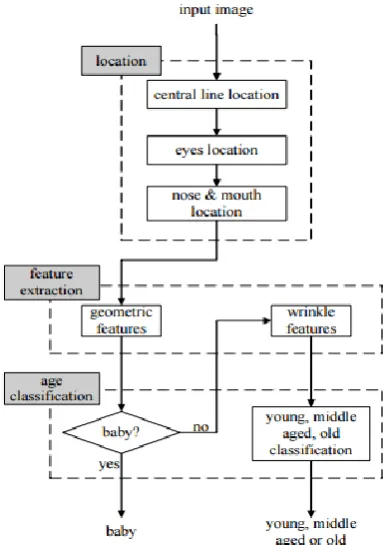
Block diagram of proposed work
3.3 Flow Chart Of Age Classification
FLOW CHART OF PROPOSED SYSTEM
`
2.1 Feature Extraction
46 wrinkles on the face in the following areas as mentioned below : a) The forehead has horizontal furrows.
b) The eye corners have crow’s feet.
c) The cheeks have clear cheekbones, sickle molded pouches, and profound lines between the cheeks and the upper lips.
Since there are evident changes in wrinkle intensities and even some form clear lines, thus in this Project we make use of Sobel edge magnitudes, approximating gradient magnitudes in order to judge the level of wrinkles[15]. The Sobel edge magnitude is larger, if the pixel belongs to wrinkles. The reason behind the larger magnitude is that the difference of gray levels is self-evident. From this perspective, a pixel is named as a wrinkle pixel if its sobel edge size is bigger than some limit. Figure 7 (a) and (c) demonstrate a youthful grown up and an old grown up[69].
2.3 Geometrical Features
As indicated by the investigations of facial representation and emotional cosmetics, there occurs a lot of change in the facial features as the age keeps on increasing. In this phase, global features in combination with the grid features are extracted from the face images. The global features include the distance between two eye balls, chin to eye, nose tip to eye and eye to lip[76].
By making use of four distance values, there occurs calculation of four features namely F1, F2, F3 and F4 as mentioned below:
F1 = (distance from left to right eye ball) / (distance from eye to nose). F2 = (distance from left to right eye ball) / (distance from eye to lip). F3 = (distance from eye to nose) / (distance from eye to chin). F4 = (distance from eye to nose) / (distance from eye to lip).
It is clear that new born babies have a number of wrinkles on their faces. The head bone structure in new born ones is not fully grown. Moreover the ration of primary features is highly different from those in other life spans. Hence we can conclude that it is more reliable to use geometric features as compared to wrinkle features when it is to be judged that whether an image is a baby or not[82].
In case of infants, the head is near a circle. The distance between two eyes is almost equal to the distance from eyes to mouth. As the head bone grows, the head becomes oval shaped and accordingly there occurs a sudden increase in the distance from the eyes to the mouth. Above and beyond the ratio between baby’s eyes and noses is equal to the distance between noses and mouths which in turn are almost equal to one while as in case of adults it is larger than 1[88].
Classification (Knn Algorithms)
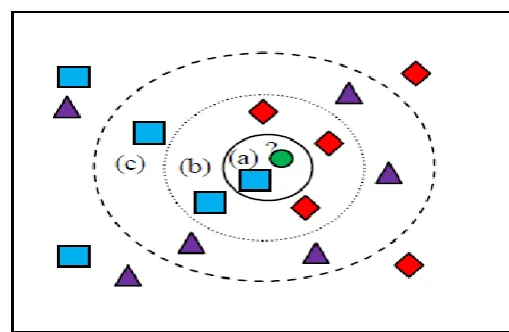
Fig 3.8 :KNN classification. At the query point of the circle depending on the k value of 1, 5, or 10, the query point can be a rectangle at (a), a diamond at (b), and a triangle at (c).
The KNN is classifies an object where the majority of the neighbor belongs to. The choice of the number of neighbors is discretionary and up to the choice of the users. If k is 1 then it is class ified [10] whichever class of neighbor is nearest[13].
result = knnclassify(Sample, Training, Group, k)
3.2 Histogram of Oriented Gradients(HoG):
The next step is to extract the features of the hand gesture. This system uses the HoG descriptor (Histogram oriented gradient) to present the hand shape. HoG descriptor counts the number of times a gradient orientation occurs in a localized are of the image[22]. It uses a histogram of intensity gradient to depict the shape of the object. This technique is resilient under change of shadow and illumination. Due to this, it's a popular method for hand gesture detection[43]. The implementation method of the HoG algorithm descriptor is given as follows. Firstly, the cells are divided into smallest possible regions of an image. These regions are called cells. For each of these cells, a histogram of of gradient orientations or edge orientations is computed. Each cell is separated and discreted into corresponding angular bins in accordance with its gradient orientation. The weighted gradient of each cell is contributed to its respective angular bin. The adjacent cell with same gradient orientation are grouped together and these spatial regions are known as blocks[57]. These groupings into blocks is the basis for histograms' normalization. The normalized group represents the block histogram which in turn represent the descriptor [21].
3.3) Principal Component Analysis(PCA)
PCA is one of the best available statistical methods available that is used for image compression and gesture recognition. The basic ideology behind the PCA algorithm is the reduction of the dimensionality of an image and also maintaining maximum variance. The features which remain then are the ones relevant for recognition[59]. Whenever there is 2-dimensional data, then due to the presence of more than 2 variables, the visualization of of the relationships becomes complex. PCA reduces the dimensionality of the data such that the two actual variables are reduced to less number of new one dimensional variables which are called Principal Components. This is done by using a single variable for a group of variables. The principal components are a linear representation of the actual variables[64]. These principal components can also be represented in the form of vectors called Eigen Vectors. The Eigen Vectors collectively create a feature space known as Eigen space which is calculated by the eigen vectors of a co-variance matrix derived from a hand gesture set. Each input gesture image corresponds to eigen vectors which represents the feature vector of the image[79].
3.4 SVM (Support Vector Machine)
48
Fig 3.6.4: Shows the formation of hyperplane and also the how the image is classified between red and blue using SVM.
Fig. 3.6.4(B) Overall flow diagram of project
III.
CONCLUSION
increased for classification the accuracy of classification is decreased. There is a strong possibility for further extension of the work which includes extracting more feature points that can improve accuracy of age group classification. By introducing more features the age range can also be further enhanced.
Future Scope
The future work is to add more category in the field of age group recognition classes to the given system. Also since the proposed system is limited to classify only for front images, so modeling 3-D face using various cameras to increase the efficiency of the proposed facial age recognition system can be used for future work. We can also implement face age detection by using fuzzy logic and genetic algorithm.
REFERENCE
[1]. A.Lanitis and C.J.Taylor, ―Towards Automatic Face Identification Robust to Ageing Variation‖, IEEE Trans. on Pattern Analysis and Machine Intelligence, vol.24, no.24, p.442-455, 2002.
[2]. A.Lanitis, C.Draganova, and C.Christodoulou, ―Comparing different classifiers for automatic age estimation‖, IEEE Trans.Syst.Man, Cybern.B, Cybern, vol34, no.1, pp.621-628, Feb.2004.
[3]. V. Blanz and T. Vetter, ―Face recognition based on fitting a 3D morphable model‖, IEEE Transactions on Pattern Analysis and Machine Intelligence, 25(9):1063 –1074, September 2003.
[4]. R. Kimmel A. M. Bronstein, M. M. Bronstein, ―Three-dimensional face recognition‖, Intl. Journal of Computer Vision, 64(1):5–30, August 2005.
[5]. N.Ramanathan and R. Chellappa, ―Face verification across age progression‖, in Proc. IEEE Conf. Computer Vision and Pattern Recognition, San Diego, CA, 2005, vol.2, pp.462-469.
[6]. N.Ramanathan and R. Chellappa, ―Modeling Age Progression in young faces‖, in Proc. IEEE Conf. Computer Vision and Pattern Recognition (CVPR), vol.1, pp.387-394, 2006.
[7]. G. Guo, A. Jain, W. Ma, and H. Zhang, ―Learning similarity measure for natural image retrieval with relevance feedback,‖ IEEE Trans.Neural Netw., vol. 13, no. 4, pp. 811–820, Apr. 2002.
[8]. G. Guo and S. Li, ―Content-based audio classification and retrieval by support vector machines,‖ IEEE Trans. Neural Netw., vol. 14, no. 1,pp. 209–215, Jan. 2003.
[9]. G. Guo, S. Li, and K. Chan, ―Support vector machines for face recognition,‖ Image Vis. Comput., vol. 19, no. 9-10, pp. 631–638, 2001.
[10]. G. Guo, S. Li, and K. Chan, ―Face recognition by support vector machines,‖ in Proc. IEEE Conf. FG, 2000, pp. 196–201. [11]. [X. F. He and P. Niyogi, ―Locality preserving projections,‖ presented at the NIPS, 2003.
[12]. T. Joachims, ―Making large-scale SVM learning practical,‖ in Advances in Kernel Methods—Support Vector Learning, B. Schölkopf,C. Burges, and A. Smola, Eds. Cambridge, MA: MIT Press, 1999.
[13]. Y. Kwon and N. Lobo, ―Age classification from facial images,‖ Comput. Vis. Image Understand., vol. 74, no. 1, pp. 1–21, 1999. [14]. A. Lanitis, C. Taylor, and T. Cootes, ―Toward automatic simulation of aging effects on face images,‖ IEEE Trans. Pattern Anal.
Mach. Intell.,vol. 24, no. 4, pp. 442–455, Apr. 2002.
[15]. Abed, M. A., Ismail, A. N., &Hazi, Z. M. (2010). Pattern recognition using genetic algorithm. International Journal of Computer and Electrical Engineering,2(3), 1793-8163.
[16]. [Gundogan, K. K., Alatas, B., &Karci, A. (2004). Mining classification rules by using genetic algorithms with non -random initial population and uniform operator. Turk J Elec Engin, 12(1)
[17]. Maulik, U., &Bandyopadhyay, S. (2000). Genetic algorithm-based clustering technique. Pattern recognition, 33(9), 1455-1465. [18]. Kwan, H. K., &Cai, Y. (1994). A fuzzy neural network and its application to pattern recognition. Fuzzy Systems, IEEE
Transactions on, 2(3), 185-193.
[19]. Karnik, N. N., & Mendel, J. M. (1998, May). Introduction to type-2 fuzzy logic systems.In Fuzzy Systems Proceedings, 1998. IEEE World Congress on Computational Intelligence., The 1998 IEEE International Conference on (Vol. 2, pp. 915-920). IEEE. [20]. Castillo, O., &Melin, P. (2008). Type-2 Fuzzy Logic: Theory and Applications. Heidelberg, Germany: Springer-Verlag.