VOLUME 12 | ISSUE 1 | 2017 | 29
Enhancement of power in the concentric phase of
the squat and jump: Between-athlete differences
and sport-specific patterns
ERIKA ZEMKOVÁ1 , TOMÁŠ VILMAN1, ALENA CEPKOVÁ2, MARIÁN UVAČEK2, PETER OLEJ1,
JAROMÍR ŠIMONEK3
1 Faculty of Physical Education and Sport, Comenius University in Bratislava, Slovakia 2 Faculty of Mechanical Engineering, Slovak University of Technology, Bratislava, Slovakia 3 Faculty of Education, Constantine the Philosopher University, Nitra, Slovakia
ABSTRACT
This study compares the differences in peak and mean power in the acceleration, as well as over the entire concentric phase of jumps and squats performed with and without countermovement (i.e. delta power) in athletes of different specializations. The participants performed either barbell squats or barbell jumps with and without countermovement bearing a weight of 70% 1RM. Results identified a significantly higher delta mean power in the entire concentric phase of jumps than in squats for high jumpers (29.8%, p=0.009) and volleyball players (24.3%, p=0.027). More specifically, their values were significantly higher during jumps in indoor volleyball players but not in beach volleyball players. On the other hand, rock & roll performers exhibited a significantly higher delta mean power during squats than jumps (19.5%, p=0.034) but this was only evident in those who specialized in acrobatics as opposed to dance. However, the values did not differ significantly during either jumps or squats for hockey players (9.5%, p=0.424) and karate competitors (11.6%, p=0.331). A similar trend was observed for peak and mean power in the acceleration phase of jumps and squats. It may be concluded then, that enhancement of power in the concentric phase of jumps and squats bearing an external load, differs in athletes with diverse demands on the explosive strength of their lower limbs. For most athletes, jumping may be considered a more specific alternative for the estimation of the
1Corresponding author. Department of Sports Kinanthropology, Faculty of Physical Education and Sport, Comenius University in Bratislava, Nábr. arm. gen. L. Svobodu 9, 814 69 Bratislava, Slovakia.
E-mail: [email protected] Submitted for publication April 2016 Accepted for publication May 2017
JOURNAL OF HUMAN SPORT & EXERCISE ISSN 1988-5202 © Faculty of Education. University of Alicante
30 | 2017 | ISSUE 1 | VOLUME 12 © 2017 University of Alicante ability to utilize elastic energy during countermovement exercise, whereas for others it may be the squat. Key words: POWER OUTPUT, UTILIZATION OF ELASTIC ENERGY, WEIGHT-LIFTING EXERCISES
Cite this article as:
Zemková, E., Vilman, T., Cepková, A., Uvaček, M., Olej, P., & Šimonek, J. (2017). Evaluation of a test module to measure relevant components of ball release height in jump throws in team handball.
VOLUME 12 | ISSUE 1 | 2017 | 31 INTRODUCTION
Strength training is utilised for various purposes, such as the improvement of power and strength endurance, increasing muscle mass, and/or the prevention of injuries (Zatsiorsky & Kraemer, 2006). To improve neuromuscular coordination (motor unit recruitment, rate coding, synchronization and the entire coordination pattern), the maximal effort method is applied. Conversely, to stimulate muscle hypertrophy, the methods of repeated and submaximal efforts are appropriate. By varying the intensity, training load, and type of exercise, adaptation in the desired direction can be implemented.
Commonly, heavy resistance is employed to enhance muscular strength, or more specifically; the maximal force generated by an athlete in a given motion. A typical example would be a weightlifter who exerts the greatest effort on a barbell in order to accelerate it maximally in the desired direction. To improve maximal strength, the forces generated in the movement (F) should be > 80% of the maximal force (Fmax). Contrary to this, F < 20% of Fmax is used to train muscular endurance (Zatsiorsky & Kraemer, 2006).
Another example is aerobic gymnasts or rock & roll performers, for whom explosive strength should be maintained for the prescribed period of the performance (Zemková & Dzurenková, 2009). Although the height of a jump in aerobics is about 3-times lower than in a maximal jump (Kyselovičová & Zemková, 2010), the
exercise must be maintained throughout an entire 1:45 minute routine that consists of about 182 jumps out of 352 other elements (e.g. balance, flexibility, strength).
Muscle hypertrophy is primarily the goal of bodybuilders, though some competitive athletes also employ the same training methods. For instance, shot-putters can utilise about 50% of Fmax during throws. Since these maximal forces should be exerted in minimal time, explosive strength is a critical ability for these athletes. Explosive strength can be a limiting factor in the performance of most combat sports however, for example tae-kwon-do and/or karate (Zemková & Dzurenková, 2004). The production of maximal force in the shortest possible time is essential for techniques such as punching and kicking. This ability is also important in the take-off movement required for sprinting and long and high jumping, as well as for sports such as basketball and volleyball.
32 | 2017 | ISSUE 1 | VOLUME 12 © 2017 University of Alicante This ability can be assessed by estimating the difference in power during the concentric phase of weight exercises performed with and without countermovement (CM). It has been demonstrated (Bosco et al., 1982) that activation of the stretch-shortening cycle during CM weight exercises, leads to a higher power production in the concentric phase than is evident in a lift performed without CM. The greater the difference between the power outputs during weight exercises performed with and without countermovement, the more the ability to utilize elastic energy is enhanced. It has been established that during bench presses this potentiating effect is rather modest at lower weights but becomes more pronounced as the weight increases, reaching a maximum at about 60% 1RM (Zemková & Hamar, 2013). Lifting heavier weights not only fails to increase the enhancing effect, but actually leads to its decline. A similar trend has been observed during squats, with the maximal enhancement of power due to CM in the concentric phase of lifting at about 70-80% 1RM. Though squats may be suitable for resistance-trained individuals, for high jumpers or volleyball players, who utilize short take-off movements in their performance, the jump may represent a more appropriate alternative. While athletes experienced in weight training are not familiar with barbell CMJs, for power athletes the squat
may constitute a “controlled” effort that does not allow the full potentiation of power in the concentric phase of the exercise.
Therefore, the question remains whether differences exist in the potentiation of power due to CM in the concentric phase of squats and jumps between athletes of different specializations. It is also not known whether the proposed method of estimating the ability to utilize elastic energy during CM exercises (the difference in power between exercises with and without CM, expressed as delta power) distinguishes between athletes with diverse demands on the explosive strength of their lower limbs. It has been assumed that between-group and within-group differences in delta power during squats and jumps are due to the preferred exercise mode used in training and competition. Verification of this hypothesis was accomplished by the comparison of delta peak and delta mean power during acceleration, and throughout the entire concentric phase of squats and jumps in athletes of various sports and selected specializations.
MATERIALS AND METHODS
Participants
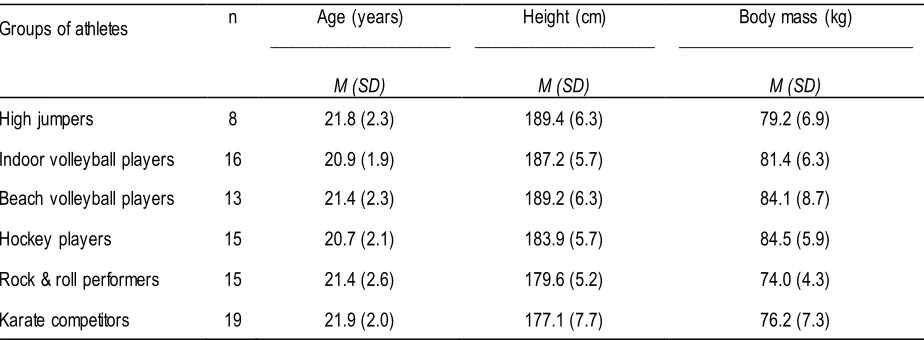
Groups of male athletes of varied sport specializations volunteered to participate in the study (Table 1). The
participants were required to be active in their particular sport. They each had over 8 years’ experience, in
VOLUME 12 | ISSUE 1 | 2017 | 33
Table 1. Characteristics of the group of athletes
Groups of athletes n ____________________ Age (years)
M (SD)
Height (cm) ____________________
M (SD)
Body mass (kg) __________________________
M (SD)
High jumpers 8 21.8 (2.3) 189.4 (6.3) 79.2 (6.9)
Indoor volleyball players 16 20.9 (1.9) 187.2 (5.7) 81.4 (6.3)
Beach volleyball players 13 21.4 (2.3) 189.2 (6.3) 84.1 (8.7)
Hockey players 15 20.7 (2.1) 183.9 (5.7) 84.5 (5.9)
Rock & roll performers 15 21.4 (2.6) 179.6 (5.2) 74.0 (4.3)
Karate competitors 19 21.9 (2.0) 177.1 (7.7) 76.2 (7.3)
Procedures
Prior to the study, the participants were provided with a familiarization session, during which the techniques of both exercises were explained. Emphasis was placed on the correct exercise technique and on achieving a knee angle of 90° during both squats and jumps.
After a standardized warm-up (a dynamic flexibility and stretching routine) and a specific warm-up (5 consecutive trials of each exercise without carrying an additional load), the subjects were required to perform barbell squats and jumps bearing a weight of 70% of the previously established 1 repetition maximum (1RM), in random order. The selection of this weight was based on previous findings which identified that maximal delta power calculated from the peak and mean values in acceleration and over the entire concentric phase of squats was achieved at 67% of 1RM, 69% of 1RM, and 77% of 1RM, respectively (Zemková et al., 2014). Exercises were performed with and without countermovement (CM), using maximal effort in the concentric phase while holding a barbell on the back.
Squats and jumps without CM began from an initial semi squat position (90° knee flexion) regulated by visual inspection. Subjects were required to hold this position for approximately 2 seconds before performing the exercise (a squat or a jump, respectively) on the command of the tester. Each subject was observed during the exercise to ensure that no countermovement occurred. The range of the movement was also recorded in graphic and digital forms using the FiTRO Dyne Premium system.
Exercises with CM consisted of an initial movement from full extension to a knee angle of 90°, followed immediately by an upward movement (a squat or a jump, respectively). A laboratory assistant stood behind the subjects to prevent a possible fall.
Rest intervals of 2 minutes were applied between reps. The most effective result of the 2 trials for both exercises with and without countermovement, were taken for evaluation.
Measures
34 | 2017 | ISSUE 1 | VOLUME 12 © 2017 University of Alicante on a precise encoder mechanically coupled to a reel. Pulling the tether (connected by means of small hook to the barbell axis) out of the reel causes it to rotate which enables it to measure velocity. The rewinding of the reel is accomplished by a string producing a force of about 2 N. Signals from the sensor unit are conveyed to the PC by means of a USB cable.
The system operates on Newton´s law of universal gravitation (force equals mass multiplied by the gravitational constant) and Newton´s law of motion (force equals mass multiplied by acceleration). The instantaneous force while moving a barbell of a specific mass in the vertical direction is calculated as the sum of the gravitational force (mass multiplied by the gravitational constant) and the acceleration force (mass multiplied by acceleration). The acceleration of the vertical motion (positive or negative) is obtained by the derivative of vertical velocity, measured by a highly precise device mechanically coupled to the barbell. The power is calculated as the product of force and velocity, and the actual position by the integration of velocity. Comprehensive software allows the collection, calculation and on-line display of the basic biomechanical parameters involved in resistance exercises.
The device was placed on the floor and anchored to the bar by a nylon tether. Subjects performed exercises while pulling on the tether connected to the device. Analysis was performed on peak and mean power in the acceleration and throughout the entire concentric phase of the lifting process. Previous studies have demonstrated that measurements of peak and mean power during resistance exercises using the FiTRO
Dyne Premium system provides reliable data (Gažovič, 1995; Jennings et al., 2005; Zemková et al., 2015). As a parameter of the capability to utilize elastic energy, the difference in power in the concentric phase of exercise with and without countermovement (delta power) was considered.
Statistical Analysis
Data analyses were performed using the statistical program SPSS for Windows version 18.0 (SPSS, Inc., Chicago, IL, USA). The Kolmogorov-Smirnov test of normality and Levene´s test of the equality of error variances was conducted on all variables. These data were normally distributed according to the Kolmogorov-Smirnov test and no significant differences were detected with the Levene test. Data were analysed using a 2 x 2 x 5 analysis of variance (ANOVA). Factors included exercise type (squat, jump) x contraction type (concentric-only, eccentric-concentric) x groups of athletes (high jumpers, hockey players, karate competitors, rock & roll performers and volleyball players). Where significant differences were detected (p≤
0.05), a Tukey post hoc test was utilised. Further analysis was conducted on the data from rock & roll performers of different specializations (acrobatics and dancing), volleyball players performing on varied surfaces (floor and sand), and those playing different positions (spikers, blockers, and setters). Given the small number of participants in these sub-groups, the Wilcoxon signed ranks test was used to determine the statistical significance of the variations in delta power during squats and jumps. The significance level was set at α < 0.05 for all comparisons. The descriptive statistics calculated include means and standard deviations (SDs).
RESULTS
Differences in delta power between groups of athletes of varied specializations
VOLUME 12 | ISSUE 1 | 2017 | 35
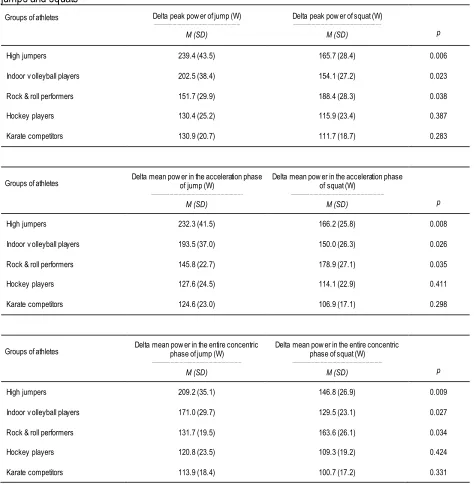
concentric phase (the difference between the exercise with and without CM) was significantly higher during jumps as compared to squats in high jumpers and volleyball players.In contrast, for rock & roll performers delta power was significantly higher during squats than jumps. However, hockey players and karate competitors recorded no significant differences in delta power during jumps and squats.Similar trends were observed for delta peak and mean power in the acceleration phase of jumps and squats in the examined groups of athletes (Table 2).
Table 2. Delta peak power and delta mean power in the acceleration and over the entire concentric phase of jumps and squats
Groups of athletes Delta peak pow er of jump (W)
____________ __ ___ __ __ ___ __ __ ___ __ __ ___ __ __ __ ___ __
M (SD)
Delta peak pow er of squat (W)
____________ __ ___ __ __ ___ __ __ ___ __ __ ___ __ __ __ ___ __ _
M (SD) p
High jumpers 239.4 (43.5) 165.7 (28.4) 0.006
Indoor v olleyball players 202.5 (38.4) 154.1 (27.2) 0.023
Rock & roll performers 151.7 (29.9) 188.4 (28.3) 0.038
Hockey players 130.4 (25.2) 115.9 (23.4) 0.387
Karate competitors 130.9 (20.7) 111.7 (18.7) 0.283
Groups of athletes Delta mean pow er in the acceleration phase of jump (W)
____________ __ ___ __ __ ___ __ __ ___ __ __ ___ __ __ __ ___ __ __ _
M (SD)
Delta mean pow er in the acceleration phase of squat (W)
____________ __ ___ __ __ ___ __ __ ___ __ __ ___ __ __ __ ___ __ __ __
M (SD) p
High jumpers 232.3 (41.5) 166.2 (25.8) 0.008
Indoor v olleyball players 193.5 (37.0) 150.0 (26.3) 0.026
Rock & roll performers 145.8 (22.7) 178.9 (27.1) 0.035
Hockey players 127.6 (24.5) 114.1 (22.9) 0.411
Karate competitors 124.6 (23.0) 106.9 (17.1) 0.298
Groups of athletes Delta mean pow er in the entire concentric phase of jump (W)
____________ __ ___ __ __ ___ __ __ ___ __ __ ___ __ __ __ ___ __ __
M (SD)
Delta mean pow er in the entire concentric phase of squat (W)
____________ __ ___ __ __ ___ __ __ ___ __ __ ___ __ __ __ ___ __ __
M (SD) p
High jumpers 209.2 (35.1) 146.8 (26.9) 0.009
Indoor v olleyball players 171.0 (29.7) 129.5 (23.1) 0.027
Rock & roll performers 131.7 (19.5) 163.6 (26.1) 0.034
Hockey players 120.8 (23.5) 109.3 (19.2) 0.424
36 | 2017 | ISSUE 1 | VOLUME 12 © 2017 University of Alicante
Differences in delta power between selected groups of athletes of varied specializations
Only male rock & roll competitors in acrobatics and dancing were selected for analysis due to the variances in their muscle work during performances, as compared to female performers (Figure 1 a). While males are accustomed to performing semi-squats while holding their counterparts, females jump predominantly with straight legs. The delta mean power was significantly higher during squats than jumps for rock & roll acrobatics competitors (F1,13 = 5.96, p = 0.024), whereas rock & roll dancers recorded no significant difference between squats and jumps (F1,13 = 1.07, p = 0.266).
Indoor volleyball and beach volleyball players accustomed to jumping with only their body weight (competition) as well as with an external load (training) on various surfaces were selected for further analysis (Figure 1 b). Volleyball players using a stable support base performed more effectively during jumps than squats (F1,27 = 6.78, p = 0.019), whereas there were no significant differences in delta mean power between jumps and squats in their counterparts playing on sand (F1,27 = 2.47, p = 0.134).
Figure 1.Delta mean power during jumps and squats in (a) rock & roll performers and (b) volleyball players
(*p ≤ 0.05)
Differences in delta power within a selected group of athletes
Further differences in countermovement potentiation of power in the concentric phase of jumping were identified in volleyball players who played different positions (Figure 2). Significantly higher delta power (the difference between the power produced during a jump with and without CM) was observed in spikers than blockers (F1,14 = 12.24, p = 0.005) and setters (F1,14 = 15.88, p < 0.001). A significant difference in delta power was also identified between blockers and setters (F1,14 = 4.37, p = 0.038). Interestingly, blockers were able to jump more effectively from a semi squat position without CM than spikers, which reduced the difference between countermovement and squat jumps.
0 50 100 150 200 250
Rock & roll acrobatics
Rock & roll dancing D e lta m e a n p o w e r (W ) Jump Squat
*
n.s. 0 50 100 150 200 250 Indoor volleyball players Beach volleyball players D e lta m e a n p o w e r (W ) Jump SquatVOLUME 12 | ISSUE 1 | 2017 | 37
Figure 2.Mean power in the concentric phase of countermovement jumps and squat jumps in volleyball
players (*p ≤ 0.05, **p ≤ 0.01)
DISCUSSION
As stated, higher power outputs during countermovement than during concentric-only jumps and squats were recorded for all groups of athletes. The production of enhanced power during countermovement weight exercises may be attributed to the activation of the stretch-shortening cycle (SSC). An effective SSC requires three critical elements: a well-timed reactivation of the muscle(s) before the eccentric phase, a short and fast eccentric phase, and an immediate transition (a very short delay) between the stretching (eccentric) and shortening (concentric) phases (Komi & Gollhofer, 1997).
The mechanism underlying this enhancement of power is usually ascribed to the utilization of elastic energy stored in the elastic components of muscle in combination with reflexively induced neural input (Thys et al., 1972; Thys et al., 1975; Komi & Bosco, 1978; Bosco et al., 1982; Komi, 1984). Alternative explanations propose that the pre-stretch of an active muscle alters the properties of the contractile machinery, and that prior stretching allows the muscles to reach a maximally active state before the concentric contraction begins (Bosco & Viitasalo, 1982; Avis et al., 1986; Bobbert et al., 1996). However, Finni et al. (2001) identified no disparity in electromyographic (EMG) activity between the SSC and isometric conditions in the concentric portion of a vertical jump, indicating that reflex activity was not involved in the increased torque. These findings have led a number of scientists to suggest that reflex activity is not involved in the increased force output observed during the SSC (e.g., Van Ingen Schenau et al., 1997). It may therefore be assumed that the utilization of elastic energy accounts for the majority of the enhanced power of countermovement in weight exercises.
To assess this ability, the difference in power in the concentric phase of squats and jumps performed with and without CM (delta power) was estimated. Greater delta power was considered to represent increased ability to utilize elastic energy. As previously highlighted, this potentiating effect of CM on power production is rather moderate for lower weights but becomes more pronounced with increased weight, reaching a maximum at about 80% 1RM during squats (Zemková & Hamar, 2013). Lifting heavier weights not only failed to increase the enhancing effect, but in fact led to its decline. Since subjects in the present study also
0 100 200 300 400 500 600 700 800 900
Spikers Blockers Setters
M e a n p o w e r in c o n c e n tr ic p h a s e ( W )
Countermovement jump Squat jump
38 | 2017 | ISSUE 1 | VOLUME 12 © 2017 University of Alicante performed jumps, the weight of the barbell held on the back while exercising was set at 70% 1RM. This allowed all the athletes, despite their various levels of explosive power in the lower limbs, to perform both exercises with the correct technique.
Greater enhancement of power due to CM in the concentric phase of jumping was identified in high jumpers and volleyball players, whereas rock & roll performers were more effective during squats. This may be attributed to the fact that the conditions of muscle work in the test were similar to the predominant training stimuli (e.g. in male rock & roll dancers, performing squat jumps from the lower knee bend position). However, there were no significant differences in delta power during jumps and squats in hockey players and karate competitors.
Further analysis identified that, unlike indoor volleyball players, beach volleyball players showed no significant differences in delta power (the difference between the power produced in concentric phase of the exercise with and without CM) during jumps and squats. There was a tendency among beach volleyball players to perform more effectively during squats, whereas their counterparts playing on a firm surface performed better during jumps.
Furthermore, there were significant differences in the countermovement potentiation of power in the concentric phase of a jump in volleyball players who played different positions. A significant difference in delta power was observed between spikers and blockers; the latter were more adept at jumping from a semi squat position without CM than the spikers. In addition, delta power was significantly higher in spikers and blockers as compared to setters.
A similar trend regarding the enhancement of power in the concentric phase of closed chain exercises with different demands on coordination, was displayed in individuals with resistance training experience (Zemková et al., 2011). A greater ΔP (the difference in power output between CM and concentric-only exercises) was identified during back squats than in jumps for the majority of subjects (n = 19). In contrast, the rest of the group (n = 5) performed significantly better during jumps than back squats. However, there were no significant differences in ΔP during hip sleds in either group. The varied enhancing effects of hip sleds as compared to jumps and squats may be attributed to their diverse force and velocity requirements (e.g., a resistance of 90 kg vs. 60 kg + body weight). In addition, the various demands placed on coordination during exercises when performed in a supine position, as opposed to an erect position, must be taken into account. However, during weight-bearing exercises, the majority of subjects were more adept at utilizing elastic energy in back squats than in jumps. This may be attributed to an enhanced technique in squats in fitness -trained subjects, who in turn, were not familiar with barbell CMJs. This is due to the fact that jumping places more demands on balance and weight-bearing forces than squatting. These findings highlighted that most of the subjects with resistance training experience were more effective at potentiating their power in the concentric phase of CM squats than in CM jumps. This fact must be considered during testing because a lack of familiarity with the test may undermine the true capacity to utilize elastic energy.
It is equally important to provide testing conditions close to those used during training and competition for highly-skilled athletes. While squats may be a suitable exercise for resistance -trained individuals or rock & roll performers, for others, such as high jumpers and/or volleyball players, who utilize short take-off movements in their performance, the jump may represent a more appropriate alternative. It is likely that
VOLUME 12 | ISSUE 1 | 2017 | 39
while carrying an additional load, the squat would be a better option. This approach may provide more relevant information in the capacity to utilize elastic energy under sport-specific conditions.
CONCLUSIONS
It has been established that activation of the stretch-shortening cycle during countermovement (CM) weight exercises, enhances power production in the concentric phase when compared to lifting from a resting position. A primary finding of the present study highlights that such enhancement of power differs between jumps and squats, the magnitude of which depends on the demands on the utilization of elastic energy in athletic performance. The potentiating effect is more elevated during jumps than squats in both high jumpers and volleyball players, whereas for rock & roll performers it is the opposite. There was no significant difference in the enhancement of power in the concentric phase of jumping and squatting due to CM in either hockey players or karate competitors. Differences in the ability to utilize elastic energy during jumps and squats was also evident between acrobatic rock & roll competitors compared to those in dance, as well as between volleyball players performing on either a hard court or the beach, and between those who play different positions. These differences can be ascribed to the specific adaptations resulting from the preferred exercise modes utilized for plyometric and/or resistance training.
Even taking into account the significant differences in the countermovement potentiation of power during jumps and squats in athletes of different specializations, the method based on the difference in power in the concentric phase of exercise with and without CM (expressed as delta power) has the greatest pote ntial to estimate the ability to utilize elastic energy. However, one must be aware that the differences in delta power may be due not only to higher power during CM jumps or squats, but also attributed to the lower power during concentric-only jumps or squats, and vice versa. These between-group and within-group differences in power enhancement must be taken into account when considering the functional assessment of an athlete´s performance. Selection of the appropriate exercise is vital when evaluating the athlete´s capability to utilize elastic energy.
ACKNOWLEDGEMENTS
This work was supported by the Scientific Grant Agency of the Ministry of Education, Science, Research and Sport of the Slovak Republic and the Slovak Academy of Sciences (Nos. 1/0373/14 and 1/0824/17).
REFERENCES
1. Avis, F. J., Toussaint, H. M., Huijing, P. A., & Van Ingen Schenau, G. J. (1986). Positive work as a function of eccentric load in maximal leg extension movements. European Journal of Applied Physiology, 55(5), 562‒568.
2. Bobbert, M., Gerritsen, K., Litjens, M., & Van Soest, A. (1996). Why is countermovement jump height greater than squat jump height? Medicine and Science in Sports and Exercise, 28(11), 1402‒1413. 3. Bosco, C., Viitasalo, J. T., Komi, P. V., & Luhtanen, P. (1982). Combined effect of elastic energy and myoelectrical potentiation during stretch-shortening cycle exercise. Acta Physiologica Scandinavica, 114(4), 557‒565.
4. Bosco, C., & Viitasalo, J. T. (1982). Potentiation of myoelectrical activity of human muscle in vertical jumps. Electromyography and Clinical Neurophysiology, 22(7), 549‒562.
40 | 2017 | ISSUE 1 | VOLUME 12 © 2017 University of Alicante 6. Gažovič, O. (1995). Reliabilita stanovenia maximálnych parametrov sily pri tlaku na lavičke
[Reliability of assessing of maximal parameters of strength during bench press]. 2nd Scientific Conference. Bratislava, Slovakia: Comenius University, 104‒108.
7. Harrison, A. J., Keane, S. P., & Coglan, J. (2004). Force-velocity relationship and stretch-shortening cycle function in sprint and endurance athletes. Journal of Strength and Conditioning Research, 18(3), 473‒479.
8. Ishikawa, M., & Komi, P. V. (2004). Effects of different dropping intensities on fascicle and tendinous tissue behavior during stretch-shortening cycle exercise. Journal of Applied Physiology, 96(3), 848‒
852.
9. Jennings, C. L., Viljoen, W., Durandt, J., & Lambert, M. I. (2005). The reliability of the FiTRO Dyne as a measure of muscle power. Journal of Strength and Conditioning Research, 19(4), 167‒171. 10. Komi, P. V., & Bosco, C. (1978). Utilisation of stored elastic energy in leg extensor muscles by men
and women. Medicine and Science in Sports and Exercise,10(4), 261‒265.
11. Komi, P. V. (1984). Physiological and biochemical correlates of muscle function: effects of muscle structure and stretch-shortening cycle on force and speed. Exercise and Sport Sciences Reviews, 12, 81‒121.
12. Komi, P. V., & Gollhofer, A. (1997). Stretch reflexes can have an important role in force enhancement during SSC exercise. Journal of Applied Biomechanics, 13(4), 451‒460.
13. Kyselovičová, O., & Zemková, E. (2010). Modified aerobic gymnastics routines in comparison with laboratory testing of maximal jumps. Sport Scientific & Practical Aspects, 7(1), 37‒40.
14. Ross, A., Leveritt, M., & Riek, S. (2001). Neural influences on sprint running: training adaptations and acute responses. Sports Medicine, 31(6), 409‒425.
15. Thys, H., Faraggiana, T., & Margaria, R. (1972). Utilization of muscle elasticity in exercise. Journal of Applied Physiology, 32(4), 491‒494.
16. Thys, H., Cavagna, T., & Margaria, R. (1975). The role played by elasticity in an exercise involving movements of small amplitude. Pflügers Archiv, 354(3), 281‒286.
17. Van Ingen Schenau, G. J., Bobbert, M. F., & de Haan, A. (1997). Does elastic energy enhance work and efficiency in the stretch-shortening cycle? Journal of Applied Biomechanics,13(4), 389‒415. 18. Zatsiorsky, V. M., & Kraemer, W. J. (2006). Science and practice of strength training. Champaign,
IL: Human Kinetics.
19. Zemková, E., & Dzurenková, D. (2004). Functional diagnostics of karate athletes. Kinesiologia Slovenica, 10(1), 57‒70.
20. Zemková, E., & Dzurenková, D. (2009). Functional diagnostics of jumping performance in rock and roll dancers. Acta Facultatis Educationis Physicae Universitatis Comenianae, XLIX(1), 63‒74. 21. Zemková, E., Ollé, G., & Hamar, D. (2011). Enhancement of power in concentric phase of closed
chain exercises with different coordination demands. 12th International Conference of Sport Kinetics
2011 “Present and Future Research in the Science of Human Movement”. Cracow, Poland: IASK,
145‒146.
22. Zemková, E., & Hamar, D. (2013). Utilization of elastic energy during weight exercises differs under stable and unstable conditions. The Journal of Sports Medicine and Physical Fitness, 53(2), 119‒
129.
23. Zemková, E., Jeleň, M., Kováčiková, Z., Ollé, G., Vilman, T., & Hamar, D. (2014). Enhancement of peak and mean power in concentric phase of resistance exercises. Journal of Strength and Conditioning Research, 28(10), 2919‒2926.