IoT Quality Control for Data and Security
Requirements Analysis
1
Amarjot Kaur,
2Sonia Sharma
1,2Dept. of CSE, Guru Nanak Dev University, Amritsar, Punjab, India
Abstract
Due to the rapid growth of network infrastructure and sensor, the age of the IoT (internet of things) that can be implemented into the smart car, smart devices, smart home, smart building, and smart city is coming. IoT is a very useful ecosystem that provides various services (e.g., amazon echo); however, at the same time, risk can be huge too. Collecting information to help people could lead serious information leakage, and if IoT is combined with critical control system (e.g., train control system), without quality of service and security attack would cause loss of lives. Furthermore, research
on IoT security requirements is insufficient now. Therefore, this
paper focuses on Quality of Service and IoT security, and its requirements. First, we propose basic security requirements of IoT by analyzing three basic characteristics (i.e., heterogeneity, resource constraint, dynamic environment). Then, we suggest six key elements of IoT (i.e., IoT network, cloud, user, attacker, service, platform) and analyze their security issues for overall security requirements. In addition, we evaluate several IoT security requirement researches.
Keywords
Internet of Things; Security Requirements
I. Introduction
With the rapid growth of sensors and devices that communicate— that is, the Internet of Things (IoT)—smart devices have permeated
every facet of modern life. There is no strict definition of IoT yet;
however, usually IoT is described as collaborative ecosystem of context-aware, intelligent and automated device connected
network for specific purpose. Figure 1 highlights some of the
more popular IoT applications in the world.
However, with these sensors’ ubiquity and pervasiveness comes vast amounts of data that need to be processed and analyzed to extract meaningful or actionable information from the data for recommending appropriate changes in the real world. This requires using not only semantic approaches, but also data streamlining to ensure that the decisions made are not erroneous. Moreover, due to the sheer volume of the data from these IoT devices, any errors from user entry, data corruption, data accumulation, data integration, or data processing can snowball, causing massive errors that can detrimentally affect the decision-making process. Accordingly, a lot of corporations in the world are developing IoT-related devices, services, and technologies to dominate the market in advance. However, they do not consider security as a functional requirement so that security concerns have come down in priority list. Therefore, corporations are reluctant to apply
security sufficiently to the devices and services. For example,
when TCP/IP was invented, the importance of security was not widely known, and most people did not know what attackers can do with security vulnerability. Because of these reasons, TCP/IP was not designed to secure enough. As a result of the insecure design, attackers are able to use a lot of vulnerability which causes security attack and huge monetary damage.
However, we currently know why security is critical, and what attackers can exactly do with security vulnerability. Thus, when
IoT-related standards are being developed, we must discuss IoT security to avoid repeating the mistakes of the past. In order to overcome the problems, this paper proposes security requirements based on three characteristics of IoT and six key elements in IoT. In addition, evaluation is conducted with several researches.
II. Related Work
There are some framework-related IoT security researches [4, 7,
11]. Alqassem [4] proposes requirements engineering framework
ensuring privacy and security. He/She mention that information protection, and integration of heterogeneous technologies is
required for security. Huang et al. [7] develop robust security
framework, and investigate security requirements by analyzing each scenario (e.g., body IoT, home IoT, and hotel IoT). Furthermore, an interesting survey is conducted by 30 adults to determine
the ranking of each security requirements (i.e., confidentiality, integrity, availability, access control). Rahman et al. [11] propose
fourlayered IoT security framework, and discusses security threats. In addition, the authors analyze security requirements regarding each component (i.e., IoT sensor node, base station, network,
cloud) of their cloud scenario. The other papers [5, 6, 8, 9, 10]
deal with security requirements, however, they do not handle
overall security requirements the same as [4, 7, 11]. Lee et al. [4]
present security threats, and security requirements according to IoT open platform, and interconnected environment. They highlight importance of security protocol meeting legacy network stack, and interoperability in heterogeneous network. Abomhara et al.
[6] discuss IoT vision, security threats and challenges
However, there are no researches specialized in security requirements in the IoT environment. Therefore, for the rest of this paper, we analyze security-related issues to study overall security requirements.
III. Mapping the OSI Framework to IoT Quality
There are several implementation concepts behind determining the IoT architectures that are application- driven and face different challenges, whether at the hardware level, software level, or
integration. Specifi cally from the Open Systems Interconnection (OSI) perspective, three quality areas need to be examined: the
device level (data link layer), the network level (network layer), and the application level (presentation and application layers). The choice of IoT devices and design protocols in the IoT systems determine the choice of implementation design, as well as analysis
algorithms to achieve the optimal quality of service. Specifically, the lower OSI layers have been extensively investigated in several
studies to extract and transmit the raw sensor data from IoT devices through protocols such as MAC or IEEE 802.3.2 However, the higher layers often get overlooked, especially from the perspective of the target domain. Using two scenarios, we will show how data
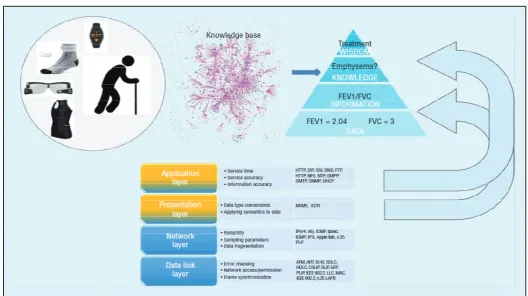
quality can be evaluated contextually and how the different OSI layers are affected by the specific user needs of the system. Figure 1. shows four of the OSI layers: data link, network, presentation,
challenges at the upper layers of the OSI model can improve the
performance of wearable systems
IV. Analysis of Characteristics in Internet of Things This section analyzes security requirements based on 3 typical IoT characteristics that have been researched in other researches. These security requirements are commonly applied in IoT security. Therefore, it is important to understand and take advantage of it to design security mechanisms in IoT environment.
A. Heterogeneity
In IoT, heterogeneity means diversity of hardware performances (e.g. CPU computation, memory footprint), protocols, platforms,
policies, etc. The biggest problem of heterogeneity is absence of common security service . heterogeneity weakens interoperability and causes extra fees about performance and money to interpret each other. Besides, making security-related policies and updates are more complex. In order to solve these problems, we can use some technologies (e.g., meta data registry (MDR), middleware); however, it is not a fundamental solution. For providing common
security service, unified IoT security standard has to be established.
Then, developer who are related to IoT development should follow standards strictly. Recently, standards organizations (e.g., ITU-T,
ETSI, ISO/IEC JTC 1) develop some standards for the security
in the IoT.
B. Resource Constraint
Fig. 1: The bottom of the figure shows four of the OSI layers: data link, network, presentation and application. The top shows the
DIKW (data-information-knowledge-wisdom) pyramid that maps wearable sensor data to meaningful information
Most IoT devices are lacking performance and battery capacity.
Therefore, legacy security services, such as TLS (transport layer
security), AES (advanced encryption standard), cannot be applied
to IoT devices directly [8]. Therefore, these services or algorithms
should be designed to be lightweight and straightforward to
increase efficiency of CPU, memory and battery. In addition,
scalability has to be considered. Apart from lack of performance of device and network bandwidth also low, so that multicast is
more effective than unicast [2]. Note that, CoAP (constrained application protocol) supports multicast in RFC 7252 officially,
but MQTT (message queue telemetry transport) does not.
C. Dynamic Environment
Due to mobility and bad connections, IoT has a dynamic network topology. In very demanding cases (e.g., smart city), numerous devices may send a large number of requests. Hence,
not only flexibility [7], but also scalability [6] is required in IoT
communication protocols. Cisco forecasts that 50 billion devices
will be created by 2020 [3], and after that, more and more devices will be made. Consequently, flexibility and scalability will be key
security requirements of IoT.
V. Security Issues and Requirements for Iot Environments
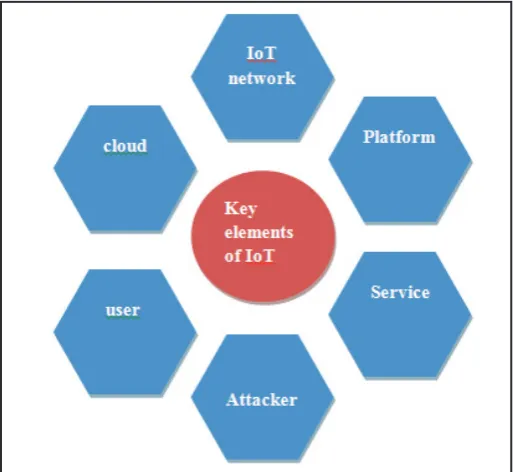
Fig. 1 shows six key elements of IoT (i.e., IoT network, cloud, user,
attacker, service, and platform). We consider reviewing security requirements from the elements to be the most effective way. A more detailed description is in the following subsections.
A. IoT Network
IoT network is a specialized form of conventional network. It has three features as described in Section 3. In IoT network, there are many Things (e.g., gateways, sensors), and they may communicate using lightweight communication protocols, such as MQTT and
CoAP based on IEEE 802.15.4. The most important fact is that
Therefore, most existing problems (e.g., fragmentation, security attacks) could happen in IoT network.In this subsection, we focus
on the following issues: privacy, Privacy. IoT is becoming more
and more closer to human life like ubiquitous. It can be used anywhere, anytime with anything security in multicasting and bootstrapping.
People will be monitored by CCTV in everywhere, and sensors will send any sensed information to the network. Additionally, types of
information will be diversified and amount of information will be
gradually increased because of big data. In this situation, ensuring privacy is critical. Thus, from now on, we need to research security for privacy under understanding of characteristics and security requirements of IoT. Particularly, encryption and authentication is necessary to be made use of bitwise operation rather than mathematical algorithm like ECC (elliptic curve cryptography) in order to make lightweight security service.
Fig. 2: Six Key Elements of IoT
Finally, privacy does not always have to be protected. If user is in emergency situation (e.g., car accident), privacy information is required to provide to doctor or close people. Security in multicasting. IoT environment which is resource-constrained can be used multicasting more effective than conventional network. When using multicasting, multicast group should be created with authenticated users, and secret key that is shared with group members is required to keep securely. Security in bootstrapping.
Bootstrapping is a process that sends data (e.g., configuration
information, key material) to participate secure IoT network. After that, authentication and authorization are performed. D.
Garcia-Carrillo et al. proposes a flexible, scalable and lightweight
bootstrapping for demanding environment like smart city using AAA (authentication, authorization, accounting), EAP (extensible
authentication protocol) and CoAP. Likewise, bootstrapping is required to designed in a flexible, scalable and lightweight
manner. These are essential characteristics in the IoT environment. Finally, it cannot be guaranteed to prevent security attack with only network security. So, devices should provide built-in security. Embedded security can support dynamic prevention, detection, diagnosis and isolation .
B. Cloud
Usually, IoT devices use cloud because they cannot save the data in their low memory capacity. In some cases, sensitive data (e.g., home CCTV video, personal location, health information) can be used for rescue people. However, if cloud out of order for some reasons, IoT devices cannot save the data. Then critical data that will be used for rescue can be missing.
As a result, rescue service that require the data may be stopped. Therefore, in this case, availability is highly necessary, so that device should have back-up cloud to be replaced with original cloud. There are a lot of data sent from many devices in cloud. To protect the data from unauthorized user, cloud should use proper access control (i.e., authentication, authorization), encryption, data anonymity, etc. In addition, the data may not be fully needed to be encrypted based on the importance of data. In this case,
security-level based encryption is required for efficiency. It is the similar concept with contextual integrity in [25].
C. User
User is the most vulnerable element in IoT security. Even if information system is implemented securely, if a user, especially system engineer, is careless to manage, any security system will be useless. For example, in ID-password authentication model, if a user makes the password with a simple and guessable passphrase, attackers could crack the password easily using brute force attack or dictionary attack which is well known security attack. That is, the user has to follow strictly the security rules, and the user needs to be educated about social engineering.
D. Attacker
Security service can be compromised by attacker Although a user follows security rule. Due to IoT devices are connected to network, it can be victim anytime. most of IoT devices cannot apply strong security service because of its constrained resources. Besides, current IoT security services have not been fully validated. For these reasons, IoT is easy target to attack so that security attack
will be increased and diversified. Thus, in this subsection, we
analyze security requirements against security threats.
In IoT environment, security threats can be categorized into
non-physical threats and physical threats. Non-physical threat
can be described as threats which uses network, and physical threats also can be described as all threat except for nonphysical threat. In contrast to conventional PC environment, IoT devices may not be placed on secure environment. Consequently, IoT devices could be easily destructed by nature and people who has malicious intention. If an attacker is able to access the device in insecure environment, the attacker can do side channel attack, or
can analyze vulnerability of firmware or platform.
Therefore, security mechanisms for the IoT device in harsh environment is required to be considered when device manufacturer implement the device. Most of non-physical threats (e.g., buffer
overflow, sniffing, man in the middle attack, spoofing) are attacks on confidentiality, integrity and availability. Due to heterogeneity,
IoT security is too complex to prevent the types of attacks. Additionally, IoT device has constrained resource to adopt the strong security services (e.g., intrusion detection system, antivirus for protecting system from security threats. For these reasons, IoT device is more vulnerable to security attacks than conventional PC environment. Even simple DoS (Denial of Service) can stop operation of device if its performance is not enough. Gateway that
performance is relatively sufficient compared to IoT device could
attack on IoT system using the vulnerability of firmware, platform
or communication protocol, etc. The security vulnerability is made by system designers and developers’ inexperience or mistake. Each vulnerability has different impacts on system. Some of
vulnerability is sufficient to break security system, or can steal
root permission. Therefore, vulnerability must be minimized by using secure coding, static analysis, dynamic analysis, reverse
engineering, etc. In critical control field, control permission never
be lost and changed by attacker, and operation should be supported continuously. Therefore, control system must need a fault tolerance and back-up devices. Back-up device can be replaced when main device is compromised or stopped.
E. Service
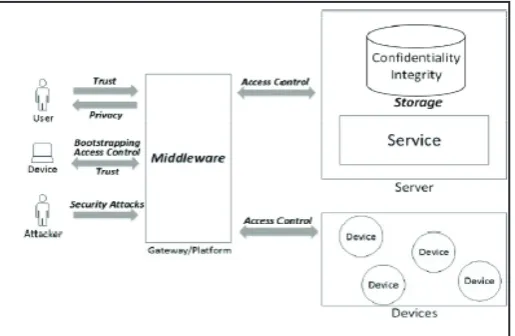
In this subsection, we analyze security issues (i.e., trust, access control, middleware, storage) as illustrated in Fig. 3. Before we describe the security requirements based on security issues, each element of the scenario in Fig. 3 will be explained. To take advantage of a service, the user needs to trust the server, and the server needs to provide privacy to the user. If the user decides the server is trustworthy, the user will use service provided by the server or group of devices with smart phone, smart watch, or some kind of network devices. After that, the devices have to progress bootstrapping and access control (i.e., authentication and authorization). Thereby, devices obtain trust from server. Especially, automated, intelligent and context-aware devices in real IoT environment might be operated by itself without human intervention. Finally, the attacker can compromise the server for malicious intentions (e.g., collecting personal information). Trust is complex concept. In spite of its importance, there is no clear
definition. Due to unclear definition of trust, it is hard to estimate and evaluate. Therefore, we have to define trust clearly, and need to
make the method for estimate and evaluate of trust in order to the IoT security. In fact, ‘Trust’ was used with two different meaning in Fig. 3. In case of the user, trust means belief. However, in other case of the device, trust means not only belief but also interoperability that any kinds of devices can be communicated with each device. In IoT environment, middleware can be used forplatformthat support interoperability and it can provide security for devices and data.
Fig. 3: Security Requirements among User, Device, Attacker,
and Service
Therefore, when we design middleware architecture, security, privacy, and use of multi communication medium should be considered, As mentioned previously, access control is security service including authentication and authorization for ensuring security and privacy. Due to dynamic environment and resource
constraint of IoT, access control should be flexible and scalable.
Furthermore, access control needs to handle various types of access
control policies. In addition, identification method to authorize
needs to be strict, and the process for managing authority should
be easy and simple. As a result of the access control, certificate will be issued. There is a problem in the number of certificates. It
could be created too many owing to scale of IoT (e.g., smart city). So, in this case, delegation of authentication and authorization will
be necessary. The last is storage issue. Confidentiality and integrity
of data in storage should be supported as the cloud environment
F. Platform
AllSeen, oneM2M, OIC (open interconnect consortium) and
other standards organizations have been established IoT platform
standards. Open IoT platform (e.g., Mobius, OneM2M, AllJoyn, COMUS) provides multiple functions (e.g., distributed cooperation,
execution control, interoperability between heterogeneous devices
to share data) [19]. They are focusing on the functionality of
platform mainly, however, security is considered only in common services (e.g., encryption, access control through authentication and authorization, signature). At this time, as mentioned earlier, because it is necessary to consider the performance of various IoT devices, all of security services should be lightweight. In addition, according to the security level of device, security service should be supported optionally in order to overcome heterogeneity of device performance. Furthermore, for authentication and authorization, method for understanding many different security policies used in diverse devices and domain is required.
VI. Conclusions
In this paper, we analyzed three key characteristics of IoT,such as heterogeneity, resource constraint, and dynamic environment to
find out basic Iot requirements. In addition, we analyzed overall IoT
security requirements (e.g., privacy, trust, control system security) based on security issues of six key elements in IoT environment. And security requirements evaluation is performed with several researches. We hope this paper can be a guide to design IoT system securely, and improve general understanding of IoT security issues and requirements. In the future, we need to analyze international standards related to IoT security for interoperability among a lot of diverse security platforms, devices, policies, etc
References
[1] IDC, [Online] Available: http://www.idc.com/getdoc. jsp?containerId=prUS25658015
[2] P. Porambage, A. Braeken, C. Schmitt, A. Gurtov, M.
Ylianttila, B. Stiller, “Group key establishment for enabling secure multicastcommunication in wireless sensor network deployed for IoTApplications”, IEEE Access, vol. 3, pp.
1503-1511, August 2015
[3] CISCO,[Online] Available: http://www.cisco.com/c/en/us/
solutions/internet-ofthings/overview.html
[4] I. Alqassem,“Privacy and security requirements framework
for the internet of things (IoT)”, International Conference on
Software Engineering (ICSE) Companion India, pp. 739-741, May-June 2014
[5] Y.J. Lee, D.H. Kim,“Threats analysis, requirements and
considerations for secure internet of things”, International
Journal of Smart Home, Vol. 9, pp. 191-198, December 2015
and Security in Mobile Systems (PRISMS) Denmark, pp.
1-8, May 2014.
[7] X. Huang, P. Craig, H. Lin, Z. Yan, “SecIoT: A security
framework for the internet of things”, Security and
communication networks, May 2015
[8] I. Alqassem, D. Svetinovic,“A taxonomy of security and
privacy requirements for the internet of things (IoT)”, Industrial Engineering and Engineering Management (IEEM)
Malaysia, pp. 1244-1248, December 2014
[9] H.-J. Kim, H.-S. Chang, J.-J. Suh, T.-S. Shon,“A study on
device security in IoT convergence”, Industrial Engineering, Management Science and Application (ICIMSA) South
Korea, pp. 1-4, May 2016
[10] S. Li, T. Tryfonas, H. Li,“The internet of things: a security
point of view”, Internet Research, Vol. 26, pp. 337-359, April
2016.
[11] A. F. A. Rahman, M. Daud, M. Z. Mohamad,“Securing Sensor
to Cloud Ecosystem using Internet of Things (IoT) Security Framework”, ICC (International Conference on Internet of