E-ISSN 2308-9830 (Online)/ ISSN 2410-0595 (Print)
Towards A New Architecture of Detecting Networks Intrusion
Based on Neural Network
Berlin H. LEKAGNING DJIONANG1 and Dr. Gilbert TINDO2
1, 2
University of Yaoundé I, Faculty of science, Yaoundé, Cameroon
1
[email protected],[email protected]
ABSTRACT
Networks intrusion detection systems appear nowadays as one of the most efficient solution for detecting illegal or suspicious activities in a network. Using neural networks to meet this objective has been studied by many authors. Most of the solutions provided in the literature face the problem of relevance and reliability. One of the major reasons of such a situation is the misconception of a correct profile. In this paper, a modular architecture is proposed, in which each module is dedicated to detecting a particular type of attack. Firstly, each module is trained with all attributes, then secondly some of the attributes used for training are pruned from the training set. This modularity allows us to know which of the system’s module threaten the NIDS performance. The experimentation led us to observe that, depending on the type of the attack, some of the attributes have a marginal effect, although in the opposite, some other have a dominant effect. We have done a comparative study of the solution proposed and the others in the literature. It appears that our solution is more efficient on certain type of attacks. The NSL-KDD dataset has been used to train, test and evaluate our architecture.
Keywords:NIDS, Neural networks, MLP, NSL-KDD Dataset.
1 INTRODUCTION
The advent of networks has allowed a wide range of services. These services are subject to many attacks and thus security mechanisms have become a necessity. Network intrusion detection systems (NIDS) are one of the most used mechanisms nowadays to detect intrusions. The purpose of network intrusion detection systems is to protect networks against attacks that can be identified by firewalls.
Intrusion detection systems are generally classified in three categories [1]:the IDS which use the behavioral approach, the IDS which use the scenario approach and the IDS which use the specification approach. The behavioral analysis actually operates in two steps: a learning step and a detection step. During the learning step, the system learns how to recognize what is an abnormal behavior, and during the detection step, the system identifies abnormal behaviors [2]. The scenario analysis doesn’t have a learning step. It comes with a predefined database of attack scenarios that they have to recognize (signature). The approach based on specifications is a method that builds the normal profile without using any learning algorithm [3].
Many good profiles learning methods (statistics, artificial learning and expert systems) have been used in the literature. Neural networks have been used by many authors to build a network intrusion detection system [4, 5, 6, 7, 8, 9]. One of the major NIDS’ problems is that the efficiency is governed by a single whole system which is in the rule of either detecting types of attacks or detecting classes of attacks. We propose a modular architecture for detecting networks intrusions by types of attacks using neural networks. This will help us to know which modules pull down performances. Our architecture is based on the behavioral approach.
One of the major problems of this approach is the design of a normal profile [10]. The automatic building of the fields that make a user profile is a real challenge. The quality of the fields is an important factor on the efficiency of the NIDS [11]. We experiment in this work, the importance of selecting attributes in order to build the right profiles.
functioning ; the section 5 is devoted to the description of inputs and the preprocessing mode of them ; then we go through the experiment and the analysis of results of our works in section 6 et 7 ; then we end this work with a conclusion in the section 8.
2 NEURAL NETWORKS
Neural networks are networks that contain nodes which are strongly connected, with elementary processors working in parallel and linked by weighted edges. These connection weights govern the functioning of the network. Each elementary processor computes a unique output based on the received inputs. Neural networks have many advantages in implementing a network intrusion detection system. They are really efficient and fast in the task of classification [4]. They are able to learn easily and identify new threats which are submitted to them. Neural network are able to deal with incomplete and imprecise data, and from multiple sources. The natural speed of neural networks helps to reduce damages when a threat is detected [5]. Neural networks usage helps to extract nonlinear relationships that exist between different fields of a packet, and to real-timely detect complex
attacks [6]. Neural networks, after having learnt correctly, have a good ability of generalization. They are able to compute the adequate outputs with precision even for data that haven’t been learnt. The flexibility given by neural networks is also one of the intrusion detection’s assets [12].
3 PREVIOUS WORKS
James Canady [5] is the first researcher to propose an intrusion detection system based on network protocols analysis. He uses the multi-layers perceptron (MLP) scheme for learning. The table below (Table1) shows some results of those researchers who used neural network models to design an intrusion detection system. The learning process used to modify the network parameters by those researchers was [13]:
Present data, formatted as a vector, to the neural network;
Check if the generated outputs match with the desired outputs;
Change the network parameters to try to match the desired outputs.
Tableau 1: Some works results
Criteria
Author
Recognition rate
False positive
False negative
Alan 2002 [14]
24%
-
-
Mehdi 2004 [13]
87%
-
-
Golovko 2005 [6]
94,3%
-
-
Vaitsekhovich 2008[7]
93,21%
12,90%
-
Khattab 2009 [15]
97%
2,4%
0,8%
Iftikar 2009 [16]
98%
1,5%
-
Muna 2010 [9]
78%
-
-
Aslihan 2012 [8]
93,42%
2,95%
-
4 PROPOSED ARCHITECTURE AND ITS FUNCTIONNING
The architecture proposed is described in this section, before showing its functioning. Then we stand out and demonstrate one of its properties.
4.1 Architecture
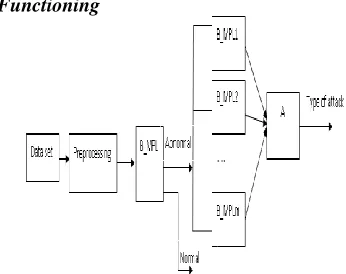
We propose a new modular architecture in which each module helps to detect only one type of attack. Each module discriminate each type of attack to normal packets. This architecture’s modularity helps us to solve the performance problem of NIDS. We propose a bi-neural model to achieve that. We define bi-neural networks as networks that discriminate two classes. Our architecture (Figure 1) propose a binary discrimination model (B_MLP) that doesn’t select any attribute and a binary discrimination model (SB_MLP) that statically selects attributes. The second model aim to see the impact of attributes selection on the classifier’s decision. Form types of attacks, we should usem+1 models (B_MLP) in our architecture. Our architecture has four levels, in which the first one preprocess the data. The second one helps to discriminate normal packets from abnormal ones. If the packet that has been analyzed is abnormal, then the packet is given to the others models (level three) in order to determine which type of attack it is. The element A (level four)in these architectures choose a reference which will decide which type of attack it is. The algorithm used to learn from these networks is described in Figure 2. Each model is made of three layers: one entry layer, one hidden layer and one output layer. For each model, we look for the number of neurons from the hidden level that helps to get the best dynamical detection rate.
We have named this architecture MAMBiM: Multiple Attacks, Multiple Binary MLP.
4.2Functioning
Fig. 1. Four level intrusion detection architecture
Fig. 2. Algorithm executed by each network
For each data vector, we make the preprocessing step as mentioned in section 5. The errors reverse propagation algorithm is used for each of our bi-neuronal models learning. Each bi-bi-neuronal network has to be optimal when classifying each type of attack in such a way that the recognition rate gets closer 100.
4.3 Training and Test Step
We have to train B_MLP with the training dataset and test it with test data. We have to do the same task for B_MLPi with the training set corresponding to the normal packets and their respective types.
4.4 Evaluation types
The first level of our network discriminate abnormal profiles from normal ones. If the data vector that has been read is an abnormal packets, then we give it to the second binary neural network. Each model produces an output and a referee will decide according to these outputs which type of attack it is. The referee will only handle a vector of
m outputs. The smaller output will determine the type of attack. And if all the others are greater than the threshold value or the classification criteria, then it is an unknown type of attack.
4.5 Properties
Let be the number of types of attack to be detected. If is the input data size and the number of neurons from the hidden layer of each bi-neural model (B_MLP), the size of the architecture in
1. Normalize the inputs.
2. For each network, look for the number of neurons from the hidden layer that gives the best recognition rate and save it in a file.
3. Learn from each network using the reverse propagation algorithm. Save the weights obtained in a file.
terms of the number of neurons is in the order of O ( ).
Proof: The size of our network is ( )(
)
5 DESCRIPTION OF DATA AND PREPROCESSING
Since 1999, KDD Cup 99 is used as an example of dataset in behavioral intrusion detection systems [17]. Each packet from the KDD Cup 99 dataset is made of 41 fields and labeled as normal or abnormal packets with the types of attacks. Besides these fields, 37 are of type numeric and 4 are of type non numeric. KDD Cup 99 regroups 37 types of attacks. These attacks are subdivided into four major classes: DOS, U2R, R2L and Probes [18, 19].
DOS (Denial of service attacks): they aim to threaten services availability by saturating computer resources, server of targeted networks. These attacks achieved in networks have as direct consequences the freezing of network traffic.
Probes: attacks that aim to gather information from the target, which can help attacker to start on attack. There exist many types of probe attacks: some abuse rightful users and others use the engineering scheme to gather information.
R2L (Remote To Local): attack that aim to bypass or usurp authentication credentials of a target in order to execute some commands. Most of these attacks derive from social engineering [17].
U2R (User To Root): The attacks come from inside. The attacker usurps the administrator’s password and thus the others users. Most of these attacks derive from the saturation of a buffer caused by programming errors [17].
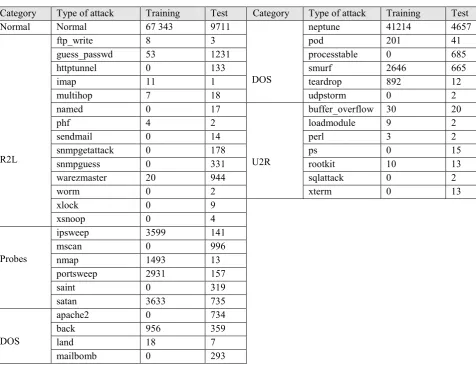
KDD99 dataset contain many redundant packets within both training and test data [17]. Redundant data are able to give more importance to a type of attack than what it merits. [17] Proposes NSL-KDD which is an excellent dataset for comparing network IDS. Our experiment has been done using NSL-KDD. The type of attacks and their number in the training datasets and test datasets are proposed in table 2 in appendix.
5.1 Preprocessing
Preprocessing is related to non-numeric fields. The non-numeric fields are: type of protocol (TCP, UDP, ICMP), type of service (aol, auth, bgp … Z39_50), flag (OTH, REJ, RSTO, RSTOS0, RSTR, S0, S1, S2, S3, SF, SH) and the class of packet (Normal or Abnormal). Regarding the type of protocol, we affect the following numeric values: TCP=1, UDP=2 and ICMP=3. We affect 1 to normal packets and 0 to abnormal packets. Regarding the fields type of service and flag, we can assign them numerical values mapped to the increasing or decreasing order of their total number. [20] Has shown the limits of such an approach, he propose to assign random values to these fields. We have, in our works, given a random value in the range 1 to 10 to the flag fields, and a random value in range 1 to 65 to the type of service field.
5.2 Normalization
It consists on transforming data to make them vary between 0 and 1, in order to make them more homogeneous and then simplify the learning process from the network. In this paper, we will use
the Min-Max normalization. Let
and the minimum and the maximum of the values of the attribute , which has value ,
the normalized value ’ = . For each attribute from the data vector, compute its normalized value replace it by the normalized value computed.
6 EXPERIMENTS AND RESULTS
The experiment has been done on both our two models. The results by types of attacks and category of attacks are respectively presented in Figure 5, and in table 3. To evaluate our models, we will use four indicators which are: The recognition rate (TR), the false positive rate (TFP), the detection rate (TR) and the false negative rate (TFN). These rates as evaluated as following:
,
,
with :
AA: Abnormal packet detected as abnormal one. For the experimentation, 80% of data are used for training, in which 20% are reserved for evaluation and 20% are reserved for testing. The set of data submitted to each network is reduced compared to initial data.
.
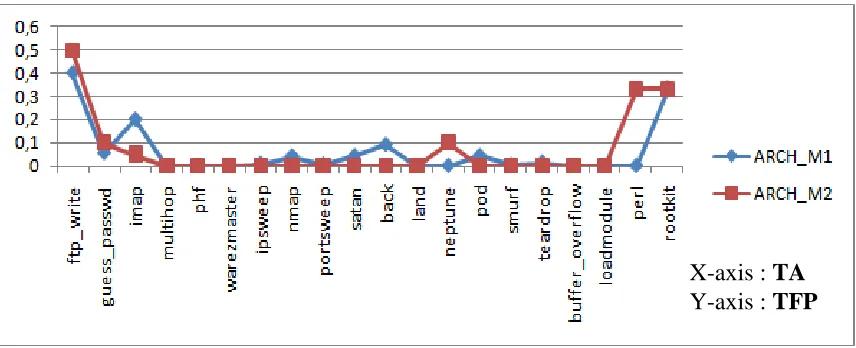
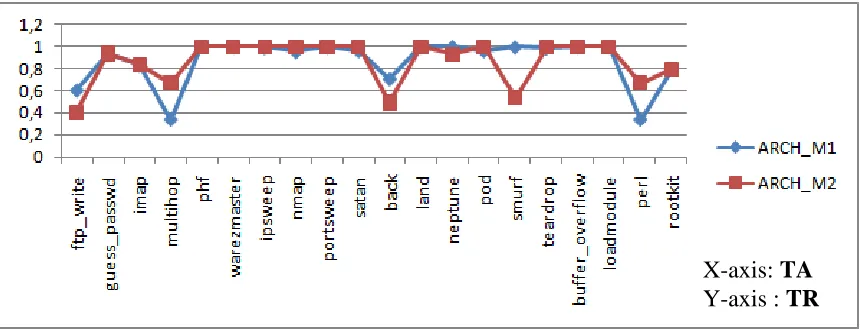
The experiment results are presented in Table 3 and 4, and the comparative plot in Figures 3, 4, 5 and 6. TA represents the type of attacks in the plot drawn We have two models of our architecture, the first (Arch_m1) that doesn’t take care of attributes selection and the second one (Arch_m2) that takes care of it.
Fig. 3. Comparative study of false positive rate in both models
Fig. 4. Comparative study of false negative in both models
X-axis :
TA
Y-axis :
TFP
X-axis :
TA
Fig. 5. Comparative study of recognition rate in both models
Fig. 6. Comparative study with the GOLOVKO works
7 RESULTS ANALYSIS
We have, for our second model architecture, fixed 12 attributes which are: duration, protocol, service, flags, source address, destination address, land, wrond_fragment, urgent, hot and the class (Normal, Abnormal). Looking the results shown in table 3, we notice that for certain type of attacks, the recognition rate decreases. That is the proof that this set of attributes is not pertinent to detect this type of attacks. An important requirement appears in the way of choosing relevant attributes that can describe each attack.
Figures 3 and 4 present a comparative study of both models in regard to false positive rate and false negative rate. The pics (ftp_write, back,
smurf) that we observe in Figure 4 teach us many things on the impact of selecting bad attributes in the false positive or false negative rate.
The Table 4 compares our results with the results shown in [6].The detection rate is used because it’s the one used by Golovko to present his results. We have chosen it to compare our results simply because it detects types of attacks, like our architecture. Figure 6 shows how the plot representing our results is clearly above the plot representing Golovko’s works. Our results, compared to Golovko’s results, are broadly better and more observable for the attacks of type R2L.
X-axis:
TA
Y-axis :
TR
X-axis:
TA
Table 3: Comparative study of categories of attacks
Category Frequency
Recognition rate
Arch_m1
Arch_m2
R2L 103 86% 71,8%
PROBES 12630 96% 96,12%
DOS 44953 99,9% 91,51%
U2R 52 92,3% 94,2%
Table 3 clearly shows us how selecting non representative attributes can impact global recognition rate. The DOS attacks case is the most perceptible. We go from a 99,9% classification rate in the architecture model 1 to 91,51% classification rate in the architecture model 2. This reveals a fact: the choice of inputs data has a considerable impact on the quality of an intrusion detection system.
Figure 5 shows us that, globally, the plot representing architecture model 2 results is almost above the plot representing the results of architecture model 1. This is the proof that selection, when it is well done, helps to better the IDS’s quality.
8 CONCLUSIONS
We have in this paper, proposed a modular architecture for network intrusion systems based on neural networks. The modularity of our architecture allows us to remove bricks that threaten the intrusion detection systems performances. Our works permit us to show the interest of selecting attributes. The architecture with a layer dedicated to attributes selection helps to get a good classification for certain types of attacks. Our work give a better performance compared to Golovko’s works. In terms of perspectives, we plan to improve our architecture by selecting dynamically the relevant attributes.
Table4: Comparative Study
Type of attack
Detection rate(TD)
GOLOVKO2005 DJIONANG2015
ftp_write 25% -
guess_passwd 92,45% 94,44%
imap 91,67% 80%
multihop 14,29% 100%
phf 50% 100%
warezmaster 85% 100% ipsweep 99,12% 99,06%
nmap 88,74% 95,74%
portsweep 98,81% 99,44% satan 99,81% 95,35%
back 99,5% 90,83%
land 100% 100%
neptune 99,98% 99,93%
pod 98,11% 95,53%
smurf 100% 99,63%
teardrop 99,8% 98,34% buffer_overflow 0% 100%
loadmodule 0% -
perl 0% -
9 ACKNOWLEDGMENT
The authors would like to thank ISESTMA for supporting the development of this work.
10 REFERENCES
[1] Asmaa Shaker, Sharer Gore « Importance of Intrusion Detection System » International Journal of Scientific & Engineering Research, Janvier 2011.
[2] Ludovic Mé and Véronique Alanou. Détection d’intrusion dans un système informatique : Méthodes et outils. TSI, 15(4):429–450, 1996.
[3] Guillaume Hiet, « Détection d’instructions paramétrée par la politique de sécurité grâce au contrôle collaboratif des flux d’informations au sein du système d’exploitation et des applications : mise en œuvre sous linux pour les programmes java » Université de Rennes, Décembre 2008 [4] G. DREYFUS “les réseaux de neurones”
Mécanique Industriel et Matériaux, n51, septembre 1998
[5] Cannady,J. , “Artificial Neural Network s for Misuse Detection,” Proceedings, National Information Systems Security Conference (NISSC ’98 ), October, Arlington , VA, pp . 443 -456. 1 998
[6] Vladimir Golovko, PavelKochurko
“Intruision recognition using neural networks” International Scientific Journal of computing, 2005, vol. 4, Issue3, 37-42
[7] Leanid VAITSEKHOVICH, Vladimir
GOLOVKO « Employment of neural network baser classifier for intrusion detection » actamechanica et automatica, vol2, no4, 2008
[8] AslihanOzkaya && BekirKarlik “Protocol Type Based Intrusion Detection Using RBF Neural Network” International Journal of Artificial Intelligence and Expert Systems (IJAE), volume (3): Issue (4):2012
[9] Muna Mhammad&& Monica Mehrotra “Design Network Intrusion Detection System using Hybrid Fuzzy-Neural Network” International Journal of Computer Science and Security, volume(4): Issue (3): 2010 [10]Ning P. &&Jajodia S. Intrusion Detection
Techniques. In H. Bidgoli (Ed.), +-theInternet Encyclopedia. John Wiley & Sons. (2003).
[11]GuofeiGu&al “Towards an Information-Theoretic Framework for Analyzing Intrusion Detection Systems” Computer Security ESORICS 2006 (2006): 527-546 [12]Yousef Abuadlla&& all “Flow-Based
Anomaly Intrusion Detection System Using Two Neural Network Stage”, Computer
Science and Information systems 11(2): 601-622: 2012
[13]Mehdi MORADI and Mohammad
ZULKERNINE, “A Neural Network based System for intrusion detection and Classification of Attacks” In 2004 IEEE International on Advances in Intelligent Systems.
[14]ALAN BIVENS && all “Network based intrusion detection using neural network” Intelligent Engineering Systems through Artificial Neural network, 2002, pp. 579-584 [15]M. Khattab Ali &all “The Effect of
Fuzzification on Neural Networks Intrusion Detection System”, IEEE computer society: 2009
[16]Iftikhar Ahmad && all “Application of Artificial Neural Network in Detection of Probing Attacks” 2009 IEEE Symposium
on Industrial Electronics and
Applications(ISIEA 2009), October 4-6, 2009, Kuala Lumpur, Malaysia
[17]Mahbod Tavallaee&& all “A Detailed Analysis of the KDD CUP 99 Data Set” Proceding of the 2009 IEEE Symposium on Computational Intelligence in Security and Defense Application (CISDA 2009)
[18]Srinivas Mukkamala&& all “Intrusion detection using an ensemble of intelligent paradigms”, Journal Network and Computer Applications 28 (2005), 167-182
[19]Matthew Vincent Mahoney “A Machine Learning Approach to Detecting Attacks by Identifying Anomalies in Network Traffic “, these of Florida Institute of Technology, May 2003
APPENDIX
Attacks from NLS-KDD99, grouped by category. These data are organized in term of training and test data.
Category Type of attack Training Test Category Type of attack Training Test Normal Normal 67 343 9711
DOS
neptune 41214 4657
R2L
ftp_write 8 3 pod 201 41
guess_passwd 53 1231 processtable 0 685
httptunnel 0 133 smurf 2646 665
imap 11 1 teardrop 892 12
multihop 7 18 udpstorm 0 2
named 0 17
U2R
buffer_overflow 30 20
phf 4 2 loadmodule 9 2
sendmail 0 14 perl 3 2
snmpgetattack 0 178 ps 0 15
snmpguess 0 331 rootkit 10 13
warezmaster 20 944 sqlattack 0 2
worm 0 2 xterm 0 13
xlock 0 9
xsnoop 0 4
Probes
ipsweep 3599 141
mscan 0 996
nmap 1493 13
portsweep 2931 157
saint 0 319
satan 3633 735
DOS
apache2 0 734
back 956 359
land 18 7