
An Electrical Discharge Machining (EDM) of Inconel
718 using Copper Tungsten Electrode with Higher
Peak Current and Pulse Duration
S. Ahmad
*and M.A. Lajis
1,2Sustainable Manufacturing and Recycling Technology (SMART), Advanced Manufacturing and Materials Center (AMMC),
Universiti Tun Hussein Onn Malaysia, 86400 Parit Raja, Batu Pahat, Johor, Malaysia
*Corresponding author, email: [email protected]
Phone: +607-4548313
Abstract--
In this experimental work, the performance of electrical discharge machining of Inconel 718 by using copper tungsten (CuW) electrode by employing high peak current, Ip
and pulse on-time (pulse duration), ton were studied. Among the responses investigated are Material removal rate (MRR), Electrode wear rate (EWR), and Surface roughness (Ra). The study had shown that the highest MRR of 28.37mm3/min was obtained at the highest peak current and the longest pulse duration of 40 A and 400 µs respectively. Otherwise, machining at the lowest peak current with longest pulse duration results the lowest EWR with value -0.005mm3/min. The negative value for EWR indicated that, the electrode deposited after EDM machining is greater than before machining due to the surface modification effect occurred at the surface of the electrode. The lowest Ra value was achieved 8.62µm at the lowest peak current and highest pulse duration used of 20A and 400µs respectively. It would be recommended that the optimum cutting condition in EDM of Inconel 718 by using CuW electrode could be performed by a combination of the highest peak current and pulse on-time at 40A and 400µs, respectively.
Index Term--
Electrical discharge machining (EDM); Inconel 718; Copper tungsten; Material removal rate (MRR), Electrode wear rate (EWR), Surface roughness (Ra)
1. INTRODUCTION
Inconel 718 is a nickel based super alloy and considered as a difficult to cut materials due to its high toughness and hardness, and rapid work hardening rate. Further, low thermal conductivity of nickel based super alloy results in heat concentrated in the cutting zone, making it ineffective to be processed through conventional machining. This alloy is attracted to many researchers due to its physical ability and often encountered in extreme environment. Inconel are widely used for the hottest parts in an aircraft gas turbine engine and about 50% of aero-engine alloys are nickel base alloys (Ezugwu, 2005). To cut this material with high speed and reasonable surface quality is quite impossible in conventional machining. So, an unconventional machining method like EDM is the best option for machining Inconel 718 in order to overcome such limitations (Rajesha et al., 2011).
Until today, EDM has successfully used to machine
increase the application of EDM in the aerospace industry (Benedict, 1987). Regardless of the application, the workpiece may be of any material, no matter how hard, as long as it is electrically conductive (Fonda et al., 2008). However, the main influence in EDM machining will be determined by electrical parameters such a peak current, pulse duration and voltage, material properties of the workpiece and electrode such as the material’s melting temperature, and its electrical and thermal conductivity (Lee and Li, 2001; Ahmad and Lajis, 2013).
Copper tungsten (CuW) is an alloy fabricated based on the powder metallurgy process by pressing Tungsten (W) particles into a desired shape, sintering the pressed W at a high temperature, and then infiltrating it with molten Cu. As Cu and W are not mutually soluble, the material is composed of distinct particles of one metal dispersed in a matrix of the other one. Therefore, this makes CuW’s microstructure or molecular shape that of a metal matrix composite and not of a true alloy. The CuW combines the properties of both metals, resulting in a material that is a highly thermal conductivity, electrical conductivity and heat resistance. The process uses CuW as an EDM electrode because it is able to withstand high current and voltage. Since CuW is susceptible to wear, holds up very well in sharp corners, the electrode provides more geometrical accuracy than the other electrodes (Kern, 2008). Beri et al., (2012) had used CuW electrode when EDM of Inconel 718 and his result revealed that at higher peak current, MRR, EWR and Ra are increased. He recommended using
positive electrode polarity to obtain maximum MRR and minimum EWR whereas negative polarity is recommended for minimum Ra. According to Kuppan et al., (2008) the peak
current is significant parameter in improving the MRR because MRR increased with the increases in peak current for the EDM of Inconel 718. As expected, Ra value also increased
of pulse duration. Meanwhile, EWR decreased with increasing of pulse duration. Other research done by Marafona (2009) exposed that the deposited of the black layer on the copper tungsten electrode surface during EDM machining had changed the thermal conductivity of the copper tungsten electrode surface and contributed to EWR improvement. When EDM of Inconel 718, majority previous researchers tend to use low peak current in the range 0.5A< Ip < 20A and
low pulse duration in range 10 µs < ton < 150 µs to control the
tool wear and surface quality. Consequently, the machining rate becomes the slow lead in lower productivity and this is an issue of EDM. Currently, there is not so much available data are found involving CuW electrode in EDM machining of Inconel 718. Therefore, the main objective in EDM machining of material is always having higher MRR and lower EWR in order to improve the productivity and save cost and it is the main aimed in this study. Thus, in this experimental work, it is hoped that by using CuW electrode at higher peak current and
pulse duration, will increase the speed in EDM machining of Inconel 718.
2. EXPERIMENTAL SETUPS
Inconel 718 specimens were EDM machined under various conditions to explore the effect of a high peak current and pulse duration on MRR, EWR and Ra of the work piece and of
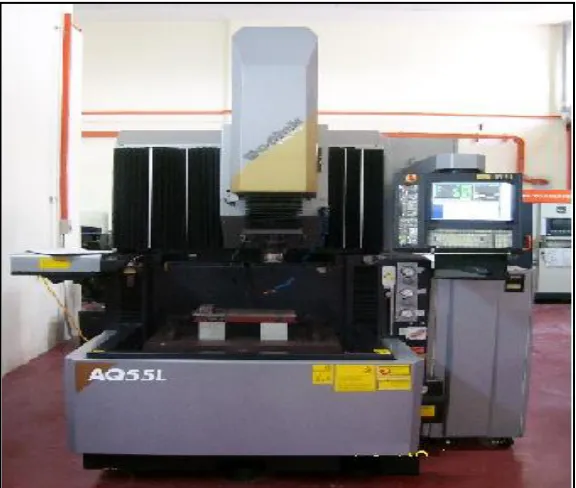
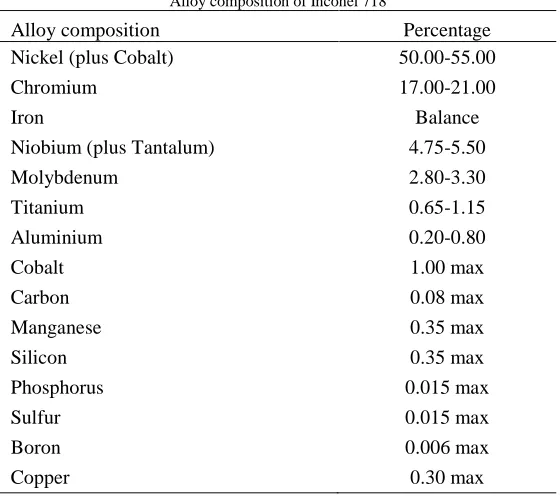
the electrode. The EDM experiments were conducted on the CNC Sodick High Speed EDM die sink AQ55L (3 Axis Linear) in kerosene as a dielectric medium as shown in Fig. 1. Inconel 718 material was cut into rectangle specimens of 40 mm x 30 mm with 10 mm of thickness. The specimens were machined with 10 mm diameter of copper tungsten electrode (Cu35%-W65%). The alloy composition of Inconel 718 is given in Table I. Two variable parameters selected are peak current, Ip and pulse duration, ton, while maintaining other
parameters such as the duty factor and voltage. The depth of cut is limited to 3mm. The machining condition applied in this study was indicated in Table II.
Table I
Alloy composition of Inconel 718
Alloy composition Percentage
Nickel (plus Cobalt) 50.00-55.00
Chromium 17.00-21.00
Iron Balance
Niobium (plus Tantalum) 4.75-5.50
Molybdenum 2.80-3.30
Titanium 0.65-1.15
Aluminium 0.20-0.80
Cobalt 1.00 max
Carbon 0.08 max
Manganese 0.35 max
Silicon 0.35 max
Phosphorus 0.015 max
Sulfur 0.015 max
Boron 0.006 max
Copper 0.30 max
Table II
Experimental parameters and levels
Parameters Levels
Workpiece material Electrode
Peak current, Ip (A)
Pulse duration, ton (µs)
Pulse interval, toff (µs)
Voltage, V Electrode polarity Dielectric fluid Depth of cut
Inconel 718 Copper Tungsten
20, 30, 40 200, 300, 400 Based on 80% duty factor
120 Positive Kerosene
3mm After specimens were EDM processed, the following
experimental techniques were employed for assessing the MRR, EWR and surface roughness of the machining samples. a) Digital weight balance: To determine MRR and EWR by measuring the mass loss of specimens and electrode, respectively before and after machining. b) Surface roughness measurement: surface roughness
in Ra (average roughness) was measured as a means
to assess the surface profile change due to different machining conditions.
c) Scanning Electron Microscopy (SEM): crater size and distribution were analyzed by observation of the machined surface of specimens and the depositions of foreign objects on electrode surface were studied. d) Energy Dispersive Spectrometer (EDS): The
chemical composition of the deposited layers on electrode surface was analyzed by EDS test analysis
MRR = (Wb - Wa / ρ718 .t) mm3/ min (1)
Where,
Wb = the initial weight of workpiece in g;
Wa = the weight of the workpiece after machining in
g;
T = the machining time in minutes and, ρ718 = the density of Inconel 718 (8.19 x 10
-3
g/mm3 ). The wear of copper tungsten electrode was calculated from the weight difference of electrode before and after the machining and is expressed as Eq. 2:
EWR = (Eb – Ea / ρCuW t) mm 3
/ min (2)
Where,
Eb = the initial weight of electrode in g;
Ea = the weight of electrode after machining in g;
The weight of the electrodes and workpiece before and after machining needs to be measured in order to obtain MRR and EWR. In order to maintain machining efficiency, a constant duty factor, 80% was selected for this experiment. Duty factor is a percentage of the pulse duration in µs over the total cycle time. A higher duty factor means increased machining efficiency (Guitrau, 1997). The formula is stated in Eq.3.
Duty factor = ton /(ton + toff) % (3)
Where,
ton = pulse duration in µs and,
toff = pulse interval in µs
Mitutoyo SJ-400 Surface Roughness Tester was used to measure the average Surface roughness (Ra) of the machining
surface. This research uses the cut-off length for each measurement trace at 0.8mm and the traverse length was 6.4mm for 9 specimens with different parameter condition. Ra
was measured three times on each specimen and the average value were calculated.
3. RESULT AND DISCUSSION
The study has covered the workpiece and electrode characteristics and through the result obtained, the main machining parameters were analyzed. It consists of the peak current (Ip), and pulse duration (ton). In the other hand, the
machining characteristic factors evaluated and measured where the material removal rate; MRR (mm3/min), electrode wear rate; EWR (mm3/min), and surface roughness; Ra (µm).
3.1 Material removal rate
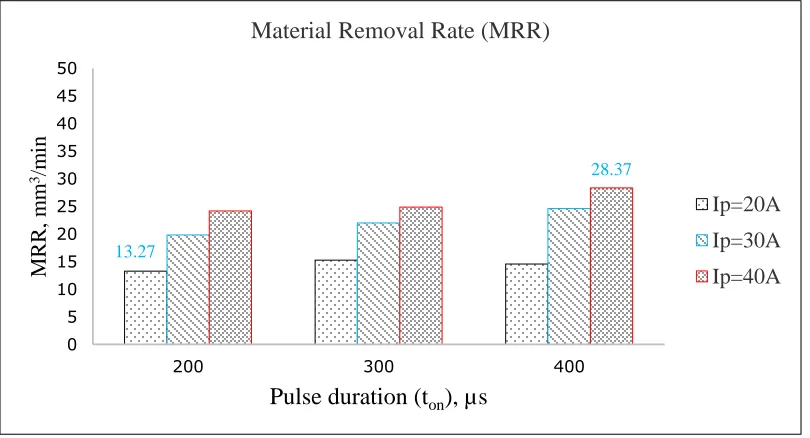
As shown in Fig. 2, MRR increased for all the conditions of pulse duration (ton) as peak current (Ip) increases. This is
because, when higher Ip generates high energy intensity, the
temperature rises and melt more material and erodes from a workpiece. In overall, MRR increased at higher ton for all Ip
except for Ip=20A and ton=400µs, MRR was slightly
decreased. The reason behind is that the power of the spark and frequency defined by the number of pulses per second determines the process performance. Low frequency usually uses in the roughing operation because it consists of long pulse duration of the spark that resulting a larger, deeper and broader crater (Guitrau, 1997). The low frequency and high power combination results in high material removal. As ton
increases the frequency reduces and consequently longer ton
increases material removal (Rahman et al, 2010). The results revealed that the combination of high peak current and pulse duration generated more MRR when EDM of Inconel 718 by using CuW electrode. The highest MRR is obtained with the value 28.37mm3/min at the combination of 40A and 400µs of Ip and ton, respectively.
Fig. 2. Effect of Peak current (Ip) and Pulse duration (ton) on MRR
13.27
28.37
0 5 10 15 20 25 30 35 40 45 50
200 300 400
MRR
, m
m
3
/m
in
Pulse duration (t
on), µs
Material Removal Rate (MRR)
Ip=20A
Ip=30A
Fig. 3. Effect of peak current (Ip) and pulse duration (ton) on EWR
3.2 Electrode wear rate
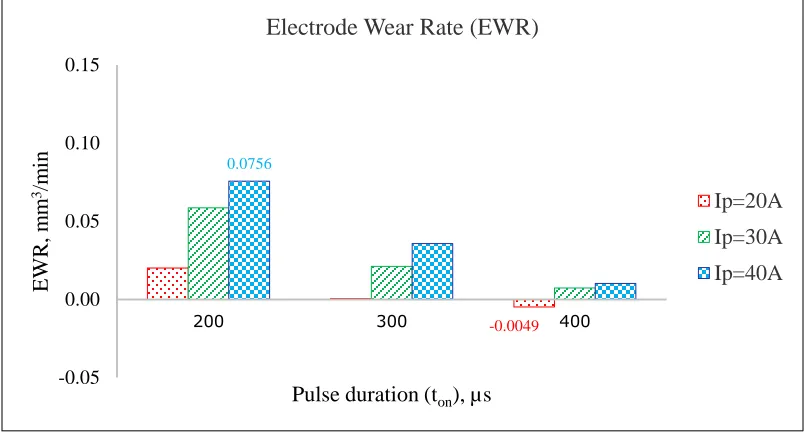
Fig. 3 shows the effect of Peak current (Ip) and Pulse duration
(ton) on the electrode wear rate (EWR) of CuW. The high Ip
resulted an increasing of EWR for all conditions of ton. Higher
Ip generates higher spark energy which facilitates more
material removal from the workpiece and the tool electrode which in effect to the increment of MRR and EWR. However, an increasing in ton the EWR was decreased for all value of Ip
used. An explanation to this due the longer discharge duration promotes more melting of workpiece material and solidification of the molten material and the deposition of the carbon on the electrode surface during the spark as shown in
Fig. 4. The graph of the EDS testing as shown in Fig. 4(a-2) and 4(b-2) has proved that the decomposed carbon from dielectric and the alloy compositions for Inconel 718 as listed in Table I was deposited on electrode surfaces. The effect of deposition on EWR is shown clearly at Ip=20A which the
EWR decreased linearly with the increases in the level of ton.
The lowest EWR is approximately -0.005mm3/min obtained by a combination of 20 A of Ip and 400 µs of ton. The negative
value for the lowest EWR indicates that the electrode weight after machining is higher than before machining due to the deposited by the carbon and material from the workpiece (Kang and Kim, 2003; Han et al, 2009).
a-1) Low EWR [Ip=20A; ton=400µs; Cp=0g/l] a-2) EDX test [Ip=20A;ton=400µs;Cp=0g/l]
-0.0049 0.0756
-0.05 0.00 0.05 0.10 0.15
200 300 400
EWR
,
m
m
3
/m
in
Pulse duration (t
on), µs
Electrode Wear Rate (EWR)
Ip=20A
Ip=30A
Ip=40A
b-1) High EWR [I
p=40A; t
on=200µs; C
p=0g/l]
b-2) EDX test [I
p=40A;
t
on=200µs; C
p=0g/l]
Fig. 4. Surface morphology and EDX testing of the CuW electrode at [a) Low EWR and b) High EWR]
3.3 Surface roughness
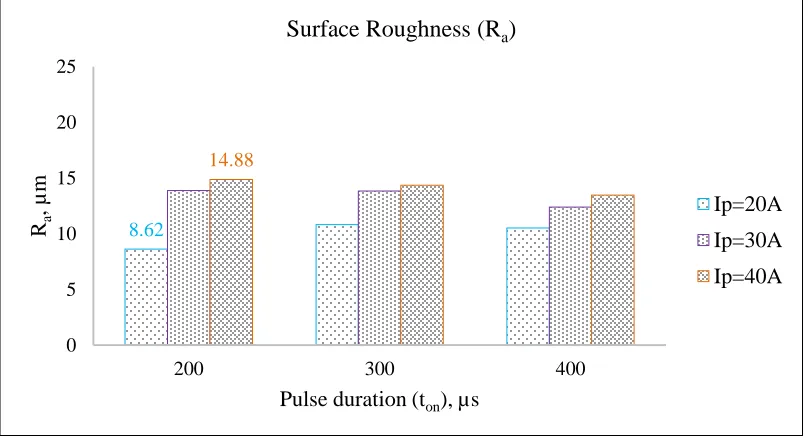
The effect of peak current and pulse duration on the surface roughness (Ra) of Inconel 718 machined surfaces is shown in
Fig. 5. As indicated in Fig. 6(a), the Ra is better at lower peak
current with shallower and flattened crater formation. Then, Ra
increased with the increase in discharge current with all ton
conditions. By increasing Ip, the amount of energy in the EDM
process will increase. Therefore, the melting and vaporizing of the workpiece will produce the larger and deep crater as indicated in Fig. 6(b). From the optical microscope image as shown in Fig. 7 also clearly observed that, the deep of the valley/craters with various shapes of recast layer was formed (Fig. 7 (b)) and this condition was contributed to the high Ra
value at higher Ip than the lower Ip (Fig. 7(a)). The analysis
was observed that the ton is the one of the significant factors
that can improve Ra. Normally, an increase in ton the Ra value
will increase because of melting boundary becomes deeper and wider (Kuppan et al., 2008; Kang and Kim, 2003), however, due to longer ton, the frequency and intensity of the
sparking will reduce. As a consequence, a shallower and flatten crater is produced. Thus, Ra value was decreased with
increasing ton throughout the overall trials, and the lowest Ra
value is 8.62µm is obtained at a combination of the lowest Ip
and the short ton of 20A and 200μs, respectively.
Fig. 5. Effect of peak current (Ip) and pulse duration (ton) on Ra
8.62
14.88
0 5 10 15 20 25
200 300 400
R
a, µm
Pulse duration (t
on), µs
Surface Roughness (R
a)
Ip=20A
Ip=30A
Ip=40A
a)
Lowest Ra [Ip=20A, ton=200µs]
b)
Highest Ra [Ip=40A, ton=200µs]
Fig. 6. Surface topography of Inconel 718 after EDM; a) lowest Ra [Ip= 20A, ton= 200µs], b) highest Ra [Ip= 40 A, ton= 200µs]
a)
Lowest Ra [Ip=20A, ton=200µs]Craters
Recast layer
Craters
b)
Highest Ra [Ip=40A, ton=200µs]Fig. 7. Cross section view image of a sub-surface layer of Inconel 718 after EDM; a) lowest Ra [Ip= 20A, ton= 200µs], b) highest Ra [Ip= 40 A, ton= 200µs]
4. CONCLUSION
Based on the results, the following conclusions can be made: 1. Peak current and pulse duration are significant
parameters in MRR for EDM of Inconel 718 by using copper tungsten electrode because MRR increases with the increase in current and pulse duration. Maximum MRR 28.37mm3/min is obtained at 40A of peak current and 400 µs of pulse duration.
2. EWR increases with an increase in peak current but decreased gradually with the increase in pulse duration. The lowest EWR with value -0.005mm3/min is achieved at 20A and 400µs of peak current and pulse duration, respectively.
3. It is believed that the deposition effect of carbon and workpiece material on CuW electrode surface may improve the EWR and act as a wear resistant for electrode.
4. The better Ra value produced by the combination of
lower peak current and higher pulse duration was used. Minimum Ra 8.62µm was obtained at the 20A
and 400µs of peak current and pulse duration, respectively. Higher peak current is not recommended if a good surface finish is desirable. 5. Further research is needed to explore the phenomena
of the deposited material on electrode surface to the machining accuracy of Inconel 718.
ACKNOWLEDGEMENTS
This research was supported by Exploitary Research Grant (ERGS) and Fundamental Research Grants (FRGS) under Ministry of Education, Malaysia. The authors would like also to thank to the Sustainable Manufacturing and Recycling
Technology (SMART) research cluster Advanced
Manufacturing and Materials Center (AMMC), and Advanced Machining Laboratory (AML), Universiti Tun Hussein Onn (UTHM) for providing the facilities
REFERENCES
[1] Ezugwu E.O. (2005): Key improvements in the machining of difficult-to-cut aerospace superalloys. International Journal of Machine Tools & Manufacture. 45, 1353-1367.
[2] Rajesha S., Sharma A., and Kumar P. (2011): On Electro Discharge Machining of Inconel 718 with Hollow Tool. Journal of Materials Engineering and Performance. 1-10.
[3] Benedict G. F. (1987): Nontraditional Machining processes. Marcel Dekker, INC, New York.
[4] Fonda P., Wang Z., Yamazaki K., and Akutsu Y. (2008): A fundamental study on Ti-6Al-4V's thermal and electrical properties and their relation to EDM productivity. Journal of Materials Processing Technology. 202(1-3), 583-589.
[5] Lee S. H., and Li X. P. (2001): Study of the effect of machining parameters on the machining characteristics in electrical discharge machining of tungsten carbide. Journal of Materials Processing Technology. 115(3), 344-358.
[6] Ahmad S., and Lajis M. A. (2013): Electrical discharge machining (EDM) of Inconel 718 by using copper electrode at higher peak current and pulse duration’. IOP Conference Series: Materials Science and Engineering 50 (2013) 012062.
[7] Kern R. (2008): TechTips: Sinker Electrode Material Selection. EDM Today. July/August Issue.
[8] Beri N., Pungotra H., and Kumar A. (2012): To Study the Effect of Polarity and Current during Electric Discharge Machining of Inconel 718 with CuW Powder Metallurgy Electrode. Proceedings of the National Conference on Trends and Advances in Mechanical Engineering, YMCA University of Science & Technology, Faridabad, Haryana. 476-481.
[9] Kuppan P., Rajadurai A., and Narayanan S. (2008): Influence of EDM process parameters in deep hole drilling of Inconel 718. International Journal Advance Manufacturing Technology. 38, 74-84.
[10] Kumar A., Maheshwari S. Sharma C., and Beri N. (2011): Analysis of Machining Characteristics in Additive Mixed Electric Discharge Machining of Nickel-Based Super Alloy Inconel 718. Materials and Manufacturing Processes. 2011, 26(8), 1011-1018.
[11] Marafona J., and Wykes C. (2000): A new method of optimising material removal rate using EDM with copper–tungsten electrodes. International Journal of Machine Tools & Manufacture. 2000, 40, 153– 164.
[12] Marafona J.D. (2009): Black layer affects the thermal conductivity of the surface of copper–tungsten electrode. International Journal Advance Manufacturing Technology. 42, 482–488
[13] Hamid F. E. A., and Lajis M. A. (2012): High Performance in EDM Machining of AISI D2 Hardened Steel. Advanced Materials Research. 500, 259-265.
[14] Guitrau E. B. (1997): The EDM Handbook. Hanser Gardner Publications, Cincinnati.
[15] Rahman, M. M., Khan, M. A. R., Kadirgama, K., Noor, M. M. and Bakar, R. A. (2010). Modeling of Material Removal on Machining of Ti-6Al-4V through EDM using Copper Tungsten Electrode and Positive Polarity. World Academy of Science, Engineering and Technology. 71.
[16] Kang S., and Kim D. (2003): Investigation of EDM characteristics of nickel-based heat resistant alloy. Journal of Mechanical Science and Technology. 17(10), 1475-1484.
![Fig. 6. Surface topography of Inconel 718 after EDM; a) lowest Ra [Ip = 20A, ton = 200µs], b) highest Ra [Ip = 40 A, ton = 200µs]](https://thumb-us.123doks.com/thumbv2/123dok_us/1359758.1645091/7.612.71.540.58.240/fig-surface-topography-inconel-edm-lowest-highest-us.webp)
![Fig. 7. Cross section view image of a sub-surface layer of Inconel 718 after EDM; a) lowest Ra [Ip = 20A, ton = 200µs], b) highest Ra [Ip = 40 A, ton = 200µs]](https://thumb-us.123doks.com/thumbv2/123dok_us/1359758.1645091/8.612.130.484.60.330/cross-section-image-surface-layer-inconel-lowest-highest.webp)