ISSN: 2278-7461, www.ijeijournal.com
Volume 1, Issue 2(September 2012) PP: 66-72
Evaluation of Urban Water Sector Performance: A Case Study of
Surat City
Mrs.Reena Popawala
1, Dr. N C Shah
21Associate. Prof. in Civil Engineering Department, C.K.Pithawalla College of Engg. & Tech., Surat 2
Prof. of CED & Section Head (TEP), SVNIT, Surat, India
Abstract––Sustainability of Urban water management system is a concern and stated objective for all municipal corporation and organization, but is often vaguely defined and clear measurement procedure are lacking. Integrated water resource management is relatively new approach and it involves the field of water supply, urban drainage, waste water treatment and storm water management. In this paper, sustainability was extrapolated from the perspective of “Triple bottom line” which highlights social, environmental and economic dimensions. For evaluation of urban water sector a case study of Surat city in Gujarat, India is taken and simple additive weightage method is used. The results provide useful information regarding loopholes in the system and potential approaches where a chances of improvement lies. It provides sufficient information to water managers and decision makers for framing development program and future policy for sustainable urban water management.
I.
INTRODUCTION
The population growth and socio-economic development has posed great threat on water sector. As the result, it is not harmonious between the water resource, development of social-economic and ecology protection. So the protection and management of water resources must be enforced and taken on sustainable way. As water demand increases, conventional system need to be change in a perspective of unsustainable to sustainable systems. The development of model for sustainable management of urban water system is one important aspect for this research paper. A model was developed based on the principle of control circuit. (1, 2) presented the strategy in terms of control circuit to discuss the integrated water management. By measuring variables in the field we determine the actual situation in a water system. This actual situation is compared to the desired situation (target level). If measured values match the desired value, the difference is zero and a controlling action will not come into play. Based on this history, a model for sustainable management system can be developed. In this model, the desired value is the need of user, stakeholder and authorities the judgment operator is replaced by sustainability assessment the controller is the improvement strategies based on various water technologies. The service data is measured by data collection from SMC officers.
Fig.1 Principle of control circuit (2)
If we find the measured service data does not match the desired value after sustainability assessment we need to make improvement strategy and implement it.
II.
BACKGROUND
The principle of sustainable development is embedded first time in the 1972 Stockholm conference which was introduced by the international union for the conservation of the nature (3). The IUCN is the first who has lay down the concrete base for economic, social and environmental sustainability. Then after in subsequent years at International level effort has been made to develop sustainable urban water management system.
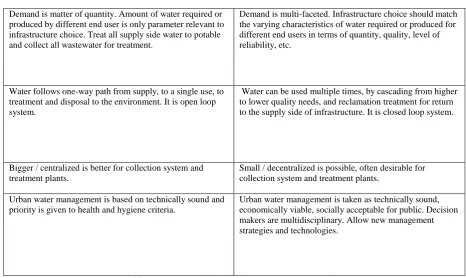
The comparison is made between old paradigm and emerging paradigm to fill the gap or deficiency for more sustainable urban water management system (4).
The Old Paradigm The Emerging Paradigm
Human waste is nuisance. It should be disposed of after treatment.
Human waste is a resource. It should be captured and processed effectively, used to nourish land and crops. Storm water is a nuisance. Convey storm water away from
urban area as rapidly as possible.
Storm water is a resource. Harvest storm water as a water supply, and infiltrate or retain it to support aquifers, waterways and vegetation.
Demand is matter of quantity. Amount of water required or produced by different end user is only parameter relevant to infrastructure choice. Treat all supply side water to potable and collect all wastewater for treatment.
Demand is multi-faceted. Infrastructure choice should match the varying characteristics of water required or produced for different end users in terms of quantity, quality, level of reliability, etc.
Water follows one-way path from supply, to a single use, to treatment and disposal to the environment. It is open loop system.
Water can be used multiple times, by cascading from higher to lower quality needs, and reclamation treatment for return to the supply side of infrastructure. It is closed loop system.
Bigger / centralized is better for collection system and treatment plants.
Small / decentralized is possible, often desirable for collection system and treatment plants.
Urban water management is based on technically sound and priority is given to health and hygiene criteria.
Urban water management is taken as technically sound, economically viable, socially acceptable for public. Decision makers are multidisciplinary. Allow new management strategies and technologies.
Table 1 Comparison of old paradigm and emerging paradigm
III.
STATE OF KNOWLEDGE
For Integrated assessment UNEP describes selected tools which are stake holder analysis and mapping, Expert panel, Focus groups, household survey, sustainable framework indicator, casual chain analysis, root cause analysis, trend analysis, scenario-building , multi criteria decision analysis (5) . The comparative study of sustainability index was carried out by Carden et al. (11) for South African cities by Triple bottom line perspective and MCA was used. Sahely et al. (6) used mathematical model for quantifying environmental and economic sustainability indicator. Shovini Dasgupta et al. (7) have categorized mandatory screening indicator and judgment indicator. Multi layer approach was used to incorporating these indicators. A normalization procedure has been adapted to work within the framework and to compare alternative across a range of indicator and different orders of data magnitude. E Lai et al. (8) have reviewed numbers of method for integrated sustainable urban water system. The four dominant approaches applied were cost benefit analysis, triple bottom line, integrated assessment and multi criteria analysis. Vairavamoorthy et al. (9) has done risk assessment for sustainable urban water management using fuzzy logic. Stefan Hajkowicz et al. (10) has review the method of MCA which includes fuzzy set analysis, comparative programming, analytical hierarchy process, ELECTRE, PROMETHEE, MAUT, MCQA, EXPROM, MACBETH, SAW, TOPSIS etc .
IV.
PROBLEM STATEMENT
In the Surat City, due to population explosion & urbanization the stress on urban water sector is increasing. Water supply, sanitation provision and drainage – are vital in the quest to promote economic, environmental and social healthy development. The scientific approach to facilitate decision making in equity, efficiency and sustainability criteria is the main goal for performance evaluation of urban water sector. For efficient management of urban water sector Sustainability Index was found which indicates performance of urban water sector in different dimensions.
Surat city has perennial river Tapi, which is main source of water supply. The tragedy is local government can extract only 300 cusec of water daily from river Tapi according to riparian right, which is not sufficient to fulfill the demand of citizen and high growth rate of population. Surat Local government demanding more water extraction capacity from river Tapi, with state government since long time but these all are political issues and not yet resolved. The City limit is increased in last few years from 112 Sq.Km to 334 Sq.Km area and corporation is not in position to cope up demand of city at faster rate. Due to construction of weir cum cause way on river Tapi reservoir is formed on upstream side of river, which led to stagnation of flowing river water. Stagnation of water give rise to growth of algal and weed, hence raw water quality get degraded which will cause problem in intake well as well as in subsequent treatment process. It also reduces the yield of water. To improve the raw water quality, frequently release of water from nearby (Ukai) dam is required. Moreover, a sewage discharge from some of the area has created terrible impact on river water quality on upstream of river. Sewage discharge enhances the growth of algae, weed and other vegetation. Recently, it was suggested in city development plan to lay down pipelines from Ukai dam to Surat (100 Km) to resolve the issues regarding quality and quantity of water supply? Will this decision economically viable or sustainable?
V.
METHODOLOGY
Fig.2 Flow chart describing methodology
1. System Boundary For Urban Water Management System:
System boundary is decided based on systematic consideration of the various dimension of water sector. Domain of system boundary consists of water supply system, waste water, storm water, rain water recharging/harvesting & its sub criteria. Sustainability is related to prolonged time perspectives hence it should be selected accordingly.
2. Selection of Indicator And Criteria:
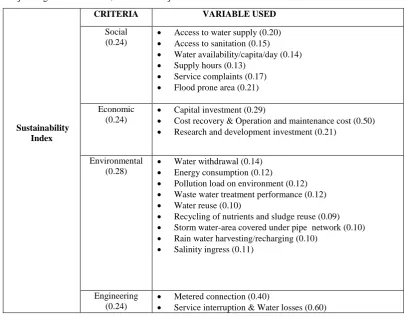
Criteria selection involved the selection of appropriate criteria for the field of research, their relevance to current issues, their appropriateness to the area in question, their scientific and analytical basis plus their ability to effectively represent the issues they are designed for. Theoretical framework building providesthe underlying basis for criteria selection and supported the overall structure of urban water management. The four dimensional view on sustainability was employed, and these four dimensions constituted the basic components for measure of sustainability of system.
3. Data Collection:
The data were collected related to the criteria and indicators which were selected for the study. This includes data related to social, economic, environmental and engineering factors and its sub factor like population served by water supply and waste water system, storm water, capital investment, economic expenditure and maintenance, water supply per capita per day, waste water generation per capita per day, area covered under pipe network, energy consumption, cost recovery, revenue collection from water supply, sewerage system, flood prone area etc. from Surat municipal corporation (SMC). The non-availability of data is one of the largest constraint to the success of most assessment study; where there were instance of indicators with incomplete data, either substitution or exclusion of variables was adopted.
4. Analysis Method:
For Analysis the Simple additive weightage method is used. A ranking approach was adopted, in which criteria and sub-criteria were ranked within their category and then assigned corresponding weight based on expert’s opinion.
Aggregate weight of indicator and criteria
Composite index value (SI)
Decide system boundary
Decide criteria and indicator
Prepare questionnaire for interview of experts, stake holders
Ranking of criteria and indicator
Decide weightage of each criteria and indicator
The Normalization involved the conversion of these criteria and sub criteria to a comparable form which ensures commensurability of data. The criteria are compared with target value based on their unit of measurement.
The scores were normalized (converted) by the following formulas
Xij= 𝒂𝒊𝒋
𝒂𝒋𝒎𝒂𝒙
--- (1)
Xij=𝒂𝒋 𝒎𝒊𝒏
𝒂𝒊𝒋
--- (2)
Where, aij = actual existing value for the sub-criteria ajmax, ajmin = target value for sub-criteria
When criteria are maximized, formula (1) is to be used, and formula (2) is to be used when criteria are minimized. For normalization target value/ threshold value is taken as a standard value.
The Weighting entailed the aggregation of criteria and sub-criteria. The aggregation refers to grouping of criteria and sub-criteria. A composite index approach was employed to calculate the overall sustainability index score. The normalized value for each criterion Xij, was multiplied by the aggregate weight of criteria and sub-criteria Wj. The
score for each sub-criterion was added to get final Sustainability Index value.
Sustainability Index (S.I) = 𝒏𝒋=𝟏𝑿𝒊𝒋𝒘𝒋 𝒋 = 𝟏, … 𝒏
Where, n = number of criteria,
wj = weight of the criterion, and xij = normalized score for the criterion.
Table 2 Decided criteria and indicator along with its weightage
Sustainability Index
CRITERIA VARIABLE USED
Social (0.24)
Access to water supply (0.20) Access to sanitation (0.15) Water availability/capita/day (0.14) Supply hours (0.13)
Service complaints (0.17) Flood prone area (0.21)
Economic (0.24)
Capital investment (0.29)
Cost recovery & Operation and maintenance cost (0.50) Research and development investment (0.21)
Environmental (0.28)
Water withdrawal (0.14) Energy consumption (0.12)
Pollution load on environment (0.12) Waste water treatment performance (0.12) Water reuse (0.10)
Recycling of nutrients and sludge reuse (0.09) Storm water-area covered under pipe network (0.10) Rain water harvesting/recharging (0.10)
Salinity ingress (0.11)
Engineering (0.24)
Metered connection (0.40)
Fig. 3 Index value for engineering and economic criteria
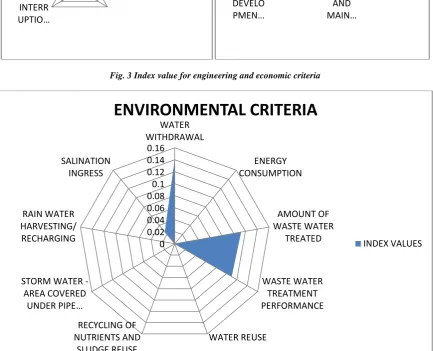
Fig. 4 Index value for environmental criteria
0 0.01 0.02 0.03
METERE D CONN…
SERVICE INTERR UPTIO…
ENGINEERING
CRITERIA
INDEX VALUES
0 0.1 0.2 0.3 0.4 0.5
CAPITAL INVEST
MENT
OPERAT ION AND MAIN… RESEAR
CH & DEVELO PMEN…
ECONOMIC CRITERIA
INDEX VALUES
0 0.02 0.04 0.06 0.08 0.1 0.12 0.14 0.16
WATER WITHDRAWAL
ENERGY CONSUMPTION
AMOUNT OF WASTE WATER
TREATED
WASTE WATER TREATMENT PERFORMANCE
WATER REUSE RECYCLING OF
NUTRIENTS AND SLUDGE REUSE STORM WATER
-AREA COVERED UNDER PIPE … RAIN WATER HARVESTING/ RECHARGING
SALINATION INGRESS
ENVIRONMENTAL CRITERIA
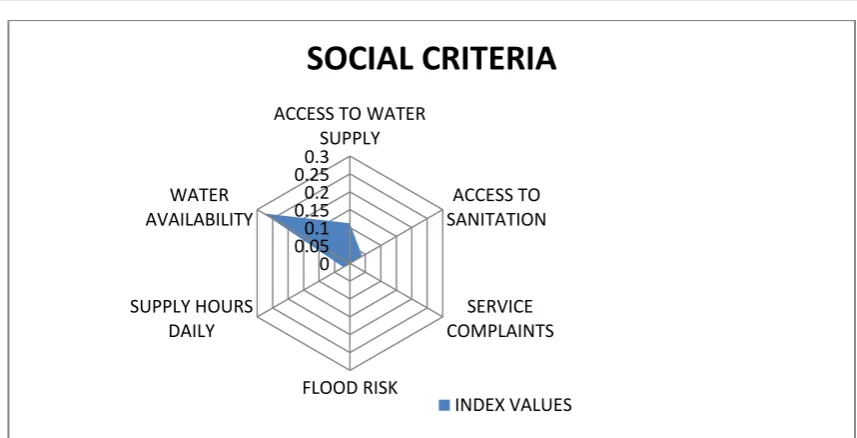
Fig. 5 Index value for social criteria
Fig. 6 Index value for main criteria
Table 3 Composite Sustainability Index value for all criteria
VI.
RESULTS AND DISCUSSION
The result shows that Surat city standing in the sustainability continuum is moderate with individual index scoring of social, economical, environmental, & engineering criteria are 0.453, 0.659, 0.4351, and 0.031 respectively. Composite sustainability index for urban water management system found is 0.396.
Engineering index is very less and it has high potential for improvement. According to the collected data metered connection is only in the area of 0.41% of Surat city which brings down engineering index. Water losses can also be minimized by installing efficient devices and conducting water audit.
0 0.050.1 0.150.2 0.250.3
ACCESS TO WATER SUPPLY
ACCESS TO SANITATION
SERVICE COMPLAINTS
FLOOD RISK SUPPLY HOURS
DAILY WATER AVAILABILITY
SOCIAL CRITERIA
INDEX VALUES
0 0.05 0.1 0.15 0.2
SOCIAL CRITERIA
ECONOMIC CRITERIA
ENVIRONME NT CRITERIA ENGINEERING
CRITERIA
MAIN CRITERIA
INDEX …
Criteria Aggregate
Index value
Social criteria 0.1087
Economic criteria 0.158196
Environment criteria 0.1218
Engineering criteria 0.0075936
Environmental index can be raised by implementing water reusing system. The energy consumption contributes 66% of total water management cost so, it can be reduced to some extent by implementing energy efficient technique or renewable energy sources should be used.
There is huge variation between area covered under pipe network & percentage population covered before & after extension of city limit. This is because of transition stage of extension of city limit. It takes time for establish infrastructure facilities which represents a drop in population & area coverage. Apart from that important issue is riparian right for water withdrawal capacity hence it is urgent need for sustainability of system to develop rainwater recharging and harvesting system, Reuse of water and waste water and water meter should be implemented to minimize water losses.
ACKNOWLEDGEMENT
This project has been funded by The Institution of Engineers (India), 8 Gokhale Road, Kolkata 70020 under R & D Grant- in –aid scheme 2010-2011.
REFERENCES
1. Geldof G.D (1995a). Policy analysis and complexity – a non-equilibrium approach for integrated water management. Water science and technology, 31(8),301-309
2. Geldof G.D (1995b) Adaptive water management: integrated water management on the edge of chaos. Water science and technology,32(1) , 7-13
3. World Commission on Environment and Development, Our Common Future (Brundtland report), 1987, Oxford University Press
4. Barbara Anton, Ralph Philip (2008) “Integrated water management- what’s in it for the city of the future, Stockholm conference
5. Integrated assessment: Mainstreaming sustainability into policymaking UNEP A guidance manual (August 2009) 6. Halla R. Sahely and Christopher A. Kennedy “ Water used model for environmental and economic sustainability
indicators” Journal of water resources planning and management , ASCE/Nov/Dec/2007 pg 550-559
7. Shovini Dasgupta and Edwin K.L.Tam “ Indicators and framework for assessing sustainable infrastructure” Canadian Journal of Civil engineering 32:30-44(2005)
8. E.Lai, S. Lundie and N.J.Ashbilt “ Review of multi- criteria decision aid for integrated sustainability assessment of urban water system” Urban water journal vol. 5. No.4 December – 2008, 315-327.
9. Vairvamoorthy, K & Khatri, K.B et al “Risk assessment for sustainable urban water management” UNESCO-IHP report (2007)
10. Stefan Hajkowicz, Kerry Collins et al “A Review of multicriteria analysis for water resource planning and management” Water resource management (2007) 21: 1553-1566