Intelligent Design Approach for Three-phase Cage
Induction Motor Using Glowworm Swarm
Optimization Algorithm
V.P. Sakthivel
Assistant Professor
Department of Electrical and Electronics Engineering Government College of Engineering, Dharmapuri – 636704, India.
Abstract: Glowworm Swarm Optimization (GSO) algorithm is a new swarm intelligence technique which replicates the movement of the glowworms in a swarm based on the distance between them and on a luminescent quantity called luciferin. This algorithm has been proven very efficient in the problems that have been applied. However, this algorithm is not applied to solve the three phase cage induction motor design (TPCIMD) problems. In this paper, the TPCIMD problem is solved using GSO approach. Due to stochastic nature of GSO, this algorithm does not trap in local optimums. In order to prove the effectiveness of this algorithm, the proposed algorithm is applied for designing two sample motors. The simulation results are compared with genetic algorithm (GA), particle swarm optimization (PSO) and conventional approaches. The results prove the effectiveness, accuracy and speed of this algorithm for solving TPCIMD problem.
Index Terms – Genetic algorithm, glowworm swarm optimization, induction motor design, particle swarm optimization.
I.INTRODUCTION
Economic considerations in the design of an induction motors (IM) were introduced in the early years of electrical motor production. However, full utilization of the materials was possible only with the advent of the digital computers, and the development of optimization techniques. In the literature, most of the works are only concerned with reducing the manufacture cost by minimizing its active material costs [1-5]. This is the main objective of the motor producer but may not be beneficial to consumers. Since the manufacture cost is a small portion of the total power loss cost of the motor during its lifetime. Accordingly, the design of IM should also put emphasis on minimizing its active power loss cost [4-6]. This is the objective of consumers as the power consumption cost is reduced and also leads to admirable goal of global energy conservation.
The design optimization of a three-phase cage IM for minimum annual cost, using evolutionary optimization techniques, is an appropriate approach to the motor design. With this approach, any desired requirements may be easily expressed in the optimization problem formulation. The optimal design parameters of the motor can be obtained by solving a constrained nonlinear optimization problem. The problem consists of an objective function which is optimized (minimized or maximized) with a set of constraints.
Heuristic algorithms such as GA [7], evolutionary algorithm [8], neural networks [9], fuzzy logic [10], PSO [11, 12], Adaptive PSO [13], bacterial foraging algorithm (BFA) and Adaptive BFA [14] have been used to solve the IM design problems. Though heuristic algorithms such as GA have been employed to solve IM design problems, recent research has indentified some deficiencies in GA performance [15]. The premature convergence of GA degrades its performance and reduces its search capability that leads to a higher probability toward obtaining local minimum.
Glowworm swarm optimization (GSO) proposed by Krishnanand and Ghose, is a new algorithm for the optimization of multimodal functions [16]. It is mimicked from the behavior that glowworms exchange information of searching for food with their peers. The GSO algorithm shows outstanding performance in finding the optimal solution for the multimodal functions.
In this paper, the GSO algorithm is investigated for the TPCIMD problem. The GSO algorithm is experimented with two sample motor design and compared with GA PSO and conventional techniques. In all the experimented TPCIMD cases, the proposed GSO competitively produced comparable results. The remainder of this paper is organized as follows: Section 2 provides the formulations of TPCIMD problem. The description of brief overview of GSO algorithm and its application to TPCIMD problems are given in Sections 3 and 4 respectively. Experimental results and analysis of the findings are presented in Section 5 while the conclusion and possible future research directions are provided in Section 6.
II.THREE –PHASE CAGE INDUCTION MOTOR DESIGN PROBLEM
The TPCIMD problem could be traditionally formulated as a minimization of the annual active material cost of the motor subject to the inequality performance indices constraints. Mathematically, the objective function of TPCIMD problem can be formulated as follows:
The expression of cost functions, in terms of the design variables are summarized as follows: The annual iron material cost of the motor is given by
Ci αci(Misc Mist Mirc Mirtt Mirtb) (1) Where,
) 7 x 5 2x 1 (x 7 Lx i K i W 0.88π isc
M
) 6 x s N -) 5 x 1 x ( (π 5 Lx i K i W 0.88π ist
M
) rc d 8 2x r D ( rc Ld i K i W 0.88π irc
JETIR1709084 Journal of Emerging Technologies and Innovative Research (JETIR) www.jetir.org 563 ) 9 x r N ) rs d r D ( (π rs Ld i K i 0.88W irtt
M
) 9 x r N -) rs d -8 x -r D ( π ( ) rs d -8 x ( L i K i 0.88W irtb M
The annual copper material cost of the motor is given by ) er M b M sc M ( c αc c
C
(2) Where,
L p 1 x 0.472 0.0635 s N 6 x 5 x ss K c W sc M ) rs d 8 x ( r N 9 Lx sr K c 1.02W bM
p j K ) rs d 8 (x r N 9 x 1 x sr K c 1.9W er M
The total annual active material cost function to be minimized can be expressed as follows:
c C i C m C
F(X)
(3)
The nine design variables are used in formulating the objective and constraint functions of the TPCIMD problem. These variables include stator bore diameter (x1), average air gap flux density (x2), stator current density (x3), air gap length (x4), stator slot depth (x5), stator slot width (x6), stator core depth (x7), rotor slot depth (x8) and rotor slot width (x9).
The six important motor performance indices are chosen as design constraints. These are: maximum to full-load torque ratio (g1), starting to full-load torque ratio (g2), starting to full-load current ratio (g3), full-load efficiency (g4), full-load power factor (g5) and maximum temperature rise (g6).
III.OVERVIEW OF GSO ALGORITHM
GSO algorithm, a new swarm optimization algorithm is proposed by K.N. Krishnanad and D. Ghose [17]. The basic idea of this algorithm is mimicked from the natural glowworm’s activities in the night, the Glowworms exercise in group in nature, they interaction and inter-attraction with each other by one’s luciferin. If the glowworm emits luciferin more lighter, it can attract more glowworms move toward it. Through simulate this natural phenomena, combined with the characteristics of natural glowworm populations, each glowworm at the owns field of view in search for the glowworm, which release the strongest luciferin, also move to the strongest glowworm.
The GSO algorithm starts by placing the glowworms randomly in the search space, so that they are well dispersed. Initially, all the glowworms contain an equal quantity of luciferin. Each iteration consists of a luciferin-update phase followed by a movement phase based on the transition rule.
A. Luciferin update phase
The luciferin update phase depends on the function value at the glowworm position and so, even though all glowworms start with the same luciferin value during the initial iteration, these values change according to the function values at their current positions. During this phase, each glowworm adds, to its previous luciferin level, a luciferin quantity proportional to the measured value of the sensed profile (fitness) at that point. In the case of a function optimization problem, this would be value of the objective function at that point. Also, a fraction of the luciferin value is subtracted to simulate the decay in luciferin with time. The luciferin update rule is expressed by using,
(4)
B. Movement phase
During this phase, every glowworm decides, using a probabilistic mechanism, to move towards a neighbor that has a luciferin value more than its own. This means that they are attracted to neighbors who are growing brighter. For every glowworm i, the probability of moving towards a neighbor j is represented by,
(5)
Where,
Let, the glowworm i select a glowworm with is expressed in the above Eq. Then, the discrete-time model
of glowworm movements can be defined as
(6)
Where, S = δ if dij(t) ≥ δ
dij(t) otherwise
0,(1 )l (t) F(t 1)
max) 1 t (
lj j j
) t ( i N k k j j ) t ( l ) t ( l ) t ( P)
t
(
N
k
i
j:di,j(t) r (t);l (t) l (t)
)t (
Ni di i j
)
t
(
N
j
i pj(t)C. Local-decision range update rule
When the glowworms depend on only local information to decide their movements, it is expected that the number of peaks captured would be a strong function of radial sensor range. For instance, if the sensor ranges of each agent covers the entire workspace, all the agents move to the global optimum point, and the local optima are ignored. Since, we have considered that a prior information about the objective function is not available, in order to detect multiple peaks, the sensor range must be made a
varying parameter. For this purpose, we associate each agent i with a local decision domain whose radial range is dynamic in
nature . The suitable function is selected to adaptively update the local-decision domain range of each glowworm and is expressed by,
(7)
IV.GLOWWORM SWARM OPTIMIZATION FOR TPCIMD
The GSO algorithm for solving the TPCIMD problem is as follows:
Step 1: Read the specifications, limits of design variables and performance indices of the motor.
Step 2: Read GSO algorithm parameters.
Step 3: Initialize initial luciferin value lo and local decision range ro.
Step 4: Initialize the glowworm within the limits of each variable.
Step 5: Find the annual active material cost of the motor using Eq. (3) and the luciferin value of all glowworms using Eq. (4).
Step 6: Find the neighborhood glowworms having brighter glow and are in the local decision range.
Step 7: Find the probability of glowworm moving towards a neighbor using Eq. (5).
Step 8: Update the glowworm movement using Eq. (6) and check the limits.
Step 9: Update the local decision range of all glowworms using Eq. (7).
Step 10: Repeat the above steps 5 to 9, until maximum iterations are attained.
Step 11: Display the optimal design variables, and their corresponding performance indices and the annual active material cost
of the cage induction motor.
V.NUMERICAL RESULTS
To test the effectiveness of the proposed GSO algorithm, two sample motors including 5 HP and 10 HP motors have been solved. The results obtained are compared with GA, PSO and conventional techniques. The proposed algorithm is coded in MATLAB platform and run 20 independent trials for each case on a core i3 processor with 2.40 GHz and 4 GB RAM. The specifications of the sample motors are given in Appendix A2.
Fig.1. Standard deviation of costs obtained by various algorithms for sample motor 2 i d r i
s i
d r
r
0
rs,max 0,r (t) (n N (t)
min ) 1 t (
r t i
i d i
JETIR1709084 Journal of Emerging Technologies and Innovative Research (JETIR) www.jetir.org 565 Fig. 2. Best solutions of various algorithms in 20 independent trials for sample motor 2
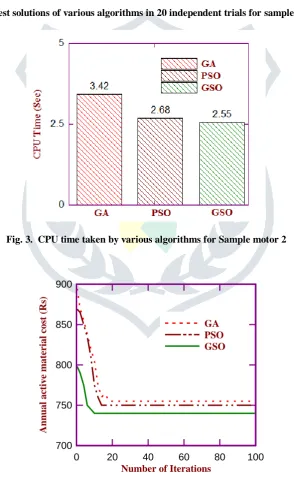
Fig. 3. CPU time taken by various algorithms for Sample motor 2
Fig. 4. Convergence characteristics of the compared algorithms for sample motor 2
Number of Trials
A
nn
ua
l
materi
al
co
st
(Rs)
0 5 10 15 20 725
750 775 800 825 850 875 900
GA PSO GSO
Number of Iterations
A
nn
ua
l
activ
e
materi
al
cost (R
s)
0 20 40 60 80 100 700
750 800 850 900
Table 1. Comparison of results of various algorithms for 5 HP motor
Variables/ indices/cost Conventional
method GA PSO GSO Independent variables
Stator bore diameter (mm) 150 145 145.7 146.8 Average air gap flux density (Wb/m2) 0.46 0.476 0.456 0.468
Stator current density (A/mm2) 4 4.2 4.02 4.2
Air gap length (mm) 0.43 0.41 0.39 0.43 Stator slot depth (mm) 24.15 22.8 22.74 22.63 Stator slot width (mm) 6.92 7.2 7.15 7.18 Stator core depth (mm) 24.94 26.6 26.4 25.99
Rotor slot depth (mm) 10 10 12 10
Rotor slot width (mm) 5 4.6 5 4.5
Dependent Variables
Gross iron length (mm) 89 92.6 95.8 93.8 Rotor current density (A/mm2) 7.74 7.6 7.4 7.32
Performance index
Maximum to full-load torque ratio 2.21 2.57 2.7 2.58 Starting to full-load torque ratio 1.27 1.6 1.37 1.47 Starting to full-load current ratio 4.15 4.92 4.68 4.72 Full-load efficiency 81.57 82.32 83.47 83.64 Full-load power factor 0.86 0.82 0.84 0.86 Maximum temperature rise 52 50.68 49.68 50.69 Annual Material cost (Rs) 487.1 460.42 499.43 452.76
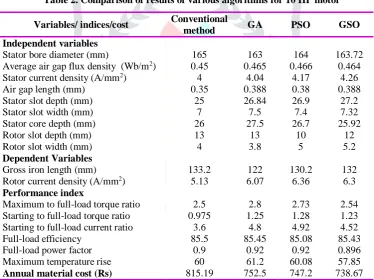
Table 2. Comparison of results of various algorithms for 10 HP motor
Variables/ indices/cost Conventional
method GA PSO GSO Independent variables
Stator bore diameter (mm) 165 163 164 163.72 Average air gap flux density (Wb/m2) 0.45 0.465 0.466 0.464
Stator current density (A/mm2) 4 4.04 4.17 4.26
Air gap length (mm) 0.35 0.388 0.38 0.388 Stator slot depth (mm) 25 26.84 26.9 27.2
Stator slot width (mm) 7 7.5 7.4 7.32
Stator core depth (mm) 26 27.5 26.7 25.92
Rotor slot depth (mm) 13 13 10 12
Rotor slot width (mm) 4 3.8 5 5.2
Dependent Variables
Gross iron length (mm) 133.2 122 130.2 132 Rotor current density (A/mm2) 5.13 6.07 6.36 6.3
Performance index
Maximum to full-load torque ratio 2.5 2.8 2.73 2.54 Starting to full-load torque ratio 0.975 1.25 1.28 1.23 Starting to full-load current ratio 3.6 4.8 4.92 4.52 Full-load efficiency 85.5 85.45 85.08 85.43 Full-load power factor 0.9 0.92 0.92 0.896 Maximum temperature rise 60 61.2 60.08 57.85 Annual material cost (Rs) 815.19 752.5 747.2 738.67
The GSO parameters used for the simulation are as follows: Luciferin decay constant = 0.95
Luciferin enhancement constant = 0.95 Constant parameter = 0.0005
Neighborhood threshold = 4
Radial range of Luciferin sensor (rs) = 0.005 Local decision domain range (rd) = 0.0005 Population size = 20
Maximum number of iterations =100
Tables 1 and 2 compare the optimal design variables, performance indices and annual active material cost obtained by various algorithms for the motor 1 and motor 2 respectively. The annual cost obtained by the GSO algorithm is less when compared to the conventional, GA and PSO techniques.
JETIR1709084 Journal of Emerging Technologies and Innovative Research (JETIR) www.jetir.org 567 execution time taken by the GSO is lesser than the other algorithms. Fig. 4 shows the graphs of the convergence of the solutions with iterations for GA, PSO and GSO for sample motor 2. It is seen that the GSO outperforms the GA and PSO algorithms in terms of the rate of convergence and getting a lower final value of the annual active material cost of the motor.
VI.CONCLUSIONS
In this paper, a new swarm intelligence technique, Glowworm Swarm Optimization (GSO) has been proposed for solving the three phase cage induction motor design (TPCIMD) problems. The main advantages of the proposed algorithm are as follows: GSO algorithm is a derivative-free, meta-heuristic algorithm and efficiently capture all the maximum multimodal function. The effectiveness of the proposed algorithm has been investigated on two sample motors. Comparative computational results with other algorithms, namely GA and PSO demonstrate that the proposed GSO algorithm significantly outperforms the compared algorithms in solving the TPCIMD problems. Especially, it is shown that GSO achieves better solutions. Additionally, the comparisons of the maximum, mean, and minimum values, in the three test sample motors, indicate that the proposed GSO is more robust than the compared algorithms since it has much lower standard deviations. Furthermore, GSO performs significantly better than the other compared algorithms in terms of solution quality and search ability. This research work not only provides a powerful optimization tool for the TPCIMD problems, but it also enriches the application of the GSO algorithm in electrical machine design problem. For future work, it will be interesting to apply this new effective swarm algorithm to address some other complicated power system related optimization problems
APPENDICES A1. List of symbols
Misc, Mist core and tooth iron masses in stator (Kg)
Mirc, Mirtb, Mirtt core, tooth bodies and tooth tips iron masses in rotor (Kg)
Mb, Mer, Msc bars, end rings and stator conductor copper
masses (Kg)
pisc, pist specific iron loss of stator core and tooth (W/Kg)
Pisc, Pist core and teeth iron power loss in stator (W)
Pb, Per, Psc bars, end rings and stator conductors copper power losses (W)
Ksr, Kss rotor and stator slot copper insulating factors
δr rotor current densities (A/mm2)
p number of poles
T motor running time per year (hr) α annual rate of interest and depreciation η full-load efficiency
W rated power (W)
Ker end ring non-uniformity current distribution factor
Wc, Wi copper and iron specific masses (Kg/m3)
ρs, ρr stator and rotor copper resistivities (Ω.m)
Ki iron insulation factor
Kj end ring to bar current density ratio
f supply frequency (Hz)
Nr, Ns rotor and stator number of slots
cc, ci specific copper and iron material costs (Rs/Kg)
drc rotor core depth (m)
drs rotor slot opening depth (m)
wrs rotor slot opening width (m)
Di rotor inner diameter (m)
Do stator outer diameter (m)
Dr rotor diameter (m)
L gross iron length (m) Li active iron length (m)
luciferin decay constant luciferin enhancement constant
di,j (t) Euclidian distance between glowworms i and j at time t s moving step size
) t (
rdi variable local decision range associated with the glowworm i at time t
) t (
lj luciferin level associated with the glowworm j at time t
A2. Specification of Test Motors
Specifications Motor1 Motor 2 Capacity 5 HP 10 HP Voltage 400 V 415 V Current 7.8 A 13.68 A Frequency 50 Hz 50 Hz
No. of Poles 4 4
Power factor 0.8 0.87 Efficiency 83 % 87 %
REFERENCES
[1] R. Ramarathnam, and B.G. Desai, “Optimization of poly-phase induction motor design – a nonlinear programming approach,” IEEE Trans. Power Apparatus and Systems, vol. 90, pp. 570-578, 1971.
[2] B.G. Bharadwal, K. Venkatesen, and R. B. Saxena, “Experience with direct and indirect search methods applied to cage induction motor design optimization,” Electric Machines and Electromechanics, vol.4, no. 1, pp. 85-93, 1979.
[3] C. Li, and A. Rahman, “Three-phase induction motor design optimization using the modified Hooke-Jeeves method,”
Electrical Machines and Power Systems, vol. 18, 1990, pp. 1-12
[4] J. Appelbaum, E.F. Fuchs, and J. C. White, “Optimization of three-phase induction motor, part I: Formation of the optimization technique,” IEEE Trans. Energy Convers., vol.2, no. 3, pp. 407-415, 1987.
[5] J. Appelbaum, I.A. Khan, E. F. Fuchs, and J.C. White, “Optimization of three-phase induction motor, part II: the efficiency and cost of an optimum design,” IEEE Trans. Energy Convers., Vol. 2, No. 3, pp. 415-422, 1987.
[6] N.H. Feith, and H.M. EI-Shewy, “Induction motor optimum design including active power loss effect,” IEEE Trans. Energy
Convers., vol. 1, no. 3, pp. 155-160, 1986.
[7] G. Fuat Uler, Osama A. Mohammed, and Chang-Seop Koh, “Design optimization of electrical machines using genetic algorithms,” IEEE. Trans. Magnetics, vol. 31, no. 3, pp. 2008-2011, 1995.
[8] Jan Pawel Wieczorek, Ozdemir Gol, and Zbigniew Michalewiez, “An evolutionary algorithm for the optimal design of induction motors,” IEEE Trans. Magnetics, vol. 34, no. 6, pp. 3882-3887, 1998.
[9] G.T. Bellarmine, R. Bhuvaneswari, and S. Subramanian, “Radial basis function network based design optimization of induction motor,” Proceedings of IEEE SOUTHEASTCON 2006, Memphis, Tennessee, USA, 2006, pp. 75-80.
[10] R. Bhuvaneswari, and S. Subramanian, “Fuzzy logic approach to three-phase induction motor design,” Proceedings of the
International Conference on Computer Applications in Electrical Engineering Recent Advances - CERA-05, IIT, Roorkee,
India, 2005, Sept 28-Oct 1, pp. 505-509.
[11] R. Eberhart, and J. Kennedy, “A new optimizer using particle swarm optimization,” Proceedings of the 1995 Sixth
International Symposium on Micro Machine and Human Science, pp. 39-43.
[12] Vadugapalayam Ponnuvel Sakthivel, Ramachandran Bhuvaneswari, Srikrishna Subramanian, “Economic design of three-phase induction motor by particle swarm optimization,” Journal of Electromagnetic Analysis and Applications, Vol. 2, No. 5, pp. 301-310, 2010.
[13] V.P. Sakthivel, R. Bhuvaneswari, and S. Subramanian, “Adaptive particle swarm optimization for the design of three-phase induction motor considering the active power loss effect,” International Journal of Computer and Electrical
Engineering, Vol. 2, No. 4, pp. 627-636, 2010.
[14] V.P. Sakthivel, R. Bhuvaneswari, and S. Subramanian, “Design optimization of three-phase energy efficient induction motor using adaptive bacterial foraging algorithm,” COMPEL: The International Journal for Computation and Mathematics
in Electrical and Electronic Engineering, Vol. 29, No. 3, pp. 699-726, 2010.
[15] D. B. Fogel, ‘Evolutionary computation: toward a new philosophy of machine intelligence,’ 2nd edition, Piscataway, NJ:
IEEE Press., 2000.
[16] K.N. Krishnand and D. Ghose, “Glowworm swarm optimization for simultaneous capture of multiple local optima of multimodal functions”, Swarm Intelligence, Vol. 3, No.2, pp. 87–124, 2009.
[17] K.N. Krishnand and D. Ghose, “Glowworm swarm optimization: a new method for optimizing multimodal functions”,