Effect of Red Clover Vaginal Cream on Dyspareunia
and Sexual Satisfaction in Postmenopausal Women:
A Triple-Blinded Clinical Trial
Jamileh Khayatan
1, Mina Iravani
2*, Eskandar Moghimipour
3, Mohammad Hossein
Haghighizade
4, Parivash Jelodarian
51M.Sc. student of Midwifery, School of Nursing and Midwifery, Menopause Andropause Research Center, Ahvaz
Jundishapur University of Medical Sciences, Ahvaz, Iran.
2 PhD in Reproductive Health, Assistant Professor in Midwifery Department, Menopause Andropause Research Center,
Ahvaz Jundishapur University of Medical Science, Ahvaz, Iran.
3PhD in Pharmaceutics, Assistant Professor in Pharmaceutics Department, Faculty of Pharmacy, Ahvaz Jundishapur
University of Medical Sciences, Ahvaz, Iran.
4Lecturer in Biostatistics Department, School of Health, Ahvaz Jundishapur University of Medical Sciences, Ahvaz, Iran.
5Gynecologist, Associate Professor in Obstetrics and Gynecology Department, Fertility Infertility and Perinatology
Research Center, Ahvaz Jundishapur University of Medical Sciences, Ahvaz, Iran.
ABSTRACT
Introduction: One of the common complaints in postmenopausal women is the decreased sexual activity, desire, and satisfaction due to the reduction of estrogen and androgen hormones. This study aimed to investigate the effect of red clover vaginal cream (RCVC) on dyspareunia and sexual satisfaction in postmenopausal women. Method: This study was performed as a triple-blinded clinical trial on 76 postmenopausal women referred to Health Center No. 1 in Ahvaz during 2018. The women were divided randomly in two groups of A and B. Group A received RCVC 2% and Group B used a placebo applicator every night for eight weeks. It should be noted that the severity of dyspareunia was assessed with a checklist and sexual satisfaction by Larson questionnaire. Data were analyzed using paired t-test, Chi-square, Mann-Whitney, independent t, and Friedman tests along with SPSS software (Version 22) at a significance level of p < 0.05. Results: Mean post-intervention score of sexual satisfaction in RCVC group was significantly higher than the placebo group (p < 0.001). In the subjects who used RCVC, there was a significant improvement in pain during intercourse (p < 0.001). Conclusion: Based on the findings of this study, the use of RCVC for 8 weeks could increase the libido, and reduce the pain during intercourse. More studies are needed to prove the effect and safety of this herbal drug.
Key Words:Red clover, Postmenopausal women, Sexual satisfaction, Painful intercourse.
eIJPPR 2019; 9(4):23-29
HOW TO CITE THIS ARTICLE: Khayatan J, Iravani M, Moghimipour E, Haghighizade M.H., Jelodarian J, (2019). Effect of red clover vaginal cream on dyspareunia and sexual satisfaction in postmenopausal women: A triple-blinded clinical trial, Int. j. pharm. phytopharm. res. 9 (4), pp.23-9.
INTRODUCTION
Women's health provision is of paramount importance as they are the pillar of the family and society [1]. Researchers believe that menopause is the last natural
event in the physical and sexual life of any woman, which begins with the cessation of menstruation resulted from the ceased ovarian function due to the dropped estrogen levels, disrupting female sexual function and reducing her sexual activity [2]. The age of menopause in women is
naturally in the range of 42-58 years with an average of
Corresponding author: Mina Iravani
Address: Menopause Andropause Research Center, Midwifery Department,Nursing & Midwifery School, Ahvaz Jundishapur University
of Medical Sciences, Golestan Ave, Ahvaz, Iran.
E-mail:minairavani2004 @ yahoo.com
Relevant conflicts of interest/financial disclosures: The authors declare that the research was conducted in the absence of any commercial or financial relationships that could be construed as a potential conflict of interest .
24 51.4 years [3]. This stage of life for women is associated
with several problems such as physical, anatomical, and clinical changes [4]. According to existing statistics, there are currently 470 million women over 50 years worldwide [5]. Since 1970, the number of elderly people has observed an increase compared to the number of young people. It is predicted that there will be one elderly per five people by 2050, of which women are expected to encounter with injuries and complications due to the presentation of menopause symptoms [6]. Reductions in estrogen and androgen hormones during menopause lead to the appearance of menopausal symptoms. Early symptoms include atrophic changes in the urinary tract, breast shrinkage and pain, axillary and pubis hair loss, phalacrosis, hand and feet tingling, headache, dizziness,
tinnitus, syncope, dyspnea, weakness, anorexia,
constipation, diarrhea, arthralgia, cognitive impairments, myalgia [7], burning and itchy skin, fatigue, hot flashes, nausea and vomiting, genitalia atrophy with discharge, burning, itching, infection, bleeding, pain when urinating, frequent urination, suprapubic pain [8], decreased sexual desire and response, painful intercourse, and sleep disorders [9]. Late symptoms include the increased risk of
cardiovascular diseases, hypertension [7], and
osteoporosis [9]. Vaginal atrophy leads to the increased vaginal dryness, dyspareunia, and decreased sexual pleasure during menopause. Pain and spotting during sexual intercourse are resulted from the vaginal mucosal vulnerability, with likely occurrence of frequent and urgent urination without infection [10]. As it has been predicted, vaginal dryness occurs in more than 50% of postmenopausal women, which exacerbates with rising age [11]. As far as possible, such women should avoid sexual activity due to the painful intercourse caused by vaginal dryness. Under such conditions, sexual quality and satisfaction decrease resulting in the appearance and intensification of vaginal atrophy symptoms. In other words, many women believe that aging expose them to symptoms of menopause. Some of such women have also been observed to be unaware of their own therapies, and of changing their lifestyles to cope with menopause and its symptoms [12]. Sexual satisfaction has many dimensions, including physiological and emotional dimensions of sexual relation. It brings physical pleasure and also influences all the emotions remaining after negative and positive dimensions of sexual relation [13]. As such, people with high sexual satisfaction declare a better quality of life than those without sexual satisfaction [14].
Because there is an inverse relationship between sexual satisfaction and menopause, experts have proposed two types of treatments for quality development and
improvement of sexual satisfaction during menopause. The first category consists of hormone therapy, and the second is the complementary therapies [15]. One of the ways for developing sexuality during menopause and resolving the related disorders is the treatment with estrogen usage. However, it should be noted that only less than 20% of postmenopausal women receive estrogen. A study conducted in 2001 in Iran determined that 8.57% of postmenopausal women used hormone replacement therapy indicating that some women were likely inclined to use a standard hormone replacement therapy [16]. The results of the study showed that estrogen therapy, both topically and systemically, increased the tissue thickness and collagen levels. Treatment with synthetic estrogen has not been accepted by many women yet, due to the concerns about its complications [17, 18]. It raises the risk of cardiovascular, thromboembolic, endometrial hyperplasia, and breast cancer, rendering women to show more tendencies to alternative therapies for improving menopausal symptoms than estrogen therapy [19]. The second group is phytotherapy, which is nowadays increasingly used in women. Researchers have stated that some herbs contain effective substances that can be used to treat menopausal disorders [20]. Among the alternative treatments, phytoestrogens (estrogen-containing plants) have been more appropriate [21, 22]. They are structurally similar to 17 beta-estradiol and act similar to estrogen in the body [23, 24]. Herbal sources contain phytoestrogens which include fenugreek, soybean,
licorice, and red clover [25, 26]. Red clover (Trifolium
25
METHOD
This triple-blinded clinical trial aimed to investigate the effect of RCVC on dyspareunia severity and sexual satisfaction in postmenopausal women referred to Health Center No. 1 in Ahvaz, Iran, during 2018. Sampling was carried out after obtaining permission from the Ethics Committee of Ahvaz Jundishapur University of Medical
Sciences (IR.AJUMS.REC.1396.728) registered as
(IRCT20171224038036N2) at the Clinical Trial Center. In this study, sampling was done randomly using computer numbers. A sample size of 32 per group was determined according to the sample size estimation through the comparison of mean values in two independent populations with a power of 90%, and a confidence coefficient of 90%. With a sample drop probability of 20%, 38 subjects were considered for each group. Inclusion criteria were dyspareunia, age range of 45-65, women with menstrual cessation for one year or having a hormonal test with a FSH level of over 40 IU, and monogamous women with sexual intercourse. Exclusion criteria included vaginal bleeding with unknown cause, consumption of isoflavones in the diet, vaginal infection, hormone therapy, or sex hormone use 8 weeks before the study, and smoker and alcoholic women. In order to select the samples, the researcher first referred to the selected health center on all weekdays. Among the referring individuals, 76 eligible volunteer women with postmenopausal status were explained about the goals and the procedure of this study. It is worth mentioning that a written consent and the trust of individuals in the confidentiality of their information were received in advance. Demographic information was completed in the personal profile questionnaire by the participants. Before and after the treatment, dyspareunia severity was self-reported at 4 degrees (0 = no, 1 = mild, 2 = moderate, and 3 = severe) by the participants using a checklist. Sexual satisfaction level was determined using Larson sexual satisfaction questionnaire with 25 questions. The responses were scored based on 5-point Likert scale, with 1 and 5 points for the answers from “never” to “always”; respectively. In questions 1, 2, 3, 10, 12, 13, 16, 17, 19, 21, 22, and 23, the responses were scored as never = 1 to always = 5 points. In questions 4, 6, 5, 6, 7, 8, 9, 11, 14, 15, 18, 20, 24, and 25, the responses were scored in reverse so that never = 5 and always = 1. The points of 25-50 showed sexual dissatisfaction, 51-75 low sexual satisfaction, 76-100 moderate sexual satisfaction, and 101-125 high sexual satisfaction [30, 31]. In this research, the validity of the questionnaires was determined using the content validity method. To this end, the questionnaires were first
prepared by the researcher with necessary examinations, and then scrutinized by 10 faculty members from the Faculty of Nursing and Midwifery at Ahvaz Medical Sciences University. A final version was drafted after making necessary changes and amendments. It should be noted that the reliability coefficient of 83% was reported for Larson questionnaire by Pazandeh et al. [32].
RCVC was prepared in the laboratory of the Faculty of Pharmacy, Ahvaz University of Medical Sciences. Each participant was given an applicator and six 50 g tubes for nightly use within 8 weeks. The way of drug use was described to the subjects both personally and verbally, and the questionnaires were completed by them before and after the intervention. They were also asked to use no other herbal or hormonal remedies during this period. The envelopes were packed by an uninformed individual in collecting and analyzing data so that the user, prescriber, and data analyzer were not aware of the applied
intervention. At the end of the 8th week, the completed
questionnaires were collected from the subjects, and all data were analyzed by SPSS 22 statistical software. Paired t-test, Mann-Whitney, Chi-square, independent t, and Friedman tests were used for data analysis with a significance level of P < 0.05.
FINDINGS
In this study, there were no statistically significant differences in demographic data between the two groups (P < 0.22). According to Table 1, mean ages of RCVC and placebo groups were 56.18 ± 3.55 years and 56.0 7 ± 3.63 years; respectively. Mean menopausal ages in RCVC and placebo groups were 49.60 ± 3.04 years and 50.26 ± 1.34 years; respectively. BMI averaged 29.75 ± 3.46 and
29.20 ± 2.71 kg/m2 in RCVC and placebo groups;
respectively. The highest frequency of sexual activity was once a week, with 68.4% and 60.5% in RCVC and placebo groups; respectively.
Table 1. The demographic information of individuals of the research units
Group Demographics
RCVC n = 38
Placebo n=38 p-
value Mean ± SD
Age (year) 56∙18 ±3/55 56∙07 ±3∙63 0.89 Menopausal age
(year) 49∙60±3∙04 50∙26 ±1∙34 0.22 Menarcheal age
(year) 12∙21±0∙52 12∙39±0∙75 0.22 BMI 29∙75±3∙46 29∙20±2∙71 0.44
26
Education
Illiterate 0)0%( 2)5∙3%(
0.10 Under
diploma 21)55∙3%( 23)60∙5%( Diploma 13)34∙2%( 13)34∙2%( Academic 4)10∙5%( 0)%0(
Occupation
Housewife 33)86∙8%( 37)97∙4%( 0.10 Retired 5)13∙2%( 1)2∙6%(
Economic status
Weak 0)0%( 0)0%(
0.43 Medium 20)52∙6%( 17)44∙7%(
Good 17)44∙7%( 21)55∙3%( Excellent 1)2∙6%( 0)0%(
Intercourse per week
0 0)%0( 0)0%(
0.63 1 26)68∙4%( 23)60∙5%( 2 10)26∙3%( 11)28∙9%( 3 )5∙3%( 2 4)10∙5%( 4 0)%0( 0)0%(
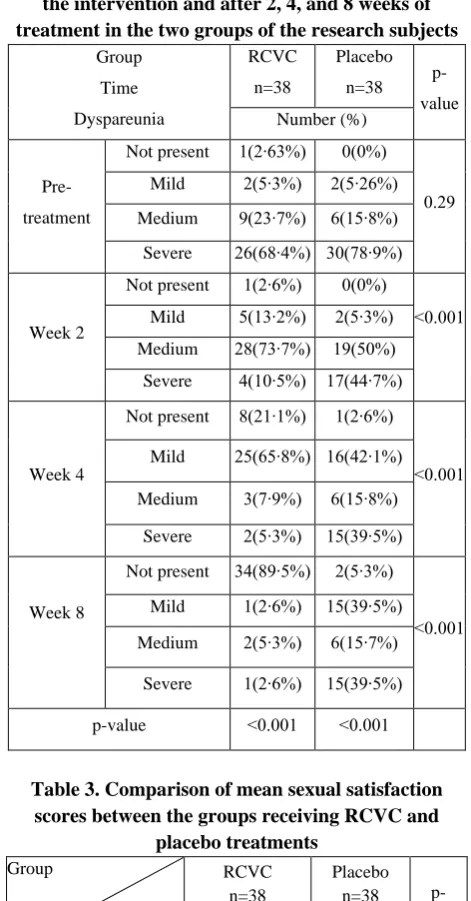
In terms of the economic status, 20 (52.6%) and 20 (55.3%) of the subjects in RCVC and placebo groups were in the middle and good classes; respectively. With respect to the employment status, 33 (86.8%) and 37 (97.4%) were housewives in RCVC and placebo groups, respectively. According to Table 2, Friedman test showed a significant difference in dyspareunia severity before and after the treatment in RCVC group compared to placebo treatment (p < 0.001). In the first visit, 26 (68.4%), 9 (23.7%), 2 (5.3%), and 1 (6.2%) of the subjects in RCVC group had severe, moderate, mild, and no dyspareunia; respectively. In the second visit, mild, moderate, severe, and no dyspareunia were observed in 25 (65.8%), 3 (7.9%), 2 (5.3%), and 8 (21.1%) of the participants with significant differences (p < 0.001). After 8 weeks of intervention, 34 (89.5%), 2 (3.5%), 1 (6.2%), and only 1 (2.6%) of the subjects presented zero, moderate, mild, and severe dyspareunia suggesting a positive effect of RCVC. The treatment of dyspareunia between the two groups of RCVC and placebo at follow-up periods (every 2 weeks) was compared by the Mann-Whitney test. There was a significant difference between the two groups in the treatment of dyspareunia severity (p < 0.001).
Table 2. Comparison of dyspareunia severity before the intervention and after 2, 4, and 8 weeks of treatment in the two groups of the research subjects
Group Time Dyspareunia
RCVC n=38
Placebo n=38
p-value Number (%)
Pre-treatment
Not present 1)2∙63%( 0)0%(
0.29 Mild 2)5∙3%( 2)5∙26%( Medium 9)23∙7%( 6)15∙8%( Severe 26)68∙4%( 30)78∙9%(
Week 2
Not present 1)2∙6%( 0)0%(
0.001 > Mild 5)13∙2%( 2)5∙3%( Medium 28)73∙7%( 19)50%( Severe 4)10∙5%( 17)44∙7%(
Week 4
Not present 8)21∙1%( 1)2∙6%(
0.001 > Mild 25)65∙8%( 16)42∙1%( Medium 3)7∙9%( 6)15∙8%(
Severe 2)5∙3%( 15)39∙5%(
Week 8
Not present 34)89∙5%( 2)5∙3%(
0.001 > Mild 1)2∙6%( 15)39∙5%( Medium 2)5∙3%( 6)15∙7%(
Severe 1)2∙6%( 15)39∙5%( p-value >0.001 >0.001
Table 3. Comparison of mean sexual satisfaction scores between the groups receiving RCVC and
placebo treatments
p- value Placebo
n=38 RCVC
n=38 Group
Sexual
satisfaction scores Mean ± SD
0.92 24 ∙ 7 ± 65 ∙ 58 82 ∙ 7 ± 81 ∙ 58 Pre-intervention
0.001 > 86 ∙ 7 ± 47 ∙ 62 00 ∙ 6 ± 92 ∙ 77 Post-intervention
According to Table 3, the mean score of sexual satisfaction was 58.81 ± 7.82 before the intervention in RCVC group, which significantly rose to 77.92 ± 6.00 after the intervention (P < 0.001).
DISCUSSION
27 satisfaction and lower dyspareunia in postmenopausal
women than placebo users. Nowadays, the administration of synthetic estrogen is common in the treatment of menopausal disorders and complications [21]. Over the past ten years, however, women were mostly inclined to use natural replacement therapy to eliminate menopausal complications. Therefore, complementary therapies were increased as compared to the estrogen therapy [33]. Lipovac et al. (2009) launched a research on the use of isoflavones (red clover extract) to improve the symptoms of anxiety and depression in postmenopausal women. They found that the use of this extract could both reduce the symptoms of anxiety and depression, and increase the sexual satisfaction in postmenopausal women [27]. Some researchers detected a significant positive relationship between libido and depression. They believed that mental and emotional distress and interpersonal distress can be resulted from the ailments of dropped libido, ultimately leading to the decreased general health status [34]. Salehi et al. (2012) also reported the effect of red clover on hot flashes in postmenopausal women. They used red clover extract for 8 weeks to treat hot flashes in postmenopausal women, and concluded that red clover could be suggested as a treatment for hot flashes in postmenopausal women [35]. Hidalgo et al. used 80 mg of isoflavone (red clover) in postmenopausal women for 90 days, and reported a total score of 27.2 ± 7.7 for menopausal symptoms at the treatment onset, which then reached 5.9 ± 3.9 based on the Kupperman index showing a significant decrease [36]. An increase in elasticity, mucosal enhancement, and blood flow occurred as a result of estrogen hormone. This hormone also reduced the sensory threshold of the vulvovaginal area, irritation, and itching, and stimulates sexual arousal and pleasure [37, 38]. In addition, Rosa lima et al. (2013) studied the effect of soybean isoflavone
vaginal gel on vaginal atrophy symptoms in
postmenopausal women for the severity of dyspareunia, and noticed the improvements in the soybean group after 12 weeks (P < 0.001) [33], which was in line with the present research. Yaralizadeh et al. (2016) examined the effect of fennel vaginal cream on sexual satisfaction and dyspareunia in postmenopausal women and showed that the use of this cream for 8 weeks had significant effects on decreasing dyspareunia and increasing sexual satisfaction compared to placebo group (P < 0.001), which was consistent with the results of this study [39]. Mazaalzadeh et al. (2018) investigated the effect of fenugreek vaginal cream on sexual satisfaction and dyspareunia in postmenopausal women. After 8 weeks, the results showed a significant increase in sexual satisfaction score and a decrease in dyspareunia (P < 0.001) [40] as was also found in this study. In a study
entitled "the effect of red clover isoflavin extract on
menopausal symptoms and vaginal cytology in
postmenopausal women, Tedeschi et al. (2012) concluded that red clover could be used for dyspareunia treatment and sexual satisfaction rise [41]. Del Giorno et al. also investigated the effect of red clover extract on the physical and sexual characteristics of postmenopausal women. They recommended oral use of 40 mg isoflavone capsules to postmenopausal women for 12 months, which resulted in some reductions in menopausal symptoms, though, there were no improvements in their sexual satisfaction [42]. The ineffectiveness of isoflavones has been seen in one fifth of the population with no specific justifications [43] suggesting that some previous studies on the impacts of isoflavones have not yielded satisfying therapeutic outcomes.
Many medicinal plants have been tested to confirm their phytoestrogenic properties. Moreover, the use of phytoestrogens for the relief and reduction of menopausal symptom severity has lesser complications than chemical drugs. It may, therefore, be hoped that confirming the effect of RCVC on the sexual satisfaction and dyspareunia of postmenopausal women can be an effective step towards improving the health of postmenopausal women.
CONCLUSION
Based on the findings of this study, the use of RCVC for 8 weeks seemed to increase the libido and reduce pain during intercourse. More studies are needed to prove the effect and safety of this herbal drug.
ACKNOWLEDGEMENTS
This research was a part of a master’s thesis by Jamileh Khayatan with the ethics code of IR.AJUMS.REC.728 dated 30.08.2017, registered as IRCT20171224038036N2 at Clinical Trial Registration Center. The research group hereby would like to appreciate all the participated women and the Health Center No. 1 in eastern Ahvaz.
REFERENCES
1. Moghassemi S, Marjani A. The effect of
short-term vitamin D supplementation on lipid profile and blood pressure in post-menopausal women: A randomized controlled trial. Iran J Nurse Midwifery Res 2014; 19(5): 517.
2. Berek J.S. Berek & Novak’s Gynecology. Trans
28
3. Gibbs RS, Karlan by, Haney AF, Nygaard IE.
Danforths obstetrics and gynecology. Philadelphia, PA: Lippincott Williams awilkins; 2008 .p. 1063-72.
4. Youngkin E, Davis M, Schadewald D, Juve C.
Women's health: A primary care clinical guide. Pearson/ prentice hall; 2004.
5. Abdollahi F. Evaluation of menopause age and
associated factors in Mazandaran's women. Mazandaran's univercity quarterly periodical. 2005; (42): 61-69.
6. Berek j s. Berek & Novak’s Gynecology.
Philadelphia: Lippincott Williams wilkin
.15th.ed.2012; 61-112.
7. Berek js. Novak’s gynecology Trans Khatibi SN,
Monajami A, Rahimzadeh P, Kazemzadeh S. Tehran. Iran: Noor Danesh Publication; 2002. p. 569.
8. Ryan KJ, Berkowitz RS, Barbieri RL, Dunaif AE,
Kistner’s gynecology and women health. Trans. Ghazijahani B, Ghotbi R, Tehran. Iran: Golban publication; 2009.p.746.
9. Abedzadeh M, Taebi M, Saberi F, Sadat Z. Quality
of life and related factors in Menopausal women in Kashan city. ISMJ. 2009 Sep 15; 12(1):81-8.
10. Nappi RE, Kokot-Kierepa M. Women`s voices in
the menopause: Results from an international survey on vaginal atrophy. Maturitas.2010; 67(3): 233-8.
11. Clayton AH. Epidemiology and neurobiology of
female sexual dysfunction. J Sex Med.2007; 4(4):260-8.
12. Bygdeman M, Swahn ML. Replens versus
dienoestrol cream in the symptomatic treatment of vaginal atrophy in postmenopausal women. Maturitas 1996; 23(3):259-63.
13. MacNeil S, Byers ES. Dyadic assessment of
sexual self-disclosure and sexual satisfaction in hetrosexual dating couples. Journal of Social and Personal Relationships.20.81-169(2)22; 05.
14. Ventegodt S. Sex and the quality of life in
Denmark. Arch. Sex. Behave.1998; 27(3):295-307.
15. Warren MP, Shortle B, Dominguez JE. Use of
alternative therapies in menopause. Best Practice & Research Clinical Obstetrics & Gynaecology. 2002; 16(3):411-48.
16. Taghizadeh Z, Rezaeipour A, Kazemnejad A,
Mirsaeedi Z. The Study of the Effect of Vitex
agnus-castus on the early menopausal
complications in menopaused. Hayat .2006; 12(1): 67-76. [Persian]
17. Sinha A, Ewies AA. Non hormonal topical
treatment of vulvovaginal atrophy: an up-to- date overview. Climactic 2013; 16(3):305-12.
18. Fritz MA, Speroff L. Clinical gynecologic
endocrinology and infertility. Trans: Ghazijahani B, Ghotbi R. 15th ed. Tehran: Golban; 2012. (Persian).
19. Poluzzi E, Piccinni C, Raschi E, Rampa A,
Recanatini M, De Ponti F. Phytoestrogens in postmenopause: the state of the art from a
chemical, pharmacological and regulatory
prespective. Curr Med Chem 2014; 21(4):414-36.
20. Sajedyan A, Maftoon F, Alavi A, Safavi M, Parsa
S. Strategies for alternative medicine in women's
health. Tehran: Noavar publishers. Third
Edition,1997 [Persian].
21. Beck V, Rohr U, Jungbauer A. Phytoestrogens
derived from red clover: an alternative to estrogen replacement therapy J Steroid Biochem Mol Biol. 2005Apr; 94(5):499-518.
22. Broumandfar Kh, Kazemian A, Safdari F, Delaram
M, Nourian K. Effect of Agnus castus on menopausal flashing in women under coverage of Isfahan health care centers. Journal of Birjand University of Medical Sciences. 2008; 14: 13-9.
23. Rajan R. Post Graduate Obstetrics, Gynecology,
Infertility and Clinical Endocrinology. New; Delhi: JAYPEE; 2005.
24. Azadbakht M. [phytoestrogens]. J Med
plants.2007; 6(1):1-10.
25. Somjen D, Knoll E, Vaya J, Stern N, Tamir S.
Estrogen-like activity of licorice root constituents: glabridin and glabrene, in vascular tissues in vitro and in vivo. J Steroid Biochem Mol Biol 2004; 91(3): 147-55.
26. Hajirahimkhan A, Simmler C, Yuan Y, Anderson
JR, Chen SN, Nikolic D, et al. Evaluation of
estrogenic activity of licorice species in
comparison with hops used in botanicals for menopausal symptoms. PLOS One 2013; 8(7): e67947.
27. Lipovac M, Chedraui P, Grueuhut C, Gocau A,
Stammler M, Imhof M. Improvement of postmenopausal depressive and anxiety symptoms after treatment with isophlavones derived from red clover extracts.Maturitas.2010Mar;65(3):258-61.
28. Lipovac M,Chedraui P,Grueuhut C,Gocau A,
29
29. Thorup AC, Lambert MN, Kahr HS, Bjerre M,
Jeppesen PB. Intake of novel red clover supplementation for 12 weeks improves bone status in healthy menopausal women. Hindawi, Evidence-based complementary and alternative medicine. Article ID: 689138; 25 June 2015; 11 pages.
30. Fakhri A, Pakpour AH, Burri A, Morshedi H,
Zeidi IM. The Female Sexual Function Index: translation and validation of an Iranian version. J Sex Med 2012; 9:514-23.
31. Larson JH, Anderson SM, Holman TB, Niemann
BK. A longitudinal study of the effects of premarital communication, relationship stability, and self-esteem on sexual satisfaction in the first year of marriage. J Sex Marital Ther 1998; 24(3): 193-206.
32. Pazandeh F, Azar M, Ziaei T, Alavi Majed H.
Survey on sexual satisfaction situation and some of affecting agents in postmenopausal women. ZUMS J 2010; 18(71):81-9.
33. Lima SM, Yamada SS, Reis BF, Postigo S,Galvao
Da Silva MA, Aoki T. Effective treatment of
vaginal atrophy with isoflavone vaginal
gel.Maturitas 2013;74(3):252-8.
34. Yangin HB, Sozer GA, Sengun N, Kukulu K. The
relationship between depression and sexual function in menopause period. Matu. 2008; 61:232-7.
35. Salehi K, Ehsanpour S, Zolfaghari B, Salehi
Z,Honargoo M, Effect of red clover Isoflavones extract on menopausal hot flash. J hormozgan uni Med Sci: 2014; 17(6)521-529.
36. Hidalgo LA, Chedraui PA, Morocho N, Ross S,
San Miguel G. The effect of red clover isoflavones on menopausal symptoms, lipids and vaginal cytology in menopausal women: a randomized,
double-blind, placebo-controlled study. Gynecol Endocrinol .2005 Nov; 21(5):257-64.
37. Golian Tehrani S, Bazzazian S, Bakhtiarian A,
Ghobadzadeh M. Effects of calci soya balance and vitagnus on menopausal symptoms. Iran Red Crescent Med J 2014; 16(10):e13651.
38. Long CY, Liu CM, Hsu SC, Wu CH, Wang CL,
Tsai EM. A randomized comparative study of the effect of oral and topical estrogen therapy on the vaginal vascularization and sexual function in
hysterectomized postmenopausal women
.Menopause 2006; 13(5):737-43.
39. Yaralizadeh M, Abedi P,Najar S, Namjoyan F,
Saki A. Effect of Foeniculum vulgare (fennel)
vaginal cream on vaginal atrophy in
postmenopausal women: a double-blind
randomized placebo-controlled trial. Maturitas 2016; 84:75-80.
40. Mazaal Zadeh F, Hekmat KH, Namjoyan F, Saki
A. Effect of Fenugreek Vaginal Cream on
Dyspareunia and Sexual Satisfaction in
Menopausal Women: A Randomized Clinical Trial.May 2018. 21(3).pp.22-30.
41. Tedeschi C, Benvenuti C, Research Group EG.
Comparison of vaginal gel isoflavones versus no topical treatment in vaginal dystrophy: results of a
preliminary prospective study. Gynecol
Endocrinol 2012; 28(8):652-4.
42. Del Giorno C, Fonseca AM, Bagnoli VR, Assis JS,
Soares JM Jr, Baracat EC. Effects of Trifolium Pratense on the climactric and sexual symptoms in postmenopause women. Rev Assoc Med Bras. 2010 Sep-Oct; 56(5):558-62. [Article in English, Portuguese]
43. Pitkin J. Red clover isoflavones in practice: a