Abstract
Post offices in India play a pivotal role in inculcating the savings habit among the people. Of late, post offices are called upon to play a much greater role of serving in achieving financial inclusion in India. Establishment of India Post Payment Bank (IPPB) by the Government of India is a revolutionized step in the Indian postal panorama which transformed the post offices into postal banks in India. Postal banks would act as a gateway to bring the people excluded from the formal financial sector into the mainstream of financial system. This study makes an attempt to examine the current trends on the realm of postal banking in India.
Keywords: Savings, Financial Inclusion, Postal banks, India post Payment Banks.
Introduction
The Post Offices in India through the Department of Post are not only providing communication services but are also providing many differential services to its customers in the form of postal banking service. The 'Department of Post' which came to be called as 'India Post' are providing this service as a sort of an agency service under the Ministry of Finance, Government of India. The working of India Post is tuned to the investment needs of rural and urban customers. The India Post has come to offer a wide variety of services like mail service, postal insurance services, remittance services and postal banking services. Postal bank services comprises of Savings Account, Recurring Deposit Account, Time Deposit Account, Senior Citizen Savings Scheme, Payment Banks etc.,. The post office banks are trustworthy and offer risk - free investment avenues backed up by the Government of India; several products are offered to meet the different investment requirements of customers.
According to Ministry of Finance there are 1, 25,857 branches of scheduled commercial banks with 48,557 (38.58%) of them being present in rural are as. This shows that the commercial banks could cover only around40% of the banking needs of the rural masses. This has virtually created a chasm in access to banking and financial facility. Government of India has been taking several steps to bridge the gap. But, still something is lacking to overcome this hindrance. Government policies like nationalization of the commercial banks in 1969, setting up of Regional Rural banks in1976, constitution
* Research Scholar, Department of Commerce, University of Madras, Chennai - 600 005, E-mail Id: [email protected]
India Postal Banking Services - A Study on Its Growth
of National Bank for Agriculture and Rural Development in 1982. Further, Basic Savings Bank Deposit Accounts scheme in 2005 was introduced, KYC norms were relaxed, and further Pradhan Mantri Jan Dhan Yojana was started in 2014. In the mean while these measures were not effective. The government was working to identify some source to overcome this issue.
India Post is a government controlled postal system in India and it is the world largest postal network with over 154,910 post offices as on 31st March 2016.Of these, 138,955 (89.70%) in rural area and 15,955 (10.30%) were located in urban areas as per the data of India post Annual report. It exhibits that maximum post offices of India post are located in the rural region which are the unbanked areas where the Government is working to bring it under the umbrella of formal banking.
On September 2014, a Task Force was appointed by the Prime Minister to study the ways and means in which the India Post can be used to its core for solving the obstacle involved in foraying into rural banking in a big way. In December 2014, the government announced that India post will issue ATM-cum-Debit card to its post office savings bank account holders and by August 2015, the India Post got approval for providing payment bank service to its postal customers. India post commands an excellent infrastructure for carrying out the banking activities because it is present in all corners of the country, having a vast number of employees and also has the experience of handling customers' savings account for many years and so, without much investment and training, the banking process can be started immediately.
Now-a-days bank services are becoming increasingly expensive. But, the post office savings account can be opened with the minimum balance of Rs. 50 and there are no service charges and all facilities comparable to the banks are provided by the India post like ATM card, passbook, cheque book, insurance, etc with bankers hiking the service charges often, most of the bank customers are moving towards postal banking services.
2. Concept of Postal Banking
2.1 Meaning
We define the term "Postal banking" to refer to a set of banking and financial products and services offered by Indian post offices. Banking products include postal deposits, financial products and services like Internet banking, Mobile banking, SMS banking, etc,. Postal banking also includes various investment products such as Monthly Income Scheme (MIS), National Savings Certificates (NSC), Public Provident Fund (PPF), etc. Going by the above, all post offices in India can be called as 'Postal Banks'.
2.2 Features
The features of postal banks are as follows:
• Postal banks cover unbanked areas.
• The main targets of postal banks are people like low-income households, small businesses, farmers, migrant workers, etc.
• Postal banking services will help the post offices to recover from the losses.
• Postal banks generate income for the government.
• Postal banks also play a role in reducing the distress of unemployment in the country.
• The customers of postal banks will get banking services at their doorstep with low service charges.
• Fast and secure money transfers serve as a reliable place for investors.
2.3 Types of Products
Postal banks offer a variety of banking products, financial services, and investment products. A brief account of the same is captured below:
2.3.1 Banking Products
Banking products are one of the parts in postal banking services. Digital banking helps customers to make payments fast and secure. The followings are the banking products offered by postal banks in India:
Internet banking: Postal banks provide banking services through internet, which helps the customers to do their banking related activities anywhere and at anytime. For this purpose postal banks will create separate user ID and password for each customer to avail this service. Postal internet banking makes banking service more convenient.
Mobile Banking: Postal banks provide mobile banking services to its customers which make the banking activities more convenient and easier to perform from anyplace. Mobile banking is easy to carry out when compared to Internet banking. Postal banking application has to be installed in the mobile handset for carrying out the postal mobile banking service.
SMS Banking: SMS banking is a service provided by postal banks. SMS banking helps its customers to check their balance and to know about the transaction taking place in their postal bank account through SMS. The customers' phone number has to be registered with post office for availing this service.
2.3.2 Financial Services and Investment Products
The following are the different types of financial services and investment products of postal banks:
Savings Account: Savings accounts play the vital role in postal banks because without opening savings account no banking activities are possible. Savings account can be opened with minimum amount of Rs. 50. Current interest rate offered by savings account is 4%. This Account is regulated by the Government Savings Bank Act of 1873. Passbook will be issued while opening this account, cheque book and ATM card also provided if the customer apply.
Recurring Deposit: The post office banks offer a recurring deposit facility with a five-year expiration period. The minimum deposit is Rs 10 and multiples of Rs 5 thereafter and there is no maximum deposit limit. Current interest rate offered against this account is 8.4%. A premature closure is allowed after three years and a part retirement is also allowed
Time Deposit: The post office banks offer term deposits for one year, two years, three years and five years. The allowed interest rate is 8.2%, 8.3%, 8.4% and 8.5% respectively. The minimum amount required to deposit is 200 rupees no maximum limit. Premature withdrawal is allowed after the expiration of six months.
Monthly Income Scheme: Under this scheme the customers make a lump sum deposit, which gives a monthly interest. The minimum deposit in the case of individual depositors is 1000 rupees and in the case of a joint depositor it is 1500 rupees. The maturity period is five years and the allowed interest rate is 8.5%.
National Savings Certificate: This is a tax-exempt certificate sold by the post office banks with a minimum investment of Rs.100 without a maximum limit. The certificates are available in the denomination of Rs 100, 500, 1000, 5000 and 10,000. The interest rate is allowed in 8.9%. Trust and HUF cannot invest in NSC.
Public Provident Fund Scheme: The Public Pension Fund is a popular long-term investment option backed up by the Government of India that offers an attractive interest rate and returns with security that are fully tax-exempt. Investors can invest a minimum of Rs. 500 to maximum Rs.1,50,000 in a fiscal year and can obtain facilities such as loan, withdrawal and account extension.
Sukanya Samriddhi Accounts:The account can only be opened by parents or legal guardians for up to two girl child. The Sukanya Samriddhi Scheme can only be opened in the name of the girl. The depositor will be an individual, who deposits the amount in the account on behalf of the minor child. The scheme offers an interest rate of 9.1% per year. The interest will be capitalized annually and will be credited directly to the account. A premature withdrawal of 50% of the accumulated amount after the girl's 18th birthday is allowed. The account can be closed only after the child turns 21 years old. If the money is not withdrawn, even after that, it will continue to earn interest. Under the scheme, all payments, including interest payments and the total maturity amount will be fully exempt from taxes in accordance with Section 80C of the Income Tax Law.
2.4 Commercial Banks & Postal Banks - A Comparison
Similarities between banks and postal banks
The followings are the similarities between Commercial banks and postal banks:
Commerci al Banks Postal Banks
Commercial bank’s customers are provided with interest amount for their deposits.
Deposits made i n postal banks also earn interest to its customers.
Commercial banks provide fast and secure transactions to its customers.
Fast and secure transactions are the sheer attraction of postal banks.
Commercial banks provide third party products like insurance, mutual funds, government bonds, utility services etc, to its customers.
Third party product services are provided by postal banks also to its customers.
Commercial banks are reliable place for investments.
Postal banks are trust worthy place for investors.
Commercial banks provide overseas
transactions like RTGS, NEFT and SWIFT to its customers.
Dissimilarities between Commercial Banks and Postal banks
The following are the dissimilarities between Commercial banks and postal banks:
Commercial Banks Postal Banks
The main objective of commercial banks is to accept deposits and lend loans to its customers.
The sole purpose of postal banks are inculcating savings habit, financial inclusion and accepting deposits from its customers.
Tax saving schemes are less in commercial banks.
Tax beneficial schemes are many in postal banks.
Commerci al banks norms are framed by RBI.
Postal banks are standardized by Government of India.
There is no li mit for depositing in commercial banks.
Postal banks can accept up to Rs.1 lakhs as deposits from their customers.
Service charges are high in commerci al banks.
Postal banks collect very low service charge from their cust omers.
2.4 Objective of the Study
To study the growth of post office banking services in India.
2.5 Methodology
This paper is basically a descriptive one. This paper makes an attempt to analyze the current trends in postal banking services in India. The paper relies exclusively on secondary data. The secondary data were collected from websites of the India Post, annual reports of India Post, Ministry of Finance year book and from various reputed publications. The tools of analysis used here are trend analysis and linear regression model. The information on total accountholders and total deposits comprises of 11 years of growth of savings deposits, time deposits, recurring deposits, monthly income schemes, public provident fund, national savings scheme and senior citizen saving scheme. Kisan vikas patra and Sukanya Samriddhi Accounts are not included as it contains only 3 years data. Trend analysis helps to understand the current position of the postal banking growth the study also helps in understanding the year on year growth of Postal Banking. Linear regression model helps to find whether the overall deposits have an influence on overall account holders of India postal banks.
3. Analysis on growth of postal banking services
3.1Trend Analysis
Table 1:Overall Accountholders in Postal bank of India
Period of Years (X)
No. of Accounts (Y)
LN(Y)
2006-2007 162,166,901 18.90413662 2007-2008 172,397,269 18.96531208 2008-2009 173,983,858 18.97447308 2009-2010 189,811,638 19.06154276 2010-2011 202,202,707 19.12478125 2011-2012 221,157,585 19.21438606 2012-2013 239,368,988 19.2935168 2013-2014 257,116,252 19.36503888 2014-2015 284,176,160 19.46510489 2015-2016 329,918,336 19.61435572 2016-2017 325,311,150 19.60029267
Source: India post.com
Chart 1:Overall Accountholders in Postal bank of India
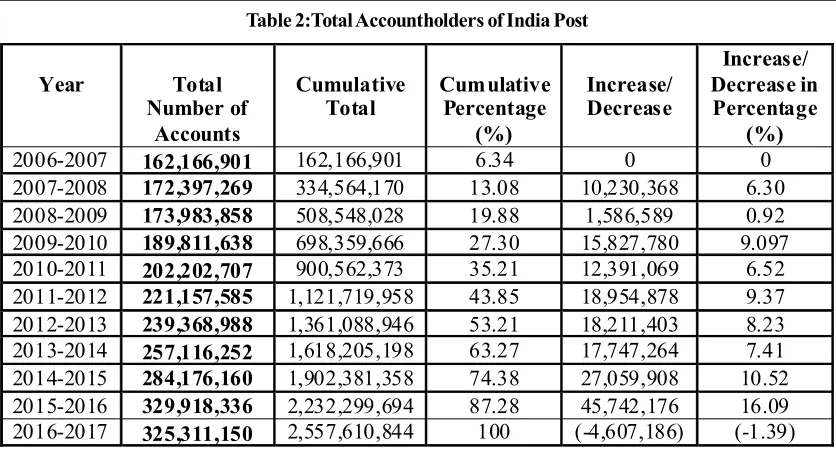
Table 2:Total Accountholders of India Post
Year Total
Number of Accounts
Cumulative Total
Cum ulative Percentage
(%)
Increase/ Decrease
Increase/ Decrease in
Percentage (%)
2006-2007 162,166,901 162,166,901 6.34 0 0
2007-2008 172,397,269 334,564,170 13.08 10,230,368 6.30 2008-2009 173,983,858 508,548,028 19.88 1,586,589 0.92 2009-2010 189,811,638 698,359,666 27.30 15,827,780 9.097 2010-2011 202,202,707 900,562,373 35.21 12,391,069 6.52 2011-2012 221,157,585 1,121,719,958 43.85 18,954,878 9.37 2012-2013 239,368,988 1,361,088,946 53.21 18,211,403 8.23 2013-2014 257,116,252 1,618,205,198 63.27 17,747,264 7.41 2014-2015 284,176,160 1,902,381,358 74.38 27,059,908 10.52 2015-2016 329,918,336 2,232,299,694 87.28 45,742,176 16.09 2016-2017 325,311,150 2,557,610,844 100 (-4,607,186) (-1.39)
Source: India post.com
Table 3:Overall deposits in Postal bank of India
Peri od of Years (X)
Total Amount Deposited (Rs in millions)
(Y)
LN(Y)
2006-2007 3,237,805.7 14.99040641 2007-2008 3,515,477.2 15.07268584 2008-2009 3,453,844.1 15.0549984 2009-2010 3,420,100.3 15.04518044 2010-2011 3,740,765.8 15.13480091 2011-2012 4,056,730.97 15.21588803 2012-2013 3,966,294.06 15.19334273 2013-2014 4,100,548.66 15.22663134 2014-2015 4,331,541.11 15.28143395 2015-2016 4,483,198.2 15.31584723 2016-2017 4,798,033.4 15.38371668
Source: India post.com
Chart 2: Overall deposits in Postal bank of India
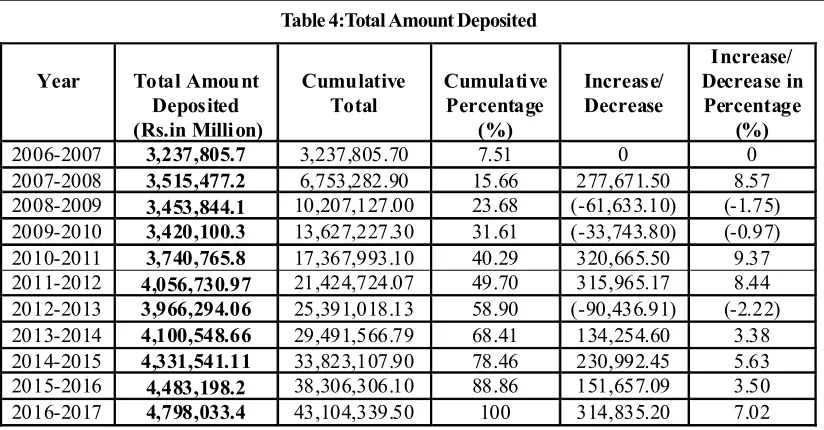
Table 4:Total Amount Deposited
Year Total Amou nt Deposited (Rs.in Milli on)
Cumulative Total
Cumulati ve Percentage
(%)
Increase/ Decrease
Increase/ Decrease in Percentage
(%)
2006-2007 3,237,805.7 3,237,805.70 7.51 0 0
2007-2008 3,515,477.2 6,753,282.90 15.66 277,671.50 8.57 2008-2009 3,453,844.1 10,207,127.00 23.68 (-61,633.10) (-1.75) 2009-2010 3,420,100.3 13,627,227.30 31.61 (-33,743.80) (-0.97) 2010-2011 3,740,765.8 17,367,993.10 40.29 320,665.50 9.37 2011-2012 4,056,730.97 21,424,724.07 49.70 315,965.17 8.44 2012-2013 3,966,294.06 25,391,018.13 58.90 (-90,436.91) (-2.22) 2013-2014 4,100,548.66 29,491,566.79 68.41 134,254.60 3.38 2014-2015 4,331,541.11 33,823,107.90 78.46 230,992.45 5.63 2015-2016 4,483,198.2 38,306,306.10 88.86 151,657.09 3.50 2016-2017 4,798,033.4 43,104,339.50 100 314,835.20 7.02
Source: India post.com
The above table explains the overall growth of deposits of India post each year. The cumulative total deposits of India post are stood at Million Rs.43,104,339.50. the overall deposits of India post are showing its maximum growth in the year 2007-2008 with 8.57%. The overall growth of deposits of India post finds fall for three years with -1.75%, -0.97% and -2.22% respectively. Despite the falls the overall deposits of India post are showing betterment in its growth over the period.
3.2 Regression Analysis
The regression analysis is a way of mathematically developing an equation which represents the statistical relationship between one or more controlled variables and the experimental variable. In this paper regression analysis is made to find out the influence of overall accountholders of Indian post banking services on the overall deposits of India postal banking service.
Equation: ODA= a + b1OAH
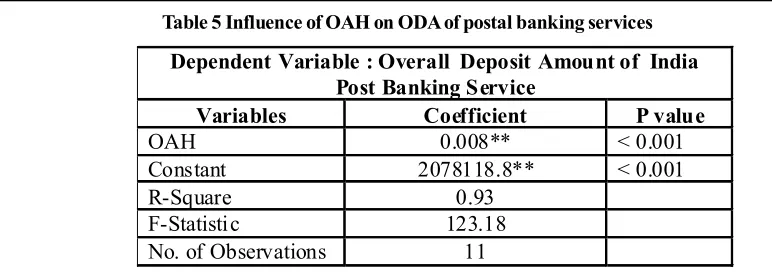
Table 5 Influence of OAH on ODA of postal banking services
Dependent Variable : Overall Deposit Amount of India Post Banking Service
Variables Coefficient P value
OAH 0.008** < 0.001
Constant 2078118.8** < 0.001
R-Square 0.93
F-Statistic 123.18
No. of Observations 11
Note: * represents significance at 5%, ** represents significance at 1%.
The table 5 shows that the influence of OAH on ODA is statistically significant at 5% level (?=0.008, P= <0.001). The OAH is significantly and positively influencing the ODA by accounting 93% of variance in ODA (R square =0.932). When there is a1% change in OAH, the change in ODA will be approximately 11%. This shows that experimental variable ODA have significant influence by controlled variable OAH and it indicates that increase in OAH which in turn increase ODA. In Accenture research report (2012) they emphasized that, extended banking services as a part of postal services will enhance and boost the overall deposits of post offices.
4. Conclusion
References
1. Chanderprabha (2017) Payment Banks: Fulcrum for Less Cashless Economy As well As for Financial Inclusion: ISSN- 2350-0530(O), ISSN- 2394-3629(P) ICV (Index Copernicus Value) 2015: 71.21 IF: 4.321 (CosmosImpactFactor), 2.532 (I2OR).
2. Dipankar Malakar (2013) Role of Indian Post in Financial Inclusion: IOSR Journal Of Humanities And Social Science (JHSS) ISSN: 2279-0837, ISBN: 2279-0845.Volume 6, Issue 4 (Jan. - Feb. 2013), PP 04-07.
3. www.economictimes.com
4. www.indiapost.com
5. www.Iosrjournals.Org
6. www.shodhganga.com
7. www.thehindubusinessline.com