JETIR1501031 Journal of Emerging Technologies and Innovative Research (JETIR) www.jetir.org 176
Analysis of performance parameter for the
drilling of INCONEL 625
1
Tushar Gundarneeya,2Hilesh Chaudhari
1
Assistant Professor Mechanical Engg.,2Lecturer Mechanical Engg. 1
Mechanical Engg. Deptt 1
Government Engg. College, Dahod,Gujarat, India
Abstract—In this study effect of cutting parameters on thrust force, surface roughness and circularity are investigated during drilling of INCONEL 625 on VMC. For experiment cutting speed (10m/min,12.5 m/min and 17.5 m/min), feed rate (0.05 mm/rev, 0.075mm/rev and 0.1 mm/rev) and different twist drill(HSS, Uncoated solid carbide tool and TiAlNcoated solid carbide tool) of 5mm diameter are used as parameter. For experiments full factorial experimental design is used. ANOVA is employed to determine most significant control factor affecting the thrust force, surface roughness and circularity. S/N ratio is employed to determine the optimum combination of the control factor. From the result it is concluded that TiAlN coated tool lead all other tools for all responses.HSS gives better result than uncoated solid carbide tool for surface roughness. It is observed that surface roughness and thrust force value improves with increase in cutting speed and decrease in feed rate. Furthermore circularity deteriorates with increase in cutting speed and feed rate both. For thrust force cutting speed is most significant parameter while for surface roughness and circularity tool and feed rate is significant parameters respectively. The empirical relation between parameters and responses are developed using multiple regression analysis.
IndexTerms— INCONEL 625, Full Factorial Design, S/N ratio, ANOVA, Multiple Regression Analysis
____________________________________________________________________________________________________
I. INTRODUCTION
Nickel-base super alloy Inconel 625 is a high-temperature, precipitate-hardening super alloy. Alloy 625 is produced by vacuum induction melting or by Argon Oxygen Decarburization (AOD) refining. It derive its strength from solution hardening, work hardening and precipitate hardening. Because of its excellent mechanical properties at low and intermediate temperatures (-250 to 7000C), it has been widely applied in recent years in aerospace, petroleum and nuclear energy industries. The outstanding and versatile corrosion resistance of INCONEL alloy 625 under a wide range of temperatures and pressures is a primary reason for its wide acceptance in the chemical processing field. The alloy has outstanding strength and toughness at temperatures ranging from cryogenic to elevated temperatures in the range of 2 000°F (1 093 °C). The properties of INCONEL alloy 625 that make it an excellent choice for sea-water applications are freedom from local attack (pitting and crevice corrosion), high corrosion-fatigue strength, high tensile strength, and resistance to chloride-ion stress-corrosion cracking[E1][18].Drilling operation is the most important conventional machining process. Drilling problems can account to expensive production waste because many drilling operation are usually among the final stages in manufacturing a part. With regard to the quality characteristics of drilled parts, some of the problems encountered include temperature, Thrust force, Torque, Surface roughness, Burr height, Power, Material removal rate, among these characteristics, surface roughness and circularity play the most important roles in the performance of a drilled part. In order to improve machining efficiency, reduce the machining cost, and improve the quality of machined parts, it is necessary to select the most appropriate machining conditions. Cutting speed, feed rate, point angle, drill work piece material, drill tool type and coolant conditions are the drilling parameters which highly affect the performance measure.
II. MATERIAL AND METHOD 2.1 Experimental Study
The experiment was conducted on three different INCONEL 625 plate of dimension 100 mm X 40 mm X 6mm at CHANDUBHAI S PATEL INSTITUTE OF TECHNOLOGY, GUJARAT on JYOTI make VMC. The chemical composition of Inconel 625 is shown in table-1.Twist drill used was of 5mm diameter having 1350 point angle with cutting fluid. The cutting parameters are shown in fig.2
Table 1 Chemical Composition of INCONEL 625
Ni Cr Fe Mo Nb C Mn Si p S Al Ti Co
58.0
min 20.0-23.0 5.0
max 8.0-10.0 3.15-4.15 0.10 max 0.50 max 0.50 max 0.015 max 0.015 max 0.40 max 0.40 max 1.0
JETIR1501031 Journal of Emerging Technologies and Innovative Research (JETIR) www.jetir.org 177 Table-2 Proposed Ranges of cutting parameter [14] [18] [E3] [E4] [E5] [E6]
Sr. NO.
Drill Tool Feed Rate (Mm/Rev) Cutting Speed (M/Min)
A B C
1 HSS drill tool 0.05 10
2 Unc oate d solid carbide drill tool 0.075 12.5
3 TiAl N c oate d solid carbide drill tool 0.1 17.5
2.2 Measurement of thrust force
Thrust force is required to be measured due to it is having significant effect on surface roughness and circularity as well. In order to measure thrust force KRISTLER make 4-COMPONENT DRILL DYNAMOMETER was mounted on VMC. It had provided continuous reading of thrust force among which maximum value was used for analysis
Figure- 1 VMC and Dynamometer
2.3 Measurement of surface roughness
Due to application of INCONEL 625 in aerospace industry fatigue life become matter of concern. Surface roughness has significant effect on the fatigue life of component. So the surface roughness is quite important response to measure, in order to investigate effect of the cutting parameters on the material of a machined surface. With this regard, the average surface-roughness value(R) in qm was measured using SURFTEST SV-2100 HIGH PRECISION SURFACE ROUGHNESS TESTER. The measurement was taken along the axis of hole.
Figure- 2 Surface Roughness Tester
2.4 Measurement of circularity
The drilling process is widely used to assemble and fixing parts of materials and making internal threads. The quality of the hole is much affected by the machining setup, machining parameter and tool geometry. Circularity is the most important
characteristics of any drilled holes in drilling process. In order to investigate the effect of cutting parameter on the quality of hole, circularity is measured using MITUTOYO make MANUAL VISION MEASURING SYSTEM (3D microscope). To get good reading accuracy minimum 140 point were selected to calculate average circularity value.
JETIR1501031 Journal of Emerging Technologies and Innovative Research (JETIR) www.jetir.org 178 III.RESULT &DISCUSSION
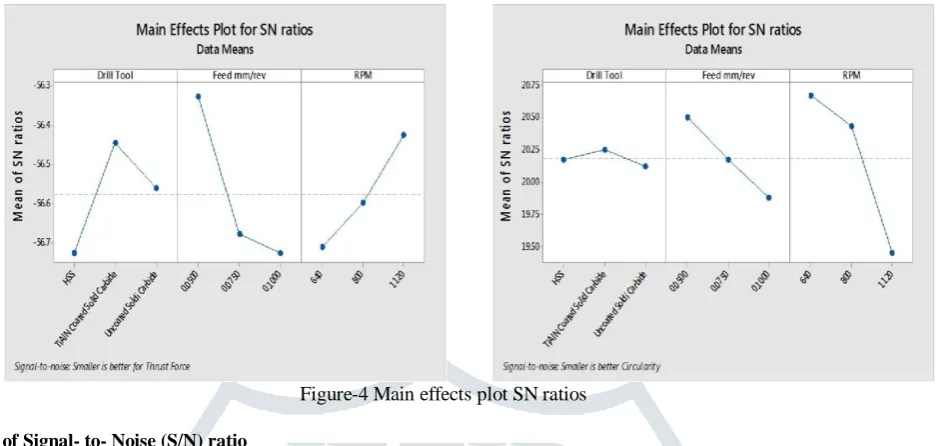
Figure-4 Main effects plot SN ratios
Analysis of Signal- to- Noise (S/N) ratio
The term signal represents the desirable value (mean) for the output characteristic and the term noise represents the undesirable value (deviation, SD) for the output characteristic. Therefore the S/N ratio is the ratio of the mean to the SD. The S/N ratio is used to measure the quality characteristic deviating from the desired value. Full-factorial design chooses to calculate the signal-to-noise ratio for finding effective parameter for desire response value. The S/N ratio is useful in identifying the significant factors. There are several S/N ratios available, depending on the type of the characteristic; lower the better, nominal is best and higher the better. The lower the better characteristic is selected, since lowest value for surface roughness, thrust force and circularity is desirable for product quality. The equation for smaller the better is given belowWhere the Y1, Y2... Yni are the response.
Figure-4 Main effect plot for S/N ratio for Thrust Force Figure-5 Main effect plot for S/N ratio for Circularity
Figure 4,5,6 shows the main effect plot for S/N ration for thrust force, circularity and surface roughness. Table 3,4,5 shows total responses for S/N ration for thrust force, circularity and surface roughness.Highest sum of S/N ratio for differnet level for factors gives the most significant level for concern factor. From ther graph it is evident that thrust force increases with increase in feed rate from 0.05 mm/rev to 0.1 mm/rev whereas thrust force decreases with increase in cutting speed from 10 m/min to 17.5 m/min.For surface roughnest, surface roughness value increases with increase in feed rate from 0.05 mm/rev to 0.1 mm/rev whereas value decreases with increase in cuttting speed from 10 m/min to 17.5 m/min.For circularity, circularity value increases with increase in feed rate from 0.05 mm/rev to 0.1 mm/rev and cuttting speed from 10 m/min to 17.5 m/min.From the graph it is observed that for all the responses TiAlN coated solid carbide tool give better results than uncoated solid carbide tool and HSS tool.
JETIR1501031 Journal of Emerging Technologies and Innovative Research (JETIR) www.jetir.org 179
Table-3 Total Responses for Signal-to-Noise ratio for Thrust Force
Table-4 Total Responses for Signal-to-Noise ratio for Circularity
Table-5 Total Responses for Signal-to-Noise ratio for Surface Roughness
For thrust force highest sum of S/N ratio for different level is available at 0.05 mm/rev feed rate and 17.5 m/min cutting speed with TiAlN coated carbide tool combination. For circularity highest sum of S/N ratio for different level is available at 0.05 mm/rev feed rate and 10 m/min cutting speed with TiAlN coated carbide tool and for surface roughness highest sum of S/N ratio for different level is available at 0.05 mm/rev feed rate and 17.5 m/min cutting speed with TiAlN coated carbide tool. As smaller-the-better was selected for thrust, surface roughness and circularity the lowest values at all levels were evaluated to determine the optimal combination of cutting tool, cutting speed and feed rate. Therefore, the optimum combination available for thrust force is A3-B2-C3, for surface roughness A3-B1-C3 and for circularity A3-B1-C1.
ANOVA METHOD
Analysis of variance will be the predominant statistical method used to interpret experimental data and make the necessary decisions as this method is the most objective. The purpose of ANOVA was to investigate which drilling parameters significantly affected the performance characteristics. The experimental plan undertaken was evaluated at confidence level of 95%.
Factor Drill Tool Fee d Rate Cutting Speed
Level Sa Sb Sc
1 -510.53 -506.96 -510.39
2 -509.07 -510.12 -509.39
3 -508.03 -510.55 -507.84
RANK 3 1 2
DELTA 2.5011 3.5901 2.5541
Factor Drill Tool Fee d Rate Cutting S pee d
Level Sa Sb Sc
1 181.5650 184.4961 186.0067
2 181.1142 181.5357 183.9056
3 182.25568 178.9031 175.0226
RANK 3.0000 2.0000 1.0000
DELTA 1.1415 5.5930 10.9841
Factor Drill Tool Fee d Rate Cutting S pee d
Level Sa Sb Sc
1 9.0280 16.1970 7.2678
2 6.6322 8.6975 9.9892
3 16.8929961 9.5834 16.1469
RANK 1 2 3
DELTA 10.2608 7.4995 8.8790
Table -6 % of contribution of factor towards response for Thrust Force
Factor S df V F %
A 1947.11 2 973.55 0.244658 22.35648
B 2009.93 2 1004.97 0.252552 23.07782
C 4752.32 2 23 76.16 0.597138 54.56568
Error 0 0 -
-
-Total 8709.6444 8 47 52.60 - -
JETIR1501031 Journal of Emerging Technologies and Innovative Research (JETIR) www.jetir.org 180
Table-7 % of contribution of factor towards response for Surface Roughness
Table-8 % of contribution of factor towards response for circularity
ANOVA values of experimental results for the surface roughness, thrust force and circularity are shown in table 6, 7, 8. The significance of control factors in ANOVA is determined by comparing F values of each control factor. For thrust force, control factors A, B and C have 22.35%, 23.07% and 54.56% contribution respectively. For surface roughness, control factors A, B and C have 39.96%, 30.72% and 29.31% contribution respectively. For circularity, control factors A, B and C have 0.82%, 80.46% and 18.70% contribution respectively. In general for thrust force cutting speed is most significant factor whereas for surface roughness and circularity drill tool and feed rate is most significant parameters respectively.
MULTIPLE REGRESSION ANALYSIS
Mathematical models based on cutting parameters, such as drill tool, cutting speed and feed rate were obtained from regression analysis using MINITAB 16.1 statistical software to predict surface roughness, thrust force and circularity. The model equation is as follows for each response. Statistically obtained linear relationship between response and parameters are statistically significant. Theoretical value obtained from this relationship varies only by 2 to 3% maximum.
IV.CONCLUSIONS
Based on experiment conducted on INCONEL 625 and analysis done for the results obtained, following conclusion is derived. For Thrust Force TiAlN coated solid carbide tool was proved to be best while for feed it was increased with increase in feed rate. On the contrary, for cutting speed it was decreased with increase in cutting speed.
For Surface Roughness TiAlN coated solid carbide tool was proved to be the best but HSS had provided better result than uncoated solid carbide tool. Surface roughness improved with decrease in feed rate and increase in cutting speed.
For Circularity T iAlN coated solid carbide tool was proved to be best though tool material have very little contribution in the result. Circularity value increases with increase in both feed rate and cutting speed. Feed has very high influence on circularity.
Based on ANOVA, most significant factor for thrust force is Cutting Speed which has 54.56% contribution. For Surface Roughness most significant factor is tool material which has contribution of 39.96% and for circularity feed rate is most significant factor has highest contribution of 80.46%.
Based on S/N ratio, optimum parameter combination for thrust force is A3-B1-C3, For Surface Roughness optimum parameter combination is A3-B1-C3 and for Circularity optimum parameter combination is A3-B1-C1.
In general TiAlN coated solid carbide tool is leading the other tool material for all responses. Lowest level Feed rate is leading the other levels for all responses. Whereas for cutting speed, highest level is leading the other levels for Thrust Force and Surface Roughness while lowest level of cutting speed is leading the other levels for Circularity.
REFERENCES
[1] Yahya Hy^man Celik, Investigating the effects of cutting parameters on the hole quality in drilling the Ti-6Al-4V alloy,
Materials and Technology 485, 653-659(2014)
[2] Turgay Kivak, Gurcan Samtas, Adem £i£ek Taguchi method based optimization of drilling parameters in drilling
ofAISI316 steel with PVD monolayer and multilayer coated HSS drills Measurement 45 1547-1557(2012)
Factor S df V F %
A 0.05 9841 2 0.029920 1.319531 o9.96038o
B 0.046012 2 0.0230059 1.014597 30.725819
C 0.043897 2 0.0219487 0.967970 29.313795
Error 0 0 - - -
Total 0.149750 6 0.074875 - -
Pooled 0.043897 2 0.0219487 -
Factor S df V F %
A 0.0000103 2 0.0000051 0.019010 0.828541
B 0.0009980 2 0.0004990 1.846171 80.466061
C 0.0002320 2 0.0001160 0.429167 18.705398
Error 0 0 - - -
Total 0.0012402 6 0.0006201 - -
JETIR1501031 Journal of Emerging Technologies and Innovative Research (JETIR) www.jetir.org 181 [3] Mohamed Elajrami, Houcine Milouki, Farouk. B. Boukhoulda, Effect of drilling parameters on hole quality, International
journal of mining, metallurgy & mechanical engineering (IJMMME) volume 1, issue 4 ISSN 23204052; EISSN 2320-4060(2013)
[4] M. Kolahdoozan, F. Azimifar S. Rismani Yazdi, Finite element investigation and optimization of tool wear in drilling
process of difficult to-cut nickel-based super alloy using Response surface methodology, International Journal of Advanced Design and Manufacturing Technology, Vol. 7/ No. 2/ June - 2014(2014)
[5] R.Hood, S.L. Soo, D.K. Aspinwall, P. Andrews, C. Sage ,Twist drilling of Haynes 282 super alloy, Procedia Engineering 19 150 - 155 (2011)
[6] Ferit Ficici, Sakip Koksal M.Cemil Karacadag, Optimization of cutting parameters for surface roughness of stainless
steel in drilling process, international journal of science and advanced technology (ISSN 2221 -8386)(2012)
[7] J.Pradeep Kumar, P.Packiaraj, Effect of drilling parameters on surface roughness, tool wear, material removal rate And
hole diameter error in drilling of OHNS, IJAERS/Vol. I/ Issue III/April-June, 150-154/(2012)
[8] M.C. Hardy, C.R.J. Herbert, J. Kwong, W. Li, D.A. Axinte A.R.C. Sharman, A. Encinas-Oropesa and P.J. Withers, Characterizing the Integrity of Machined Surfaces in a Powder Nickel Alloy used in Aircraft Engines, Procedia CIRP 13 411 - 416( 2014 )
[9] V. Baghlani, P. Mehbudi, J. Akbari, M Sohrabi, Ultrasonic assisted deep drilling of Inconel 738LC super alloy, Procedia
CIRP 6 571 - 576( 2013 )
[10]Arshad Noor Siddiquee, Zahid A. Khan, Gaurav Agarwal, Pankul Goel, Noor Zaman Khan, Mukesh Kumar,
[11]Optimization of Deep Drilling Process Parameters of AISI 321 Steel using Taguchi Method, Procedia Materials Science
6 1217 - 1225( 2014 )
[12]J. Prasanna, L. Karunamoorthy, M. Venkat Raman, Sai Prashanth, D. Raj Chordia, Optimization of process parameters
of small hole dry drilling in Ti—6Al—4V using Taguchi and grey relational analysis, Measurement 48 346-354(2014)
[13]Tamilselvan Raguraj, Optimization of Process Parameters of Drilling in Ti-TiB Composites using Taguchi Technique,
International Journal on Mechanical Engineering and Robotics (IJMER) ISSN (Print) : 2321-5747, Volume-29,Issue-4(2014)
[14]Du Jin & Zhanqiang Liu, Damage of the machined surface and subsurface in orthogonal milling of FGH95 super alloy,
Int J Adv Manuf Technol 68:1573-1581(2013)
[15]Turgay KIVAK, Kasim HABALI , Ulvi SEKER and Tool Wear During The Drilling of Inconel 718, GU JSci 25(2):533-540 (2012)
[16]HMT, Production Technology 23rd reprint, Tata McGraw-Hill Publishing Company Limited. [17]SHARMA P.C, A Textbook Of Production Technology 5th edition,2005 S. Chand & company
[18]E. PAUL DEGARMO, Materials and Processes in Manufacturing Hardcover - December 29, 2003
[19] Matthew J. Donachie, Stephen J. Donachie , Super Allot: A Technical Guide, 2nd Edition, ASM International, 2002 [20]Rojar C. Reed, The Super alloys Fundamentals and applications, Cambridge University Press,2006
[21](E1) Alloy 625 data sheet of Jacquet Metal Service [22](E2) Data Sheet of Inconel Alloy 625 from Special Metals [23](E3) SECO tool selection guide, page no.34-40
[24](http ://legacv.secotools.com/upload/asia/iapan/PDF/MN2006/Drilling/DrillingE2006-2007.pdf) [25](E4) KENNA METAL Hole Making Guide
[26](E5) http://www.mitutoyo.co.uk/form-measurement/surface-roughness/178-636-02e