A STUDY ON REMOVAL OF CHROMIUM FROM AQUEOUS
SOLUTION
Deepak B. Sajjanar1, Dr. M C Sampathkumar2
1. INTRODUCTION
Water is an important source for both the flora and fauna, but due to the anthropogenic activities, the sources of waters were affected in quantity as well as in quality. Nowadays in some places, the humans are deprived from availability of clean drinking wholesome water. The rivers are drying up due to effect of global warming causing less precipitation, so due to less precipitation the water usage from the surface sources like rivers have been drastically reduced.
Natural resources are limited and considering industrialization we should start focusing on preserving natural resources or need to find out optimum way to utilize these resources and regenerate the used water for recreational purposes.
2. OBJECTIVE OF THE STUDY
Objective of the study conducted for the experiment performed are as mentioned below: •Synthesis of adsorbents into the required form
•To determine optimum values of dosage, pH and contact time
•Removal of Chromium using Walnut Shell power as an adsorbents from Aqueous solution
First objective is about preparation of Walnut shell powder by following certain process which is explained in detail in the methodology section, the next objective is to determine optimum dosage, optimum pH and optimum contact time further the final objective is to remove chromium from aqueous solution using walnut shell powder performing batch study.
3. METHODOLOGY
Flow chart on step by step procedure for carrying out the experiment
1Research Scholar, Department of Civil Engineering, BMS College of Engineering, Bangalore, Karnataka India
2Associate Professor, Department of Civil Engineering, BMS College of Engineering, Bangalore, Karnataka India
DOI: http://dx.doi.org/10.21172/1.103.28
e-ISSN:2278-621X
Abstract: This study deals with the removal of Chromium from aqueous solution using Walnut shell powder as an adsorbent, the study was carried out by synthesizing and characterization of the adsorbent and finding out the elemental composition of it. Various experiments were performed to check for Cr removal efficiency such as optimum dosage, optimum pH, optimum contact time etc , adsorbents were tested and was known that Walnut shell has a carbon content of 68.84% and hence has a high probability of removing Cr from the prepared aqueous solution. Thus, Chromium (VI ) removal efficiency was known to be 66.9% using walnut shell powder as an adsorbent from aqueous solution.
3.1 Characterization of Adsorbent
Adsorbents characterization was carried out using SEM, XRD and EDAX where in we get to know the structure, composition, chemical and physical properties of the adsorbents. The results of which are mentioned as below
i) Characterization of Walnut Shell powder
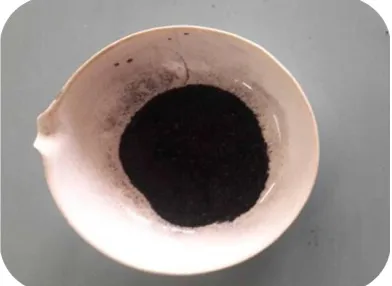
Figure 1.Microscopic view of fine particles of Walnut Shell powder
From Figure 1 it can be observed that the adsorbent particle has oval shaped void spaces within the particle which may act as one of key factor for adsorbing Chromium from aqueous solution.
Table 1.Elemental composition of Walnut shell powder
Element Weight% Atomic%
Carbon 68.84 71.44
Oxygen 35.67 29.86
Potassium 0.40 0.14
Calcium 1.67 0.56
3.2 Preparation Of Chromium(Vi) Solution
Potassium dichromate (K2Cr2O7) is used as the source for chromium stock solution. All the required solutions are prepared with analytical reagents and double-distilled water. 2.835 g of 99% K2Cr2O7 is dissolved in distilled water of 1.0L volumetric flask up to the mark to obtain 1000 ppm (mg/L) of Cr (VI) stock solution. Synthetic samples of different concentrations of Cr (VI) are prepared from this stock solution by appropriate dilutions. For example, 100 mg/L chromium stock solution is prepared by diluting 100mL of 1000 mg/L chromium stock solution with distilled water in a 1000mL volumetric flask up to the mark. Similarly solutions with different metal concentrations such as (5, 10, 15, 20, 25 and 30mg/L) are prepared.
3.3. Synthesis Of Adsorbents
The Walnut shell were collected and then washed with water for removal of dust adhere to it. Adsorbents were sieved using 100 micron sieves to attain uniformity .Then it was placed in oven for 24 hours at 100ᵒ C to remove moisture and other volatile impurities. Then adsorbents were kept inside the muffle furnace for 1 hr at 650°C and thus the synthesis of walnut adsorbent was completed.
4. RESULTS AND DISCUSSIONS
Batch Studies were performed to find optimum dosage, optimum pH and contact time for removal of Chromium form aqueous solution.
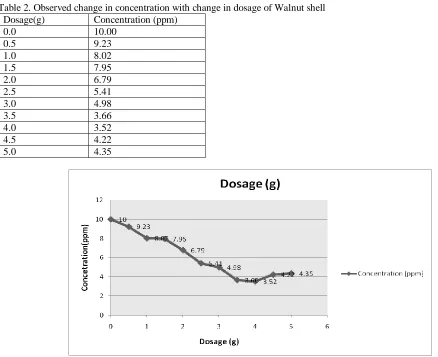
i) To determine optimum dosage both parameters pH and contact time were kept constant and dosage quantity was varied by certain value.
The concentration of the solution was checked using Atomic Absorption Spectrophotometer (AAS) instrument and was known as mentioned in the table below
Table 2. Observed change in concentration with change in dosage of Walnut shell Dosage(g) Concentration (ppm)
0.0 10.00
0.5 9.23
1.0 8.02
1.5 7.95
2.0 6.79
2.5 5.41
3.0 4.98
3.5 3.66
4.0 3.52
4.5 4.22
5.0 4.35
Figure 3. Graph representing change in concentration with change in dosage of Walnut shell
Removal Efficiency: 64.8% of chromium concentration removal at 4 g of walnut powder dosage.
From the above table we got to know the optimum dosage as 4.0 g, therefore now finding optimum pH by keeping dosage as 4.0 g and initial concentration as constant.
ii)To determine optimum pH both parameters dosage(4.0 g) and contact time were kept constant and pH was varied by certain value.
Table 3.Observed change in concentration with change in pH
pH Concentration (ppm)
6-7 9.25
5-6 8.63
4-5 7.11
3-4 5.45
2-3 3.31
Figure 4.Graph representing change in concentration with change in pH
Removal Efficiency: 66.9% of chromium concentration removal at pH between 2 to 3.
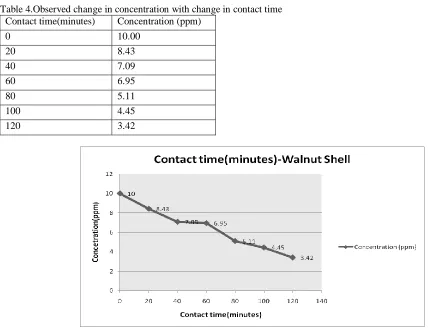
iii) To determine optimum contact time both parameters pH(2-3) and dosage(4.0 g) were kept constant and contact time was varied by certain value.
Table 4.Observed change in concentration with change in contact time Contact time(minutes) Concentration (ppm)
0 10.00
20 8.43
40 7.09
60 6.95
80 5.11
100 4.45
120 3.42
Figure 5.Graph representing change in concentration with change in contact time
Removal Efficiency: 65.8% of chromium concentration removal at 120 minutes of contact time.
5. CONCLUSIONS
Walnut shell powder as an adsorbent at contact time of 120 minutes could remove 65.8% Chromium concentration at optimum dosage and optimum pH. Thus, Walnut shell powder can be used effectively for removal of chromium(VI) under specified conditions.
6. REFERENCES
[1] C. K. Lee,* K. S. Low & K. L. Kek on Removal Of Chromium From Aqueous Solution- April 1995
[2] Tabrez A.Khan MominaNazir ImranAli Ajeet Kumar Removal of Chromium(VI) from aqueous solution using guar gum–nano zinc oxide biocomposite adsorbent-2013
[3] S.A. Wanees, A.M.M. Ahmed, M.S. Adam, M.A. Mohamed Adsorption studies on the removal of hexavalent chromium-contaminated wastewater using activated carbon and bentonite -2015
[4] M.N. Sepehr, A. Amrane, K.A. Karimaian, M. Zarrabi, H.R. Ghaffari Potential of waste pumice and surface modified pumice for hexavalent chromium removal: characterization, equilibrium, thermodynamic and kinetic study-Aug 2011
[5] Y. Wang, D. Liu, J. Lu, J. Huang Enhanced adsorption of hexavalent chromium from aqueous solutions on facilely synthesized me soporous iron– zirconium bimetal oxide-2008
[6] Y.C. Sharma, B. Singh, A. Agrawal, C.H. Weng -Removal of chromium by riverbed sand from water and wastewater: effect of important parameters-2009