Estimation of Design Flood with Four Frequency Analysis Distributions
Ery Suhartanto
1, Lily Montarcih Limantara
1, Dina Noviadriana
2, Febri Iman Harta
2and Dwi Aryani K
21Lecturer on the Department of Water Resources, Faculty of Engineering, University of Brawijaya, Jl. MT Haryono No. 167 Malang 65145, East Java of Indonesia.
2
Doctoral Program on the Department of Water Resources, Faculty of Engineering, University of Brawijaya, Jl. MT Haryono No. 167 Malang 65145, East Java of Indonesia
Article Received: 21 September 2017 Article Accepted: 23 December2017 Article Published: 07 January 2018
1. INTRODUCTION
Frequency analysis is generally used in hydrology for the possibility of discharge extremes, mainly for low flow or
high flow [1]. .The application of the frequency analysis methods has been widely recognized by the numerous
researchers in the field. There are several kinds of frequency analysis distribution that have been successfully
applied to the hydrological data [2]. Some of the extreme value probability distributions are usually used for
hydrological analysis such as Normal Distribution, Log-Normal Distribution, Gumbel-Weibull Distribution, and
Log Perason Type III Distribution [3].
Flood frequency analysis is the important parameter to determine the extend od flooding for the different of return
period [4]. Generally, the instantaneous peak discharge of river at the various recorded location are taken from long
term data [5] and the maximum flood of each year is extracted. Then the data is processed for the outliers and
consistency test. The outliers is those the data points which departs significantly from the trend of the remaining
data [6]. The consistency of data is evaluated with the help of t-test (t-statistics) [7]. Estimation of design flood are
routinely required by water resources engineering purposes. The design flood is required for the planning and
operation measures, the structural design, and the safety and risk analysis of the existing structures [8]. The
conventional approaches for estimating the design flood are the flood frequency analysis. Hosking [9] and Hosking
and Wallis [10] have provided the estimation of design floods based on the regional frequency analysis. However,
Moon and Lall [11] used the nonparametric kernel estimator for reliable flood frequencies estimation analysis.
The Lesti sub-watershed is located in the Malang regency and it is as the priority sub-watershed in the upstream
Brantas watershed. The Lesti sub-watershed has the complex enough of problem related with the area damage,
erosion, landslide, the fluctuation of river discharge and sedimentation is high enough. In the last few years, the
condition is changed regarding to the land use change, geographical condition of the upstream area where is part of
A B S T R A C T
The Lesti sub-watershed has the complex enough of problem related with the area damage, erosion, landslide, the fluctuation of river discharge and sedimentation is high enough. The solution which can be carried out to prevent the problem is by the accurate design, develop ment, and the controlling of water structure accurately. However, the accuracy can be reached by the optimum accuracy in analyses including the hydrological analysis in it. One of the important hydrological analyses is to calculate the design flood. This study intends to analyze the design flood by using the four frequency analysis distribution. The methodology consist of analyzing the flood frequency by using the distributions of Normal, Log Normal, Log Pearson Type III, and Gumbel. The result is hoped can support the accurate project design of water resources structures.
them is as mountainous, the global climate change, and the dangerous level of natural disaster in the Lesti
sub-watershed is high enough.
The solution to prevent the problem is by well design, development, and controlling the water structure accurately.
However, the accuracy can be reached by the optimum accuracy in analyses including the hydrological analysis in
it. One of the important hydrological analysis is to calculate the design flood. Therefore, the analysis of design
flood is very necessary to be carried out including the testing of goodness of fit for evaluating the suitable
probability distribution which is used in the frequency analysis. In additional, this evaluation is also to know the
suitable water recorder as the reference of flooding recorder.
2. MATERIALS AND METHODS
2.1. Study location
Lesti sub-watershed is located on the south longest of 8°02’50’’- 8°12’10’’ and east longest of 112° 42’58’’-
112°56’21’’. This area is on the Malang regency and has the heterogenic characteristic of the basic physical
condition. The delineation of the research area uses the ecological boundary such as the division of the upstream
Lesti sub-watershed which is remained by the Brantas watershed determination institution.
The condition of river network is known that the Lesti sub-watershed has the river arbitrary with the tree shaped
which the affluent connects to the main river. The pattern shows that part of the area is homogeny. It indicates that
there is happened the concentration of water surface in this area. However, this condition will cause the ability of
water absorption in the soil is relatively small so it will be frequently happened the flooding and there is the water
concentration (flooding) in some area. Map of the study location is presented as in the Figure 1.
2.2. Data collecting
The secondary data are needed for this study. The secondary data are the data which is obtained from some sources
which can be responsible to the truth. The secondary data which are needed in this study is as follow:
1. The daily rainfall data from the Poncokusumo station (2007-2016)
2. The daily rainfall data from the Dampit station (2007-2016)
3. The daily discharge data from the Tawangrejeni water recorder (2007-2016)
2.3. Steps of study
The steps of study are as follow:
1. To analyze the design flood by using the methods of Normal, Log Normal, Log Perason Type III. And Gumbel.
2. To carry out the testing of goodness of fit by using the methods of smirnov-kolmogorof and chi-square.
2.4. Normal distribution
The Normal distribution or Normal curve is also mentioned as the Gauss distribution. The formula for calculating
the estimation value with the return period of T (Xt) is as follow:
(1)
Where,
XT : estimation of value which is hoped to be happened by the return period of T
X : mean
S : deviation standard
KT : factor of frequency which is as the function of probability or return period and as the type of mathematical
modeling of the probability distribution that is used for the probability analysis
2.5. Log Normal distribution
The formula of Log Normal distribution is the same as the Normal distribution, but the data have to be transformed
(2)
Where,
XT : estimation of value which is hoped to be happened by the return period of T )in the log)
X : mean (in the log)
S : deviation standard (in the log)
KT : factor of frequency which is as the function of probability or return period and as the type of mathematical
modeling of the probability distribution that is used for the probability analysis
2.6. Log Pearson Type III distribution
To use the Log Pearson Type III, the data have to be transformed into the Log form. The formula of Log Pearson
Type III with the return period of T (Xt) is as follow:
Log XT = Log X + K.s (3)
Where,
Log XT : estimation of value (in the Log from) which is hoped to be happened by the return period of T
X : mean (in the Log form)
S : deviation standard (in the log form)
KT : factor of frequency which is as the function of probability or return period and as the type of mathematical
modeling of the probability distribution that is used for the probability analysis
2.7. Gumbel distribution
The formula of the Gumbel distribution that is used for estimating the value which is hoped to be happened with the
return period of T(Xt) is as follow:
(4)
Xt = design rainfall in the return period of T year (mm)
X = mean rainfall of the observed result
Yt = reduced variate that is as the Gumbel parameter for the return period of T year
Yn = reduced mean that is as the function of the data number= f(n)
Sn = reduced deviation standard that is as the function of the data number = f(n)
Sx = deviation standard
3. RESULTS AND DISCUSSIONS
3.1. Analysis of discharge data
In the hydrological analysis, the data of Automatic Water Level Recorder (AWLR) is obtained from the
Tawangrejeni station which consists of disxharge data on the period from 2007 until 2016. Table 1 presents the
maximum discharge of Tawangrejeni AWLR.
Table 1. Maximum discharge data of Tawangrejeni AWLR
No. Year Discharge (m3/s)
1 2007 514.4
2 2008 202.5
3 2009 254.7
4 2010 85.8
5 2011 127.9
6 2012 175.3
7 2013 86.5
8 2014 81.5
9 2015 72.3
10 2016 63.2
Source: own study
3.2. Analysis by using the Normal Distribution
Analysis by using the Normal distribution uses the formula as follow:
(5)
The data preparation is presented as in the Table 2, however the result of design flood by using the Normal
Table 2. Data preparation for Normal distribution analysis
No year Q max
(m3/s)
1 2016 63.25
2 2015 72.34
3 2014 81.47
4 2010 85.79
5 2013 86.50
6 2011 127.85
7 2012 175.29
8 2008 202.54
9 2009 254.67
10 2007 514.42
Mean 166.4
Deviation standard 138.0
Source: own study
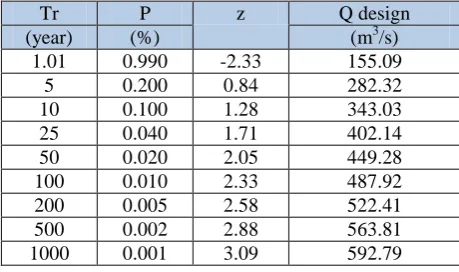
Table 3. Result of design flood by using the Normal distribution
Tr P z Q design
(year) (%) (m3/s)
1.01 0.990 -2.33 155.09
5 0.200 0.84 282.32
10 0.100 1.28 343.03
25 0.040 1.71 402.14
50 0.020 2.05 449.28
100 0.010 2.33 487.92
200 0.005 2.58 522.41
500 0.002 2.88 563.81
1000 0.001 3.09 592.79
Source: own study
Explanation: Tr = return period; P = probability; Z = parameter in Normal distribution; Q = discharge
3.3. Analysis by using the Log Normal distribution
If y = log x, so the analysis by using the Log Normal distribution can be carried out by using the formula of the
Normal distribution. The data preparation for the Log Normal distribution is presented as in the Table 4, however,
the result of design flood by using the Log Normal distribution is presented as in the Table 5.
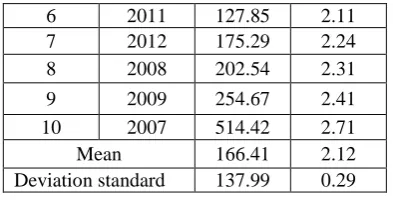
Table 4. Data preparation for Log Normal analysis
No year Q Max Log Q
(m3/s)
1 2016 63.25 1.80
2 2015 72.34 1.86
3 2014 81.47 1.91
4 2010 85.79 1.93
6 2011 127.85 2.11
7 2012 175.29 2.24
8 2008 202.54 2.31
9 2009 254.67 2.41
10 2007 514.42 2.71
Mean 166.41 2.12
Deviation standard 137.99 0.29
Source: own study
Table 5. Result of design flood by using the Log Normal distribution
Tr P
P(z) z Log Q Q design
(year) (%) (m3/s)
1.01 99 0.010 -2.33 1.44 27.74
5 20 0.800 0.84 2.37 232.41
10 10 0.900 1.28 2.49 312.17
25 4 0.960 1.71 2.62 416.03
50 2 0.980 2.05 2.72 523.15
100 1 0.990 2.33 2.80 631.20
200 0.5 0.995 2.58 2.87 746.41
500 0.2 0.998 2.88 2.96 912.73
1000 0.1 0.999 3.09 3.02 1050.75
Source: own study, Explanation: Tr = return period; P = probability; Q = discharge
3.4. Analysis by using the Log Pearson Type III
If y = log x, so the analysis by using Log Pearson III distribution can be carried out by transforming the data into
Log form and then to analyze it by using the formula of Log Pearson III. The data preparation for the Log Pearson
III distribution is presented as in the Table 6, however, the result of design flood by using the Log Pearson III
distribution is presented as in the Table 7.
Table 6. Data preparation for the Log Pearson Type III distribution
No year Q Max Log Q
(m3/s)
1 2016 63.2 1.80
2 2015 72.3 1.86
3 2014 81.5 1.91
4 2010 85.8 1.93
5 2013 86.5 1.94
6 2011 127.9 2.11
7 2012 175.3 2.24
8 2008 202.5 2.31
9 2009 254.7 2.41
10 2007 514.4 2.71
Mean Log Q 2.12
Cs Log Q 0.92
Deviation standard of Log Q 0.29
Table 7. Result of design flood by using the Log Pearson Type III distribution
Tr P
K Log Q Q design
(year) (%) (m3/s)
1.01 99 -1.648 1.64 43.81
2 50 -0.151 2.08 119.61
5 20 0.767 2.35 221.34
10 10 1.339 2.51 324.80
25 4 2.022 2.71 513.43
50 2 2.505 2.85 709.85
100 1 2.968 2.99 967.89
200 0.5 3.415 3.12 1306.80
500 0.2 3.791 3.23 1681.78
1000 0.1 4.418 3.41 2560.76
Source: own study
Explanation: Tr = return period; P = probability; k = coefficient of frequency; Q= discharge
3.5. Analysis by using the Gumbel distribution
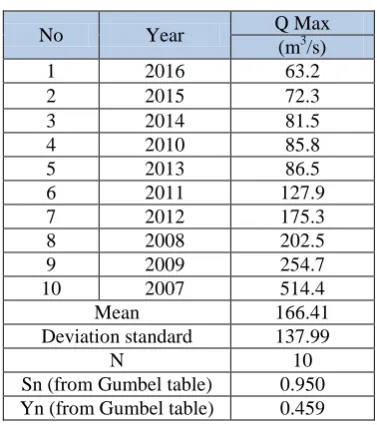
By using the Gumbel distribution, the data preparation for Gumbel distribution is presented as in the Table 8,
however, the result of design flood by using the Gumbel distribution is presented as in the Table 9.
Table 8. Data preparation for Gumbel distribution
No Year Q Max
(m3/s)
1 2016 63.2
2 2015 72.3
3 2014 81.5
4 2010 85.8
5 2013 86.5
6 2011 127.9
7 2012 175.3
8 2008 202.5
9 2009 254.7
10 2007 514.4
Mean 166.41
Deviation standard 137.99
N 10
Sn (from Gumbel table) 0.950 Yn (from Gumbel table) 0.459
Source: own study
Table 9. Result of design flood by using the Gumbel distribution
Tr P
Yt K Q design
(year) (%) (m3/s)
1.01 99 -1.529 -2.094 -122.54
2 50 0.367 -0.098 152.94
10 10 2.250 1.886 426.68
20 5 2.970 2.644 531.28
25 4 3.199 2.885 564.46
50 2 3.902 3.625 666.67
100 1 4.600 4.361 768.13
200 0.5 5.296 5.093 869.21
500 0.2 6.214 6.060 1002.58
1000 0.1 6.907 6.790 1103.37
Sumber : Hasil perhitungan
Explanation: Tr = return period; P = probability; k = coefficient of frequency; Q= discharge; Yt = reduced variate
3.6. Testing of goodness of fit by using Smirnov Kolmogorov test
Testing of goodness of fit by using Smirnov-Kolmogorof test is carried out by comparing the probability of every
variant between the empirical and theoretical probability and then the maximum deviation is compared with the
deviation of table [12].
If the Δ max (D max) on the probability paper is less than Δ critic (Dcr) for a level of significance and the number
of certain variant, so it can be concluded that the deviation which is happened is caused by the accidental error. The
steps for carrying out the test are as follow:
a. To rank the data (from small to big or big to small) and to calculate the probability each of the data as the
empirical probability.
b. To determine the value each of the theoretical probability
c. To find the maximum deviation between the empirical and theoretical probability.
d. Then, the maximum deviation is compared with the critical value with a level of significant from the
Smirnov-Kolmogorof’ table.
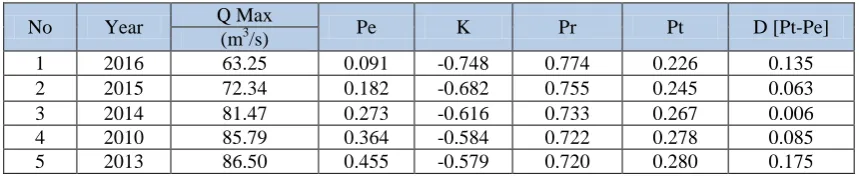
Testing of goodness of the Smirnov-Kolmogorof test is for evaluating the frequency analysis by using the Normal
distribution, the Log Normal distribution, the Log Pearson Type III distribution, and the Gumbel distribution. The
results are presented each on the Table 10, 11, 12, and 13.
Table 10. Smirnov-Kolmogorov test for the Normal distribution
No Year Q Max Pe K Pr Pt D [Pt-Pe]
(m3/s)
1 2016 63.25 0.091 -0.748 0.774 0.226 0.135
2 2015 72.34 0.182 -0.682 0.755 0.245 0.063
3 2014 81.47 0.273 -0.616 0.733 0.267 0.006
4 2010 85.79 0.364 -0.584 0.722 0.278 0.085
6 2011 127.85 0.545 -0.279 0.610 0.390 0.155
7 2012 175.29 0.636 0.064 0.474 0.526 0.111
8 2008 202.54 0.727 0.262 0.396 0.604 0.123
9 2009 254.67 0.818 0.640 0.260 0.740 0.078
10 2007 514.42 0.909 2.522 0.006 0.994 0.085
Source: own study
Explanation: Pe = empirical probability; Pt = theoretical probability; D = deviation
Table 11. Smirnov-Kolmogorov test for the Log Normal distribution
No year Q Max Log Q Pe K Pr Pt D [Pt-Pe]
(m3/s)
1 2016 63.25 1.801 0.091 -1.101 0.860 0.140 0.049
2 2015 72.34 1.859 0.182 -0.901 0.814 0.186 0.004
3 2014 81.47 1.911 0.273 -0.723 0.767 0.233 0.040
4 2010 85.79 1.933 0.364 -0.646 0.744 0.256 0.107
5 2013 86.50 1.937 0.455 -0.634 0.739 0.261 0.194
6 2011 127.85 2.107 0.545 -0.051 0.520 0.480 0.066
7 2012 175.29 2.244 0.636 0.419 0.337 0.663 0.026
8 2008 202.54 2.307 0.727 0.635 0.262 0.738 0.011
9 2009 254.67 2.406 0.818 0.976 0.169 0.831 0.013
10 2007 514.42 2.711 0.909 2.025 0.022 0.978 0.069
Source: own study
Explanation: Pe = empirical probability; Pt = theoretical probability; D = deviation
Table 12. Smirnov-Kolmogorov test for the Log Pearson Type III distribution
No Year Q Max Pe Log Q K Pr Pt D [Pt-Pe]
(m3/s)
1 2016 63.25 0.091 1.801 -1.101 0.885 0.115 0.024
2 2015 72.34 0.182 1.859 -0.901 0.816 0.184 0.002
3 2014 81.47 0.273 1.911 -0.723 0.744 0.256 0.017
4 2010 85.79 0.364 1.933 -0.646 0.712 0.288 0.075
5 2013 86.50 0.455 1.937 -0.634 0.706 0.294 0.161
6 2011 127.85 0.545 2.107 -0.051 0.468 0.532 0.013
7 2012 175.29 0.636 2.244 0.419 0.314 0.686 0.050
8 2008 202.54 0.727 2.307 0.635 0.243 0.757 0.029
9 2009 254.67 0.818 2.406 0.976 0.163 0.837 0.018
10 2007 514.42 0.909 2.711 2.025 0.040 0.960 0.051
Source: own study, Explanation: Pe = empirical probability; Pt = theoretical probability; D = deviation
Table 13. Smirnov-Kolmogorov test for the Gumbel distribution
No Year Q Max P K Yt Tr Pr D [1-Pr-Pe]
(m3/s)
1 2016 63.25 0.091 -0.748 -0.251 1.382 0.723 0.186
2 2015 72.34 0.182 -0.682 -0.188 1.427 0.701 0.117
4 2010 85.79 0.364 -0.584 -0.096 1.499 0.667 0.031
5 2013 86.50 0.455 -0.579 -0.091 1.503 0.665 0.120
6 2011 127.85 0.545 -0.279 0.194 1.782 0.561 0.107
7 2012 175.29 0.636 0.064 0.520 2.232 0.448 0.084
8 2008 202.54 0.727 0.262 0.708 2.570 0.389 0.116
9 2009 254.67 0.818 0.640 1.067 3.434 0.291 0.109
10 2007 514.42 0.909 2.522 2.854 17.864 0.056 0.035
Source: own study
Explanation: Pe = empirical probability; Pt = theoretical probability; D = deviation
3.7. Testing of goodness of fit by using the Chi- Square distribution
Test of chi square distribution evaluates the difference between the sample data and the probability distribution.
The formula of chi square is as follow:
(6)
where X2 = chi-square calculated value; Ei = frequency that is hoped regarding to the class division; Oi= frequency
on the same class; N = number of class. The value of Ei can be found with the formula as follow:
(7)
Where, n = number of N = number of class.
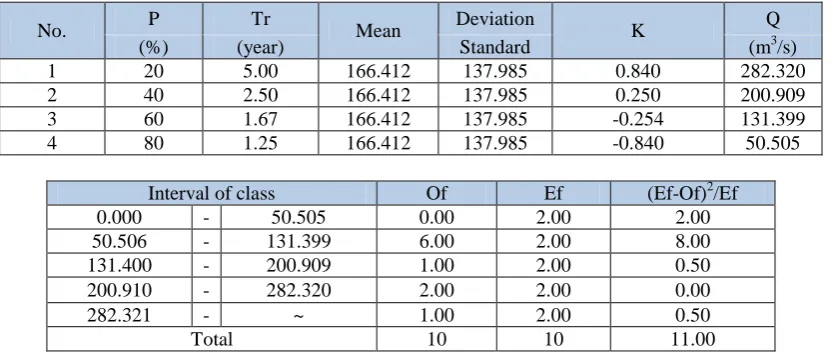
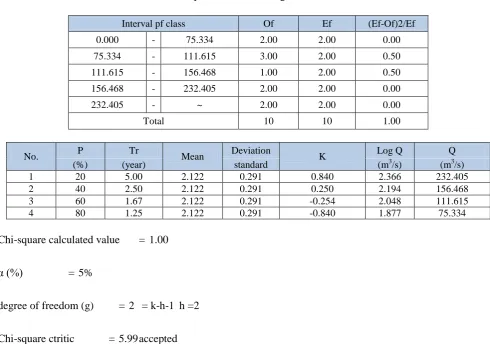
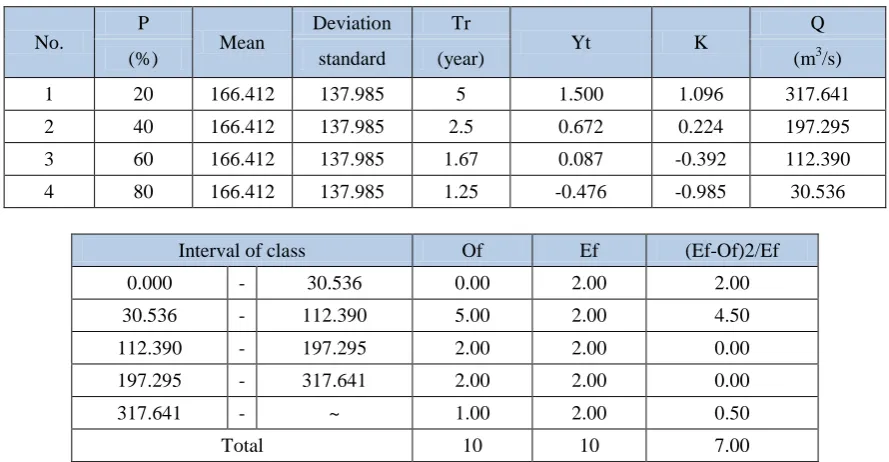
Testing of goodness of fit by using chi square distribution test for evaluating the frequency analysis by using the
Normal distribution, the Log Normal distribution, the Log Pearson Type III distribution, and the Gumbel
distribution. The results are presented each on the Table 14, 15, 16, and 17
Table 14. Chi-Square test for the Normal distribution
No. P Tr Mean Deviation K Q
(%) (year) Standard (m3/s)
1 20 5.00 166.412 137.985 0.840 282.320
2 40 2.50 166.412 137.985 0.250 200.909
3 60 1.67 166.412 137.985 -0.254 131.399
4 80 1.25 166.412 137.985 -0.840 50.505
Interval of class Of Ef (Ef-Of)2/Ef
0.000 - 50.505 0.00 2.00 2.00
50.506 - 131.399 6.00 2.00 8.00
131.400 - 200.909 1.00 2.00 0.50
200.910 - 282.320 2.00 2.00 0.00
282.321 - ~ 1.00 2.00 0.50
Chi-square calculated value = 11.00
α (%) = 5%
degree of freedom (g) = 2 = k-h-1 h =2
Chi-square critic = 5.99 non accepted
Source: own study
Table 15. Chi-Square test for the Log Normal distribution
Interval pf class Of Ef (Ef-Of)2/Ef
0.000 - 75.334 2.00 2.00 0.00
75.334 - 111.615 3.00 2.00 0.50
111.615 - 156.468 1.00 2.00 0.50
156.468 - 232.405 2.00 2.00 0.00
232.405 - ~ 2.00 2.00 0.00
Total 10 10 1.00
No. P Tr Mean Deviation K Log Q Q
(%) (year) standard (m3/s) (m3/s)
1 20 5.00 2.122 0.291 0.840 2.366 232.405
2 40 2.50 2.122 0.291 0.250 2.194 156.468
3 60 1.67 2.122 0.291 -0.254 2.048 111.615
4 80 1.25 2.122 0.291 -0.840 1.877 75.334
Chi-square calculated value = 1.00
α (%) = 5%
degree of freedom (g) = 2 = k-h-1 h =2
Chi-square ctritic = 5.99 accepted
Table 16. Chi-Square test for the Log Pearson Type III distribution
No. P Mean Deviation Cs K Q
(%) standard Log (m3/s)
1 20 2.122 0.291 0.916 0.787 2.351 224.295
2 40 2.122 0.291 0.916 0.164 2.169 147.695
3 60 2.122 0.291 0.916 -0.391 2.008 101.782
Interval of class Of Ef (Ef-Of)2/Ef
0.00 - 73.407 2.00 2.00 0.00
73.407 - 101.782 3.00 2.00 0.50
101.782 - 147.695 1.00 2.00 0.50
147.695 - 224.295 2.00 2.00 0.00
224.295 - ~ 2.00 2.00 0.00
Total 10 10 1.00
Chi-square calculated value = 1.00
α (%) = 5%
degree of freedom (g) = 2 = k-h-1 h =2
Chi-square critic = 5.99 accepted
Source: own study
Table 17. Chi-Square test for the Gumbel distribution
No.
P
Mean
Deviation Tr
Yt K
Q
(%) standard (year) (m3/s)
1 20 166.412 137.985 5 1.500 1.096 317.641
2 40 166.412 137.985 2.5 0.672 0.224 197.295
3 60 166.412 137.985 1.67 0.087 -0.392 112.390
4 80 166.412 137.985 1.25 -0.476 -0.985 30.536
Interval of class Of Ef (Ef-Of)2/Ef
0.000 - 30.536 0.00 2.00 2.00
30.536 - 112.390 5.00 2.00 4.50
112.390 - 197.295 2.00 2.00 0.00
197.295 - 317.641 2.00 2.00 0.00
317.641 - ~ 1.00 2.00 0.50
Total 10 10 7.00
Chi-square calculated value = 7.00
α (%) = 5%
degree of freedom (g) = 2 = k-h-1 h =2
Chi-square critic = 5.99 non accepted
Sn = 0.950
Source: own study
4.
CONCLUSION
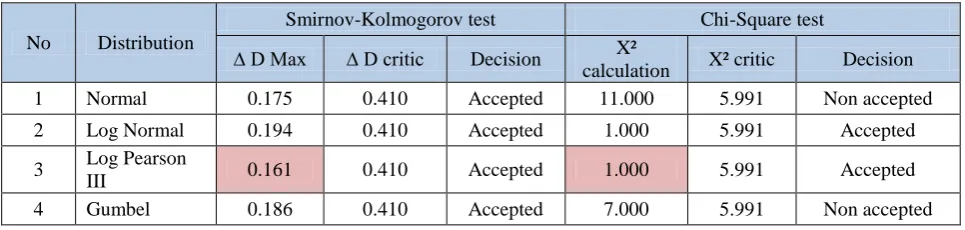
Based on the statistical analysis result as above which includes the Normal distribution, the Log Normal
distribution, the Log Pearson Type III distribution, and the Gumbel distribution, it can be concluded that the rainfall
data from 2007 until 2016 due to the four distributions can be accepted regarding to the Smirnov-Kolmogorof test.
However, based on the chi square test, the Normal distribution and the Gumbel distribution are not accepted. Table
18 presents the recapitulation of test results.
Table 18. The recapitulation of test results for every distribution
No Distribution
Smirnov-Kolmogorov test Chi-Square test
∆ D Max ∆ D critic Decision X²
calculation X² critic Decision
1 Normal 0.175 0.410 Accepted 11.000 5.991 Non accepted
2 Log Normal 0.194 0.410 Accepted 1.000 5.991 Accepted
3 Log Pearson
III 0.161 0.410 Accepted 1.000 5.991 Accepted
4 Gumbel 0.186 0.410 Accepted 7.000 5.991 Non accepted
Source: own study
Based on the result as above, it can be selected the Log Pearson Type III distribution as the suitable distribution for
the Lesti sub-watershed. It is due to the result which indicates that the Log Pearson Type III is accepted for the two
testing of goodness of fit and has the minimum deviation.
REFERENCES
[1] Radevski, I; Gorin, S; Dimitrovska, O; Milevski, I, Apostolovska, B; Taleska, M; and Zlatanoski, V. 2016.
Estimation of maximum annual discharges by frequency analysis with four probability distribution in case of
non-homogeneous time series (Kazani Karst Spring in Republic of Macedonia). Acta Carsalogica, 45(3): 253-262,
Postoina.
[2] Selaman, O.S.; Said, S; and F.J. Putuhena. 2007. Flood frequency analysis for Sarawak using Weibull,
Gringorten and L-Moments formula. Journal-The Institution of Engineers, 68(1): 43-52.
[3] Guru, N. and R. Jha. 2015. Flood frequency analysis for Tel sub-basin of Mahanadi River, India using Weibull,
Gringorten and L-moments formula. International Journal of Innovative Research and Creative Technology, 1(2):
220-223.
[4] US Water Resources Council (USWRC). 1981. Guidennes for determining flood flow frequency. Bulletin No.
[5] Ahmad, I; Z., Ahmad.; and S.A.,Ahmad. 2012. Flood frequencies to Soan Valley. Pakistan Journal of
Sciences, 64(1): 1-6.
[6] Chow, V.T.; D.R., Maidment; and W. Larry. 1988. Applied hydrology. Mc. Graw Hill Book Company, New
York, USA, pp 380-405.
[7] Kpttegoda, N.T. 1980. Stochastic water resources technology. The Macmillan Press Ltd, pp. 38-46.
[8] Hyun-Han Kwon; Young-Il Moon; and Abedalraszq, F. Khalil. 2007. Nonparametric Monte Carlo simulation
for flood frequency curve derivation: an application to a Korean watershed. Journal of the Amaericam Water
Resources Association, 43(5): Biological Sciences Database, 1316-1328.
[9] Hosking, J.R,M. 1990. L-Moment – analysis and estimation of distribution using linear-combination of
order-statistics. Journal of the Royal Statistical Society SeriesB-Methodological, 52(1): 271-281.
[10]Hosking, J.R.M. and J.R. Wallis. 1993. Some statistics useful in regional frequency analysis. Water Resources
Research, 29(2); 271-0181.
[11]Moon, Y.I. and U. Lall. 1994. Kernel quantile function estimator for flood frequency analysis. Water
Resources research, 30(110; 3096-3100.
[12]Soewarno 1995. Hidrologi aplikasi metode statistik untuk analisa data [Statistical method of hydrological