e-ISSN: 2278-067X, p-ISSN: 2278-800X, www.ijerd.com
Volume 11, Issue 03 (March 2015), PP.01-08
Electronics Library Management System from the Website
Dr.Hussein Abdul-Ridha Mohammed
1, Rasha Asaad Kamil
21Iraqi Commission for Computers and Informatics/ Informatics Institute for Postgraduate Studies, Iraq. 2
Dijlah University College, Iraq
Abstract:- Electronics libraries are libraries in which collections are stored in electronic media formats and accessible via computers. The electronic content may be stored locally, or accessed remotely via computer networks. An electronic library is a type of information retrieval system. In this work MySQL database and php dynamic 3-tire website is design. The tested on this website don as a college virtual library it provide fast and secured system.
Keywords:-Library Website, Library Management, Electronic Library, Library Searching Website.
I.
INTRODUCTION
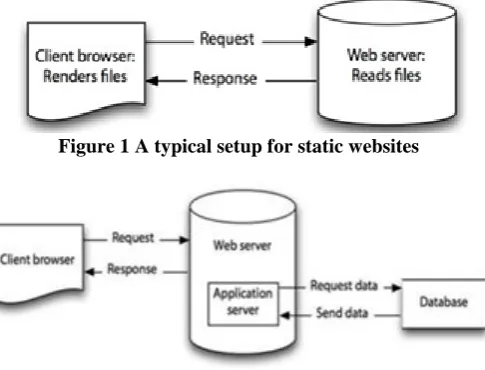
A static site displays the same information to all users, whenever they access it. A dynamic site over time its contents would change as users added comments [1].
Figure 1 A typical setup for static websites
Figure 2A typical setup for dynamic websites
Web application by definition, it is something more than just a „web site‟. It is a client/server application that uses a web browser as its client program, and performs an interactive service by connecting with servers over the Internet (or Intranet). A web site simply delivers content from static files. A web application presents dynamically tailored content based on request parameters, tracked user behaviors, and security considerations. Browsers send requests to servers, and the servers generate responses and return them to the browsers [2].
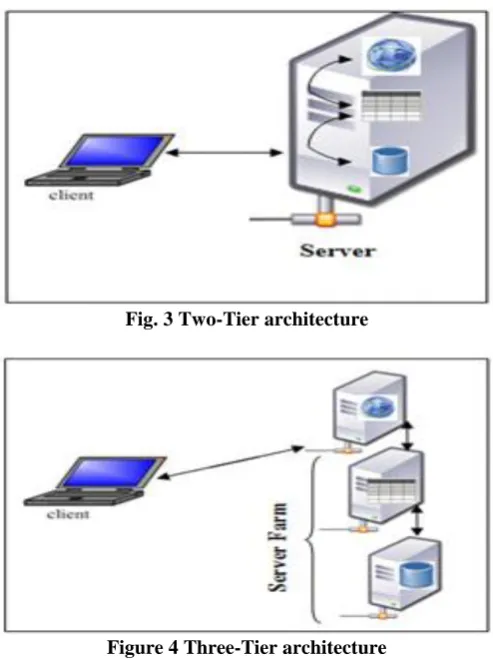
The "N" in the N-Tier concept implies any number, such as 2-tier, or 3-tier; basically, any number of distinct tiers used in the architecture. In fig. 3, a 2-tier architecture which is very popular has simple structure, easy to setup and maintain but the disadvantages of a 2-tier design includes limited scalability [3]. 3-tier architecture: the client, the server, and the Database Management System which are combined in a web application [4].
in the middle tier, and databases that store the application data in the back-end tier [6]. The 3-Tier system basically works as illustrated in figure 4.
Fig. 3 Two-Tier architecture
Figure 4 Three-Tier architecture
PHP stands for Hypertext Preprocessor and is a server side language. This means that the script runs on web server, not on the user‟s browser [7], so PHP language has been used to connecting the database in MySQL language. MySQL is a very fast, robust, relational database management system (RDBMS). A database enables the website designer or developer to efficiently store, search, sort, and retrieve data [8]. MySQL is a popular and free database system that can store information and then integrate with PHP to create a fully functional web application, the dynamic page scheme is shown in figure 5 [9].
Figure 5 Dynamic page scheme
Remote access to library services including web renewal service, online reservation service and email enquiry service, gives the public greater convenience and faster than traditional library system [11].
II. ELECTRONIC LIBRARY MANAGEMENT
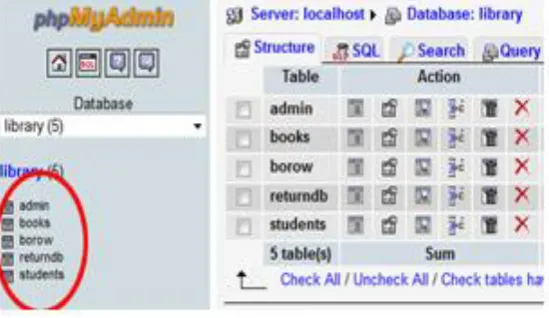
To designing a search system, the database has been worked for the website using PHP and MySQL languages. the library database consists of five tables, the first table for the manager's user name and password, the second table for the books' information, the third table for the borrowing system data, fourth table to saving retrieving system information and the last table for the students' login accounts as shown in figure 6.
Figure 6 Making database in phpMyAdmin
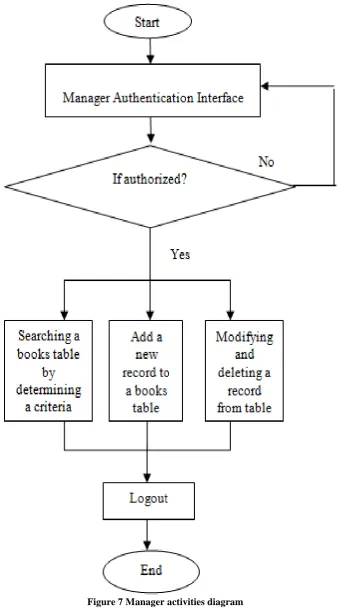
To creating the Manager Login Account, this page is designed by using PHP and HTML languages. The "form" page is created by using HTML language, and the second page which connected to the database, is created by using PHP language. So, when the manager logins his information correctly, PHP code of authentication page transfers the control from HTML page to the PHP page. This page includes a manager's settings and operations. The manager can control all this operations (search, add, edit, delete within the library website, after recording the user name and password as shown in figure 7.
A.Search Operation
As knowing, if the number of books was more than ten in a database, the search operation about specific book information will be difficult. So the search page made to help the manager and students to find data about books even if database was contained more than 8000 book. This page is designed by using two files: the first file is designed by using HTML language and the second file in PHP language. This system of search introduces three types of search: "by the book name", "by the book author", and "by the department of that book". The manager can write exact phrase or any word from the book phrase. Each of these searches has a different form and a related set of results, as shown in figure 8.
B.Add Operation
The manager can add a new book to the database by typing its information in the form page, to be saved in books table. After the database being tested by using the PHP language, the data that will received has been entered by a manager of the library within variables format that are passed to the database by the statement (Query="insert into books table the entered values"). If the information has been entered correctly, it will be stored in the database and a message will appear confirming that a new record had been keeping in the database, but if the information is not entered correctly a message is showing that the record is not saved, as shown in figure 9.
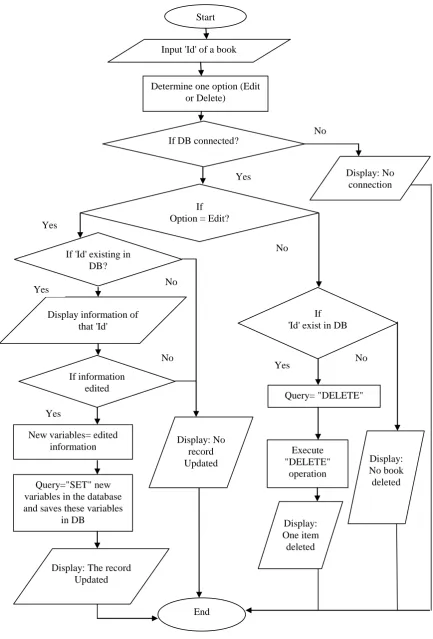
C.Edit & Delete Operation
will been displayed to be edited on the data by using the (Query="SET" new variables in the database and saves these variables in DB). But if the (deletion) option has been selected, all information of the book that it's the (ID) selected will been removed from the database by using the (DELETE) statement, as shown in figure 10.
The server replies the user: (the record not found)
Figure 8 Search operation diagram End
Return a message to the server (not found)
Start
Search result(s) found? Web server converts the request to
MySQL command
My SQL command is executed on DB
Return the results from the web server to the client by the browser
Input search phrase &
Specify search criteria
Select "Search" command
Searching about the phrase in all fields within the database, according to the
specific criteria
Start
Input these fields: id, name, author, label,
department
If Database exist?
Display: No book saved
Connect to database by connect ( ) function
Query="insert into books table the entered values"
$results= Query
End If Results correct?
Display: book inserted into database
Display: no connection
Figure 9 Add new books diagram Yes
No
Execute "DELETE" operation Display: One item deleted New variables= edited
information
Query="SET" new variables in the database and saves these variables
in DB
Display: The record Updated End Display: No book deleted Start
Input 'Id' of a book
Determine one option (Edit or Delete)
If Option = Edit?
Query= "DELETE" If
'Id' exist in DB Display information of
that 'Id' If 'Id' existing in
DB? If information edited Display: No record Updated If DB connected?
Display: No connection No Yes No Yes No Yes
Yes No
No
Yes
III.
CONCLOSIONS
The electronic library website provides electronic search system that is better than the traditional search by the paper records, the electronic books library published online cannot be damaged or lost as in the paper books, also the electronic reproduction is faster than the paper reproduction. The library manager can use an electronic library management system to add, modify or delete data from the database by using online control panel that is protected with a username and password through the library website.
Electronic library management system saves time and effort by the control panel of the library manager, in addition to ease of use, and the accuracy of the information being searched.
REFERENCES
[1]. Irina Dumitrascu, “Building Your First Dynamic Website – Part 1: Setting up Your Site and Database Connection”, Adobe Systems Incorporated, 2010 .
[2]. Leon Shklar, Richard Rosen, Dow Jones and company, "Web Application Architecture: Principles, Protocols and Practices", Copyright by John Wiley & Sons Ltd, 2003.
[3]. "Integrating Oracle E-Business Suite 11i in, the Cisco Data Center", Cisco System, Inc, 2007, available at: www.cisco.com.
[4]. Mumtaz Al-Mukhtar and Sarmad Hadi, "Developing a Three-Tier Web Data Management Application for Higher Education Admission Environment", International Arab Journal of e-Technology, Vol. 2, No. 4, June 2012.
[5]. Fernandez B., et al, "The Secure Three-Tier Architecture Pattern", International Conference on Complex, Intelligent and Software Intensive System, Barcelona, Spain, pp. 555-560, 2008.
[6]. Zhao W., Moser E., and Meliar-Smith P., "Unification of Transactions and Replication in Three-Tier Architectures Based on CORBA", IEEE Transactions on Dependable And Secure Computing, Vol. 2, No. 1, pp. 20-33, 2005.
[7]. Alireza Nematollahi, “Programming in PHP and MySQL”, ARNIT Education Centre, 2, 2005.
[8]. Luke Welling, Laura Thomson, "PHP and MySQL Web Development", Fourth Edition, Copyright by Pearson Education, Inc., 2009.
[9]. Steve Suehring and Janet Valade, ”PHP, MySQL, Javascript & HTML5”, Published by John Wiley & Sons, Inc., Hoboken, New Jersey, 2013.
[10]. Ash Mohammad Abbas, " An Analytical Model for Service Profile Based Service Quality of an Institutional eLibrary", arXiv:1102.4078v2 [cs.DL] 2 Mar 2011.
[11]. Oshilalu, Habdulhakeem Adeyinka, "Emergence of Electronic Library resources", Accepted at 12 January, 2011.
AUTHORS
Dr.Hussein.A.Mohammed is a currently Ph.D.degree in electrical engineering from university of Technology-Baghdad, He is now with Computer engineering lecturer in Informatics Institute for Postgraduate Studies. Iraqi Commission for Computer and Informatics. Baghdad, Iraq.