Experimental and Theoretical Studies of
Mechanical Properties for Reinforcement Fiber
Types of Composite Materials
Prof. Dr. Muhsin J. Jweeg
, Asst. Prof. Dr. Ali S. Hammood and Muhannad Al-Waily
Abstract--- In this research, experimental and theoretical study of composite materials reinforcement fiber types are presented. The experimental work and the theoretical investigation covered the study of modulus of elasticity for long, short, woven, powder, and particle reinforcement of composite materials types with difference volume fraction of fiber. In addition the compare it the experimental results with theoretical results of modulus of elasticity for difference composite materials types.
The results show that the effect of fiber and resin types on modulus of elasticity for composite materials are presented. In addition the effect of volume fraction of fiber and matrix materials on modulus of elasticity for composite materials shown a presented. The results show have good agreement between experimental and theoretical study for different types of composite materials. The results having that shown the best modulus of elasticity for reinforcement composite is unidirectional fiber types in longitudinal direction and the woven reinforcement fiber types for transverse direction.
Index Term--- Mechanical Properties, Composite Materials, Powder Composite Materials, Reinforcement Fiber.
I. INTRODUCTION
The bonding between fibers and matrix is created during the manufacturing phase of the composite material. This has fundamental influence on the mechanical properties of the composite material. Fibers consist of thousands of filaments, each filament having a diameter of between 5 and 15 micrometers, allowing them to be producible using textile Machines These fibers are sold in the following forms, [5]:
1. Short fibers, with lengths of a few centimeters or fractions of millimeters are felts, mats, and short fibers used in injection molding.
2. Long fibers, which are cut during time of fabrication of the composite material, are used as its or woven.
Principal fiber materials are, [5],
Prof. Dr. Muhsin J. Jweeg is serving in
Al-Nahrain University, College of Engineering, Mech. Eng. Department
Asst. Prof. Dr. Ali S. Hammood is serving in Kufa University, College of Engineering, Mat. Eng. Department
Muhannad Al-Waily is serving in
Kufa University, College of Engineering, Mech. Eng. Department, [email protected]
1. Glass
2. Aramid or Kevlar (very light)
3. Carbon (high modulus or high strength) 4. Boron (high modulus or high strength) 5. Silicon carbide (high temperature resistant)
In forming fiber reinforcement, the assembly of fibers to make fiber forms for the fabrication of composite material can take the following forms: 1. Unidimensional: unidirectional tows, yarns, or
tapes
2. Bidimensional: woven or nonwoven fabrics (felts or mats)
3. Tridimensional: fabrics (sometimes called multidimensional fabrics) with fibers oriented along many directions (>2)
The matrix materials include the following
1. Polymeric matrix: thermoplastic resins
(polypropylene, polyphenylene sulfone, polyamide, polyetheretherketone, etc.) and thermoset resins (polyesters, phenolics, melamines, silicones, polyurethanes, epoxies).
2. Mineral matrix: silicon carbide, carbon.
3. Metallic matrix: aluminum alloys, titanium alloys, oriented eutectics.
II. THEORETICAL STUDY
Denote as ply the semi-product “reinforcement + resin” in a quasi-bidimensional form, [5].
Fiber mass fraction is defined as,
(1) In consequence, the mass of matrix is,
,
With, (2) Fiber volume fraction is defined as,
(3) As a result, the volume of matrix is given as,
,
With,
(4) Note that one can convert from mass fraction to volume
fraction and vice versa. If f and m are the specific mass of the fiber and matrix, respectively, get,
,
(5)
The mass density of a ply can be calculated as,
(6) Unidirectional Ply
The mechanical characteristics of the fiber/matrix mixture can be obtained based on the characteristics of each of the constituents. With the definitions in the previous paragraph, one can use the following relations to characterize the unidirectional ply, [13]:
Modulus of elasticity along the direction of the fiber E1 is given by,
, Or,
( ) (7) Modulus of elasticity in the transverse direction to
the fiber axis, E2 and Shear modulus G12,
[ ( ) ] [( )
] (8)
Note the directions of unidirectional ply shown in the Fig. 1.
Fig. 1. Orientations in composite layers, [13]. Woven Fabrics
The fabrics are made of fibers oriented along two perpendicular directions,[5],
one is called the warp and,
the other is called the fill (or weft) direction.
The fibers are woven together, which means the fill yarns pass over and under the warp yarns, following a fixed pattern.
Fig. 2.a. shows a plain weave where each fill goes over a warp yarn then under a warp yarn and so on. In Fig. 2.b, each fill yarn goes over 4 warp yarns before going under the fifth one. For this reason, it is called a “5-harness satin.” Fig. 2.c. shows a twill weave.
The fabric layer is replaced by one single anisotropic layer, x being along the warp direction and y along the fill direction (see Fig. 2). One can therefore obtain, [5],
( ) , ( ) , (9)
Where,
, number of warp yarns per meter , number of fill yarns per meter.
And, , , and are mechanical properties of woven fabrics in 1 and 2-directions; and , , and as in equations (7) to (8).
Fig. 2. Forms of woven fabrics, [5].
The stiffness obtained with a woven fabric is less than what is observed if one were to superpose two cross plies of unidirectionals. This is due to the curvature of the fibers during the weaving operation (see Fig. 3). This curvature makes the woven fabric more deformable than the two cross plies when subjected to the same loading. (There exist fabrics that are of “high modulus” where the unidirectional layers are not connected with each other by weaving. The unidirectional plies are held together by stitching fine threads of glass or polymer).
Fig. 3. Cross section of a layer with fibers crossed at 90o, [5].
Mats Materials
Mats are made of cut fibers (fiber lengths between 5 and 10 cm) or of continuous fibers making a bidimensional layer. Mats are isotropic within their plane (x, y). If E1 and E2 are the elastic module (along the longitudinal and 2 1 warp Fill Unidirectional Fabric Fibers Matrix 1
Longitudinal Direction, Unidirectional Ply
2 Transverse Direction z 1 2 a) Plain Weave b) Satin Weave c) Twill Weave Fill Warp Matrix Woven Reinforcement
transverse directions) of an unidirectional ply with the same volume fraction of Vf, one has, [5],
,
(
)
(10)
Spherical (Powder) Fillers
Spherical fillers are reinforcements associated with polymer matrices. They are in the form of microballs, either solid or hollow, with diameters between 10 and 150 m. They are made of glass, carbon, or polystyrene. The composite (matrix + filler) is isotropic, with elastic properties E, G given by the following relations, [5]:
( )[ ( ) ( )]
( ) [ ( ) ( )] (11)
Discontinuous (Short) Fiber-Matrix Composite Materials
For unidirectional fiber matrix shown in Fig. 4.a. the following Halpin-Tsai relation are used to determine the elastic properties, [6],
, , (12) Where, , ,
let E1m and E2m be the longitudinal and transverse module defined by eq. (12) for a unidirectional discontinuous fiber 00 composite matrix of the same fiber aspect ratio and fiber volume fraction as the randomly oriented discontinuous fiber matrix shown in Fig. 4.b. Since the fiber is randomly oriented, the matrix exhibits isotropic behavior. The Young's modulus and shear modulus of such a composite matrix are given by, [6],
,
(13)
(a)
(b)
Fig. 4. Unidirectional and randomly oriented discontinuous fiber matrix, [6].
III. EXPERIMENTAL STUDY
The experimental study of composite materials included study of mechanical properties of difference types of composite materials with various volume fraction of reinforcement fiber as powder, particle, long, woven, and short reinforcement glass fiber, as shown in Fig. 5.
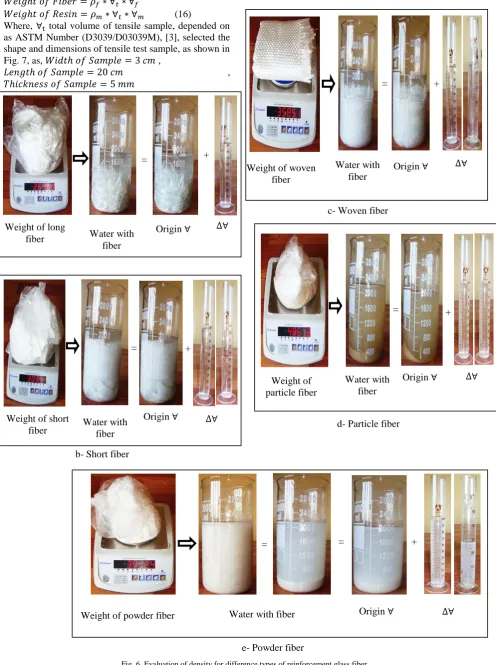
Fig. 5. Over view pictures for types of composites fiber. The density of fiber used can be evaluated, as shown in Fig. 6, as,
(14)
Where, change of water volume after case the weight of fiber.
Then, the density of fiber types are, Polyester Resin Materials Powder Fiber ,
Particle Fiber , Long Fiber , Short Fiber ,
Woven Fiber (15)
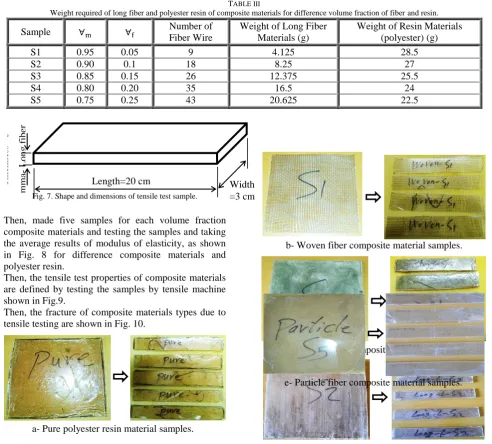
Then, the weight required of tensile samples for difference volume fraction of difference types of fiber and resin can be evaluated from,
2 1 Discontinuous Fiber Matrix 2 1 Discontinuous Fiber Matrix
c- Long fiber
a- Short fiber b- Woven fiber
(16)
Where, total volume of tensile sample, depended on as ASTM Number (D3039/D03039M), [3], selected the shape and dimensions of tensile test sample, as shown in Fig. 7, as, ,
,
Fig. 6. Evaluation of density for difference types of reinforcement glass fiber
Then, the weight of difference volume fraction of fiber and resin can be calculated as shown in Tables 1. to 3. Water with
fiber
+ =
Origin Weight of long
fiber
b- Short fiber Water with
fiber
= +
Origin
Weight of short fiber
c- Woven fiber Water with
fiber
+ =
Origin
Weight of woven fiber
d- Particle fiber Water with
fiber
+ =
Origin
Weight of particle fiber
+ =
=
Origin
Weight of powder fiber Water with fiber
TABLE I
Weight required of short, powder, and particle fiber and polyester resin of composite materials for difference volume fraction of fiber and resin.
Sample Weight of Fiber Materials ( g ) Weight of Resin Materials (g)
short fiber particle fiber powder fiber polyester
S1 0.9 0.1 5.88 7.2 9 27
S2 0.8 0.2 11.76 14.4 18 24
S3 0.7 0.3 17.64 21.6 27 21
S4 0.6 0.4 23.52 28.8 36 18
S5 0.5 0.5 29.4 36 45 15
TABLE II
Weight required of woven fiber and polyester resin of composite materials for difference volume fraction of fiber and resin.
Sample Thickness of
Sample (mm)
Weight of Woven Fiber Materials (g)
Weight of Resin Materials (polyester) (g)
S1 1 0.75 0.25 3.6 4.5
S2 2.5 0.9 0.1 3.6 13.5
S3 5 0.95 0.05 3.6 28.5
S4 7.5 0.967 0.033 3.6 43.515
TABLE III
Weight required of long fiber and polyester resin of composite materials for difference volume fraction of fiber and resin.
Sample Number of
Fiber Wire
Weight of Long Fiber Materials (g)
Weight of Resin Materials (polyester) (g)
S1 0.95 0.05 9 4.125 28.5
S2 0.90 0.1 18 8.25 27
S3 0.85 0.15 26 12.375 25.5
S4 0.80 0.20 35 16.5 24
S5 0.75 0.25 43 20.625 22.5
Fig. 7. Shape and dimensions of tensile test sample. Then, made five samples for each volume fraction composite materials and testing the samples and taking the average results of modulus of elasticity, as shown in Fig. 8 for difference composite materials and polyester resin.
Then, the tensile test properties of composite materials are defined by testing the samples by tensile machine shown in Fig.9.
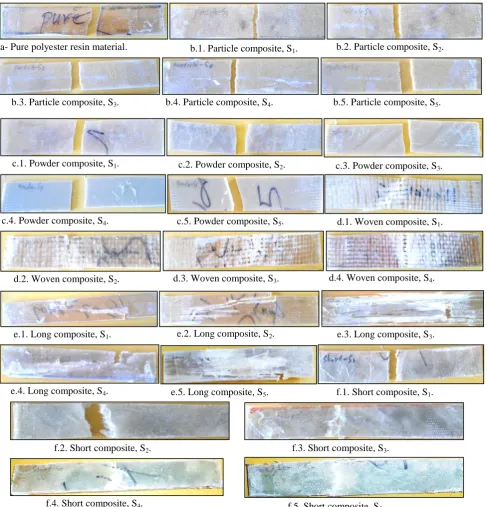
Then, the fracture of composite materials types due to tensile testing are shown in Fig. 10.
a- Pure polyester resin material samples.
b- Woven fiber composite material samples.
T
h
ick
n
ess
=
5
mm
L
o
n
g
f
ib
er
Length=20 cm Width
=3 cm
c- Short fiber composite material samples.
Fig. 8. Stepping of made tensile sample
Fig. 9. Tensile test machine.
Fig. 10. Fracture of composite materials due to tensile loading (by tensile testing). d- Powder fiber composite material samples.
Fra me
Su
p
p
o
rted
o
f
sam
p
le
Mo
v
in
g
p
ar
t
C
o
m
p
u
ter
p
ar
t
a- Pure polyester resin material. b.1. Particle composite, S1. b.2. Particle composite, S2.
b.3. Particle composite, S3. b.4. Particle composite, S4. b.5. Particle composite, S5.
c.1. Powder composite, S1. c.2. Powder composite, S2. c.3. Powder composite, S3.
c.4. Powder composite, S4. c.5. Powder composite, S5. d.1. Woven composite, S1.
d.2. Woven composite, S2. d.3. Woven composite, S3. d.4. Woven composite, S4.
e.1. Long composite, S1. e.2. Long composite, S2. e.3. Long composite, S3.
e.4. Long composite, S4. e.5. Long composite, S5. f.1. Short composite, S1.
f.2. Short composite, S2. f.3. Short composite, S3.
IV. RESULT AND DISCUSSIONS
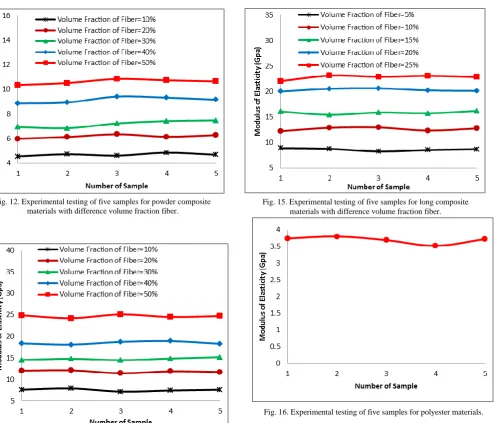
The results get by experimental and theoretical study presented the modulus of elasticity for differences composite materials. The experimental work included the study of long, short, powder, particle and woven reinforcement fiber of composite materials for difference volume fraction of fiber. Figs. 11 to 16. show the modulus of elasticity of difference composite materials testing for five sample for each composite materials types with volume fraction fiber. And, the average modulus of elasticity for composite materials are shown in Table 4.
TABLE IV
Modulus of elasticity (Gpa) of different types of composite materials.
f
Reinforcement Fiber Types
Woven Long Short Particle Powder
3.3% 4.77 / / / /
5% 6.02 8.62 / / /
10% 10.80 12.64 7.56 3.878 4.68
15% / 15.87 / / /
20% / 20.32 11.85 4.24 6.18
25% 18.76 22.80 / / /
30% / / 14.78 4.66 7.18
40% / / 18.51 5.82 9.14
50% / / 24.70 6.48 10.62
Fig. 11. To 16. Show the various of modulus of elasticity for composite materials types testing of five samples for each volume fraction of fiber sample. Fig. 17. Shows the modulus of elasticity for difference composite materials with difference volume fraction. Form Figures shown the modulus of elasticity increasing with increasing the volume fraction of fiber. And, the modulus of elasticity for long fiber composite more than for other reinforcement fiber. In addition to, the modulus for powder composite more than for particle composite.
The experimental study compares with theoretical study for woven, long, powder and short fiber, as shown in Figs. 18. to 21. for woven, long, short and powder reinforcement fiber, respectively. Figures show a good agreement between experimental and theoretical results.
The theoretical study of composite materials types included study of different composite materials types, as shown in Tables 5.
TABLE V Types of reinforcement for composite materials.
Composite Materials Combine
Resin Matrix Fiber
Reinforcement
Epoxy Polyester Nylon Polyester (PC) Glass Carbon-High-strength Carbon-High-modulus Boron
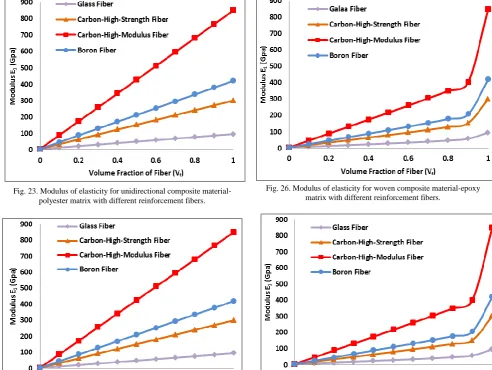
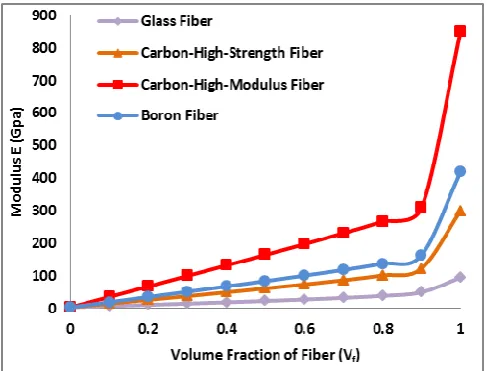
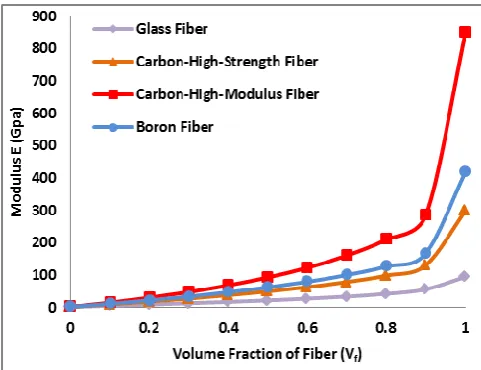
Figs. 22. to 25. show the relation-ship between modulus of elasticity and volume fraction of unidirectional composite materials for difference fiber types, for epoxy, polyester, nylon, and polyester (PC) matrix, respectively. Figs. 26. to 29. show the relation-ship between modulus of elasticity and volume fraction of Woven composite materials for different fiber types, for epoxy, polyester, nylon, and (PC) polyester matrix, respectively. And, Figs. 30. to 33. show the relation-ship between modulus of elasticity and volume fraction of Mats composite materials for difference fiber types, for epoxy, polyester, nylon, and polyester (PC) matrix, respectively. From the figures it is seen that the modulus of elasticity increasing with increasing of volume fraction of fiber and increase with increasing the strength of fiber reinforcement and matrix materials.
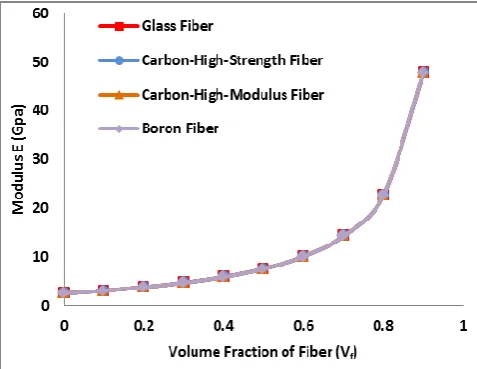
Figs. 34. to 37. show the relation-ship between modulus of elasticity and volume fraction of Spherical (Powder) composite materials for difference fiber types, for epoxy, polyester, nylon, and polyester (PC) matrix, respectively. From the figures it is seen that the modulus of elasticity increasing with increasing of volume fraction of fiber and un-difference with increasing or decreasing the strength of fiber reinforcement increasing with increasing strength of matrix materials.
Figs. 38. to 41. show the relation between modulus of elasticity and volume fraction of Discontinuous (Short) composite materials for difference fiber types, for epoxy, polyester, nylon, and (PC) polyester matrix, respectively. From the figures it is seen that the increasing of volume fraction of fiber increase the modulus of elasticity. In addition to the modulus of elasticity increasing with increasing the strength of fiber reinforcement and matrix materials.
Fig. 42. to 46. show the relationship between modulus of elasticity and volume fraction for unidirectional, woven, mats, powder, and short Carbon-High-Modulus reinforcements fiber composite materials, respectively, for differences resin matrix. Form Figures it is seen that the modulus of elasticity for unidirectional, woven, and mats reinforcements fiber composite materials not effect with change of matrix materials. And the modulus of elasticity for short and powder reinforcement fiber composite materials increasing with increasing of modulus of matrix materials. In addition to, the change for modulus of elasticity for powder reinforcement more than for short reinforcement composite materials.
Fig. 11. Experimental testing of five samples for particle composite materials with difference volume fraction fiber.
Fig. 12. Experimental testing of five samples for powder composite materials with difference volume fraction fiber.
Fig. 13. Experimental testing of five samples for short composite materials with difference volume fraction fiber.
Fig. 14. Experimental testing of five samples for woven composite materials with difference volume fraction fiber.
Fig. 15. Experimental testing of five samples for long composite materials with difference volume fraction fiber.
Fig. 17. Modulus of elasticity for different composite materials types with various volume fraction of fiber.
Fig. 18. Compare between theoretical and experimental study of woven fiber composite materials with difference volume fraction fiber
Fig. 19. Compare between theoretical and experimental study of long fiber composite materials with difference volume fraction fiber
Fig. 20. Comparison between theoretical and experimental study of short fiber composite materials with different volume fraction fiber
Fig. 22 Modulus of elasticity for unidirectional composite material-epoxy matrix with different reinforcement fibers.
Fig. 25. Modulus of elasticity for unidirectional composite material-polyester (PC) matrix with different reinforcement fibers.
Fig. 26. Modulus of elasticity for woven composite material-epoxy matrix with different reinforcement fibers.
Fig. 23. Modulus of elasticity for unidirectional composite material-polyester matrix with different reinforcement fibers.
Fig. 24. Modulus of elasticity for unidirectional composite material-nylon matrix with different reinforcement fibers.
Fig. 27. Modulus of elasticity for woven composite material-polyester matrix with different reinforcement fibers.
Fig. 29. Modulus of elasticity for woven composite material-polyester (PC) matrix with different reinforcement fibers.
Fig. 30. Modulus of elasticity for mats composite material-epoxy matrix with different reinforcement fibers.
Fig. 31. Modulus of elasticity for mats composite material-polyester matrix with different reinforcement fibers.
Fig. 32. Modulus of elasticity for mats composite material-nylon matrix with different reinforcement fibers.
Fig. 33. Modulus of elasticity for mats composite material-polyester (PC) matrix with different reinforcement fibers.
Fig. 35. Modulus of elasticity for spherical fillers composite material-polyester matrix with different reinforcement fibers.
Fig. 36. Modulus of elasticity for spherical fillers composite material-nylon matrix with different reinforcement fibers.
Fig. 37. Modulus of elasticity for spherical fillers composite material-polyester (PC) matrix with different reinforcement fibers.
Fig. 38. Modulus of elasticity for discontinuous (short) composite material-epoxy matrix with different reinforcement fibers.
Fig. 39. Modulus of elasticity for discontinuous (short) composite material-polyester matrix with different reinforcement fibers.
Fig. 41. Modulus of elasticity for discontinuous (short) composite material-polyester (PC) matrix with different reinforcement fibers.
Fig. 42. Modulus of elasticity for unidirectional composite material-carbon-high-modulus fiber with different matrix.
Fig. 43. Modulus of elasticity for woven composite material-carbon-high-modulus fiber with different matrix.
Fig. 44. Modulus of elasticity for mats composite material-carbon-high-modulus fiber with different matrix.
Fig. 45. Modulus of elasticity for spherical fillers composite material-carbon-high-modulus fiber with different matrix.
V. CONCLUSIONS
The main conclusions of this work are,
1. The best modulus of elasticity for composite materials are unidirectional composite materials in longitudinal direction and woven composite materials in any direction.
2. The powder, particle, mats, and short fiber composite materials may be give isotropic properties of composite materials. With depend on resin materials properties.
3. The variable of matrix materials affect the properties in powder, short, and mats composite materials more than in properties of woven and unidirectional composite materials.
4. Unidirectional composite materials gives minimum modulus of elasticity in transverse direction compare with other composite materials types.
5. The increasing of mechanical properties of reinforcement fiber increasing of mechanical properties of composite materials.
6. For future work, study of hybrid composite materials properties.
REFERENCES
[1] Abdalla F. H., Megat M. H., Sapuan M. S. and B. B. Sahari
'Determination of Volume Fraction Values of filament Wound Glass and Carbon Fiber Reinforced Composites' ARPN Journal of Engineering and Applied Sciences, Vol. 3, No. 4, pp. 7-11, 2008.
[2] Ali S. Humod and Muhannad Al_Waily 'Experimental and
Analytical Study of Tensile Properties for Hybrid Composite Material' The Iraqi Journal for Mechanical and Material Engineering, Vol. 10, No. 1, 2010.
[3] D3039/D03039M „Standard Test Method for Tensile Properties
of Polymer Martix Composite Materials‟ Annual Book of ASTM Standards, Vol. 15, 1995.
[4] Daniel B. Miracle and Steven L. Donaldson 'Composites, ASM
Handbook, Volume-21' ASM International, 2001.
[5] Daniel Gay, Suong V. Hoa and Stephen W. Tsai 'Composite
Materials Design and Applications' Book, CRC Press LLC, 2003.
[6] J. S. Rao 'Dynamics of Plates' Narosa Publishing House, 1999.
[7] Jang-Kyo Kim and Yiu-Wing Mai 'Engineered Interfaces in
Fiber Reinforced Composites' Book, Elsevier Science Ltd, 1998.
[8] Jack R. Vinson and Robert L. Sierakowski 'The Behavior of
Structures Composed of Composite Materials' Book, Kluwer Academic Publishers, 2004.
[9] Liyong Tong, Adrian P. Mouritz and Michael K. Bannister '3D
Fibre Reinforced Polymer Composites' Book, Elsevier Science Ltd. All Rights Reserved, 2002.
[10] Laszlo P. Kollar and George S. Springer 'Mechanics of
Composite Structures' Book, Cambridge University Press, 2003.
[11] Muhannad Al_Waily "Analysis of Stiffened and Un-Stiffened
laminated Plates Subjected to Time Dependant Loading" M. Sc. Mechanical Engineering Department, College of Engineering, Kufa University, 2005.
[12] Nicolaie Dan Cristescu, Eduard-Marius Craciun, and Eugen
Soos 'Mechanics of Elastic Composites' Book, Chapman and Hall/CRC, 2004.
[13] Valery V. Vasiliev and Evgeny V. Morozov 'Advanced
Mechanics of Composite Materials, Second Edition' Book, Elsevier Ltd. All Rights Reserved, 2007.
[14] George H. Staab 'Laminar Composites' Book,
Butterworth-Heinemann, 1999.
[15] Mil Hdbk-a 'Composite Materials Handbook Volume 2.
Polymer Matrix Composites Materials Properties' Book, Department of Defense Handbook, 1999.
[16] Mil Hdbk-b 'Composite Materials Handbook Volume 4. Metal
Matrix Composites' Book, Department of Defense Handbook, 1999.
[17] Peter F. Drucker and Joseph R. Soderquist 'Fiber Composite
Analysis and Design: Composite Materials and Laminates, Volume I' Book, U. S. Department of Transportation Federal Aviation Administration, 1997.
[18] Robert M. Jones 'Mechanics of Composite Materials, Second
Edition' Book, Taylor and Francis, 1999.
[19] Valery V. Vasiliev and Evgeny V. Morozov 'Mechanics and
Analysis of Composite Materials' Book, Elsevier Science Ltd, 2001.
Fig. 47. Modulus of elasticity for different types of composite materials of epoxy matrix-carbon high modulus fiber.
![Fig. 1. Orientations in composite layers, [13].](https://thumb-us.123doks.com/thumbv2/123dok_us/1379995.1648582/2.595.305.546.575.686/fig-orientations-in-composite-layers.webp)