Automatic Tweet Classification Using Keyword
Strapping
1
Rahul Chaturvedi, 2 Nishchol Mishra
1,2
School of Information Technology, RGPV University Bhopal
Abstract - Recently, a new form of blogging has emerged known as microblogging. Microblogging is a simplified form of blogging where entries are restricted in length, typically to around 140 characters or less. Microblog usage has grown dramatically recently thanks in part to Twitter, the leading provider of microblogs, and the integration of microblogging services. In this dissertation, attempt to address some of the opportunities and challenges of automatically processing microblogging data by considering two specific problems. First, an automatically Keyword Strap classifier that classify a single Twitter post into a set of high-level categories using a Naïve Bayes classifier. While such tasks have been performed before using traditional blogs, no such research exists to our knowledge of applying this technique to microblogging data. Our research indicates that even though an average Twitter post is only 11 words in length they can be categorized into one of ten categories with an Fl-measure up to 78%. Secondly, automatically summarize a large number of Twitter messages and calculate happy index of user.
Keywords - Learning Analytics, LAK, EDM, Twitter API’s, Naïve Bayes Classifier, SVM Classifier.
1. Introduction
Micro-blogging is an emerging form of communication and became very popular in recent years. Micro-blogging services allow users to publish updates as short text messages that are broadcasted to the followers of users in realtime. Twitter is currently the most popular micro-blogging service. It is a rich and real-time information source and a good way to discover interesting content or to follow recent developments. However, the service is fairly simple, and rely on the concept of following other users. With the lack of classification or filtering tools, the user receives all messages posted by the users he follows. In most cases, the user receive a noisy stream of updates.
Twitter has grown to one of the most popular websites on the Web. Presently, Twitter maintains over 100 million users that generate over 50 million updates (or "Tweets") a day. While the majority of these tweets are pointless babble or simple conversations, approximately 3.6% of
them are topics of mainstream news [13]. Furthermore, even within the simple conversations of friends, a large amount of information is being communicated that could serve a variety of data mining applications.
Unfortunately, many of the tools available to users today to search and use this vast quantity of microblogging data are still in their relative infancy. For example, Twitter provides a search engine for searching for posts that contain a set of keywords. However, the results are simply a list of posts returned by regency instead of relevancy. Therefore, it is not uncommon to receive a large amount of spam, posts in other languages, rants, and other sources if misinformation.
In this paper, we attempt to address some of the opportunities and challenges of automatically processing microblogging data by considering two specific problems. First, we attempt to automatically classify a single microblogging post into a set of high-level categories. While such tasks have been performed for traditional Twitter, no research to our best knowledge exists for applying this technique with Twitter. For this task, develop Keyword strap algorithms based on research in the area of automatic text summarization and apply it to a corpus of popular Twitter topics.
2. Related Works
major problems engineering students encounter in their learning experiences fall into several prominent categories for this researcher takes a random sample of 2,450 tweets, and developed 14 categories like heavy study load, study difficulties, imbalanced life, sleep problems, stress etc. Based on these categories, they implemented a multilevel Naïve Bayes classification algorithm. In Naïve Bayes classifier algorithm test for each word and then for each document (each tweet is a document) it will calculate the maximum likelihood probability of each word and document appear in any category c.
Bodong Chen et al [2].In this paper author present study to uncover new insights about the learning analytics community by analyzing Twitter archives from the past 4 year Learning Analytics and Knowledge (LAK11 to LAK14). They extract the Twitter data using the Hashtags, archived using the Twitter Archiving Google Spreadsheet (TAGS). A total of 10,736 tweets by 1,217 unique twitter user were archived in this dataset categorized by name of conference, participants and number of Tweets hashtag. Over that Twitter data they perform descriptive analysis, interaction network analysis, hashtag analysis, and topic modeling.
Kiberlyet al [6].In this paper researcher at Purdue University created a system named Signals that mines student performance data such as, order to create self-awareness in learning. Students positive experiences with Course Signals overall (58% said they would like to use CS in every course and 89% of CS provided a positive experience). The use of student analytics through the application of Course Signals to difficult courses has shown good results with regard to the success. But the manual maintains of such nudge data and perform learning analytics over that data is a difficult and time consuming task.
Xinchen et al [14].In this paper author propose a web-based tool named as SWAB(Social web analysis tool) that integrate both quantitative and large scale data mining techniques. The SWAB focuses on analyzing textual content on Twitter. This tool can automatically download Twitter data using the Twitter search API. Based on the qualitative analysis results, the embedded data mining algorithm can learn a classification model. This model then can applied to other similar datasets for classification and detection on twitter of interests.
3. Proposed Work
As per our observation about the previous technique and their disadvantage in different terms and scenario‘s. Our work present a new approach which is productive and perform batter classification of Tweets and thus
computational better result over the large number of available live Twitter dataset. Our work propose a new algorithm Keyword Strap probability model which utilize the concept of Naïve Bayes classification technique, which give a better classification and also provide a flexible environment for the complete process and thus it generate a better probability based model for Tweet classification.
The proposed algorithm is described below:
1. Extracting and loading of all the available Twitter data from the #hashtag which mentioned by user.
2. Perform data cleaning over that data and extract keywords from each Tweet.
3. Loading the complete category table from the dataset.
4. Calculate Happy Index of that hashtag or user by performing positive and negative keyword discriminator.
5. Perform the Keyword Strap algorithm to classify each tweet according to their probability value in categories.
6. Plotting a count wise table for top keyword for that hashtag analysis.
7. Plotting a maximum keywords matched basis top five categories.
8. Observing the values and thus it effect accuracy and efficiency for the complete scenario.
9. Exit.
Algorithm Psudo Code:
Keyword Strap Algorithm (class C, Document D):
Input: Happy index tables, Dataset tables of categories.
Output: algorithm process, top five categories, top keywords, happy index.
Steps:
Active Analysis
While (true) do {
Extract keywords from each tweet;
Keywords {w1, w2…..wN};
Perform Happy index (); // which will result users happiness value count in percentage;
Call for each word wk € W // where W is the dataset of Tweet words
{
nj = Count Occurrence of word(wk, nj); // where nj will take the value of count occurrence of similar keyword in tweets
P (wk/c) = /∑ࡺ=;
Otherwise the word belong to other category;
}
Suppose there are M document in training set, and c of them of category C. then probability of category c is
P(c) = C/M;
Call for each class ck C do // where C is collection of all category
{
mj = Count Occurrence of class(ck, mj); // it will count the occurrence of similar class in tweets
P(c/wi) = ;
}
Compute the top keyword matching;
{
Plotting a count wise category matches;
}
Set status=finish and exit;
}
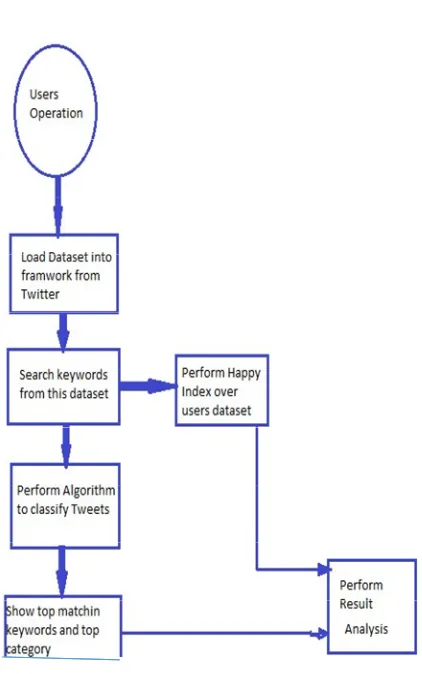
The figure below represent the complete flow of the proposed scenario which represent our work and computes parameters efficiently.
Fig. 1: Flow Chart For Propose Technique
The figure illustrate the flow where the processing system unit is given step by step from the starting of query as input and then intermediate process , further the execution and processing of data , further data is generated.
4. Result Analysis
The Naive Bayes classifier is a supervised learning technique. Therefore, it requires training using a set of pre classified documents before it is able to classify a document of unknown class. For our training corpus, chose to use microblogs exclusively from the domain Twitter.com since it is the leading microblogging service on the web and provides a wide range of users.
4.1. Training Corpus
containing posts were only related to a single category. Our input list was tailored to provide approximately 2K keywords per category. Given the list of accounts to crawl, the Twitter crawler would download the posts from each account using Twitter's programmatic API and then write the results to a file.
Fig. 2. Remaining number of words within the training corpus after pre-processing.
As seen in Figure 2, most categories contained between 2K – 2.5K words for training. The largest exception was for the category Politics which contained only 3.2K words. Differences in the number of words available for each category were due to variations in the average post length and the amount of filtering necessary. Unfortunately, [5] indicate that imbalanced like these can bias the classifier towards the more represented classes. However, rather than attempt balancing the training data to an equal number of words per category, focused our efforts on optimizing the classifier in order to remove its sensitivity towards these types of issues.
4.2. Training Corpus Results
Before optimizing our classifier, first determined our initial classifier's performance on our training corpus using a standard validation technique known as stratified 8-fold cross-validation [5]. This validation technique works as follows. First, the corpus is randomly divided into ten relatively equal partitions in both size and class distribution. Next, nine of the partitions are used for training and the remaining partition is used for testing. This process is then repeated for each of the partitions that are held out as a testing partition. Between each iteration, the results of the classifier are measured against the training partition in terms of recall, precision, and F1-measure. Finally, the results across all ten iterations are then macro-averaged together for an overall measurement
of performance. The performance results for the training corpus are shown below in Figure 3.
Fig. 3. Training corpus performance using stratified 8-fold cross-validation.
As seen in Figure 6.2, the average3 performance across all ten categories was 0.79 precision, 0.78 recall, and 0.78 Fimeasure. These results were higher than expected given that we are classifying individual posts with an average length of only 11 words. The best performing category was Science which had precision, recall, and Fi-measure scores all equal to 0.7. The worst performing category was Politics which had performance scores of 0.68 precision, 0.69 recall, and 0.7 Fi-measure. This category also had the largest difference between precision and recall scores while the majority of the remaining categories exhibited a balance between these two opposing metrics. Finally, the standard deviation was 0.08 Fi-measure across all of the ten categories.
5. Conclusion
Our work on microblogging classification and summarization has made the following contributions to furthering the state of the art in natural language processing and machine learning:
(1) Demonstration of the efficacy of the naive Bayes classifier on a very short document type. Our results indicate that, on average, a single Twitter post consists of only 11 words. Even with such a short document, we have demonstrated average Fi-measure classification results of approximately 0.74 for a set of 8 categories. These results demonstrate the capacity of the naive Keyword Strap classifier for classifying very short documents and the potential for using microblogs for many of the same applications as classifying traditional blogs.
0 0. 0. 0. 0. 0. 0. 0. 0. 0.
Training Corpus
F- Recal Precisio
0 0. 1 1. 2 2. 3 3.
Enter Busni TechnolPoliti Gam Scien Wor Heal
(2) Baseline performance values for both microblog classification and summarization. Prior to our work, no published results were available for either of these topics (to the best of our knowledge). Without prior work, it required additional time and effort to generate expected ranges of performance for these two tasks in order to be able to evaluate our work. Given our use of industry-accepted evaluation metrics, we have provided a set of baseline performance levels against which future efforts in microblog classification and summarization can be evaluated. This will hopefully motivate and simplify new efforts in this field.
(3) Availability of our developed software and data for future students interested in research in natural language processing and machine learning.
References
[1] Ben Fei and Jinbai Liu Binary Tree of SVM: A New Fast Multiclass Training and Classification Algorithm, IEEE TRANSACTIONS ON NEURAL NETWORKS, VOL. 17, NO. 3, MAY 2006.
[2] Bodong Chen University of Minnesota, Xin Chen Purdue University, Wanli Xind University Of Missouri,“Twitter Archeology” of Learning Analytics and Knowledge Conferences.
[3] D. Gaffney, “#iran Election: Quantifying Online Activism,” Proc. Extending the Frontier of Society On-Line (WebSci), 2010.
[4] Dilrukshi, I.; De Zoysa, K. Twitter news classification: Theoretical and practical comparison of SVM against Naive Bayes algorithms Advances in ICT for Emerging Regions (ICTer), 2013 International Conference on Year: 2013 Pages: 27- 278, DOI: 10.1109/ICTer.2013.6761192.
[5] Durant, K., and Smith, M. (2006). Mining sentiment classification from political web logs. In Proceeding of the workshop on web mining and web usage analysis of the Jih ACM SIGKDD international conference on knowledge discovery and data mining (WebKDD-2006), Philadelphia, PA, USA. SIGKDD Workshop on Web Mining and Web Usage Analysis.
[6] Kiberly E. Arnold Purdue University, Matthew D. Pitilli Purdue University “Course Signals at Purdue: Using Learning Analytics to Increase Student Success”.
[7] Jie Yin, CSIRO ICT Centre, Andrew Lampert, Palantir Technologies, Mark Cameron, Bella Robinson, and Robert Power, CSIRO ICT Centre Using Social Media to Enhance Emergence Situation Awareness.
[8] Jun Zhang; Honavar, V. AVT-NBL: an algorithm for learning compact and accurate naive Bayes classifiers from attribute value taxonomies and data. Data Mining, 2004. ICDM '04. Fourth IEEE International Conference on Year: 2004 Pages: 289 - 296, DOI: 10.1109/ICDM.2004.10083
[9] Kanakaraj, M.; Guddeti, R.M.R. NLP based sentiment analysis on Twitter data using ensemble classifiers Signal Processing, Communication and Networking (ICSCN), 2015 3rd International Conference on Year: 2015 Pages:15,DOI:
10.1109/ICSCN.2015.7219856.
[10] Lee, K.; Palsetia, D.; Narayanan, R.; Patwary, M.M.A.; Agrawal, A.; Choudhary, A. Twitter Trending Topic Classification Data Mining Workshops (ICDMW), 2011 IEEE 11th International Conference on Year:
2011 Pages: 251 - 258, DOI:
10.1109/ICDMW.2011.171
[11] Luca Maria Aiello, Georgios Petkos, Carlos Martin, David Corney, Symeon Papadopoulos, Ryan Skraba, Ayse Göker, Ioannis Kompatsiaris, Senior Member, IEEE, and Alejandro Jaime Sensing Trending Topics in Twitter. IEEE TRANSACTIONS ON MULTIMEDIA, VOL. 15, NO. 6, OCTOBER 2013.
[12] Mihaela Vorvoreanu, Xin Chen, and Krishna Madhavana “Mining Social Media Data for Understanding Students Learning Experiences”. [13] Pear Analytics (2009). Retrieved from
http://www.scribd.com/doc/18548460/Pear-Analytics Twitter-StudyAugust-2009.
[14] Xinchen, Krishna Madhavan School Of Engineering Education Purdue University, Mihaela Vorvoreanu Computer Graphics Technology.
RAHUL CHATURVEDI
He is currently pursuing the M.Tech at state university, RGPV Bhopal (Madhya Pradesh). His research interests include Mining over Social Media Data. (1School of Information Technology, RGPV University Bhopal).
NISHCHOL MISHRA