Synchronizing Emergency Services on Accident
Detection and Fall Detection: Using IoT
1
Sneha Pisey,
2Shweta Joshi,
3Nikita Shah,
4Preeti Kumari,
5Shweta Tatiya
1Dept. of Computer Engineering, MES College of Engineering, Pune, India
2,3,4,5MES College of Engineering, SPPU, Pune, India
Abstract
Road safety is an all-time global concern. Everyday a large number of human lives are lost due to accidents and delay in calling the rescue services. Also it is difficult to know about the occurrence of an accident and to obtain its location. Over the past years improvements have been made and with the advent of smart phones, it is now possible to get the location of accidents using GPS. Further form filling formalities and FIR filing is required in case of accidental events and in the case of fall. This causes delay in providing the victim with immediate medical help. Even though there are new enhancements in the area of accident and/or fall detection there is a need to focus on the integration part of all the above mentioned services for minimizing the delay in providing immediate help to the victim. This paper describes an efficient system which takes sensory input from an android application and notifies the emergency service providers like hospitals and police stations about such events immediately using the concept of Internet of Things (IoT).
Keywords
Internet of Things (IoT), Global Positioning System (GPS), Accelerometer, Android, Global System for Mobile Communication(GSM), Cloud
I. Introduction
In the recent years, many new technologies have emerged in the automobile industry to enhance user experiences and also facilitate smooth driving. With the vast improvements in the infrastructure in cities, construction of quality roadways is very common. This further adds to improving the travel experiences of the commuters not only for long journeys but also in day to day travel. Despite the progresses in the field of transport and efficient modes of communication, we still witness huge number of accidents taking place every day.
According to a survey, there is one death in every four minutes in India and one serious road accident occurs in every one minute. In 30% of the accident cases, deaths are caused due to the time taken for the victim to reach from the accident spot to the hospital. Many times victims are taken to hospitals far away from the accident spot instead of near ones. Such cases also involve police intervention and a lot formalities are involved in the same. This lead to a need to focus on how casualties due to accidents can be reduced by minimizing the delay in providing emergency services to the victims.
This paper addresses the integration of emergency services after automatic accident and fall detection through an Android smartphone and emergency assistance to the victims.
The remaining sections are organized as follows. Section 2 describes related work reviewing the existing systems for accident detection. Section 3 describes the proposed system, the Algorithm along with the block diagram. Section 4 presents the results and
efficiency of the new system. Section 5 summarizes the main conclusions of the paper and unveils the future scope.
II. Related Work
This section highlights the various previously developed systems related to accident detection and the alert mechanisms used in these systems.
[1] proposed a Mobile Application for automatic accident detection and multimodal alert which uses an Accident Detection Algorithm. It uses eCall system to automatically detect Vehicle accidents along with Collisions and Roll-overs. The Acceleration Severity Index (ASI) evaluates the potential risks for occupants. In [2], a Communication Flow Algorithm has been proposed in which Backend Systems interact with IoT using Database Management Systems and Web sites. Gateways inter-connect the end devices to the main communication infrastructure of the system. IoT peripheral nodes produce the data that is to be delivered to the control center.
[3] proposed an Incident Detection Algorithm to identify incidents, verify the nature of incidents and provide emergency services based on the nature. In [4], a WreckWatch Approach has been introduced in which the device accelerometer detects wreck utilizing device sensors to detect traffic accidents and notify first responders. Users utilize map to view wreck information and other motorists can view accident locations immediately and avoid accident locations. Also, users can upload or view images of the wreck to the server to provide first responders with additional information related to the accident [7].
The ABEONA Algorithm is proposed in [5], in which an accident is detected using crash sensors of the air bag sensors. A GPS is used to locate an accident spot and Vehicular Ad-Hoc Networks (VANET) are used to broadcast messages. It enables rescue services to forecast traffic congestion events and re-route their path accordingly to reach the location as soon as possible. Traffic signal module in this system, receives the information about the accident and the VANET signal receiver is switched ON to search for ambulance closest to the traffic signal [7].
One of the most important features of HDy Copilot is its automatic accident detection mechanism, from the eCall system. The algorithm detects accidents in situations like collisions, rollovers and airbag deployment. The algorithm is constantly analysing the incoming USB data, particularly, the OBD-II data frames. If the connection to USB is lost, the application stops receiving the data, but does not stop its execution and continues to function. The time elapsed between the occurrence of a rollover and the start of the Countdown Activity is 690 milliseconds, which shows that the application responds quickly [1]. If the countdown is not stopped then an SMS is sent to the contacts after 10 seconds and a voice call is placed after approximately 5 seconds after the delivery of the SMS. This waiting time is necessary to ensure unobstructed GSM connectivity failing which the call would fail [7].
III. Proposed System
The proposed system covers users of all age groups owning an Android smartphone, registered Hospitals and local Police stations and the principle is based on Internet of Things(IoT).
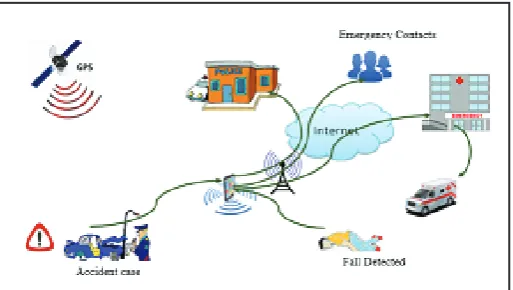
Fig. 1: System Architecture
A. System Architecture
Fig. 1 shows the basic architecture of the accident detection and alert system. It includes an Android Smartphone for the user and Web Applications for the hospitals and Police stations and the Cloud Server. The Android smartphone consists of an Accelerometer sensor which detects the change in motion caused to the Android phone in terms of acceleration. This change can be used for the detection of accidents since, in such cases the phone is likely to be damaged with a severe impact. The idea behind using an Android application to detect accidents is the increase in the use of Smartphones.
The system is initiated when an event is triggered from the Android smartphone in the form of sensory input. As soon as acceleration of a certain value is detected, the user’s emergency contact’s list is fetched from the server and a text message is sent to them providing a Google Map link to view the user’s exact location. Along with the text message, the nearest hospitals and police stations are found and a notification is sent to them. The hospitals and police stations also get all the important information about the user so that the succeeding activities of form filling and FIR filing (in case of severe road accidents) can be accelerated.
Internet of Things refers to the ever-growing network of physical objects that feature an IP address for internet connectivity, and the communication that occurs between these objects and other Internet-enabled devices and systems. IoT shall be able to incorporate a large number of different and heterogeneous end systems [2]. Urban IoTs can be designed to support the smart city vision. IoTs can be developed to exploit the most advanced
communication technologies to support added-value services for the administration of the city and for the citizens. Due to these advantages of IoT the central database for storing the user information is deployed on a cloud. This enables faster transmitting and fetching of information further reducing the delay in notifying the rescue services.
B. Android Application and Web Services
For the purpose of Accident and Fall detection an Android application has been developed. The smartphone consists of GSM/GPRS capabilities and a three axis linear accelerometer. This application named Emergen is to be installed on the user’s device. The application has a simple user interface and is user friendly. The application consists of a Registration Activity where the user is allowed to enter important information such as name, age, blood group, medical, history, gender and three emergency contact numbers. The user is also allowed to update the fields as and when required. An important aspect of this application is that it should be able to detect accidents even when the screen is off or the user is not logged into the application. For this purpose, a Background service has been implemented in the application. A service is an application component that can perform long running operations and does not provide a user interface. This enables the application to continuously sense the changes in motion and according to the threshold specified by the algorithm, generate the notifications. When the Android application detects an accident or a fall, a countdown sequence is generated in the form of a dialog box. This is used for avoiding false positives or declining the services if not needed by the victim. It also generates an audio alarm along with the dialog box to grab the attention of the user. The exact GPS location of the user is found out immediately using the location providers. There are two types of providers, GPS location provider and Network location provider. The Network location provider depends on the cell tower and returns the nearest tower location. However, the GPS location provider gives the accurate location in the form of latitude and longitude.
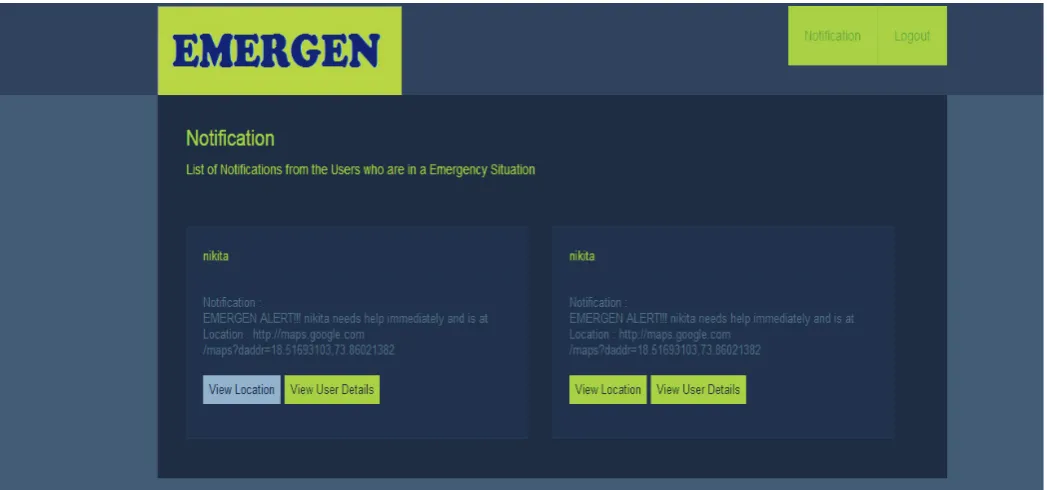
The hospitals and police stations communicate with the Android device with the help of Web services. Web services are applications that communicate over the Internet using the Hypertext Transfer Protocol(HTTP). When the user registers from the Android phone, all the information is stored on the centralized database on the cloud immediately through this web service. A user interface is provided for the hospitals and the police stations where a list of the notifications is displayed along with the name of the user and the user’s exact GPS location. The location of the victim can be viewed on a Google Map. Also, on a button click, the user details that were stored in the database during registration are fetched and displayed. The use of cloud allows these web services and android application to communicate from any location without compromising the speed.
C. Algorithm
smartphone sensor if the value of the acceleration is 4g (g=9.8m/ s2) [1]. A fall can be a cardiac arrest, or minor accidents where medical help is required but is not fatal for the victim. For such cases the acceleration value of 4g is too high. Hence a smaller value of acceleration is taken into consideration which is in the range of 3g to 4g (g=9.8m/s2).
This algorithm can be modified for different types of notifications such as minor accidents, major accidents and also accidents that would cause severe damage and death by using different threshold values for each.
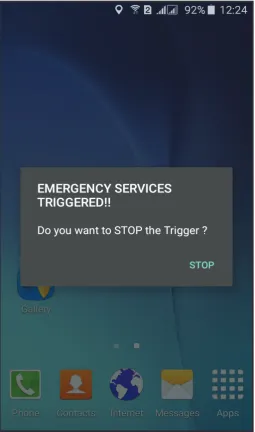
There can be many instances where the smartphone can undergo severe changes in motion which might raise false alarms. Thus, an alert has been included to avoid such false positives. When an accident or a fall is detected, an alarm is generated for 30 seconds. The user can stop the alarm if the emergency services need not be triggered. If the user does not switch off the alert within 30 seconds, the comparison with the threshold values is done automatically and accordingly notifications are sent to the hospitals and the police stations.
The second algorithm is used for fetching the data from the Android device and storing it in the database. On receiving the notifications about the accidents along with the latitude and longitude of the user’s location, the algorithm also finds the nearest police stations and hospitals. To find the nearest hospitals and police stations from the user’s location, it makes use of the Haversine formula. The Haversine formula takes into account great circle distances that include the geometrical reality of the spherical Earth, and offers an alternative to widely held notion that travel over water can be exactly modelled by Euclidean distances [8]. The Haversine formula is an equation important in navigation, giving great-circle distances between two points on a sphere from their longitudes and latitudes [8]. In this algorithm, the hospitals and police stations are found using the Google APIs. Among these, the nearest hospitals and police stations are found by using Haversine formula. The Haversine formula is given as follows.
d = 2r sin-1 (√ ( sin2 ((lat2 - lat1) / 2) + cos(lat1). cos(lat2). sin2((long2-long1)/2))
Here, ‘d’ is the distance between two points with latitude, longitude as (lat1, long1) and (lat2, long2).
‘r’ is the radius of the earth in kilometres.
‘sin’ and ‘cos’ are trigonometric functions that return the sine and cosine of the angles respectively.
After the distance has been calculated the nearest hospital and police station is notified.
Fig. 2: Shows a General Flow of the Working of the Algorithms
V. Results
The proposed system aims at reducing the delay in provision of the emergency help to the victims. Former systems, made use of hardware components such as microcontrollers and external sensors which are mounted at specific points onto the vehicles, for the detection of accidents. Such systems require huge initial investments and constant maintenance. The newly developed system is completely based on software and makes use of Internet of Things (IoT). Thus, the system is cost effective and easy to deploy and use. This can open a new vision for enhancing the services in Smart Cities. From experiments, it has been found that the false positives are efficiently handled by the system.
Fig. 4: Victim’s Exact Current Location Viewed on the Map
Fig. 5: Alert dialog to enable the user to switch off the trigger if no help is needed
Also, the delay is significantly reduced since the user information is sent to the server on registration. Thus, on accident detection only the location is sent thereby reducing the amount of data to be communicated over the Internet. This further reduces the delay. It has been observed that the notifications are received on the side of the hospitals and police stations within 50 seconds. This also includes the time for which the alert dialog is displayed on the screen of the smartphone. This time is significantly low, and also accelerates the formal procedures of the hospitals and police stations by making the user information available to them instantly. Fig. 3 shows a snapshot of the notification page where the notifications are displayed when a new case arrives. Fig. 4 shows a snapshot of the page that includes a Google map on which the current location of the victim can be viewed.
IV. Conclusion and Future Scopes
This paper presents an efficient system for accident and fall detection and instant provision of emergency services to the victims. It includes an Android application through which the accidents and falls will be detected and notified to the hospitals and police stations and also the victim’s near ones using the concept of Internet of Things. Once the notifications have been sent to the hospitals and the police stations the victim can get immediate help as his location and data will be available to the hospitals and police stations.
This system can be extended further to include blood banks so that there is no delay to make the blood available to the hospitals for severe accident cases where there can be heavy blood losses. Also, fine tuning of the patterns for finding the nearest hospitals and police stations depending on the traffic conditions can further enhance the system. The application can be used for other purposes such as Woman Safety and all other kinds of safety issues.
References
[2] Andrea Zanella, Nicola Bui, Angelo Castellani, Lorenzo Vangelista, Michele Zorzi,“Internet of Things for Smart Cities”, IEEE Internet of things Journal, Vol. 1, No. 1, February 2014.
[3] William M. Evanco,“The Impact of Rapid Incident Detection on Freeway Accident Fatalities”, Mitretek Center for Information Systems McLean, Virginia, June 1996. [4] Chris Thompson, Jules White, Brian Dougherty, Adam
Albright, Douglas C. Schmidt,“Using Smartphones to Detect Car Accidents and Provide Situational Awareness to Emergency Responders”, Vanderbilt University, Nashville, TN US.
[5] V Praveena, Adithya Raam Sankar, S Jeyabalaji, V Srivatsan,“Efficient Accident Detection and Rescue System using ABEONA Algorithm”, International Journal of Emerging Trends and Technology in Computer Science (IJETTCS), Vol. 3, Issue 5, September-October 2014. [6] Jorge Zaldivar, Carlos T. Calafate, Juan Carlos Cano,
Pietro Manzoni,“Providing Accident Detection in Vehicular Networks Through OBD-II Devices and Android-based Smartphones”, Department of Computer Engineering, Universitat Politècnica de València Camino de Vera S/N, 46022, Spain”, 5th IEEE Workshop on user mobility and Vehicular networks, 2011.
[7] Prof. Spurti Shinde, Ms. Shweta Joshi, Ms. Shweta Tatiya, Ms. Preeti Kumari, Ms. Nikita Shah,“Accident Detection and Alert Systems for Immediate Emergency Services: A Literature Review”, International Journal of Science and Resarch (IJSR), Vol. 4, Issue 10, October 2015.
[8] Prof. Nitin R. Chopde, Mr.Mangesh K. Nichat, “Landmark Based Shortest Path Detection by Using A* and Haversine Formula”, International Journal of Innovative Research in Computer and Communication Engineering Vol. 1, Issue 2, April 2013.
Nikita Shah pursuing Bachelor of Engineering Degree in Computer from M.E.S College of Engineering, SPPU.
Preeti Kumari pursuing Bachelor of Engineering Degree in Computer from M.E.S College of Engineering, SPPU.
Shweta Joshi pursuing Bachelor of Engineering Degree in Computer from M.E.S College of Engineering, SPPU.
Shweta Tatiya pursuing Bachelor of Engineering Degree in Computer from M.E.S College of Engineering, SPPU.