Enhancing Salted Password Hashing Technique Using
Swapping Elements in an Array Algorithm
1
Dr. Abdelrahman Karrar,
2Talal Almutiri,
3Sultan Algrafi,
4Naif Alalwi,
5Ammar Alharbi
1,2,3,4,5Taibah University, Saudi Arabia
Abstract
The importance of internet has become highly valid environment for organizations and governments due to providing services and easily dealing with e-commerce and government services. All of these services are provided to registered users which an
organization store their profiles in its databases. User’s profile
may contain sensitive information such as passwords, credit card numbers, and personal data. One of most concerned issues is how to protect this sensitive information. However, a dictionary attack, brute force attack and rainbow table are the most common ways of guessing passwords in cryptanalysis. As a result, salted password
hashing technique one of most efficient ways to protect user’s
passwords. In cryptography, a salt is random string appending
or prepending to original user’s password before enter it hash
function. This is paper will provide guidelines to use this technique
to increase efficiency for preventing dictionary attack, brute force attacks and rainbow table from guessing users’ passwords. Also,
this paper will provide an algorithm to improve salted password hashing technique by swapping elements in array which work
to rearrange the user’s password and salt before send it to hash function. For example, suppose the user’ password is “123” and the salt is “abc”. The common way is use hash(user’ password, salt) - hash(123abc ). This algorithm is to reorder user’s password and salt to become like “a1bc23” and then send it to hash function.
Also in common using of salted password hashing technique the salt is storing in database without any changes, therefore this algorithm we will rearrange the salt before storing it in database.
This algorithm will make guessing the password more difficult
because isolating the password and the salt from each other
through the final hashes will become very difficult.
Keywords
Password Security, Hash Algorithm, Encyption, Array Algorithm.
I. Introduction
Hashing algorithms are used to convert passwords into string called hash values, hash codes, digests, or simply hashes. A hash is also a one-way function which theoretically cannot reverse or get a plain text from hash. Salted password hashing means
appending or prepending a random string to the user’s password
before hashing.
To make hashes more secure, salt can be added to the hash. This
means that, a random string of characters is either prefixed or postfixed to the password before hashing it. Every password has a
different salt. Even if the salts are stored on the database, it will be very complicated cracking the passwords using a rainbow table as the salted passwords are long, complex and unique. Salted hashes
can be brutally forced but the time taken is significantly longer. Using two salts, one public and one private can also protect the password against offline attacks [1].
To store password in database there is four ways. The first way:
storing password in a plain text that mean the password does not need any process to discover it can be known just by looking. The
second way: Using symmetric encryption to convert password
from the plain text – the original string- into cipher text by using the same cryptographic key which could lead to possibility of decryption the cipher text and stolen the password by knowing
the cryptographic key. The third way: Using password hashing
algorithm to generate non-reversible hashes but dictionary attack, brute force attacks and rainbow table can guess the password because the hashes will be same for all the same plain text. The
fourth way: Using salted password hashing to generate different hashes for the same plain text that make guessing too difficult.
Most database applications usually store their passwords in
the database as plain text which is not a sufficient method for
protection, especially for applications that hold sensitive data of
user [2]. MD5 (Merkl-Damagerd), SHA1 (Secure Hash Algorithm) and RIPEMD (RACE Integrity Primitives Evaluation Message Digest) algorithm are considered as broken algorithms and they should not be used in the new applications [2].
Swapping Elements in an array algorithm focuses on rearrange
hash input (password and salt) before send to hashing function that arrangement is flexible where we relied on the even elements
- positions - of the array to store the password and then reverse the salt and store it in the remaining places. This algorithm, also,
rearrange salt before store it in database based on a predefined
array.
II. Related Work
Nicholas Oluwole Ogini and Noah Oghenefego Ogwara focused on database passwords security, using a strong hashing algorithm and salting. They provided a platform to eliminate the need to ever persist user password in plain text or easy to know any
users’ password. This system is implemented using the message digest 5 (MD5) algorithms for hashing and salt pattern. They,
also, provided some challenges of the existing such as storing passwords in a plain text and encrypting passwords before store
it [2]. They used username as salt, but this is a contrary to the
principle of salt where it should be random and preferable not to create an algorithm for generating random number.
Prathamesh Churi, Medha Kalelkar and Bhavin Save had provided
a new algorithm for improvising password encryption using Jumbling-Salting-Hashing technique. JSH algorithm consists of three techniques namely jumbling, salting and hashing. In the
jumbling part, the password undergoes “addition”, “selection” and “reverse” processes. Addition process is responsible for generating
a value required for determining the number of characters to
be added to the password [4]. Selection deals with selecting characters to be added to the password from predefined character
set. Reverse process is responsible for reversing the output of
selection process on some predefined condition. In salting part,
random salt is added to the jumbled password. Selection of salt is based on timestamp value which is determined when the user creates an account. Finally, jumbled and salted password is given
is similar to the principle of salt by having an additional string to the password.
III. Guidelines for Improving Password Security
There are many aspects to password security that must be considered. These include the manner in which passwords are chosen. Also, salt reuse, short salt, hash algorithm should be used
and Cryptographically Secure Pseudo-Random Number Generator (CSPRNG).
A. Choosing a Password
The password must be difficult to guess and also should be easy to
remember. Personal information or common words such as names, special dates, places, and dictionary words should be avoided when
choosing a password. Using a variation of capital letters, small
letters, numbers, and symbols is highly recommended as well as the length of a password should be considered at least 9 letters.
B. Salt Reuse
Using the same salt in each hash is ineffective because if two
users have the same password, they will still have the same hash which an attacker can still use a reverse lookup table attack to run a dictionary attack on every hash at the same time. As a result, a new random salt must be generated each time a user creates an account or changes their password.
C. Short Salt
Using a short salt also ineffective because attackers may be able to guess user’ password by generating a lookup table for every possible salt. A salt recommended being at least 32 random
bytes.
D. Hash Algorithm
A fast cryptographic hash functions such as MD5 and SHA1 this algorithm are considered as broken algorithm. MD5 is a fast hashing
function, that is, it is computationally fast to calculate. Iterative hashing makes the calculation slower, hence computationally
slower and more difficult to crack. The number of iterations can typically be made to be equal to 1000 [5].
However, a key derivation functions such as bcrypt, crypt,
PBKDF2, and scrypt are slower than common functions like MD5 and SHA1 but is hard to break it.
E. Cryptographically Secure Pseudo-Random Number Generator (CSPRNG).
Cryptographically Secure Pseudo-Random Number Generator (CSPRNG) should be used to generate salt. It is designed to be
cryptographically secure. However, using simple Pseudo-Random
Number Generator like rand() function is not recommended. It
is designed for generating random number only without any consideration of cryptography.
IV. Swapping Elements in an Array Algorithm
Swapping Elements in an array algorithm consists of two major modules, Hash input rearrangement module and Salt rearrangement module. The diagram of swapping Elements in an array algorithm
is given in fig. 1.
Fig. 1: Architecture Diagram of Swapping Elements in an Array
Algorithm
A. Hash Input Rearrangement Module
This module is responsible for rearranging hash input (password
and salt). It is consisted of two processes, Reversion Process which is receiving the salt then reversing its elements and preparing the salt for next process. Rearrangement Process, which gets
the reversed salt and original user’s password then it, will be placing the first letter of password in the first even position in an
array and inputting the next letter in the next even position. After
finishing the password, it will add the reversed salt sequentially to
the remaining positions. Then, the rearranged hash input will be
sending to hash function to generate hashes. Fig. 2 shows Hash
Input Rearrangement Module.
Fig. 2: The Diagram of Hash Input Rearrangement Module
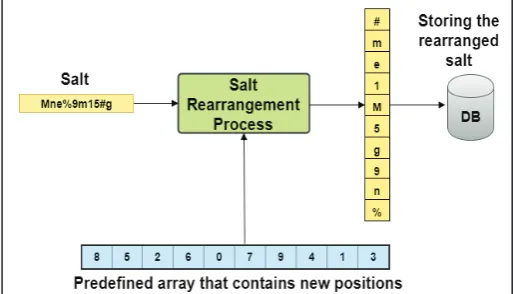
B. Salt Rearrangement Module
This module is responsible for rearranging the salt before storing
it in database. Salt rearrangement process is based on predefined
array, which contains the new positions of the salt. The purpose of rearranging salt is to reduce the possibility of salt detection
that mean guessing of the password will be very difficult. Fig. 3
shows Salt Rearrangement Module.
V. Algorithm Steps
The detailed steps of Swapping Elements in an array algorithm
will be:
Receiving user’ password from user. 1.
Generating the salt. 2.
Reversing the salt by Reversion Process.
3.
Rearranging hash input (user’s password and salt) by 4.
Rearrangement Process.
Sending hash input to hash function to generate hashes.
5.
Rearranging the salt by Salt Rearrangement Process 6.
Storing hashes and the rearranged salt in database. 7.
VI. Algorithm Implementation
The algorithm will be implemented using SHA2 with .Net framework using C#.Net 2013. Two pages will be implemented,
Registration page, and Login page. The main class is Swapping Elements Algorithm which contains this methods.
using System;
using System. Security. Cryptography;
using System.Text;
public class SwappingElementsAlgorithm {
public SwappingElementsAlgorithm()
{ }
private const int saltSize = 24; public static string GenerateSalt()
{
RNGCryptoServiceProvider rng = new RNGCryptoServiceProvider();
byte[] salt = new byte[saltSize]; rng.GetBytes(salt);
return Convert.ToBase64String(salt);
}
// Reversion Process
public static string ReversingSalt(string Salt)
{
char[] reversedSalt = Salt.ToCharArray(); Array.Reverse(reversedSalt);
return new string(reversedSalt);
}
// Rearrangement Process
public static string RearrangingHashInput(string Paasword,
string ReversedSalt) {
char[] password = Paasword.ToCharArray(); char[] reversedSalt = ReversedSalt.ToCharArray();
char[] rearrangedHashInput = new char[password.Length + reversedSalt.Length];
int pIndex = 0 ; int rsIndex = 0;
for (int i = 0; i < rearrangedHashInput.Length; i++ )
{
if(i % 2 == 0) // even number
{
if (pIndex < password.Length)
{
rearrangedHashInput[i] = password[pIndex]; pIndex++;
} else {
rearrangedHashInput[i] = reversedSalt[rsIndex]; rsIndex++;
} } else {
rearrangedHashInput[i] = reversedSalt[rsIndex]; rsIndex++;
} }
return new string(rearrangedHashInput);
}
//Salt Rearrangement Process
public static string RearrangingSalt(string Salt)
{
// new positions 32 elements depend on salt length int[] predefinedArray = { 3,0,31,24,5,9,17,29,13,1, 6,10,18,2,4,8,7,15,21,19,11,20,27,23,14,12,22,16,25,30, 26,28};
char[] rearrangedSalt = new char[predefinedArray. Length];
for (int i = 0; i < predefinedArray.Length; i++)
{
rearrangedSalt[i] = Salt.ToCharArray() [predefinedArray[i]];
}
return new string(rearrangedSalt);
}
//SHA384 hash function
public static string HashPasswordUsingSHA384(string
HashInput) {
SHA384 sha384 = new SHA384CryptoServiceProvider(); byte[] hash = sha384.ComputeHash(Encoding.UTF8. GetBytes(HashInput));
return Convert.ToBase64String(hash);
}
//Verifying user’s password. Calling from login page public static bool VerifyPassword(string UserPassword, string
Salt,string HashedPassword) {
string reversedSalt = SwappingElementsAlgorithm.
ReversingSalt(Salt);
string rearrangedHashInput = SwappingElementsAlgorithm.
RearrangingHashInput(UserPassword, reversedSalt);
string hash = HashPasswordUsingSHA384(rearrangedHa
shInput);
if (String.Compare(hash, HashedPassword, false) == 0 )
else
return false;
} }
Registration page is shown in fig. 4.
Fig. 4: The Design of Registration Page
protected void btnRegister_Click(object sender, EventArgs e)
{
string salt = SwappingElementsAlgorithm.GenerateSalt();
string reversedSalt = SwappingElementsAlgorithm.
ReversingSalt(salt);
string rearrangedHashInput = SwappingElementsAlgorithm.
RearrangingHashInput(txtPassword.Value, reversedSalt);
string hashes = SwappingElementsAlgorithm.HashPasswo
rdUsingSHA384(rearrangedHashInput);
// Storing user info in database also hashes and salt
SqlParameter[] parameters = new SqlParameter[]{ new SqlParameter(“@Username”,txtUsername.
Value),
new SqlParameter(“@FullName”,txtName.Value), new SqlParameter(“@Salt”,salt),
new SqlParameter(“@Hashes”,hashes),
};
if (SQLHelper.ExecuteNonQuery(“INSERT INTO UsersAccounts VALUES(@Username,@FullName,@Salt,@ Hashes)”, CommandType.Text, parameters))
lbMessage.Text = “Successfully saved”;
else
lbMessage.Text = “Failed to save data”;
}
Login page is shown in Fig 5.
Fig. 5: The Design of Registration Page
protected void btnLogin_Click(object sender, EventArgs e)
{
SqlParameter[] parameters = new SqlParameter[]{ new SqlParameter(“@Username”,txtUsername.
Value), };
// Getting data from database
DataTable userInfo = SQLHelper.ExecuteQuery(“SELECT * FROM UsersAccounts WHERE Username=@Username”, CommandType.Text, parameters);
if (userInfo == null || userInfo.Rows.Count <= 0) lbMessage.Text = “Username or password is incorrect”;
else {
string salt = userInfo.Rows[0][“Salt”].ToString(); string hashedPassword = userInfo.Rows[0] [“HashedPassword”].ToString();
if (SwappingElementsAlgorithm.VerifyPassword(txtPassword.
Value, salt, hashedPassword))
lbMessage.Text = “successfully logged in”;
else
lbMessage.Text = “Username or password is incorrect”;
} } }
VII. Future Scope
The future scope of algorithm will include some enhancements
and modifications that can be implemented using the other hashing algorithm and key derivation functions such as PBKDF2. A new
method can be implemented is using the salt not, only, as an additional string to the password before rearrangement, but also as an input to hashing function which means adding salt to the rearranged hash input.
VIII. Conclusion
In cryptanalysis, a dictionary attack, brute force attack and rainbow table are the most common ways of guessing passwords. However, there are many aspects to password security that must be considered which some of them should be avoided to increase security ratio such as selecting a strong password consists of variations of capital letters, small letters, numbers, and symbols, as well as voiding using short salt and using the same salt in each hash. Also, using a
fast cryptographic hash functions such as MD5 and SHA1 which
are considered as broken algorithm is not highly recommended. Therefore, salted password hashing technique is one of most
efficient ways to protect user’s passwords. In addition, swapping
Elements in an array algorithm consists of two major modules, Hash input rearrangement module and Salt rearrangement module which try to enhancing salted password hashing technique by rearranging hash input before hashing it and rearranging salt before storing it in database. This algorithm is recommended to reduce the
possibility of guessing the password and make it more difficult.
References
[1] K. Chanda,“Password Security: An Analysis of Password Strengths and Vulnerabilities”, I. J. Computer Network and Information Security, 2016, 7, pp. 23-30.
[3] P. Sriramya, R. A. Karthika,“Providing password security by salted password hashing using bcrypt algorithm”, ARPN Journal of Engineering and Applied Sciences, Vol. 10, No. 13, pp. 5551-5556, 2015.
[4] Secure password methods(salting and hashing methods) , https://crackstation.net/hashing-security.htm#salt
[5] Prathamesh Churi, Medha Kalelkar, Bhavin Save, “JSH Algorithm: A Password Encryption Technique using JumblingSalting-Hashing”, International Journal of Computer Applications, Vol. 92, No. 02, pp. 26-29, 2014. [6] M. C. Kioon, Z. Wang, S. D. Das,“Security Analysis of