e-ISSN: 2278-067X, p-ISSN: 2278-800X, www.ijerd.com
Volume 12, Issue 12 (December 2016), PP.09-16
The Design of the Components of A Computer-Oriented
Methodical System of Teaching Differential Equations of
Future Information Technology Specialists.
Vlasenko Kateryna
1, Rotaneva Natalia
2, Sitak Irina
31Professor of the Department Of Mathematics of Donbas State Engineering Academy, Kramatorsk, Ukraine. 2Associate Professor of the Department of Mathematical Methods and System Analysis of Mariupol State
University, Mariupol, Ukraine
3Senior Lector Of The Department Of Mathematics And Computer Technologies Of Volodymyr Dahl Institute Of
Chemical Technologies Of Eastern Ukrainian National University, Rubizhne, Ukraine.
Abstract:
The design of a computer-oriented methodical System of teaching differential equations of futureInformation Technology specialists is described.Specified learning objectives are updated, training content is
improved, and the feasibility of computer-oriented methods, forms and means of education is justified. The use
of computer-based support of teaching which is placed on the educational site is considered.
Keywords:
computer oriented methodical system, differential equations, learning objectives, learning tools, methods and forms of education, educational site.I.
INTRODUCTION
Informatization of modern society requires new approaches to teaching mathematical disciplines, especially for future professionals in the field of information technology (IT). One of the factors that should provide a positive impact on the effectiveness of mathematical training of IT bachelors is the introduction of computer-based support in the teaching of mathematics, in particular differential equations (DE).
II.
ANALYSIS
OF
PUBLISHED
DATA
AND
PROBLEM
SETTING
Different aspects of computer-based mastering by future specialists of higher mathematics and its separate sections have been lighted in the methodological literature
The researchers have created computer-oriented teaching systems that enable mathematical training of future teachers (G. Myhalin [7] V. Motorina [8], etc.), economists (S. Bass [1] K. Slovak [12] and al.), engineers (S. Bondarenko [2], C. Vlasenko [3], I. Hom'yuk [15] and others. The works of scientists that reflect certain approaches to the solution of the problem under study were not aimed at the development of components of methodical system of mastering differential equations by future bachelors of Information Technology.
The analysis of the works of researchers mentioned above confirmed the importance of improving the methodological training system of IT bachelors. Its implementation in the learning process requires the use of multiple approaches to teaching such as student-centered, activity-based, and competency-based ones. Compliance with certain principles of these approaches determines the feasibility of developing methodical system as a computer-oriented. This specification provides for adjustment of purposes, content, methods, forms and means of education.
III.
PRESENTATION
OF
THE
MATERIAL
Student’s awareness of purposes of DE learning will boost his efficiency. Thus, the result of future specialist training depends on how clearly the interaction of internal and external purposes happens. External discipline goals are defined by educational program of training and express social needs, while internal objectives are formed by a participant of the process by himself.
Taking into account the opinion of O. Kovalenko [5], we provide a transition of external goals, which are formulated in the form of requirements to the student in the internal through the use of computer-based support that contributes to meeting the needs and motives of the student, affecting his "right- hemispheric” perception (Fig. 1).
Figure 1: Relationship of internal and external goals
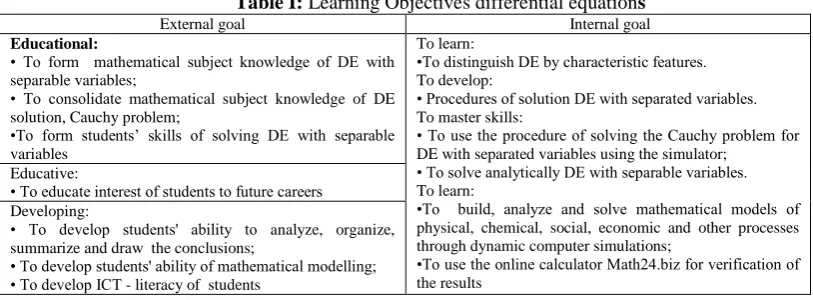
Let us consider the internal and external objectives on the example of studying the topic "Differential equations with separated variables" (tab. I).
Table I: Learning Objectives differential equations
External goal Internal goal
Educational:
• To form mathematical subject knowledge of DE with separable variables;
• To consolidate mathematical subject knowledge of DE solution, Cauchy problem;
•To form students’ skills of solving DE with separable variables
To learn:
•To distinguish DE by characteristic features. To develop:
• Procedures of solution DE with separated variables. To master skills:
• To use the procedure of solving the Cauchy problem for DE with separated variables using the simulator;
• To solve analytically DE with separable variables. To learn:
•To build, analyze and solve mathematical models of physical, chemical, social, economic and other processes through dynamic computer simulations;
•To use the online calculator Math24.biz for verification of the results
Educative:
• To educate interest of students to future careers Developing:
• To develop students' ability to analyze, organize, summarize and draw the conclusions;
• To develop students' ability of mathematical modelling; • To develop ICT - literacy of students
Objectives should be offered by a teacher before each classroom sessions (theoretical and practical) and as well as during independent work.
Strategic objectives define the content of training, which is implemented through systematic assignments of different levels of complexity and funding of computer-oriented learning technologies.
The developed system meets the objectives of certain requirements and provides a rational organization of educational and professional activities of students during training. The complexity of the tasks is divided into five levels.
The tasks of the first level of difficulty ensure students to master the ability to identify types of differential equations, to determine the order of equations, to reproduce the simplest mathematical operations such as grouping of elements, replacing the derivative by the ratio of differentials and etc. Tests are used for this purpose. 10-12 tasks, provided with information support, are chosen for each theme. For example, during the study of the topic "Linear differential equations of the first order. Bernoulli equation" students are offered to work on a test for updating the knowledge of the structure and the general form of linear differential equations of the first order.
Task 1. Reduce differential equations to the form yP x y( ) Q x( ) and defineP x( ), Q x( ).
а) y (1 2 )x y 1
x
,
b) xy (x 1)y3x e2 x,
с) y y x2
x
,
d) 2 4
2 2
xy x y x .
Information support. If there is a multiplier beforey, divide all parts of the equation by it.
The challenge at the second level is aimed at students’ awareness of the set of elements that make up a differential equation, substitution of variables in the differential equation, recurrence of the original table. The task of the second level is aimed at understanding by the students the totality of the elements included in a differential equation, performing a replacement of variables in the differential equation, the repetition of finding tabular and initial derivatives. Solving such problems ensures the creation of rules-guidelines for the solution of equations of various types by bachelors and familiarizes future specialists with the procedures of the use of certain software, in particular SCM Maxima, Scilab and visualization system GRAN
For example, while studying the topic "Equation in full differentials" for updating knowledge of differential function of two variables is advisable to offer students the following task. Taking into consideration the fact, that such problems include revising of learning material students are recommended the links to paper guides in which this material is considered in more details.
Task 2. Specify the differential of functionzcosxsiny.
а) dzcosxdxsinydy,
b) dz sinxdxcosydy,
c) dz(dx dy ) cos sinx y,
d) dz sinx x cosy y .
Information support. Repeat educational material from textbooks [13], [14]. Use formuladz zdx zydy
x y
. to
calculate the differential
The tasks of the third level of complexity require students to use the acquired skills for solving typical problems. Their solution provides students to clarify certain procedures implemented in computer simulators.
For example, while studying the theme "Homogeneous differential equations" the students are explained an example of solving equations of a certain type and at the same time the appropriate procedure is produced.
Task 3.Find the general solution of equation xy xsiny y x
.. Make the procedure of solving of the
homogeneous differential equations
Step I. We write the equation in the formy f y x( / ), for this divide left and right sections by x.
Step ІІ. Make sure that the function on the right side of the equation is homogeneous. For this reason
put x, y instead of x and y.
If you have got a homogeneous function, go to Step III. If the function does not apply to homogeneous, find out the type of DE and choose it for the appropriate procedure.
Step І І І. Replace y u y, ux y, u x u x .
Step ІV. Get equation for the function u x( ). Determine its type and choose a particular procedure.
Step V. Replace u y x
and obtain the general solving of the equation.
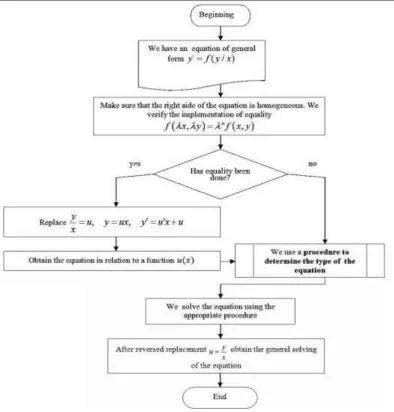
In the process of explaining solving steps to the equation the teacher and students make the procedure of certain actions based on the block diagram (Fig. 2).We offer students the use of interconnected successive blocks (appearance of each block isn`t different from the well-known ones), which contains educational messages about operations that provide the operating basis for student`s actions during awareness of each procedures for solving DE. Such procedures are developed for all themes in the process of mastering by bachelors of certain types of DE and their systems.Working during classroom practical learning and independent work on the other connected tasks future IT professionals have the ability to contact any of the flowcharts. We have developed simulators based on the flowcharts that can provide training of students in the process of preparation for independent or test work.
Figure 2: The procedure for solving homogeneous equation
Task 4. The rate of decay of radium in every moment of time is directly proportional to its mass.
Determine what percentage of weight m0 of radium will disintegrate in 200 years, knowing that the half-life of
radium (the period of time after which a half of the current weight of radium splits) is 1590.
During the explanation the teacher demonstrates solving the problem by way of a dynamic process of the model of decay of radium (Fig. 3).
Changes in the following image are accompanied by explanations of the teacher. The rate of radium
decay is measured by its number, which disintegrated in a time unit. For a small period of time t elapsed from
some point of time t , the amount of radium, which collapsed, is km t , where m is the amount of radium at the
moment, k is a coefficient of proportionality. The same mass, taken with the sign «-» (weight decreases), is
equal to weight increment during t :
. m km t
(1)
Divide both parts of received equality (1) by t and go to the limit when t 0. Then:
0
lim .
x
m dm km t dt
(2)
So we got the equation .
dm km dt
Involvement of different types of sensory perception of students and dynamic of elements enable bachelor’s awareness of physical setting of problems and creation of mathematical model. Taking it into account, we have developed dynamic models of the processes: the decay of radium, electric circuit, population growth, heat transfer, body dropping, cooling, getting a solution, harmonic oscillations, trajectory of a body thrown at an angle to the horizon, nonlinear motion of the pendulum, leakage of fluid from vessels.
The tasks of the fifth level consist of professionally oriented tasks which solution provides a simulation of future careers of students. Organization of educational and professional activities of Bachelors of IT is provided by involving cases. Working with cases requires involving students` programming skills during the implementation of algorithms for approximate solution of DE and their systems using online calculators such as Wolfram | Alfa or Math24.biz.
For example, after learning the theme "Differential equations of the first order" future specialists are offered a task-case.
Task 5.Assuming that the rate of population growth is directly proportional to the number of people,
find the relationship between population A and time t, knowing that at the point that we take for the initial,
population was equal to A0, and a year later it increased by a%. Calculate estimated on this basis amount of
population of a definite city on January 1, 2020, taking into account the statistical average growth rate of previous years.
Case includes the task that involves a formulated problem to build a mathematical model; instruction on the procedure for the assignment; dynamic model, statistical data on the population of the city of a definite region over the past 5 years; the formula for calculating population growth; the formula for calculating the population in a year; links to online calculators and MathForYou.net Math24.biz; questions for discussion.
Organization of educational and professional activities of students involving computer-based support enables them to familiarize themselves with the skills that are necessary for future professional activities of IT specialists. Mastering each topic by future specialists ends with the work using the above cases.
Systematized tasks that provide additions to the content of learning DE by Bachelor of IT are located in the developed educational-methodical manual [3].
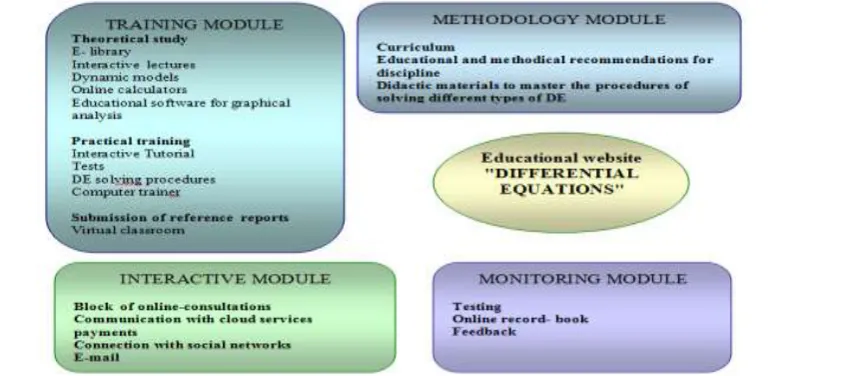
The educational content of computer-based course "Differential equations” is posted on the school website "Differential equations" [11]. The structure of the site is presented in the form (Fig. 4).
All the modules that make up the structure of the site are interconnected to each other. Each of the tools that make content modules helps to ensure communication between components of computer oriented methodical system which is implemented in the process of learning DE by IT bachelors and ensures its effectiveness.
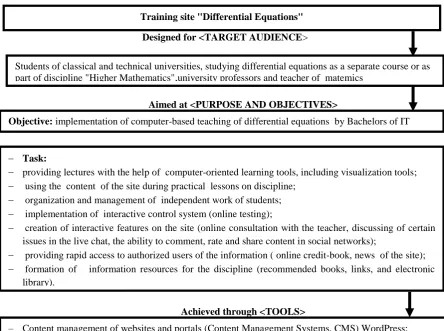
The concept of a developed educational site "Differential equations" [11] can be represented in the scheme (Fig. 5).
Designed for <TARGET AUDIENCE>
Aimed at <PURPOSE AND OBJECTIVES>
Achieved through <TOOLS>
Ґ р у нт у єт ь с я н а <ПРИНЦИПИ>
Based on <Principles>
Leads to <RESULT>
Figure 5: The concept of the training site "Differential Equations"
Students of classical and technical universities, studying differential equations as a separate course or as part of discipline "Higher Mathematics",university professors and teacher of matemics
Training site "Differential Equations"
Effective implementation of computer-oriented methodological training system of differential equations by Bachelors of Information Technology.
Integrity. Provides the creation of an integrated self-contained blended system of teaching of differential equations students of technical universities.
Accessibility. Provids the necessary material and methodological support for effective online training course "Differential equations".
Interactivity. Provides effective interaction between the students themselves, as well as educational materials and teacher.
Compliance with the current level of computer-oriented technologies.All main site design decisions are based on the achievements of modern WEB technologies.
Practical orientation. Ensures effective online learning for each user of the site according to his individual needs and capabilities.
Updating content. Prompt and systematic information content of the site.
Task:
providing lectures with the help of computer-oriented learning tools, including visualization tools;
using the content of the site during practical lessons on discipline;
organization and management of independent work of students;
implementation of interactive control system (online testing);
creation of interactive features on the site (online consultation with the teacher, discussing of certain
issues in the live chat, the ability to comment, rate and share content in social networks);
providing rapid access to authorized users of the information ( online credit-book, news of the site);
formation of information resources for the discipline (recommended books, links, and electronic
library).
Objective: implementation of computer-based teaching of differential equations by Bachelors of IT
– Content management of websites and portals (Content Management Systems, CMS) WordPress;
– Interactive tools for implementing communicative, administrative and other functions;
Focus on the conceptual provisions of the scheme ensures compliance with the requirements, which are defined in the regulatory documents [4], [9], [10] on Informatization and development of certain Internet resources in Ukraine.
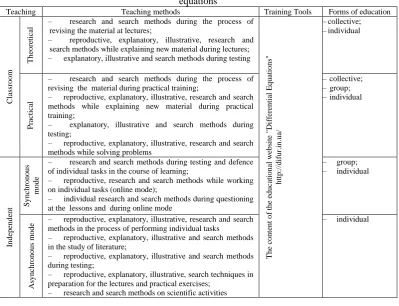
Creation of the concept is aimed at providing computer-based support methods of training IT Bachelors and forms of their activity during mastering DE. Interaction of methods and ways of learning through educational content of the site organizes classroom (theoretical and practical) sessions and self-management activities (synchronous and asynchronous learning) of students (tab. II).
Table II: Technology of teaching and professional work of students while studying differential equations
Teaching Teaching methods Training Tools Forms of education
C la ssr o o m Th eo re ti ca
l –revising the material at lectures; research and search methods during the process of
– reproductive, explanatory, illustrative, research and search methods while explaining new material during lectures; – explanatory, illustrative and search methods during testing
Th e co n te n t o f th e ed u ca ti o n al w eb si te " D if fe re n ti al E q u at io n s" h tt p :/ /d if u r. in .u a/ –collective; –individual P ra ct ic al
– research and search methods during the process of revising the material during practical training;
– reproductive, explanatory, illustrative, research and search methods while explaining new material during practical training;
– explanatory, illustrative and search methods during testing;
– reproductive, explanatory, illustrative, research and search methods while solving problems
–collective; –group; –individual In d ep en d en
t Sy
n ch ro n o u s mo d e
– research and search methods during testing and defence of individual tasks in the course of learning;
– reproductive, research and search methods while working on individual tasks (online mode);
– individual research and search methods during questioning at the lessons and during online mode
– group; – individual A sy n ch ro n o u s m o d
e – reproductive, explanatory, illustrative, research and search
methods in the process of performing individual tasks
– reproductive, explanatory, illustrative and search methods in the study of literature;
– reproductive, explanatory, illustrative and search methods during testing;
– reproductive, explanatory, illustrative, search techniques in preparation for the lectures and practical exercises;
– research and search methods on scientific activities
– individual
IV.
CONCLUSION
Computer-oriented methodical system provides methods of creating computer-oriented theoretical and practical teaching differential equations and methods of control of the self-activity of IT Bachelor. Development of these methods is the aim of our further research.
REFERENCES
[1]. Bas S. V. Formuvannia predmetnoi kompetentnosti u protsesi navchannia vyshchoi matematyky
studentiv ekonomichnykh spetsialnostei: dys….kand. ped. nauk: 13.00.02 «Teoriia ta metodyka navchannia (matematyka)» / Svitlana Vitaliivna Bas; Kryvorizkyi natsionalnyi universytet. – Kryvyi Rih, 2015. – 195 s.
[2]. Bondarenko Z. V. Metodyka navchannia informatsiinykh tekhnolohii rozv’iazuvannia dyferentsialnykh
rivnian u tekhnichnykh universytetakh : avtoref. dys….kand. ped. nauk 13.00.02 «Teoriia y metodyka navchannia (informatyka)» / Zlata Vasylivna Bondarenko; Natsionalnyi pedahohichnyi universytet im. M. P. Drahomanova. – Kyiv, 2010. – 22 s.
[3]. Vlasenko K. V. Komp’iuterno-oriientovani praktychni zaniattia iz dyferentsialnykh rivnian :
navchalno-metodychnyi posibnyk / K. V. Vlasenko, I. V. Sitak. – Kh. : Vydavnytstvo Lider, 2016. – 220 s.
[4]. Zakon Ukrainy «Pro vyshchu osvitu». [Elektronnyi resurs] Rezhym dostupu:
http://zakon5.rada.gov.ua/laws/show/2984-14 – Data zvernennia: 24.02.2016.
[5]. Kovalenko E. Je. Metodika professional'nogo obuchenija : uchebnik dlja inzhenerov-pedagogov,
[6]. Melecinek A. Inzhenernaja pedagogika / A. Melecinek. – M. : MADI (TU), 1998. – 185 s.
[7]. Mykhalin H. O. Profesiina pidhotovka vchytelia matematyky u protsesi navchannia matematychnoho
analizu : Monohrafiia / H. O. Mykhalin. – Kyiv : RNNTs «DINIT», 2003. – 320 s.
[8]. Motorina V. H. Innovatsiini pidkhody do navchannia matematyky : navch. posibnyk / V. H. Motorina.
– Kharkiv : KhNPU im. H. S. Skovorody, Skorpion, 2008. – 112 s.
[9]. Nakaz MON Ukrainy «Pro zatverdzhennia Polozhennia pro dystantsiine navchannia». – [Elektronnyi
resurs]. – Rezhym dostupu: http://zakon4.rada.gov.ua/laws/show/z0703-13 – Data zvernennia: 03.07.2015.
[10]. Nakaz MON Ukrainy «Pro pravyla vykorystannia komp’iuternykh prohram v navchalnykh zakladakh».
– [Elektronnyi resurs]. – Rezhym dostupu: http://zakon4.rada.gov.ua/laws/show/z0044-05 – Data zvernennia: 10.04.2015.
[11]. Sitak I. V. Dyferentsialni rivniannia [Elektronnyi resurs]. Rezhym dostupu: http://difur.in.ua/
[12]. Slovak K. I. Metodyka vykorystannia mobilnykh matematychnykh seredovyshch u protsesi navchannia
vyshchoi matematyky studentiv ekonomichnykh spetsialnostei : dys….kand. ped. nauk: 13.00.10 «Informatsiino-komunikatsiini tekhnolohii v osviti» / Kateryna Ivanivna Slovak; Instytut informatsiinykh tekhnolohii i zasobiv navchannia Natsionalnoi akademii pedahohichnykh nauk Ukrainy. – Kyiv, 2011. – 291 s.
[13]. Smirnov V. I. Kurs vysshej matematiki. Tom vtoroj / V. I. Smirnov. – M., Nauka, 1974. – 656 s.
[14]. Hol'kin A. M. Vysshaja matematika. Chast' ІІІ. Differencial'nye uravnenija. Rjady. Kratnye integraly:
Uchebnik / A. M. Hol'kin. – Mariupol' : PGTU, 2016. – 333 s.
[15]. Khom’iuk I. V. Interaktyvni tekhnolohii v protsesi formuvannia profesiinoi mobilnosti maibutnikh
inzheneriv [Elektronnyi resurs] / I. V. Khom’iuk // Nauchnыe yssledovanyia. Teoryia y praktyka.