IJIRT 144343
INTERNATIONAL JOURNAL OF INNOVATIVE RESEARCH IN TECHNOLOGY166
Analysis of MUSIC and Root MUSIC Algorithm for
DOA for implementation of 2D MIMO Radar Estimations
G Kishore Kumar
1and R. Narendra Reddy
31,2
Assistant Professor©, Dept. of ECE, University College of Engineering (A), Osmania University,
Telangana, India
Abstract—Radar is a device used to locate a target utilizing the parameters, velocity , distance from the radar, angle of Departure (AOD), perspective of Arrivals (AOA), Radar- cross- Coefficients (RCS), and many others. The conventional radars undergo from less parameter identiablity, much less resolution, non adaptive techniques and so on. MIMO proposal is a developing subject in wireless communication. It's described in research studies that”MIMO mean superiority”. If MIMO has exceptional purposes in wireless communications, why it isn't in radar conversation. This scheme, the algorithms used to estimate the target parameters , velocity, distance, AOA,AOD are implemented for both one dimensional array processing and two dimensional array processing. This paper analyzed the performance of MUSIC and B.Root MUSIC MUSIC DOA estimation algorithm on the uniform linear array (ULA) which are used in design of smart antenna system.
Index Terms—Direction of arrival (DOA), Smart Antenna system, MUSIC, Root MUSIC, Uniform Linear Array (ULA)
I. INTRODUCTION
The emerging motivation of input multiple-output (MIMO) radar has been the focus of intensive research [1]–[3]. Many researchers focussed their research on MIMO radar with extensively separated antennas exploiting on the spatial diversity of the target [2], [4], [5]. It has been shown within the literature that the aforementioned type of MIMO radar improves the target detection performance, enhances the ability to fight signal scintillation, and makes it possible for accurate parameter estimation of rapidly moving ambitions [4], [5]. Other researchers investigated MIMO radar based on colocated transmit/receive arrays and showed that the latter form of MIMO radar makes it possible for improving angular decision, increasing the higher limit on the number of detectable targets, improving parameter
identifiability, and extending the array aperture by means of digital sensors [3], [6]–[8].
Nonetheless, MIMO radar suffers from the lack of coherent transmit processing gain accordingly of omnidirectional transmission of orthogonal waveforms on the transmitter. A couple of strategies for transmit beam forming in MIMO radar with colocated transmit arrays were investigated within the literature [6]–[13]. The aforementioned ways have been developed within the context of one-dimensional transmit arrays. It has been proven in [8] that the performance of a MIMO radar approach with a number of waveforms less than the number of transmit antennas associated with making use of transmit beam forming acquire is best than the efficiency of a MIMO radar approach with full waveform diversity without a transmit beam forming gain. This reality turns into more evident in the case when the transmit array contains a large number of antennas, e.g., in the case of two-dimensional (2D) transmit arrays.
IJIRT 144343
INTERNATIONAL JOURNAL OF INNOVATIVE RESEARCH IN TECHNOLOGY167
consequence, the one limit we location on our set ofwaveforms is that they be orthogonal.
Smart Antennas used to establish the direction of arrival (DOA) of the signal that is required to trace and in finding the meant mobile set. Direction of arrival (DOA) estimation is the procedure of estimating the course of an incident signal from mobile devices to the base Transceiver Station. In this manner, sign-to-Interference and-Noise Ratio (SINR) improves through producing nulls alongside the path of interference. Accordingly direction of arrival for incident signals is an essential processing step in lots of sensors methods, i.e., radar, sonar, Measure electronic Surveillance (MSE), submarine acoustics, geodesic vicinity, optical interferometry, and many others.
II. LITERATURE SURVEY
MIMO which is a short time period of more than one enter and multiple output, is a thought technology in modern wireless conversation approach. MIMO, used to be introduced by way of Fisheler in Fishler et al. (2004) as new proposal in radar signal processing. It is tabulated in the be taught that there are fundamental variations between the conventional segment radars and MIMO radars. MIMO radars are exaggerated for its’ bigger efficiency for prime SNR. It is also famous that phased-array radars has rather better efficiency in low SNR. In the proposed proposal, the transmit factors emits orthogonal and independent waveform where as in usual phased radars the emitted wave changes phase co-related. The Cramer-Rao-Bound( CRF) is applied to show it’s dramatically enhancements inter of DF.
MIMO radars sophisticated advantage are illustrated in J. Li and Stoica (2007). A evaluation between the ordinary radar and MIMO radar has been finished making use of the causes parameter identifiablity, effective and adaptive beam forming, probing signal design. MIMO radars has decreased part-lobes in beam forming and it’s decision utilizing the CAPON and GIRT methods and increase within the detection performance of more than one targets.
Additional more J. Li et al. (2007) , proved that the parameter identiablity - the ability to identify the maximum targets over the phased-arrays making use of CRB manner. Moreover the superiority of MIMO
over its’ phased counter parts as a result of the wave form diversity.
The elemental works on detection performance of radar to different type was once performed in (Swerling, 1960) bu Peter Swerling. Four varieties of radar targets had been presented . Style 1, TypeII, TypeIII, TypeIV, TypeV. The more explanation about these model are in the introduction section David.M has elevated swerling goal items Chi-rectangular goal models in (Drumheller, 1994). A theoretical analysis is implemented in (Du et al., 2008) with the finite quantity of small scatters regarded and formulation has derived for the probability of detection efficiency of the MIMO radar. That was named as non time ingesting simulation.
(J. Li & Stoica, 2007) states that MIMO radar with co-located antennas implies huge superiority over it’s phased-array method , similar to elevated parameter identiablity , direct applicability of adaptive methods for parameter estimation as well as superior flexibility of transmit beam pattern designs. In a similar fashion (Haimovich, Blum et al. 2008) has observed generally separated antennas can be utilized to obtain a diversity gain for goal detection and for estimation of various parameter comparable to angle of arrival and Doppler. Both study advise that different configuration of antenna increase extraordinary features of radar. Nevertheless this study is thinking about patched antenna varieties for that reason propagates in two dimensional.
IJIRT 144343
INTERNATIONAL JOURNAL OF INNOVATIVE RESEARCH IN TECHNOLOGY168
1. Angle resolution, detecting higher number ofambitions, making improvements to parameter identiablity and extending array aperture
2. Using beam forming strategies at each the transmitting and receiving end effective design of overall beam pattern of the virtual array
3. Resolution and robustness against beam-shape loss
4. Improved robustness strong interference
Considerably like the above thought however with small one of a kind, in (Browning et al., 2009),used to be offered with identify hybrid phased-MIMO. Identical as the above, arrays are portioned into sub arrays and cub array configuration will also be modified but it's concluded that there are extra works needed to be performed because the quantity of open issues raised.
But in Hassanien and Vorobyov (2010), the certainly one of predicament upward thrust with hybrid-phased MIMO is solved, a decision matrix is introduced with steering vector to select subsets hence the configuration can also be transformed.
III. PROPOSED FRAMEWORK
The procedure used for estimating the direction of arrival (DOA) of radio indicators in wireless process has received gigantic awareness seeing that estimating the course of arrival of several radio signals impinging on an array of sensors is required in a type of different applications, together with radar, sonar and seismology[12-13].
DOA estimation utilising a constant antenna has many negative aspects akin to its resolution is confined by antenna’s primary lobe beam width [14].Antenna’s mainlobe beam width is inversely proportional to bodily dimension. Accordingly improving accuracy of perspective dimension by using increasing physical dimension of receiving antenna is just not at all times a practical solution. Certain techniques comparable to a missile seeker or aircraft antenna have bodily dimension challenge, as a consequence they furnish broad essential lobe beam width. So that decision is terrible. Instead of making use of a single antenna an array antenna procedure with revolutionary signal processing can increase the resolution of signal
DOA[15]. A array antenna has higher efficiency in sign reception and parameter estimation.
As proven in fig.1 DOA estimation is relies on many parameters similar to number of cell users, inter element spacing, quantity of indicators and spatial distribution. There are many exclusive tremendous resolution algorithms similar to spectral estimation, model founded and Eigen evaluation. In this paper we pay attention to estimation of DOA making use of tune (a couple of signal classification) algorithm.
Fig.1: Uniform linear array with M-Element
Consider, D signals which are incident on ULA and the received input data vector at M-elements that are separated by a distance d can be expressed as a linear combination of N incident waveforms and noise. The signal vector u (k) can be defined as
𝑢(𝑘) = ∑𝐷𝑙=1𝑎(𝑎𝜃1)𝑠1+ 𝑛(𝑘)………. (1)
𝑢(𝑘)[𝑎(𝑎𝜃1) … … 𝑎(𝑎𝜃𝐷) [𝑠𝑠1(𝑘)
𝐷(𝑘)] + 𝑛(𝑘) ……(2)
𝑢(𝑘) = 𝐴𝑠(𝑘) + 𝑛(𝑘) ……….. … (3) where 𝐴 = [𝑎𝜃1𝑎𝜃2… … … . . 𝑎𝜃𝐷] is the matrix
of steering vectors, 𝑠𝑇(𝑡) = [𝑠1(𝑘)𝑠2(𝑘) … … . . 𝑠𝐷(𝑘)] is the signal vectors and
𝑛(𝑡) = [𝑛1(𝑘)𝑛2(𝑘) … … . 𝑛𝐷(𝑘)] is a noise vector
with components of varience 𝜎𝑛2.
The input covariance matrix is given by
𝑅𝑢𝑢= 𝐴𝐸[𝑠𝑠𝐻]𝐴𝐻+ 𝐸[𝑛𝑛𝐻] ……….(4)
𝑅𝑢𝑢= 𝐴𝑅𝑠𝑠𝐴𝐻+ 𝜎𝑛2 ……… (5)
where 𝑅𝑠𝑠 is the signal correlation matrix.
A. Music algorithm
IJIRT 144343
INTERNATIONAL JOURNAL OF INNOVATIVE RESEARCH IN TECHNOLOGY169
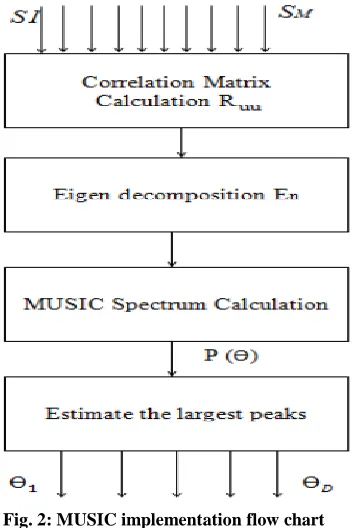
Fig. 2: MUSIC implementation flow chart
MUSIC deals with the decomposition of correlation matrix into two orthogonal matrices, signal-subspace and noise subspace [15]. Estimation of direction is performed from one of these subspaces, assuming that noise in each channel is highly uncorrelated [15]. This makes the correlation matrix diagonal [15]. The correlation matrix from equation (5) is
𝑅𝑢𝑢= 𝐴𝑅𝑠𝑠𝐴𝐻+ 𝜎𝑛2
Where H – “Hermitian” means conjugate transpose. The eigenvectors of the covariance matrix belong to either of the two orthogonal subspaces, signal subspace and the noise subspace. The array correlation matrix has M Eigen values ((𝜆1, 𝜆2, 𝜆3… … 𝜆𝑀) along
with M Eigenvectors (𝐸1, 𝐸2, … … . . 𝐸𝑀).
If the Eigen values are arranged in largest to smallest order, the next step is dividing the matrix E into two subspaces [ ]. is the noise subspace composed of M – D Eigenvectors associated with the noise and dimension of noise subspace is, while is 𝐸𝑆 is the
signal subspace composed of M Eigenvectors associated with the incoming signal. Due to the orthogonality of noise subspace and the array steering vector corresponding to signal components at the angles of arrival (𝜃1, 𝜃2, 𝜃3… 𝜃𝑀) the matrix product
𝑎𝐻(𝜃)𝐸
𝑁𝐸𝑁𝐻𝑎(𝜃)=0 corresponding to the DOA of a
multipath component. Then the DOAs of the multiple
incoming signals can be finding out by locating the peak of a MUSIC spatial spectrum given by
𝑃𝑀𝑈𝑆𝐼𝐶(𝜃) =𝑎𝐻(𝜃)𝐸𝑛1𝐸𝑛𝐻𝑎(𝜃)………..(6)
B. Root MUSIC
There are many different approaches has been found to modify MUSIC algorithm to increase the resolution of the angle estimation and decrease the computation complexity. The one accepted by many and used by many researchers is called Root-MUSIC which was developed by Barbell, which is based on the idea exploring the polynomial roots of linear spaced arrays. Signal space eigen vectors is used to define a rational spectrum function with improved resolution capability.
IV. CONCLUSION
This study just focus on implementing available AOA, AOD estimating algorithms and implementing newly proposed 2D Root MUSIC algorithm.values. MUSIC can estimate incoherent (uncorrelated) signal very well but it fails to detect correlated signals. Root MUSIC estimates accurate DOA of signal under coherent condition while MUSIC algorithm shows interference.
REFERENCES
[1] J. Li and P. Stoica, MIMO Radar Signal Processing. New Jersy: Wiley, 2009.
[2] A. Haimovich, R. Blum, and L. Cimini, “MIMO radar with widely separated antennas,” IEEE Signal Processing Magaz., vol. 25, pp. 116– 129, Jan. 2008.
[3] J. Li and P. Stoica, “MIMO radar with colocated antennas,” IEEE Signal Processing Magaz., vol. 24, pp. 106–114, Sept. 2007. [4] E. Fishler, A. Haimovich, R. Blum, L. Cimini,
D. Chizhik, and R. Valenzuela, “Spatial diversity in radarsModels and detection performance,” IEEE Trans. Signal Process., vol. 54, pp. 823–838, Mar. 2006.
IJIRT 144343
INTERNATIONAL JOURNAL OF INNOVATIVE RESEARCH IN TECHNOLOGY170
[6] A. Hassanien and S. A. Vorobyov,“Phased-MIMO radar: A tradeoff between phased-array and MIMO radars,” IEEE Trans. Signal Processing, vol. 58, no. 6, pp. 3137–3151, June 2010.
[7] D. Wilcox and M. Sellathurai, “On MIMO Radar Subarrayed Transmit Beamforming,” IEEE Trans. Signal Processing, vol. 60, no. 4, pp. 2076– 2081, Apr. 2012
[8] A. Hassanien and S. A. Vorobyov, “Transmit energy focusing for DOA estimation in MIMO radar with colocated antennas,” IEEE Trans. Signal Processing, vol. 59, no. 6, pp. 2669– 2682, June 2011.
[9] T. Aittomaki and V. Koivunen, “Beampattern optimization by minimization of quartic polynomial,” in Proc. 15 IEEE/SP Statist. Signal Process. Workshop, Cardiff, U.K., Sep. 2009, pp. 437-440.
[10] D. Fuhrmann and G. San Antonio, “Transmit beamforming for MIMO radar systems using signal cross-correlation,” IEEE Trans. Aerospace and Electronic Systems, vol. 44, no. 1, pp. 1–16, Jan. 2008.
[11] A. Hassanien and S. A. Vorobyov, “Direction finding for MIMO radar with colocated antennas using transmit beamspace preprocessing,” in Proc. IEEE Inter. Workshop Computational Advances in Multi-Sensor Adaptive Processing, Aruba, Dutch Antilles, Dec. 2009, pp. 181–184.6982.
[12] S.U.Pillai, Array Signal Processing, Springer-Verlag, 1989.
[13] M. Brandstein and D. Ward, Eds., Microphone Arrays, Springer, 2001.
[14] Marshall M.Grice, Direction of arrival estimation using superresolution algorithms.M Sc. Thesis, California State Polytechnic University, Pomona, 2007.