Volume 5, Issue 06[June 2016] PP: 57-62
Consultants’ Perspective on Factors Causing Construction Waste
Generation in Less Developed Regions
Aftab Hameed Memon
1, Mohsin Ali Soomro
2, Shadab Noor Bhangwar, Abdul
Hafeez Memon, Muhammad Usama Memon
Department of Civil Engineering, Quaid-e-Awam University of Engineering, Science and Technology, Nawabshah, Sindh, Pakistan
Abstract:-Waste generation issue in construction has attained an alarming situation globally, as it does not only affect the project success, but also creates an environmental problem. The interior regions of the Sindh, a province of Pakistan, are one of the least developed regions in the country. Due to its low economic development, the traditional construction methods dominates the local industry. In Sindh, now days a lot of development projects are under construction in which huge amount of construction material waste is disposed into the countryside lands. Suchexcessive generation of waste is a result of several reasons associated with different aspects of construction, which are compelling to acquire deeper knowledge for effective control of the waste. This paper has, therefore, focused on uncovering such underlying causes of waste generation through structured interviews of 28 experienced consulting engineers currently handling construction projects. The statistical software package for social scientists(SPSS)is then used to analyze responses to calculate frequency and mean rank value of the factors highlighted by the consulting engineers during the structured interviews. The results have revealed that the topmost factors responsible for construction waste generation are design errors, frequent design changes, the effect of weather, incompetent worker and equipment failure. The findings will help industrial practitioners in improving the performance of construction activities while working in less developed regions; so as to reduce construction waste. This research will also help academic researchers in better understanding of factors responsible for construction waster.
Keywords:-construction, waste generation, consultants’ perspective
I.
INTRODUCTION
Construction waste generation has globally attained an alarming situation, as it not only affects the success of a project, but also creates a drastic situation for the environment and all humanity. In comparison to rural areas, the amount of waste generation in urban areasis high[1]. The waste may be defined as something that is not considered valueless [2]. The waste may be a result of mistakes, working out of sequence, redundant activity and movement, delayed or premature inputs and products or services that do not meet customer needs [3]. The waste indulges environment, project cost, productivity, time, social and economy of the construction industry [4, 5]. In Thailand, yearly average waste generated from construction project was 1.1 million tomes and it contributed as 7.7% of the total waste generated countrywide [6]. Similarly, in the Shenzhen city of the South China waste generation was recorded as 3.275 to 8.791 kg/m2 [7]. In 2013 in South Korea, the waste generated in construction and demolition processes is recorded at about 50% of the total solid waste [8].
influence differently over the previously known factors responsible for the waste generation, and therefore, this research seeks to find the severity and significance of such factors with respect to the perception of consultants practicing in the Sindh province of Pakistan.
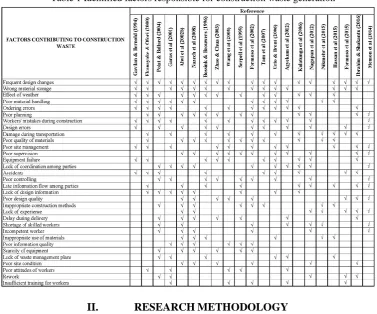
A comprehensive literature review is carried out that identified 32 common factors, which are then mapped in the table 1:
Table 1 Identified factors responsible for construction waste generation
II.
RESEARCH
METHODOLOGY
This study is based on structured interviews, in which identified factors are presented to the selected respondents from engineering consultant organizations practicing the Sindh province of Pakistan. The respondents are then asked to rate to a particular factor on a five point Likert scale. To maintain the consistency of the collected data, the respondents having minimum bachelors or diploma degree in the field of civil engineering are chosen. Statistical software package (SPSS) Version 20 [22] and Microsoft Excel program are then used for statistical analysis of the collected data.
III.
RESEARCH
FINDINGS
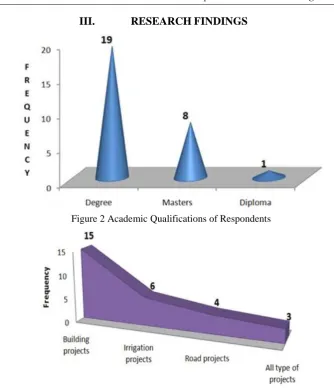
Figure 2 Academic Qualifications of Respondents
Figure 3 Types of the Projects Handled byRespondents
A) Validity of the consultants interviewed
Historically, all of the selected respondents have remained engaged with various consultant firms. All respondents, i.e., a total of twenty consultants, have demonstrated an experience of various types of construction projects in the Sindh of Pakistan.
Figure1 shows the working experience profile of the respondents in terms of years. Figure 2 illustrate the respondents‟ distribution with respect to their academic qualifications, while the figure 3 demonstrate their experience with the types of projects.
From figure 3, it is witnessed that the majority of the respondents with (i.e., 57.1%) have experienced handling of the construction project for more than 16 years. Which is then followed by 39.3% of the respondents having experience between 11 – 15 years of working. Only 1 respondent (i.e., 3.6%) of respondents have experience of lower than 10 years. Similarly, figure 2 and figure 3 reveals that all the respondents are well qualified, having obtained engineering and master degree and interacted with all types of civil engineering projects.
B) Consistency and Validity of the Data
Consistency and validity of the collected data is tested for its reliability. Cronbach‟s alpha statistics are used for this purpose, by using SPSS 20 [22]. The Cronbach's Alpha test yielded the value of 0.951, which is considered as an indicator of higher consistency [20].
C) Ranking of the Factors Causing Construction Waste Generation
the contractors complain about the errors and mistakes in the design provided at the time of contract award which are rectified slowly. Such errors occur due to a variety of reasons. For example, [13] identified “in-experienced designer” as one the main reasons causing design problems. The reference [14] has reported that Mistakes and errors in design are significant contributors of waste generation. Change in designs and variation order are the other reasons causing resulting in generation of waste material; especially when it is required to incorporated change or variation order at later project stages. The references [15] and [16] highlighted that waste generation during execution is directly related to the design process, specifically lack of design information leads to assumptions in calculating quantities of material, which may result in over ordering of materials [13].
After factors associated with design, the external factors are the most significant to create waste in construction project. Most dominant external factors is „weather condition‟, which is un-controllable in some cases. However, proper planning for prevailing seasonal conditions may be helpful in the reduction of waste. While sudden weather changes may be very dangerous and generate a huge amount of waste by indulging materials. Also, it affects the productivity of labor which causes wastage of time. The reference [18] also mentioned that inclement of weather is one of the important sources of waste generation. The reference [14] also mentioned that effect of weather is a dominant factor in causing waste generation.
Since, construction industry is a resource driven industry, hence performance of manpower and equipment plays a crucial role in effective use of material. For this, competency of labor is very vital for a better performance. Due to many development of works in the region, the availability of competent labor is shortened. Incompetent workers also mishandle equipment and material, which can cause damages and consequent generation of unnecessary waste. The reference [19] has mentioned that one of the source and cause factors of material waste is damage by subsequent trade. The reference [5] intimated that wastage of materials is directly affected by human behavior and poor attitude workers cause leftover materials on a site. Such wastage can be prevented by proper training of the workers deployed on the sites. Similarly, it is very essential to use proper and adequate equipment for work as well maintaining the equipment. If the equipment breakdown/fail, it can cause stoppage of the works and generate waste. Equipment malfunction is amongst the common source of waste generation [18]. Also, it is imperative to select proper equipment and it must be inspect before start of a project. Further, in adequate number of equipment may result in waiting times for performing certain operations resulting in wastage of time.
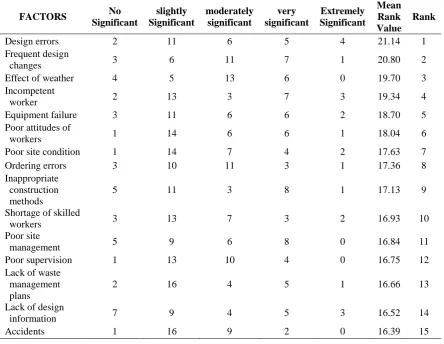
Table 2 Ranking of the Factors of Waste Generation
FACTORS No
Significant slightly Significant moderately significant very significant Extremely Significant Mean Rank Value Rank
Design errors 2 11 6 5 4 21.14 1
Frequent design
changes 3 6 11 7 1 20.80 2
Effect of weather 4 5 13 6 0 19.70 3 Incompetent
worker 2 13 3 7 3 19.34 4
Equipment failure 3 11 6 6 2 18.70 5 Poor attitudes of
workers 1 14 6 6 1 18.04 6
Poor site condition 1 14 7 4 2 17.63 7 Ordering errors 3 10 11 3 1 17.36 8 Inappropriate
construction methods
5 11 3 8 1 17.13 9
Shortage of skilled
workers 3 13 7 3 2 16.93 10
Poor site
management 5 9 6 8 0 16.84 11
Poor supervision 1 13 10 4 0 16.75 12 Lack of waste
management plans
2 16 4 5 1 16.66 13
Lack of design
information 7 9 4 5 3 16.52 14
FACTORS No Significant slightly Significant moderately significant very significant Extremely Significant Mean Rank Value Rank Lack of coordination among parties
4 11 7 5 1 16.25 16
Late information flow among parties
7 7 7 6 1 16.18 17
Poor controlling 4 11 10 2 1 16.14 18 Poor planning 3 12 10 1 2 16.14 18 Insufficient
training for workers
4 15 3 3 3 16.07 19
Workers' mistakes during
construction
4 10 10 4 0 15.89 20
Lack of
experience 5 11 6 5 1 15.84 21
Poor design
quality 5 10 8 5 0 15.63 22
Rework 3 14 7 2 2 15.34 23
Delay during
delivery 4 11 11 1 1 15.07 24
Inappropriate use
of materials 4 14 6 2 2 15.04 25
Poor quality of
materials 5 13 6 2 2 14.61 26
Wrong material
storage 7 11 4 4 2 14.59 27
Poor information
quality 6 11 7 4 0 14.02 28
Damage during
transportation 4 14 8 2 0 13.95 29 Scarcity of
equipment 8 10 4 4 2 13.88 30
Poor material
handling 6 15 2 4 1 13.46 31
IV.
CONCLUSION
This study has investigated the significance level of factors causing generation of construction waste. The significance is evaluated through structured interviews from experienced engineers engaged in consultant organization; and currently are involved in handling the execution works on site. Statistical analysis of collected responses is then performed to examine the frequency of ratings for each factor and then to develop their rank based on Kendell‟s W statistics. The findings have revealed that the top factors causing waste generation in construction projects of Sindh province are associated with design errors, frequent design changes, the effect of weather, incompetent worker and equipment failure.
REFERENCES
[1] Nazech, E. M., Zaldi, D., & Trigunarsyah, B. Identification of construction waste in road & highway construction projects.Proceedings Eleventh East Asia-Pacific Conference on Structural Engineering and Construction (EASEC-11). 2008,pp. 1–7.
[2] Garas GL, Anis AR, El Gammal A. Materials waste in the Egyptian construction industry. Proceedings IGLC-9, Singapore. 2001 Aug.
[4] Osmani, M. Construction waste minimization in the UK: Current pressures for change and approaches. Procedia - Social and Behavioral Sciences 2012,40, 37–40.
[5] Wang, J.-Y., Kang, X.-P., & Tam, V. W.-Y. An investigation of construction wastes: an empirical study in Shenzhen. Journal of Engineering, Design and Technology, 2008, 6(3), 227–236.
[6] Kofoworola, O. F., & Gheewala, S. H. Estimation of construction waste generation and management in Thailand. Waste management (New York, N.Y.), 2009, 29(2), 731–8.
[7] Lu, W., & Yuan, H. A framework for understanding waste management studies in construction. Waste management (New York, N.Y.), 2011, 31(6), 1252–60.
[8] Won, J., Cheng, J. C. P and Lee, G. “Quantification of construction waste prevented by BIM-based design validation: Case studies in South Korea”, Waste Management, 2016, Vol. 49, pp. 170–180 [9] Formoso, C., Bølviken, T., Rooke, J. and Koskela, L.. A conceptual framework for the prescriptive
Causal analysis of construction waste. In: Proc. 23rd Ann. Conf. of the Int‟l. Group forLean Construction. Perth, Australia, July 29-31, 2015, pp. 454-462, available at www.iglc.net
[10] Hassan, S. H., Ahzahar, N., Fauzi, M. A., & Eman, J. Waste management issues in the Northern Region of Malaysia. Procedia - Social and Behavioral Sciences, 2012, 42, 175–181.
[11] Nagapan, S., Rahman, I. A., Asmi, A., Hameed, A., & Zin, R. M. Identifying Causes of Construction Waste - Case of Central Region of Peninsula Malaysia. International Journal of Integrated Engineering, 2012, 4(2), 22–28.
[12] Memon, N. A, Laghari, M. A. and Memon, F. A. Factors Contributing to the Waste Generation in Building Projects of Pakistan”, Mehran University Research Journal of Engineering & Technology, 2016, Volume 35, No. 1, pp. 95-100
[13] Osmani, M., Glass, J., & Price, A. D. F. Architects‟ perspectives on construction waste reduction by design. Waste Management, 2008, 28(7), 1147–1158.
[14] Nagapan, S., Rahman, I. A., & Asmi, A. Factors Contributing to Physical and Non-Physical Waste Generation in Construction Industry. International Journal of Advances in Applied Sciences (IJAAS), 2012, 1(1), 1–10.
[15] Panos, K., & Danai, G. I. Survey regarding control and reduction of construction waste. PLEA2012 - 28th Conference, Opportunities, Limits & Needs Towards an environmentally responsible architecture Lima, Perú. 2012.
[16] Faniran, O. O., and Caban, G. Minimizing waste on Construction Project Sites”, Engineering, Construction and Architectural Management, 1998, Vol. 5, Issue 2, pp. 182-188
[17] Ekanayake, L. L., & Ofori, G. Building waste assessment score: Design-Based Tool. Building and Environment, 2004, 39(7), 851–861.
[18] Urio, A. F., & Brent, A. C. Solid waste management strategy in Botswana : The reduction of construction waste. Journal of the South African Institution of Civil Engineering, 2006, 48(2), 18–22.
[19] Zhang, X. and Ali Soomro, M. Failure Path Analysis with Respect to Private Sector Partners in Transportation Public-Private Partnerships. 2015. Journal of Management in Engineering 10.1061/(ASCE)ME.1943-5479.0000384, 04015031.
[20] Siegel S and Castellan Jr. N.J. Nonparametric Statistics for the Behavioral Sciences (1988) International Edition. McGraw-Hill Book Company New York. ISBN 0-07-057357-3 p. 262-272