Open Access
Review
Biliary atresia
Christophe Chardot*
Address: Service de chirurgie pédiatrique, Hôpital Cantonal Universitaire de Genève, Rue Willi Donzé 6, CH 1205 Geneve, Switzerland
Email: Christophe Chardot* - [email protected] * Corresponding author
Abstract
Biliary atresia (BA) is a rare disease characterised by a biliary obstruction of unknown origin that presents in the neonatal period. It is the most frequent surgical cause of cholestatic jaundice in this age group. BA occurs in approximately 1/18,000 live births in Western Europe. In the world, the reported incidence varies from 5/100,000 to 32/100,000 live births, and is highest in Asia and the Pacific region. Females are affected slightly more often than males. The common histopathological picture is one of inflammatory damage to the intra- and extrahepatic bile ducts with sclerosis and narrowing or even obliteration of the biliary tree. Untreated, this condition leads to cirrhosis and death within the first years of life. BA is not known to be a hereditary condition. No primary medical treatment is relevant for the management of BA. Once BA suspected, surgical intervention (Kasai portoenterostomy) should be performed as soon as possible as operations performed early in life is more likely to be successful. Liver transplantation may be needed later if the Kasai operation fails to restore the biliary flow or if cirrhotic complications occur. At present, approximately 90% of BA patients survive and the majority have normal quality of life.
Disease name
Biliary atresia
Definition
Biliary atresia (BA) is a rare disease characterised by a bil-iary obstruction of unknown origin that presents in the neonatal period [1].
Background
BA is the most frequent surgical cause of cholestatic jaun-dice in neonates. The common histopathological picture is one of inflammatory damage to the intra- and extrahe-patic bile ducts with sclerosis and narrowing or even oblit-eration of the biliary tree [2]. Untreated, this condition leads to cirrhosis and death within the first years of life. Surgical treatment usually involves an initial attempt to restore bile flow: the Kasai portoenterostomy [3], which is
performed as soon after diagnosis as possible. Later, liver transplantation may be needed if the Kasai operation fails to restore the biliary flow or if cirrhosis complications occur [4]. BA remains the most common indication for paediatric liver transplantation worldwide.
Epidemiology
The reported incidence of BA varies from 5/100,000 live births in The Netherlands [5], 5.1/100,000 in France [6], 6/100,000 in the British Isles [7], 6.5/100,000 in Texas [8], 7/100,000 in Victoria Australia [9], 7.4/100,000 in Atlanta USA [10] and in Japan [11], 10.6/100,000 in Hawaii [12], to 32/100,000 in French Polynesia [13]. Inci-dence of BA is highest in Asia and the Pacific region. Females are affected slightly more often than males. Although some studies of time- and space-time distribu-tion of BA cases have suggested seasonal variadistribu-tion and
Published: 26 July 2006
Orphanet Journal of Rare Diseases 2006, 1:28 doi:10.1186/1750-1172-1-28
Received: 06 June 2006 Accepted: 26 July 2006
This article is available from: http://www.OJRD.com/content/1/1/28
© 2006 Chardot; licensee BioMed Central Ltd.
clustering of cases [8-10], these results have not been con-firmed by larger studies [5,6], [14,15].
Anatomical forms
Two different forms of BA have been identified [16]:
• Syndromic BA (~10%), associated with various congen-ital anomalies such as polysplenia, asplenia, cardiac or intra abdominal defects (situs inversus, pre-duodenal por-tal vein, absence of retro-hepatic inferior vena cava, intes-tinal malrotation).
• Non-syndromic BA (~90%), in which BA is an isolated anomaly.
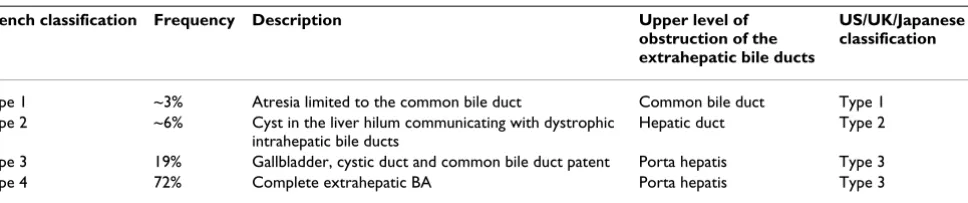
Several surgical classifications of BA have been proposed. The French classification is based on the anatomical pat-tern of the extrahepatic biliary tract remnant (Table 1) [17,18].
Aetiology
The aetiology of BA remains unknown. Some cases seem to be related to abnormal morphogenesis of bile ducts occurring early in gestation, while others appear to arise from later damage to normally developing bile ducts.
There are several strands of evidence to suggest that even in non-syndromic BA, the onset takes place early in gesta-tion. Antenatal ultrasonography allows detection of those forms of BA that show cystic changes [19]. In a series of 10 infants detected antenatally, most were non-syndromic and the first abnormal scans were observed at about 20 weeks of gestation [20]. In one study on serial digestive enzyme sampling in amniotic fluid, gamma-glutamyl transpeptidase (gamma-GTs) levels were found signifi-cantly low as early as 18 weeks of gestation in infants born with non-syndromic BA, providing strong evidence of bil-iary obstruction at this term of gestation [21].
Human embryo studies have also revealed similarities between the appearance of developing bile ducts during the first trimester of pregnancy and the residual ductules seen at porta hepatis level in BA patients; thus, it was sug-gested that some cases of BA may result from alteration of
the remodelling process of the bile ducts originating from the ductal plate membrane [22]. The persistence of prim-itive foetal-type bile ducts that leak bile into surrounding tissues and induce a secondary inflammatory reaction in utero has also been suggested. Recent studies have focused on normal and altered bile duct morphogenesis [23,24] and the initiation of hepatic fibrosis [25].
The role of viruses has been extensively studied. An asso-ciation of BA with cytomegalovirus [26,27], respiratory syncitial virus [28], Epstein-Barr virus [29] and human papilloma virus [30] has been reported. In contrast, no association with hepatitis A, B and C viruses has been found [31,32]. Reovirus type 3 can cause cholangitis resembling BA in mice [33] and may be associated with spontaneous BA in the rhesus monkey [34]. In human neonates, the association of reovirus type 3 and BA has been suggested in several studies [35-38] but not sup-ported in others [39-41]. Rotavirus type A can cause bil-iary obstruction in newborn mice, mimicking BA [42]; deleterious effects of rotavirus infection in mice can be prevented by interferon alpha [43]. In humans, the role of rotavirus type C in the aetiology of BA remains controver-sial [44,45].
Several observations suggest that a genetic component plays a role in the pathogenesis of BA, although this is probably only one of multiple factors. Familial cases of BA have been reported [46-50] although discordant sets of monozygotic twins have also been observed [51-53]. Var-iations in the incidence of BA among different races have been reported from Hawaii [12] and Atlanta, USA [10]. The incidence of HLA B12 and haplotypes A9-B5 and A28-B35 was found to be higher in infants with BA com-pared to a control group in one UK study [54].
Clinical features
After birth, the clinical triad of BA is:
• Jaundice (conjugated hyperbilirubinemia lasting beyond two weeks of life)
• Acholic (white) stools and dark urine (Figure 1)
Table 1: Anatomical types of biliary atresia (BA)
French classification Frequency Description Upper level of obstruction of the extrahepatic bile ducts
US/UK/Japanese classification
Type 1 ~3% Atresia limited to the common bile duct Common bile duct Type 1 Type 2 ~6% Cyst in the liver hilum communicating with dystrophic
intrahepatic bile ducts
Hepatic duct Type 2
• Hepatomegaly
The general condition of the child is usually good. There is no failure to thrive, at least in the first months. Thereaf-ter, weight loss and irritability develop, accompanied by increasing levels of jaundice. Later signs include splenom-egaly (suggesting portal hypertension), ascites and haem-orrhage (which can be intracranial, gastrointestinal or from the umbilical stump) due to impaired absorption of vitamin K. Untreated, this condition leads to cirrhosis and death within the first years of life.
Diagnosis and diagnostic methods
Since early diagnosis appears essential for effective surgi-cal treatment [17,18], [55-57], every case of neonatal jaundice lasting more than two weeks should be investi-gated and biliary atresia actively excluded [58,59]. Diag-nosis is made on the basis of the clinical manifestations and is supported by the following diagnostic methods:
• Ultrasonography
Ultrasonography of the liver is performed after 12 hours of fasting (with an IV dextrose infusion). BA is suspected when the gallbladder is shrunk despite fasting, when the liver hilum appears hyperechogenic ("triangular cord sign") or when there is a cyst at the liver hilum. There should be no evidence of bile duct dilatation. Syndromic BA infants may show other features such as multiple spleens, preduodenal portal vein, absence of retrohepatic vena cava or abdominal situs inversus.
• Cholangiography
When the gallbladder seems normal on ultrasonography scans, cholangiography is needed to assess the morphol-ogy and patency of the biliary tree. A cholangiogram can be obtained percutaneously (puncture of the gallbladder), endoscopically (ERCP) or at operation.
• Liver biopsy
The main histological features suggestive of BA are bile plugs, ductular proliferation, portal oedema and/or fibro-sis. As with any other cause of neonatal cholestasis, giant cell transformation may be observed.
• Others
Biochemical liver function tests show cholestasis (with elevated cholesterol and gamma-GTs). Hepatobiliary scintigraphy (e.g. HIDA scans) demonstrates a failure of excretion of the radioisotope into the intestine, but this feature can also be observed in any severe neonatal cholestasis [60].
Differential diagnosis
Medical causes of neonatal cholestasis must be excluded. The main differential diagnose are: Alagille syndrome, sclerosing cholangitis with neonatal onset, alpha-1-antit-rypsin deficiency, cystic fibrosis, and more rarely progres-sive familial intrahepatic cholestasis (PFIC).
In most cases, diagnosis of BA can be strongly suspected after consideration of the clinical features, ultrasonogra-phy scans and exclusion of the main medical causes of neonatal cholestasis. Cholangiography and/or liver biopsy are indicated only in cases where the diagnosis remains uncertain, especially when the gallbladder seems normal on ultrasonography scans [61,62].
Antenatal diagnosis
Antenatal diagnosis of BA remains exceptional. BA Types 1 and 2, which are rare, can be suspected on antenatal ultrasonography scans when a cystic structure is detected in the liver hilum [19,63]. Postnatal examination has to distinguish the cystic form of BA, which requires urgent surgery, from a choledocal cyst for which surgery may be delayed.
Non-visualization of the foetal gallbladder in early preg-nancy (14–16 weeks gestation) may be associated with severe foetal anomalies, including polymalformation syn-dromes, chromosomal aberrations, cystic fibrosis [64]: amniocentesis is recommended for cystic fibrosis screen-ing, hepatic enzymes tests and chromosomal analysis. Gallbladder may be visualised later in pregnancy, suggest-ing a delay in its recanalisation process. When the gall-bladder remains undetectable after birth, the possibility that the patient has BA has to be carefully investigated.
Acholic white stools
Figure 1
The incidence of agenesis of the gallbladder (without BA) is estimated at approximately 1/6000 pregnancies [64].
Features of polysplenia syndrome may be detected by antenatal ultrasonography. They may be part of a cardios-plenic syndrome whose prognosis depends mainly on the underlying cardiopathy [65,66]. Interrupted inferior vena cava may be isolated and benign [67]. However, neonates with features of the polysplenia syndrome should be care-fully followed in order to rule out BA.
Management
The current management of BA patients involves two steps:
• Kasai operation (in the neonatal period), which aims to restore bile flow.
• Liver transplantation in children for whom the Kasai operation has failed in its primary aim or for whom com-plications of biliary cirrhosis have supervened.
• The Kasai operation: hepatoporto-enterostomy
After transverse supra-umbilical incision and laparotomy, diagnosis is confirmed by inspection of the liver and bil-iary tract. In most cases (type 4: complete extrahepatic BA), diagnosis is obvious with a cholestatic or fibrotic liver and a shrunken fibrotic gallbladder (Figure 2). If the gallbladder is still patent or if there is a cyst at the liver hilum, the colour of their content is noted and cholangi-ography is performed. Features of polysplenia syndrome, as well as any other intra-abdominal anomaly, are noted. The portal pressure can be measured through a small cath-eter introduced via the umbilical vein. After section of the falciform, left and right triangular ligaments, the liver is
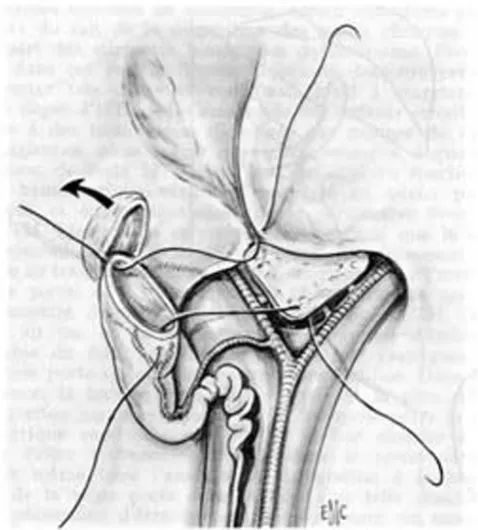
exteriorised out of the abdominal cavity. The entire extra-hepatic biliary tree is excised together with the fibrous tis-sue occupying the space between the left and right branches of the portal vein at the level of the porta hepa-tis. A 45 cm Roux-en-Y loop is prepared and passed through the mesocolon to the liver hilum. An anastomo-sis is fashioned between the cut edge of the transsected tis-sue in the porta hepatis and the antimesenteric side of the Roux loop (Figure 3). A liver biopsy is performed.
Many technical variants are possible, according to the ana-tomical pattern of the biliary remnant:
• Type 1 BA: cholecysto-enterostomy, or hepatico-enteros-tomy.
• Type 2 BA: cysto-enterostomy. This operation can be performed only if the hilar cyst communicates with the dystrophic intrahepatic bile ducts (as shown at cholangi-ography).
• Type 3 BA: hepatoporto-cholecystostomy. The patent galbladder, cystic duct and common bile duct are pre-served. The gallbladder is mobilised with preservation of its pedicle. An anastomosis is performed between the gall-bladder and the transsected tissue in the porta hepatis (Figure 4). Since there is no direct contact between the porta hepatis and the intestine, this operation reduces the risk of post-operative cholangitis [57]. Its specific compli-cations, however, are bile leaks and post-operative biliary
Hepatoporto-enterostomy (Kasai procedure) [68]*
Figure 3
Hepatoporto-enterostomy (Kasai procedure) [68]*. * Valayer J, Chardot C: Atrésie des voies biliaires. Encycl Méd Chir (Elsevier SAS, Paris, All rights reserved), Techniques chirurgicales – appareil digestif (40–890); 2002: p. 12. Repro-duction authorized by Elsevier Masson SAS.
Operative view of complete extrahepatic biliary atresia
Figure 2
ascites caused by kinking and obstruction of the cystic duct and the common bile duct [69-71].
• Post-operative course
Post-operatively, different drugs have been proposed either for reducing the inflammatory process at the liver hilum, which might lead to granulation and fibrous scar obstructing the biliary ductules, or for increasing the bil-iary flow. Although recommended by several surgeons [72-74], the use of corticosteroids remains controversial since their long-term benefit has not been proven; in addi-tion there is a theoretical risk of exacerbating cholangitis. During the evaluation phase of biliary atresia, the infant's diet typically is not changed; post-operative breastfeeding is encouraged when possible, but an energetic supplemen-tation may be required to obtain a 150 to 180 Kcal/kg/day intake. As long as cholestasis persists, supplementation in fat-soluble vitamins (ADEK) is needed.
Outcome after successful Kasai operation
If the Kasai operation succeeds in restoring bile flow, the stools become coloured and jaundice fades. This process may last several weeks or months. The evolution of the
biliary cirrhosis is prevented or at least delayed; survival with the native liver has been reported up to adulthood (Figure 5) [75,76].
The most common complications following the Kasai procedure include:
• Cholangitis
Direct communication of the intestine with the dys-trophic intrahepatic bile ducts, together with poor bile flow, can cause an ascending bacterial cholangitis. This occurs particularly in the first weeks or months after the Kasai procedure in 30%-60% of cases [77,78]. This infec-tion may be severe and sometimes fulminant. There are signs of sepsis (fever or hypothermia, impaired haemody-namic status), recurrent jaundice, acholic stools and per-haps abdominal pain. Diagnosis can be confirmed by analysis of blood cultures and/or liver biopsies [78]. Treatment requires IV antibiotics and effective IV resusci-tation. In the cases with recurrent and/or late cholangitis, obstruction of the Roux en Y loop or persisting colonisa-tion of intrabiliary cyst should be considered. Recurrent cholangitis without a "surgical" cause may require contin-uous antibiotic prophylaxis.
• Portal hypertension
Portal hypertension occurs in at least two-thirds of the children after porto-enterostomy [79,80], even in those with complete restoration of bile flow. The most common sites of varices include the oesophagus, stomach, Roux loop and anorectum. If the Kasai operation has clearly
Survival with native liver of 271 infants who underwent Kasai operation for biliary atresia between 1968 and 1983 at Bicê-tre hospital (Paris) [75]*
Figure 5
Survival with native liver of 271 infants who underwent Kasai operation for biliary atresia between 1968 and 1983 at Bicê-tre hospital (Paris) [75]*. * Lykavieris P, Chardot C, Sokhn M, Gauthier F, Valayer J, Bernard O: Outcome in adulthood of biliary atresia: a study of 63 patients who survived for over 20 years with their native liver. Hepatology 2005, 41: p. 367. Reproduction authorized by John Wiley and Sons, Inc.
0 ,2 ,4 ,6 ,8 1
0 5 10 15 20 25 30 35 40 Survival w ith native liver
Age (years)
271 108 85 66 63 21 5 1 Number of patients
Hepatoporto-cholecystostomy [68]*
Figure 4
failed and the patient displays poor biochemical liver function and persisting jaundice, then liver transplanta-tion is indicated. However, variceal sclerotherapy or band ligation before liver replacement may be necessary. In those cases with good liver function and absence of jaun-dice, endoscopic therapy may be the only treatment nec-essary [81,82]. Transjugular intrahepatic portosystemic shunts (TIPS) are rarely used for this indication due to the young age of the patients, the frequently observed hypo-plasia of the portal vein and the possible development of intrahepatic biliary cavities [83]. Surgical portosystemic shunts are nowadays rarely indicated, especially when transplantation is available, but should be considered when there is a normal liver function, non-progressive liver disease and life-threatening varices [84]. Severe hypersplenism may exceptionally require splenic artery embolisation [85].
• Hepatopulmonary syndrome and pulmonary hypertension
Similarly to patients with other causes of spontaneous (cirrhosis or prehepatic portal hypertension) or acquired (surgical) portosystemic shunts, pulmonary arteriov-enous shunts may occur even after complete clearance of jaundice (hepatopulmonary syndrome). Gut-derived vasoactive substances that are not cleared by the liver (due to the portosystemic shunts) may be responsible for this complication. Typically, hepatopulmonary syndrome causes hypoxia, cyanosis, dyspnoea and digital clubbing. Diagnosis is confirmed by pulmonary scintigraphy. Pul-monary hypertension can occur in cirrhotic children and may provoke syncope or even sudden death. Diagnosis of pulmonary hypertension is suggested by echocardiogra-phy. Liver transplantation reverses pulmonary shunts [86] and can reverse pulmonary hypertension (especially when diagnosed at an early stage) [87].
• Intrahepatic biliary cavities
Large intrahepatic biliary cysts may develop several months to years after the Kasai operation, even in patients with complete clearance of jaundice. These cavities may become infected and/or may compress the portal vein, requiring external drainage. Cystoenterostomy [88] or liver transplantation may eventually be required.
• Malignancies
Hepatocarcinomas, hepatoblastomas [89] and cholangi-ocarcinomas [90] have been described in the cirrhotic liv-ers of patients with BA, in childhood or adulthood. Screening for malignancy has to be performed regularly in the follow-up of patients who underwent a successful Kasai operation.
Outcome after unsuccessful Kasai operation
If the Kasai operation fails to restore the bile flow, biliary cirrhosis progresses and necessitates liver transplantation. This is usually performed in the second year of life but may be necessary earlier (from 6 months of life) when there is a rapid aggravation of the liver disease. BA repre-sents more than half of the indications for liver transplan-tation in childhood. Transplantransplan-tation may also be required in those cases where recurrence of jaundice (secondary failure of the Kasai operation) or complications of
cirrho-sis (e.g. hepatopulmonary syndrome) occur despite an
initially successful outcome after the Kasai operation.
There are two sources of liver grafts:
• Cadaveric donor: the graft is rarely a full size liver taken from a size-matched paediatric donor. More commonly, the graft consists of a left lobe (segments 2+3) or a left liver (2+3+4) obtained after reduction or splitting of an adult liver graft.
• Living-related donor: usually from one of the parents of the child.
Currently, patient survival at 5 and 10 years after liver transplantation is more than 80% [91-94]. In most cases, the quality of life of the transplanted patient is close to normal. Normal somatic growth pattern and physical, sexual and intellectual maturity are usually achieved [95-97].
Overall outcome of BA patients
The overall prognosis of BA patients has improved since the early days of paediatric liver transplantation. Nowa-days about 90% of BA patients may hope to survive (Table 2), with a normal quality of life for most of them.
Table 2: Current prognosis of BA in France and the United Kingdom.
France 1997–2002 (271 patients) UK 1999–2002 (148 patients) [98]
Overall 4-year patient survival 87% 89%
4-year survival with native liver after Kasai operation
43% 51%
Several prognostic factors have been identified in BA patients. Some of them are related to characteristics of the disease (and cannot be altered): the prognosis of the Kasai operation is worse when BA is associated with a polysple-nia syndrome [17,18,99]; when macroscopic obstructive lesions of extra-hepatic biliary remnant are diffuse (prog-nosis worsens from type 1 to type 4) [17,55-57]; when his-tological obliteration of the bile ducts (especially at porta hepatis) is more severe [100,101]; and when liver fibrosis is more extensive at time of the Kasai operation (102– 107). Other prognostic factors are related to the manage-ment of BA patients and can be improved:
• the chances of success of the Kasai operation decrease when the age at Kasai operation increases [17,55,57,59]. It is, therefore, very important to diagnose BA early.
• accessibility to liver transplantation [108]: the mortality while waiting for a liver graft has recently decreased due to the development of surgical techniques that increase the availability of liver grafts: liver graft splitting [109], living related liver donation [110].
• experience of the centre managing BA patients [7,17,111]. This point led the British health authorities to centralise all BA patients from England and Wales in three paediatric liver units [98]. In France, a collaborative policy between centres was promoted and a national observatory of BA was created, in order to standardize therapeutic results nationwide and evaluate the results of this decen-tralized management.
Conclusion
With the sequential treatment including the Kasai opera-tion in the first weeks of life and, in case of failure of this procedure, secondary liver transplantation, 90% of patients with BA can nowadays survive, with a normal quality of life for most of them. Early diagnosis and treat-ment by an experienced team provides children with the best chance of survival.
Links
French Observatory of Biliary Atresia: http:// www.orpha.net/nestasso/OFAVB
European Federation for Biliary Atresia Research: http:// www.orpha.net/nestasso/EFBAR
European Biliary Atresia Registry: http://www.biliary-atresia.com
Biliary Atresia Research Consortium: http://www.barcnet work.org
Acknowledgements
To paediatricians and surgeons of the 45 centres participating in the studies of the French Observatory of Biliary Atresia.
References
1. Alagille D: Extrahepatic biliary atresia. Hepatology 1984, 4(1 Suppl):7S-10S.
2. Gautier M, Eliot N: Extrahepatic biliary atresia. Morphological study of 98 biliary remnants. Arch Pathol Lab Med 1981,
105:397-402.
3. Kasai M, Kimura S, Asakura Y, Suzuki Y, Taira Y, Obashi E: Surgical treatment of biliary atresia. J Pediatr Surg 1968, 3:665-675. 4. Otte JB, de Ville de Goyet J, Reding R, Hausleithner V, Sokal E,
Char-dot C, Debande B: Sequential treatment of biliary atresia with Kasai portoenterostomy and liver transplantation: a review.
Hepatology 1994, 20(1 Pt 2):41S-48S.
5. Houwen RH, Kerremans I, van Steensel-Moll HA, van Romunde LK, Bijleveld CM, Schweizer P: Time-space distribution of extrahe-patic biliary atresia in The Netherlands and West Germany.
Z Kinderchir 1988, 43:68-71.
6. Chardot C, Carton M, Spire-Bendelac N, Le Pommelet C, Golmard JL, Auvert B: Epidemiology of biliary atresia in France: a national study 1986–96. J Hepatol 1999, 31:1006-1013.
7. McKiernan PJ, Baker AJ, Kelly DA: The frequency and outcome of biliary atresia in the UK and Ireland. Lancet 2000, 355:25-29. 8. Strickland AD, Shannon K: Studies in the etiology of extrahe-patic biliary atresia: time-space clustering. J Pediatr 1982,
100:749-753.
9. Danks DM, Campbell PE, Jack I, Rogers J, Smith AL: Studies of the aetiology of neonatal hepatitis and biliary atresia. Arch Dis Child 1977, 52:360-367.
10. Yoon PW, Bresee JS, Olney RS, James LM, Khoury MJ: Epidemiol-ogy of biliary atresia: a population-based study. Pediatrics 1997,
99:376-382.
11. Chiba T, Ohi R, Kamiyama T, Nio M, Ibrahim M: Japanese biliary atresia registry. In Biliary atresia Edited by: Ohi R. Tokyo (Japan): ICOM Associates; 1991:79-86.
12. Shim WK, Kasai M, Spence MA: Racial influence on the incidence of biliary atresia. Prog Pediatr Surg 1974, 6:53-62.
13. Vic P, Gestas P, Mallet EC, Arnaud JP: Atrésie des voies biliaires en Polynésie française. Etude rétrospective de 10 ans. Arch Pediatr 1994, 1:646-651.
14. Ayas MF, Hillemeier AC, Olson AD: Lack of evidence for seasonal variation in extrahepatic biliary atresia during infancy. J Clin Gastroenterol 1996, 22:292-294.
15. Davenport M, Dhawan A: Epidemiologic study of infants with biliary atresia. Pediatrics 1998, 101:729-230.
16. Howard ER: Biliary atresia. In Pediatric surgery and urology: long term outcomes Edited by: Stringer MD, Oldham KT, Mouriquand PDE, Howard ER. London: WB Saunders; 1998:402-416.
17. Chardot C, Carton M, Spire-Bendelac N, Le Pommelet C, Golmard JL, Auvert B: Prognosis of biliary atresia in the era of liver transplantation: French national study from 1986 to 1996.
Hepatology 1999, 30:606-611.
18. Gauthier F, Luciani JL, Chardot C, Branchereau S, de Dreuzy O, Lab-abidi A, Montupet P, Dubousset AM, Huault G, Bernard O, Valayer J:
Determinants of life span after Kasai operation at the era of liver transplantation. Tohoku J Exp Med 1997, 181:97-107. 19. Brunero M, De Dreuzy O, Herrera JM, Gauthier F, Valayer L:
Prena-tal detection of a cyst in the liver hilum. Interpretation for an adequate treatment. Minerva Pediatr 1996, 48:485-494. 20. Hinds R, Davenport M, Mieli-Vergani G, Hadzic N: Antenatal
pres-entation of biliary atresia. J Pediatr 2004, 144:43-46.
21. Muller F, Oury JF, Dumez Y, Boue J, Boue A: Microvillar enzyme assays in amniotic fluid and fetal tissues at different stages of development. Prenat Diagn 1988, 8:189-198.
22. Tan CE, Driver M, Howard ER, Moscoso GJ: Extrahepatic biliary atresia: a first-trimester event? Clues from light microscopy and immunohistochemistry. J Pediatr Surg 1994, 29:808-814. 23. Desmet VJ: Ludwig symposium on biliary disorders-part I.
Pathogenesis of ductal plate abnormalities. Mayo Clin Proc
1998, 73:80-89.
24. Mazziotti MV, Willis LK, Heuckeroth RO, LaRegina MC, Swanson PE, Overbeek PA, Perlmutter DH: Anomalous development of the hepatobiliary system in the Inv mouse. epatology 1999,
25. Ramm GA, Nair VG, Bridle KR, Shepherd RW, Crawford DH: Con-tribution of hepatic parenchymal and nonparenchymal cells to hepatic fibrogenesis in biliary atresia. Am J Pathol 1998,
153:527-535.
26. Fischler B, Ehrnst A, Forsgren M, Orvell C, Nemeth A: The viral association of neonatal cholestasis in Sweden: a possible link between cytomegalovirus infection and extrahepatic biliary atresia. J Pediatr Gastroenterol Nutr 1998, 27:57-64.
27. Hart MH, Kaufman SS, Vanderhoof JA, Erdman S, Linder J, Markin RS, Kruger R, Antonson DL: Neonatal hepatitis and extrahepatic biliary atresia associated with cytomegalovirus infection in twins. Am J Dis Child 1991, 145:302-305.
28. Nadal D, Wunderli W, Meurmann O, Briner J, Hirsig J: Isolation of respiratory syncytial virus from liver tissue and extrahepatic biliary atresia material. Scand J Infect Dis 1990, 22:91-93. 29. Weaver LT, Nelson R, Bell TM: The association of extrahepatic
bile duct atresia and neonatal Epstein-Barr virus infection.
Acta Paediatr Scand 1984, 73:155-157.
30. Drut R, Drut RM, Gomez MA, Cueto Rua E, Lojo MM: Presence of human papillomavirus in extrahepatic biliary atresia. J Pediatr Gastroenterol Nutr 1998, 27:530-535.
31. A-Kader HH, Nowicki MJ, Kuramoto KI, Baroudy B, Zeldis JB, Balis-treri WF: Evaluation of the role of hepatitis C virus in biliary atresia. Pediatr Infect Dis J 1994, 13:657-649.
32. Balistreri WF, Tabor E, Gerety RJ: Negative serology for hepati-tis A and B viruses in 18 cases of neonatal cholestasis. Pediat-rics 1980, 66:269-271.
33. Bangaru B, Morecki R, Glaser JH, Gartner LM, Horwitz MS: Com-parative studies of biliary atresia in the human newborn and reovirus-induced cholangitis in weanling mice. Lab Invest 1980,
43:456-462.
34. Rosenberg DP, Morecki R, Lollini LO, Glaser J, Cornelius CE: Extra-hepatic biliary atresia in a rhesus monkey (Macaca mulatta).
Hepatology 1983, 3:577-580.
35. Glaser JH, Balistreri WF, Morecki R: Role of reovirus type 3 in persistent infantile cholestasis. J Pediatr 1984, 105:912-915. 36. Morecki R, Glaser JH, Cho S, Balistreri WF, Horwitz MS: Biliary
atresia and reovirus type 3 infection. N Engl J Med 1982,
307:481-484.
37. Morecki R, Glaser JH, Johnson AB, Kress Y: Detection of reovirus type 3 in the porta hepatis of an infant with extrahepatic bil-iary atresia: ultrastructural and immunocytochemical study.
Hepatology 1984, 4:1137-1142.
38. Tyler KL, Sokol RJ, Oberhaus SM, Le M, Karrer FM, Narkewicz MR, Tyson RW, Murphy JR, Low R, Brown WR: Detection of reovirus RNA in hepatobiliary tissues from patients with extrahepatic biliary atresia and choledochal cysts. Hepatology 1998,
27:1475-1482.
39. Brown WR, Sokol RJ, Levin MJ, Silverman A, Tamaru T, Lilly JR, Hall RJ, Cheney M: Lack of correlation between infection with reo-virus 3 and extrahepatic biliary atresia or neonatal hepatitis.
J Pediatr 1988, 113:670-676.
40. Dussaix E, Hadchouel M, Tardieu M, Alagille D: Biliary atresia and reovirus type 3 infection. N Engl J Med 1984, 310:658.
41. Steele MI, Marshall CM, Lloyd RE, Randolph VE: Reovirus 3 not detected by reverse transcriptase-mediated polymerase chain reaction analysis of preserved tissue from infants with cholestatic liver disease. Hepatology 1995, 21:697-702.
42. Petersen C, Biermanns D, Kuske M, Schakel K, Meyer-Junghanel L, Mildenberger H: New aspects in a murine model for extrahe-patic biliary atresia. J Pediatr Surg 1997, 32:1190-1195.
43. Petersen C, Bruns E, Kuske M, von Wussow P: Treatment of ext-rahepatic biliary atresia with interferon-alpha in a murine infec-tious model. Pediatr Res 1997, 42:623-628.
44. Bobo L, Ojeh C, Chiu D, Machado A, Colombani P, Schwarz K: Lack of evidence for rotavirus by polymerase chain reaction/ enzyme immunoassay of hepatobiliary samples from chil-dren with biliary atresia. Pediatr Res 1997, 41:229-234. 45. Riepenhoff-Talty M, Gouvea V, Evans MJ, Svensson L, Hoffenberg E,
Sokol RJ, Uhnoo I, Greenberg SJ, Schakel K, Zhaori G, Fitzgerald J, Chong S, el-Yousef M, Nemeth A, Brown M, Piccoli D, Hyams J, Ruffin D, Rossi T: Detection of group C rotavirus in infants with ext-rahepatic biliary atresia. J Infect Dis 1996, 174:8-15.
46. Cunningham ML, Sybert VP: Idiopathic extrahepatic biliary atresia: recurrence in sibs in two families. Am J Med Genet 1988,
31:421-426.
47. Gunasekaran TS, Hassall EG, Steinbrecher UP, Yong SL: Recurrence of extrahepatic biliary atresia in two half sibs. Am J Med Genet
1992, 43:592-594.
48. Lachaux A, Descos B, Plauchu H, Wright C, Louis D, Raveau J, Her-mier M: Familial extrahepatic biliary atresia. J Pediatr Gastroen-terol Nutr 1988, 7:280-283.
49. Silveira TR, Salzano FM, Howard ER, Mowat AP: Extrahepatic bil-iary atresia and twinning. Braz J Med Biol Res 1991, 24:67-71. 50. Smith BM, Laberge JM, Schreiber R, Weber AM, Blanchard H:
Famil-ial biliary atresia in three siblings including twins. J Pediatr Surg
1991, 26:1331-1333.
51. Hyams JS, Glaser JH, Leichtner AM, Morecki R: Discordance for bil-iary atresia in two sets of monozygotic twins. J Pediatr 1985,
107:420-422.
52. Poovorawan Y, Chongsrisawat V, Tanunytthawongse C, Norapaksun-thorn T, Mutirangura A, Chandrakamol B: Extrahepatic biliary atresia in twins: zygosity determination by short tandem repeat loci. J Med Assoc Thai 1996, 79(Suppl 1):S119-S124. 53. Strickland AD, Shannon K, Coln CD: Biliary atresia in two sets of
twins. J Pediatr 1985, 107:418-420.
54. Silveira TR, Salzano FM, Donaldson PT, Mieli-Vergani G, Howard ER, Mowat AP: Association between HLA and extrahepatic biliary atresia. J Pediatr Gastroenterol Nutr 1993, 16:114-117.
55. Altman RP, Lilly JR, Greenfeld J, Weinberg A, van Leeuwen K, Flanigan L: A multivariable risk factor analysis of the portoenteros-tomy (Kasai) procedure for biliary atresia: twenty-five years of experience from two centers. Ann Surg 1997, 226:348-355. 56. Ibrahim M, Miyano T, Ohi R, Saeki M, Shiraki K, Tanaka K, Kamiyama
T, Nio M: Japanese Biliary Atresia Registry, 1989 to 1994.
Tohoku J Exp Med 1997, 181:85-95.
57. Karrer FM, Lilly JR, Stewart BA, Hall RJ: Biliary atresia registry, 1976 to 1989. J Pediatr Surg 1990, 25:1076-1081.
58. Bernard O: Plaidoyer pour un diagnostic précoce de l'atrésie des voies biliaires. Douze erreurs à éviter. Arch Pediatr 1995,
2:937-939.
59. Mieli-Vergani G, Howard ER, Portman B, Mowat AP: Late referral for biliary atresia – missed opportunities for effective sur-gery. Lancet 1989, 1:421-423.
60. Spivak W, Sarkar S, Winter D, Glassman M, Donlon E, Tucker KJ:
Diagnostic utility of hepatobiliary scintigraphy with 99mTc-DISIDA in neonatal cholestasis. J Pediatr 1987, 110:855-861. 61. Bernard O: Diagnostic précoce des cholestases néonatales.
Arch Pediatr 1998, 5:1031-1035.
62. Bernard O, Gauthier F: Progrès récents en hépatologie pédi-atrique. Arch Fr Pediatr 1991, 48:53-56.
63. Redkar R, Davenport M, Howard ER: Antenatal diagnosis of con-genital anomalies of the biliary tract. J Pediatr Surg 1998,
33:700-704.
64. Blazer S, Zimmer EZ, Bronshtein M: Nonvisualization of the fetal gallbladder in early pregnancy: comparison with clinical out-come. Radiology 2002, 224:379-382.
65. Berg C, Geipel A, Smrcek J, Krapp M, Germer U, Kohl T, Gembruch U, Baschat AA: Prenatal diagnosis of cardiosplenic syndromes: a 10-year experience. Ultrasound Obstet Gynecol 2003, 22:451-459. 66. Abuhamad AZ, Robinson JN, Bogdan D, Tannous RJ: Color Doppler of the splenic artery in the prenatal diagnosis of heterotaxic syndromes. Am J Perinatol 1999, 16:469-473.
67. Celentano C, Malinger G, Rotmensch S, Gerboni S, Wolman Y, Glezerman M: Prenatal diagnosis of interrupted inferior vena cava as an isolated finding: a benign vascular malformation.
Ultrasound Obstet Gynecol 1999, 14:215-218.
68. Valayer J, Chardot C: Atrésie des voies biliaires. Encyclopédie Médico Chirurgicale. Techniques chirurgicales – appareil digestif (40–890);
2002:1-11.
69. Freitas L, Gauthier F, Valayer J: Second operation for repair of biliary atresia. J Pediatr Surg 1987, 22:857-860.
70. Lilly JR: Hepatic portocholecystostomy for biliary atresia. J Pediatr Surg 1979, 14:301-314.
71. Lilly JR, Stellin G: Catheter decompression of hepatic portoc-holecystostomy. J Pediatr Surg 1982, 17:904-905.
72. Altman RP, Anderson KD: Surgical management of intractable cholangitis following successful Kasai procedure. J Pediatr Surg
1982, 17:894-900.
74. Kasai M, Suzuki H, Ohashi E, Ohi R, Chiba T, Okamoto A: Tech-nique and results of operative management of biliary atresia.
World J Surg 1978, 2:571-579.
75. Lykavieris P, Chardot C, Sokhn M, Gauthier F, Valayer J, Bernard O:
Outcome in adulthood of biliary atresia: a study of 63 patients who survived for over 20 years with their native liver. Hepatology 2005, 41:366-371.
76. Ohi R, Nio M, Chiba T, Endo N, Goto M, Ibrahim M: Long-term fol-low-up after surgery for patients with biliary atresia. J Pediatr Surg 1990, 25:442-445.
77. Burnweit CA, Coln D: Influence of diversion on the develop-ment of cholangitis after hepatoportoenterostomy for bil-iary atresia. J Pediatr Surg 1986, 21:1143-1146.
78. Ecoffey C, Rothman E, Bernard O, Hadchouel M, Valayer J, Alagille D:
Bacterial cholangitis after surgery for biliary atresia. J Pediatr
1987, 111:824-849.
79. Kasai M, Okamoto A, Ohi R, Yabe K, Matsumura Y: Changes of por-tal vein pressure and intrahepatic blood vessels after surgery for biliary atresia. J Pediatr Surg 1981, 16:152-159.
80. Ohi R, Mochizuki I, Komatsu K, Kasai M: Portal hypertension after successful hepatic portoenterostomy in biliary atresia. J Pedi-atr Surg 1986, 21:271-274.
81. Sasaki T, Hasegawa T, Nakajima K, Tanano H, Wasa M, Fukui Y, Okada A: Endoscopic variceal ligation in the management of gastroesophageal varices in postoperative biliary atresia. J Pediatr Surg 1998, 33:1628-1632.
82. Stringer MD, Howard ER, Mowat AP: Endoscopic sclerotherapy in the management of esophageal varices in 61 children with biliary atresia. J Pediatr Surg 1989, 24:438-442.
83. Rossle M, Siegerstetter V, Huber M, Ochs A: The first decade of the transjugular intrahepatic portosystemic shunt (TIPS): state of the art. Liver 1998, 18:73-89.
84. Valayer J, Branchereau S: Portal hypertension: porto systemic shunts. In Pediatric surgery and urology: long term outcomes Edited by: Stringer MD, Oldham KT, Mouriquand PDE, Howard ER. London: W.B. Saunders; 1998:439-446.
85. Chiba T, Ohi R, Yaoita M: Partial splenic embolization for hypersplenism in pediatric patients with special reference to its long-term efficacy. In Biliary atresia Edited by: Ohi R. Tokyo: ICOM Associates Inc; 1991:154-158.
86. Yonemura T, Yoshibayashi M, Uemoto S, Inomata Y, Tanaka K, Furusho K: Intrapulmonary shunting in biliary atresia before and after living-related liver transplantation. Br J Surg 1999,
86:1139-1143.
87. Losay J, Piot D, Bougaran J, Ozier Y, Devictor D, Houssin D, Bernard O: Early liver transplantation is crucial in children with liver disease and pulmonary artery hypertension. J Hepatol 1998,
28:337-342.
88. Tsuchida Y, Honna T, Kawarasaki H: Cystic dilatation of the int-rahepatic biliary system in biliary atresia after hepatic por-toenterostomy. J Pediatr Surg 1994, 29:630-634.
89. Tatekawa Y, Asonuma K, Uemoto S, Inomata Y, Tanaka K: Liver transplantation for biliary atresia associated with malignant hepatic tumors. J Pediatr Surg 2001, 36:436-439.
90. Kulkarni PB, Beatty E Jr: Cholangiocarcinoma associated with biliary cirrhosis due to congenital biliary atresia. Am J Dis Child
1977, 131:442-444.
91. Bourdeaux C, Tri TT, Gras J, Sokal E, Otte JB, de Ville de Goyet J, Reding R: PELD score and posttransplant outcome in pediat-ric liver transplantation: a retrospective study of 100 recipi-ents. Transplantation 2005, 79:1273-1276.
92. Diem HV, Evrard V, Vinh HT, Sokal EM, Janssen M, Otte JB, Reding R:
Pediatric liver transplantation for biliary atresia: results of primary grafts in 328 recipients. Transplantation 2003,
75:1692-1697.
93. Fouquet V, Alves A, Branchereau S, Grabar S, Debray D, Jacquemin E, Devictor D, Durand P, Baujard C, Fabre M, Pariente D, Chardot C, Dousset B, Massault PP, Bernard D, Houssin D, Bernard O, Gauthier F, Soubrane O: Long-term outcome of pediatric liver trans-plantation for biliary atresia: a 10-year follow-up in a single center. Liver Transpl 2005, 11:152-160.
94. Utterson EC, Shepherd RW, Sokol RJ, Bucuvalas J, Magee JC, McDi-armid SV, Anand R, The Split Research Group: Biliary atresia: clin-ical profiles, risk factors, and outcomes of 755 patients listed for liver transplantation. J Pediatr 2005, 147:180-185.
95. Asonuma K, Inomata Y, Uemoto S, Egawa H, Kiuchi T, Okajima H, Shapiro AM, Tanaka K: Growth and quality of life after living-related liver transplantation in children. Pediatr Transplant
1998, 2:64-69.
96. Codoner-Franch P, Bernard O, Alvarez F: Long-term follow-up of growth in height after successful liver transplantation. J Pedi-atr 1994, 124:368-373.
97. Midgley DE, Bradlee TA, Donohoe C, Kent KP, Alonso EM: Health-related quality of life in long-term survivors of pediatric liver transplantation. Liver Transpl 2000, 6:333-639.
98. Davenport M, De Ville de Goyet J, Stringer MD, Mieli-Vergani G, Kelly DA, McClean P, Spitz L: Seamless management of biliary atresia in England and Wales (1999–2002). Lancet 2004,
363:1354-1357.
99. Vazquez J, Lopez Gutierrez JC, Gamez M, Lopez-Santamaria M, Mur-cia J, Larrauri J, Diaz MC, Jara P, Tovar JA: Biliary atresia and the polysplenia syndrome: its impact on final outcome. J Pediatr Surg 1995, 30:485-487.
100. Schweizer P, Kirschner HJ, Schittenhelm C: Anatomy of the porta hepatis (PH) as rational basis for the hepatoporto-enteros-tomy (HPE). Eur J Pediatr Surg 1999, 9:13-18.
101. Tan CE, Davenport M, Driver M, Howard ER: Does the morphol-ogy of the extrahepatic biliary remnants in biliary atresia influence survival? A review of 205 cases. J Pediatr Surg 1994,
29:1459-1464.
102. Ohya T, Miyano T, Kimura K: Indication for portoenterostomy based on 103 patients with Suruga II modification. J Pediatr Surg 1990, 25:801-804.
103. Schweizer P, Schweizer M, Schellinger K, Kirschner HJ, Schittenhelm C: Prognosis of extrahepatic bile-duct atresia after hepat-oportoenterostomy. Pediatr Surg Int 2000, 16:351-355.
104. Tanano H, Hasegawa T, Kimura T, Sasaki T, Kawahara H, Kubota A, Okada A: Proposal of fibrosis index using image analyzer as a quantitative histological evaluation of liver fibrosis in biliary atresia. Pediatr Surg Int 2003, 19:52-56.
105. Vazquez-Estevez J, Stewart B, Shikes RH, Hall RJ, Lilly JR: Biliary atresia: early determination of prognosis. J Pediatr Surg 1989,
24:48-50.
106. Weerasooriya VS, White FV, Shepherd RW: Hepatic fibrosis and survival in biliary atresia. J Pediatr 2004, 144:123-125.
107. Wildhaber BE, Coran AG, Drongowski RA, Hirschl RB, Geiger JD, Lelli JL, Teitelbaum DH: The Kasai portoenterostomy for biliary atresia: A review of a 27-year experience with 81 patients. J Pediatr Surg 2003, 38:1480-1485.
108. Nio M, Ohi R, Miyano T, Saeki M, Shiraki K, Tanaka K: Five- and 10-year survival rates after surgery for biliary atresia: a report from the Japanese Biliary Atresia Registry. J Pediatr Surg 2003,
38:997-1000.
109. Gridelli B, Spada M, Petz W, Bertani A, Lucianetti A, Colledan M, Altobelli M, Alberti D, Guizzetti M, Riva S, Melzi ML, Stroppa P, Torre G: Split-liver transplantation eliminates the need for living-donor liver transplantation in children with end-stage chole-static liver disease. Transplantation 2003, 75:1197-1203. 110. Reding R, Chardot C, Paul K, Veyckemans F, Van Obbergh L, De
Clety SC, Detaille T, Clapuyt P, Saint-Martin C, Janssen M, Lerut J, Sokal E, Otte JB: Living-related liver transplantation in children at Saint-Luc University Clinics: a seven year experience in 77 recipients. Acta Chir Belg 2001, 101:17-19.
111. McClement JW, Howard ER, Mowat AP: Results of surgical treat-ment for extrahepatic biliary atresia in United Kingdom 1980-2. Survey conducted on behalf of the British Paediatric Association Gastroenterology Group and the British Associ-ation of Paediatric Surgeons. Br Med J (Clin Res Ed) 1985,
![Figure 3Hepatoporto-enterostomy (Kasai procedure) [68]*Hepatoporto-enterostomy (Kasai procedure) [68]*](https://thumb-us.123doks.com/thumbv2/123dok_us/763396.1573209/4.612.54.296.509.692/figure-hepatoporto-enterostomy-kasai-procedure-hepatoporto-enterostomy-procedure.webp)