DOI 10.1007/s13173-010-0005-3 I N V I T E D PA P E R
OWL schema matching
Luiz André P. Paes Leme·Marco A. Casanova· Karin K. Breitman·Antonio L. Furtado
Received: 1 March 2010 / Published online: 20 April 2010 © The Brazilian Computer Society 2010
Abstract Schema matching is a fundamental issue to many database applications, such as query mediation and data warehousing. It becomes a challenge when different vocab-ularies are used to refer to the same real-world concepts. In this context, a convenient approach, sometimes called ex-tensional, instance-based, or semantic, is to detect how the same real world objects are represented in different data-bases and to use the information thus obtained to match the schemas. Additionally, we argue that automatic approaches of schema matching should store provenance data about matchings. This paper describes an instance-based schema matching technique for an OWL dialect and proposes a data model for storing provenance data. The matching technique is based on similarity functions and is backed up by experi-mental results with real data downloaded from data sources found on the Web.
Keywords Schema matching·OWL·Similarity· Provenance
L.A.P.P. Leme (
)·M.A. Casanova·K.K. Breitman· A.L. FurtadoDepartment of Informatics, Pontifical Catholic University of Rio de Janeiro, Rua Marquês de S. Vicente, 225, Rio de Janeiro, RJ, CEP 22451-900, Brazil
e-mail:[email protected]
M.A. Casanova
e-mail:[email protected]
K.K. Breitman
e-mail:[email protected]
A.L. Furtado
e-mail:[email protected]
1 Introduction
A database conceptual schema, or simply a schema, is a high level description of how database concepts are orga-nized. Aschema matchingfrom a source schema S into a target schemaT defines concepts inT in terms of the con-cepts inS.
The problem of finding schema matchings becomes a challenge when different vocabularies are used to refer to the same real-world concepts [7]. In this case, a convenient approach, sometimes called extensional, instance-based or semantic, is to detect how the same real-world objects are represented in different databases and to use the informa-tion thus obtained to match the schemas. This approach is grounded on the interpretation, traditionally accepted, that “terms have the same extension when true of the same things” [24].
Moreover, in many applications, the schema matchings alone are not sufficient; it is also required to unveil the ev-idences, and to reveal the methods used to get to the final alignments. We refer to such data as the provenance data about matchings.
In this paper, we address the problem of matching two schemas that belong to an expressive OWL dialect. We adopt an instance-based approach, assuming that a set of instances from each schema is available.
Several papers address schema matching. Rahm and Bernstein [25] is an early survey of schema matching tech-niques. Euzenat and Shvaiko [13] survey ontology matching techniques. Castano et al. [8] describe the H-Match algo-rithm to dynamically match ontologies.
Bilke and Naumann [2] describe an instance-based tech-nique that explores similarity algorithms. Brauner et al. [4] adopt the same idea to match two thesauri. Wang et al. [27] describe a technique to match Web databases, which uses a set of typical instances. Brauner et al. [6] apply this idea to match geographical database. Brauner et al. [5] describe a matching algorithm based on measuring the similarity be-tween attribute domains.
Unlike any of the above techniques, the schema matching process we propose uses similarity functions to induce vo-cabulary matchings in a non-trivial way, using an expressive OWL dialect. Through a set of examples, we also illustrate that the structure of OWL schemas may lead to incorrect concept mappings, and indicate how to avoid such pitfalls.
This paper is organized as follows. Section2introduces the OWL dialect adopted and the notions of vocabulary matching and concept mapping. Section 3 describes our technique to obtain OWL vocabulary matchings and con-tains experimental results. Section 4 describes how to in-duce concept mappings from vocabulary matchings. Sec-tion5presents a provenance data model for schema match-ings. Finally, Sect.6lists the conclusions and directions for future work.
2 OWL schema matching
2.1 OWL extralite
We assume that the reader is familiar with basic XML con-cepts. In particular, recall that aresourceis anything iden-tified by an URIref and that an XML namespaceor a vo-cabularyis a set of URIrefs. Aliteralis a character string that represents an XML Schema datatype value. We refer the reader to [1] for more details.
An RDF statement (or simply a statement) is a triple (s,p,o), wheres is a URIref, called thesubject of the statement, p is a URIref, called the propertyof the state-ment, andois either a URIref or a literal, called theobject of the statement; ifo is a literal, then o is also called the valueof property thep.
The Web Ontology Language (OWL) describes classes and properties in a way that facilitates machine interpreta-tion of Web content. The descripinterpreta-tion of OWL is organized as three dialects: OWL Lite, OWL DL, and OWL Full.
We will define and work an OWL dialect, that we call OWL Extralite. It supports:
• named classes
• datatype and object properties • subclasses
• individuals
• domainand range of datatype and object properties • the domain is always a class
• the range of a datatype property is an XML schema type, whereas therangeof an object property is a class • minCardinalityandmaxCardinality, with the usual
mean-ing
• inverseFunctionalProperty, which captures simple keys (we note that only OWL Full supports the inverseFunc-tionalPropertyfor datatype properties)
Note that, OWL Extralite thus defined has the same ex-pressiveness as UML [22]. In the context of this paper, we use OWL Extralite to express database schemas since it is a convenient technology to exchange data in the web, as well as to manipulate database schemas.
AnOWL schema(more often called an OWLontology) is a collection of RDF triples that uses the OWL vocabulary. Aconceptin an OWL schema is a class, datatype property or object property defined in the schema. Thevocabulary of the schema is the set of concepts defined in the schema (a set of URIrefs). It is important to note that, unlike UML, the scope of a property name is global to the OWL Extralite schema.
A triple of the form(s,rdf:type,c)indicates that sis an instance of a classc; a triple of the form(s,p,v) indicates thatshas a datatype propertypwith valuev; and a triple of the form(s,p,o) indicates that s ando are related by an object propertyp.
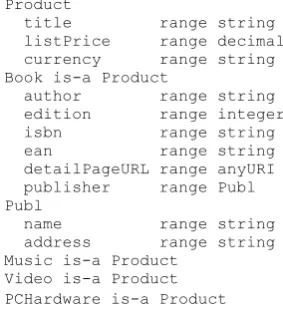
In the rest of the paper, we refer to OWL Extralite schemas simply asschema. Figures1and2 show schemas for fragments of the Amazon and the eBay databases, using a shorthand notation to save space and improve readabil-ity. Consistently with XML usage, from this point on, we will use the namespace prefixesam:andeb:to refer to the vocabularies of the Amazon and the eBay schemas respec-tively, and qualified names of the formV:Tto indicate that Tis a term of the vocabularyV.
In Fig. 1, for example, am:title is defined as a datatype property with domain am:Product and range string(an XML Schema data type),am:Bookis declar-ed as a subclass ofam:Product, andam:publisheris defined as an object property with domainam:Bookand range am:Publ. Note that the scope of am:titleand am:publisheris the schema, and not the classes defined as their domains.
Fig. 1 An OWL schema for a fragment of the Amazon Database
Fig. 2 An OWL schema for a fragment of the eBay Database
all properties, except eb:author, have maxCardinality equal to 1, andeb:isbn-10 andeb:isbn-13are in-verse functional.
2.2 Vocabulary matching and concept mapping
We decompose the problem of schema matching into the problem ofvocabulary matchingand the problem ofconcept mapping. In this section, we introduce both notions with the help of examples.
In what follows, let Sand T be two schemas, and VS
andVT be their vocabularies, respectively. LetCS andCT
be the sets of classes andPSandPT be the sets of datatype
or object properties inVSandVT, respectively.
Acontextualized vocabulary matchingbetweenSandT is a finite setμof quadruples(v1, e1, v2, e2)such that • if(v1, v2)∈CS×CT, thene1ande2are the top classT • if(v1, v2)∈PS×PT, thene1ande2are classes inCS
andCT that must be subclasses of the domains, or the
domains themselves, of propertiesv1andv2, respectively If(v1, e1, v2, e2)∈μ, we say thatμmatchesv1withv2in the context of e1ande2, thatei is the context of vi and that
(ei, vi)is acontextualized concept, fori=1,2. A
contex-tualized property (or class) matchingis a matching defined only for properties (or classes).
Intuitively, a vocabulary matching expresses equiva-lences between properties and classes in a given context. The context of a propertyPin a vocabulary matching is an RDF class that specifies therdf:typeof subjects of ex-isting triples of the form(?subject P ?object) for which the matchings holds. The context of a class is always the top classT(i.e., this notion is not used for class match-ings). Note that, if the database instances follows the schema the class of the?subjectmust be either the domain of the propertypor a subclass of its domain, because the property pcan only be applied to database instances of that classes.
For example, Table1 shows a fragment of the vocabu-lary matching between the schemas in Figs.1 and2. The first row indicates that the classesam:Bookandeb:Book are equivalent. The last row indicates that the property am:Publapplied to instances of typeam:Publis equiv-alent to the propertyeb:publisherapplied to instances of typeeb:Book.
Aconcept mapping from a source schema Sto a target schemaT is a set of transformation rules that express con-cepts of the target schema T in terms of concepts of the sourceS such that it is possible to translate queries overT into queries overS.
In this paper, we consider queries defined in the SPARQL Query Language for RDF [23]. The query of Fig. 3a re-turnstitles,authorsandpublishersof book instances from the Amazon database. The variable?bin lines 4–6 means that only instances which have the propertiesauthor,title, andpublisher attached to them match theWHEREcriteria. The variable?pin lines 6 and 7 means that, in addition to the previous criteria, only instances which are related to an-other instance through the propertyam:publishermatch theWHEREcriteria. This is the JOIN relational operator for RDF graphs. Figure3b shows an equivalent query over the eBay database.
LetAandEbe the schemas of Amazon and eBay data-bases, respectively, andAS andES be states of these two
databases, i.e.ASandEScontain individuals and their
prop-erty values of the two databases. The query depicted in Fig.3a is valid over the RDF graphA∪AS.
Now consider the graphG=E∪A∪AS, i.e. the Amazon
Table 1 Example of a vocabulary matching between Amazon and eBay schemas
Amazon eBay
v1 e1 v2 e2
am:Book T eb:Book T
am:title am:Book eb:title eb:Book
am:author am:Book eb:author eb:Book
am:listPrice am:Product eb:startPrice eb:Offer
am:name am:Publ eb:publisher eb:Book
Fig. 3 Simple SPARQL queries over the Amazon and eBay databases
how to add triples toGin order to get the same answer while submitting the previous two queries to G. To do that, we adopt the Semantic Web Rule Language (SWRL) [16], in a simpler syntax, to infer additional triples. An example of the rules in our simplified syntax would be:
1. eb:title(b,t)←am:title(b,t),
am:Book(b)
2. eb:Book(b)←am:title(b,t),
am:Book(b)
The first rule says that, ifbis an individual attached to the property am:titleand it is of class am:Bookthen bis attached to the propertyeb:title. The second rule means that if the same conditions hold then bis of class eb:Book. Note that these two rules can be derived from the second matching depicted on Table1because the match-ing says that the property am:title while attached to instances of class am:Book is equivalent to eb:title when subjects are of classeb:Book. For example, imag-ine the triples of the form (b, am:title, t) and (b, rdf:type, am:Book). We can directly infer the triples (b, eb:title, t) and (b, rdf:type, eb:Book).
We can extend the previous set of rules using other rows of Table1as follows.
3. eb:author(b,a)←am:author(b,a),
am:Book(b)
4. eb:Book(b)←am:author(b,a),
am:Book(b)
5. eb:startPrice(b,pr)
←am:listPrice(b,pr), am:Book(b)
6. eb:Book(b)←am:listPrice(b,pr),
am:Book(b)
Fig. 4 Translate SPARQL query from Fig.2
7. eb:publisher(b,n)
←am:publisher(b,p), am:name(p,n),
am:Book(b)
8. eb:Book(b,n)←am:publisher(b,p),
am:name(p,n), am:Publ(p)
9. eb:Book(b)←am:Book(b)
Note that rule 8 is not directly derived from Table1. We will later specify, how to derive such a rule.
Now letR be the set of 9 rules derived from vocabulary matching of Table1andR(G)be the set of inferred triples fromG by R. Then the queries of Fig.3 over G∪R(G) return the same set of answers.
The rules can be used to do query translation. Con-sider that a query over eBay should be translated into a query over Amazon. According to rule 3, triples of the form (b, eb:author, a) can be derived from triples(b,
am:author, a), (b, rdf:type, am:Book). By
3 Instance-based vocabulary matching
3.1 Instance-based technique
In this section, we describe an instance-based process to create contextualized vocabulary matchings that are struc-turally consistent.
Let S andT be two (OWL Extralite) schemas, and VS
andVT be their vocabularies, respectively. LetCS andCT
be the sets of classes, andPSandPT be the sets of datatype
or object properties inVSandVT, respectively.
Acontextualized vocabulary matchingbetweenSandT is a finite setμV of quadruples(v1, e1, v2, e2)such that
(i) if(v1, v2)∈CS×CT, thene1ande2are the top classT (ii) if(v1, v2)∈PS×PT, thene1ande2are classes inCS
andCT that must be subclasses of the domains of v1
andv2, respectively
(iii) and these are the only possible quadruples inμV
If(v1, e1, v2, e2)∈μV, we say thatμV matchesv1with v2in the context of e1ande2, thatei is the context ofvi and
that(vi, ei)is acontextualized concept, fori=1,2. A
con-textualized property (or class) matchingis a matching de-fined only for properties (or classes).
We first recall the matching technique for catalogue schemas based on similarity heuristics introduced in [17]. Briefly, acatalogueis a relational database whose schemaS has a single table. Given a catalogue stateUS, an attribute
AofSis represented by the set of values ofAthat occur in US, or by the set of pairs(i, v)such thatv is the value of
Afor the object with idi that occurs inUS. If the domain
ofAis a set of strings, the set of values is replaced by a set of tokens, and the attribute representations are reinterpreted accordingly. Similarity, models were then applied to such
attribute representations to generate attribute matchings be-tween two catalogue schemas.
Bilke and Naumann [2] propose an instance matching technique where each database tuple is represented by a character string, created by concatenating all attribute vues of each tuple. The technique uses k-mean clustering al-gorithms to find duplicate tuples. The identification of du-plicates is necessary for creating(i, v)representations of at-tributes. However, we note that the representations of the same object in distinct databases may differ in the list of at-tributes and/or in the attribute values. As a consequence, we may end up with dissimilar tuples that are used to represent the same object.
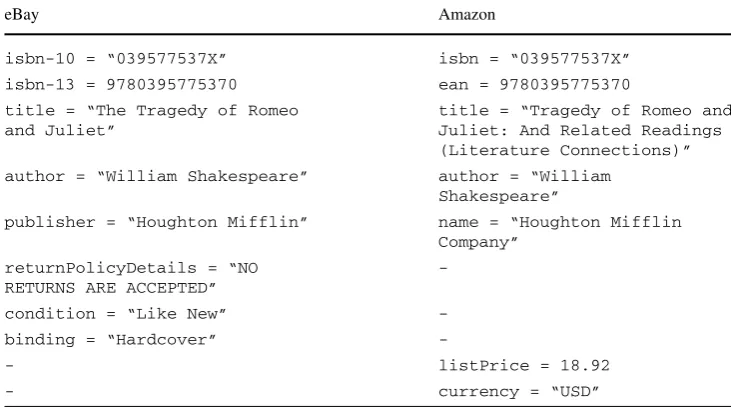
For example, suppose that we apply the Bilke and Nau-mann technique to match the two instances that represent the book “The Tragedy of Romeo and Juliet”, whose property-value pairs are shown in Table2. If we measure the similar-ity between the sets of tokens by the percentage of common tokens extracted from all property values of each instance, we obtain a score of 43% of common tokens. By contrast, if we consider only the values of properties that match, the similarity increases to 70%. Please note that, to improve the instance matching strategy, we used the fact thatam:Book matcheseb:Book, and the fact that several other properties match.
Combining these observations, we propose the four-step vocabulary matching process outlined as follows:
(1) Generate a preliminary property matching using simi-larity functions.
(2) Use the property matching obtained in Step (1) to gen-erate a class matching.
(3) Use the property matching obtained in Step (1) to gen-erate an instance matching.
Table 2 Example the same book instance representation in eBay and Amazon
eBay Amazon
isbn-10 = “039577537X” isbn = “039577537X”
isbn-13 = 9780395775370 ean = 9780395775370
title = “The Tragedy of Romeo and Juliet”
title = “Tragedy of Romeo and Juliet: And Related Readings (Literature Connections)”
author = “William Shakespeare” author = “William
Shakespeare”
publisher = “Houghton Mifflin” name = “Houghton Mifflin
Company”
returnPolicyDetails = “NO RETURNS ARE ACCEPTED”
-condition = “Like New”
-binding = “Hardcover”
-- listPrice = 18.92
(4) Use the class matching and the instance matching ob-tained in Step (2) to generate a refined contextualized property matching.
The final vocabulary matching is the result of the union of the class matching obtained in Step (2) and the refined property matching obtained in Step (4). Step (1) generates a preliminary property matching based on the intuition that “two properties match iff they have many values in com-mon and few values not in comcom-mon”. Step (2) creates class matchings that reflect the intuition that “two classes match iff they have many matching properties”. To work correctly, Steps (2) and (3) require that Step (1) generates preliminary property matchings that do not use(i, v)pairs to represent properties.
In what follows, letSandT be two schemas,VS andVT
be their vocabularies,PSandPT be their sets of properties,
andCS andCT be their sets of classes, respectively. LetUS
andUT be fixed sets of triples ofS andT, respectively, to
be used to compute the vocabulary matchings.
Step (1): Preliminary property matching
LetU be the universe of all tokens extracted from literals and all URIrefs. Consider a similarity functionσ:U×U→ [0,1], asimilarity thresholdτ ∈ [0,1]and arelated similar-ity thresholdτ∈ [0,1]such thatτ< τ.
For each property P ∈PS, for each classC∈CS such
that C is the domain of P or a subclass of the domain of P, consider the contextualized propertyPC=(P , C)and construct the seto[US, PC]of all v such that either there are triples of the form(I,P,v)and(I,rdf:type,C’) in US or there are triples of the form (I,P,s) and
(I,rdf:type,C’)inUSwherevis a token in the literal
strings, whereC=CorCis a subclass ofC, and likewise for a property inPT. We callo[US, PC]theobserved-value representationofPC inUS. This construction explores the
fact thatP is inherited by all subclasses of its domain. Thecontextualized property matchingμP betweenSand T induced byσandτ, and based on the observed-value rep-resentation of properties, is the relationμP such that
(P , C, Q, D)∈μP iffσ
oUS, PC
, oUT, QD
≥τ.
(1)
Step (2): Class matching
For each classC inCS, letprops[S, C]be the set of
prop-erties in PS whose domain is C or that C inherits from
its superclasses, and likewise for classes in CT. We call
props[S, C]theproperty representationofCinUS.
Thecontextualized class matchingμCbetweenSandT induced byσ,τ andμP is the relationμC⊆CS×CT such
that (recall thatTis the top class) (C,T, D,T)∈μC iffσ
props[S, C],props[S, T , D]≥τ (2) where props[S, C, T , D] = relprops[S, C, T , D] ∪ not_relprops[S, C, T , D],relprops[S, C, T , D]denotes the set of propertiesP of classCofSsuch that there is a prop-ertyQof the classDofT such that(P , C, Q, D)∈μP and
wherenot_relprops[S, C, T , D]denotes the set of properties P of the classDofT such that there are not related proper-ties inSbyμP. Note that it does not make sense to directly
compute σ (props[S, C],props[T , D]), since props[S, C] andprops[T , D]are sets of URIrefs from different vocab-ularies. To avoid this problem, we replacedprops[T , D]by props[S, C, T , D].
Step (3): Instance matching
From the matchings directly induced byσ andτ, computed in the previous step, the process then derives an instance matching and a refined contextualized property matching, as follows.
Figure5shows the algorithm that computes the instance matching. Its inputs areS,T, class matchingμC and
prop-erty matchingμP. It also implicitly receivesUS andUT as
input. It outputs the instance matchingμIthat relates match-ing class instances inUSandUT.
In Fig.5, ifCis a class inCS, andI is an instance ofCin
US, thentI[S, C, I, T , D]denotes the set of tokens extracted
from all valuesv such that, for some propertyP ∈PS, for
some propertyQinPT, for some classD∈CT, there is a
triple(I, P , v)inUSand there is a quadruple(P , C, Q, D)
inμP. In addition, ifCis a class inCS, andJis an instance
of D inUT, then tJ[S, C, T , D, J] denotes the set of
to-kens extracted from all valuesvsuch that, for some property P ∈PS, for some propertyQinPT, for some classD∈CT,
there is a triple (I, Q, v) in UT and there is a quadruple
(P , C, Q, D)inμP.
Step (4): Refined property matching
Figure 6 shows the algorithm that computes the refined contextualized property matching. It depends on the fol-lowing additional definitions. For each (P , C, Q, D) ∈ μP such that (C,T, D,T)∈ μC, construct the set q of
triples (I, u, v) such that there are triples of the form (I, P , u)and (I,rdf:type,C)inUS, there are triples
of the form (J, Q, v) and (J,rdf:type,D) in UT,
and(I, C, J, D)∈μI (where μI is the instance matching
Fig. 5 The class instance matching algorithm
Fig. 6 The contextualized property matching algorithm
US (and likewise fort). This second representation is
use-ful since it helps distinguish between properties with similar sets of values that refer to distinct instances, matched byμI.
Returning to the algorithm in Fig. 6, it has similar in-puts to the algorithm depicted in Fig. 5. Its output, how-ever, is the contextualized property matching μA between
properties whose domains are classes directly or indirectly matched byμC. The algorithm uses the maximum similarity
values computed using the observed-value and the instance-value representations for a pair of propertiesP andQ, and the more relaxed similarity threshold. Although not shown in Fig.6, object properties receive a special treatment, since their representations are sets of URIrefs that are compared with help of the instance matchingμI (computed by the
al-gorithm in Fig.5).
The final vocabulary matchingμis the union of the class matchingμCinduced byσ,τandμP and the contextualized
property matchingμAcomputed by the algorithm in Fig.6.
3.2 Experimental vocabulary matching results
We conducted an experiment to assess the performance of the vocabulary matching process described in Sect.3.1, us-ing product data obtained from Amazon and eBay websites. We preferred to use data directly downloaded from the web, rather than using the benchmark proposed in [12], be-cause the last does not include instances and, therefore, is unsuitable to test the proposed process.
We first defined a set of terms, which was used to query both databases. From the query results, we extracted the less frequent terms common in both databases. We then used this
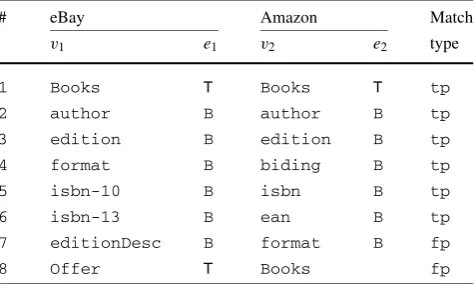
Table 3 Automatically obtained vocabulary matching from eBay into Amazon
# eBay Amazon Match
v1 e1 v2 e2 type
1 Books T Books T tp
2 author B author B tp
3 edition B edition B tp
4 format B biding B tp
5 isbn-10 B isbn B tp
6 isbn-13 B ean B tp
7 editionDesc B format B fp
8 Offer T Books fp
set of terms to query the databases once more. This pre-processing step enhanced the probability of retrieving dupli-cate objects from the databases, which is essential to evalu-ate any instance-based schema matching technique. We ex-tracted a total of 116,201 records: 16,410 from Amazon and 99,791 from eBay.
As similarity functions, we adopted the contrast model [20] for property matchings, and the cosine distance with TF/IDF for instance matchings. The experiments provided us with enough empirical data to conclude that the contrast model performs better in situations where the goal is to em-phasize the differences between two sets of values. This fol-lows because the contrast model alfol-lows for parameter cali-bration.
Table3shows sample entries of the vocabulary matching obtained. The headings indicate thate1is the context ofv1, ande2that ofv2. Also,“B”abbreviates classeseb:Book andam:Book.
The rightmost column of Table 3 classifies the match-ings in types:tpfor true positive, fpfor false positive and fnfor false negative. Since the total number (not all shown in Table3) of true positives is 25, that of false positives is 4 and that of false negatives is 10, the performance measures therefore are:
precision= tp
tp+fp=86%, recall= tp
tp+fn=71%, F=2 precision·recall
precision+recall=78%.
Fig.4ignored the instance-value representation of proper-ties. In this case, the performance measures would drop to: precision=82%, recall=51%,
fMeasure=63%.
4 Concept mapping induced by vocabulary matching
4.1 Definition
LetSbe an OWL Extralite schema in what follows. We say thatSiswell-formediff
• for any propertypofS, the domain ofpis a class ofS • for any object propertypofS, the range ofpis a class of
S
• for any classcofS, ifsis defined as a superclass ofcin S, thensis also a class ofS
We understand S as a theory T[S] =(A[S], C[S]) in
ALCQI [9], a dialect of Description Logics, such that • the concepts and roles of the alphabetA[S]are the classes
and properties ofS
• the axioms of C[S]are the constraints of S, denoted in
ALCQIas follows:
– a property p has domain d and range r: T ∀p.r ∀p−.d
– a property p, with ranger, is inverse functional:r (≤1p−)
– a propertyp, with domaind, has minCardinalityk:d (≥kp)
– a property p, with domain d, has maxCardinality k: d(≤kp)
– a classsis defined as a superclass ofc:cs
In what follows, we will also use fromALCQIthe inter-sectionof two concepts, denotedcd, and thesubsumption of two concepts, denotedcd.
LetVbe the set ofvariables, which is assumed to be dis-joint from the set of concepts ofS. Aclass literalis an ex-pression of the formc(x), wherecis a class andxis a vari-able; aproperty literalis an expression of the formp(x, y), wherepis a property andxandy are variables; aliteralis a class literal or a property literal. Aconjunctionis a list of literals separated by commas. Adisjunctionis a list of con-junctions separated by semi-colons. (This notation should be familiar to Prolog programmers).
Aruleis an expression of one of the forms:
• c(x)←B[x], wherec(x)is a class literal andB[x]is a disjunction where the variablex occurs in each conjunc-tion
• p(x, y)←B[x, y], wherep(x, y)is a property literal and B[x, y]is a disjunction where the variablesxandyoccur in each conjunction
The literal is the head and the disjunction is the body of the rule. We use the notationB[x]andB[x, y]to stress which variables must occur in the body.
LetI be a set of triples ofS. TheuniverseofI is the set U[I]of all URIrefs and literals that occur in triples ofI.
Consistently with the notion of interpretation of Descrip-tion Logics, given a classcofS, theinterpretation ofcinI is the set
cI=i∈U[I] |(i,:type, c)∈I
and, given a propertypofS, theinterpretation ofpinI is the binary relation
pI=(i, o)∈U[I] ×U[I] |(i, p, o)∈I.
Theinterpretationof the intersection of two conceptscd is the set
(cd)I=cI∩dI.
We say that the subsumption of two concepts cd is true inI, denotedI|=cd, iffcI⊆dI.
Rather than resorting to the formalization inALCQI, we directly define when a constraintσofSistrue inI, denoted I|=σ:
• ifσ declares that a propertyphas domaind and ranger, thenI|=σ iffpI⊆dI×rI
• ifσ declares that a propertyp, with ranger, is inverse functional, then I |=σ iff, for any b⊆rI, card({a ∈ U[I] |(a, b)∈pI})≤1
• ifσ declares that a propertyp, with domaind, has min-Cardinalityk, thenI |=σ iff, for anya⊆dI,card({b∈ U[I] |(a, b)∈pI})≥k
• ifσ declares that a propertyp, with domaind, has max-Cardinalityk, thenI |=σ iff, for anya⊆dI,card({b∈ U[I] |(a, b)∈pI})≤k
• ifσ declares that a classsis a superclass ofc, thenI|=σ iffcI⊆sI
We now turn to the semantics of rules. Avaluationfor the set of variablesV inIis a functionvthat maps the variables inV into elements ofU[I].
We extend the notion of interpretation of the right-hand side of the rule as follows. We first define when the right-hand side of ruleB is true in I for v, denotedI, v|=B, inductively as follows:
• ifBis of the formc(x)thenI, v|=B iffv(x)∈cI • ifBis of the formp(x, y)thenI, v|=Biff(v(x), v(y))∈
pI
• ifB is of the formC, D thenI, v|=B iffI, v|=C and I, v|=D
Theinterpretationof the right-hand side of a rule of the formB[x]inI is the set
B[x]I=a∈U[I] |there is a valuationvforV inI such thatI, v|=B[x]andv(x)=a
and theinterpretationof the right-hand side of a rule of the formB[x, y]inI is the binary relation
B[x, y]I = {(a, b)∈U[I] ×U[I] |there is a valuationv forV inI such thatI, v|=B[x, y]
andv(x)=aandv(y)=b}.
Finally, we say that a setI of triples ofSisconsistentiff I satisfies all constraints ofS.
4.2 Derivation from vocabulary matching
Given an OWL schema, we say that a classf dominatesa classcor the intersection c=deof two classesd ande iff there is a sequence(c1, c2, . . . , cn)such that
• f =c1andc=cn
• cn−1subsumescn
• for eachi∈ [1, n−2), either
– ci+1andci are classes andci+1is declared as a sub-class ofci, or
– ci+1is a class,ci is an object property andci+1is de-clared as the range ofci, or
– ci+1is an object property,ciis a class andciis declared
as the domain ofci+1
We also say thatπ=(c1, c2, . . . , cn)is adominance path
fromctodandθ=(pk1, pk2, . . . , pkm), the subsequence of
π consisting of the object properties that occur inπ, is the property path corresponding toπ (note that θ may be the empty sequence).
Let S andT be two (OWL Extralite) schemas in what follows. Recall that a contextualized vocabulary match-ing between S and T is a finite set μV of quadruples
(v1, e1, v2, e2).
A contextualized vocabulary matchingμV fromSintoT
isstructurally correctiff, for all(v1, e1, v2, e2)∈μV such
thatv1andv2are properties:
(i) there is a classf ofSsuch thatμV matchesf with the
domain ofv2andf dominatesd1e1, whered1is the domain ofv1
(ii) if v1 is a datatype property, then the range ofv1 is a subtype of the range ofv2
(iii) ifv1is an object property, thenμV matches the range
ofv1with the range ofv2
LetμV be a structurally correct contextualized
vocabu-lary matching. Aconcept mappingMfromSintoT induced
byμV is a set of rules derived from the quadruples ofμV as
follows.
For each quadruple (v1, e1, v2, e2)∈μV, the concept
mappingMcontains the following rules:
Case 1:v1andv2be classes. ThenM contains rules of the form
v2(x)←v1(x), s(x)←v1(x)
for each superclasssofv2.
Case 2:v1 andv2 are properties. Letd1 andd2be the do-mains, andr1andr2be the ranges ofv1andv2(recall thatr1 andr2are XML Schema data types, ifv1andv2are datatype properties, and that μV matches the range of v1 with the
range ofv2, ifv1andv2are object properties).
Case 2.1:μV matchesd1withd2. Then,Mcontains a rule
of the form
v2(x, y)←v1(x, y), e1(x).
Case 2.2:μV does not matchd1withd2. Letf be a class of Ssuch thatμV matchesf withd2andf dominatesd1e1.
Letpk1, pk2, . . . , pkmbe the property path corresponding to
a dominance path fromftod1e1. Then,Mcontains a rule of the form
v2(x, y)←pk1(x, x1), pk2(x1, x2), . . . , pkm(xm−1, z),
v1(z, y), e1(z)
if the property path is non-empty; otherwise the rule reduces to that of case 2.1. (Note that, sinceμV is structurally
cor-rect, a dominance path fromf tod1indeed exists. Also note that, since the dominance path may not be unique, the con-cept mapping induced byμV is not unique).
Note that the contextualized vocabulary matching μV
may have more than one quadruple for the same conceptv2 of the target schema, which implies that the above process may generate more than one rule forv2. In addition,v2may be a superclass of more than one class which, again, implies that the process described in Case 1, may generate more than one rule forv2. Therefore, as a last step in the construction of the concept mappingM, we collect all rules forv2 in a single rule with a disjunctive body. More precisely, ifv2is a class, and the above process generates rules of the following form:
v2(x)←Bi[x], fori∈ [1, n]
then we replace all such rules by a single ruleρof the form v2(x)←B1[x];. . .;Bn[x]
and likewise, ifv2is a property.
v2(x, y), ifv2is a property (by the transformation described above,Mhas at most one rule for each concept ofT).
However, there might be a conceptv2ofT such thatM has no rule that defines v2. We therefore define T /M as the subset of T restricted to the concepts that M defines. Then the constraints ofT /Mare the constraints ofT defined over such vocabulary. In particular, we can prove that super-classes, domains, and ranges are properly defined inT /M.
Proposition 1 Let μV be a structurally correct
contextu-alized vocabulary matching andM be a concept mapping fromSintoT induced byμV.Then:
(i) for any classcofT /M,ifsis a superclass ofcinT, thensis also a class ofT /M.
(ii) for any propertypofT /M,the domain ofpis also a concept ofT /M.
(iii) for any object property p ofT /M, the range ofp is also a concept ofT /M.
Proof
(i) Letcbe a class ofT /Mandsbe a superclass ofcinT. Sincecis a class ofT /M, by Case 1 of the construction ofM, there is a rule inM of the formc(x)←p1(x). Sinces is a superclass ofc, again by Case 1, there is a rule inMof the forms(x)←p1(x). Hence,sis de-fined inM, that is,sis a class ofT /M.
(ii) Letp be a property ofT /M. Letd be domain of p. Since p is a property of T /M, by Case 2, there is a rule inM of the form p(x, y)←B[x, y]and a class f ofS such thatμV matchesf with the domaind of
p. Then by Case 1, there is a rule inM of the form d(x)←f (x). Hence,dis defined inM, that is,d is a class ofT /M.
(iii) Letpbe an object property ofT /M. Letrbe the range ofp. Sincepis an object property ofT /M, by Case 2, there is a rule inMof the formp(x, y)←B[x, y]and a classgofSsuch thatμV matchesgwith the ranger
ofp. Then by Case 1, there is a rule inMof the form r(x)←g(x). Hence, ris defined inM, that is,r is a
class ofT /M.
Corollary 1 T /Mis a well-defined OWL Extralite schema.
Finally, we define the functionM¯ induced by M as the mapping from sets of triples ofSinto sets of triples ofT /M such that, for each set of triplesI ofS,J = ¯M(I )iff, for each ruleρinM
• ifρis of the formc(x)←B[x], thenJ contains a triple (i,:type, c)iffi∈B[x]I
• ifρ is of the formp(x, y)←B[x, y], thenJ contains a triple(i, p, j )iff(i, j )∈B[x, y]I
We stress that M is used to map queries submitted to the target schemaT into queries of the source schemaS, whereasM¯ is a theoretical device to prove the consistency of the concept mapping, as discussed in the next section.
4.3 Consistency
In this section, we briefly discuss the consistency of OWL Extralite vocabulary matchings, referring the reader to [18] for the detailed definitions and proofs.
In what follows, we use the notion of subsumption as in Description Logic. We say that a classcdominates a class diff there is a sequence(c1, c2, . . . , cn)of classes such that
c=c1, d =cn and, for each i∈ [1, n−2), either ci+1 is declared as a subclass ofci or there is an object property
whose domain isci and whose range isci+1, andcn−1 sub-sumescn. We consider that a class dominates itself.
A contextualized vocabulary matchingμfromSintoT is structurally correctiff, for all(v1, e1, v2, e2)∈μsuch that v1andv2are properties:
(i) there is a classf ofSsuch thatμmatchesf with the domain ofv2andf dominatese1(recall from the def-inition of vocabulary matching thate1is a subclass of the domain ofv1)
(ii) ifv1is a datatype property, then the range of v1 is a subtype of the range ofv2
(iii) ifv1is an object property, thenμmatches the range of v1with the range ofv2
A concept mappingγ fromSintoT induced bya struc-turally correct contextualized vocabulary matching μ is a set of rules derived from μas suggested by the examples in Sect.2.2. The rules inγ in turn induce a functionγ¯ that maps sets of triples ofSinto sets of triples ofT.
We say that the declarations of the domain and range of properties, property characteristics, cardinality restrictions, and subclass declarations are theconstraintsof a schema.
We denote the minCardinality and the maxCardinality of a propertypbymC[p]andMC[p], respectively. By con-vention, we takemC[p] =0 (andMC[p] = ∞), if minCar-dinality (or maxCarminCar-dinality) is not declared forp.
A propertyq isno less constrainedthan a propertypiff mC[p] ≤mC[q]andMC[p] ≥MC[q]and, ifpis declared as inverse functional, then so isq. Note that this definition applies even ifpandq are from different schemas.
LetSandT be two schemas,μbe a structurally correct contextualized vocabulary matching fromS intoT, and γ be a concept mapping fromSintoT induced byμ.
Finally, we say that a constraintαofT is relevant forγ iffαuses only concepts that occur in the heads of the rules inγ. We then say thatγ isconsistentiff, ifI is a consistent set of triples of S, then the set of triples ofT defined by J = ¯γ (I )satisfies all constraints ofT that are relevant for γ.
Lemma 1 Letμbe a structurally correct contextualized vo-cabulary matching andγbe a concept mapping fromSinto T induced byμ.Assume thatγ is correct.Thenγ is consis-tent.
(The proof generalizes Examples 2, 3, and 4. See [18] for the details).
5 Storing provenance data for matchings
In this section, we discuss the problem of storing provenance data for schema matchings and propose a data model for provenance applied to the algorithm presented in Sect.2.
Clearly, schema matching process is a laborious task. Au-tomatic or semi-auAu-tomatic tools that are able to identify such correspondences definitely boost up the process. Neverthe-less, schema matching algorithms, in general, must be cali-brated so as to achieve better performance in relation tofalse positives and negatives. Leme et al. [17] propose a cross val-idation process which aims at choosing the best similarity model and calibrations for a given set of test data. In this context, provenance data could be used to store parameters and calibrations for each matching result in order to allow for the identification of the best models.
Benchmarks are also very important to refine matching algorithms and to identify best suited scenarios for each al-gorithm. Of course, the algorithms must be compared over the same dataset, otherwise it does not make sense to com-pare performance measures. A classification of the scenar-ios might also be useful. If schemas are classified according their application domains, we could identify the ones that work better in the geographic domain, for instance.
Finally, matching entries can be validated by using a semi-automated matching process. In this case, we would make the internal representation of schema elements, the intermediate matching calculations and the final similarity degree between elements available. This information would help users to decide and/or validate the matchings.
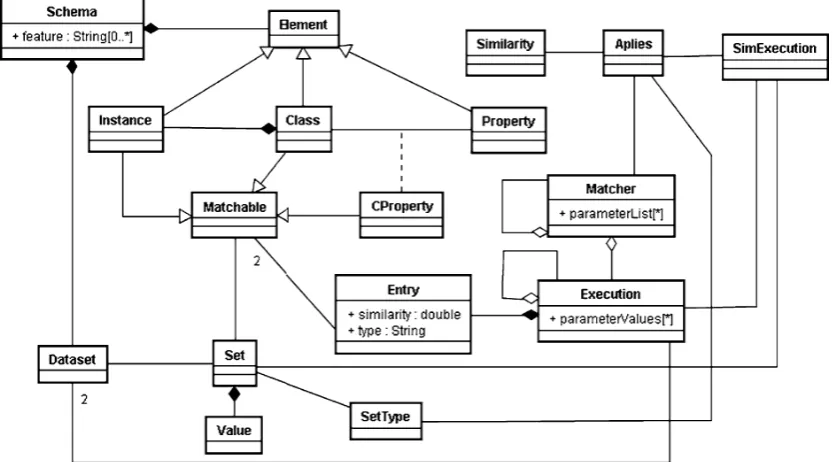
Our provenance model consists of an OWLschema(top left of Fig.7), modeled as an aggregation ofelements, spe-cialized intoclasses,properties, andinstances. Amatchable is any object that can be matched to another object (classes or properties).
Each schema is associated with one of more datasets (bottom left of Fig.7). Each dataset contains a set of triples, which describes the elements of the schema, including in-stances of classes and properties. A schema also has a set offeaturesthat can be used to identify the best model for a given scenario. For example, iffeature[0]contains the clas-sification categories of the schemas, it would be possible to select the best algorithms for the particular domain of fea-ture[0].
From a dataset,representations (Set in Fig.7) for each matchable of the schema are extracted [20]. Each represen-tation is a set ofvalues, and has atype. For example, a
erty can be represented by a set of tokens extracted from its observed values, in this case the set is of typeTokenand values are the extracted tokens of the property values. Our matching technique proposes the following representation sets for each type schema elements:
(i) Classes:
a. Set of properties (denoted byprops) (ii) Properties (datatype and object properties)
a. Set of tokens (denoted byo)
b. Set of instance value(i, v)pairs (denoted byiv) (iii) Instances
a. Set of tokens (denoted byt)
TheMatcher(top right of Fig.7), stores descriptions of matching algorithms, or matchers, and ofsimilarity func-tions(Similarityin Fig.7). To model the fact that a match-ing algorithm has a series of matchmatch-ing steps, as in Sect.3.1, a matcher is modeled as an aggregation of matchers. Each matcher applies one or more similarity functions, using a parameter list, if available. The matching algorithm de-scribed at the end of Sect.3.1provides the archetypal ex-ample of the family of instance-based matching algorithms that the tool supports. In this example we used the simi-larity functionscosine distanceand contrast modelwhich are stored in Similarity. In step 1, we used the contrast modelfunction applied to the token representation of prop-erties (o). In step 2, we applied thecontrast modelfunction to the property representation of classes (props). In step 3, we usedcosine distancefunction applied to token represen-tation of instances (t). In step 4, we usedcontrast model function applied totoken(o) andinstance value(iv) repre-sentations of properties. The configuration of the similarity functions is stored by theApliesclass (top right of Fig.7).
Each execution of a matcher (bottom right of Fig. 7) stores the parameter values that were used, and the sim-ilarity functions were applied (SimExecution in Fig. 7). It also stores the order in which the similarity functions were applied, as well as values used in the computations. Each execution results in an aggregation of matching en-tries (Entry), which, in turn, model a vocabulary matching. In step 1, we usedα=1.0,β=γ=3.5 andthreshold(τ )= max similarity−31% as the parameters values. In step 2, we usedthreshold(τ )=0.8 as the parameter values. In this step, because we used the cosine distance, there were no configuration parameters required to run the similarity func-tion. In step 3, we usedα=1.0,β=γ=3.5 andthreshold (τ )=max similarity−26%. In step 4, we used α=1.0, β=γ=3.5 andthreshold(τ )=max similarity−12% for the similarities between token and instance representations of properties. All parameters were stored in the parameter-Values of Execution. Thetype of an Entry tells us if it is false positive,false negative and so on. It is only used in
cross validation matchings, as inputs for performance mea-suring. The similarity is the final similarity measure for each particular entry.
6 Conclusions
In this paper, we proposed hybrid matching techniques based on instance values and on schema information, such as datatypes, cardinality, and relationships. The techniques uni-formly apply similarity functions to generate matchings and are grounded on the interpretation, traditionally accepted that “terms have the same extension when true of the same things” [24]. In our context, two concepts match if they de-note similar sets of objects. The techniques essentially differ on the nature of the sets to be compared and on the similar-ity functions adopted. For example and in a very intuitive way, two classes match if their sets of observed instances are similar, two terms from different thesauri match if the sets of instances they classify are similar; properties match if their sets of observed values are similar.
The assumptions that the database schemas we want to match are described in OWL notation, and that data from the databases can be obtained as sets of RDF triples facili-tated the construction of matching techniques. However, the techniques introduced in the paper can be directly applied to conceptual schemas described in other conceptual modeling representation languages, such as the relational model [10]. In conjunction, these assumptions permitted us to concen-trate on a sconcen-trategy to unveil the semantics of the database schemas to be matched, without being distracted by syn-tactical peculiarities. In fact, we consider good practice to provide OWL descriptions of the export schemas of data source providers. In conjunction with WSDL descriptions of the web services encapsulating the backend databases, this measure facilitates the interoperability of databases.
We focused on the more complex problem of matching two schemas that belong to an expressive OWL dialect. We decomposed the problem of OWL schema matching into the problems of vocabulary matching, and the problem of con-cept mapping. We also introduced sufficient conditions to guarantee that a vocabulary matching induces correct con-cept mappings. We adopted the contrast model [26] as the preferred similarity function, which proved to efficiently capture the notion of similarity in this context, and described heuristics that led to practical OWL matchings.
Unlike any of the instance-based techniques previously defined, see Sect. 1, the OWL schema matching process we described uses similarity functions to induce vocabulary matchings in a non-trivial way. The results demonstrated that the proposed technique performs well, with precision and recall rates around 80%.
Contrasting to the work of [6,27], which measure sim-ilarity between concepts based on the commonalities be-tween sets of values alone, we made use of similarity func-tions that took into account not only the commonalities, but also the differences between concepts.
Differently from the work of [2], we overcame the limi-tations of representing instances using strings that concate-nated all of its property values, by representing instances us-ing strus-ings that were constructed usus-ing only matchus-ing prop-erties, as the first approximation.
As future work, we are considering three broad areas. First, further work is required on techniques to gradually construct the matchings as new data becomes available, which is typical of a query mediation environment. We refer the reader to [3,5] for discussions about this issue. Second, belief revision techniques should be investigated to help ad-just the mediated schemas in time, as new data sources are integrated into the mediated environment. Third, implemen-tation issues are pending, although [14,15] is a step in this direction.
In summary, unlike previous approaches, we proposed hybrid matching techniques that are uniformly grounded on similarity functions to generate matchings between simple catalogue schemas, as well as between more complex OWL schemas. We introduced the idea of decomposing the prob-lem of schema matching into the probprob-lems of vocabulary matching and concept mapping, which are often confused in the literature. We also showed when a vocabulary match-ing induces correct concept mappmatch-ings, with respect to the integrity constraints of the schema, an issue also frequently overlooked in the literature.
Acknowledgements This work was partly supported by CNPq under grants 557128/2009-9, 142103/2007-1, 301497/2006-0, and 473110/2008-3, and by FAPERJ under grant E-26/170028/2008.
References
1. Bechhofer S, van Harmelen F, Hendler J, Horrocks I, McGuinness DL, Patel-Schneider PF, Stein LA (2004) OWL web ontology lan-guage reference. W3C recommendation. Last access on Dec 2008 at:http://www.w3.org/TR/owl-ref/
2. Bilke A, Naumann F (2005) Schema matching using duplicates. In: Proceedings of the 21st international conference on data engi-neering, pp 69–80
3. Brauner DF, Casanova MA, Milidiú RL (2006) Mediation as rec-ommendation: an approach to the design of mediators for ob-ject catalogs. In: On the move to meaningful internet systems 2006: OTM 2006 workshops. Lecture notes in computer science, vol 4277. Springer, Berlin, pp 46–47
4. Brauner DF, Casanova MA, Milidiú RL (2007) Towards gazetteer integration through an instance-based thesauri mapping approach. In: Advances in geoinformatics; VIII Brazilian symposium on geoinformatics (GEOINFO), pp 235–245
5. Brauner DF, Gazola A, Casanova MA (2008) Adaptive matching of database web services export schemas. In: Proceedings of the 10th international conference on enterprise information systems (ICEIS), pp 49–56
6. Brauner DF, Intrator C, Freitas JC, Casanova MA (2007) An instance-based approach for matching export schemas of geo-graphical database Web services. In: Proceedings of the IX Brazil-ian symposium on geoinformatics (GEOINFO), pp 109–120 7. Casanova M, Breitman K, Brauner D, Marins A (2007) Database
conceptual schema matching. Computer 40(10):102–104 8. Castano S, Ferrara A, Montanelli S, Racca G (2004)
Seman-tic information interoperability in open networked systems. In: Proceedings of semantics for grid databases, first international IFIP conference (ICSNW). Lecture notes in computer science, vol 3226. Springer, Berlin, pp 215–230
9. Chomicki J, Saake G (1998) Description logics for conceptual data modeling. In: Logics for databases and information systems. Springer, Berlin, chapter 8
10. Codd EF (1970) A relational model of data for large shared data banks. Commun ACM 13(6):377–387
11. Doan A, Domingos P, Halevy AY (2001) Reconciling schemas of disparate data sources: a machine-learning approach. In: Pro-ceedings of the 2001 ACM SIGMOD international conference on management of data, vol 30, pp 509–520
12. Duchateau F, Bellahsène Z, Hunt E (2007) XBenchMatch: a benchmark for XML schema matching tools. In: Proceedings of the 33rd international conference on very large data bases, demo sessions: group 1, pp 1318–1321
13. Euzenat J, Shvaiko P (2007) Ontology matching. Springer, Berlin 14. Gazola A (2008) A software infrastructure for catalog matching.
Master’s thesis, Departamento de Informática, PUC-Rio 15. Gazola A, Brauner D, Casanova MA (2007) A mediator for
het-erogeneous gazetteers. In: Poster session of the 22nd Brazilian symposium on database
16. Horrocks I, Patel-Schneider PF, Boley H, Tabet S, Grosofand B, Dean M (2004) SWRL: A semantic web rule language combining OWL and RuleML. W3C member submission. Last access on Dec 2008 at:http://www.w3.org/Submission/SWRL/
17. Leme LAP, Brauner DF, Breitman KK, Casanova MA, Gazola A (2008) Matching object catalogues. J Innov Syst Softw Eng 4(4):315–328
18. Leme LAPP (2009) Conceptual schema matching based on simi-larity heuristics. DSc thesis (Advisor: Casanova MA), Department of Informatics, Pontifical Catholic University of Rio de Janeiro 19. Leme LAPP, Casanova MA, Breitman KK, Furtado AL (2008)
Evaluation of similarity measures and heuristics for simple RDF schema matching. Monografias em Ciência da Computação MCC44/08, Department of Informatics, Pontifical Catholic Uni-versity of Rio de Janeiro
20. Leme LAPP, Casanova MA, Breitman KK, Furtado AL (2009) Instance-based OWL schema matching. In: Proceedings of the 11th international conference on enterprise information systems. Lecture notes in business information processing, vol 24. Springer, Berlin, pp 14–26
21. Madhavan J, Bernstein P, Doan A, Halevy A (2005) Corpus-based schema matching. In: Proceedings of the 21st international con-ference on data engineering, pp 57–68
23. Prud’hommeaux E, Seaborne A (2008) SPARQL query language for RDF. W3C recommendation. Last access on Dec 2008 at:
http://www.w3.org/TR/rdf-sparql-query
24. Quine WV (1968) Ontological relativity. J Philos 65(7):185–212 25. Rahm E, Bernstein P (2001) A survey of approaches to automatic
schema matching. VLDB J 10(4):334–350
26. Tversky A, Gati I (1978) Studies of similarity. Cogn Categ 1:79– 98