R E S E A R C H
Open Access
A unifying perspective on protocol
mediation: interoperability in the future internet
Amel Bennaceur
1*, Emil Andriescu
2,3, Roberto Speicys Cardoso
3and Valérie Issarny
2Abstract
Given the highly dynamic and extremely heterogeneous software systems composing the Future Internet,
automatically achieving interoperability between software components —without modifying them— is more than simply desirable, it is quickly becoming a necessity. Although much work has been carried out on interoperability, existing solutions have not fully succeeded in keeping pace with the increasing complexity and heterogeneity of modern software, and meeting the demands of runtime support. On the one hand, solutions at the application layer synthesise intermediary entities, mediators, to compensate for the differences between the interfaces of components and coordinate their behaviours, while assuming the use of the same middleware solution. On the other hand, solutions at the middleware layer deal with interoperability across heterogeneous middleware technologies but do not reconcile the differences between components interfaces and behaviours at the application layer. In this paper we propose a unified approach for achieving interoperability between heterogeneous software components with compatible functionalities across the application and middleware layers. First, we provide a solution to automatically generate cross-layer parsers and composers that abstract network messages into a uniform representation
independent of the middleware used. Second, these generated parsers and composers are integrated within a mediation framework to support the deployment of the mediators synthesised at the application layer. More
specifically, the generated parser analyses the network messages received from one component and transforms them into a representation that can be understood by the application-level mediator. Then, the application-level mediator performs the necessary data conversion and behavioural coordination. Finally, the composer transforms the
representation produced by the application-level mediator into network messages that can be sent to the other component. The resulting unified mediation framework reconciles the differences between software components from the application down to the middleware layers. We validate our approach through a case study in the area of conference management.
Keywords: Interoperability; Cross-layer parsers and composers; Mediation; Dynamic composition; Middleware
1 Introduction
Enabling the composition of functionally-compatible soft-ware components regardless of the technology they use and the protocols according to which they interact is a fundamental challenge in the Future Internet [1]. It has been the focus of extensive research, from approaches that identify the causes of interoperability issues and give guidelines on how to address them [2], to approaches that try to automate the application of such guidelines [3]. This challenge is exacerbated when heterogeneity spans the
*Correspondence: [email protected] 1The Open University, Milton Keynes, UK
Full list of author information is available at the end of the article
application,middleware, andnetworklayers. At the appli-cation layer, components may exhibit disparate data types and operations, and may have distinct business logics. At the middleware layer, they may rely on different com-munication standards (e.g., SOAP and JMS) which define disparate data representation formats and induce differ-ent architectural constraints. Finally, at the network layer, data may be encapsulated differently according to the net-work technology in place. Heterogeneity at the netnet-work layer has partially been solved by convergence to a com-mon standard (i.e., IP - Internet Protocol). In this paper, we focus on achieving interoperability across the applica-tion and middleware layers assuming the use of IP at the network layer.
Middleware provides an abstraction that facilitates the communication and coordination of distributed compo-nents despite the heterogeneity of the underlying plat-forms, operating systems, and programming languages. However, middleware also defines specific message for-mats and coordination models, which makes it difficult (or even impossible) for applications using different mid-dleware solutions to interoperate. For example, SOAP-based clients deployed on Mac, Windows, and Linux machines can seamlessly access a SOAP-based Web Service deployed on a Windows server. However, a SOAP-based client cannot access a RESTful Web Service. Fur-thermore, the evolving application requirements lead to a continuous update of existing middleware tools and the emergence of new approaches. For example, SOAP has long been the protocol of choice to interface Web services but RESTful Web services are somehow prevailing nowa-days. As a result, application developers have to juggle with a myriad of technologies and tools, and includead hocglue code whenever it is necessary to integrate appli-cations implemented using different middleware. Mid-dleware interoperability solutions [3] facilitate this task, either by providing an infrastructure to translate messages into a common intermediary protocol, as is the case for Enterprise Service Buses [4], or by proposing a Domain Specific Language (DSL) to describe the translation logic and to generate corresponding bridges [5]. These solu-tions, however, provide only an execution framework and still require developers to implement or specify the trans-lations needed to enable the applications to interoperate.
Solutions oriented toward interoperability at the appli-cation layer, on the other hand, target higher automation and loose coupling. In particular, they rely on intermedi-ary entities,mediators[6], to enforce interoperability by mapping the interfaces of functionally-compatible com-ponents and coordinating their behaviours. Solutions for the synthesis of mediators [7–13] focus on compensat-ing for the differences between the components at the application layer, based on some domain knowledge, but without specifying how to deploy them on top of het-erogeneous middleware solutions. As far as we know, only Starlink [14] allows binding application-layer media-tors to different middleware solutions. However, Starlink requires the binding to be explicitly described in terms of the structure of messages that need to be sent or received by the components. Furthermore, this descrip-tion is monolithic and binding cannot be reused across many applications.
In summary, existing solutions to interoperability have not fully succeeded in dealing with the increasing hetero-geneity of components because of the following reasons: (i) they deal with middleware heterogeneity while assum-ing matchassum-ing application components atop and rely on developers to provide all the translations that need to
be made, (ii) they deal with behavioural mismatches at the application layer and generate corresponding medi-ators but fail to deploy them on top of heterogeneous middleware, or (iii) they deal with both middleware and application interoperability in conjunction but require the complete, and low-level specification of message structure using a general purpose DSL.
Furthermore, a critical issue for enabling heteroge-neous components to interoperate is the ability to parse messages from the middleware layer into a for-mat that can be handled by application-layer mediators and then concretise back (a.k.a. compose/un-parse) the messages produced by application-layer mediators into middleware-layer messages. We refer to the process of parsing and composing a message asmessage translation. However, message translation is challenged by the encap-sulation of data according to different middleware proto-cols, e.g., SOAP message encapsulated within HTTP for Web Services. As a result, implementing message transla-tors requires dealing with multiple message formats and identifying the parts of the message corresponding to each protocol. What is needed is a declarative solution that facilitates the composition of multiple, and potentially heterogeneous, translators while taking into account the data dependencies between the application and middle-ware layers.
In this paper, we define a unified approach to deal with interoperability at both the application and middle-ware layers. We focus on client-service systems which are functionally-compatible, that is at some high level of abstraction the client requires a functionality that is pro-vided by the service but is unable to interact successfully with it due to mismatching interfaces and behaviours. Our key contribution stems from the systematic and rigorous approach to generate complex message translators and their seamless integration with application-layer medi-ation techniques in order to manage cross-layer data dependencies. More specifically, we make the following contributions:
• Composite Cross-Layer (CCL) message translators. We devise an approach to automate the composition of message translators, calledCCL message
translators, that are able to process messages sent or received by software components implemented using different middleware solutions. We generate the message translators based on a declarative high-level specification that: (i) reuses implementations of message translators for legacy protocols (e.g., HTTP, SOAP, CORBA), (ii) easily integrates with interface-description and serialisation languages (e.g.,WSDL, XSD, ASN.1), and (iii) builds upon format-specific reverse-engineering tools (e.g., XML learning). • A unified mediation framework. In previous
ontology reasoning and constraint programming to synthesise application-layer mediators automatically. We build upon this approach and extend it with CCL message translators to provide a unified mediation framework that deals with interoperability at both the application and middleware layers. This framework is capable of generating composite message translators as well as to synthesise application-layer mediators, which are deployed over a dedicated mediator engine. • Implementation and experimentation with a
real-world scenario. To validate our approach, we implemented a prototype tool and experimented it with heterogeneous conference management systems. Conference management systems provide various services such as ticketing, attendee management, and payment to organise events like conferences,
seminars and concerts. Nevertheless, it is sometimes necessary to interact with different conference management systems. This is the case of Ambientic (http://www.ambientic.com/), which develops mobile software in the domain of Event Management (expos, trade shows, exhibitions, conferences). Depending on the event, organisers may choose to rely on different conference management systems. Our solution helps Ambientic integrate with different conference management systems transparently.
This paper is organised as follows. Section 2 intro-duces the interoperable conference management example, which we use throughout the paper to motivate and illus-trate our mediation approach. Section 3 presents the proposed unified mediation framework that enables the generation of both CCL message translators and their integration with mediator synthesis at the application layer. Section 4 then surveys state of the art solutions to the generation and composition of message translators, thereby highlighting the variety of atomic message trans-lators that need to be composed within CCL transtrans-lators.
The latter is the focus of Section 5, which details our approach to the generation of CCL translators by reusing and composing legacy ones. Section 6 describes a proto-type implementation of the unified mediation framework and reports on the experiment we conducted using the interoperable conference management example. Finally, Section 7 concludes the paper and discusses future work.
2 The interoperable conference management
example
To motivate and illustrate our approach, we consider the Ambientic application for event management, called
U-Event (see Fig. 1). U-Event embeds a client
com-ponent implemented as an Amiando client (http:// developers.amiando.com/). U-Event needs to coordinate with a functionally-compatible service, Regonline (http:// developer.regonline.com/). Instead of re-implementing the client component, the integration of the U-Event app with Regonline relies on our unified mediation frame-work.
In the following, we examine the challenges of enabling the Amiando client and the Regonline service to inter-operate. The complete description of both systems is beyond the scope of this paper as they define more than 50 operations each. We thus concentrate on the follow-ing interaction: the client component must obtain a list of conferences based on keywords found in their title, and browse the information (such as dates or registra-tion fees) of the obtained conferences. Amiando clients
have to send anEventFindrequest containing the
key-words to query. For security purposes, each Amiando
client is assigned a unique and fixed ApiKey which
must be included in every interaction with the service. The EventFindresponse includes a list of conference identifiers. To get some information about a conference, clients issue anEventReadrequest with the event iden-tifier as a parameter. To produce the equivalent result,
Ev
ent Management Application
HTTP
Mediator
EventFind
Login
GetEvents
EventRead
Conf
erence Management Client Component
SOAP/HTTP HTTP
U-Event
a Regonline client must first invoke the Login opera-tion in order to obtain a session identifier ApiToken, which must be included in all subsequent requests. The Regonline client then sends aGetEventsrequest, which
includes a Filter argument specifying the keywords
to search for. The client gets in return the list of con-ferences matching the search criteria including their details. Both Amiando and Regonline are based on the request/response paradigm, i.e., the client issues a request which includes the appropriate parameters and the server returns the corresponding response. However, Amiando is developed according to the REST architectural style, uses HTTP as the underlying communication protocol, and relies on JSON (http://www.json.org) for data for-matting. On the other hand, Regonline is implemented using SOAP, which implies using WSDL (http://www.w3. org/TR/wsdl) to describe the application interface, and is further bound to the HTTP protocol. Although the client component, which is an Amiando client, requires some functionality provided by the Regonline service, it is unable to interact with it because of the mismatches described in the following.
Application-layer mismatches. To interoperate, com-ponents have to agree on the syntax and semantics of the operations they require and provide together with the associated input and output data. However, the same con-cepts (e.g., conferences, tickets, and attendees) may be expressed using different data types. To enable the com-ponents to interoperate, the data need to be converted in order to meet the expectations of each component. For example, to search for a conference with a title containing a given keyword, the Amiando client simply specifies the keyword in the title parameter, which is of typeString.
The Regonline GetEvents operation has a Filter
argument used to specify the keywords to search for and which is also of typeString. However, contrary to the WSDL description, the Regonline developer documenta-tion specifies that thisStringfield is in fact a C# expres-sion and can contain some .NET framework method calls
(such as Title.contains(“keyword”)), which is
incompatible with the Amiando search string. The granu-larity and sequencing of operations is also very important.
For example, the GetEvents operation of Regonline
returns a list of conferences with the corresponding infor-mation. To get the same result in Amiando, two operations need to be performed.
Middleware-layer mismatches. Amiando is based on REST while Regonline is based on SOAP. Messages gen-erated by both systems are incompatible and must be translated to allow them to interoperate. Moreover, the mechanisms provided by each middleware to describe the application interface are different: while SOAP-based
Web Services rely on a standard interface description language (WSDL) to describe operations, there is no stan-dard description language for RESTful services, although JSON is widely used, and in particular by Amiando.
Cross-layer data mismatches. Even though applica-tion and middleware layers are conceptually separate, in real-world scenarios the boundaries between them are ill-defined. This is due to multiple factors such as performance optimisation, simplified development or
bad design decisions. For example, the Login
opera-tion of Regonline returns anApiToken value, which is
application-specific data. However, instead of including this token in subsequent operations at the application-layer encapsulation, it is inserted in the HTTP message-header (i.e., part of the middleware layer) as an optional field.
This example, although simple, demonstrates many problems that are faced by developers, and suggests why existing interoperability approaches still fall short in achieving interoperability. What is needed is a uni-fied approach to interoperability that brings together and enhances the solutions that tackle interoperability at the application and middleware layers, and automates the generation of message translators and mediators.
3 A unified mediation framework
We aim at providing a unified approach to support interoperability between functionally-compatible client-service systems by mediating their protocols from the application down to the middleware layers. Figure 2 depicts the main elements of our unified mediation frame-work where those with grey background are automati-cally synthesised. The framework revolves around two key elements:CCL translator generator andsynthesis of application-layer mediators.
CCL translator generator: enables fast design of com-plex message translators while requiring minimal develop-ment effort by reusing existing impledevelop-mentations of atomic message translators, when available. Figure 2 depicts the main elements relating toCCL translator generator:
Mediator Engine Input
Synthesis
Execution
automatically synthesized element
Behaviour
description Domain Ontology Message
Model 1
Synthesis of Application-layer
Mediators Abstract
Message Schemas CCL
Translator Generator
CCL Translators
Application-layer Mediator
Abstract Messages Concrete
Messages
Communication Manager
TCP/IP Network
Atomic Message Translators
Fig. 2A unified mediation framework
• Message Model defines the strategy for assembling Atomic message translators in order to deal with the data encapsulation in different middleware solutions and cross-layer data dependencies. The message model also includes annotations that are integrated in the generatedAbstract Message Schemas. Each rule or annotation in theMessage Model is applied to an Atomic message translator at a particular node of its AST structure to solve or to annotate a cross-layer data dependency.
• Abstract Message Schemas is an abstract description of the component’s interface that facilitates the synthesis of application-layer mediators. This schema composes and refines the AST schemas of a set of Atomic message translators. Abstract messages of a generatedCCL message translator validate the generatedAbstract Message Schema.
Synthesis of application-layer mediators: is respon-sible for generating application-layer mediators based on the description of the interfaces and behaviours of the components involved, together with the associated
domain ontology. The interfaces of the components are described usingAbstract Message Schemas. Thebehaviour
of a component then describes the ordering of the mes-sages sent or received by this component in order to interact with other components in the environments. The behaviour of a component may be automatically extracted using automata learning techniques [15–18].
The synthesis of application-layer mediators has been the subject of a lot of work, as surveyed in [19]. In their seminal paper, Yellin and Strom [7] propose an algo-rithm for the automated synthesis of mediators based on predefined correspondences between messages. By considering the semantics of actions, Vaculín et al.[20] are able to infer the correspondences between messages automatically. To generate the application-layer mediator, they generate all requester paths and find the appropriate mapping for each path by simulating the provider pro-cess. Cavallaroet al. [21] also consider the semantics of data and relies on model checking to identify mapping scripts between interaction protocols automatically. Nev-ertheless, they propose to perform the interface mapping beforehand so as to align the actions of both systems. However many mappings may exist and should be consid-ered during the mediator generation. Indeed, the interface and behavioural descriptions are inter-related and should be considered in conjunction. Moreover, they focus on the mediation at the application layer assuming the use of Web services for the underlying middleware. Finally, Inverardi and Tivoli [11] propose an approach to compute a mediator that composes a set of pre-defined patterns in order to guarantee that the interaction of components is deadlock-free.
suitable mediators must happen at runtime whereas in all these approaches, the mediator models or some media-tion strategies and patterns are known a priori and applied at runtime. We have specifically developed a solution combining ontology reasoning and constraint program-ming to synthesise application-layer mediators automati-cally [13]. In the following, we briefly describe the gist of this approach while details can be found elsewhere [13]. Our main goal in this paper is to define a unified approach that deals with mediation at both the application and middleware layers rather then presenting the synthesis of application-layer mediators.
To synthesise an application-layer mediator, we begin by identifying the semantic correspondence between the messages sent by one component and those expected by the other component, that is interface matching. Indeed, a significant role of the mediator is to convert data avail-able on one side and make it suitavail-able and relevant to the other. This conversion can only be carried out if the data enclosed in the expected messages can be safely produced from the data embedded in the received messages. We formulate interface matching as a constraint satisfaction problem and use constraint programming to solve it. We further incorporate the use of ontology reasoning within constraint solvers by defining an encoding of the ontol-ogy relations using arithmetic operators supported by widespread solvers. For each identified correspondence, we generate an associated matching process that performs the necessary data conversions between the actions of the components’ interfaces. Then, we analyse the behaviours
of components so as to generate the application-layer mediator that combines the matching processes in a way that guarantees that the components progress and reach their final states without errors.
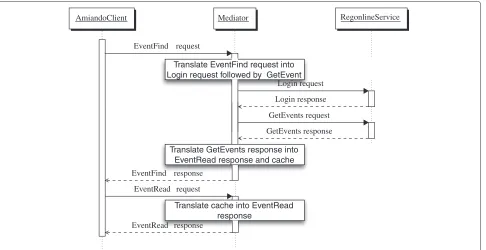
Figure 3 illustrates the data conversion and behavioural
coordination performed by the application-layer
medi-ator that enables the Amiando client and the Regonline service to interoperate. The application-layer mediator
intercepts theEventFindrequest sent by theAmiando
clientand transforms it into two invocations:Loginand
GetEvent. It generates theEventFindresponse based
on theGetEventsresponse and is able to produce the
responses of the followingEventFindinvocations. The
reason is that the GetEvents includes a list of events
while theEventReadrequires only one event.
As depicted in Fig. 2, theMediator Engineenables the components to interoperate by executing the synthesised
application-layer mediator while relying on the gener-ated CCL message translators to deliver the messages
in the expected formats. The Communication Manager
keeps track of all network connections and pending mes-sage receptions. It support several IP transport protocols including TCP, UDP, TLS/SSL, and SOCKS.
4 Message parsing and composition: state of the art and analysis
In order to deal with cross-layer message translation and generate CCL message translators, it is essential to have a good knowledge and understanding of the various mes-sage syntaxes encountered in middleware technologies as
Translate EventFind request into Login request followed by GetEvent
AmiandoClient Mediator RegonlineService
EventFind request
Translate GetEvents response into EventRead response and cache
Login request
Login response
GetEvents request
GetEvents response
EventFind response
EventRead request
Translate cache into EventRead response
EventRead response
well as the issues that can rise when composing hetero-geneous message translators. In general, a message trans-lator assures two functions: (i) parsing a stream of bits or characters, representing a network message in order to produce an AST, and (ii) processing an AST to pro-duce a network message in the format expected by a given component. Most existing approaches focus on the pars-ing problem, which is, in the general case, the hardest. In this section, we present and analyse existing approches for generating and composing message translators.
4.1 Survey of message parsing approaches
There exist a plethora of approaches to build message parser: some are optimised for low bandwidth overhead (e.g., Google’s mechanism for serialising structured data known as Protocol Buffers), and others are specifically designed to facilitate interoperability (e.g., by using stan-dard data serialisation formats). The forms in which parsers are available also differ: parsers can be precom-piled components, or high-level descriptions in a domain-specific language. In Fig. 4, we distinguish four major classes of approaches to build message parsers.
Custom-made parsers. These are parsers implemented
in anad hoc manner using a general purpose
program-ming language. The composition of such parsers often requires adding “glue code” to adapt the data and interac-tions between the individual parsers.
CFG-based generation of parsers. An efficient alterna-tive to implementingcustom-madeparsers is provided by parser generators (e.g., Yacc, Bison, ANTLR). Parser gen-erators transform a user-provided Context-Free Grammar (CFG) into an executable component, which parses an input according to the specification given. While parser generators allow the extensible or even incremental [22] generation of parsers, they lack the ability of integrating
Expressive power
Fixed encoding
Common encoding patterns
Context-free languages
Custom-made CFG-based
generationofparsers DSL-based
generation ofparsers IDL-based
serialisers
Degreeof automation
Fig. 4Parser design methods
and composing already existing parser implementations. The problem of parser composition in the context of CFG-based generators has already been addressed by Schw-erdfegeret al.[23, 24] with a precise focus onextensible programming languages. Combinatory parsing [25] offers a set of primitive operations for modular parser composi-tion. These operations can define parser composition with respect to the parser’s input e.g., sequential composition, alternative parsing, optional parsing and repetition, or by applying a transformation to a parser’s output (i.e., result-conversion). However, CFGs are anon-compositional for-malism in the sense that compositions require in-depth modification of the base CFG derivation rules.
DSL-based generation of parsers. DSLs can be used by experts to specify parsers for complex message for-mats at a higher abstraction level, and in a more compact way, than CFGs. Solutions for generating parsers based on a DSL specification [14, 26, 27] focus on enabling interoperability of already existing systems. However, they are usually associated with a specific kind of message encoding pattern (e.g., text-based, XML, type-length-value encoding, etc.), and thus have a limited expressive power. Further, such approaches are not future proof as more message formats are expected to emerge, which will not be accounted for by DSLs that are defined according to known message encoding patterns. In addi-tion, DSL-based solutions do not support composition and require messages to be defined in a monolithic way, which can easily become unmanageable for complex protocols.
IDL-based serialisers. A different class of approaches for parser generation, use an Interface Description Lan-guage (IDL) that allows users to describe abstract struc-tures of data using the IDL’s type system. The description is passed to a compiler that generates source code, or compiled components capable of serialising & deserial-ising messages to & from the described data format. A major deficiency of IDL-based approaches (e.g., ASN.1, Protocol Buffers, CORBA OMG IDL, etc.) is that, while they can define an arbitrary data format, they usually sup-port a fixed (or, in the case of ASN.1, a small set of ) message encoding mechanism. Therefore, we view seri-alisers as a specific case of message parsers, with limited expressive power relative to the serialised message for-mat (lower expressive power than DSL-based parsers). To facilitate the integration of serialisers with other systems, development environments, such as CORBA-based ones,
provide anIDL mapping (http://www.omg.org/spec/) to
limitation on message formats, the serialiser composition methods are also limited to IDL message-type encap-sulation. While this method enables the reuse of IDL descriptions, it cannot be used to integrate other types of parsers.
All the aforementioned approaches are specific to a singleparsing method.
These are insufficient for the case of composite mes-sage parsing as, in real life situations, protocol stacks may use a mix of message formats that originate from
custom-made, CFG, DSL and IDL generators. Hence, message
parser composition must deal with the composition of heterogeneous message syntaxes and hence parsers.
4.2 Composing heterogeneous message syntaxes In a composite message format, ambiguity can occur between the encapsulating (outer) message format, called
host, and encapsulatedmessage format, called extension. Parsing ambiguity is known to be a theoretically hard problem [28] but in communication protocols, several solutions are commonly implemented to deal with it:
• Context-aware parsing [23, 29] refers to methods and algorithms in which the scanner uses contextual information to disambiguate lexical syntax. This functionality allows a parser to carry out an
alternative interpretation for the extension message. When they are ignored, the extension message can later be parsed by a second parser for that part of the message (e.g., CDATA escape sections in XML documents). The context change may be triggered by different mechanisms likeescape strings (or
characters), or implicitly at predefined locations (e.g., SOAP envelope messages can only contain XML extensions, which may only be placed inside the <head>or<body>elements).
• Lexical disambiguation. Escape characters or character replacement can be used to resolve conflicts between the grammars of the host and extension. This method allows input lexemes (i.e., character sequences) from the base language to also appear in the extension language without causing ambiguities, which would otherwise result in parsing errors. For example, the stringHello <World> can be transformed intoHello <World> to disambiguate it from XML markup syntax. • Re-encoding. Extension messages may also be entirely
transformed into a different representation that does not conflict with the host syntax. This transformation can be done (i) by the host parser, in which case the behaviour is similar to escape sequences, (ii) by the extension parser, or (iii) by a separate component. For example Simple Mail Transfer Protocol (SMTP), which uses only text encoded messages, uses Base64
binary-to-text re-encoding to include binary data within SMTP messages.
In the following, we present the classes of syntax com-position based on the principles ofcontext-aware parsing. Figure 5 shows a schematic example for each class.
• Sequential inclusion. It is common in many protocols (e.g., protocols part of the TCP-IP stack, HTTP, etc.,) to compose messages by simply arranging the content in a sequential manner (e.g., one parser analyses a part of the input, and returns the remaining part in its result). In Fig. 5(a), we observe that the parsing context a a (corresponding to the host syntax) ends before the parsing context b b (corresponding to the extension syntax) begins. • Bounded stratified inclusion. A middleware protocol
parser is syntactically “unaware” of encapsulated messages, which are treated as a collection of binary data or arbitrary character strings. Because of this containment property, we can state that whenever two message parsers are composed to handle an encapsulated message format, they specialize (or restrict) the set of messages initially accepted. Thus, bounded stratified inclusion is a special case of syntax composition, which may only restrict the
expressiveness of the base language, in the same sense explained by Cardelliet al. in [30]. Figure 5(b) illustrates such an example, where data associated with an extension syntax (shown in blue) is included at a specific point in the data of a message associated with a host syntax (shown in white). Although context
b b is included in a a , they are properly delimited such that this message may be parsed even in the presence of lexical ambiguity between tokens of the host message and tokens of the encapsulated message. • Bounded composition represents a generalisation of
bounded stratified inclusion where the parsing context is not strictly delimitated. This means that lexemes from the host syntax can appear alongside lexemes of the extension syntax. Sections of the data block where thiscomposed syntax is used
(exemplified using hatched blue in Fig. 5(c)) can be parsed neither by the host parser, nor by the
extension parser. Unlike bounded stratified inclusion, bounded composition may include bothsyntax extensions and syntax restrictions. Syntax extensions expands the initial language with new message types, while syntax restrictions introduces intentional limitations on the expressiveness of a language. • Mutually-recursive syntax composition refers to the
b a
a
b
(a) Sequential inclusion
b
b a
a
(b) Bounded stratified
in-clusion
b b
a
a
(c) Bounded composition
b b
a a
b
b a
a
(d) Mutually-recursive
composition
Extension syntax
Composed syntax
Parsing context boundaries Host
syntax Data block
1 1
Fig. 5Illustrative example of the three classes of syntax composition
composition isrecursive descent parsing (in particular implemented by parser combinators [25, 31]), where a composed parser is defined from a set of mutually recursive procedures. This class of syntax composition has been extensively studied in the domain of extensible programming languages [23, 24], where parser composition extends the syntax of a host programming language, for instance Java (e.g., context a a in Fig. 5(d)), with another syntax, such as SQL (e.g., context b b ). Intuitively, the syntax is mutually-recursive because SQL queries can appear within Java expressions, and, at the same time, Java expressions can appear within SQL queries, allowing an unbounded chain of compositions. The same cannot be said about messages exchanged by protocol stacks where mutually-recursive compositions are unlikely given the fixed number of layers.
As far as we know, in existing protocol stacks, messages are encapsulated either using (a) sequential inclusion, or (b) bounded stratified inclusion. In [32], we further show that for these cases, heterogeneous parsers can be composed as black box functions (i.e., without requiring in-depth modification of the already existing parsers).
4.3 Atomic message translators
TheAtomic message translatorsthat can be used as input for composition are eitherLegacy(i.e., re-using an existing implementation) orGenerated (i.e., generated at design-time).
Legacy Atomic message translators are appropriate for middleware protocols given that they are based on industry-wide standards, with reference implementations widely available, and are unlikely to change frequently.
Generated Atomic message translators are useful for application-specific protocols, where changes in message structure are frequent.Generated Atomic message transla-torsare further categorised depending on the availability
of a message description language:DSL andIDL-based
and Inferred. As the title suggests, some message for-mats can indeed be inferred automatically. This is the case when protocols represent/encode data using an extensible serialisation (e.g, JSON, YAML) or encoding format (e.g., ASN.1 –syntactical– - BER –lexical–, XSD –syntactical– - XML –lexical–)a. For this case to be applicable in a pro-tocol mediation scenario, we obviously require a set of
trang.html) that can infer a schema from XML, JSON or other similar serialisation formats. Based on this schema, we automatically generate the correspondingsyntactical parsers.
In the above, we make the assumption that parsers output ASTs using a uniform format that can be manip-ulated. In our implementation, we reduce the scope to object-oriented parser implementations. This is because AST instances represented as Objects may be examined or even manipulated at runtime using reflection and byte-code manipulation and may be easily serialised to other formats, like XML.
Assuming that all necessaryAtomic message translators
(either inferred, generated or off-the-shelf ) for the medi-ated applications are available we generate a set ofCCL message translatorscorresponding to the set of message types exchanged. In theAmiando clienttoRegonline ser-vicescenario, the set ofAtomic message translators con-tains:a)legacy message translators for HTTP and SOAP,
b)custom XML parsers generated from the WSDL/XSD
description provided by Regonline andc)custom JSONb parsers for Amiando inferred using a set of pre-collected
Concrete Message Samples.
5 Cross-layer mediation
In this section, we describe our approach for generat-ingCCL message translatorsby composing multiple, and possible heterogeneous,Atomic message translators.
5.1 Composition of message translators
We mentioned that Atomic message translators are
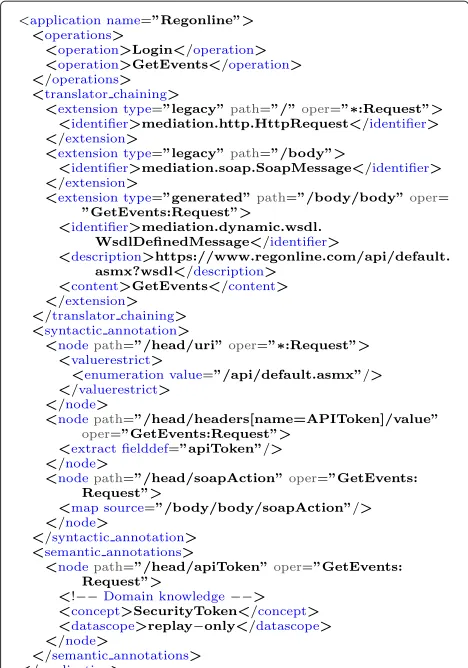
combined based on a Message Model. In Fig. 6 we
present a fragment of the Message Model describing
the Regonline service. This description is used to
gen-erate the corresponding CLL Translator and Abstract
Message Schema. A Message Model comprises three
sections: translator chaining, syntactic
annotations, and semantic annotations. The
translator chainingsection of theMessage Model
defines the composition ofAtomic message translatorsto form the set ofCCL message translatorsassociated with
an application. Each CCL message translator is
gener-ated according to anoperation(i.e., a pair of request and response messages and associated data) of the
com-ponent’s interface. Using the extension composition
rule, we declare how a specific field in the output (i.e.,
the output AST) of anAtomic orCCL message
transla-tor can be derived as input of a second Atomic message
translator determined by theidentifier tag.
Gener-ated Atomic message translatorextensionsrequire an
extradescriptionelement containing a URI pointing
to the message description and, optionally, a
domain-specific content tag that specifies which part of the
message description must be used, in the case where the
Fig. 6Fragment of the message model for the regonline component
provided description covers multiple operations. Field selection inside the AST is done usingpathexpressions. For convenience, the syntax is borrowed from XPath (http://www.w3.org/TR/xpath/). Extension declarations
may also contain the optional attribute oper, which
defines the operation for which the rule is relevant in the form [Operation|*]:[Request|Response|*]. Wildcards may be used on both sides of the attribute to specify that this rule applies to multiple operations or to both requests and responses.
We use the Message Model to create a tree structure based on the user definedpathattributes and the ASTs corresponding to the referenced Atomic translators. We then recursively construct the composite message
trans-lators corresponding to each protocol operation, by
applying composition and syntactical rules. This phase allows the composite message translators to produce
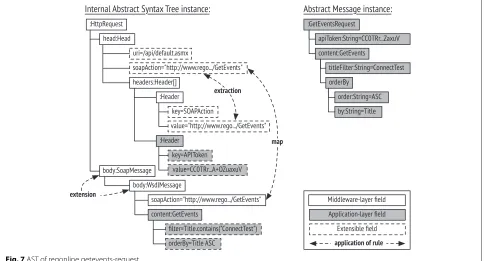
Internal AST instances. As an illustration, a CCL AST
instance of the Regonline GetEvents Request
mes-sage is given in Fig. 7. In this particular case, the initial
input is parsed by an HttpRequest parser, then the
Fig. 7AST of regonline getevents-request
processed by a SoapMessage parser, and finally the
SOAPbodyelement is parsed by a dynamically generated
WsdlMessagetranslator. The problem of inferring the data schema of theInternal ASTsis non-trivial. For this reason, in [32] we provide a formal mechanism, using tree automata, which based on a path expression (using a sub-set of the navigational core of the W3C XML query lan-guage XPath), generates an associated AST data-schema for the translator composition.
Secondly, we refine eachInternal AST structure into a middleware-independent message-schema which defines the syntax of theAbstract Message. This process includes pruning all middleware-specific fields of theInternal AST
schema, and also flattening the structure when possi-ble without introducing ambiguity. The generated mes-sage schemas are enhanced with semantical annotations defined in the Message Model. This is the structure on which the application-layer mediator synthesis tool will reason, and infer appropriate mapping of data. Finally, we generate the functions necessary to transform Abstract Messagesinto their correspondingInternal AST represen-tation, and the inverse.
5.2 Overcoming cross-layer data dependency
We now take a closer look on how syntactic
and semantic annotations can help solve cross-layer data dependencies and also support the synthesis of application-layer mediators.
A first step is assuring that all necessary data require-ments are made explicit. While most abstract message structures (i.e., AST schemas) are automatically extracted from Atomic message translators and composed using
our algorithm in [32], thesyntactic annotations
section of the Message Model further augments this description. This may include specifying whether some fields are required or optional, or if there are any addi-tional restrictions on the value of certain fields. For
instance, in our scenario, the Regonline GetEvents
operation accepts an optionalorderByparameter (see
Fig. 7) to specify the return order of conferences. If the application-layer mediator synthesis tool is unaware that this field is optional, it may fail to map an operation between components because a required input is not
pro-vided. Thus, we annotate this field as optional. For
specific fields, the valuerestrict annotation allows
specifying detailed value patterns for simple data types. While it may increase the complexity of the specification, this feature leads to a more precise data-mediation and message-validation than relying only on type-definition and/or semantical annotations.
key ApiToken. The extractannotation allows mak-ing this requirement explicit with respect to the structure of the message by removing the specific field from the
headers sequence, and reattaching it as a field at a higher level of the tree format.
When protocols are based on multiple middleware solutions, message composition may require data to be mapped internally across multiple translators. The
map element enables to associate the values of
mid-dleware fields internal to a single CCL translator. For example, in the case of the message instance illus-trated in Fig. 7, the WSDL message translator field
body/body/soapAction is mapped to the HTTP
request header field/head/soapAction.
The last section of the Message Model, semantic
annotations, enables the annotation of parsed data at various granularity. We support two types of seman-tic annotation: (i) domain knowledge (i.e., references to
concepts in an ontology) and (ii) the scope of data. One may annotate an operation, a message, and/or any message field (either of complex or simple type). Such annotations support the synthesis of application-layer mediators in finding relevant matches between available data and data required to perform an operation. Thedata scopeis important whenever applications configure the underlying middleware, causing application-specific data to be scattered over multiple layers. We mentioned that, in order to achieve mediation, we must identify and
for-ward all application data. The element datascope set
toapplicationormiddlewaremarks that the syn-thesis of application-layer mediators must consider this data as part of the application scope or, respectively, the middleware scope (in which case it should be ignored). However, the separation of middleware data is not suf-ficient as components may exhibit more complex data scoping. For example, Amiando uses a static key called
ApiKeyto control service access while Regonline uses a session id called ApiToken. Both data are instances of
the same domain concept, but the mediator should never
assign theApiTokentoApiKeyor vice versa: Amiando
will not recognise session keys created by Regonline and Regonline will not accept access keys generated by Amiando. Still, the application-layer mediator synthesis
tool must map the ApiToken between the subsequent
Regonline requests.
In response to the above data scoping challenge, we
allow the datascope annotation to take the following
values: (i)middlewarewhen data is purely middleware
specific and it should not be exposed to the
application-layer mediator synthesis; (ii) applicationwhen data
belongs to the application layer, and must be forwarded to the application-layer mediator; (iii)replay-onlywhen application layer data should only be shared between the set of operations from the same component; (iv)
operation-onlywhen application layer data may only
be included in certain operations; (v) one-way when
application layer data may only flow in one direction, i.e., only Request or Response messages may include this data.
6 Implementation and validation
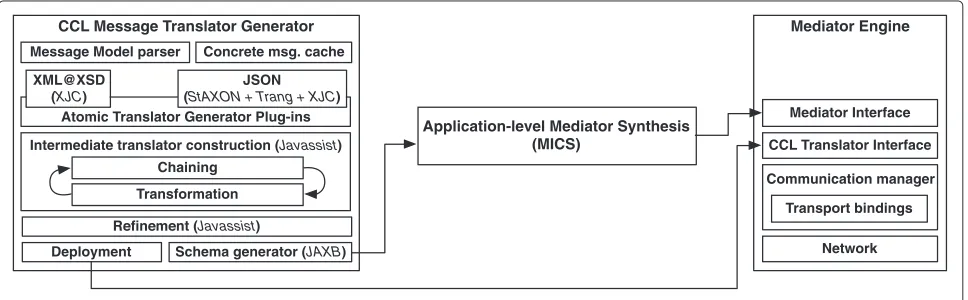
We have implemented a prototype tool of the proposed mediation framework using Java, following the archi-tecture described in Fig. 8. The third-party tool and library dependencies for each component are mentioned
between parentheses. The Mediator Engine implements
the interfaces necessary to interact with the artefacts
gen-erated by the Composite Message Translator Generator
andApplication-layer Mediator Synthesis (MICS).
In the case of the CCL Message Translator
Genera-tor, Legacy and Generated Atomic message translators arechained,transformedandrefinedusing the bytecode manipulation library Javassist (http://www.csg.is.titech. ac.jp/~chiba/javassist/). To express richer constraints on the syntactic structure of ASTs beyond the basic means provided by Java Type definitions, we use the stan-dard Java Architecture for XML Binding. In this way,
CCL Message Translator Generator
Concrete msg. cache
Javassist)
Intermediate translator construction (Javassist)
Deployment Schema generator (JAXB) Message Model parser
Atomic Translator Generator Plug-ins XML@XSD
(XJC)
JSON (StAXON + Trang + XJC)
Application-level Mediator Synthesis (MICS)
Mediator Engine
Communication manager
Network Transport bindings
Mediator Interface
CCL Translator Interface
Chaining
Transformation
Fig. 9Comparison between mediated and non-mediated executions
each class structure is bound to an XSD schema. Since value-restrictions, as described by the Message Model, cannot be injected as compile-time JAXB annotations,
they are transformed to a JAXB External Binding
Cus-tomization File. Generated Atomic message translator are obtained using external tools, which are integrated as plug-ins. XJC (http://jaxb.java.net) is used for generating XML message translators based on XML Schemas. Since there is no well-established data-schema for JSON we use StAXON (https://github.com/beckchr/staxon/) tool to transform JSON messages to XML before learning
their data-schema using the XML learning tool Trang.
We consider the integration of additional Atomic mes-sage translator generators like, for example, Java Asn.1 Compiler (http://sourceforge.net/projects/jac-asn1/) for
ASN.1parser specifications.
In what follows, we assess our approach by comparing the time to perform a conversation in the mediated and non-mediated case between Amiando client/service and Regonline client/service. Figure 1) shows the result. On the server-side, we use the services operated by Amiando and Regonline. On the client-side we use a Java implemen-tation provided by Amiando, while for Regonline, we par-tially generate the client source-code using the provided WSDL service description.
We first specify a Message Model (https://www.rocq.
inria.fr/arles/software/ccl-Mediation-Framework/) for
each system, as well as two message samples containing the JSON formatted responses of the Amiando service. The composite message translator Generator is then able to generate eight different composite message translators (listed in Fig. 10) and their associatedSemantically Anno-tated XSDs (http://www.w3.org/2002/ws/sawsdl/). The SAXSDs are obtained by injecting semantical annotations obtained from the Message Models into the XSD schemas generated using JAXB. At runtime, MICS generates the two mediators given the SAXSDs, a conference manage-ment ontology and the behavioural descriptions of each system.
We compare the mediated execution-time with the non-mediated case. Each test was repeated 30 times, in similar conditions, and connection delays were excluded (e.g., opening sockets, SSL handshake, etc).
In Fig. 9, we evaluate the execution-time overhead of the mediation. Since this test is performed using the real online services, the response time varies depending on the network conditions. As expected, the mediated execution-time is superior to the non-mediated case, given that the number of messages exchanged is doubled. We show the decomposition of the execution-time for mediation,
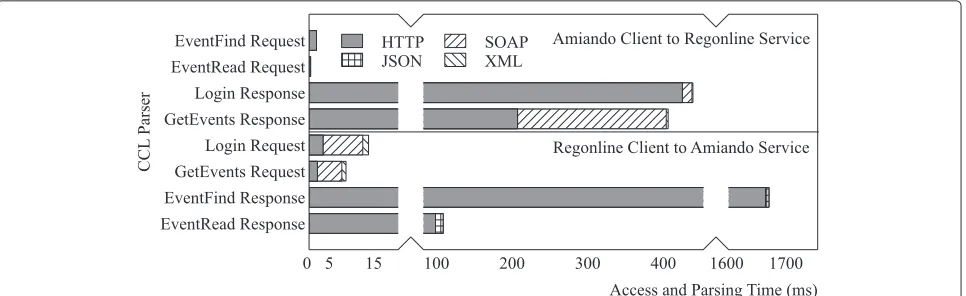
composing and access/parsing. Network access and pars-ing cannot be distpars-inguished in this case because parspars-ing is done in multiple steps when data is available on the com-munication channel. While the overhead of mediation and message composition is low, we see that parsing and net-work reception introduce the largest overhead. This is why, in Fig. 10, we detail the decomposition of parsing time over each Atomic parser used internally by a
spe-cific generated translator. We see that the EventFind
response message parsing has a peak of 1662 ms. We also observe that the entire time is associated with the HTTP parser, and given that the size of the message is only 869 bytes, we can conclude it is almost entirely due to the response delay of the Amiando Service. The same
rea-soning applies for theGetEventsresponse message of
the Regonline service, but in this case 197 ms are asso-ciated with the SOAP parser which is chained to parse the HTTP response’s payload (the HTTP body). Knowing that in this particular implementation, the SOAP parser does not wait for network access, we observe that the SOAP Atomic parser introduces an important SOAP-Envelope parsing overhead. This observation confirms that the Amiando/Regonline (i.e., Amiando Client medi-ated to the Regonline Service) mediator execution-time (in Fig. 9) can be reduced by using a more efficient SOAP Atomic parser. Hence, we can conclude that our medi-ation approach introduces an acceptable overhead while enabling seamless interoperability between two originally incompatible systems.
7 Conclusion and future work
Interoperability is a very challenging topic. Over the years, interoperability has been the subject of a great deal of work, both theoretical and practical. However, existing approaches focus on achieving interoperabil-ity either at the application or middleware layer. This paper presented a unified mediation framework to achieve interoperability from application down to middleware layers. We have shown via our implemented prototype that the framework successfully enables interoperabil-ity in a transparent way, while introducing acceptable overhead.
Future work includes increasing automation by infer-ring, at least partially, the Message Model by cooperating with discovery mechanisms and packet inspection soft-ware. We also intend to experiment with various learning techniques, both active and passive, for the inference of component behaviour. Finally, incremental re-synthesis of mediators and, runtime refinement of composite message translators would be useful in order to respond to changes in the individual systems or in the ontology. A further direction is to consider improved modelling capabilities that take into account the probabilistic nature of systems and the uncertainties in the ontology. This would facilitate
the construction of mediators where we have only partial knowledge about the system.
Endnotes
aNote the difference between: (i)lexical parsersthat
consume streams of characters or bytes and, in case of success, output a result in the form of an AST, and (ii)
syntactical parsersthat consume streams of tokens to produce the corresponding ASTs.
bSyntactical parsers defined on XML or JSON tokens.
Competing interests
The authors declare that they have no competing interests.
Authors’ contributions
AB developed the mediator synthesis approach and implemented the MICS tool. EA developed the translator generation approach and implemented the prototype tool. RSC proposed the case study and participated in the tests. VI supervised and coordinated the work. All authors read and approved the final manuscript.
Author details
1The Open University, Milton Keynes, UK.2Inria, Paris-Rocquencourt, Rocquencourt, France.3Ambientic, Paris, France.
Received: 2 February 2015 Accepted: 15 May 2015
References
1. Issarny V, Georgantas N, Hachem S, Zarras A, Vassiliadis P, Autili M, Gerosa MA, Hamida AB (2011) Service-oriented middleware for the future internet: state of the art and research directions. J Internet Serv Appl 2(1):23–45. doi:10.1007/s13174-011-0021-3
2. Garlan D, Allen R, Ockerbloom J (1995) Architectural mismatch or why it’s hard to build systems out of existing parts. In: ICSE. ACM, New York, NY, USA
3. Issarny V, Bennaceur A, Bromberg YD (2011) Middleware-layer connector synthesis: Beyond state of the art in middleware interoperability. In: LNCS SFM-11. Springer, Berlin, Heidelberg
4. Chappell DA (2004) Enterprise Service Bus. O’reilly Media 5. D. Bromberg Y, Grace P, Réveillère L (2011) Starlink: Runtime
Interoperability between Heterogeneous Middleware Protocols. In: ICDCS. IEEE Computer Society, Washington, DC, USA
6. Wiederhold G (1992) Mediators in the architecture of future information systems. IEEE Comput 25(3):38–49
7. Yellin DM, Strom RE (1997) Protocol specifications and component adaptors. ACM TOPLAS 19(2):292–333
8. McIlraith SA, Son TC, Zeng H (2001) Semantic web services. IEEE Intell Syst 16(2):46–53
9. Spitznagel B, Garlan D (2003) A compositional formalization of connector wrappers. In: ICSE. IEEE Computer Society, Washington, DC, USA 10. Mateescu R, Poizat P, Salaün G (2012) Adaptation of service protocols
using process algebra and on-the-fly reduction techniques. IEEE Trans Softw Eng 38(4):755–777
11. Inverardi P, Tivoli M (2013) Automatic synthesis of modular connectors via composition of protocol mediation patterns. In: Proc. of the 35th International Conference on Software Engineering, ICSE. IEEE Pres, Piscataway, NJ, USA. pp 3–12
12. D’Ippolito N, Braberman VA, Kramer J, Magee J, Sykes D, Uchitel S (2014) Hope for the best, prepare for the worst: multi-tier control for adaptive systems. In: Proc. of the 36th International Conference on Software Engineering, ICSE. ACM, New York, NY, USA. pp 688–699 13. Bennaceur A, Issarny V (2015) Automated synthesis of mediators to
support component interoperability. IEEE Trans Softw Eng 41(3):221–240 14. Bromberg YD, Grace P, Réveillère L, Blair GS (2011) Bridging the
16. Lorenzoli D, Mariani L, Pezzè M (2008) Automatic generation of software behavioral models. In: Proc. of the International Conference on Software Engineering, ICSE. ACM, New York, NY, USA. pp 501–510
17. Krka I, Brun Y, Popescu D, Garcia J, Medvidovic N (2010) Using dynamic execution traces and program invariants to enhance behavioral model inference. In: Proc. of the 32nd International Conference on Software Engineering, ICSE (2). ACM, New York, NY, USA. pp 179–182
18. Bennaceur A, Issarny V, Sykes D, Howar F, Isberner M, Steffen B, Johansson R, Moschitti A (2012) Machine learning for emergent middleware. In: Proc. of the Joint Workshop on Intelligent Methods for Software System Engineering, JIMSE. Springer, Berlin Heidelberg
19. Issarny V, Bennaceur A (2012) Composing distributed systems: Overcoming the interoperability challenge. In: Formal Methods for Components and Objects - 11th International Symposium, FMCO 2012, Bertinoro, Italy, September 24–28, 2012, Revised Lectures. Springer Berlin, Heidelberg. pp 168–196
20. Vaculín R, Neruda R, Sycara KP (2009) The process mediation framework for semantic web services. Int J Agent-Oriented Softw Eng IJAOSE 3(1):27–58 21. Cavallaro L, Nitto ED, Pradella M (2009) An automatic approach to enable
replacement of conversational services. In: ICSOC. Springer, Berlin, Heidelberg
22. Heering J, Klint P, Rekers J (1989) Incremental Generation of Parsers. In: PLDI. doi:10.1145/73141.74834. http://doi.acm.org/10.1145/73141.74834 23. Schwerdfeger AC, Van Wyk ER (2009) Verifiable Composition of
Deterministic Grammars. PLDI. doi:10.1145/1543135.1542499 24. Schwerdfeger AC, Van Wyk ER (2009) Verifiable Parse Table Composition
for Deterministic Parsing. In: SLE. Springer-Verlag, Berlin, Heidelberg 25. Swierstra SD (2000) Combinator parsers - from toys to tools 41:38-59 26. Burgy L, Reveillere L, Lawall J, Muller G (2011) Zebu: A Language-Based
Approach for Network Protocol Message Processing. IEEE TSE. doi:10.1109/TSE.2010.64
27. Borisov N, Brumley DJ, Wang HJ (2007) Generic Application-Level Protocol Analyzer and its Language. In: NDSS, The Internet Society 28. Basten H (2007) Ambiguity detection methods for context-free
grammars. Master’s thesis, Universiteit van Amsterdam
29. Van Wyk ER, Schwerdfeger AC (2007) Context-aware Scanning for Parsing Extensible Languages. In: GPCE. doi:10.1145/1289971.1289983. http://doi. acm.org/10.1145/1289971.1289983
30. Cardelli L, Matthes F, Abadi M (1994) Extensible grammars for language specialization. In: DBPL. http://dl.acm.org/citation.cfm?id=648290.754352 31. Moors A, Piessens F, Odersky M (2008) Parser combinators in scala. KU
Leuven, CW Reports vol:CW491
32. Andriescu EM, Martinez T, Issarny V (2015) Composing Message Translators and Inferring their Data Types using Tree Automata. In: Proc. of the 18th International Conference on Fundamental Approaches to Software Engineering, FASE, London, United Kingdom. https://hal.inria.fr/ hal-01097389
Submit your manuscript to a
journal and benefi t from:
7Convenient online submission 7Rigorous peer review
7Immediate publication on acceptance 7Open access: articles freely available online 7High visibility within the fi eld
7Retaining the copyright to your article