O R I G I N A L R E S E A R C H A R T I C L E
Open Access
LODPRO: learning objects development
process
Leandro Marques Queiros
1*, Denis Silva da Silveira
2, Jorge da Silva Correia-Neto
1and Guilherme Vilar
1Abstract
Background:Research concerning to the use of technology in education has received increasing attention from
scholars in recent years. This attention has resulted in new educational materials demanding creative ways to plan, develop, distribute, and evaluate them.
Methods:This paper integrates software innovation and management approaches, resulting in an innovative,
efficient methodology for the development of learning objects (LOs). The process proposed in this research paper was applied in a case study in which two health-related LOs were developed.
Results:The process proposed in this study is called Learning Objects Development Process - LODPRO. This work contributes to both theory and practice in the development of LOs, a field in which innovative techniques such as Design Thinking and the Business Model Canvas are fundamental.
Conclusions:Based on these results, we conclude that the present study offers a significant contribution to both theory and practice in this field. If used as a method to develop LOs that focus innovation, the techniques of Design Thinking and Business Model Canvas become fundamental parts of the process.
Keywords:Learning objects, Innovation in software design, Software engineering
Background
Research concerning the use of technology in education has received increasing attention from scholars in recent years. This recent attention has resulted in the trans-formation of educational materials and the way in which they are planned, developed, distributed, and evaluated. Considering the ease of creating them, learning objects (LOs) have emerged in an attempt to support the teach-ing process and to disseminate learnteach-ing through educa-tional content [1]. However, the concept of LOs is polysemic; examples of LOs range from small resources (such as the paragraph of a text) to very large resources (such as an entire training course in a teaching technique) [2]. Broadly speaking, LOs are digital or non-digital instruments used for learning, teaching, or training [3]. For the purposes of this paper, LOs are digital artifacts—in the shape of information bits—which
can be used—either individually or as part of a larger effort—to aid learning processes.
Because they are digital artifacts, LOs are very closely related to software [4]. Both of them share similar characteristics in their development and production. To ensure that software is being developed according to their specifications, we must first establish procedures, methods, and objects to be utilized in their development [5]. Therefore, we insist that methodologies and prac-tices in software engineering should also support the de-velopment of LOs. Software engineering, however, on its own is not enough to meet all the needs of those devel-oping educational artifacts [6], calling for the need to identify more specific alternatives.
Given the issue previously discussed, Chalegre et al. [7] point to the agile methodology as a possible solution. Among other things, this methodology aims to reduce the length and costs to develop software, improve the quality of the final product, adapt to changes, promote daily tasks to reach a final goal, include the client in the development process, and fully integrate the develop-ment team. Through these, the agile methodology
* Correspondence:[email protected]
1Department of Statistics and Informatics, Federal Rural University of
Pernambuco, Recife 52171-900, Pernambuco, Brazil
Full list of author information is available at the end of the article
aims to improve and support the development of LOs, especially as it concerns design difficulties and issues with the multidisciplinary nature of LOs.
To fully support this methodology, this paper inte-grates four dimensions: software engineering, innovative approaches, business management, and quality manage-ment, always seeking elegant solutions that address users’expectations [8]. As of 2014, a search on the inter-national databases of IEEE Xplore® Digital Library and Scopus®, as well as the Annals of the Brazilian Informatics Symposium, did not yield any conceptual frameworks that included the four previously mentioned dimensions being used in the development of LOs.
This study proposes a process for the development of digital LOs. In this paper, we address the following re-search questions: considering these four dimensions, which methods and techniques should aid in the devel-opment of LOs? How should we integrate these methods and techniques in the development of LOs? This paper is divided into six sections: this introduction, a literature review, related studies, methodology, results, and final considerations (including recommendations for future research).
Literature review
In our review, we investigated the current state-of-the-art in four areas: learning objects, software engineering, total quality management, and innovative approaches.
Learning objects
There are no formal, universal definitions for LOs; there is only a consensus among scholars that these objects must have an educational purpose [9]. The term
“learning objects”was originally used by Wayne Hodgins, in 1994, in the CedMA research group named Learning Architectures, Application Programming Interface, and Learning Objects, which became a reference in the field of computer-assisted learning [10].
LOs are closely related to the object-oriented para-digm (OOP), given that this parapara-digm helps to manage and to maintain the code [11] and increases its capacity for reutilization, maintenance, recovery, and sharing [12]. Thus, LOs are flexible, because they can be easily increased without overcomplicating their level of ab-straction or compromising their efficacy [13].
Software engineering
Software engineering is a method for developing and maintaining systems. Some of its characteristics there is the fact that is a dynamic process; it allows for effective quality control; and it fosters productivity, planning, and management of activities, as well as resources, costs, and deadlines [14]. Software engineering is also a discipline that establishes the principles of engineering, aiming to
develop products in a systematic manner, resulting in an effective, trustworthy product [5].
Software engineering, however, in its traditional man-ner, can only be applied in circumstances in which the system specifications are stable. The lack of that require-ment suggests the use of agile methodologies, justifying the use of these methodologies in the present work [15].
The term “agile methodology” emerged in 2001, as specialists in software proposed new techniques and tools to improve software development while comprom-ising as little as possible in quality and project documen-tation [16]. Agile projects must have the following characteristics [17]:
Processes and tools are replaced by individuals and interactions.
Extensive documentation is replaced by a working software.
Contract negotiation is replaced by collaborating with the client.
Following a plan is replaced by adapting to changes.
The most well-known agile methodologies are: Scrum, Agile Documentation, Crystal Clear, Dynamic Systems Development Method(DSDM), andeXtreme Programming (XP). In this study, we chose to use Scrum; its benefits are evident given that it increased productivity by over 80 % and project quality by 40 % while decreasing cost by 25 % [Cohn 2010, apud [18]].
The smaller piece of the development cycle of a Scrum project is called“sprint” and is defined by iterations that can last 2 to 4 weeks, allowing the project in question to be versioned at the end of each sprint or to continue being improved in the subsequent iteration [19]. Scrum implements a framework in which activities are conducted by people that assume three core roles [20]: Product Owner, Scrum Master, and the Development Team.
Total quality management
The Plan, Do, Check, and Act cycle (PDCA) is centered around total quality management (TQM) [21]. Shewhart (1931) was responsible for introducing PDCA concepts and the logic of this cycle. However, it was his pupil, Edward Deming, who developed many of the quality management techniques in which PDCA is based. Therefore, the technique is also known as Deming’s cycle, and over the years, Deming became one of the most important scholars of this area [22].
includes mitigating possible mistakes or flaws in the product or its execution processes [23].
Innovative approaches
This section presents the main innovative approaches to software projects aimed at providing a better under-standing of them and to present possible elements that can be added to the development of LOs.
Business Model Generation
The business model is an abstraction about how a business should work and how the organization creates, captures, and delivers value. Therefore, it is of key importance to have a business model that can be under-stood by all parties involved in the software innovation, and that is not overly complex to the point of negatively affecting the project [24, 25].
Business Model Generation (BMG) is a methodology that works as a guide that inspires the creation of a new business model or the improvement of an existing one. One of BMG’s tools is the Business Model Canvas (BMC), which is simple, comprehensible, and used by many large organizations [26]. The tool consists of nine steps, aimed at capturing different elements involved in the business model, as well as ideas to facilitate the understanding of the project at hand [27]. These steps are customer segment, value proposition, communica-tion channels, customer relacommunica-tionships, revenue streams, key resources, key activities, key partnerships, and cost structure.
Business Process Management
Business Process Management (BPM) can be used in a myriad of contexts. Oliveira et al. [28] defined BPM as a collection of methods, techniques, and technologies that assist organizations in managing their business; this collection can be used to design, analyze, execute, and control business processes and can, among other things, be shaped by Business Process Model and Notation (BPMN).
BPMN is a graphic notation for specifying business processes; according to Gonçalves et al. [29], BMPN’s main objective is to give representation to users while
also representing the complex semantics of processes. The graphic notation elements of BPMN are used to model most business processes [30] and were used in this study to support the development process of LOs.
Design Thinking
Design Thinking is a model for organizational innovation that has its own characteristics; it proposes a new mental model to the organization and has as its main advantage the development of creative solutions—which use user-centered research methods to address organizational stra-tegic challenges, given in Table 1 [31].
Related research
Some methods are generically used in the development of didactic-pedagogic content, other methods are solely used for the development of software, and there are others that were designed specifically for LOs [4]. This section presents works that are related to the content and context of this study.
A study by Amaral et al. [32] presents the steps for the development of LOs used by the Rede Internacional Virtual de Educação (International Network for Virtual Education—RIVED) and stresses the importance of team interaction and of using storyboards to route the devel-opment of LOs.
Pessoa and Benitti [33] discuss the elements included in the development process of LOs, focusing on the project’s conception, development, and distribution, but they do not cover innovative approaches to software development.
Finally, the Analysis, Design, Development, Implementation and Evaluation Model (ADDIE), presented in a study by Branch [34], it is commonly employed in the creation of LOs, but it is not used in innovative approaches to product conception.
Some desirable attributes should be present in the LO’s development process from the perspective of innovation approaches, multidisciplinary, and reuse. Table 2 shows the dimensions and points out if they are present or not in LO’s development processes presented in this section.
Table 1Description of Design Thinking tools
Tool Description
Analysis and synthesis The analysis is very important to break down complex issues as a way of better understanding them; yet, the creative process is based on synthesis or the collective act to join parts in the creation of complete ideas.
Brainstorming Very necessary when the goal is to obtain a wide range of ideas.
Prototyping A prototype is any tangible object that allows for the exploration, evaluation, and development of an idea.
Conceptual framework
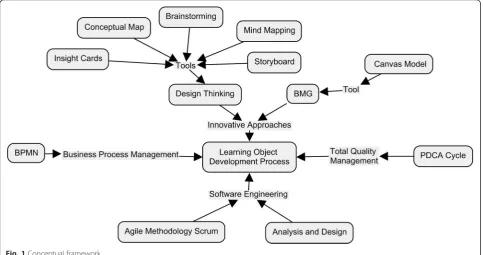
Figure 1 describes the conceptual framework used in this study, which stemmed from studies on innovative ap-proaches from Design Thinking (tools: insight cards, conceptual map, brainstorming, mind mapping, and storyboard) and BMG (tool: Canvas), as well as PDCA, software engineering (through the agile methodology using the Scrum method and project analysis) and BPM (tool: BPMN). All of them were used in the development process of the LOs discussed in this study.
Methods
We first conducted a literature search covering themes related to this study, more specifically: LOs, software engineering, agile methodology, BMG, BPM, and Design
Thinking. We also searched for related works and pos-sible gaps in the literature.
The selection of themes included in this study used a criterion that emerged from literature search, defined as a way to assure that the results would address the re-search questions and objectives proposed in this study.
Based on the selected elements from each of the four dimensions covered in the literature review, we estab-lished the development process for the LOs, here called learning object’s development process (LODPRO). This process was later validated through a case study detailed in the next section.
The present study aimed to demonstrate the applic-ability of the proposed process, which utilized all of the previously defined instruments. This process offers guid-ance to those interested in developing LOs, discussing the planning, execution, development, and evaluation phases. Further details on the process will be presented in the discussion section.
Results and discussion
The proposed process
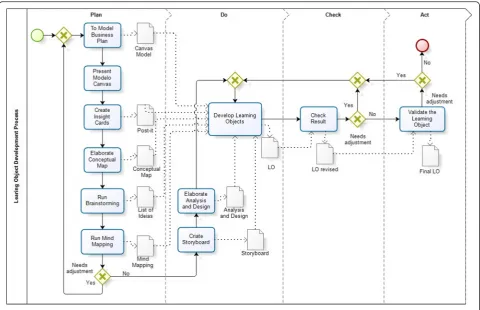
The process proposed in this study, which is drawn in Fig. 2, is called LODPRO. It consists of the insertion of tasks in the“Plan”phase of the PDCA cycle—given that a well-executed plan avoids flaws and unnecessary time loss in the following phases of the cycle. Another phase is“Do,”which executes the task planned in the previous phase. The “Check” phase verifies and analyzes the results obtained in the process. Finally, the “Act” phase
Table 2Approach of the processes used in the development of LO
Categories Learning object’s development process
Dimensions RIVED SOPHIA ADDIE
Continuous improvement No No Yes
Brainstorm No No No
Business modeling No No No
Project management No No No
Reuse No Yes No
Teaching skills Yes Yes Yes
Educational evaluation Yes No Yes
Usability No Yes No
reflects on the reason for deviations and devises possible corrective actions, such as altering the business model.
Case study on the process’application
Based on LODPRO, we established the roles of the Development Team, a team of five individuals (two be-ing physicians/customers and three bebe-ing developers). The team met bi-weekly for 10 weeks in a local hospital that was well-known in the study site (Recife, Brazil); they also met weekly usingSkype®.
First, the stakeholders identified the need for and the relevance of LOs that represented the extra-uterine and intra-uterine circulations. As defined by LODPRO, the development process of the LOs begins by creating a business plan (“Plan” phase), which happens during the immersion phase. The project team created this business model using the Business Model Canvas tool. After its creation, the plan was presented to stakeholders involved in the project, who herein on will be called“customers.” While the Scrum Master used Canvas to present the model to the customers, the customers registered their insights in insight cards. This represents the last step of the immersion phase.
The analysis and synthesis phase begins with the cre-ation of a conceptual map by the customers, using both the presented Canvas and the ideas contained in insight
cards. We used the brainstorming technique and selected a participant to act as a moderator. The customers came up with a multitude of ideas, and from these, a catalog was developed; the catalog contained a synthesis of all the ideas created in the project.
In this first task of LODPRO, the team of the project and the stakeholders (customers, users, investors, spon-sors, etc.) must meet in order to develop the Canvas model. The model of this tool describes how an organization creates, delivers, and captures values for
Fig. 2LODPRO: learning object’s development process
Table 3Task specification to model the business plan Task: to model the business plan
Purpose: develop a business plan
Responsible: team with the help of stakeholders
Input
Product work: business plan
Description: document that describe the strategies and organizational goals
Output
Product work: business model
Description: it describes how the logical organization creates, delivers, and captures values
Tool
Name: Business Model Canvas
Purpose: illustrate and comment on the overview of the business model
the target audience. It is important to emphasize that those responsible for creating the Canvas model may change according to the project. For example, the sup-plier may present the Canvas model already finalized for an investor. Table 3 shows the specification of this task.
The“Do”phase began with the creation of a storyboard using the data collected during the previous phases and following a story line. We decided that two virtual LOs would be developed using the basic techniques of graphic design and sequential narration of images and text. In the analysis phase, we mapped products that had been previously created to understand their specifications and designs.
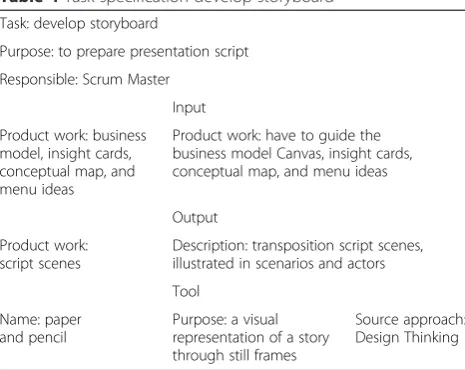
Table 4 shows the task specification develop story-board. In this task, the Scrum Master must coordinate the Development Team (DT) to produce the storyboard. The DT should prepare a written script and then separate the story into sections, taking into account the scenarios, actors, and frameworks that will be used to represent what you want. Finally, we choose the imaging technique available or most suitable for the purpose, depending on the outcome, that may be printed or digital. It is important to visually represent what you want to communicate.
The“Check”phase aimed to evaluate whether the LOs matched the previously agreed upon specifications. In the LOs that the team developed, we identified the need for improving color tones and also for adjusting the pos-ition of text presented in the videos. Therefore, the process returned to the development phase, where the necessary adjustments were made. The resulting LOs were evaluated once again, and we concluded that they matched the specifications of the project, therefore end-ing this phase. See Table 5.
The “Act” phase corresponds to the validation of the LOs, in which we would try to validate the LOs along with the customer and users. It was not possible to enact
this phase due to the limited availability of stakeholders. Therefore, there is a need for future studies that address the validation of the process proposed in the present study.
If identified by users/clients need some adjustment, it is possible to return to the development stage of the LOs and perform whatever is necessary. In sequence, it continues the process and triggers the Check stage again, returning to the validation phase. Table 6 shows the specification of this task.
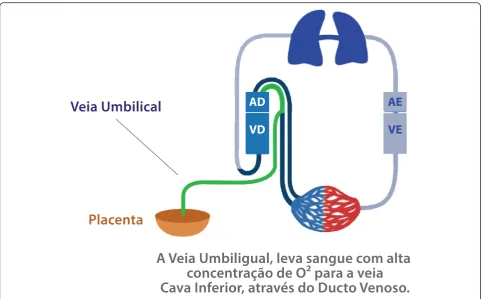
Given that our LO is a digital video, we present two figures to illustrate the LOs developed. Figure 3 corre-sponds to the fetal circulation LO, and the Fig. 4 is the extra-uterina circulation LO. Full previews of the LOs are available on YouTube. Fetal circulation is available at http://youtu.be/-1TE3xo6nv4 and extra-uterina circula-tion is available at http://youtu.be/O9AZvQKBJ7s.
Conclusions
The literature review was the first step in developing the LOs here discussed. In this study, we applied techniques and tools used in innovative approaches. We also in-cluded methodologies from business management and software engineering. Based on the fundamental charac-teristics and definitions of LOs, we established 11 steps: create a business plan, present it using Canvas, create insight cards, elaborate a conceptual map, run brain-storming session, make the mind map, create the
Table 4Task specification develop storyboard Task: develop storyboard
Purpose: to prepare presentation script
Responsible: Scrum Master
Input
Product work: business model, insight cards, conceptual map, and menu ideas
Product work: have to guide the business model Canvas, insight cards, conceptual map, and menu ideas
Output
Product work: script scenes
Description: transposition script scenes, illustrated in scenarios and actors
Tool
Name: paper and pencil
Purpose: a visual representation of a story through still frames
Source approach: Design Thinking
Table 5Task specification check learning object Task: check learning object
Purpose: verification of learning object
Responsible: Scrum Master
Input
Product work: learning object developed
Description: verification of learning object developed
Output
Product work: learning object Description: checking if the learning object is according to requirements
Table 6Task specification validate learning object Task: validate learning object
Purpose: validation of learning object
Responsible: users/clients
Input
Product work: learning object
Description: users/clients validate the learning object developed
Output
Product work: feedback of learning object
storytelling, analyze the project, develop the learning tool, verify results, and validate the learning tool.
The main aim of this study was to propose a develop-ment process for LOs that took into consideration as-pects of software engineering, innovative approaches, business process management, and total quality manage-ment, hoping to accelerate the software development while also mitigating losses in quality and project
documentation. We observed that, in some situations, it was necessary to return to previous phases of the process. As an example, when the evaluation of the LO indicated the need for improvements, calling for a return to the previously concluded development phase.
When the stages and steps in the process which needed to be adjusted were defined, the need to graphic-ally represent the process emerged; that is, the need for
Fig. 3Schematic view of fetal circulation
creating visual elements that represented the LO’s development process. Considering the findings of the lit-erature review on innovative approaches, we found the need for using BPM. This tool aims to provide a graphic representation that is user-friendly and intuitive when representing the complex semantics of the processes [29]. Analysis of the characteristics and objectives at each stage concluded that they should be divided in phases; therefore, we decided to use the Plan, Do, Check, and Act phases from the PDCA cycle.
The proposed process also made use of elements from the agile methodology Scrum to manage the project, and given the aforementioned specifications, we could achieve a building process for the development of the LOs in question.
Based on these results, we conclude that the present study offers a significant contribution to both theory and practice in this field. If used as a method to develop LOs that focus innovation, the techniques of Design Thinking and Business Model Canvas become fundamental parts of the process. This work has also indicated the need for future studies that (i) define roles responsible for executing tasks and (ii) evaluate other innovative tools in a new case study, given that there is a wealth of approaches that are heavily adopted by the market.
Competing interests
The authors declare that they have no competing interests.
Authors’contributions
LMQ is the main author of this paper, which is the result of his Master Degree Dissertation at Federal Rural University of Pernambuco (Brazil). GV is LMQ’s research adviser and was the responsible to guide the research. JSCN and DSS contributed to the writing and revising of the manuscript, and they are also accountable for all aspects of the work. All authors read and approved the final version of the manuscript.
Acknowledgements
This study was financed by the Brazilian Agency“Coordenação de Aperfeiçoamento de Pessoal de Nível Superior–CAPES.”
Author details
1Department of Statistics and Informatics, Federal Rural University of
Pernambuco, Recife 52171-900, Pernambuco, Brazil.2Center of Applied Social
Science, Federal University of Pernambuco, Recife 50740-580, Pernambuco, Brazil.
Received: 23 September 2015 Accepted: 15 June 2016
References
1. Rocha FL, Moraes H, Fabri LB, Oliveira TDJ, Costa AC, Netto CM, Morais RC (2011) Repositórios de objetos de aprendizagem–um estudo exploratório. In: Anais do Simpósio Brasileiro de Informática na Educação
2. Barritt C, Alderman Jr. FL. (2004) Creating a Reusable Learning Objects Strategy: Leveraging Information and Learning a Knowledge Economy. USA: John Wiley & Sons
3. IEEE (2002) Draft standard for learning object metadata. Institute of Electrical and Electronics Engineers. Learning Technology Standards Committee (LTSC). 1484.12.1-2002
4. Braga J, Dotta S, Pimentel E, Stransky B (2012) Desafios para o Desenvolvimento de Objetos de Aprendizagem Reutilizáveis e de
Qualidade. In: Anais do Workshop de Desafios da Computação Aplicada à Educação., pp 90–99
5. Pressman R. (2010) Software engineering: a practitioner’s approach, 7th edn. McGraw-Hill, USA
6. Lapolli F, Cruz CM, Motta CL, Tolla CE (2010) Modelo de Desenvolvimento de Objetos de Aprendizagem Baseado em Metodologias Ágeis e Scaffoldings. Revista Brasileira Informática na Educação 18(2):17–32 7. Chalegre VC, Santos WB, Souza LO, Muñoz HJ, Meira SRL (2010) Estudo de
Caso da Utilização de Scrum no Desenvolvimento Distribuído de Software. In: Anais Workshop Brasileiro de Métodos Ágeis
8. Souza R (2014) Prática de Design Thinking. Subject Inovação em Projetos de Software. University of Federal Rural de Pernambuco, Recife
9. Macêdo LN, Macêdo A, Castro JA (2007) Avaliação de um objeto de aprendizagem com base nas teorias cognitivas. In: Anais do Workshop de Informática na Escola
10. Polsani P (2003) Use and abuse of reusable learning objects. J Digit Inf. https://journals.tdl.org/jodi/index.php/jodi/article/view/89/88, April 11. Wiley D (2000) Conectando Objetos de Aprendizagem com a teoria de
projeto instrucional: uma definição, uma metáfora e uma taxonomia. http://penta3.ufrgs.br/objetosaprendizagem/11wiley_traducao.doc. Accessed 6 Sept 2014
12. Calil FC, Peres HHC, Zaima J, Tobase L (2012) A produção científica de objetos de aprendizagem no ensino em enfermagem. J Healthc Inf 4(Special Number - SIIENF 2012):138–43
13. Oliver R (2001) Learning objects: supporting flexible delivery of online learning. Centre for Research in Information Technology and Communications. Edith Cowan University, Australia
14. Engholm H. Jr. (2010) Engenharia de Software na Prática, 1ª Edição, São Paulo: Editora Novatec
15. Soares M (2004) Comparação entre Metodologias Ágeis e Tradicionais para Desenvolvimento de Software. INFOCOMP J ComputSci 3(2):8–13 16. Beck K, Beedle M, Van Bennekum A, Cockburn A, Cunningham W, Fowler M,
Kern J (2001) Manifesto for agile software development. http://www. agilemanifesto.org. Accessed 15 Jan 2015
17. Asfora D (2009) Uma abordagem para a priorização de requisitos em ambientes ágeis, Masters dissertation. University Federal of Pernambuco, Recife
18. Piccinini J (2013) Desenvolvimento de um repositório e jogos para o ensino do Scrum. Final Paper, University Federal of Santa Caratina, Florianópolis, Brazil, http://www.gqs.ufsc.br/wp-content/uploads/2011/11/JoaoPiccinini_ RelatorioTCC2_Final.pdf-content/uploads/2011/11/JoaoPiccinini_ RelatorioTCC2_Final.pdf. Accessed 29 Oct 2014.
19. Cavalcanti E, Maciel TMM, Albuquerque J (2009) Ferramenta Open-Source para Apoio ao Uso do Scrum por Equipes Distribuídas. In: Simpósio Brasileiro de Engenharia de Software. In: Anais II Workshop de Desenvolvimento Distribuído de Software
20. Schwaber K (2004). Agile project management with Scrum. Microsoft press 21. Fonseca AV, Miyake DI (2006) Uma análise sobre o Ciclo PDCA como um
método para solução de problemas da qualidade. XXVI Encontro Nacional de Engenharia de Produção. pp. 1-9, Accessed 8 Apr 2014. http://www. abepro.org.br/biblioteca/ENEGEP2006_TR470319_8411.pdf
22. Costa AML (2010) A qualificação do serviço de apoio domiciliário, Master dissertation, Instituto Superior de Ciências Sociais e Políticas, Portugal., https://www.repository.utl.pt/bitstream/10400.5/3027/1/Disserta%C3% A7%C3%A3o%20Mestrado%20Pol%C3%ADtica%20Social.pdf. Accessed 12 Nov 2014
23. Moen R, Norman C (2006) Evolution of the PDCA cycle. http://pkpinc.com/ files/NA01_Moen_Norman_fullpaper.pdf, April.
24. Eriksson H, Penker M. (2000) Business Modeling with UML: Business Patterns at Work. New York: John Wiley & Sons
25. Osterwalder A, Pigneur Y (2013) Business model generation: Inovação em Modelos de Negócios. Alta Books, Rio de Janeiro
26. BMG, Business Model Generation (2015), http://www.businessmodelgeneration. com. Accessed 3 Apr 2015
27. Capela L (2014) Especificação de uma Aplicação para Definição de Modelos de Negócio. Masters dissertation, University do Porto, Portugal. http://repositorio-aberto.up.pt/bitstream/10216/71526/2/45681.pdf. Accessed 21 Apr 2015
29. Gonçalves J, Santoro FM, Amorim FAB (2010) Story mining: Elicitação de processos de negócio a partir de Group Storytelling e técnicas de mineração de texto, Master dissertation. UNIRIO/PPGI, Rio de Janeiro 30. OMG, Object Management Group (2014) Business process model and
notation—BPMN. http://www.omg.org/spec. Accessed 28 Nov 2014. 31. Bonini L, Sbragia R (2011) O modelo de Design Thinking como indutor da
inovação nas empresas: um estudo empírico. Revista de Gestão e Projetos-GeP 2(1):03–25
32. Amaral LL, Gomes TA, Souza MFC, Castro Filho JA, Pequeno MC (2006) Um aprimoramento do modelo de processo de criação de objetos de aprendizagem do projeto RIVED. In: Anais do Workshop de Informática na Escola, vol 1, i. 1
33. Pessoa MC, Benitti FB (2008) Proposta de um Processo para Produção de Objetos de Aprendizagem. In: Hífen, Uruguaiana, vol 32, i 62., pp 172–180 34. Branch R. (2009) Instructional design: The ADDIE approach (Vol. 722).
Springer Science & Business Media
Submit your manuscript to a
journal and benefi t from:
7Convenient online submission
7Rigorous peer review
7Immediate publication on acceptance
7Open access: articles freely available online
7High visibility within the fi eld
7Retaining the copyright to your article