Scalable two‑phase co‑occurring
sensitive pattern hiding using MapReduce
Shivani Sharma
*and Durga Toshniwal
Abstract
Background: Expansion of Internet and its use for on-line activities such as E-Com-merce and social networking are producing large volumes of transactional data. This huge data volume resulted from these activities facilitates the analysis and understand-ing of global trends and interestunderstand-ing patterns used for several decisive purposes. Analyt-ics involved in these processes expose sensitive information present in these datasets, which is a serious privacy threat. To overcome this challenge, few sequential heuristics have been used in past where volumes of data were comparatively accommodating to these sequential heuristics; the current situation is not that much in-line and often results in high execution time. This new challenge of scalability paves a way for experi-menting with Big Data approaches (e.g., MapReduce Framework). We have agglomer-ated the MapReduce framework with adopted heuristics to overcome this challenge of scalability along with much-needed privacy preservation and yields efficient analytic results within bounded execution times.
Methods: MapReduce is a parallel programming framework [16] which provides us the opportunity to leverage largely distributed resources to deal with the Big Data analytics. MapReduce allows the resource of a largely distributed system to be utilized in a parallel fashion. The simplicity and high fault-tolerance are the key features which make MapReduce a promising framework. Therefore, we have proposed a two-phase MapReduce version of these adopted heuristics. MapReduce framework divides the whole data into ‘n’ number of data chunks D = {d 1 d ∪ 2 ∪ d 3 ... ∪ d n } and distrib-utes them over ‘n’ computing nodes to achieve the parallelization. The first phase of MapReduce job runs on each data chunk in order to generate intermediate results, which are further sorted and merged in the second phase to generate final sanitized dataset.
Results: We conducted three set of experiments, each with five different scenarios corresponding to the different cluster sizes i.e., n = 1,2,3,4,5 where ‘n’ is a number of computing nodes. We compared the approaches with respect to real as well as synthetically generated large datasets. For varying data sizes and varying number of computing nodes, it has been observed that sanitization time required by the MapReduce-based algorithm for same size dataset is much less than the sequential traditional approach. Further, the scalability can be improved by using more number of computing nodes. Lastly, another set of experiments explores the change in sanitiza-tion time with varying sizes of the sensitive content present in a dataset. We evaluated the effectiveness of proposed approach in different scenarios, with varying cluster size from 1 to 5 nodes. It has been observed that still the execution time of our approach is much less than traditional schemes. Further, no hiding failure, artifactual patterns
Open Access
© The Author(s) 2017. This article is distributed under the terms of the Creative Commons Attribution 4.0 International License (http://creativecommons.org/licenses/by/4.0/), which permits unrestricted use, distribution, and reproduction in any medium, provided you give appropriate credit to the original author(s) and the source, provide a link to the Creative Commons license, and indicate if changes were made.
RESEARCH
have been observed during the experiments as well as in terms of misses cost also the MapReduce version performance is same as of traditional approaches.
Conclusion: Traditional approaches for data hiding primarily MaxFIA and SWA were lacking with due inability to tackle large voluminous data. To subjugate the new challenge of scalability, we have implemented these basic heuristics with Big Data approach i.e., MapReduce framework. Quantitative evaluations have shown that the fusion of MapReduce framework with these adopted heuristics fulfills its obligatory responsibility of being scalable and many-fold faster for yielding efficient analytic results.
Keywords: Privacy preservation, MapReduce framework, Big data, Information hiding
Background
With advancements in technology, applications such as social networking, e-commerce, wireless sensors etc. tend to produce a large volume of data. These voluminous datasets facilitate the analysis and understanding of much needed global trends and interesting patterns, for which organizations/clients may require to share their data with others. Sharing may cause exposure of sensitive information present in these datasets and might invite number of privacy threats [2] (e.g. medical records or financial records if mined can provide significant human benefits but the failure of privacy might allow malicious users or providers to misuse this information which can cause considerable economic or social loss).
A number of privacy preservation techniques exist some of which focus on preserving the privacy of outsourced data i.e. for the secure data storage and computation at third party [1, 3, 4]. Methods such as anonymization, encryption used in these techniques, preserve the privacy by considering whole data as private. These approaches fairly deal with the issues like frequency attack, access control, etc. but the analytically generated rules/patterns still can reveal sensitive information present in these datasets. This is due the inability of these techniques which do not obstruct the mining of patterns exposing any sensitive information. Therefore, we need to restrict the generation of such sensitive rules, before sharing or analyzing data.
A number of data hiding techniques are used in [9–14] to mask sensitive knowledge before sharing or analyzing datasets. Existing data hiding techniques can be broadly divided into three categories: heuristic, border and exact. Heuristics based approaches are simple and provide high privacy level but process the data in sequential fashion [13]. These heuristics are fairly adequate for small/medium sized datasets though the current situation is not that much in-line. The exponential increase in data volume and sequen-tial nature of conventional data hiding techniques often result in high execution time or sometimes even non-feasible. This new challenge of scalability paves a way of experi-menting with Big data approaches (e.g. MapReduce framework) for parallel processing.
distributing heavy computational operations across a cluster of distributed computing machines while abstracting many of the underlying implementation details (e.g. load balancing, job monitoring, data partitioning etc) [19].
In our work, we propose a scalable and fast heuristic-based approach to hide sensi-tive knowledge using MapReduce Framework. To adequately utilize the abundant power of the framework, the sanitization process is split into two MapReduce phases. Initially, original data is partitioned into ‘n’ number of data chunks which are distributed over ‘n’ computing machines. On each data chunk, a subroutine runs to select the victim item against each sensitive itemset and produces an intermediate result. In the second phase, the corresponding victim item is removed from identified transaction. Further, all these modified transactions are sorted and combined to obtain final sanitized dataset which can be uploaded or shared with others. We deliberately designed a number of MapRe-duce jobs to collaboratively mask the sensitive knowledge. We evaluated our approach on large-scale real transactional dataset as well as synthetically generated datasets using IBM Quest Synthetic Data Generator. Results demonstrate that our approach is signifi-cantly efficient and scalable over existing data hiding techniques.
Our work contributed in three major directions. Firstly, we designed MapReduce jobs to mask sensitive knowledge in highly scalable fashion. Secondly, we proposed some modifications in basic heuristics to prevent over-hiding and high communication/com-putation cost while collaborating them with MapReduce Framework. Parallelization ensures to sanitize large-scale dataset in real execution time Lastly, with reproducible quantitative evaluations, we have shown that the MapReduce framework combined with basic heuristics overcome the identified challenges in significant and efficient manner.
The rest of this paper is organized as follows. "Related work and problem analysis" sec-tion briefly discusses some related work. "MapReduce" secsec-tion discusses the basics of the MapReduce framework. In "Proposed MapReduce version of MaxFIA and SWA" section, scalable two-phase co-occurring sensitive pattern hiding heuristic approach is described in detail. "Experiments and performance analysis" section presents experimental results and performance analysis. Finally, "Conclusion" section draws the conclusion.
Related work and problem analysis Related work
cryptographic access control mechanism. The system claims reduced computational cost at user side. Yi et al. [3] introduced another cryptographic approach for preserving the privacy of association rules in a cloud. The ElGamal cryptographic approach has been used in distributed fashion where semi-honest server mine the encrypted data. Liu et al. [2] proposed privacy preserved scanning of big data using MapReduce framework. The technique minimizes the sensitive data exposure during the data detection for outsourc-ing data securely. Wei et al. [6] proposed a secure computation auditoutsourc-ing protocol which bridges secure storage and computation within a cloud and achieves privacy using veri-fier signature, batch verification, and probabilistic sampling techniques. Yan et al. [7] proposed two privacy preserving techniques for trust evaluation based on additive homo-morphic encryption. It is applicative approach and supports big data process.
Most of the work has been done for handling scalability issue while preserving data privacy for outsourced data i.e. for secure data storage and computation at a third party. But for sanitization techniques like hiding sensitive co-occurring patterns or masking restricted rules, scalability is still an issue. Masking techniques play a crucial role in pri-vacy preservation as even after anonymization or encryption, mined rules can generate certain patterns which may expose sensitive information. Hence, it is equally important for masking techniques to be scalable and fast enough such that data privacy can be pre-served in both ways. Further, we will discuss some primary data hiding techniques and their limitations to understand the background of the problem.
Traditional heuristic approaches
Table
1
Summar
y of e
xisting tr
aditional heuristic based da
ta hiding t
echniques S. no A ppr oach Technique used A chie ved Issues 1 [ 11 ] Construc ted lattice -lik e g
raph of a dataset
Gr eedy it erativ e tra versal t o immediat e subset Selec ted vic
tim with maximum suppor
t G ood pr ivac y le vel
Simple and fast
Ha
ve not consider
ed the ex
tent of loss of suppor
t f
or lar
ge
itemsets hence data qualit
y get aff
ec
ted
Scalabilit
y t
o handle lar
ge -scale data 2 [ 14 ] Incr ease suppor
t of ant
ecedent ( A ) → B D ecr ease suppor
t of consequent
A → ( B ) H ybr id decr
ement till confidence or suppor
t goes belo
w
the thr
eshold
D
ecr
ease the suppor
t or confidence but not both
Based on str
ong assumption of an
y it
em contained in one
sensitiv
e it
emset will not appear in another sensitiv
e itemset Scalabilit y 3 [ 15 ] D elet
ed maximum suppor
t it em i ∈ s fr om minimum length transac tion
The second algor
ithm sor
t sensitiv
e it
emset in t
er
ms of
siz
e and suppor
t of it
emsets and mask them in r
ound
robin fashion
Sanitiz
e minimum length transac
tion first in or
der t
o
decr
ease the side eff
ec
t on non-sensitiv
e data
Second algor
ithm is fair enough b
y mask
ing in r
ound
robin fashion
Scalabilit
y is still an issue
H
igh ex
ecution time f
or lar ge dataset 4 [ 9 ] M axFIA: delet
ed maximum suppor
t it em i ∈ s wher e s ⊆ T M inFIA: D elet
e minimum suppor
t it em i ∈ s wher e s ⊆ T
IGA: mak
e clust
ers of sensitiv
e patt
er
ns shar
ing same
itemsets and delet
e max or min suppor
t it
em
Clust
er f
or
mation hides the set of sensitiv
e it emsets at once No tra versal r equir ed
, easily count and selec
t max and
min suppor
t it
em
Sensitiv
e dataset is separat
ed out in or
der t
o r
educe the
data siz
e and sanitization time
Issue of scalabilit
y and high ex
ecution time in case of lar
ge scale dataset 5 [ 10 ] SW
A mask sensitiv
e rules b
y hiding maximum fr
equenc y item i ∈ s wher e s ⊆ T SW A r equir
es single database
scan
Conceal all the sensitiv
e rules
Requir
e single database scan
Sliding windo
w concept made the appr
oach scalable t
o
some ex
tent
H
igh ex
ecution time as w
ell as scalabilit
y when data is big
data 6 [ 12 ] A gg regat e: delet ed transac tion T ∩ S suppor ting maxi -mum sensitiv e it emsets Disagg regat e: delet
e maximum suppor
t it em i ∈ s wher e s ⊆ T fr om r emaining transac tions H ybr id appr
oach is fast as it selec
tiv
ely identify transac
-tion and delet
e maximum suppor
t it
em
Dir
ec
t deletion of transac
tions aff
ec
ts the data qualit
y as
the transac
tions ma
y contain non-sensitiv
e inf or mation to o Scalabilit
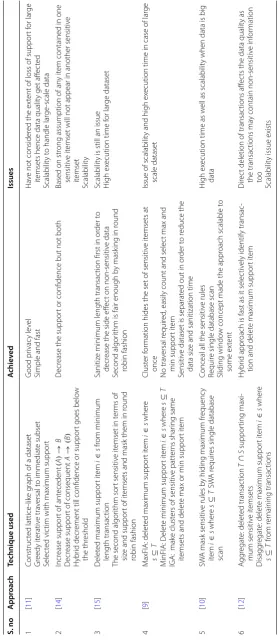
sliding window approach which maintains good data privacy and scalability. Amiri [12] claims to provide a high data quality and lower distortion by using the aggregation and disaggregation scheme. The author proposes to delete the transactions supporting the maximum number of sensitive itemsets directly and further, delete the maximum sup-port victim from the remaining sensitive transactions. Direct deletion of transactions may hide the sensitive itemsets in much less time but, possibly degrades the data quality. Because these deleted transactions may also contain some non-sensitive information. A summary of all the above traditional techniques is presented in Table 1.
Problem analysis
From the literature discussed in "Related work" and "Traditional heuristic approaches" sections, it can be stated that we need to preserve the data privacy in both ways i.e. for secure data storage/rule mining at a third party as well as by masking restricted sensi-tive information before data sharing. A number of traditional techniques exist in both categories which perform well with comparatively accommodating volumes of data; the current situation is not that much in-line and often results in high execution time and sometimes result in non-feasibility. Much work has been done to improvise outsourced techniques but data hiding techniques are still struggling with these limitations.
From Table 1, it can be observed that both MaxFIA [9] and SWA [10] are primary data hiding techniques offering multiple advantages over others in terms of simplicity, required number of database scans etc. Both these approaches identify maximum sup-port item as a victim and remove it from the supsup-porting transactions. For accommodat-ing volumes of data, as discussed in "Traditional heuristic approaches" section, MaxFIA is a novel scheme but when applied to a big dataset, it results in high execution time and non-scalability. Further, K-sliding window approach used in SWA resolves the scalability issue but these K-data windows still need to be processed in a sequential manner i.e. one after another which again results in high execution time.
These new challenges of scalability and high execution time paves a way for experi-menting with Big Data approaches (e.g. MapReduce framework). Thus, here we propose parallelized version of these conventional approaches by using MapReduce Framework.
Challenges in collaborating basic heuristics with MapReduce
Conventional MaxFIA and SWA techniques maintain a list of supporting transac-tion Ids against each sensitive itemset [9, 10]. After every victim item removal, a look ahead procedure is performed to verify if the transaction has also been selected for other restrictive rules. If yes, and the victim item we removed is also the part of this other restricted rule, we need to remove the transaction from the respective list. This improves the misses cost but requires to repeat the procedure for every transaction and sensitive itemset; it is a time consuming, computationally expensive and sometimes infeasible procedure for Big Data and a parallel environment. Therefore, these heuristics require to be modified in terms of following:
• Traditionally all sensitive itemsets are masked in one by one fashion.
to communicate and revise their set of sensitive itemset and respective list, which ultimately will increase communication and computation cost.
• If every node sanitizes their set of transaction (data chunk) independently then there is a chance of over-hiding which will degrade the data quality of sanitized dataset.
• To study how to divide a dataset into small data chunks such that even during paral-lel sanitization, the minimum length/DoC transaction can be modified first.
Therefore, we require few modifications of these basic heuristics to handle these chal-lenges while implementing them in a parallel environment (i.e. MapReduce framework). The proposed improved version maintains a global index file with the master node con-taining sensitive itemset, supporting transaction Ids list and their delta value to keep a check if a particular sensitive itemset further needs to be masked or not. This method-ology ultimately prevents over-hiding. Transaction ids list will now be used to find if a restricted pattern belongs to a transaction or not i.e. by directly searching for the particu-lar transaction id in the corresponding list. This helps in speeding up the sanitization pro-cess. Further, the global index file also mitigates the requirement of revising transaction list recursively during look ahead procedure. Now all computing nodes need to propagate the effect of victim item removal directly to the global file by reducing the correspond-ing delta value. This methodology is neither computationally expensive nor requires any communication among computing nodes but only with the master node. Lastly, for main-taining the requirement of sanitizing minimum length/DoC transaction first, we have modified data partitioner explained in "Overview" section. These small amendments in adopted heuristics when combined with MapReduce framework ultimately resolve all identified issues and help in masking sensitive itemsets in a parallel fashion within the real execution time.
MapReduce
MapReduce is a parallel programming framework [16] which provides us the oppor-tunity to leverage largely distributed resources to deal with the Big Data analytics. The framework divides and distributes the Big Data as well as heavy computation involved,
over n computing machines. These ‘n’ computing machines are combined to form a clus-ter. User need to specify two functions i.e. Map and Reduce which accept and process dataset in form of (key, value) pair and output the processed data again in (key value) same format i.e. (key1,val1)→(key2,val2). Map function processes the data and
gener-ates intermediate (key2,val2) pair which is given as the input to the reducer function for merging the values associated with the same key. MapReduce allows the resource of a largely distributed system to be utilized in a parallel fashion. The simplicity and high fault-tolerance are the key features which make MapReduce a promising framework. It hides the complications and handles failure automatically. Simple MapReduce compu-tation phase can be seen in Fig. 1 MapReduce provides two level of parallelization i.e. task level and job level. When a number of MapReduce jobs execute together, it is called job level parallelization and if multiple mappers and reducers run within a single job, it refers to task level parallelization.and distributes them
Proposed MapReduce version of MaxFIA and SWA
MapReduce framework divides the whole data into ‘n’ number of data chunks D= {d1∪d2∪d3· · · ∪dn} and distributes them over ‘n’ computing nodes. This is called data partition. By default, the maximum size of each data chunk is 64 MB depending on which value of n varies. We have deliberately designed a number of Map Reduce jobs which processes each data chunk parallel in two MapReduce phases.
Overview
Proposed two-phase MapReduce version can be viewed as a composition of some easy and small objectives. The first phase of MapReduce job runs on each data chunk in order to generate intermediate results, which are further sorted and merged in the second phase to generate final sanitized dataset. The overview of these phases is discussed below:
• Phase-I
• Sub-routine 1: (Data separator) Sensitive transactions (T*) {if s⊆T,where s∈S,T ∈D} are separated out from the non-sensitive transac-tions (T’) in order to reduce the size of dataset need to be processed further.
• Sub-routine 2: (Frequency calculator) Support of each 1-frequent item calculates and stores in an support index file(SIF), such that support of any item can be directly accessed by any node in a cluster.
• Sub-routine 3: (Victim identifier) Against each sensitive itemset, an item with maxi-mum support is selected as a victim.
• Sub-routine 4: (Transaction sorting) Sensitive transactions are sorted depending on the given condition (e.g. Length of transaction, Degree of conflict etc.).
• Sub-routine 5: (Sensitive itemset effect calculator) It calculates
sensitive itemset need to be masked for making it infrequent. All the sensitive item-sets and their corresponding values are stored in a global index file (GIF).
• Phase-II
Data partitioner: Initially, the sensitive dataset determined in Phase-I is sorted in increas-ing order of length/DoC. A total number of computincreas-ing nodes (n) in a cluster and sorted sensitive dataset is provided as input to the partitioner, where ’n’ new buckets(sets) are ini-tialized. Every (i+n)th transaction is provided to the (i)th bucket. Further, these data
buck-ets can be divided according to the value set for the size of each data chunk.
• Sensitive transactions are further divided into data chunks using data partitioner and distributed over n computing machines.
• At each node, victim item against each sensitive itemset is removed till all restricted information is hidden.
Finally, modified transactions and a non-sensitive set of transactions are combined to form final sanitized dataset. Further, we will take the techniques one by one and discuss their MapReduce version in detail.
MapReduce version of MaxFIA
Here, we introduce two-phase MapReduce version of MaxFIA which selects victim item with maximum support and sanitizes the transaction with a minimum degree of con-flict (DoC) first. Initially, we deliberately design the subroutine which runs over each of the partitioned datasets in parallel. For each restricted sensitive itemset, subroutine 1: concretely computes the frequency of each 1-frequent item (item, 1), subroutine 2: com-putes the DoC for each transaction i.e. number of the sensitive itemset, the transaction is supporting (Tid, 1). Further, subroutine 3: computes Delta value for each sensitive
itemset s. MapReduce framework sorts, shuffles, and merges these key value pairs to form a value list against each key i.e. (Tid,countlist), (item,countlist) and (s,�). These lists
These two phases explore the abundant computation power of the MapReduce parallel programming framework and can handle even voluminous data by using largely distrib-uted computing nodes. It is shown in "Experiments and performance analysis" section, that MapReduce can process the huge data volume in highly scalable fashion and within bounded execution time.
MapReduce version of SWA
SWA is an improvised version of MaxFIA and requires only single database scan. Slid-ing window approach used in SWA make it quite scalable but, still in case of big data the sanitization time is huge. Hence, MapReduce implementation helps the approach to be fast enough such that even voluminous data can be sanitized in an adequate amount of time. Unlike MaxFIA, SWA sorts the identified supporting transactions against any sensitive itemset in increasing order of their ’length’ to minimize the side effects on non-sensitive information. The data is processed by considering the set of transactions within K-size window. It adds to scalability but still each data window needs to be processed one after another i.e. in a sequential fashion and often results in high execution time. MapReduce framework not only reduces the sanitization time but also mitigates the requirement of sliding window approach. This is possible since it directly divides data into small chunks and sanitizes them in parallel.
In Phase-I, for each sensitive itemset s∈S, the frequency of a 1-frequent item is cal-culated by a subroutine in mapper and intermediate key-value pair (item, 1) is gener-ated. Subroutine 2: separates the sensitive transactions from the set of non-sensitive ones. Subroutine 3: calculates the length of the transaction denoted by variable ‘len’ i.e. number of total items in the transaction (Tid,len) and further, subroutine 4: evaluates
In Phase-II, set of the sensitive itemsets, corresponding victim item and sorted list (in terms of length) of sensitive transactions are provided as input to the mapper. Each node masks sensitive itemsets in parallel by removing the victim item. Finally, sanitized trans-actions are combined with the set of non-sensitive transtrans-actions to form final sanitized dataset, which can be shared with other parties. The pseudo-code of Phase-II is given in Algorithm 2. The only difference in Phase-II for both schemes is in the way of sorting taking place. In MaxFIA, transaction batch is sorted on the basis of DoC and in SWA it is sorted on the basis of length respectively.
Experiments and performance analysis
“kaggel’s- dataset repository” [20] and others are synthetically generated using IBM Quest Synthetic Data Generator.
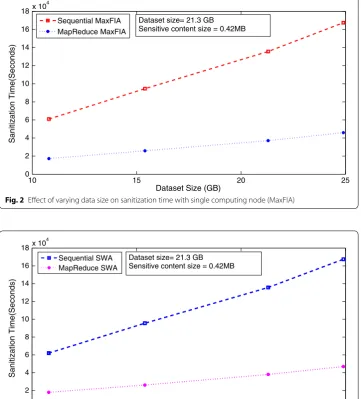
First, experimental setup compares both proposed and existing version of MaxFIA and SWA from the perspective of scalability and sanitization time. Figures 2 and 3 show the change in execution time with varying data size i.e. ranging from [10 to 25 GB]. It can be clearly observed that sanitization time required by the MapReduce-based algorithm for same size dataset is much less than the sequential traditional approach. Therefore, it can be concluded that even if we implement our approach on single node, we can observe that the sanitization time is much less compared to traditional approaches. This is because even on single node setup, Hadoop provides two mappers running in parallel.
10 15 20 25
0 2 4 6 8 10 12 14 16 18x 10
4
Dataset Size (GB)
Sanitization Time(Seconds)
Sequential MaxFIA MapReduce MaxFIA
Dataset size= 21.3 GB Sensitive content size = 0.42MB
Fig. 2 Effect of varying data size on sanitization time with single computing node (MaxFIA)
10 15 20 25
0 2 4 6 8 10 12 14 16
18x 10
4
Dataset Size (GB)
Sanitization Time(Seconds)
Sequential SWA MapReduce SWA
Dataset size= 21.3 GB Sensitive content size = 0.42MB
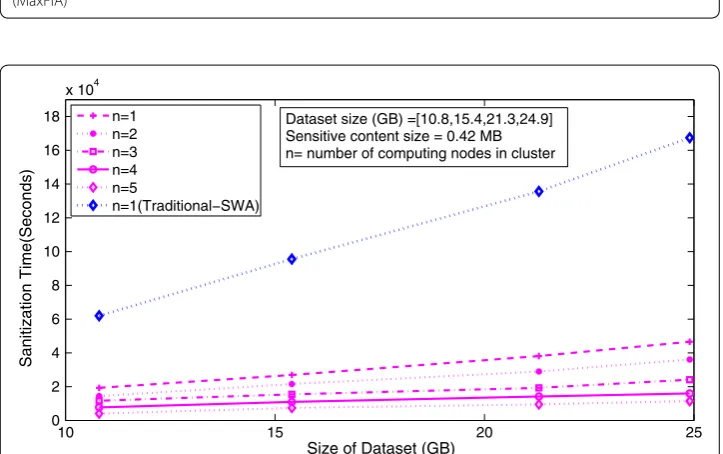
In the second set of experiments, we evaluated the effectiveness of MapReduce version in terms of change in execution time with varying data and cluster size. Figures 4 and 5 show the comparison of both approaches with respect to data size ranging from [10 to 25 GB] and a number of nodes within the cluster varying from 1 to 5. It can be observed that with the increase in the number of computing nodes, the execution time decreases for both schemes, because of the parallelization.
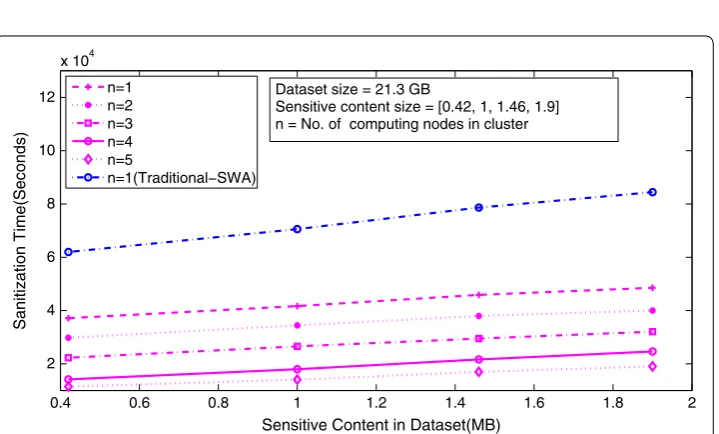
Lastly, the third set of experiments explores the change in sanitization time with vary-ing size of the sensitive content (0.5–2 MB) which exist in the dataset of size 21.3 GB. We evaluated the effectiveness of proposed approach in different scenarios, with varying cluster size from 1 to 5 nodes. Figures 6 and 7 compare the execution time for both the
10 15 20 25
0 2 4 6 8 10 12 14 16 18x 10
4
Size of Dataset (GB)
Sanitization Time(Seconds)
n=1 n=2 n=3 n=4 n=5
n=1(Traditional−MaxFIA)
Dataset size (GB) =[10.8,15.4,21.3,24.9] Sensitive content size = 0.42 MB n= number of computing nodes in cluster
Fig. 4 Effect of varying data size on sanitization time with varying number of computing nodes in cluster (MaxFIA)
10 15 20 25
0 2 4 6 8 10 12 14 16 18
x 104
Size of Dataset (GB)
Sanitization Time(Seconds)
n=1 n=2 n=3 n=4 n=5
n=1(Traditional−SWA)
Dataset size (GB) =[10.8,15.4,21.3,24.9] Sensitive content size = 0.42 MB n= number of computing nodes in cluster
approaches. It can be clearly observed that with the increase in sensitive content size the sanitization time increases. But still, the execution time of our approach is much less than traditional schemes. Further, with the increase in the number of computing nodes, sanitization time can be further reduced.
The efficiency of the proposed method in terms of privacy preservation can be explained using performance measures introduced in [10]: Hiding Failure There will be no hiding failure as the approach is committed to run till all the sensitive itemsets are masked. Artifactual Patterns As no foreign element has been added to the dataset for masking sensitive content, therefore no artificial patterns are expected to be generated. Lastly, in terms of Misses Cost: the performance of parallelized and original heuristics
0.4 0.6 0.8 1 1.2 1.4 1.6 1.8 2
2 4 6 8 10 12
x 104
Sensitive Content in Dataset(MB)
Sanitization Time(Seconds)
n=1 n=2 n=3 n=4 n=5
n=1(Traditional MaxFIA)
Dataset size = 21.3 GB
Sensitive content size = [0.42, 1, 1.46, 1.9] n = No. of computing nodes in cluster
Fig. 6 Effect of varying sensitive content size present in dataset with varying number of computing nodes in cluster (MaxFIA)
0.4 0.6 0.8 1 1.2 1.4 1.6 1.8 2
2 4 6 8 10 12
x 104
Sensitive Content in Dataset(MB)
Sanitization Time(Seconds)
n=1 n=2 n=3 n=4 n=5
n=1(Traditional−SWA)
Dataset size = 21.3 GB
Sensitive content size = [0.42, 1, 1.46, 1.9] n = No. of computing nodes in cluster
is expected to be the same because the quality of information hiding depends on two major factors that are- victim item selection and transaction selection. In either way (parallelized or traditional approach), maximum support item is selected as victim item and transactions are sanitized in the increasing order of their length or DoC. Hence, it can be clearly deduced that the privacy level achieved by both traditional and parallel version will be approximately same.
Finally, we can conclude that the MapReduce version of data hiding techniques out-performs the existing approaches in terms of scalability and execution time. Further, the efficiency of proposed approach can be improved by engaging more number of comput-ing nodes in a cluster. MapReduce framework supports cloud environment and hence, our approach can be easily implemented on a cloud infrastructure.
Conclusion
Expansion of Internet and its use for on-line activities (e.g. social networking, e-com-merce) overwhelmed E-Business with huge data volume, which facilitates organiza-tions for analyzing and understanding global trends and patterns. Sharing and analysis involved may expose personal or confidential information a dataset may contain; which is certainly a serious privacy threat. Traditional approaches for data hiding primar-ily MaxFIA and SWA were lacking with due inability to tackle large voluminous data. To subjugate the new challenge of scalability we have implemented these basic heuris-tics with Big Data approach i.e. MapReduce framework. Quantitative evaluations have shown that the fusion of MapReduce framework with these adopted heuristics fulfills its obligatory responsibility of being scalable and many-fold faster for yielding efficient analytic results.
Authors’ contributions
DT contributed to the underlying idea and helped in drafting the manuscript. DT played a pivotal role in guiding and supervising throughout. SS developed and implemented the idea, designed the experiments, analyzed the results and wrote the manuscript. Both authors read and approved the final manuscript.
Acknowledgements
We are thankful to DeitY for providing the scholarship to do the research in Ph.D. Program.
Competing interests
The authors declare that they have no competing interests.
Appendix
s Sensitive itemset
v Victim item selected to remove in order to reduce support of corresponding sensitive itemset
S Set of sensitive itemsets D Dataset
T Transaction 2 D
T* Sensitive transaction i.e. one which supports one or more sensitive itemsets
DOC Degree of conflict i.e. number of sensitive itemsets transac-tion supports
len Length of transaction i.e. total number of items transaction consists of
db Data chunk D* Sanitized dataset D′ Non-sensitive dataset
Sanitization time Execution time = Total time taken by the algorithm to hide all the given sensitive information present in a dataset. In this paper, we have used both terms interchangeably
Sensitive itemset Pattern of two or more items that exist together and may reveal some personal/confidential information that client do not want to disclose
Scalability Capability of a system/ model/function/algorithm to cope and perform under an increased or expanding workload (data volume)
Outsourced techniques All the privacy preservation techniques which ensure secure storage and computation of data at any third party like on a cloud
Data Hiding techniques Techniques which distort or block sensitive patterns which can reveal any personal or confidential information before sharing data
Privacy level It can be defined as the % of sensitive information masked before sharing data
Data quality Ratio of knowledge content present in dataset after sanitization
Global index file It maintains the sensitive itemset with corresponding sup-porting transaction Ids list and Delta value(Δ). It is main-tained with the master node and shared with all other com-puting nodes in a cluster
Support index file It maintains the list of 1-frequent itemset with global sup-port i.e. with respect to the whole dataset. SIF can be accessed directly by any node in a cluster
Received: 2 September 2016 Accepted: 27 February 2017
References
1. Zhang X, Yang LT, Liu C, Chen J. A scalable two-phase top-down specialization approach for data anonymization using mapreduce on cloud. IEEE Trans Parallel Distrib Syst. 2014;25(2):363–73.
2. Liu F, Shu X, Yao D, Butt AR. Privacy-preserving scanning of big content for sensitive data exposure with MapReduce. In: Proceedings of the 5th ACM conference on data and application Security and Privacy. New York: ACM; 2015. p. 195–6.
3. Yi X, Rao FY, Bertino E, Bouguettaya A. Privacy-preserving association rule mining in cloud computing. In: Proceed-ings of the 10th ACM symposium on information, computer and communications security. New York: ACM; 2015. p. 439–50.
4. Huang C, Lu R. EFPA: efficient and flexible privacy-preserving mining of association rule in cloud. In 2015 IEEE/CIC international conference on communications in China (ICCC). New York: IEEE; 2015. p. 1–6.
5. Li J, Li J, Chen X, Liu Z, Jia C. Privacy-preserving data utilization in hybrid clouds. Fut Gener Comput Syst. 2014;30:98–106.
6. Wei L, Zhu H, Cao Z, Dong X, Jia W, Chen Y, Vasilakos AV. Security and privacy for storage and computation in cloud computing. Inf Sci. 2014;258:371–86.
7. Yan Z, Ding W, Niemi V, Vasilakos AV. Two schemes of privacy-preserving trust evaluation. Fut Gener Comput Syst. 2016;62:175–89.
8. Dean J, Ghemawat S. MapReduce: simplified data processing on large clusters. Commun ACM. 2008;51:107–13. 9. Oliveira SR, Zaiane OR. Privacy preserving frequent itemset mining. In: Proceedings of the IEEE international
10. Oliveira SR, Zaïane OR. Protecting sensitive knowledge by data sanitization. New York: ICDM; 2003. Vol. 3, pp. 613–16. 11. Atallah M, Bertino E, Elmagarmid A, Ibrahim M, Verykios V. Disclosure limitation of sensitive rules. In: 1999 Workshop
on knowledge and data engineering exchange, (KDEX’99) Proceedings. 1999. p. 45–52.
12. Amiri A. Dare to share: protecting sensitive knowledge with data sanitization. Decis Support Syst. 2007;43(1):181–91. 13. Zhang X, Liu C, Nepal S, Yang C, Chen J. Privacy preservation over big data in cloud systems. In: Security, Privacy and
Trust in Cloud Systems. Berlin: Springer; 2014. p. 239–57.
14. Dasseni E, Verykios VS, Elmagarmid AK, Bertino E. Hiding association rules by using confidence and support. In: International workshop on information hiding. Berlin: Springer; 2001. p. 369–383.
15. Verykios VS, Elmagarmid AK, Bertino E, Saygin Y, Dasseni E. Association rule hiding. IEEE Trans Knowl Data Eng. 2004;16(4):434–47.
16. Bhandarkar M. MapReduce programming with apache Hadoop. In: IEEE international symposium on parallel and distributed processing (IPDPS), 2010. New York: IEEE; 2010.
17. Zhang Y, Cao T, Li S, Tian X, Yuan L, Jia H, Vasilakos AV. Parallel processing systems for big data: a survey. Proc IEEE. 2016;104(11):2114.
18. Fung BC, Wang K, Yu PS. Top-down specialization for information and privacy preservation. In: 21st international conference on data engineering (ICDE’05). New York: IEEE; 2005.
19. Sharma S, Toshniwal D. Parallelization of association rule mining: survey. In: International conference on computing, communication and security (ICCCS). New York: IEEE; 2015. p. 1–6.
![Fig. 1 Computation phase of MapReduce [1]](https://thumb-us.123doks.com/thumbv2/123dok_us/858038.1583390/7.595.119.480.562.720/fig-computation-phase-of-mapreduce.webp)