R E S E A R C H
Open Access
The many facets of community detection
in complex networks
Michael T. Schaub
1,2,3*, Jean-Charles Delvenne
2,4, Martin Rosvall
5and Renaud Lambiotte
3*Correspondence: [email protected]
1Institute for Data, Systems, and
Society, Massachusetts Institute of Technology, MA, 02139 Cambridge, USA
2ICTEAM, Université catholique de
Louvain, B-1348 Louvain-la-Neuve, Belgium
Full list of author information is available at the end of the article
Abstract
Community detection, the decomposition of a graph into essential building blocks, has been a core research topic in network science over the past years. Since a precise notion of what constitutes a community has remained evasive, community detection algorithms have often been compared on benchmark graphs with a particular form of assortative community structure and classified based on the mathematical techniques they employ. However, this comparison can be misleading because apparent
similarities in their mathematical machinery can disguise different goals and reasons for why we want to employ community detection in the first place. Here we provide a focused review of these different motivations that underpin community detection. This problem-driven classification is useful in applied network science, where it is important to select an appropriate algorithm for the given purpose. Moreover, highlighting the different facets of community detection also delineates the many lines of research and points out open directions and avenues for future research.
Keywords: Community detection, Graph partitioning, Modularity, Block model
Introduction
Sparked by the work of Newman and Girvan (Newman 2006b; Newman and Girvan 2004) on Modularity in Complex Systems, the area of community detection has become one of the main pillars of network science research. The promise that we can gain a deeper understanding of a system by discerning important structural patterns within a network has spurred a huge number of studies in this area. However, as has become abundantly clear by now, this problem has no canonical solution. In fact, even a general definition of what constitutes a community is still lacking. The reasons for this are not only grounded in the computational difficulties of tackling community detection. Furthermore, various research areas view community detection from different perspectives, which the lack of a consistent terminology illustrates: ‘network clustering’, ‘graph partitioning’, ‘community’, ‘block’ or ‘module detection’ all carry slightly different connotations. This jargon bar-rier creates confusion as soon as readers and authors have different preconceptions and intuitive notions are not made explicit.
We argue that community detection should not be considered as a well-defined prob-lem, but rather as an umbrella term with many facets. These facets emerge from different goals and motivations of what it is about the network that we want to understand or achieve, which lead to different perspectives on how to formulate the problem of
community detection. Therefore, it is critical to be aware of these underlying motiva-tions when selecting and comparing community detection methods. Thus, rather than an in-depth discussion of the technical details of different algorithmic implementa-tions (Schaeffer 2007; Fortunato 2010; Coscia et al. 2011; Parthasarathy et al. 2011; Newman 2012; Malliaros and Vazirgiannis 2013; Xie et al. 2013; Fortunato and Hric 2016), here we focus on the conceptual differences between different perspectives on community detection.
By providing a problem-driven classification, however, we donotargue that the
differ-ent perspectives are unrelated. In fact, in some situations, differdiffer-ent mathematical problem formulations can lead to similar algorithms and methods, and the different perspectives can offer valuable insights. For example, for undirected networks, optimizing the objec-tive function Modularity (Newman and Girvan 2004), initially proposed from a clustering perspective, can be interpreted both as optimizing a particular stochastic block model (Newman 2016) and a particular diffusion process on the networks (Delvenne et al. 2013), In other situations, however, such relations are not apparent.
Neither do we argue that there is a particular perspective that is a priori better suited for any given network. In fact, no method can consistently perform best on all kinds of networks (Peel et al. 2016). Community detection is an unsupervised learning task and we cannot know what are the quantities of interest for the analysis. Instead, to understand how useful a particular method is, we must take into account the context of why the researcher is interested in the communities (Von Luxburg et al. 2012).
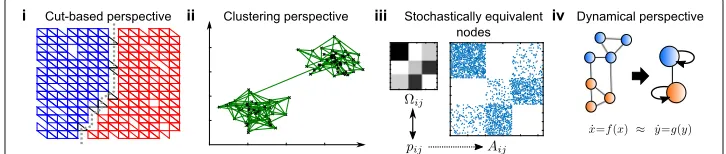
In the following, we unfold different aims underpinning community detection and dis-cuss how the resulting problem perspectives relate to various applications. We focus on four broad perspectives that have served as motivation for community detection in the literature: (i) community detection as minimization of some form of constraint violation; (ii) community detection framed as a discretised analogue of data clustering, in which densely knit groups of nodes are to be found; (iii) community detection aiming to iden-tify structurally equivalent nodes in a network, leading to notions such as stochastic block models; and (iv) community detection looking for simplified descriptions of the dynami-cal flows occurring on the network, that is, some form of dynamidynami-cal model reduction (see Fig. 1). While this categorization is not unique, we believe that it can help clarifying con-cepts about community detection and be a guide to using an appropriate method for a particular purpose.
Minimizing constraint violations: a cut based perspective
One of the earliest graphs partitioning applications was in the area of circuit layout and design (Alpert and Kahng 1995; Fortunato 2010). This spurred the development of the now classical Kernighan-Lin algorithm (Kernighan and Lin 1970) and the work by Donath and Hoffman (1972, 1973), who were among the first to suggest the use of eigenvectors for graph partitioning. For instance, we might be confronted with a graph which describes the signal flows between different components of a circuit. To implement the circuit in an efficient way, our goal is now to partition the graph into a fixed number of approximately equally sized groups with a small number of edges between those groups. The edges that run between the groups are commonly denoted as the cut. Our aim is thus to minimize
this cut while keeping some kind ofbalanced groups, which is an important ingredient in
this context.
To make this more precise let us consider one specific variant of this scheme, known as ratio cut(Hagen and Kahng 1992). Let us denote the adjacency matrix of an undirected
network withnnodes byA, whereAij =1 if there is a connection from nodeito nodej,
andAij=0 if the nodes are not connected. We can now write the problem of optimizing
the ratio cut for a bipartition of all verticesVinto two communitiesV1andV2=V\V1as
follows (Hagen and Kahng 1992; Von Luxburg 2007):
min
Vi RatioCut(V1,V2):=minVi
i
cut(Vi,V\Vi)
|Vi| , (1)
where cut(V1,V2):=i∈V1,j∈V2(Aij+Aji)/2 is the sum of the (weighted) edges between
the two vertex setsV1,V2. Related problem formulations also occur in the context of
par-allel computations and load scheduling (Spielman and Teng 1996; Pothen 1997), where approximately equally sized portions of work are to be sent to different processors, while keeping the dependencies between those tasks minimal. Further applications include sci-entific computing (Pothen 1997; Spielman and Teng 1996), where partitioning algorithms can be used to divide the coordinate meshes arising in the context of discretizing and solving partial differential equations. Image segmentation problems may also be phrased in terms of cut-based measures (Shi and Malik 2000; Von Luxburg 2007).
Investigating these types of problems, has led to many important contributions for par-titioning graphs, in particular in relation to spectral methods. The connection of spectral algorithms to cut-based problem formulations arises naturally by considering relaxations of the original, combinatorially hard discrete optimization problems such as (2), or other related objective functions such as the average or normalized cuts. This can be best seen when rewriting the above optimzation problem as follows:
min
f f
TLf (2)
subject to f ⊥1 f =√n (3)
where fi:=
−|V2|/|V1| ifi∈V1
|V1|/|V2| ifi∈V2
(4)
Here the Laplacian matrix of the network has been defined asL = D−A, whereD
is the diagonal degree matrix withDii = jAij. We mention here the seminal work of
eigenvector can thus be used to compute spectral bi-partitions. Such spectral ideas led to many influential algorithms and methods, see, for example, (Von Luxburg 2007) for a tutorial on spectral algorithms.
In this cut-based problem formulation, there is no specification as to how the found groups in the partition should be connected internally. While there is the implicit con-straint that the groups must not split into groups with an even smaller cut, there is no specification that the found groups of nodes are densely connected internally. Indeed, the type of graphs considered in the context of cut-based partitions are often of a mesh or grid like form, and for these kind of graphs several guarantees can be given in terms of the quality of the partitions obtained by spectral algorithms (Spielman and Teng 1996). While such non-dense groupings emerging from ‘non-clique structures’ (Schaub et al. 2012) can also be dynamically relevant (see Section “Communities as dynamical building blocks”), they are likely to be missed when employing a community notion that focuses on finding dense groupings as discussed next.
Maximizing internal density: the clustering perspective
A different motivation for community detection arises when considered in the context of data clustering. We use the term clustering, which itself has been a synonym for many different things, in the following sense: For a set of given data points in a possibly high-dimensional space, the goal here is to partition the points into a number of groups, such that points within a group are ‘close’ (or ‘similar’); and points in different groups are more distant to each other. To achieve this goal one often constructs a proximity or similarity graph between the points and tries to group nodes together that are closer to each other than they are to the rest of the graph. This approach results again in a form of community detection problem where the closeness between nodes is described by the presence and weight of the edges between them.
Although minimizing the cut size and maximizing the internal number of links are closely related, there are differences here contrasting with the cut-based perspective out-lined above, pertaining to the typical constraints and search space associated with these objective functions. First, when employing a clustering perspective there is normally no a priori information as to the number of groups we are looking for. Second, we do not necessarily require the groups to be balanced in any way, rather we would like to find an ‘optimal’ split into densely knit groups irrespective of their relative sizes.
Unsurprisingly, finding an optimal clustering is again a computationally hard problem. Further, as Kleinberg has shown (Kleinberg 2003), there are no clustering algorithms sat-isfying a certain set of intuitive properties we might require from a clustering algorithm in continuous spaces; and similar problems also arise in the discrete setting for clustering of graphs (Browet et al. 2016).
find localized clusters around one or more seed nodes. Given a set of nodesVk ⊂ V, a
potential community, its local conductance can be written as:
φ(Vk):=
i∈Vk,j∈/VkAij
min{vol(Vk), vol(V\Vk)}
, (5)
where vol(Vk) := i∈VkjAij is the total degree of the nodes in set Vk, commonly
termed its volume in analogy with (continuous) geometric objects. Interestingly, it has been shown that in specific contexts the conductance can be a good predictor of some
latent group structures in several real-world applications (Yang and Leskovec 2015)1.
Moreover, a local perspective on community detection has two appealing properties: First, the definition of a cluster does not depend on the global graph structure but only on the relative local density. Second, only a portion of a graph needs to be accessed, which is advantageous if there are computational constraints (very large graphs), or we are only interested in a particular subsystem. In such cases, we would like to avoid having to apply a method to the whole graph to find, for example, the cluster containing a particular node in the graph.
The Newman-Girvan Modularity (Newman and Girvan 2004; Newman 2006b) is arguably one of the most common clustering measures used in the literature and was originally proposed from the clustering perspective discussed here. It is a global quality function and aims to find the community structure of the network as a whole. Given a
partitionP = {V1,. . .,Vk}of a graph intokgroups, the Modularity ofPcan be written
as:
Q(P):= 1 2m
k
q=1
i,j∈Vq
Aij−
didj
2m
, (6)
wheredi =jAijis the degree of nodeiand 2m=idiis the total weight of all edges
in the graph. By optimizing the Modularity measure over the space of all partitions, one aims to identify groups of nodes that are more densely connected to each other than one would expect according to a statistical null model of the graph. This statistical null model is commonly chosen to be the configuration model with preserved degree sequence.
However, a by-product of this choice of a global null-model is the tendency of Modular-ity to balance the size of the modules in terms of their total connectivModular-ity. While different variants of Modularity aim to account for this effect (Fortunato 2010), this makes Mod-ularity also interpretable as a trade-off between a cut-based measures and an entropy (Delvenne et al. 2013). In fact, Modularity can be seen as a proxy for all the perspec-tives discussed in this article. The optimization of Modularity is usually performed by means of spectral or greedy algorithms (Fortunato 2010; Newman 2006a; Blondel et al. 2008). While there are problems with this approach, such as its resolution limit (Fortu-nato and Barthélemy 2007) and other spurious effects (Fortu(Fortu-nato and Barthélemy 2007; Good et al. 2010; Guimera et al. 2004; Lancichinetti and Fortunato 2011), the general idea has triggered development of a plethora of algorithms that follow a similar strategy (Fortunato 2010). Several works have addressed some of these shortcomings, for instance by incorporating a resolution parameter, or explicitly accounting for the density inside each group (Chen et al. 2014; Chen et al. 2015).
By grouping similar nodes that link to similar nodes into communities, we
differently, if we ordered the nodes in the network according to the underlying group structure, the adjacency matrix would be close to block diagonal. While we may also have hierarchical clusters with clusters of clusters etc., such an assortative structural organisa-tion might be too restrictive if we want to analyse, for example, social networks or capture the organisation of bipartite networks. If we aim to define groups based on more general connectivity patterns, this leads naturally to notions such as the stochastic equivalence, which we will consider in the next section.
Nodes with similar structural roles and stochastic block models
Within social network analysis, a common goal is to identify nodes within a network that serve a similar structural role in terms of their connectivity profile. Accordingly, nodes are similar if they share the same kind of connection patterns to other nodes. This idea
is captured in notions such asregular equivalence, which states that nodes are regularly
equivalent if they are equally related to equivalent others (Everett and Borgatti 1994;
Han-neman and Riddle 2005). A relaxation of this idea isstochastic equivalence(Holland et al.
1983), which means that nodes are equivalent if they connect to equivalent nodes with equal probability.
One of the most popular techniques to model and detect such kind of relationship in network data is the use of stochastic block models (SBMs) (Holland et al. 1983; Nowicki and Snijders 2001) and associated inference techniques. These models have their roots in the social networks literature (Anderson et al. 1992; Holland et al. 1983), and provide a flexible framework for modelling block structures within a network. When consider-ing block models, we are interested in identifyconsider-ing node groups such that nodes within a community connect to nodes in other communities in an ‘equivalent way’ (Fortunato and Hric 2016).
Consider a network composed ofnnodes divided intokclasses. The standard SBM is
defined by the set of node class labels and the affinity matrix. More precisely, the link
probability between two nodesi,jbelonging to classciandcjis given by:
pij:=P(Aij)=cicj.
Under an SBM, nodes within the same class thus have exactly the same probabilities to connect to nodes of another class. This is the mathematical formulation of having stochastically equivalent nodes within each class. Finding the latent groups of nodes in a network now amounts to inferring the model parameters that provide the best fit for the observed network. That is, find the SBM with the highest likelihood.
The standard SBM assumes that the expected degree of each node is a Poisson binomial random variable (a Binomial random variable with possibly non-identical success proba-bilities in each trial). Because inferring the most likely SBM typically results in grouping nodes based on their degree in empirical networks with broad degree distributions, it can be advantageous to include a degree correction into the model. In the degree corrected
SBM (Karrer and Newman 2011), the probabilitypij for a link to appear between two
nodesi,jdepends both on their class labelsci,cjand their respective degree parameters
di,dj(each entryAijmight be a Bernoulli or a Poisson random variable such as in (Karrer
and Newman 2011)):
Thus, while edges in real-world networks tend to be correlated from effects such as triadic closure (Fortunato 2010), by construction edges are conditionally independent random variables in SBMs. Moreover, most common SBMs are defined for unweighted networks or networks with integer weights by modelling the network as a multi-graph. Though there are generalizations (Aicher et al. 2014; Peixoto 2015), this is still an area comparably less studied.
In contrast to the notions of community considered above, with stochastic equivalence we are no longer interested in maximising some internal density or minimising a cut. To see this, consider a bipartite graph that from a cut- or density-based perspective contains no communities (one may even see bipartite structure as ‘anti-communities’). From the stochastic equivalence perspective, however, we would say that this graph contains two groups because nodes in each set only connect to nodes in the other set.
When adopting an SBM to detect such structural organisation of the links, we explicitly adopt a statistical model for the networks. The network is essentially an instance of an
ensemble of possible networks generated from such a model2. This model based approach
comes with several advantages: First, by defining the model we effectively declare what is signal and what is noise in the data under the SBM. We can thus provide a
statisti-cal assessment of the observed data with, for example,p-values under the SBM. In other
words, we can identify patterns that cannot be reasonably explained from density fluctu-ations of edges inherent to any realisation of this model. Second, we are, for example, able to generate new networks from our model with a similar group structure, or predict miss-ing edges and impute data. Third, we can make strong statements about the detectability of groups within a graph. For example, precise criteria specify when any algorithm can recover the planted group structure for a graph created by an SBM (Decelle et al. 2011; Mossel et al. 2013). By fitting an SBM to an observed adjacency matrix it is possible to recover such a planted group structure down to its theoretical limit (Mossel et al. 2013; Massoulié 2014). While these criteria apply to networks generated with SBMs and not real networks in general, in which case we do not know what kind of process created the network (Peel et al. 2016), it is nevertheless a remarkable result since it highlights that there are networks with undetectable block patterns.
Many benchmark graphs proposed in the literature, such as the commonly used LFR benchmarks (Lancichinetti et al. 2008), can be seen as specific types of SBMs. Results on these benchmarks graphs should therefore be interpreted with the SBM perspective in mind, especially with respect to the detectability limit. Finally, this model based approach also offers ways to estimate the number of communities from the data by some form of model selection, including hypothesis testing (Bickel and Sarkar 2016), spectral tech-niques (Krzakala et al. 2013; Saade et al. 2014), the minimum description length principle (Peixoto 2013), or Bayesian inference (Yan 2016).
Communities as dynamical building blocks
that can take place on the network, the network topology alone cannot explain the system behavior. Whence, instead of finding a coarse grained description of the adjacency matrix, we might be interested in finding a coarse grained description of the dynamics acting on top of the network.
Take air traffic as an example. An airline network, with weighted links connecting cities according to the number of flights between them, can offer some interesting insights about air traffic. For instance, in the US air traffic network, Las Vegas and Atlanta form two major hubs. However, if we instead focus on the passenger flows based on actual itineraries, the two cities show very different behavior: Las Vegas is a tourist destination and typically the final destination of itineraries, whereas Atlanta is a transfer hub onto other final destinations (Rosvall et al. 2014; Peixoto and Rosvall 2015). Thus, these air-ports play dynamically quite different roles in the network. Focusing on interconnection patterns alone can thus give an incomplete picture if we are interested in the dynamical behavior of a system, for which additional dynamical information should be taken into account. Conversely, a concentration of edges with high impact on the dynamics may just arise from a statistical fluctuation, if the network is seen as a realization of a par-ticular random graph model. In this way, structural and dynamical approaches can offer complementing information.
Flow-based community detection approaches focus on specifying the modular dynam-ics on a given, fixed network. Consequently, depending on the dynamdynam-ics of interest, the modular building blocks may look different. In general, however, they are blocks of nodes with different identities that trap the flow or channel it in specific directions. That is, they form reduced models of the dynamics where blocks of nodes are aggregated to
sin-gle meta nodes with similardynamical functionwith respect to the rest of the network.
In this view, the goal of community detection is to find effective coarse-grained system descriptions of how the dynamics take place on the network structure.
This dynamical take on community detection has primarily focused on modelling the dynamics with Markovian diffusion processes (Delvenne et al. 2010; Lambiotte et al. 2014; Rosvall and Bergstrom 2008), though work of topological scales and synchroniza-tion share the same common ground (Arenas et al. 2006). Interestingly, for a simple diffusion dynamics such as a random walk on an undirected network, which is essen-tially determined by the spectral properties of the network Laplacian, this perspective is tightly connected with the clustering perspective discussed in Section “Maximizing internal density: the clustering perspective”. This is because the presence of densely knit groups within the network can introduce a time-scale separation in the diffusion dynam-ics: A random walker traversing the network will initially be trapped for a significant time inside a community corresponding to the fast time-scale, before it can escape and explore the larger network corresponding to a slower time-scale. However, already for directed networks this connection between link density and dynamical behavior breaks down, even for a simple diffusion process Lambiotte et al. (2014; Rosvall and Bergstrom 2008; Schaub et al. 2012). This apparent relationship breaks down completely when focusing on longer pathways, possibly with memory effects in the dynamics (Rosvall et al. 2014; Salnikov et al. 2016).
A dynamical perspective is useful especially in applications in which the network itself is well defined, but the emergent dynamics are hard to grasp. For instance, consider the
A basic generative network model, such as a Barabasi-Albert graph or an SBM, might be too simple to capture the complex architecture of the network, and sampling alternative networks from such a model will not create valid alternative roundworm connectomes. Indeed, some more complicated network generative models have been proposed to model the structure of the network (Nicosia et al. 2013), and may be used to assess the signifi-cance of individual patterns compared to the background of the assumed model. However, if instead we are interested in assessing the dynamical implications of the evolutionary conserved network structure, it may be fruitful to engineer differences in the actual net-work and investigate how they affect the dynamical flows in the system. For instance,
one can replicate experimental node ablationsin silicoand assess their dynamical impact
(Bacik et al. 2016).
In the dynamical perspective we are typically interested in how short term dynamics are integrated into long term behavior of the system and seek a coarse grained descrip-tion of the dynamics occurring on a given network. The network itself represents the true structure, save for empirical imperfections. This dynamical viewpoint is not tied to a particular method: for instance, it is possible to formulate generative statistical
mod-els for empirically observed pathways (Peixoto and Rosvall 2015)3. Compared to some
the previous perspectives, the dynamical viewpoint has received somewhat less atten-tion and has been confined mainly to diffusion dynamics. A key challenge is to extend this perspective to other types of dynamics and link it more formally to approaches of model order reduction considered in control theory. In light of the recently growing interest in control of complex systems, this could help us better understanding complex systems.
Discussion
Community detection can be viewed through a range of different lenses. Rather than look-ing at community detection as a generic tool that is supposed to work in a generic context, considering the application in mind is important when choosing between or comparing different methods. Each of the perspectives outlined above has its own particularities, which may or may not be suitable for the problem of interest.
We emphasize the different perspectives in the following example. Given a real-world graph generated by a possibly complex random assignment of edges, we assume that we are interested in some particular dynamics taking place on this graph such as epi-demic spreading. We also assume that the graph is structured such that the dynamics exhibit a time-scale separation. If, for instance, we want to coarse grain an epidemic and identify critical links that should be controlled to confine the epidemics, then it does not matter whether or not random fluctuations generated the modules that induces the time-scale separation. In any case, these modules will be relevant for the dynamics.
Let us now consider the same network from a stochastic equivalence perspective, and assume for simplicity that the graph is a particular realization of an Erd˝os-Rényi graph. In this case, an approach based on the SBM is expected to declare that there is no significant pattern to be found here at all, as the encountered structural variations can already be explained by random fluctuations rather than by hidden class labels. Thus, communities in the SBM picture are defined via the latent variables within the statistical model of the network structure, and not via their impact on the behavior of the system. In this way, different motivations for community detection can find different answers even for the very same network.
In addition to the differences between these perspectives, there are also variations
withineach perspective. For instance, distinct plausible generative models such as the standard SBM or the degree corrected SBM will for a given graph lead to different inferred community structure. Similar variations exist in the dynamical paradigm as well: distinct natural assumptions for the dynamics, such as dynamics with memory or not, uniform across nodes or edges, etc., applied to a given graph will lead to different partitions. Also different balancing criteria, or different concepts of high internal density will be valid in different contexts.
As a matter of fact, some of the internal variations make the perspectives overlap in particular scenarios. For instance, one can compare all algorithms on simple, undirected LFR benchmark graphs (Lancichinetti et al. 2008). However, the LFR benchmark clearly imposes a density-based notion of communities. Similarly, for simple undirected net-works, optimizing Modularity corresponds to the inference of a particular SBM (Newman 2016) or may be reinterpreted as a diffusion process on a graph (Delvenne et al. 2013). Nevertheless, this overlap of concepts, typically present on unweighted undirected net-works, is only partial, and breaks down, for example, for directed, weighted netnet-works, or for more complex dynamics.
Conclusions
Endnotes
1Let us emphasize here again that this fact does not mean that conductance is a more
meaningful algorithm in any way, or able to reveal some generic ‘ground truth’; see (Peel et al. 2016) for an extensive discussion on the relation of meta-data and structure.
2This ensemble assumption is also reflected in the Modularity formalism, where the
observed network is compared to a null model.
3Note, however, that whereas the generative approach in (Peixoto and Rosvall 2015)
tries to explicitly model the underlying state space of the trajectories, we may simply be interested in effectively compressing the long term behavior of the system, which is a somewhat different goal. See, for instance, the discussion in (Peixoto and Rosvall 2015; Persson et al. 2016)
Acknowledgements
We thank Aaron Clauset, Leto Peel and Daniel Larremore for fruitful discussions. M.R. was supported by the Swedish Research Council grant 2012-3729. MTS, JCD, and RL acknowledge support from: FRS-FNRS; the Belgian Network DYSCO (Dynamical Systems, Control and Optimisation) funded by the Interuniversity Attraction Poles Programme initiated by the Belgian State Science Policy Office; and the ARC (Action de Recherche Concerte) on Mining and Optimization of Big Data Models funded by the Wallonia- Brussels Federation.
Availability of data and materials Not applicable.
Authors’ contributions
All authors wrote the manuscript. All authors read and approved the final manuscript.
Competing interests
The authors declare no competing financial interests.
Author details
1Institute for Data, Systems, and Society, Massachusetts Institute of Technology, MA, 02139 Cambridge, USA.2ICTEAM,
Université catholique de Louvain, B-1348 Louvain-la-Neuve, Belgium.3naXys and Department of Mathematics, University
of Namur, B-5000 Namur, Belgium.4CORE, Université catholique de Louvain, B-1348 Louvain-la-Neuve, Belgium. 5Integrated Science Lab, Department of Physics, Umeå University, SE-901 87 Umeå, Sweden.
Received: 15 November 2016 Accepted: 3 February 2017
References
Ahn YY, Bagrow JP, Lehmann S (2010) Link communities reveal multiscale complexity in networks. Nature 466(7307):761–764. doi: 10.1038/nature09182
Aicher C, Jacobs AZ, Clauset A (2014) Learning latent block structure in weighted networks. J Complex Netw 3(2):221–248. doi:10.1093/comnet/cnu026
Alpert CJ, Kahng AB (1995) Recent directions in netlist partitioning: a survey. Integration VLSI J 19(1):1–81 Andersen R, Chung F, Lang K (2006) Local graph partitioning using pagerank vectors. In: 2006 47th Annual IEEE
Symposium on Foundations of Computer Science (FOCS’06). IEEE. pp 475–486. doi:10.1109/FOCS.2006.44 Anderson CJ, Wasserman S, Faust K (1992) Building stochastic blockmodels. Soc Netw 14(1):137–161
Arenas A, Díaz-Guilera A, Pérez-Vicente CJ (2006) Synchronization reveals topological scales in complex networks. Phys Rev Lett 96(11):114–102. doi:10.1103/PhysRevLett.96.114102 http://prl.aps.org/abstract/PRL/v96/i11/e114102 Bacik KA, Schaub MT, Beguerisse-Díaz M, Billeh YN, Barahona M (2016) Flow-based network analysis of theCaenorhabditis
elegansConnectome. PLoS Comput Biol 12(8):1–27. doi:10.1371/journal.pcbi.1005055
Benson AR, Gleich DF, Leskovec J (2016) Higher-order organization of complex networks. Science 353(6295):163–166. doi:10.1126/science.aad9029
Bickel PJ, Sarkar P (2016) Hypothesis testing for automated community detection in networks. J R Stat Soci Series B (Stat Methodol) 78(1):253–273
Blondel VD, Guillaume JL, Lambiotte R, Lefebvre E (2008) Fast unfolding of communities in large networks. J Stat Mech Theory Experiment 2008(10):P10008
Boccaletti S, Bianconi G, Criado R, Del Genio CI, Gómez-Gardeñes J, Romance M, Sendiña-Nadal I, Wang Z, Zanin M (2014) The structure and dynamics of multilayer networks. Phys Rep 544(1):1–122
Browet A, Hendrickx JM, Sarlette A (2016) Incompatibility boundaries for properties of community partitions. arXiv:160300621. https://arxiv.org/abs/1603.00621
Chen M, Kuzmin K, Szymanski BK (2014) Community detection via maximization of modularity and its variants. IEEE Trans Comput Soc Syst 1(1):46–65
Chen M, Nguyen T, Szymanski BK (2015) A new metric for quality of network community structure. arXiv:150704308 Coscia M, Giannotti F, Pedreschi D (2011) A classification for community discovery methods in complex networks. Stat
Decelle A, Krzakala F, Moore C, Zdeborová L (2011) Inference and phase transitions in the detection of modules in sparse networks. Phys Rev Lett 107:065701. doi:10.1103/PhysRevLett.107.065701
Delvenne JC, Yaliraki SN, Barahona M (2010) Stability of graph communities across time scales. Proc Natl Acad Sci 107(29):12755–60
Delvenne JC, Schaub MT, Yaliraki SN, Barahona M (2013) The stability of a graph partition: A dynamics-based framework for community detection. In: Dynamics On and Of Complex Networks, Volume 2. Springer. pp 221–242.
doi:10.1007/978-1-4614-6729-8_11
Donath WE, Hoffman AJ (1972) Algorithms for partitioning of graphs and computer logic based on eigenvectors of connection matrices. IBM Tech Discl Bull 15(3):938–944
Donath, WE, Hoffman AJ (1973) Lower bounds for the partitioning of graphs. IBM J Res Dev 17(5):420–425 Everett MG, Borgatti SP (1994) Regular equivalence: General theory. J Math Sociol 19(1):29–52
Fiedler M (1973) Algebraic connectivity of graphs. Czechoslov Math J 23(2):298–305
Fiedler, M (1975) A property of eigenvectors of nonnegative symmetric matrices and its application to graph theory. Czechoslov Math J 25(4):619–633
Fortunato S (2010) Community detection in graphs. Phys Rep 486(3):75–174
Fortunato S, Barthélemy M (2007) Resolution limit in community detection. Proc Natl Acad Sci 104(1):36–41. doi:10.1073/pnas.0605965104 http://www.pnas.org/content/104/1/36.abstract
Fortunato S, Hric D (2016) Community detection in networks: a user guide. Physics Reports 659:1 – 44. arXiv:160800163. doi:10.1016/j.physrep.2016.09.002
Good BH, de Montjoye YA, Clauset A (2010) Performance of modularity maximization in practical contexts. Phys Rev E 81(4):046106. doi:10.1103/PhysRevE.81.046106 http://pre.aps.org/abstract/PRE/v81/i4/e046106
Guimera R, Sales-Pardo M, Amaral LAN (2004) Modularity from fluctuations in random graphs and complex networks. Phys Rev E 70(2):025101
Hagen L, Kahng AB (1992) New spectral methods for ratio cut partitioning and clustering. IEEE Trans Comput Aided Des Integr Circ Syst 11(9):1074–1085
Hanneman RA, Riddle M (2005) Introduction to social network methods, University of California Riverside Holland PW, Laskey KB, Leinhardt S (1983) Stochastic blockmodels: First steps. Soc Netw 5(2):109–137 Holme P, Saramäki J (2012) Temporal networks. Phys Rep 519(3):97–125
Kannan R, Vempala S, Vetta A (2004) On clusterings: Good, bad and spectral. J ACM (JACM) 51(3):497–515 Karrer B, Newman ME (2011) Stochastic blockmodels and community structure in networks. Phys Rev E 83(1):016107 Kernighan BW, Lin S (1970) An efficient heuristic procedure for partitioning graphs. Bell Syst Tech J 49(2):291–307 Kleinberg J (2003) An impossibility theorem for clustering. In: Becker S, Thrun S, Obermayer K (eds). Advances in neural
information processing systems 15. MIT Press. pp 463–470. http://papers.nips.cc/paper/2340-an-impossibility-theorem-for-clustering.pdf
Kloster K, Gleich DF (2014) Heat kernel based community detection. In: Proceedings of the 20th ACM SIGKDD international conference on Knowledge discovery and data mining. ACM. pp 1386–1395. doi:10.1145/2623330.2623706 Krzakala F, Moore C, Mossel E, Neeman J, Sly A, Zdeborová L, Zhang P (2013) Spectral redemption in clustering sparse
networks. Proc Natl Acad Sci 110(52):20935–40
Lambiotte R, Delvenne JC, Barahona M (2014) Random walks, Markov processes and the multiscale modular organization of complex networks. IEEE Trans Netw Sci Eng 1(2):76–90
Lancichinetti A, Fortunato S (2011) Limits of modularity maximization in community detection. Phys Rev E 84:066122. doi:10.1103/PhysRevE.84.066122
Lancichinetti A, Fortunato S, Radicchi F (2008) Benchmark graphs for testing community detection algorithms. Phys Rev E 78(4):046110. doi:10.1103/PhysRevE.78.046110 http://pre.aps.org/abstract/PRE/v78/i4/e046110
Malliaros FD, Vazirgiannis M (2013) Clustering and community detection in directed networks: A survey. Phys Rep 533(4):95–142
Massoulié L (2014) Community detection thresholds and the weak Ramanujan property. In: Proceedings of the 46th Annual ACM Symposium on Theory of Computing. ACM. pp 694–703. doi:10.1145/2591796.2591857
Mossel E, Neeman J, Sly A (2013) A proof of the block model threshold conjecture. arXiv:13114115. https://arxiv.org/abs/ 1311.4115
Newman MEJ (2016) Equivalence between modularity optimization and maximum likelihood methods for community detection. Phys. Rev. E 94(5):052315. American Physical Society. arXiv:160602319, doi:10.1103/PhysRevE.94.052315, http://link.aps.org/doi/10.1103/PhysRevE.94.052315
Newman ME (2006a) Finding community structure in networks using the eigenvectors of matrices. Phys Rev E 74(3):036104
Newman MEJ (2006b) Modularity and community structure in networks. Proc Natl Acad Sci 103(23):8577–8582. doi:10.1073/pnas.0601602103 http://www.pnas.org/content/103/23/8577.abstract
Newman ME (2012) Communities, modules and large-scale structure in networks. Nat Phys 8(1):25–31
Newman MEJ, Girvan M (2004) Finding and evaluating community structure in networks. Phys Rev E 69(2):026,113. doi:10.1103/PhysRevE.69.026113 http://pre.aps.org/abstract/PRE/v69/i2/e026113
Nicosia V, Vértes PE, Schafer WR, Latora V, Bullmore ET (2013) Phase transition in the economically modeled growth of a cellular nervous system. Proc Natl Acad Sci 110(19):7880–7885. doi:10.1073/pnas.1300753110 http://www.pnas.org/ content/110/19/7880.abstract
Nowicki K, Snijders TAB (2001) Estimation and prediction for stochastic blockstructures. J Am Stat Assoc 96(455):1077–1087
Parthasarathy S, Ruan Y, Satuluri V (2011) Community discovery in social networks: Applications, methods and emerging trends. In: Social network data analytics. Springer. pp 79–113
Peel L, Larremore DB, Clauset A (2016) The ground truth about metadata and community detection in networks. arXiv:160805878 http://arxiv.org/abs/1608.05878
Peixoto, TP (2015) Inferring the mesoscale structure of layered, edge-valued, and time-varying networks. Phys Rev E 92(4):042807
Peixoto TP, Rosvall M (2015) Modeling sequences and temporal networks with dynamic community structures. arXiv:150904740. https://arxiv.org/abs/1509.04740
Persson C, Bohlin L, Edler D, Rosvall M (2016) Maps of sparse markov chains efficiently reveal community structure in network flows with memory. arXiv preprint arXiv:160608328. https://arxiv.org/abs/1606.08328
Pothen A (1997) Graph partitioning algorithms with applications to scientific computing. In: Parallel Numerical Algorithms. Springer. pp 323–368. doi:10.1007/978-94-011-5412-3_12
Rosvall M, Bergstrom CT (2008) Maps of random walks on complex networks reveal community structure. Proc Natl Acad Sci 105(4):1118—1123
Rosvall M, Esquivel AV, Lancichinetti A, West JD, Lambiotte R (2014) Memory in network flows and its effects on spreading dynamics and community detection. Nat Commun 4630:5. doi:10.1038/ncomms5630
Saade A, Krzakala F, Zdeborová L (2014) Spectral clustering of graphs with the bethe hessian. In: Ghahramani Z, Welling M, Cortes C, Lawrence ND, Weinberger KQ (eds). Advances in Neural Information Processing Systems 27. Curran Associates, Inc. pp 406–414. http://papers.nips.cc/paper/5520-spectral-clustering-of-graphs-with-the-bethe-hessian.pdf
Salnikov V, Schaub MT, Lambiotte R (2016) Using higher-order Markov models to reveal flow-based communities in networks. Sci Rep:6:23194. doi:10.1038/srep23194
Schaeffer SE (2007) Graph clustering. Comput Sci Rev 1(1):27–64
Schaub MT, Delvenne JC, Yaliraki SN, Barahona M (2012) Markov dynamics as a zooming lens for multiscale community detection: non clique-like communities and the field-of-view limit. PloS ONE 7(2):e32210
Sekara V, Stopczynski A, Lehmann S (2016) Fundamental structures of dynamic social networks. Proc Natl Acad Sci 113(36):9977–9982. doi:10.1073/pnas.1602803113
Shi J, Malik J (2000) Normalized cuts and image segmentation. IEEE Trans Pattern Anal Mach Intell 22(8):888–905 Spielman DA, Teng SH (1996) Spectral partitioning works: Planar graphs and finite element meshes. In: Foundations of
Computer Science, 1996. Proceedings., 37th Annual Symposium on. IEEE. pp 96–105. doi:10.1109/SFCS.1996.548468 Spielman DA, Teng SH (2013) A local clustering algorithm for massive graphs and its application to nearly linear time
graph partitioning. SIAM J Comput 42(1):1–26
Von Luxburg U (2007) A tutorial on spectral clustering. Stat Comput 17(4):395–416
Von Luxburg U, Williamson RC, Guyon I (2012) Clustering: Science or art?, Vol. 27. http://www.jmlr.org/proceedings/ papers/v27/luxburg12a/luxburg12a.pdf
Xie J, Kelley S, Szymanski BK (2013) Overlapping community detection in networks: The state-of-the-art and comparative study. ACM Comput Surv (csur) 45(4):43
Yan X (2016) Bayesian Model Selection of Stochastic Block Models. arXiv:160507057. https://arxiv.org/abs/1605.07057 Yang J, Leskovec J (2015) Defining and evaluating network communities based on ground-truth. Knowl Inf Syst
42(1):181–213
Submit your manuscript to a
journal and benefi t from:
7Convenient online submission
7Rigorous peer review
7Immediate publication on acceptance
7Open access: articles freely available online
7High visibility within the fi eld
7Retaining the copyright to your article