M E T H O D O L O G Y
Open Access
Methods and processes for development of
a CONSORT extension for reporting pilot
randomized controlled trials
Lehana Thabane
1*, Sally Hopewell
2, Gillian A. Lancaster
5, Christine M. Bond
6, Claire L. Coleman
3,
Michael J. Campbell
4and Sandra M. Eldridge
3Abstract
Background:Feasibility and pilot studies are essential components of planning or preparing for a larger
randomized controlled trial (RCT). They are intended to provide useful information about the feasibility of the main RCT—with the goal of reducing uncertainty and thereby increasing the chance of successfully conducting the main RCT. However, research has shown that there are serious inadequacies in the reporting of pilot and feasibility studies. Reasons for this include a lack of explicit publication policies for pilot and feasibility studies in many journals, unclear definitions of what constitutes a pilot or feasibility RCT/study, and a lack of clarity in the objectives and methodological focus. All these suggest that there is an urgent need for new guidelines for reporting pilot and feasibility studies.
Objectives:The aim of this paper is to describe the methods and processes in our development of an extension to the Consolidated Standards of Reporting Trials (CONSORT) Statement for reporting pilot and feasibility RCTs, that are executed in preparation for a future, more definitive RCT.
Methods/design:There were five overlapping parts to the project: (i)the project launch—which involved
establishing a working group and conducting a review of the literature; (ii)stakeholder engagement—which entailed consultation with the CONSORT group, journal editors and publishers, the clinical trials community, and funders; (iii)
aDelphi process—used to assess the agreement of experts on initial definitions and to generate a reporting
checklist for pilot RCTs, based on the 2010 CONSORT statement extension applicable to reporting pilot studies; (iv)
aconsensus meeting—to discuss, add, remove, or modify checklist items, with input from experts in the field; and
(v)write-up and implementation—which included a guideline document which gives an explanation and
elaboration (E&E) and which will provide advice for each item, together with examples of good reporting practice. This final part also included a plan for dissemination and publication of the guideline.
Conclusions:We anticipate that implementation of our guideline will improve the reporting completeness, transparency, and quality of pilot RCTs, and hence benefit several constituencies, including authors of journal manuscripts, funding agencies, educators, researchers, and end-users.
Keywords:CONSORT extension, Pilot randomized controlled trial, Reporting guideline
* Correspondence:[email protected]
1Clinical Epidemiology and Biostatistics, McMaster University, Hamilton, Ontario, Canada
Full list of author information is available at the end of the article
© 2016 Thabane et al.Open AccessThis article is distributed under the terms of the Creative Commons Attribution 4.0 International License (http://creativecommons.org/licenses/by/4.0/), which permits unrestricted use, distribution, and reproduction in any medium, provided you give appropriate credit to the original author(s) and the source, provide a link to the Creative Commons license, and indicate if changes were made. The Creative Commons Public Domain Dedication waiver (http://creativecommons.org/publicdomain/zero/1.0/) applies to the data made available in this article, unless otherwise stated. Thabaneet al. Pilot and Feasibility Studies (2016) 2:25
Background
Feasibility and pilot studies are essential components of planning or preparing for a larger randomized controlled trial (RCT). They are intended to provide useful infor-mation about the feasibility of running the main RCT [1, 2] with the goal of reducing uncertainty and thereby in-creasing the chance of successfully conducting the main RCT. They are also useful preliminary studies that other researchers can learn from when developing their own study designs to enhance their approach or avoid similar pitfalls. However, many journals do not have a specific publication policy for these types of study or consider them a priority, and it has been shown that there are serious inadequacies in how pilot and feasibility studies are reported [1–6]. First, the dearth of published re-search describing pilot/feasibility studies suggests that only a minority of them actually reach publication; add-itionally, when they are published, a wide variety of terms are used to describe them. Second, only a small percentage of this minority of published pilot and feasi-bility studies explicitly state that they are intended as preparation for a larger RCT. Third, in many instances, the objectives of pilot and feasibility studies are unclear or are mis-specified as being the same as in the main RCT. Lastly, methodological features of pilot and feasi-bility studies are often inappropriately reported in the same format as in the main RCT. Reasons for these defi-ciencies include not only the lack of explicit publication policies for pilot and feasibility studies in many journals [3, 4] but also unclear definitions of what actually consti-tutes a pilot or feasibility RCT/study [2, 6] and confu-sion about what the objectives and methodological focus ought to be in such studies [1–3]. All these suggest that there is an urgent need for the development of new guidelines for reporting of pilot and feasibility studies. Given the importance of these studies in preparing for future definitive trials, we anticipate that the guideline will help to address the prevailing flaws in their conduct and reporting, leading to superior-quality pilot trials and enhanced feasibility for the main RCTs.
Initial discussions on developing reporting guidelines for feasibility and pilot studies occurred at the annual scientific meeting of the Society for Academic Primary Care (SAPC) held in Bristol (UK) on June 6–8, 2011, during a workshop on “Pilot and feasibility studies: How best to obtain pre-trial information and publish it”, organized and led by Sandra Eldridge, Gillian Lan-caster, and Sally Kerry and attended by Christine Bond. The workshop was intended to clarify the aims of pilot and feasibility studies, improve understanding of the particular requirements of these studies (including spe-cification of their key objectives), and discuss how to report them appropriately. It was proposed (after the workshop) that reporting guidelines for feasibility and
pilot studies would be helpful as a template for re-searchers, reviewers, and editors to use when preparing or reviewing papers for publication; they would also provide guidance to funders and policy-makers who review grant or funding proposals for feasibility and pilot studies.
Arising from this workshop, SE, GL, and CB engaged other collaborators in the area (MJC, LT, SH), and the group embarked together on a programme of research focusing on the reporting of feasibility and pilot studies. This paper reports part of that work: the methods and processes used in the development of a consolidated stan-dards of reporting trials (CONSORT) extension guideline for reporting randomized pilot and feasibility studies. The guideline focuses on reporting of pilot and feasibility RCTs, using the 2010 CONSORT Statement [7] as the starting point. The original CONSORT guideline aimed to improve the reporting of two-arm parallel group RCTs [8] and was later extended to cover other types of designs: cluster randomized trials [9], non-inferiority and equiva-lence trials [10], pragmatic trials [11], and N-of-1 trials [12]. A variety of clinical areas has also been discussed, in-cluding the following interventions: herbal medicinal [13], non-pharmacological [14], and acupuncture [15]. Finally, related types of data have been described, including the following: patient-reported outcomes [16], harms [17], abstracts [18], and RCT protocols [19].
Aims
The aim of this paper is to describe the methods and processes for development of our CONSORT exten-sion for reporting feasibility and pilot RCTs that are executed in preparation for a future definitive large-scale RCT. Reporting guidance for other types of pilot and feasibility studies—which include non-randomized and qualitative pilot and feasibility studies—will be a focus of future work.
Methods and processes
We followed previously recommended methods and pro-cesses for developing, disseminating, and implementing consensus reporting guidelines [20–22]. Briefly, these in-cluded a series of activities: (1) project launch—which in-cluded establishing the working group, identifying the need for the guideline, performing a literature review of current practice, and drafting an initial list of items and starting to seek funding support for the project; (2) en-gagement with stakeholders—which included identifying potential participants for a Delphi study and face-to-face consensus meeting and early presentations of potential items to gain feedback at conferences and workshops; (3) conducting the Delphi study, including a pilot Delphi and set-up of the questions online and presentation of the results at a methodology meeting of trialists; (4) a
consensus meeting, to present the results of the literature review and the Delphi study and to discuss the revised list of checklist items; (5) write-up and implementation including creating the guideline, addressing feedback from users, establishing the explanation and elaboration (E&E) document, and devising a publication strategy; and (6)post-publication activities—which covers encouraging guideline uptake and endorsement, updating the guideline, and evaluating impact. These methods or their varia-tions and adaptavaria-tions have been used in development of other similar guidelines [7, 9–20]. Figure 1 illus-trates the five parts of the development process for this guideline: (i) the project launch, (ii) stakeholder engagement, (iii) a modified Delphi process, (iv) a consensus meeting, and (v) write-up and implementa-tion. It does not yet include post-publication activities where we will engage in dissemination and endorse-ment, as we have not yet reached this stage. The de-velopment process is described below. But it should be noted, however, that the process was iterative— re-peating some part(s) as necessary—rather than linear.
Part 1: project launch
Establishing a working group
After the SAPC meeting in June 2011, our (SE, GL, CB) first step was to establish a working group to lead the process of developing the reporting guide-lines. The core makeup of the group included people with experience in conducting and publishing meth-odological work on pilot and feasibility RCTs (CB, SE, GL, LT, MC) and methodologists and statisti-cians with expertise in the design and reporting of RCTs and in reviewing funding or ethics applications (SE, GL, LT, MC). A member of the CONSORT group (SH) was invited and agreed to join the group during the Delphi process. The group communicated regularly throughout the process via a number of face-to-face and virtual meetings (by teleconference or Skype) and email discussions. CC joined the group when she was appointed to a National Insti-tute of Heath Research (NIHR) research methods fellowship focusing on pilot studies supervised by SE in 2013.
2013
Fig. 1Development of the CONSORT extension to pilot trials guideline
Review of the literature
We first reviewed the literature to assess the quality of pilot and feasibility studies that had been published in major medical journals (Lancet, the BMJ, the New Eng-land Journal of Medicine, JAMA). These are amongst the leading medical journals that have been included in previous systematic reviews or surveys of the reporting of pilot studies [1, 3]. We included articles identified in the searches by Lancaster et al. [1] and Arain et al. [3], as well as examples used in previous workshops con-ducted by some of the working group members. We assessed whether clear statements had been made with respect to the following: whether the article concerned a pilot or feasibility study; feasibility objectives; and whether they stated that the feasibility or pilot study was in preparation for a larger RCT. We also reviewed exist-ing definitions of and reportexist-ing guidelines for pilot and feasibility studies [1, 2, 23].
Part 2: stakeholder engagement
We engaged several groups of stakeholders in the process:
The CONSORT group: As noted earlier, the guideline was developed with involvement of the CONSORT group. As with other CONSORT-related guidelines, the inclusion of a CONSORT Group member (SH) was intended to ensure consistency in the use of recom-mended methods in the development, dissemination, and implementation of high quality reporting guidelines [24].
Clinical Trials Community: Our first engagement of the clinical trials community was at the Annual Meeting of the Society for Clinical Trials in Boston in May 2012, where we presented early work from the Delphi study (see later). This was organized as an invited session at the meeting, and there were about 40 attendees. The presentation focused on problems in the reporting of pilot and feasibility studies and the need to develop guidance to improve the situation [25].
A second opportunity to engage a larger clinical trials community was at the 2nd Clinical Trials Methodology Conference in November 2013 in Edinburgh, Scotland. This was an open session, and the discussion focused mainly on the definitions of pilot and feasibility studies (see“Part 3: the Delphi process”section later).
Over the course of the project, we have also delivered a number of workshops and talks on feasibility and pilot studies and sought feedback from the research commu-nity. Overall, the reactions have supported the idea of developing a CONSORT-type reporting guidelines for feasibility and pilot studies. We recognize that there are differences of opinion about the definitions of these
studies, particularly as they reflect various user groups and theoretical perspectives, as we report elsewhere [26].
Journal Editors and Publishers: We engaged editors of prominent journals known to published pilot and feasibility studies including theBMJ Open,Journal of Clinical Epidemiology,Clinical Trials, andBMC Trials. The selection of the journal editors was pragmatic: (i) our knowledge of publication of pilot and feasibility studies led us to believe that these journal editors would be interested in the work; (ii) the working group members were already serving on the editorial boards of some of these journals and had sent out personal invitations to the editors; and (iii) these editors were available to attend the consensus meeting. We also engaged several publishers including BioMed Central and theBMJ. We will continue to engage other journal editors and publishers to ensure wider awareness and endorsement of our guideline upon their completion. It has been shown that formal endorsement of a guideline by journals is a strong determinant of its adoption and subsequent adherence to it [27].
Funders: We approached several funding agencies, including the Medical Research Council UK, the Canadian Health Research Institutes, and the Chief Scientist Office, Scottish Government, to engage them in providing financial support for the development of the guideline. These are amongst the major agencies that have financially supported pilot studies through the national or international funding competitions. Our own project was subsequently funded in part by the Queen Mary University of London, the University of Sheffield, the Chief Scientist Office in Scotland, the NIHR Research Design Services London and South East and the NIHR Statisticians Network.
The project was registered on the Enhancing the QUAlity and Transparency Of health Research (EQUATOR) Net-work website [28].
Part 3: the Delphi process
The Delphi process is iterative and provides a structured collection of input, information, and feedback from partic-ipants by using a series of survey questionnaires. Typically, each questionnaire is refined based on comments from previous iterations [29]. Generally considered to be one of the central features in developing reporting guidelines [21, 22], the Delphi method has been widely used in this way [7, 9–20]. The objectives of our Delphi process were (a) to evaluate the agreement of the various participants (ap-proximately 100 stakeholders in total, including trialists, methodologists, and statisticians) with respect to our ini-tial definitions of feasibility and pilot studies; (b) to assess
their agreement on two reporting checklists, one for pilot studies and the other for feasibility studies (see rationale below), with the initial items being based on the current (2010) CONSORT Statement [7]; (c) to elicit any further items or changes to items that the participants thought might be important; and (d) to identify which items the Delphi participants felt were the most important. We re-ceived research ethics approval for the Delphi study from the University of Sheffield Research Ethics Committee.
Personal networks allowed us to identify individual participants who were involved in, or interested in, pilot and feasibility studies. We also sent invitations to people on contact lists of the following: Canadian Institutes of Health Research, the Biostatistics Section of the Statis-tical Society of Canada, the American StatisStatis-tical Society, UK NIHR, Medical Research Council (MRC) Method-ology Hubs, the International Society for Clinical Bio-statistics, the UK Clinical Trials Units Network, the Society for Clinical Trials, and the World Association of Medical Editors.
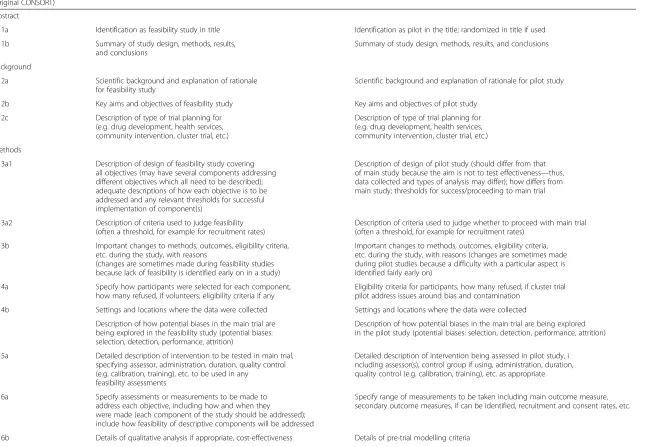
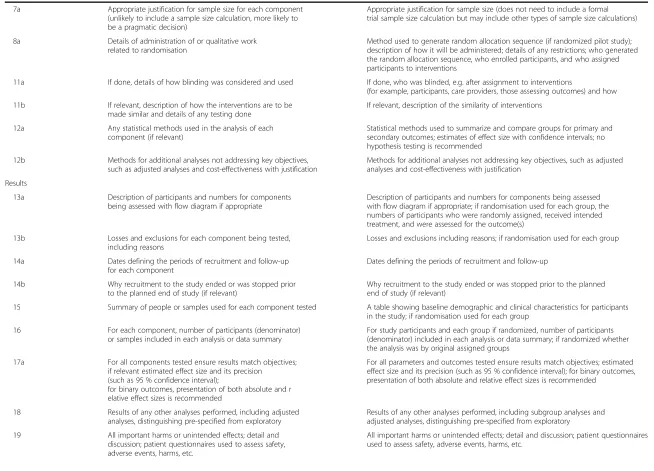
Based on the literature review described earlier, the current CONSORT Statement [7], and the mutually exclusive definitions of pilot and feasibility studies articulated by the UK National Institute of Health Research, we created two versions of the checklis-t—one for feasibility studies and the second for pilot studies (Table 1).
The Delphi survey comprised three sections: partici-pant demography, feedback on the NIHR and MRC defi-nitions of feasibility and pilot studies [23, 26], and the two checklist items (Table 1). The survey was produced in an online format using CLINVIVO software and dis-tributed through a weblink sent in an email.
The Delphi process was carried out between June and October 2013. It was done in two phases.Phase 1was the pilot phase. We piloted the Delphi survey using a “ think-aloud”approach on 13 colleagues working at our own insti-tutions. The purpose of this phase was to evaluate the ques-tionnaire for face and content validity, usability, and clarity of its items.
Phase 2 was the main Delphi study, which was ducted in two rounds using an online survey con-ducted by Clinvivo.
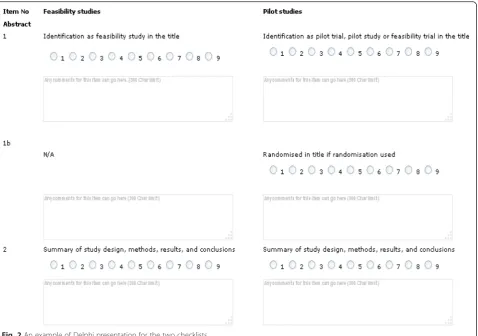
i. First round: We invited participants to declare an interest in the study to Clinvivo by emailing [email protected]. Clinvivo then replied by sending a personalized link to the round. The round opened on July 26, 2013 and closed on August 27, 2013. Invitations were sent to all those who had expressed an interest up to and including August 26. The two checklists are presented in Table1. Most items were identical or similar in the two lists. The participants rated items on a nine-point scale,
ranging from 1 =“not at all appropriate”to 9 =“completely appropriate”. Participants could also write comments under each rating (Fig.2).
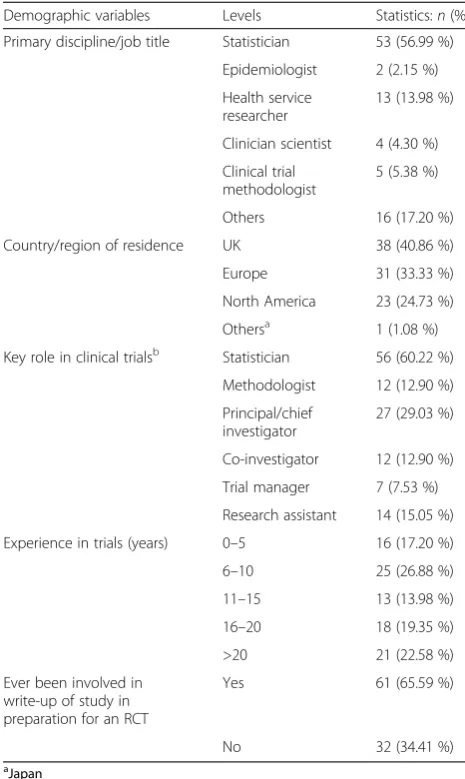
Overall, 93/100 participants responded to the online survey. Table2provides a summary of the
demographic characteristics of the respondents. ii.)2nd round: Participants who had completed the first
round were sent an email link to the second round on September 24. Reminders to complete was sent on October 7 and 14. The round closed on midnight, at the International Date Line, on October 15.
In this round, participants were asked to review tables of the scores of histograms of pilot and feasibility items for which 70 % or more of the panel had rated using the two highest appropriateness scores (i.e. 8 and 9). They could then make additional comments on these items. Participants were also asked to review the remaining items that had been rated slightly lower in terms of appropriateness, and for each item, they were asked to indicate whether they thought the item should be kept, discarded, or whether they were unsure or had no opinion. Participants were also asked whether they thought any reporting aspects had been missed and should be included in a checklist, and separately whether a pilot study checklist would be suitable for phase I studies, phase II studies, internal pilots, and external pilots; and whether a feasibility checklist would be suitable in the context of qualitative work, and what they would regard as quantitative work. In each case, participants could rate items as suitable, unsure/no opinion, or not suitable. Finally, participants could add comments on any other aspects about the suitability of pilot and feasibility study checklists. About 85 % (79/93) of the respondents participated in the second round.
Overall, the Delphi results showed a strong agreement on checklist items both for pilot and feasibility studies. However, there was substantial disagreement about the definitions of pilot and feasibility studies and the distinc-tion between them.
At the Edinburgh meeting, we presented four proposi-tions regarding definiproposi-tionsand preliminary Delphi results [26]. The main outcome from the discussions was that participants unanimously suggested that we should begin by developing only one reporting checklist. At this stage, it was unclear how wide the scope of this checklist would be, though a strong steer from the meeting was not to make it too wide.
Part 4: the consensus meeting
Prior to the consensus meeting: In February 2014, our group had a face-to-face meeting in London, UK, to review
Table 1Drafts of the initial proposed checklists for feasibility and pilot studies Item no.
(original CONSORT)
Feasibility studies Pilot studies
Abstract
1a Identification as feasibility study in title Identification as pilot in the title; randomized in title if used
1b Summary of study design, methods, results, and conclusions
Summary of study design, methods, results, and conclusions
Background
2a Scientific background and explanation of rationale for feasibility study
Scientific background and explanation of rationale for pilot study
2b Key aims and objectives of feasibility study Key aims and objectives of pilot study
2c Description of type of trial planning for (e.g. drug development, health services, community intervention, cluster trial, etc.)
Description of type of trial planning for (e.g. drug development, health services, community intervention, cluster trial, etc.)
Methods
3a1 Description of design of feasibility study covering all objectives (may have several components addressing different objectives which all need to be described); adequate descriptions of how each objective is to be addressed and any relevant thresholds for successful implementation of component(s)
Description of design of pilot study (should differ from that of main study because the aim is not to test effectiveness—thus, data collected and types of analysis may differ); how differs from main study; thresholds for success/proceeding to main trial
3a2 Description of criteria used to judge feasibility (often a threshold, for example for recruitment rates)
Description of criteria used to judge whether to proceed with main trial (often a threshold, for example for recruitment rates)
3b Important changes to methods, outcomes, eligibility criteria, etc. during the study, with reasons
(changes are sometimes made during feasibility studies because lack of feasibility is identified early on in a study)
Important changes to methods, outcomes, eligibility criteria, etc. during the study, with reasons (changes are sometimes made during pilot studies because a difficulty with a particular aspect is identified fairly early on)
4a Specify how participants were selected for each component, how many refused, if volunteers; eligibility criteria if any
Eligibility criteria for participants, how many refused; if cluster trial pilot address issues around bias and contamination
4b Settings and locations where the data were collected Settings and locations where the data were collected
Description of how potential biases in the main trial are being explored in the feasibility study (potential biases: selection, detection, performance, attrition)
Description of how potential biases in the main trial are being explored in the pilot study (potential biases: selection, detection, performance, attrition)
5a Detailed description of intervention to be tested in main trial, specifying assessor, administration, duration, quality control (e.g. calibration, training), etc. to be used in any
feasibility assessments
Detailed description of intervention being assessed in pilot study, i ncluding assessor(s), control group if using, administration, duration, quality control (e.g. calibration, training), etc. as appropriate
6a Specify assessments or measurements to be made to address each objective, including how and when they
were made (each component of the study should be addressed); include how feasibility of descriptive components will be addressed
Specify range of measurements to be taken including main outcome measure, secondary outcome measures, if can be identified, recruitment and consent rates, etc.
6b Details of qualitative analysis if appropriate, cost-effectiveness Details of pre-trial modelling criteria
Thabane
et
al.
Pilot
and
Feasibility
Studies
(2016) 2:25
Page
6
of
Table 1Drafts of the initial proposed checklists for feasibility and pilot studies(Continued)
7a Appropriate justification for sample size for each component (unlikely to include a sample size calculation, more likely to be a pragmatic decision)
Appropriate justification for sample size (does not need to include a formal trial sample size calculation but may include other types of sample size calculations)
8a Details of administration of or qualitative work related to randomisation
Method used to generate random allocation sequence (if randomized pilot study); description of how it will be administered; details of any restrictions; who generated the random allocation sequence, who enrolled participants, and who assigned participants to interventions
11a If done, details of how blinding was considered and used If done, who was blinded, e.g. after assignment to interventions
(for example, participants, care providers, those assessing outcomes) and how
11b If relevant, description of how the interventions are to be made similar and details of any testing done
If relevant, description of the similarity of interventions
12a Any statistical methods used in the analysis of each component (if relevant)
Statistical methods used to summarize and compare groups for primary and secondary outcomes; estimates of effect size with confidence intervals; no hypothesis testing is recommended
12b Methods for additional analyses not addressing key objectives, such as adjusted analyses and cost-effectiveness with justification
Methods for additional analyses not addressing key objectives, such as adjusted analyses and cost-effectiveness with justification
Results
13a Description of participants and numbers for components being assessed with flow diagram if appropriate
Description of participants and numbers for components being assessed with flow diagram if appropriate; if randomisation used for each group, the numbers of participants who were randomly assigned, received intended treatment, and were assessed for the outcome(s)
13b Losses and exclusions for each component being tested, including reasons
Losses and exclusions including reasons; if randomisation used for each group
14a Dates defining the periods of recruitment and follow-up for each component
Dates defining the periods of recruitment and follow-up
14b Why recruitment to the study ended or was stopped prior to the planned end of study (if relevant)
Why recruitment to the study ended or was stopped prior to the planned end of study (if relevant)
15 Summary of people or samples used for each component tested A table showing baseline demographic and clinical characteristics for participants in the study; if randomisation used for each group
16 For each component, number of participants (denominator) or samples included in each analysis or data summary
For study participants and each group if randomized, number of participants (denominator) included in each analysis or data summary; if randomized whether the analysis was by original assigned groups
17a For all components tested ensure results match objectives; if relevant estimated effect size and its precision
(such as 95 % confidence interval);
for binary outcomes, presentation of both absolute and r elative effect sizes is recommended
For all parameters and outcomes tested ensure results match objectives; estimated effect size and its precision (such as 95 % confidence interval); for binary outcomes, presentation of both absolute and relative effect sizes is recommended
18 Results of any other analyses performed, including adjusted analyses, distinguishing pre-specified from exploratory
Results of any other analyses performed, including subgroup analyses and adjusted analyses, distinguishing pre-specified from exploratory
19 All important harms or unintended effects; detail and discussion; patient questionnaires used to assess safety, adverse events, harms, etc.
All important harms or unintended effects; detail and discussion; patient questionnaires used to assess safety, adverse events, harms, etc.
Thabane
et
al.
Pilot
and
Feasibility
Studies
(2016) 2:25
Page
7
of
Table 1Drafts of the initial proposed checklists for feasibility and pilot studies(Continued)
Discussion
20 Limitations addressing sources of potential bias, changes to components, imprecision of estimates, multiplicity of analyses, etc.
Limitations addressing sources of potential bias, changes to components, imprecision of estimates, multiplicity of analyses etc. and changes to pilot study protocol
21 Generalisability of the findings to other studies;
transferable information (external validity, applicability), etc.
Generalisability of pilot work to other studies; is larger trial needed; transferable information (external validity, applicability), etc.
22a Interpretation consistent with results for each component tested, balancing benefits and harms, and considering other relevant evidence
Interpretation consistent with results for pilot study, balancing benefits and harms, and considering other relevant evidence; will main trial go ahead; how it will be designed
22b Assessment of feasibility of each component Changes to main study protocol
23 Not applicable Registration number and name of trial registry
24 Research review committee approval, ethics approval and consent to participate
Research review committee approval, ethics approval and consent to participate; where the trial protocol can be accessed, if available
25 Sources of funding and other support Sources of funding and other support
Thabane
et
al.
Pilot
and
Feasibility
Studies
(2016) 2:25
Page
8
of
progress. Based on the feedback from all the stakeholder engagements and Delphi process results, we redrafted our definitions, with feasibility as an overarching term, and we agreed to focus on reporting guidelines for pilot/feasibility RCTs as our next step. We finalized the draft list of items for a reporting guideline to be discussed at the consensus meeting. At this stage, we also confirmed with the CON-SORT group that our checklist would be included as an of-ficial CONSORT checklist extension.
Consensus meeting: We held a 2-day meeting in Oxford, UK, on October 27–28, 2014, to seek feedback on the proposed items to be included in the guideline, and its scope. We invited a group of international stakeholders (n= 26) representing different professional sectors (aca-demic, pharmaceutical, journal editors, publishers, fund-ing bodies) and different clinical RCT roles (such as trialists, methodologists, statisticians, and clinicians).
Using approaches that were similar to those used in pre-vious consensus meetings for other guidelines [7, 9–20], participants were presented in advance of the meeting with the results of the literature review and the Delphi survey. Working group members presented the background and an update on work done to date, in order to facilitate the dis-cussions. We also presented a penultimate version of the
checklist—based on the Delphi process and feedback from the earlier stakeholder engagement meetings. The meeting was audiotaped, and formal minutes were subsequently prepared and circulated to all attendees.
The key recommendations that emerged were as follows:
Modify items: It was recommended that 24 items should be modified. These modifications were primarily to prefix all references to“trial”with “pilot”to clearly indicate that the information being reported is about the pilot RCT, and not the main RCT. As in previous CONSORT extensions [9–19], some of the recommended changes begin with“if relevant”or“when applicable”, to show that some information which authors are being asked to report might not be relevant or applicable for their
particular pilot RCT.
Add new items: Four new items were suggested as follows.Participants: how participants should be identified and consented;outcomes: if applicable, criteria used to judge whether, or how, to proceed with a future definitive RCT;limitations:
implications for progression from the pilot to a Fig. 2An example of Delphi presentation for the two checklists
future definitive RCT, including any proposed amendments or modifications to the protocol of the main RCT; andother information: if ethical approval/research review committee approval was confirmed, with a reference number.
Remove items: It was recommended that, beyond an item our group had already suggested, removing one further item should be removed,Methods for additional analyses,such as subgroup analyses and adjusted analyses.Participants felt strongly that this item was not applicable to pilot RCTs, because such analyses would be about hypothesis testing or generation—which is not the focus of a pilot RCT.
Part 5: write-up, dissemination, and implementation Following the consensus meeting, we continued to refine the content and wording of the items by virtual group dis-cussion and by involving those who had attended the meeting, to ensure they reflected the decisions that had been made. There was second working group meeting in London, UK, on January 12, 2015. We discussed the feed-back from the consensus meeting in detail and outlined strategies to complete the write-up of the guideline, in-cluding plans for dissemination and implementation in order to maximize its adoption by various journals, pro-fessional associations and the clinical trial community.
As with previous guidelines [7, 9–20], our guideline statement will be published with a detailed Explanation and Elaboration (E&E) document that will provide an in-depth explanation of the scientific rationale for each recommendation, together with an example of clear reporting for each item. We have sought feedback from the consensus conference participants on the E&E docu-ment to ensure that it accurately reflects the discussions and decisions that were made during the meeting. To widely disseminate the guideline, we will publish in peer-reviewed journals and do presentations and work-shops at conferences and other venues. We also plan to seek endorsement of the guideline by journal editors. Research has shown that formal endorsement and adop-tion of the CONSORT Statement by journals is associ-ated with improved quality of reporting [26]
Discussion
This article has described the methods and processes that we have used to develop a CONSORT extension for reporting of pilot/feasibility RCTs—using the 2010 version of the CONSORT Statement as its basis [7]. The work actually began with a broader mandate, to develop guide-lines for feasibility and pilot studies. However, after receiv-ing feedback from the research community, we have started with a narrower focus of firstly developing a set of guidelines for reporting feasibility and pilot RCTs. We have attempted to use the best available and evidence-based methods [21, 22], similar to those used by other guideline developers [7, 9–20]. These include establishing a working group to lead the project; conducting a system-atic review of the literature to determine current practice and identify available guidelines; applying an online Delphi survey on the initial list of items to be included in the guideline; holding a consensus meeting attended by vari-ous stakeholders to finalize the list; and creating a dissem-ination plan to enhance uptake for the guideline. In addition, because of the perceived differences of opinion about the definitions of feasibility and pilot studies, we found that an ongoing discussion amongst the research community over a considerable period was invaluable for validating the direction of our work.
Table 2The demographic characteristics of the main Delphi
study:n= 93
Demographic variables Levels Statistics:n(%)
Primary discipline/job title Statistician 53 (56.99 %) Epidemiologist 2 (2.15 %) Health service
researcher
13 (13.98 %)
Clinician scientist 4 (4.30 %) Clinical trial
methodologist
5 (5.38 %)
Others 16 (17.20 %)
Country/region of residence UK 38 (40.86 %)
Europe 31 (33.33 %)
North America 23 (24.73 %)
Othersa 1 (1.08 %)
Key role in clinical trialsb Statistician 56 (60.22 %) Methodologist 12 (12.90 %) Principal/chief
investigator
27 (29.03 %)
Co-investigator 12 (12.90 %) Trial manager 7 (7.53 %) Research assistant 14 (15.05 %) Experience in trials (years) 0–5 16 (17.20 %)
6–10 25 (26.88 %)
11–15 13 (13.98 %)
16–20 18 (19.35 %)
>20 21 (22.58 %)
Ever been involved in write-up of study in preparation for an RCT
Yes 61 (65.59 %)
No 32 (34.41 %)
a
Japan
b
Levels are not mutually exclusive
RCTrandomized controlled trial
In this paper, we have provided detailed descriptions of the methods and processes that we used to develop our guideline. These details are intended to provide readers with enough information to assess the quality and validity of the methods used to develop the CON-SORT extension to pilot/feasibility RCTs guideline. We applied approaches, methods, and processes that had been used previously by guideline developers, to ensure that the foundation for and development of our own guideline was truly evidence-based. As with previous guidelines [7, 9–19], we involved a wide spectrum of stakeholders and participants representing different sec-tors, perspectives, areas of expertise, and experiences with trials—both in the Delphi process and the consensus meeting. The participants in the Delphi surveys included (bio)statisticians, clinicians, health services researchers, regulatory staff, primary care practitioners, to mention a few. A potential limitation is that the views of non-statisticians may not have been adequately represented since the majority of the participants were statisticians. The participants in the consensus meeting came from dif-ferent stakeholder groups representing professional sec-tors (academic, pharma, journal edisec-tors, publishers, funding bodies) and different clinical RCT roles (such as trialists, methodologists, statisticians, and clinicians). Prior to the consensus meeting, we had several Skype and face-to-face discussions and presentations at sev-eral professional conferences, to gather data and feed-back. These steps were preceded by an extensive review of the literature to assess the reporting of pilot and feasibility trials.
We also spent a considerable amount of time debating alternative definitions of feasibility and pilot trials, and we used the Delphi study along with discussions at con-ferences, and the expert consensus meeting, to get feed-back on them. This led to the development of a framework, in which pilot studies are viewed as a subset of feasibility studies [26]. Within this framework, a feasi-bility study is defined as a study asking “whether some-thing can be done, should we proceed with it, and if so, how”[26]. In contrast,“a pilot study asks the same ques-tions but also has a specific design feature: in a pilot study a future study, or part of a future study, is con-ducted on a smaller scale” [26]. The framework and the resulting definitions became essential elements in the development process of the guideline.
We hope that our guideline will improve the reporting of pilot/feasibility RCTs. We have already liaised with editors of some key clinical journals, and we also plan to embark on a campaign to get more journals to endorse the guide-line. The intent is to target several groups: authors of jour-nal manuscripts, who can use it as an outline for reporting results of their pilot/feasibility RCTs; manuscript reviewers, who can use it as template to evaluate reports of pilot/
feasibility RCTs; funding agencies, for use as a foundation to create funding programmes for and evaluation of pilot and feasibility RCT proposals; educators, for use as a tool for training students and researchers about the unique nature of pilot RCT methodology and reporting; and end-users, for use as a tool to identify relevant pilot RCTs—that provide evidence about feasibility to inform their planning of main RCTs or other pilot/feasibility RCTs.
Like all reporting guidelines, ours will require re-evaluation and revisions over time—to ensure that it is kept up to date with evolving research and knowledge on pilot and feasibility trials.
One major outcome of this work is the setting up of a new journal by BioMed Central, Pilot and Feasibility Studies (http://pilotfeasibilitystudies.biomedcentral.com/), which was launched on January 12, 2015. It provides a platform for publishing these types of studies and consti-tutes a much-needed place for researchers to share their work and ideas on all aspects of the design, conduct, and reporting of pilot and feasibility studies in health or bio-medical research. While this is an important achievement on its own, we hope that our guideline will also be a cata-lyst for the establishment of better publication practices and editorial policies regarding the reporting of pilot and feasibility trials—a deficiency that has been noted previ-ously [1, 3]. As of March 19, 2016, the new journal has re-ceived over 70,000 unique web accesses, published 61 papers, of which 34 are protocols, 21 report the results of pilot or feasibility studies/trials, and 6 are reviews, com-mentaries, or methods papers. These statistics suggest that investigators are indeed using the journal as an outlet for publishing their pilot or feasibility works.
Participants at the Oxford 2014 consensus meeting Doug Altman1, Colin Begg2, Frank Bretz3, Marion Campbell4, Erik Cobo5, Peter Craig6, Peter Davidson7,
Trish Groves8, Freedom Gumedze9, Jenny Hewison10, Allison Hirst11, Pat Hoddinott12, Sallie Lamb13, Tom Lang14, Elaine McColl15, Alicia O’Cathain16, Daniel R Shanahan17, Chris Sutton18, Peter Tugwell19,
Working group
Christine Bond20, Michael Campbell21, Claire Cole-man22, Sandra Eldridge22, Sally Hopewell23, Gillian Lan-caster24, Lehana Thabane25
1. Centre for Statistics in Medicine, Nuffield Department of Orthopaedics, Rheumatology and Musculoskeletal Sciences, University of Oxford, Oxford, UK
2. Department of Epidemiology and Biostatistics, Memorial Sloan Kettering Cancer Center, New York, NY, USA
3. Statistical Methodology and Consulting, Novartis Pharma AG, Basel, Switzerland
4. Health Services Research Unit, University of Aberdeen, Polwarth Building, Foresterhill, Aberdeen, UK
5. Department of Statistics and Operations Research, UPC, Barcelona-Tech, Spain
6. MRC/CSO Social and Public Health Sciences Unit, University of Glasgow, Glasgow, UK
7. National Institute for Health Research, Evaluation, Trials, and Studies Coordinating Centre, University of Southampton, Southampton, UK
8. BMJ, BMA House, London, UK
9. Department of Statistical Sciences, University of Cape Town, Cape Town, South Africa
10.Leeds Institute of Health Sciences, University of Leeds, Leeds, UK
11.IDEAL Collaboration, Nuffield Department of Surgical Sciences, University of Oxford, Oxford, UK 12.Nursing Midwifery and Allied Health Professionals
Research Unit, Faculty of Health Sciences and Sport, University of Stirling, Scotland, UK
13.Oxford Clinical Trials Research Unit, Nuffield Department of Orthopaedics, Rheumatology and Musculoskeletal Sciences, University of Oxford, Oxford, UK
14.Tom Lang Communications and
Training International, Kirkland, Washington, USA 15.Newcastle Clinical Trials Unit and Institute of
Health & Society, Newcastle University, Newcastle Upon Tyne, UK.
16.School of Health and Related Research, University of Sheffield, Sheffield, UK
17.BioMed Central, London, UK
18.School of Health, University of Central Lancashire, Preston, UK
19.Department of Medicine, University of Ottawa, Ottawa, Ontario, Canada
20.Centre of Academic Primary Care, University of Aberdeen, Aberdeen, Scotland, UK
21.School of Health and Related Research, University of Sheffield, Sheffield, South Yorkshire, UK
22.Centre for Primary Care and Public Health, Queen Mary University of London, London, UK
23.Oxford Clinical Trials Research Unit, Nuffield Department of Orthopaedics, Rheumatology and Musculoskeletal Sciences, University of Oxford, Oxford, UK
24.Department of Mathematics and Statistics, Lancaster University, Lancaster, Lancashire, UK 25.Clinical Epidemiology and Biostatistics, McMaster
University, Hamilton, Ontario, Canada
Competing interests
The authors declare that they have no competing interests.
Authors’contributions
ICMJE criteria for authorship read and met: SE, GL, and CB conceived the study supported by LT, SH, and MJC. SE led the overall development and execution. SE, MJC, GL, CB, LT, SH, and CC all contributed to various aspects of the empirical work. LT, SH, and MJC wrote the first draft of the manuscript. All authors participated in the international consensus meeting, commented on drafts of the manuscript, and have approved this manuscript.
Acknowledgements
CC was funded by a National Institute for Health Research (NIHR) Research Methods Fellowship. This article therefore presents independent research funded by the NIHR. The views expressed are those of the authors and not necessarily those of the NHS, the NIHR, or the Department of Health. We are grateful to Alicia O’Cathain (University of Sheffield, Sheffield, UK) and Pat Hoddinott (University of Stirling, Scotland, UK) for attending and providing valuable input at one of our Healthrow Airport meetings. We thank the Clinvivo staff for their services and support in conducting the Delphi study. We are grateful to Dr. Stephen Walter for proofreading the paper.
Author details
1
Clinical Epidemiology and Biostatistics, McMaster University, Hamilton, Ontario, Canada.2Oxford Clinical Trials Research Unit, Nuffield Department of Orthopaedics, Rheumatology and Musculoskeletal Sciences, University of Oxford, Oxford, UK.3Centre for Primary Care and Public Health, Queen Mary University of London, London, UK.4School of Health and Related Research, University of Sheffield, Sheffield, South Yorkshire, UK.5Department of Mathematics and Statistics, Lancaster University, Lancaster, Lancashire, UK. 6Centre of Academic Primary Care, University of Aberdeen, Aberdeen, Scotland, UK.
Received: 22 December 2015 Accepted: 7 May 2016
References
1. Lancaster GA, Dodd S, Williamson PR. Design and analysis of pilot studies: recommendations for good practice. J Eval Clin Pract. 2004;10(2):307–12. 2. Thabane L, Ma J, Chu R, Cheng J, Ismaila A, Rios LP, et al. A tutorial on pilot
studies: the what, why and how. BMC Med Res Methodol. 2010;10(1):1. 3. Arain M, Campbell MJ, Cooper CL, Lancaster GA. What is a pilot or feasibility
study? A review of current practice and editorial policy. BMC Med Res Methodol. 2010;10(1):67.
4. Shanyinde M, Pickering RM, Weatherall M. Questions asked and answered in pilot and feasibility randomized controlled trials. BMC Med Res Methodol. 2011;11(1):117.
5. Loscalzo J. Pilot trials in clinical research: of what value are they? Circulation. 2009;119(13):1694–6.
6. Arnold DM, Burns KE, Adhikari NK, Kho ME, Meade MO, Cook DJ. The design and interpretation of pilot trials in clinical research in critical care. Crit Care Med. 2009;37(1):S69–74.
7. Schulz KF, Altman DG, Moher D. CONSORT 2010 statement: updated guidelines for reporting parallel group randomised trials. BMJ (Clinical research ed). 2010;340:c332.
8. Begg C, Cho M, Eastwood S, Horton R, Moher D, Olkin I, et al. Improving the quality of reporting of randomized controlled trials. The CONSORT statement. JAMA. 1996;276(8):637–9.
9. Campbell MK, Piaggio G, Elbourne DR, Altman DG. Consort 2010 statement: extension to cluster randomised trials. BMJ (Clinical research ed). 2012;345:e5661. 10. Piaggio G, Elbourne DR, Pocock SJ, Evans SJ, Altman DG, Group C.
Reporting of noninferiority and equivalence randomized trials: extension of the CONSORT 2010 statement. JAMA. 2012;308(24):2594–604.
11. Zwarenstein M, Treweek S, Gagnier JJ, Altman DG, Tunis S, Haynes B, et al. Improving the reporting of pragmatic trials: an extension of the CONSORT statement. BMJ (Clinical research ed). 2008;337:a2390.
12. Vohra S, Shamseer L, Sampson M, Bukutu C, Schmid CH, Tate R, et al. CONSORT extension for reporting N-of-1 trials (CENT) 2015 Statement. BMJ (Clinical research ed). 2015;350:h1738.
13. Gagnier JJ, Boon H, Rochon P, Moher D, Barnes J, Bombardier C. Reporting randomized, controlled trials of herbal interventions: an elaborated CONSORT statement. Ann Intern Med. 2006;144(5):364–7.
14. Boutron I, Moher D, Altman DG, Schulz KF, Ravaud P. Methods and processes of the CONSORT Group: example of an extension for trials assessing nonpharmacologic treatments. Ann Intern Med. 2008;148(4):W-60-W-6. 15. MacPherson H, Altman DG, Hammerschlag R, Youping L, Taixiang W, White
A, et al. Revised STandards for Reporting Interventions in Clinical Trials of Acupuncture (STRICTA): extending the CONSORT statement. PLoS Med. 2010;7(6):e1000261.
16. Calvert M, Blazeby J, Altman DG, Revicki DA, Moher D, Brundage MD, et al. Reporting of patient-reported outcomes in randomized trials: the CONSORT PRO extension. JAMA. 2013;309(8):814–22.
17. LOANNIDIS J, EVANS SJ, GØTZSCHE PC, O'NEILL RT, ALTMAN DG, SCHULZ K, et al. Better reporting of harms in randomized trials: an extension of the CONSORT statement. Ann Intern Med. 2004;141(10):781–8.
18. Hopewell S, Clarke M, Moher D, Wager E, Middleton P, Altman DG, et al. CONSORT for reporting randomized controlled trials in journal and conference abstracts: explanation and elaboration. PLoS Med. 2008;5(1):e20. 19. Chan A-W, Tetzlaff JM, Gøtzsche PC, Altman DG, Mann H, Berlin JA, et al.
SPIRIT 2013 explanation and elaboration: guidance for protocols of clinical trials. BMJ (Clinical research ed). 2013;346:e7586.
20. Montgomery P, Grant S, Hopewell S, Macdonald G, Moher D, Michie S, et al. Protocol for CONSORT-SPI: an extension for social and psychological interventions. Implement Sci. 2013;8(1):99.
21. Moher D, Schulz KF, Simera I, Altman DG. Guidance for developers of health research reporting guidelines. PLoS Med. 2010;7(2):e1000217.
22. Simera I, Altman DG, Moher D, Schulz KF, Hoey J. Guidelines for reporting health research: the EQUATOR network’s survey of guideline authors. PLoS Med. 2008;5:869–74.
23. National Institute for Health Research. NIHR evaluation, trials and studies | Pilot studies 2015 [cited 2015 17 August]. Available from: http://www.nets. nihr.ac.uk/glossary/pilot-studies.
24. CONSORT Statement website. [Last accessed on 2015 17 August]. Available from: www.consort-statement.org.
25. Dolgin E. Publication checklist proposed to boost rigor of pilot trials. Nat Med. 2013;19(7):795–6.
26. Eldridge SM, Lancaster GA, Campbell MJ, Thabane L, Hopewell S, Coleman CL, et al. Defining feasibility and pilot studies in preparation for randomised controlled trials: development of a conceptual framework. PLoS ONE. 2016; 11(3):e0150205.
27. Samaan Z, Mbuagbaw L, Kosa D, Borg Debono V, Dillenburg R, Zhang S, et al. A systematic scoping review of adherence to reporting guidelines in health care literature. J Multidiscip Healthc. 2013;6:169–88.
28. The EQUATOR network. [Last accessed on 2015 17 August]. Available from: http://www.equator-network.org/library/reporting-guidelines-under-development. 29. Murphy MK, Black NA, Lamping DL, McKee CM, Sanderson CFB, et al.
Consensus development methods, and their use in clinical guideline development. Health Technol Assess. 1998;2:1–88.
• We accept pre-submission inquiries
• Our selector tool helps you to find the most relevant journal
• We provide round the clock customer support
• Convenient online submission
• Thorough peer review
• Inclusion in PubMed and all major indexing services
• Maximum visibility for your research
Submit your manuscript at www.biomedcentral.com/submit