Submitted in: January 2013 Accepted in: May 2013 Published in: January 2014
Recommended citation
Márquez, E. & Jiménez-Rodrigo, M.L. (2014). Project-basedlearninginvirtualenvironments:acasestu
-dyofauniversityteachingexperience. RevistadeUniversidadySociedaddelConocimiento (RUSC).
Vol. 11, No 1. pp. 76-90. doihttp://dx.doi.org/10.7238/rusc.v11i1.1762
Abstract
Thisarticlepresentsacasestudyabouttheimplementation ofateachinginnovation project ai
-medatapplyingtheproject-basedlearningtechniquethroughtheuseofnewtechnologies, and specificallythroughtheresourcesavailableinthevirtuallearningenvironmentattheUniversityof Seville(US), Spain. Thisprojectwascarriedoutinthe2010/2011academicyearontwoSociology subjectsformingpartofthecurriculaoftheManagement & Public AdministrationandNursingshort degreecourses. Theobjectivesofthisprojectwere:1) Toapplyandassesstheuseofanewteaching methodologyforimprovingtheteachingandlearningprocessonsocio-healthsubjects, and2) To fosterthestudents’active, participatoryandcollaborativelearningbydoingprojectsandusingva
-riousvirtual-learningdidacticinstruments. Besidestheprojectrationaleandobjectives, thearticle willdescribetheresourcesusedandthemainresultsobtained. Finally, itwilldiscussthelimitations andpotentialassociatedwiththeuseofthesenewteachingtechniquesinuniversityteaching.
Keywords
El aprendizaje por proyectos en espacios virtuales:
estudio de caso de una experiencia docente universitaria
Resumen
En este artículo se presenta un estudio de caso sobre la puesta en práctica de un proyecto de innovación docente dirigido a la aplicación de la técnica del aprendizaje basado en proyectos (ABP) mediante la utili-zación de nuevas tecnologías. Concretamente, a través de los recursos disponibles dentro de la Plataforma de Enseñanza Virtual de la Universidad de Sevilla. Este proyecto se ha llevado a cabo durante el curso 2010-2011 en dos asignaturas del Área de Sociología recogidas dentro de los planes de estudio de la diplomatura de Gestión y Administración Pública y la diplomatura de Enfermería. Los objetivos de este proyecto han sido: 1) aplicar y evaluar el uso de una nueva metodología docente para la mejora de los procesos de ense-ñanza y aprendizaje en asignaturas socio-sanitarias, y 2) fomentar en el alumnado un aprendizaje activo, participativo y colaborativo a partir de la realización de proyectos y el uso de diferentes instrumentos di-dácticos de la enseñanza virtual. Junto al marco de justificación del proyecto y los objetivos se expondrán los recursos utilizados, sus principales resultados y, finalmente, se discutirán las limitaciones y las potencia-lidades asociadas a la utilización de estas nuevas técnicas docentes en la enseñanza universitaria.
Palabras clave
innovación docente, aprendizaje basado en proyectos, nuevas tecnologías
1. Introduction
TheincorporationofSpanishuniversitiesintotheEuropean HigherEducation Area(EHEA)iscreating newteachingchallengesthatcontemplatemethodologicalandpedagogicalelementsunlikethose usedpreviously. Thishasledtoaprocessofprofound, rapidchangeaffectingboththeuniversity teachingstructureanditssocialmeaningandposition(Zabalza, 2007). Incontrasttothetraditional modelwhereteachingstaff actedastheonlyknowledge-bearingagent, thenewteachingmodel ismoreopenandstudentcentred, fosteringself-directed, participatory, active, group-orientedand engagedlearning. Thisrepresentsaradicalchangeintheroleoflecturers, whobecomedesignersof mediatedlearningscenariosandsituations, andofstudents, whobecomeactorsin–andnotspectators of–theirlearning(Caberoetal., 2006). Inaddition, thereareincreasingdemandsforuniversitywork tohaveadirectrelationshipwiththestudents’futureinclusioninthelabourmarket(Michavila, 2000).
Together with the above, knowledge society transformations situate the Internet and new technologiesas key means ofcommunication, accessand knowledge constructionin university classrooms(CebriándelaSerna, 2003). Someofthemeasurestopromotethisprocessofchange andinnovationinvolvefosteringactive, participatorylearningmethodologies, whichareacquiring ever-greaterprotagonisminnewcurriculardesignsandeducationalpractices(Huber, 2008;Kolmos,
2004). Inthisarticle, wedescribeateachinginnovationproject1inwhichoneofthesemethodologies
wasimplemented:informationandcommunicationtechnology-mediated(ICT-mediated)project
-basedlearning(PBL). Inthisarticle, wesetouttheexperienceundertakenoveroneacademicyear
ontwoSociologysubjectsanddescribetheuseandevaluationofthedidacticandassessmenttools
used, aswellastheresultsobtained.
2. Project-based Learning
PBLisaboutgettingthestudentscollaborativelyandactivelytoplan, developandassessaproject
thathasapracticalapplication. AccordingtoBadíaandGarcía(2006), thismeansaskingagroupof
studentstosolveproblemsor findanswerstocomplexissues, andtodothattheymustdesignan
actionplan, makedecisionsasitisbeingappliedandsolveanyproblemsthatarise. Accordingto
Huber(2008)thismethod:1)isbasedonaninterestorarealinitiative;2)thestudentsdiscusstheir
interestsinandviewsonthetopic(givingeachotheradvice);3)thestudentsdeveloptheirown
activityscope(planninganddecision-making), and4) thestudentsreflecton theirownlearning
processes. Thus, byinvolvingthestudentsintheirlearningandassessmentprocesses, theybecome
theprotagonistsoftheorganisationoftheirowncurriculaandeducationalitineraries(Boud, 1995;
Boud & Falchikov, 2007;Falchikov, 2005;LópezPastor, 2005).
ThePBLformathasbeenwidelyappliedtodisciplinessuchasEngineering, Information Technology
(IT)and Architectureformanyyears(Calvo, López, & Zulueta, 2010;Casasola, Pérez, & García, 2012;
Mesa, Álvarez, Villanueva, & DeCos, 2008), andhasproventobeofpracticalutilityoutsideacademic
contexts (Badía & García, 2006). Incontrast, intheSocialSciencesingeneral andinSociologyin
particular, veryfewexperiencesofteachinginnovationbasedonPBLhavebeenpublished(LaParra,
Muñoz-Baell, Ortiz, Davó, & Álvarez, 2011)despitethefactthatagreaterpenetrationofmethodologies
likePBLhasbeenobserved(Kolmos, 2004).
3. Case Study: ICT-Mediated Project-based Learning
on Sociology Subjects
3.1. Objectives and method
Theobjectivesofthisteachinginnovationprojectwereasfollows:
1. Tofosterthestudents’active, participatoryandcollaborativelearningbydoingprojectsand
usingvirtuallearning.
2. Toapply, examineandevaluatetheuseofICT-mediatedPBL.
Tothatend, weconductedacasestudyontwoSociologysubjectstaughtondifferentdegreecourses
giventothetopicbeingstudied, whereastheselectionofthecasewassecondary. Theaimofthe
studywastoexamineanexampleinactioninordertointerpretthemeaningandtheevaluation
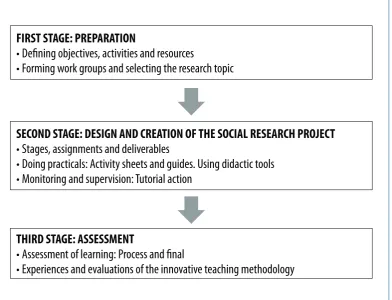
that thestudents madeof theexperience. Thiscase study comprisedthree stages: preparation,
designandcreationofthesocialresearchproject, andassessment, themainelementsofwhichare
summarisedinFigure1below.
Figure 1.Case study development stages
3.2. Criteria for applying project-based learning in virtual environments
InordertoattaintheICT-mediatedPBLobjectives, threecriteriawereconsidered:
1. Thedevelopmentofagreatercommunicativecapacitytowardsandamongthestudentsby
usingnewteachingstrategies, especiallyinthevirtuallearningenvironment(VLE).
2. A continuousassessmentsysteminwhichthestudentsfeeljointlyresponsibleforboththeir
individualandgroupachievementsandefforts.
3. Thecreationofopen-contentactivitieswithmorethanonesolutionandsharingtheminthe
virtual environmentandin theclassroom sothat thedifferent groups couldcompareand
discusstheworkdone, learnfromitandcontribute.
FIRST STAGE: PREPARATION
t%FöOJOHPCKFDUJWFTBDUJWJUJFTBOESFTPVSDFT
t'PSNJOHXPSLHSPVQTBOETFMFDUJOHUIFSFTFBSDIUPQJD
SECOND STAGE: DESIGN AND CREATION OF THE SOCIAL RESEARCH PROJECT
t4UBHFTBTTJHONFOUTBOEEFMJWFSBCMFT
t%PJOHQSBDUJDBMT"DUJWJUZTIFFUTBOEHVJEFT6TJOHEJEBDUJDUPPMT
t.POJUPSJOHBOETVQFSWJTJPO5VUPSJBMBDUJPO
THIRD STAGE: ASSESSMENT
t"TTFTTNFOUPGMFBSOJOH1SPDFTTBOEöOBM
t&YQFSJFODFTBOEFWBMVBUJPOTPGUIFJOOPWBUJWFUFBDIJOHNFUIPEPMPHZ
ª
Inordertotryandmeetthesethreecriteria, virtualcommunicationandinteractiontoolsintheVLE
attheUSwereusedinconjunctionwitheducationalresourcescontainingattractive, opencontent
thatpromotedcritical, complex, divergentandcreativethinking. Attemptsweremadetofostera
continuouslearningprocessbyintensifyingtheguidanceandtutoringwork, andbyimplementing
anassessmentsystemthatwasnotexclusivelylinkedtothecontent, butinsteadtotheacquisition
ofgeneralandspecificcompetencies. Finally, everyendeavourwasmadetodevelopacollaborative
approachbysettinggroupobjectivesthatwouldsurpasstheindividualdimension, andtofoster
intersubjectivityandjointresponsibilitythroughgroup-workstructures(Badía & García, 2006).
3.3. Participating group characteristics
Twogroupsofstudentstookpartintheteachinginnovationproject, correspondingtotwoSociology
subjectstaughtattheUS:theSociologyof Healthand HealthcareSystems(semestral)ontheNursing
shortdegreecourse(thirdyear, FacultyofNursing), with46students, andSocial Theory(annual)on
theManagement & Public Administrationshortdegreecourse(thirdyear, FacultyofLaw), with98
students. Althoughthesubjectsareorientedtowardsdifferentknowledgeareas, theybothsharethe
sociologicallinkthatischaracteristicoftheareainwhichtheyarelocated. Inbothcases, workisdone
onlearningcompetenciesconnectedwiththedesignanddevelopmentofappliedsocialresearch
projects. However, theproject’smethodologyandimplementationwereadaptedtothecurricular
particularitiesandneedsofeachgroup.
Thus, wefound thatthe sociodemographic profile was diverse. The profile ontheSociology
of Healthand HealthcareSystemssubjectwasmoreuniform, relativelyyoungandmostlyfemale
(80%ofthestudentswerefemale). TheprofileontheSocial Theorysubjectwasmuchmorediverse,
withasmallerdifferencebetweengenders(70%werefemale)andasignificantproportionofolder
students, manyofwhomhadfamilyandworkresponsibilities. Whilethisprofilemaybeconsidered
atypical, itisbecomingmoreandmorecommonplaceinuniversityclassrooms. Thissupportsthe
relevanceofapplying new, more flexibleteachingmethodologiestorespondtothediversityof
universityclassroomsandthegoalsofhighereducation(Jiménez-Rodrigo & MárquezLepe, 2011).
3.4. Activities undertaken
Defining objectives, stages and resources
Atthestartoftheacademicyear, thelecturersofferedanintroductorysessionabouttheproject
objectivesanddevelopmentstages, andthedidacticandmethodologicalstrategiestocarryitout.
Forthatpurpose, aworkscriptwasprovided, containingspecificinstructionsforparticipationinthe
subjectpracticals. Severalexamplesofcallsforresearchprojectsweregivensothatthepracticals
wouldbeasmuchlikereal-lifeprofessionalsituationsaspossible. Thenanexpertinthedesignand
managementofprojectsinPublic Administrationwasinvitedtogiveatalkabouttheprofessional
utilityofsocialresearchcompetenciesandtheirpotentialapplicationtosocio-healthandsocial-legal
areas. Afterputtingtheprojectintocontext, thevariousstagesrelatingtothecreationoftheproject
Figure 2.Stages, assignments to be undertaken and resultant deliverables
Thenanexplanationwasgivenofthetoolsthatweregoingtobeusedduringtheprocess, paying
specialattentiontovirtualtools, and finally, oftherulesfordraftingandpresentingtheresearchwork,
togetherwiththecriteriaandresourcesforassessingit.
Distribution of work teams
Theworkteamswereformedfreely, inaccordancewiththestudents’affinities. OntheSocial Theory
subject, 16teamswereformed, eachwithbetween4and6members, encompassingatotalof78
students(85%ofthestudentsenrolled). Giventheconsiderablysmallernumberofstudentssigned
uptotheSociologyof Healthand HealthcareSystemssubject, 8teamswereformed, eachwith4or5
members, accountingfor76%ofthetotalnumberofstudentsenrolled. Eachgroupchoseasubject
-relatedtopiconwhichtodevelopitsresearchprojectduringtheacademicyear.
Didactic tools and virtual environment use
In an attempt to improve the communicative capacity between teaching staff and students,
educational strategies linked tothe use of new technologies were applied:assignments, chats,
forumsande-mail.
Theassignmentsstructuredtheworkthathadtobedoneatthedifferentstagesoftheproject.
Fourassignmentsweredesigned, withfouractivitysheets thathadtobesubmittedviatheVLE
bytheagreeddeadline. Afterreceivinganassignment, thelecturercorrectedandreturneditwith
suggestionsforimprovement, thusgettingthestudentsinvolvedinboththeirownlearningprocesses
1. RATIONALE AND THEORETICAL
FRAMEWORK
"TTJHONFOU4FBSDIJOHGPSTPVSDFT
PGJOGPSNBUJPOBOESFWJFXJOHUIF
MJUFSBUVSF
[ACTIVITY SHEET 1]
ª
¨
2. DEFINING OBJECTIVES AND
HYPOTHESES
"TTJHONFOU%FöOJOHHFOFSBMBOE
TQFDJöDPCKFDUJWFTBOEIZQPUIFTFT
[ACTIVITY SHEET 2]
3. SELECTING RESEARCH
TECHNIQUES
"TTJHONFOU4FBSDIJOHGPSTPVSDFT
PGJOGPSNBUJPOBOESFWJFXJOHUIF
MJUFSBUVSF
[ACTIVITY SHEET 3]
4. CREATING THE FINAL PROJECT
"TTJHONFOU%SBGUJOHUIFöOBM
QSPKFDUBOETQFDJGZJOHUIFSFTPVSDFT
BOEUJNFMJOFT
[FINAL REPORT]
andtheirsubsequentassessments. Finally, eachteam hadtosubmita finalreportincorporating
everythingtheyhadlearnedfromthepreviousassignments(Figure2).
Theforumsandchatsweredesignedtobespacesfordiscussionanddebatetoenablecooperative
learning, andtheywereofparticularimportancetotutorialaction.
Tutorial action
Tutorial action, thefundamentalpillarofthisproject, aimedtofostercontinuouslearning, where
thelecturerwouldserveasasupport, supervisorandguideinthestudents’learningprocesses. To
achievethat, face-to-facegrouptutorialswereheldbeforeandafterthestudentshadsubmitted
eachassignmentinordertoansweranyqueries, tostimulatetheircapacityforcriticalanalysisand
personalreflection, andtoencouragethegroupmemberstogetinvolvedintheproject. Theforums,
chatsand e-mail fostered interactionamong the students, andcommunication andcontinuous
advicebetweenthestudentsandtheteachingstaff.
3.5. Assessment
Assessmentof theinnovation project was firstly oriented towardsassessing theeffectivenessof
PBLwithregardtothestudents’acquisitionanddevelopmentofthecompetenciesspecifiedinthe
subjects, andsecondlytowardstheevaluationofthestudents’andteachingstaff experiencesofthe
projectitself, andoftheuseofnewtechnologiesintheteaching-learningprocess..
Assessment of competencies developed
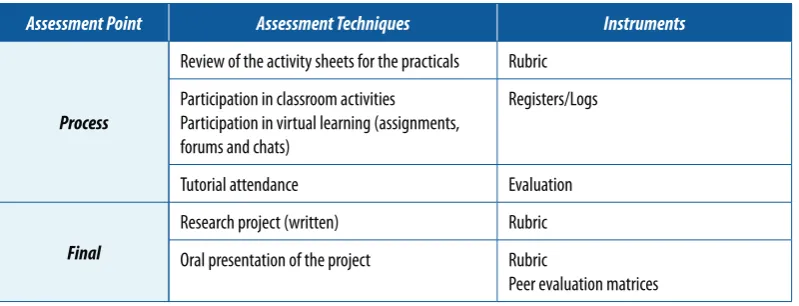
Thesystemputinplacetoevaluatethelevelofcompetencyattainmentanddevelopmentthrough
PBLcombinedaprocessassessmentanda finalassessmentinanattempttomakethestudents
feel responsible for boththeir achievementsand theirefforts. To that end, different assessment
techniquesandinstrumentswereusedasshownin Table1.
Table 1. PBL assessment techniques and instruments
Assessment Point Assessment Techniques Instruments
Process
3FWJFXPGUIFBDUJWJUZTIFFUTGPSUIFQSBDUJDBMT 3VCSJD
1BSUJDJQBUJPOJODMBTTSPPNBDUJWJUJFT 1BSUJDJQBUJPOJOWJSUVBMMFBSOJOH BTTJHONFOUT GPSVNTBOEDIBUT
3FHJTUFST-PHT
5VUPSJBMBUUFOEBODF &WBMVBUJPO
Final
3FTFBSDIQSPKFDU XSJUUFO 3VCSJD
0SBMQSFTFOUBUJPOPGUIFQSPKFDU 3VCSJD
1FFSFWBMVBUJPONBUSJDFT
Theprocessassessmentshowsthattherewasasustainedmajorityparticipationinactivitiesin
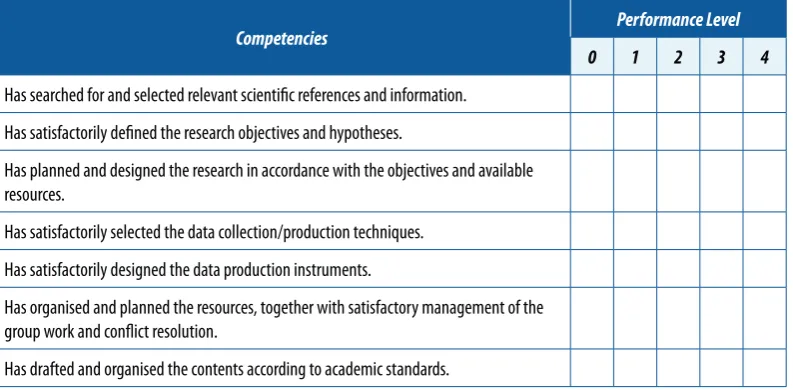
tounderstanding anddoing thepracticals. In ordertoassess thepracticalactivities, thelevelof
developmentofaseriesofcompetenciesshownin Table2wastakenintoconsideration. Inboth
subjects, thescoresobtainedgraduallygotbetterasthestudentsimprovedtheirworkbyreviewing
thedifferentassignments. Thescoresinbothsubjectsreachedameanof3onascaleof0to4.
Table 2.Evaluation matrix for the specific competencies worked on in the practicals
Competencies
Performance Level
0 1 2 3 4
)BTTFBSDIFEGPSBOETFMFDUFESFMFWBOUTDJFOUJöDSFGFSFODFTBOEJOGPSNBUJPO
)BTTBUJTGBDUPSJMZEFöOFEUIFSFTFBSDIPCKFDUJWFTBOEIZQPUIFTFT
)BTQMBOOFEBOEEFTJHOFEUIFSFTFBSDIJOBDDPSEBODFXJUIUIFPCKFDUJWFTBOEBWBJMBCMF SFTPVSDFT
)BTTBUJTGBDUPSJMZTFMFDUFEUIFEBUBDPMMFDUJPOQSPEVDUJPOUFDIOJRVFT
)BTTBUJTGBDUPSJMZEFTJHOFEUIFEBUBQSPEVDUJPOJOTUSVNFOUT
)BTPSHBOJTFEBOEQMBOOFEUIFSFTPVSDFTUPHFUIFSXJUITBUJTGBDUPSZNBOBHFNFOUPGUIF HSPVQXPSLBOEDPOøJDUSFTPMVUJPO
)BTESBGUFEBOEPSHBOJTFEUIFDPOUFOUTBDDPSEJOHUPBDBEFNJDTUBOEBSET
Performance levels: 0 = Did not do the assignment /Plagiarism; 1= Unsatisfactory; 2=Good; 3=Very good; 4=Excellent.
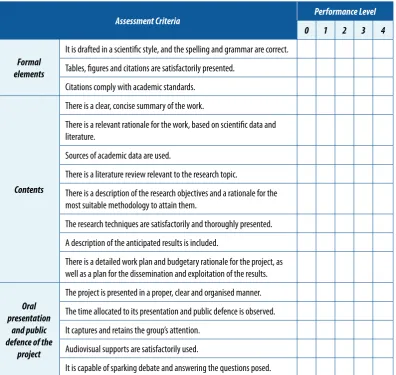
Forthe finalassessmentoftheprojectsubmittedattheendoftheacademicyearandpresented
intheclassroom, anevaluationrubricforspecificcompetencies(Table3)wasappliedinconjunction
withthe peer evaluationof thepresentation bytheir fellowstudents. The latteractivitywas an
elementofmotivationandinvolvementintheprocessesof(self-)assessmentand(self-)criticism. The
finalassessmentalsoproducedgoodresultswithregardtotheacquisitionoftheinitiallyanticipated
competencies, witha finalscoreinbothsubjectsof3.
Experiences and evaluations of the teaching innovation project
Consideringthenovelnatureofthisteachingtechniqueforstudentsandteachingstaff alike, an
assessment of its implementation was done by integrating their evaluations, experiences and
perceptionsofthefollowingaspects:
R Projectparticipation andmonitoring, as wellasany relateddifficultiesorfacilitating factors.
Classdiarieswereused, wherethelecturersnoteddownanyobservationsandincidentsthat
hadoccurredineithertheclassroomortheVLE, aswellasananalysisofanyotherevidenceof
participation.
R Thestudents’experiencesandperceptionsoftheinnovativeexperience, bothintermsofthe
wayitwascarriedoutandofitseffectsontheteaching-learningprocess. Theforumsandthe
fielddiarieskeptbythestudentswerethemaintoolsforstrengtheningreflectivenessinthe
Table 3. Rubric for the evaluation of the final report and its presentation in the classroom
Assessment Criteria
Performance Level
0 1 2 3 4
Formal elements
*UJTESBGUFEJOBTDJFOUJöDTUZMFBOEUIFTQFMMJOHBOEHSBNNBSBSFDPSSFDU
5BCMFTöHVSFTBOEDJUBUJPOTBSFTBUJTGBDUPSJMZQSFTFOUFE
$JUBUJPOTDPNQMZXJUIBDBEFNJDTUBOEBSET
Contents
5IFSFJTBDMFBSDPODJTFTVNNBSZPGUIFXPSL
5IFSFJTBSFMFWBOUSBUJPOBMFGPSUIFXPSLCBTFEPOTDJFOUJöDEBUBBOE MJUFSBUVSF
4PVSDFTPGBDBEFNJDEBUBBSFVTFE
5IFSFJTBMJUFSBUVSFSFWJFXSFMFWBOUUPUIFSFTFBSDIUPQJD
5IFSFJTBEFTDSJQUJPOPGUIFSFTFBSDIPCKFDUJWFTBOEBSBUJPOBMFGPSUIF NPTUTVJUBCMFNFUIPEPMPHZUPBUUBJOUIFN
5IFSFTFBSDIUFDIOJRVFTBSFTBUJTGBDUPSJMZBOEUIPSPVHIMZQSFTFOUFE
"EFTDSJQUJPOPGUIFBOUJDJQBUFESFTVMUTJTJODMVEFE
5IFSFJTBEFUBJMFEXPSLQMBOBOECVEHFUBSZSBUJPOBMFGPSUIFQSPKFDUBT XFMMBTBQMBOGPSUIFEJTTFNJOBUJPOBOEFYQMPJUBUJPOPGUIFSFTVMUT
Oral presentation
and public defence of the
project
5IFQSPKFDUJTQSFTFOUFEJOBQSPQFSDMFBSBOEPSHBOJTFENBOOFS
5IFUJNFBMMPDBUFEUPJUTQSFTFOUBUJPOBOEQVCMJDEFGFODFJTPCTFSWFE
*UDBQUVSFTBOESFUBJOTUIFHSPVQTBUUFOUJPO
"VEJPWJTVBMTVQQPSUTBSFTBUJTGBDUPSJMZVTFE
*UJTDBQBCMFPGTQBSLJOHEFCBUFBOEBOTXFSJOHUIFRVFTUJPOTQPTFE
Performance levels: 0 = Did not do the assignment /Plagiarism; 1= Unsatisfactory; 2=Good; 3=Very good; 4=Excellent.
Regardingprojectparticipationandmonitoring, agrowinginterestinthecreationoftheresearch
work was observed. According to the teaching staff diary, at the beginning the students had
considereditsomethingstrange, asyetanotherimpositionbytheteachingstaff, butlateronthey
begantointeriorise itasa usefulresourcewithintheirlearningprocesses. Likewise, throughthe
tutorialaction, differentlevelsoftheteammembers’involvementinandreasoningfortheproject
werenoted. The forumswerefrequentlyused, andthisincreased throughouttheacademicyear.
Theopportunityaffordedbytheforumstoshareinformationstrengthenedcooperativeworkboth
intra-groupandinter-group. Incontrast, thechatswerenotverypopularforavarietyofreasons:
Internetaccesslimitations, difficulties(mainlyworkandfamily-related)inconnectingtotheInternet
atthetimesscheduledfortheactivityandthevoluntarynatureofit, whichendedupdiscouraging
participation. Incontrast, andtogetherwiththeforums, the fielddiarieswereveryusefulforgathering
theexperiencesandperceptionsofstrengthsandweaknessesastheprojectwasbeingimplemented
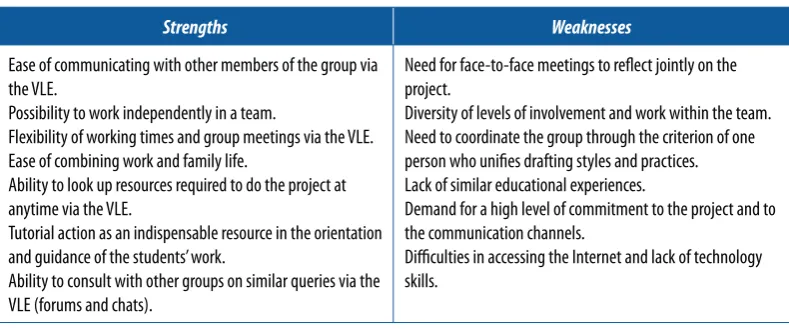
Table 4. Students’ perceived strengths and weaknesses of PBL and of VLE use Strengths Weaknesses &BTFPGDPNNVOJDBUJOHXJUIPUIFSNFNCFSTPGUIFHSPVQWJB UIF7-& 1PTTJCJMJUZUPXPSLJOEFQFOEFOUMZJOBUFBN 'MFYJCJMJUZPGXPSLJOHUJNFTBOEHSPVQNFFUJOHTWJBUIF7-& &BTFPGDPNCJOJOHXPSLBOEGBNJMZMJGF "CJMJUZUPMPPLVQSFTPVSDFTSFRVJSFEUPEPUIFQSPKFDUBU BOZUJNFWJBUIF7-& 5VUPSJBMBDUJPOBTBOJOEJTQFOTBCMFSFTPVSDFJOUIFPSJFOUBUJPO BOEHVJEBODFPGUIFTUVEFOUTXPSL "CJMJUZUPDPOTVMUXJUIPUIFSHSPVQTPOTJNJMBSRVFSJFTWJBUIF 7-& GPSVNTBOEDIBUT /FFEGPSGBDFUPGBDFNFFUJOHTUPSFøFDUKPJOUMZPOUIF QSPKFDU %JWFSTJUZPGMFWFMTPGJOWPMWFNFOUBOEXPSLXJUIJOUIFUFBN /FFEUPDPPSEJOBUFUIFHSPVQUISPVHIUIFDSJUFSJPOPGPOF QFSTPOXIPVOJöFTESBGUJOHTUZMFTBOEQSBDUJDFT -BDLPGTJNJMBSFEVDBUJPOBMFYQFSJFODFT %FNBOEGPSBIJHIMFWFMPGDPNNJUNFOUUPUIFQSPKFDUBOEUP UIFDPNNVOJDBUJPODIBOOFMT %JóDVMUJFTJOBDDFTTJOHUIF*OUFSOFUBOEMBDLPGUFDIOPMPHZ TLJMMT
RegardingthepotentialofPBL, thestudentspointedoutthatthismethodologygavethemgreater
protagonismwithintheirteaching-learningprocesses. However, thenoveltyoftheproposalandthe
students’limitedpriorpracticeofusingnewteachingtechniquesandinexperienceofworkingin
smallgroupsgaverisetoanumberofdifficultiesconnectedwiththedistributionandassumption
ofresponsibilitieswithinthegroup, andthetranslationofthisworkintoanassessmentthatwasnot
doneindividually. Accordingtothestudentdiaries, onestudentcommentedthatthenewapproach
wasveryparticipatoryandinteractive–somethingratherunusualintheircurriculum–andthatwas
whytheyhadinitiallyfeltalittledisconcertedabouttherealdimensionsofthework. Anotherstudent
notedthatbecausetherewaslessdirect, face-to-faceinteraction, ahighlevelofcommitmenttothe
projectwasrequired, asweresmoothcommunicationsamonggroupmemberstopreventalackof
coordinationasregardscontents. Despitethesedrawbacks, the finalevaluationoftheprojectwas
verypositive, withthestrengthsfaroutweighing theweaknesses. LikeOvejero(1988), webelieve
that, inthistypeofcollaborativemethodology, thestudentshavetheopportunitytodevelophigher
levels oftolerance, respect andcooperation becausetheyhavetoreach consensuson different
viewpointsandcreateaclimateofprogressandcohesiontoundertakeactionsandattaincommon
goals.
Likewise, ourstudentsunderscoredthatPBLpromotedabetterprofessionalorientationofthe
practicals, astheyhadmadeuseofproblemsandinstrumentsthatcouldbetransferreddirectlyto
theirfutureworkingenvironment. Thisobservation fitsinwithareorientationofteachingactivity,
wherelearningtolearnisgivenpriorityandeveryeffortismadetoensurethatboththeresources
and the methodology help to lay the basic foundations and develop the competencies and
aptitudesrequiredforprofessionalpractice(Martín & Roldán, 2011). TheuseoftheVLEledtomore
flexiblewaysofworkingandcommunicating, whichwereevaluatedespeciallypositively. According
tothestudentdiaries, onestudentsaidthattheVLEhadenabledhim/hertogetintouchwithfellow
studentstotryandansweranyjointqueriesthatarose. Anotherstudentstatedthatanyonecould
contributewhenevertheywanted, andyetanothermentionedtheabilitytoworkfromhome. An
addedstrengthwastheeaseofcombiningwork, familyandpersonallife, astheVLEofferedgreater
Amongtheweaknesses, thestudentspointedoutthenecessarychangeinmentality, asthese
newmethodologiesrequiredmoreeffortanddedication. Likewise, theyunderscoredthe(enduring)
difficultiesinaccessingnewtechnologiesandindevelopingskillstousethemproperly.
4. Conclusions
AlthoughspecialisedandtechnicalliteratureonPBLexists, weconsiderthatboththesystematisation
oftheparticularexperiencedetailedinthisarticleandthespecificationofthemaininstrumentsused
tomonitorandassessitcouldbeusefultoothersimilarinitiatives. Aslecturersimmersedinaprocess
wherebytheroleofuniversityteachingischanging, weconsideritcrucialtocontinueworkingon
strengthening theuseofthesenew methodologiesandtechnologies, and ontaking advantage
of the strengths they offer for teaching and learning. The diversification of teaching strategies,
andaboveallmoving awayfromthosethatseeteachingas aseries ofunidirectionalexpository
sessionsoriginatingfromtheteachingstaff anddirectedattheclass/group, canhelptogivegreater
protagonismtostudentsandreinforceachangeinmentalityandattitudestowardslearningthatis
moreactive, independentandcreative, asseveralotherstudieshavealsonoted(Calvoetal.,2010;
Casasolaetal., 2012;LaParraetal., 2011).
Thus, ICTsarenotonlyafundamental instrumentforcommunicationbetweenteachingstaff
andstudents, butalsoameansofstrengtheningcollaborativework, asoneofthekeystoworkingin
virtualenvironmentsisthedevelopmentofinteractionasacentralcomponentoftheeducational
process(Flores & Arco, 2012). Promotingcommunicationtoolsisthereforeanecessaryundertaking
inordertoturntheseenvironments– nowusedmoreandmoreoften–intonetworkingspaces
insteadofjustinformationrepositoriesand, bysodoing, tocontributetothedevelopmentofnew
waysofapproachingreality, whereknowledgeisunderstoodasasocialconstruct, whichstudents
arriveatontheirownandthroughtheirownmeans(González & Díaz, 2005).
The challenges posed by designing and doing a project with a real application facilitated
the development of skills and competencies that are better oriented towards the students’
futureworking lives. Inaddition, it enabledprogress to bemade oncompetencies relating to
collaborativework, conflictresolutionandindependentdecision-making. Theaimofthisproject
was to provide a flexible teaching scheme, placing considerable emphasis on tutoring and
monitoringthroughouttheprocess, anddesigningaspaceforinteractioncapableofcombining
individualandcollaborativelearningprocesses. Likewise, thevirtualenvironmentenabledagreater
adaptationoftheteaching-learningprocessasitgavethestudentstheopportunitytoundertake
self-directedlearning accordingtotheircircumstances. Inthisrespect, afuturelineofresearch
and teaching innovationis the use of new methodologies adaptedto student characteristics,
suchasgender, life-cyclestageandsocioeconomiccircumstances, astheseareissuesthatremain
References
Badía, A., & García, C. (2006). Incorporacióndelas TICenlaenseñanzayelaprendizajebasadosenla
elaboracióncolaborativadeproyectos [The incorporationofinformation andcommunication
technologiesintoteachingandlearningbasedoncollaborativeprojectwork]. RUSC. Universities
and Knowledge Society Journal, 3(2), 42-54. Retrievedfromhttp://www.uoc.edu/rusc/3/2/dt/esp/
badia_garcia.pdf
Boud, D. (Ed.)(1995). Enhancing Learning through Self-Assessment. London, England:KoganPage.
Boud, D., & Falchikov, N. (Eds.)(2007). Rethinking Assessment in Higher Education. Learning for the long
term.Oxon, England:Routledge.
Cabero, J., MoralesLozano, J. A., MartínezSánchez, F., BallesterosRegaña, C., Romero Tena, R., Barroso
Osuna, J. ... Salinas Ibáñez, J. (2006). Formación del profesorado universitario en estrategias
metodológicasparalaincorporacióndelaprendizajeenredenelEspaciodeEducaciónSuperior
[Formationoftheuniversityfacultyinmethodologicalstrategiestoincorporationofe-learningin
EuropeanSpaceof HigherEducation]. Revista Pixel-Bit, 27, 11-29. Retrievedfromhttp://www.sav.
us.es/pixelbit/pixelbit/articulos/n27/n27art/art2702.htm
Calvo, I., LópezGuede, J. M., & Zulueta, E. (2010). AplicandolametodologíaProjectBasedLearning
enladocenciadeIngeniería TécnicaInformáticadeGestión [ApplyingthePBLmethodologyin
ComputerEngineering]. Revista de Formación e Innovación Educativa Universitaria, 3(4), 166-181.
Retrievedfromhttp://webs.uvigo.es/refiedu/Refiedu/Vol3_4/REFIEDU_3_4_1.pdf
Casasola, M. A., PérezChamorro, V. A., & García Álvarez dePerea, J. (2012). Aprendizajebasadoen
proyectosytrabajoenequipo:innovandoenladocenciadelaasignaturaSistemasContables
Informatizados [Project-based learning and teamwork: innovating in the teaching of the
Computerised AccountingSystemssubject]. UPO INNOVA. Revista de Innovación Docente, 1, 107
-122. Retrievedfromhttp://www.upo.es/revistas/index.php/upoinnova/article/view/89
CebriándelaSerna, M. (2003). Enseñanza virtual para la innovación universitaria [Virtualteachingfor
universityinnovation]. Madrid, Spain:Narcea.
Falchikov, N. (2005). Improving Assessment through Student Involvement. Practical Solutions for Aiding
Learning in Higher and Further Education. Oxon, England:Routledge.
Flores, Ò., & De Arco, I. (2012). Lainfluenciadelas TICenlainteraccióndocenteydiscenteenlos
procesosformativosuniversitarios [TheImpact ofICTsonLecturerandStudentInteractionin
UniversityEducationProcesses]. RUSC. Universities and Knowledge Society Journal, 9(2), 31-47. doi:
10.7238/rusc.v9i2.1243
González, G., & Díaz, L. (2005). Aprendizaje colaborativo: una experiencia desde las aulas
universitarias [Collaborativelearning:auniversityclassroomexperience]. Educación y Educadores,
8, 21-44. Retrievedfromhttp://educacionyeducadores.unisabana.edu.co/index.php/eye/article/
view/564
Huber, G. L. (2008). Aprendizajeactivoymetodologíaseducativas [Activelearningandeducational
methodologies]. Revista de Educación, Special Issue, 59-81. Retrievedfromhttp://www.duoc.cl/
Jiménez-Rodrigo, M. L., & Márquez Lepe, E. (2011). Estudiardespuésde los30: Interacción entre
desigualdades de géneroyedad enlosestudios universitarios [Studyingafter 30:Interaction
betweengenderinequalitiesandageinuniversitystudies]. InI. Vázquez(Coord.), Investigación y
género: logros y retos [Researchandgender:achievementsandchallenges] (pp. 961-974). Seville,
Spain:UniversidaddeSevilla.
Kolmos, A. (2004). Estrategiaspara desarrollarcurrículosbasadosen laformulacióndeproblemas
y organizados en base a proyectos [Strategies for developing problem-based learning
curricula]. Educar, 33, 77-96. Retrieved from http://www.raco.cat/index.php/Educar/article/
download/20789/20629
LaParra, D., Muñoz-Baell, I. M., Ortiz, R., Davó, M. C., & ÁlvarezGarcía, J. S. (2011). Aprendizajebasado
enproyectosyresolucióndeproblemasenSocioestadísticaII, asignaturadeGradoenSociología
[Problem-basedlearningandproblem-solvinginSocialStatisticsII, aSociologydegreesubject].
In M. T. Tortosa, J. D. Álvarez Teruel, & N. Pellín(Coords.), Jornadas de Redes de Investigación en
Docencia Universitaria: Diseño de buenas prácticas docentes en el contexto actual [University Teaching
ResearchNetworksConference:Designofbestteachingpracticesinthecurrent context] (pp.
40-50) Alicante, Spain:Universidadde Alicante. Retrievedfromhttp://web.ua.es/es/ice/jornadas
-redes-2011/documentos/posters/183834.pdf
LópezPastor, V. (2005).Evaluación, aprendizajeydocenciauniversitaria. Surelaciónconel espacio
europeodeeducaciónsuperior [Assessment, Learningand Teachingin HigherEducation And
Their RelationWith Higher Education European Area]. Revista Electrónica Interuniversitaria de
Formación de Profesorado, 8(4), 1-4. Retrievedfromhttp://www.aufop.com/aufop/uploaded_files/
articulos/1229705605.pdf
MartínLópez, M., RoldánMárquez, A. (Coords.)(2011). EES y cambios en las metodologías docentes
[EHEA andchangesinteachingmethodologies]. Seville, Spain: TirantLoBlanch.
Mesa, J. A., Álvarez, J. V., Villanueva, J. M. yDeCos, F. (2008). Actualizacióndemétodosdeenseñanza
-aprendizaje en asignaturasde dirección de proyectosde ingeniería [AnUpdate of Teaching/
LearningMethodsinProjectManagementCourses]. Formación Universitaria, 1(4), 23-28. Retrieved
from http://www.scielo.cl/scielo.php?pid=S0718-50062008000400004&script=sci_arttext. doi
http://dx.doi.org/10.4067/S0718-50062008000400004
Michavila, F. (2000). ¿Soplanvientos de cambiosuniversitarios? [Arewindsofchangeblowingin
universities?] Boletín de la Red Estatal de Docencia Universitaria, 1(1), 4-7. Retrievedfrom http://
revistas.um.es/redu/article/view/11441
Ovejero, A. (1988). Psicología Social de la Educación [Socialpsychologyofeducation]. Barcelona, Spain:
Herder.
Stake, R. E. (1998). Investigación con estudios de caso [Theartofcasestudyresearch]. Madrid, Spain:
Morata.
Zabalza, M. A. (2007). La enseñanza universitaria. El escenario y sus protagonistas [Universityteaching.