ABC-PSO Based Routing For Wireless Sensor
Network Using AODV Protocol
Vignesh Ramamoorthy H, Dr. R. Gunavathi
Abstract: The utilization of wireless sensor applications is increased due to the fast convergence, efficient and easy adaptation. Need of computing technologies to inherit specific tasks are also in demand to achieve. In this concern, the proposed protocol concentrates in achieving efficient routing through a combined ABC-PSO based AODV protocol for WSN. Artificial Bee Colony (ABC) has a strong search ability combined with Particle Swarm Optimization (PSO) to search for the best operators and particle search makes a fastest jump out of local advantages to achieve the better route for the network. ABC algorithm optimization, evolution of subroutine swarms and faster particle selection improves the network performance and more accurate path selection. The simulation results show that the proposed ABC-PSO based AODV protocol achieves efficient route discovery and recovery mechanism for WSN. In addition, the robustness and reliability of the network is improved than the existing schemes.
Index Terms: Artificial bee colony, particle swarm optimization, AODV, path selection, route discovery and recovery —————————— ——————————
1.
INTRODUCTION
Wireless Sensor Networks (WSN) is widely used in most of the fields like environmental monitoring, space exploration, medical, military, rescue and disaster relief and other developing application areas. Nowadays, the research on WSN is focused in cross-layer protocols is increased [1]. In addition, through the emergence of intelligent sensor driven mobile devices the network occupies a special place in developing smart cities, internet of things (IOT) and so on [2]. WSN [3] and Wireless Mesh Network (WMN) plays a major technology to provide many IOT based applications and services.
Though the interesting factors of WSN, the network also faces various constraints and challenges [4]. Some of the constraints on design of WSN are,
• Limited battery life and Quality of Service (QoS) • Dynamic network topologies configuration • Reliability of wireless connection
• Functionality and scalable of routing protocols • Security violation and threads
The routing protocols of WSN is an effective tool for efficient communication in this network. The development of latest routing protocols focused in effective communication between the wireless nodes in infrastructure less network is a tedious process. The power consumption and QoS communication are the two major key factors for routing protocols to maintain smoother communication from end to end [2, 4]. The reliability and stability of the network remain challenges to WSN [5]. Most of the routing protocols proposed for ad hoc based network are unipath. Therefore, the routing between source and destination is achieved through a single path. Multipath communication allows identification of multiple paths, utilization of best path among the multiple paths and rerouting can be accomplished easily [6]. The benefit of multiple path
routing is fault tolerance. The introduction of redundancy and provision of backup path or rerouting can be applied through packet recovery where the path of the packet is modified to the latest path when the error or interruption occurs to the actual path. Fault tolerance improves the reliability and stability of the network [7]. In recent years, a greater number of research works were presented in fault tolerance applications. It also focuses on various aspects like, coverage and topology control, fault tolerance of hardware, fault detection and fault separation on routing concept of WSN. The three aspects of fault tolerance, which are concentrated mostly by the researchers, are: retransmission, error correcting codes and multipath mechanisms [6, 9]. In view of routing fault tolerance in WSN, this paper efficiently reconstructs alternate routes. Intelligent routing fault-tolerant mechanism based on ABC-PSO is proposed. Through the establishment of fault-tolerant routing models, the complicated computation and application problems can be solved. In addition, stable operation of the network, enhancement of network performance, network robustness and reliability, reduction of energy consumption and network lifetime improvement also can be achieved.
The main contribution of the proposed work is summarized as follows:
• Characterize the issues of available fault tolerant protocol mechanisms and formulate a problem for fault tolerant algorithm.
• Propose a new fault-tolerant routing algorithm using ABC-PSO.
• Extensive simulation results to demonstrate the use and efficiency of the proposed fault-tolerant routing algorithm.
• Evaluate the performance of the proposed ABC-PSO based AODV with other existing schemes.
The rest of the paper is organized as follows: Section 2 discusses the related work. Section 3 discusses the proposed work. Section 4 presents the performance analysis through simulation parameters and evaluation of the proposed work. Section 5 concludes the paper.
2
RELATED
WORK
Umadevi et al. [10] presents associative cluster head based fault recovery method for Wireless Sensor Networks. The work concentrates in election of associative cluster head election ————————————————
Vignesh Ramamoorthy H is currently pursuing part time Ph.D program in Computer Science at Sree Saraswathi Thyagaraja College, Pollachi, India, and also working as an Assistant Professor, Dept. of Information Technology, Sri Krishan Arts and Science College, Coimbatore, India, PH-09791770735. E-mail: [email protected]
through fault recovery method. The fault recovery model proposed in this scheme achieves the recovery through LEACH protocol. The work also selects the cluster head based on the effective path selection process. This work achieves best cluster head than the other schemes still the energy consumption of this work is a major pitfall of this scheme. Li and Liang [11] proposed compressed sensing methodology for multi-hop large-scale wireless sensor networks. This work focused on routing topology tomography on WSN. The sense data is compressed with high fidelity when a few data is collected from the network. If suppose the network collects a greater number of data then it follows the usual way of data collection. The research work follows random projection matrix for compression. Jayekumar and Nagarajan [12] displayed a novel DEA-OR algorithm for WSN. The route failure recovery is identified using this scheme. Traditional technique for optimization is modified with Distance and Energy Aware Optimization Routing (DEA-OR). Distance metrics is considered as a major factor in this scheme. Therefore routing, clustering and other terminologies are followed based on the distance factor. After considering distance then the cluster formation and cluster head election is considered based on the proposed energy metrics. Routing and cost-confined greedy method is proposed for route failure identification and backtracking method proposed minimized neighbor selection. The downside of this research work is not suitable for multi-path routing and large-scale WSN. Qureshi and Javaid [13] proposed an enhanced adaptive geographic opportunistic routing for WSN. The proposed work avoids the interference with mobile sinks. The work caters over penalized of forwarder node. It normally adapted by lowering priority of node with residual energy. Geoopportunistic routing paradigm is proposed based on interference avoidance using the assisted sink node. The whole network is divided into cubes in this proposed work. Using packet delivery probability based on geographic location of neighboring cubes is identified. Void node mechanism also proposed in this scheme to refuse the election of sink node. The research work focused on geoopportunistic protocol which are not identified more in this category, still the protocols need to concentrate on improvement of network lifetime. Sun et al. [14] proposed Loop-aware routing for energy-harvesting WSN. Using collection tree protocol (CTP) updates new parent update metric for proactive and adaptive beaconing scheme to suppress the occurrence of loops and unlock the unavoidable loops. The loops are processed based on iterative methodology using CTP. The model not focused on energy aware metric, which may drain the energy soon due to the looping process. Yue et al. [15] focused on swarm intelligence algorithm for WSN. The work focused on routing recovering strategy where the routing is processed based on particle swarm optimization (PSO) with artificial bee colony (ABC). Through the combined ABC-PSO the algorithm achieves a better routing recovering process than the other schemes in this field. The work is focused on mobile sink and WMSN.
3.
ABC-PSO
BASEDAODV
P
ROTOCOLThe proposed ABC-PSO based AODV Protocol is a combined ABC and PSO based algorithm for efficient routing in WSN. The route identification and rerouting is carried out through the proposed algorithm to extent the network lifetime.
3.1 AODV Protocol
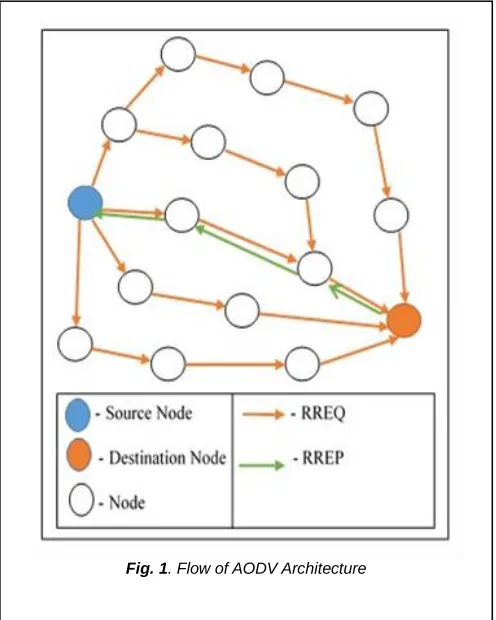
Ad-hoc Distance Vector (AODV) [16] protocol is a reactive routing protocol, where the routes are determined only when needed. The protocol forwards hello packets to detect and monitor the links to its neighbors. The Hello message is forwarded periodically and when the destination node doesn’t react to the hello message then it is detected as link break. When source node is ready to forward a packet then it first sends Route REQuest (RREQ) to its neighbors. Neighbors receives the RREQ and it checks with its route table whether it has path to reach the destination or not. If it has the path then it gives a RouteREPly (RREP) else it forwards the RREQ to its neighbors. Finally, the path will be identified and starts the data forwarding. RREP is a unicast hop-by-hop forwarding technique. In addition, the data flow will start when the RREP is received to source. When multiple RREP is received then the source will decide the shortest hop path to reach the destination node. Each node in the route update its routing time for each data flow in the route. Through this updation, the node can assure the routing time between the source and destination node.
If suppose the route is not used for a period, then the node deactivates and delete the route in the routing table. In addition, when the link break is detected then the node forwards the Route ERRor (RERR) to its source to validate the destination which is not available and asks the node to remove the route from routing table. It also asks for reinitiating the route discovery process. The Figure. 1 shows the flow of AODV architecture.
3.2. PSO Algorithm
PSO is a population based stochastic optimization technique. Generally, PSO shares similarities with evolutionary
techniques like Genetic Algorithm (GA). Evolutionary operators’ crossover and mutation are followed in PSO that is not avail in GA.
The three steps of PSO are, Evaluating the fitness
Update individual and global bests
Update velocity and position of each particle
Particle Swarm Optimization algorithm is used to identify the foraging behavior of birds through experience and cognition for food and information sharing. For the V dimensional vector space and one of the positions of ith in a group of N particles [15] is and speed is calculated as, and i=1,2,3….V best position is and position searched by all particles is . Therefore, each particle updates its speed and position through (k+1)th iteration formula.
(1)
(2)
where , is the inertia weight, and are recognition parameters, and social parameters and are random numbers between 0 and 1.
3.3 ABC-PSO based algorithm
In the year of 2006, Karboga and Basturk [17] proposed bionic artificial bee colony algorithm based on bee swarm model. Due to its search ability the performance in optimizing the unequal multimodal functions are easily evaluated [18].
(3)
where are random indexes
and is the random number between -1 and 1.
3.
PERFORMANCE
ANALYSIS
To compare the proposed ABC-PSO based algorithm using AODV protocol, NS-3.29 simulator with the following parameter specification in table 1.
The simulation performs network energy consumption, packet delivery rate and network connectivity parameters with AODV-SMS [19] and AODV-AODV-SMS(ABC-PSO) [15].
4 CITATIONS
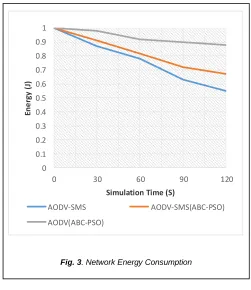
The network energy consumption is presented in the Figure 3. This diagram depicts that, the proposed AODV(ABC-PSO) receives a better energy consumption than the existing two works AODV-SMS and AODV-SMS(ABC-PSO).
TABLE1
SIMULATION PARAMETERS
Simulation parameter Value
Network Simulator Network Simulator
Version (NS-3.29)
Area Size 1000*1000
Protocols AODV
Total Simulation Time 120 Sec
Number of Nodes 100
Packet Size 64 Byte
Application Data Rate 2048 bps
Mobility Model Random Waypoint
Mobility Model
Fig. 3. Network Energy Consumption 0
0.1 0.2 0.3 0.4 0.5 0.6 0.7 0.8 0.9 1
0 30 60 90 120
Ene
rg
y
(J
)
Simulation Time (S)
AODV-SMS AODV-SMS(ABC-PSO)
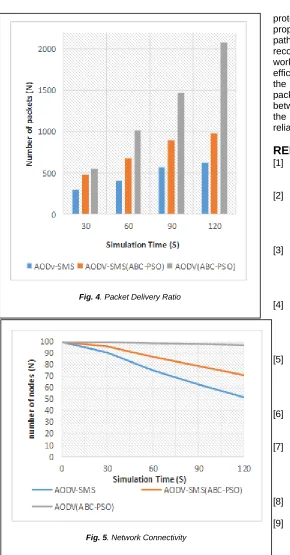
In Figure.4 the proposed AODV(ABC-PSO) receives a better packet delivery ratio than the existing two works AODV-SMS and AODV-SMS(ABC-PSO). In Figure.5 the proposed AODV(ABC-PSO) receives a better network connectivity than the existing two works AODV-SMS and AODV-SMS(ABC-PSO). The comparison of network connectivity is based on the number of alive nodes.
4.
CONCLUSION
Wireless Sensor Networks have gained popularity due to their real time applications and low-cost nature. Given the routing fault tolerance, using the proposed ABC-PSO based AODV
protocol for efficient routing and path finding for WSN. The proposed work combines ABC and PSO to identify the best path for routing. The proposed work studies the optimal recovery strategy for alternate route. Further, the proposed work enhances the optimization capacity to improve the efficiency and performance of the network. This work shows the performance based on network energy consumption, packet delivery rate and network connectivity parameters between the proposed and existing works. In future research, the network concentrates on fault tolerant problem, network reliability and energy utilization problems.
REFERENCES
[1] Akyildiz, I. F., Su, W., Sankarasubramaniam, Y., & Cayirci, E. (2002), “Wireless sensor networks: a survey. Computer networks”, 38(4), 393-422.
[2] Van Dam, T., & Langendoen, K. (2003, November), “An adaptive energy-efficient MAC protocol for wireless sensor networks”, In Proceedings of the 1st international conference on Embedded networked sensor systems (pp. 171-180). ACM.
[3] H. Vignesh Ramamoorthy & Dr. R. Gunavathi, "A Review on Structural Health Monitoring in Wireless Sensor Networks", Vol. 4, no.7, International Journal for Research in Applied Science and Engineering Technology (IJRASET) pp. 550-559, ISSN : 2321-9653, www.ijraset.com.
[4] Heinzelman, W. R., Kulik, J., & Balakrishnan, H (1999, August), “Adaptive protocols for information dissemination in wireless sensor networks”, In Proceedings of the 5th annual ACM/IEEE international conference on Mobile computing and networking (pp. 174-185), ACM.
[5] Vignesh Ramamoorthy H & Dr.R.Gunavathi (2019), “Survey on Discovery Practices of Black Hole Attack”, International Journal of Information and Computing Science (IJICS), DOI:16.10089.IJICS.2019.V6I5.18.3125, ISSN: 0972-1347, 6 (5), pp. 486-492.
[6] Ghaffari, A. (2015), “Congestion control mechanisms in wireless sensor networks: A survey”, Journal of Network and Computer Applications, 52, 101-115.
[7] Vignesh Ramamoorthy H & Dr.R.Gunavathi, “A Novel Trust based Routing protocol for Wireless Sensor Networks”, International Journal of Scientific and Technology Research (IJSTR), Vol. 8, no. 9, September 2019, pp. 1152-1156, ISSN: 2277-8616.
[8] Press, C. R. C. (2016), “Wireless sensor networks: Current status and future trends”, CRC press.
[9] Krishnakumar, A., & Anuratha, V. (2019), “Energy-Efficient LEACH Protocol with Multipower Amplification for Wireless Sensor Networks”, In Pervasive Computing: A Networking Perspective and Future Directions (pp. 103-110). Springer, Singapore.
[10]Umadevi, K. S., Swathi, H. R., Singhal, S., & Himanshu, S. S. (2018), “Associative Cluster Head Based Fault Recovery Method for Wireless Sensor Networks”, Advanced Science Letters, 24(8), 6025-6029.
[11]Li, Y., & Liang, Y. (2018), “Compressed sensing in multi-hop large-scale wireless sensor networks based on routing topology tomography”, IEEE Access, 6, 27637-27650. [12]Jayekumar, M., & Nagarajan, V. (2018), “A novel DEA-OR
algorithm for route failure recovery in dense wireless sensor networks”, Cluster Computing, 1-9.
[13]Qureshi, T. N., & Javaid, N. (2018, December), “Enhanced adaptive geographic opportunistic routing with interference
Fig. 4. Packet Delivery Ratio
avoidance assisted with mobile sinks for underwater wireless sensor network”, In 2018 International Conference on Frontiers of Information Technology (FIT) (pp. 367-372). IEEE.
[14]Sun, G., Shang, X., & Zuo, Y. (2018), “La-CTP: Loop-aware routing for energy-harvesting wireless sensor networks”, Sensors, 18(2), 434.
[15]Yue, Y., Cao, L., Hang, B., & Luo, Z. (2018), “A Swarm Intelligence Algorithm for Routing Recovery Strategy in Wireless Sensor Networks with Mobile Sink”, IEEE Access, 6, 67434-67445.
[16]Vignesh Ramamoorthy H & Dr.R.Gunavathi., “Improving the lifetime of Wireless Sensor Network through Energy Proficient AODV Protocol”, in International Journal of Engineering and Advanced Technology (IJEAT), DOI: 10.35940/ijeat.F9021.088619, Vol.8, no.6, August 2019, pp. 3016-3020, ISSN: 2249-8958.
[17]Karaboga, D., & Basturk, B. (2007), “A powerful and efficient algorithm for numerical function optimization: artificial bee colony (ABC) algorithm”, Journal of global optimization, 39(3), 459-471.
[18]Abu-Mouti, F. S., & El-Hawary, M. E. (2011), “Optimal distributed generation allocation and sizing in distribution systems via artificial bee colony algorithm”, IEEE transactions on power delivery, 26(4), 2090-2101.