Corruption Begets Corruption In Developing
Countries - How The Use Of Technology
Could Change The Landscape
Okey Igbonagwam, Saint Leo University, Virginia Beach, Virginia, USAV. Joy Rose, Saint Leo University, Atlanta Center, Georgia, USA
ABSTRACT
This paper investigates the role technology can play in fostering good business practices that would deter economic corruption and extortion in developing countries. This paper first provides a problem statement with a brief description of corruption in form of bribery and extortion based on Foreign Corrupt Practices Act (FCPA) and its provisions. Second, we propose a definition of bribery and extortion. Our definitions indicate that, contrary to what is often claimed, many of the kinds of payments forbidden by the Foreign Corrupt Practices Act are not instances of bribery, but rather extortion. Third, we present an economic analysis of bribery and extortion and explain why they are thought to be undesirable practices from an economic point of view. Fourth, we present two case studies to support the use of technology to mitigate and facilitate business in developing countries that should improve economic and business practices.
Keywords: Foreign Corrupt Practices Act; Bribery; Extortion; Foreign Countries
INTRODUCTION
he Saint Leo University International Business Conference (IBC) theme is “Sustainable Development in a Global Economy: Creating Vibrant Economies.” In accordance with the IBC theme, the main research problem this study will address is some economic deterrent issues in developing nations. More specifically, this study will investigate any contributions of perceived bribery (PB), perceived extortion (PE), and targeted aids/assistance (TAA) to perceived business practices (PBP) for a developing nation’s economic growth. This paper argues that corruption and extortion could retard sustainable economies in the developing nations. In some developed nations there might be perceived strong moral presumption against either making or accepting bribery payments. Thus, the United States Congress 1977 responded to public concern over corrupt practices by passing the Foreign Corrupt Practices Act (Gustman, 1977; Thomas, 1985). This paper will also argue that there is perceived presumption for extortion payments hindering economic growth in many of these developing nations. An issue is that some forms of payments forbidden by FCPA are morally permissible, emanating from cultural norms. We assert in this paper that corruption and extortion contribute to economic retardation of the developing nations. This paper first will provide a problem statement with a brief description of the corruption and extortion based on Foreign Corrupt Practices Act" (FCPA) and its provisions. Second we propose definitions of bribery and extortion. Our definitions have the consequence that, contrary to what is often claimed, many of the kinds of payments forbidden by the Foreign Corrupt Practices Act are not instances of bribery, but rather extortion. Third we present an economic analysis of bribery and extortion and explain why they are thought to be undesirable practices from an economic point of view. Fourth, we present two case studies to support the use of technology to mitigate and facilitate business in developing nations; subsequently we presume to improve economies in the developing nations. The definitions of bribery and extortion issues have been studied in the past, (Thomas, 1985; Annals of the American Academy of Political and Social Science). Thomas (1985) defined them by contrasting extortion with bribery. Thus, “a clear case of extortion could be gangster threatening to blow up one’s store unless the owner pays for protection each month, and a policeman threatening to frame an innocent person for a crime unless money is paid.” He further explained that extortion is sometimes construed in a very narrow sense as an official's demanding payment for services that he is obligated to perform without payment. In contrast, bribery
could start from the favor sicker to an officer payment for doing something contrary to the duties of his position. However, this paper will define, extortion as not just when an official demands payment for doing something that he ought to do without being paid but also when criminals demand money or favor in exchange of goods and services protections. This is still supported by Thomas’s suggestion of extortion as “an act of threatening someone with harm in order to obtain payment or other benefits to which one has no prior entitlement.” Other studies have defined bribery to include a source for common forms of corruption (Wated and Sanchez, 2005; Walzer, 1997; Association of Certified Fraud Examiners, 1997; Sullivan, 1999). Rose-Ackerman (1999) qualified a bribe as “a payment, in money or in kind, that involves a reciprocal obligation and that aims at inducing unethical behavior of the person receiving the bribe.” This paper will use a broad based definition of perceived bribery and extortion based on a literature review.
Our research found few studies on targeted assistance, as Woodward and Ribar (2012) noted, “… much less, however, about whether targeted assistance, such as the SBP, NSLP, and WIC, affects out-comes for non-targeted household members.” Their study suggested that social scientists conceptualize that non-targeted and non- targeted food assistance may impact each individual differently with respect to food consumption. Other research by Oliveira and Gundersen (2000) investigated the relationship between WIC participation and young children’s food consumption, comparing outcomes for targeted and non-targeted children in WIC-receiving households. This latter comparison suggests that non-targeted children do not benefit from household WIC participation. Therefore, this research will investigate to what extent TAA benefits recipients; and any impact to PB and PE to positively influence PGBP. In our hypothesis section, we will discuss some of the relationships between independent and dependent variables. Since few studies have developed and empirically tested theoretical models of the PB, PE, and TAA, however, Wated and Sanchez (2005) study explained the manner in which managers handle an employee bribery behavior; their study was based on Fishbein and Ajzen’s (1985) theory of reasoned action. The fundamental overarching argument of this research is that the nature and scope of the PB, TAA, and PE impact the nature and scope of PBP and possibly economic improvement outcome.
In summary this paper does not claim to propose a new deal because history has shown where enough efforts have alleviated chronic suffering such as the 1937 Housing Act, while contributed greatly to the amelioration of housing conditions on Indian reservations in the US, Brian (2010). This scheme was designed in the New Deal era without Indians in mind. Indian reservations needed a new housing finance framework that better conformed to the tribes' status as self-governing sovereigns, a goal achieved in 1996 with the enactment of the NAHASDA. Where the NAHASDA provided the Indian Housing Block Grants (IHBGs) to tribal governments, thereby provide choices to the Tribes. Tribes can choose whether to administer the grants directly or designate a related entity (tribally designated housing entity, or TDHE in NAHASDA terms) for that purpose. We argue that the models described here can benefit from the New Deal era quest to eliminate poverty in housing.
STUDY FRAMEWORK
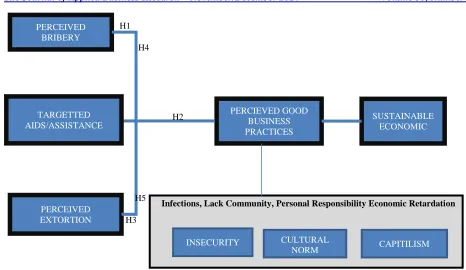
In this section, we will build the hypotheses for our research model (see Figure 1) for sustainable economies in developing nations through technology. All the hypotheses pertain to actions on perceived good business practices. This is the extant literature on PB, PE, and TAA. Just the threat of PB and PE could discourage sustainable economic development, research in information security suggest that people can be discouraged from using the Internet because of perception of vulnerability to threat that they are not even familiar with (Downs et al. 2006; Lee and Geistfeld 1999). Since perception of threat is an essential component of assessing the threat in order to make an appropriate decision (Liang and Xue 2009; Woon et al. 2005), we propose to test the following hypothesis:
H1: Higher the targeted aids/assistance leads to less reliance on bribery
H2: Higher the targeted aids/assistance leads to more perceived good business practices and a sustainable economy.
H3: Higher the targeted aids/assistance leads to less extortion in perceived good business practices and sustainable economy.
Figure 1: A Perceived Good Business Practice Framework
METHOD
The proposed study involves an exploratory case study that will qualitatively search for complex variables in order to understand the process by which a technology-driven case could impact other variables formed (Glesne 2006). The qualitative approach allows an in-depth examination of the policy-related phenomenon, while recognizing the issues in their multifaceted forms, dimensions, and layers, without simplifying the phenomenon observed from multiple participants and their individual experiences within an organizational setting (Creswell 2003; Leedy and Ormrod 1985). According to Benbasat et al. (1987), much insight can be gained from case study research, especially when the research is not preceded by numerous related studies. This case study comprises an all-encompassing method, which covers the logic of design, data collection techniques, and specific approaches to data analysis (Yin 2003). Data will be collected using multi-methods (i.e., survey, observations, document reviews) to strengthen the results through triangulation (Creswell 2003; Kaplan and Duchon 1988; Yin 2003). Since qualitative research is assessed on the quality and rigor of the research (Creswell 2003; Yin 2003; Guba and Lincoln 2005), Tables 2 and 3 briefly identify the validity and the reliability criteria important to the credibility of this case study.
CASE STUDIES
The authors believe that the impact of technology would positively influence PGBP through TAA devices, especially on a small scale for small businesses. Studies suggest a correlation between technology and business productivity, Stadler (1990). This study on business cycle models with endogenous technology assumed that random changes in/or shocks to productivity or technology cause output fluctuations in perfectly competitive environments even though technology maybe independent of economic forces and exogenous to the economic environment. However, the Stadler study indicated that there is “substantial theoretical and empirical literature that emphasizes the dependence of technological progress on economic factors, implying that technology is, to a large degree, endogenous.” Other works suggest the connection between technology and innovation include (Arrow, 1962; Eltis, 1971; Schmookler, 1966; Utterback, 1974). Studies have shown that technology, as such the Internet, offers great possibilities through a many-to-many communication model beyond traditional marketing media, in which the flow of information is unidirectional (Berthon, Leyland, and Watson, 1996; Hoffman and Novak 1996; Hoffman, Novak, and Chatterjee 1995). Thus, the two case studies in this paper are also Web enabled to provide
Infections, Lack Community, Personal Responsibility Economic Retardation SUSTAINABLE
ECONOMIC
CULTURAL NORM PERCEIVED
BRIBERY
PERCEIVED EXTORTION
PERCIEVED GOOD BUSINESS PRACTICES
INSECURITY TARGETTED
AIDS/ASSISTANCE
CAPITILISM H1
H2
H3 H5
detailed product information, establish a presence in new markets, enhance small businesses and encourage consumer involvement in developing their products and establish interactivity with the consumers. Eliminating the human element in services is a key to this paper. Watson, Pitt, and Berthon (1996) suggested that the Internet and the Web can offer such capability through customization. According to Watson, Pitt, and Berthon (1996, p. 00), this will "eliminate variability ... by allowing [information technology to create and deliver the precise service that the customer desires."
This paper investigates the case of MPESA, a low cost secured real-time fund transfer via the cell phones according to (http://www.safaricom.co.ke/?id=257). The Jack and Suri research suggested in March 2007 that Safaricom, the Kenyan leading cell phone company, formalized the money transfer technique by launching the M‐PESA, an SMS‐based money transfer system that allows individuals to deposit, send, and withdraw funds using their cell phone. “M‐PESA has grown rapidly, currently reaching approximately 38 percent of Kenya’s adult population and is widely viewed as a success story to be emulated across the developing world, according to Jack and Suri (2009)”.
An early assessment of the money transfer system indicated three major lessons have emerged from M-PESA. First, it demonstrates the value of leveraging mobile technology to extend financial services to large segments of unbanked poor people. Second, it shows the importance of designing usage-based, rather than float-based, revenue models for reaching poor customers with financial services. Unlike a traditional bank, which typically distinguishes between profitable and unprofitable customers based on the likely size of their account balances and ability to absorb credit, M-PESA serves any Safaricom mobile customer who pays for an account. Finally, M-PESA reveals the need for a low-cost transactional platform that enables low-income customers to meet a range of payment needs.
This paper’s tentative finding will show that since the M-PESA introduction in mid-2007, over 9 million customers had adopted it. In late 2009, about 40 percent of Kenya’s adult population utilizes it as a form of banking and mobile money transfer model. Current estimates indicate that it is facilitating an average of $320 million per month in person-to-person transfers - roughly 10 percent of Kenya’s GDP on an annualized basis. According to (http://www.safaricom.co.ke/?id=257), “the extremely rapid uptake of M-PESA is a strong vote of confidence by local users in a new technology as well as an indication of significant latent demand for remittance services.”
With its popularity the M-PESA model is now attracting institutions to use it as a form of payments for to pay salaries and collect bills.
The second case investigates Kiva Micro Finance, a nonprofit organization, formed to promote a link between small individual lenders and small individual borrowers. This approach has been extolled by such personalities as Oprah Winfrey, talk-show host; David Roodman, a research fellow at the Center for Global Development; and Nicholas D. Kristof, a columnist for The New York Times. According to Nicholas D. Kristof, who “lent $25 each to the owner of a TV repair shop in Afghanistan, a baker in Afghanistan, and a single mother running a clothing shop in the Dominican Republic.”
Ogden (2009) described Kiva as “the person-to-person micro-lending site, that has been held up as something of a poster child for social entrepreneurship. The site lets users choose an entrepreneur in a developing country and make a loan to them. This ability to personally help someone escape poverty has obvious appeal. The site has caught the eye of celebrities with predictable results of explosive growth for Kiva. The organization has also drawn praise for being a model of Web 2.0 thinking. Kiva has cultivated user interaction through such sites as kivafriends.org.” Thus, this paper argues that with the direct person-to-person connection of Kiva, it facilitates TAA without PB and PE risks. One outcome is truth-in-impact by facilitating economic growth in developing nations.
over, Virginia Mayo discussed with Paul Romer, a radical new model of growth and governance, which calls for the establishment of city-scale special administrative zones. Based on the success of these cases, we will argue that government policies should support individuals’ legal rights to facilitate these case studies, thus protecting the sanctity of economic environment. Jenks (1908) wrote “…much personal comfort in a discussion of their "natural rights", as if they had rights opposed to the legal rights given them by the state. Such an expression is, of course, an excellent talking point as a basis for argument to convince people, and perhaps through them to change the opinion of the government as to what should be done.”
Although, Jenks argued that the immediate principle to direct governmental action, the theory of natural rights, as interpreted by the individual beyond what is laid down in law is a vagary of enthusiasts, a breeder of fanaticism and it is harmful because it turns aside from practical means the minds of many of our most unselfish, high-minded, public-spirited citizens. The only sound basis for advocating a change in governmental policies is that the welfare of society will be improved by the change advocated. Let all arguments for social reform be made on this basis; let the weight of argument show the practicability of securing the desired benefit; convert thereby as many of the citizens as possible; thus you may convert the government. The whole question of governmental activity in business matters is not one of the "natural right" of an individual as against his government or against his fellow citizens; it is one of the thoughtful judgment of the few men who are directing the affairs of political society as to the practicable means for doing their duty under the powers laid down in the constitution and laws. An online and/or paper survey will be administered to local business owners in two developing countries where the study participants will be asked to recruit additional participants for the study.
While there are many microfinances models, the one this paper will utilitze is the government-to-person (G2P) model. This model is mostly implemented in Pakistan as a government and private collaboration for the poor. According the (http://www.cgap.org) retrieved January 31, 2013, Governments make regular payments to at least 170 million poor people worldwide. These G2P payments include social transfers as well as wage and pension payments. This form of payment can only be facilitated by technology, and now an indication of technological solutions at work to help increase efficiency as well as expand access to financial services. However, one main objective is to ensure that technology does not obscure the greater good of pushing electronic systems to link G2P payments with financial accounts. Thus, the (http://www.cgap.org) encouraged “a well-designed social transfer payment strategy will build on and support the development of a country’s general retail payment system.” The end objective is for the social transfer programs to function as a stepping stone in the move from cash to electronic payment to support diverse customers including the urban and rural users.
According (http://www.cgap.org), Pakistan is on the path to digitizing a large share of its government flows to people. The country serves as an example of how public and private institutions together can move a country towards a digital financially inclusive system. Government and public actors have created the enabling environment and provided seed funding, while private actors are developing the infrastructure and services and developing a long-term business case. The initial efforts to distribute social cash transfers electronically have now been expanded to include a wider variety of government flows. In fact, social cash transfer programs constitute about 11% of total government payments, while salaries make up 68% and pensions 21%. Among social cash transfers, the Benazir Income Support Programme (BISP) represents the largest in terms of number of beneficiaries and volume of payments. CGAP estimates that if things keep moving forward, as they have in recent years, within 5 years over 75% of government flows could be digitized. The digitization of government flows builds in part on the progress made by the industry and the regulators to grow the branchless banking industry. This industry has been moving at a steady pace in Pakistan over the last few years. More than 1.8 million branchless banking accounts have been opened and there are more than 31,000 agents in almost 90% of Pakistan’s districts processing more than 10.4 million transactions monthly. Six more banks have recently obtained approval for branchless banking activities and are carrying out pilots. Going forward, there is interest from the banking sector to design suitable products linked to digital government flows.
private actors, compliment of the (http://www.cgap.org). To ensure efficiency in the G2P, there is a set-up of three check-and-balance methods. First a highlight of branchless-banking where key deployments, the role of regulators, and donors are converged to quick status. Second, overview of G2P payment schemes, where we detail the flows and implementations involved in both social cash transfers and government employee salaries and pensions and provide a brief history of those flows. Third, challenges and opportunities in digitizing government flows where we briefly discuss key lessons from the Pakistani experience.
Today some West Africa nations are seen as a dynamic region when it comes to mobile banking. The current relatively permissive regulatory environment makes it attractive for branchless banking activities. Eighteen mobile network operators are currently active in the region with a new player entered the market in Côte d’Ivoire in 2012. The penetration rate of mobile phones continues to growth with an annual increase of 9.4% in 2012 for an average penetration rate at 70.2% in the region (Source: Wireless Intelligence, Q4, 2012).
CGAP CEO, Tilman Ehrbeck, has provided more insight from a recent writing on the HuffingtonPost.com about how the field of impact investing can learn from the experience of microfinance institutions (MFIs). “The field can benefit from some of the hard-learned lessons from the three decade-old experience of investments in microfinance institutions, which in 2012 constituted still by far the largest share of impact investing -- estimated to be one third of total new commitments and two thirds of outstanding total in developing countries (www.cgap.org).
TENTATIVE LESSONS
While technology is facilitating these models in support of local small businesses in developing nations, the first of these models is yet to be focused as a business model to attract investors. Second, according to the worldbank.org, a model like the M-PESA has “demonstrated the value of leveraging mobile technology to extend financial services to large segments of unbanked poor people”. This observation is rooted on the capability of the M-PESA to show the importance of designing usage-based rather than float-based revenue models for reaching poor customers with financial services. However, while this model is on lower scale in comparison to a traditional bank, which typically distinguishes between profitable and unprofitable customers based on the likely size of their account balances and ability to absorb credit, M-PESA serves any Safaricom mobile customer who pays for an account. Third, M-PESA reveals the need for a low-cost transactional platform that enables low-income customers to meet a range of payment needs.
Some of the issues facing these models include return on expectations. In a recent JPM/GIIN survey, 65 percent of impacted investors said that they seek market return for their financial investment. This investor segment was less inspiring. Wouldn't anyone want to have market returns and social returns on top for good measure? Or, from market development perspective, if market returns are available, wouldn't plentiful commercial capital flow in anyhow?
The microfinance investment community demonstrated that philanthropic capital was necessary to prove a concept and attract new sources of capital and talent to an area where no market existed before. Microfinance investors also learned that you can't conceptualize away potential tradeoffs between social impact and financial returns pointing to the long-term. They have to ask themselves questions such as: how do we find the right entrepreneurs with whom we share the impact and financial objectives at the outset? Once invested and on board, how do we set or not set growth targets? How do we incentivize for a profitability sweet spot -- not so low as to jeopardize financial viability, but not so high as to tempt management to take short cuts? How do we responsibly exit and to whom so that the impact objective remains preserved?
The microfinance community learned some important answers the hard way and is still learning. The broader, emerging impact investment community can only benefit from these lessons.
CONCLUSIONS AND FINDINGS
developing national economy could improve based on this model. Then, it would be prudent to build a business model to take advantage of intended business growth. The world is truly a global village. Thus, most of the transaction processing could be based in better secured technological advanced places to ensure that PB and PE are not in play.
This paper does not claim to have all the answers to the questions of mitigating economic challenges facing the developing nations. But, solutions that have provide some level of comfort, for example, in developed nations like the US. Brian (2010) noted that Indian reservations suffer from chronic shortages of decent, safe, and affordable housing. In “2003, the US Commission on Civil Rights found that 200,000 units of housing were needed immediately on Indian reservations and that 90,000 Native families were homeless or under housed”. The housing challenges is the result of the growth of Indian gaming over the past twenty years that on one hand brought economic development and jobs to many Indian communities but, with a few exceptions, has not made individual tribal members wealthy. One solution to the housing shortage is the Native American Housing Assistance and Self-Determination Act, which is again government at work with persons. Brian wrote the tribes have learned to leverage this Act, the principal federal housing program for Indians, “with the Low-Income Housing Tax Credit Program, Federal Home Loan Bank Affordable Housing Program subsidies, rural development programs, tax-exempt bonds, and other finance tools commonly used outside Indian reservations, Brian 2010). This concludes with this background of federal housing assistance to Indians, explores the unique legal environment of Indian reservations, and describes the federal housing finance programs that are specifically targeted at Indian to improving the lives of the poor. Imagine a time when such partnerships are extended to the economic developing of a developing nation.
FURTHER RESEARCH
The authors are aware that with new technology come new challenges; however, further research for any evidence of networking problems is needed. As some areas may face network coverage problems that could contribute to some form of criminal activities. Currently, a key challenge facing M-PESA is that the platform or technology has faced limitations in keeping up with the demand, as the users of the service continue to increase across the country. Also cost challenges for service must be considered to ensure affordability to poor people with adequate consideration of investors’.
AUTHOR INFORMATION
Dr. Okey Igbonagwam is an Ass. Professor of Computer Information Systems at Saint Leo University, Hampton Roads Center, Virginia. With 25 years industrial and defense experiences at Lockheed Martin as a Technical Director modeling & Simulation. General Dynamic and AT&T as lead Systems Engineer & Architect in computer engineering including systems architecture, software development, database development, C4I systems development, Cyber Operations and Information Security, logistics systems, and new technology insertion for the Department of Defense, Department of Energy, and Department of Homeland Security. DoD Cyber Operation included Defensive and Offensive techniques; a research analyst in probability of Intercontinental Ballistic Missile Engagement success; the Ballistic Missile Defense; the Naval Ammunition Logistics Center (NALC), and CVN 77 program M&S as a principal systems engineer and senior systems engineer. Dr. Igbonagwam received a Bachelor Degree in Computer Science, a Master in Information Systems Degree from Southern University, and a PhD in Information Systems from Nova Southeastern University.
REFERENCES
1. Ajzen, I. (1985). From Intentions to Actions a Theory of Planned Behavior, in J. Kuhl and J. Beckman (eds.), Action-Control: From Cognition to Behavior (Springer, Heidelberg), pp.11–39.
2. Annals of the American Academy of Political and Social Science, Vol. 101, “The Ethics of the Professions and of Business” (May, 1922), pp. 228-236 Published.
3. Arrow, K. (1962). “The Economic Implications of Learning by Doing”. Review of Economic Studies, June 29, 155-73.
4. Association of Certified Fraud Examiners: 1997, The White Paper. (Wiley, Austin).
5. Berthon, P, P Leyland, and R.T. Watson (1996), "Marketing Communication and the World Wide Web," Business Horizons, (September/October), 24-32.
6. Brian, P. L. (2010). “Developing Affordable Housing in Indian Country”, Journal of Affordable Housing & Community Development Law 19. 3/4 (Spring 2010): 367-390.
7. Cavusoglu, H., Raghunathan, S., and Cavusoglu, Hasan (2004). “How does security technology interact with each other to create value? The analysis of firewall and intrusion detection system”, Tulane University and University of Texas at Dallas University of British Columbia.
8. Dustman, D (1977). The Foreign Corrupt Practices Act of 1977, Public Law 95-213 (5305), December 19, 1977, United States Code 78a (hereafter cited as “FCPA”); The Foreign Corrupt Practices Act 1977; A Transactional Analysis, Journal of International Law.
9. Eltis, W. A. (1971). “The Determination of the Rate of Technical Progress”. Economic Journal, 502-24. 10. Hoffman, D.L. and Novak, T.P. (1996), "Marketing in Hypermedia Computer-Mediated Environments:
Conceptual Foundations," Journal of Marketing, 60 (July), 50--68.
11. Hoffman, D.L., Novak, T.P. and Chatterjee, R (1995), "Commercial Scenarios for the Web: Opportunities and Challenges," Journal of Computer Mediated Communication, 1 (December), 00-00.
12. Jack and Suri (2009). The Economics of M‐PESA, MIT Sloan and Safaricom. [email protected] and [email protected].
13. Jeremiah W. Jenks, J. W. (1908). The Principles of Government Control of Business Author(s): Reviewed work(s): Source: American Economic Association Quarterly, 3rd Series, Vol. 9, No. 1, Papers and Discussions of the Twentieth Annual Meeting, Madison, Wis., December 28-30, 1907 (Apr., 1908), pp. 1-20
14. NPR, Episode 415: “Can A Poor Country Start Over?” November 09, 2012 Virginia Mayo / Associated Press/Jacob Goldstein / NPR
15. Ogden (2009). “Kiva: A Cautionary Tale for Social Entrepreneurs?” Harvard Business Review Blog Network. 16. Oliveira, V and Gundersen, C. (2000) “WIC and the Nutrient Intake of Children,” Food Assistance and Nutrition
Re-search Report No. 5, Economic Research Service, Washington.
17. Rose-Ackerman, S, (1999). Corruption and Government Causes, Consequences and Reform. (Cambridge University Press, Cambridge, England).
18. Schmookler, J. (1966). Invention and Economic Growth, Cambridge, MA: Harvard University. Press, 1966. 19. Stadler G. W. (1990) “Association Business Cycle Models with Endogenous Technology”: The American
Economic Review, Vol. 80, No. 4 (Sep., 1990), pp. 763-778 Published.
20. Strom, S., “Confusion on Where Money Lent via Kiva Goes”: The New York Times Global Business Published: November 8, 2009
21. Sullivan, J. D.: 1999, Bribery and Corruption in the OSCE Region, Retrieved 09/30/02 from http://www.cipe.org/whats_new/events/conferences/bribery.htm.
22. Thomas, L. C. (1985). “Bribery, Extortion, and The Foreign Corrupt Practices Act” Author(s): Reviewed work(s): Source: Philosophy & Public Affairs, Vol. 14, No. 1 (Winter, 1985), pp. 66-90.
23. Utterback, J. M. (1974). “Innovation in Industry and the Diffusion of Technology”. Science, February, 183, 620-26.
24. Walzer, M.: 1997, “The Fraud”, The New Republic 217, 27.
25. Wated and Sanchez (2005). “The Effects of Attitudes, Subjective Norms, Attributions, and Individualism– Collectivism on Managers’ Responses to Bribery in Organizations: Evidence from a Developing Nation”. 26. Watson, R.T., L.F. Pitt, and P.R. Berthon (1996), "Service: The Future of Information technology," The DATA
BASE for Advances in Information Systems, 27 (4), 58-67.