A Lossless Multspectral Image Compression With
Wavelet Band Decomposition And Binary Plane
Technique
M.Renu Babu D. Satyanarayana
Abstract: Multispectral image acquisition devices produce multi-layer images in which each layer contains the pixel values which are non-negative in nature. Compression of these multi spectral image aims to transform the image into more compact form that is convenient for storage, transmission, processing and retrieval. In this paper a band decomposition and discarding approach is proposed with wavelet and correlation coefficients. The resultant spectral image is subjected for spatial binary plane technique based compression algorithm. The approach is operated in lossless mode and compared against traditional JPEG-LS with multiple metrics. Experiments were conducted on several standard multispectral images that are available for research and observed that the proposed method provides an average compression ratio of 7.34 which is 1.73 times more than earlier method
Index Terms: Multispectral image compression, band decomposition, band ordering, binary plane technique, lossless compression. —————————— ——————————
1.
INTRODUCTION
Multispectral imaging frameworks dependent on getting the light reflecting back at every pixel of a picture give a gadget free portrayal which can be rendered in the right shading under any survey condition. Since this sort of data is totally free of the attributes of the procurement gadget this kind of imaging can be utilized for exact otherworldly shading propagation under various survey and lightning conditions [1]. Unlike conventional imaging systems, multispectral cameras produce a multilayer image in which at each layer the pixel values are non-negative numeric values corresponding to the spectral power at one narrow wavelength band. In other words, by increasing the number of channels beyond the traditional three channels of color imaging, the captured image will contain both the spatial features of the scene as well as the spectral information at each pixel [2]. Hyperspectral cameras that were mounted on satellites tries to provide precise information about earth’s surface. The processing of these images are becoming popular day by day as they are being used in environmental monitoring, defense applications like target detection and identification [3].
Multispectral Image pressure is utilized for changing the pictures into an increasingly smaller structure for capacity, preparing and recovery applications. In pressure the spatial and phantom redundancies or connections are diminished without loss of data, this uncorrelated splendor esteems don't contain any auxiliary excess as neighboring pixels bear no relationship to one another [4].Currently most of the operational satellites implement standard JPEG-LS and JPEG 2000 algorithms which achieve an average compression ratio of 2~2.5. This paper focuses on providing a solution for selecting optimal band for compression byemploying inter and intra band relationship analysis with 2D integer wavelet transform. This paper also presents a spatial compression approach that aims to compress the optimal band in quasi
lossless manner and provide one of the best compression solutions to multispectral images.
2.
RELATED
WORK
Multispectral image compression has attracted many researchers to propose conduct their innovative works, few of them which are related to the current work were presented in this section. In [5] Ruedin et.al proposed a 2D integer wavelet transform based band ordering mechanism with predictions using the wavelet coefficients and presented a class conditioned lossless image compressor with athematic encoding. The method also compared against 3D-SPIHT and KLT transform however, the band decomposition method introduces artifacts and discontinuities by which the compressed loses its originality. Zhang et al in [6] proposed a lossy to the lossless blower for hyperspectral pictures, comprising in a whole number KLT in the otherworldly measurement and a 2-D DWT in the spatial measurement, trailed by a 3-D Tarp-based coder. In [7] Bhagyaraju et.al displayed an improved SPIHT calculation which is utilized to pack the multi-otherworldly satellite pictures. Here, the addition based super-goals strategy is utilized to improve the multispectral pictures and furthermore to gauge a high-goals (HR) picture from a low goals (LR) picture. At that point, utilizing the discrete wavelet change (DWT) the de-associated otherworldly groups are changed. The utilization of Improved SPIHT calculation quantizes and encodes the ghastly groups. The fundamental preferred position of this calculation is the high-pressure proportion of bits per pixel per band and the advancement of most extreme coding proficiency.
In [8] Hagaga et.al introduced a pressure procedure for multispectral pictures. In this strategy before applying pressure, the ideal multispectral band requesting procedure is performed. For unearthly measurement, the doubletree discrete wavelet change is utilized and for spatial measurement, the 2D discrete wavelet change is utilized. At that point, for pressure, a straightforward Huffman coding is utilized. An analysis is completed utilizing Landsat ETM+ pictures and accomplishes better pressure proportion. Another model OLCP(W)- X (Optimal Leaders Color grouping PCA-WW Weighted-X coding) was proposed in [9]. In the model, for scanty proportional portrayal, the unearthly colorimetric bunching is structured. At that point, for the expulsion of ————————————————
M.Renu Babu, Research Scholar, Rayalaseema University, Kurnool, AP,India ,2Department of ECE, E-mail: [email protected]
ghastly repetition the important segment examination (PCA) is utilized.
The distinction in the picture is anticipated utilizing blunder remuneration system. At long last, customary multispectral picture coding plans are utilized to encode the picture. Under different light conditions, this model improves the colorimetric exactness of reconstructing pictures. Under a similar pressure proportion, this model accomplishes agreeable pinnacle signal-to-commotion proportion. From various available literatures it is evident that there is a scope to proposed an effective way of band ordering and discarding and also a compressor that could efficiently provide the spatial information in lossless manner with low complexity.
3.
PROPOSED
APPROACH
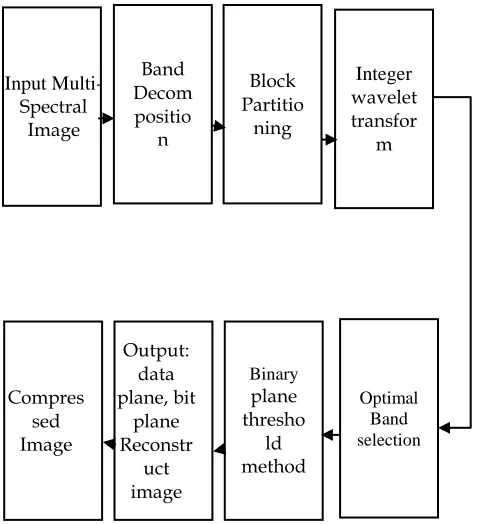
The generalized block diagram of the proposed work is depicted in fig/1.
Figure 1: Overall block diagram of the proposed work
The proposed strategy includes a few stages for acquiring the productive lossless packed picture. From the outset, the multispectral picture is deteriorated into "N" number of groups, wherein the spatial space, the comparable force estimations of the adjoining homogeneous highlights cause high spatial connections from pixel to pixel in the neighboring territories. A transient connection has been broadly abused in video pressure between the casings yet not inconsistent in the event of multi-worldly remote detecting picture pressure. Yet, during late years' fleeting connection has been abused with different measurements where pictures are taken from a similar scene from space a brief span separated [10].Hence processing every single band is not necessary however much of the content can be available from optimal band. After the block decomposition, each sub-band is partitioned in ―mxn‖ non- overlapping sub blocks.
Integer wavelet transform is applied [11] [12], is applied for each block of sub–band as it provides lesser entropy morals than additional wavelet changes, while verified on numerous multispectral images. In [13] author presents a vivid explanation of usage of IWT for multispectral decomposition that aims for efficient compression. After the decomposition of the multispectral image with IWT as shown in figure 2, each sub band is partitioned into stack of blocks belonging to multiple bands. Each block in a sub band do have the same position the consecutive band, hence the sum of correlation is performed amongst the present block also the block previous sub band. The band which has maximum correlation value is considered and the rest discarded, so a new order of band can be attained with the analysis.
The final order ―b‖ of bands can be represented as
b = max ∑ | W , W |
(1)
Where Nb is the amount of bands, Ob is the order of blocks for ―k‖ band The sorted blocks are merged together and inverse wavelet convert is performed to attain the optimal band image in spatial domain. This image is subjected for binary plane technique for efficient compression.
Figure 2: Sub band decomposition of multispectral image with IWT
The concept of Binary plane technique (BPT) is employed by several authors for different applications of compression and in detail explanation of algorithm is presented in [14] [15] [16]. When the image is subjected for BPT, the image is segmented into two planes namely data plane and bit plane, the first plane contains the spatial elements and the later contains the bit allocations at the respective positions. The algorithm has proven to be more efficient than JPEG and SPIHT for natural images [15] and also medical images [14]. In this work the optimized image band is subjected for BPT with no threshold and varying threshold values.
Input
Multi-Spectral Image
Band Decom positio
n
Block Partitio
ning
Integer
wavelet transfor
m
Optimal Band selection Binary
plane thresho
ld method Output:
data plane, bit
plane Reconstr
uct image Compres
4. EXPERIMENTAL
RESULTS
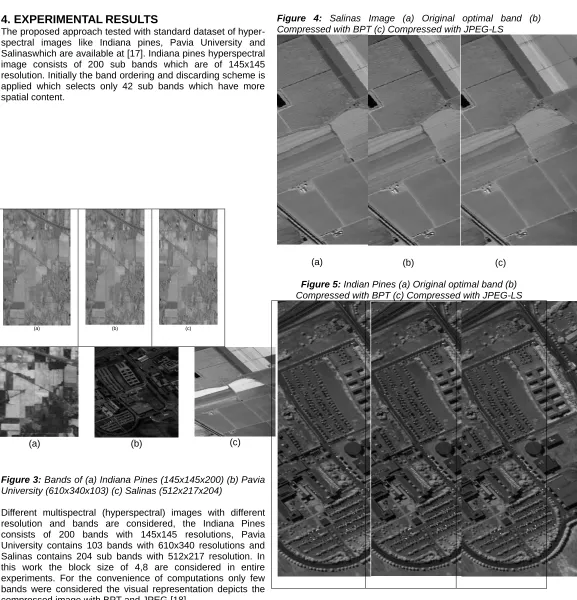
The proposed approach tested with standard dataset of hyper-spectral images like Indiana pines, Pavia University and Salinaswhich are available at [17]. Indiana pines hyperspectral image consists of 200 sub bands which are of 145x145 resolution. Initially the band ordering and discarding scheme is applied which selects only 42 sub bands which have more spatial content.
(a) (b) (c)
Figure 3: Bands of (a) Indiana Pines (145x145x200) (b) Pavia University (610x340x103) (c) Salinas (512x217x204)
Different multispectral (hyperspectral) images with different resolution and bands are considered, the Indiana Pines consists of 200 bands with 145x145 resolutions, Pavia University contains 103 bands with 610x340 resolutions and Salinas contains 204 sub bands with 512x217 resolution. In this work the block size of 4,8 are considered in entire experiments. For the convenience of computations only few bands were considered the visual representation depicts the compressed image with BPT and JPEG [18].
To assess the performance of the method several metrics like compression ratio (CR), peak/signal-to-noise/ratio-(P/S/N/R), mean/square/error-(M/S/E), mean/absolute/error-(M/A/E), mean structural similarity index (MSSIM), normalization cross/correlation/coefficient(N/C/C),structural/content (S/C) and image fidelity (IF) were calculated
[19], [20] .
Figure 4: Salinas Image (a) Original optimal band (b) Compressed with BPT (c) Compressed with JPEG-LS
(a) (b) (c)
Figure 5: Indian Pines (a) Original optimal band (b) Compressed with BPT (c) Compressed with JPEG-LS
Figure 6: Pavia University (a) Original optimal band (b) Compressed with BPT (c) Compressed with JPEG-LS
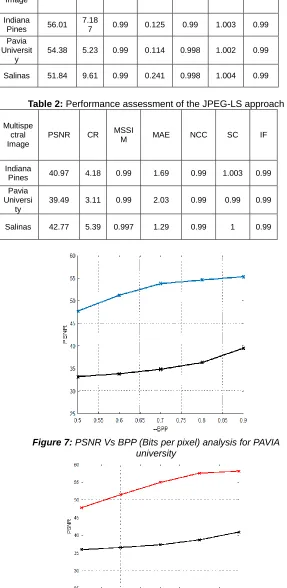
Table 1: Performance assessment of the proposed approach
Multispe ctral Image
PSNR CR MSSI
M MAE NCC SC IF
Indiana
Pines 56.01 7.18
7 0.99 0.125 0.99 1.003 0.99 Pavia
Universit y
54.38 5.23 0.99 0.114 0.998 1.002 0.99
Salinas 51.84 9.61 0.99 0.241 0.998 1.004 0.99
Table 2: Performance assessment of the JPEG-LS approach
Multispe ctral Image
PSNR CR MSSI
M MAE NCC SC IF
Indiana
Pines 40.97 4.18 0.99 1.69 0.99 1.003 0.99 Pavia
Universi ty
39.49 3.11 0.99 2.03 0.99 0.99 0.99
Salinas 42.77 5.39 0.997 1.29 0.99 1 0.99
Figure 7: PSNR Vs BPP (Bits per pixel) analysis for PAVIA university
Figure 8: PSNR Vs BPP (Bits per pixel) analysis for Indian Pines
Figure 9: PSNR Vs BPP (Bits per pixel) analysis for Salinas
Figure 4,5,6 shows the compressed images with proposed approach and JPEG-LS approach, and its metrical analysis is shown in tables 1 and 2, and the varying PSNR performance of the approach is also depicted in figure 5,6,7. From the above analysis it is evident that this approach is attaining high quality at different bit rates.
5. CONCLUSIONS
This work presents an effectives band decomposition discarding mechanism with binary plane approach for effective compression. It is evident that the proposed approach achieves high quality however it also shows an exponential increment with varying bit rates. This method also proves to be very simple in implementation making it easy for on board/chip implementation. This work can be further extended by deploying deep networks concepts for the selection of optimal band.
REFERENCES
[1] Agahian, F., Funt B., and Amirshahi, S. H., ―Spectral
Compression: Weighted Principal Component Analysis versus Weighted Least Squares‖. In Proc. of Human Vision and Electronic Imaging Conference, SPIE,2014
[2] Konig F. and Praefcke W., ―The Practice of Multispectral Image Acquisition‖. In Proc. of International Symposiom on electronic capture and publishing, SPIE 3409,1998
[3] M. Olaru and M. Craus, "Lossless multispectral and hyperspectral image compression on multicore systems," 2017 21st International Conference on System Theory, Control and Computing (ICSTCC), Sinaia, 2017, pp. 175-179.
[4] C. H. Genitha and R. K. Rajesh, "A technique for multi-spectral satellite image compression using EZW algorithm," 2016 International Conference on Control, Instrumentation, Communication and Computational Technologies
Jan. 2010.
[6] J. Zhang, J. Fowler, and G. Liu, ―Lossy-to-lossless
compression of hyperspectral imagery using three-dimensional TCE and an integer KLT,‖ IEEE Geosci. Remote Sens. Lett., vol. 5, no. 4, pp. 814–818, Oct. 2008
[7] V. BhagyaRaju, Jaya Sankar K, Naidu C.D and SrinivasBachu, ―Multispectral Image Compression for various band images with High Resolution Improved DWT SPIHT‖, International Journal of Signal Processing, Image Processing and Pattern Recognition, Vol. 9, No. 2, pp.271-286, 2016
[8] Ahmed Hagag, Mohamed Amin, Fathi E. Abd El-Samie, ―Multispectral image compression with band ordering and wavelet transforms‖, Signal, Image and Video Processing, Vol. 9,No. 4, pp. 769-778, May 2015.
[9] Wei Liang, Ping Zeng, Zhaolin Xiao, Kun Xie, ―Multispectral image compression methods for improvement of both colorimetric and spectral accuracy‖, Journal of Electronic Imaging, Vol. 25, No. 4, Aug 2016.
[10] M. A. Mamun, X. Jia and M. Ryan, ―Non-linear Elastic
Model for Flexible Prediction of Remote Sensed Multi-temporal images‖. IEEE Geoscience and Remote Sensing Letters, vol. 11, no. 5, pp. 1005 - 1009, May 2014.
[11] Ruedin, Ana & Acevedo, Daniel. (2005). Prediction of
coefficients for Lossless Compression of Multispectral Images. 10.1117/12.615386.
[12] R. O. El Safy, H. H. Zayed and A. El Dessouki, "An
adaptive steganographic technique based on integer wavelet transform," 2009 International Conference on Networking and Media Convergence, Cairo, 2009, pp. 111-117
[13] M. A. Mamun, M. A. Hossain, M. N. I. Mondal and M.
Aktar, "Satellite image compression using integer wavelet regression," 2017 International Conference on Electrical, Computer and Communication Engineering (ECCE), Cox's Bazar, 2017, pp. 438-442.
[14] Vempati Krishna and V. PurnaChnder Rao, ―Region
Based Medical Image Compression with Binary Plane Coding‖, arpnjournals, Vol12, no17, sep-2017
[15] Dr.M.Ashok and Dr. T. Bhaskar Reddy, ―Color image
compression based on Luminance and Chrominance using Binary Wavelet Transform (BWT) and Binary Plane Technique (BPT)‖, International Journal of Computer Science and Information Technology & Security (IJCSITS). 1(2): 2249-9555, 2012
[16] N.SubhashChandra , ―Loss less compression of
images using binary plane, difference and huffman coding (bdh technique)‖. Journal of Theoretical and Applied Information Technology. 3(1): 3-56,2008
[17] http://www.ehu.eus/ccwintco/index.php/Hyperspectral
_Remote_Sensing_ScenesPennebaker, William B., and Joan L. Mitchell, JPEG: Still Image Data Compression Standard, Van Nostrand Reinhold, 1993.
[18] Martin bernas ,‖ Image quality evaluation ―,
VIpromCom 2002, 4th Eurisp-IEEE region 8th international symposium on video image processing and multi- media communication 16-19 june 2002
[19] Sonja Grgic, MislavGrgic , Marta mrak , ― Reliability