http://www.sciencepublishinggroup.com/j/am doi: 10.11648/j.am.20170606.17
ISSN: 2327-2503 (Print); ISSN: 2327-252X (Online)
Effect of Rice Husks Concrete Preformed Coffers and
Bricks Use on Building Structural Elements
Yawovi Mawuénya Xolali Dany Ayité
*, Irina Pachoukova, Koffi-Sa Bédja
Higher National Engineers School, University of Lome, Lome, Togo
Email address:
[email protected] (Y. M. X. D. Ayité)
*Corresponding author
To cite this article:
Yawovi Mawuénya Xolali Dany Ayité, Irina Pachoukova, Koffi-Sa Bédja. Effect of Rice Husks Concrete Preformed Coffers and Bricks Use on Building Structural Elements. Advances in Materials. Vol. 6, No. 6, 2017, pp. 159-164. doi: 10.11648/j.am.20170606.17
Received: November 4, 2017; Accepted: November 16, 2017; Published: December 27, 2017
Abstract:
This article highlights the effect of rice husks concrete preformed coffers and bricks use on building structural elements (joists, beams, columns and footings). For this purpose, 15 cm thick of preformed coffers, hollow and solid bricks are made from cement - rice husks, cement - rice husks - sand and sand –cement mixtures to determine their characteristics: density, surface weight, brick compressive strength and preformed coffer bending strength. These characteristics were used to calculate building structural elements (joist, beam, column and footing). The results show that the preformed coffers and bricks of rice husks concrete are lighter than those made of sand - cement mortar. The compressive or bending strengths of these elements are similar. The use of rice husks concrete preformed coffers reduces dimensions and reinforcing steels of building structural elements.Keywords:
Preformed Coffers, Bricks, Rice Husks Concrete, Compressive Strength, Bending Strength, Beam, Column, Footing1. Introduction
Rice husks concretes are cement, water and rice husks mixture to which sand can be added to improve these concrete characteristics and to reduce the cement dosage [1-4]. These concretes have for interest, environment protection and rice husks valorization in civil engineering. A lot of work is done to better understand these concretes [1-28]. It turns out that rice husk concretes is a light material with the main disadvantage of cement high dosage. Indeed, to obtain a compressive strength of 10 MPa at 28 days of age, it requires a cement dosage exceeding 700 kg per meter [3]. Current dosages (between 250 and 500 kg of cement) resistances are of 1 to 8 MPa order [3]. One of these concretes applications is their use for the manufacture of preformed coffers and bricks used in building [3-4].
The objective of the present study is therefore to determine the characteristics of rice husks concrete preformed coffers and bricks and to analyze the effect of their use on buildings structural elements. Thus, 15 cm thick preformed coffers and bricks (thickness often used in Togo for the same elements
made in sand-cement mortar) are made using cement - rice husks and cement - rice husks - sand mixtures. On these
masonry elements, density, surface weight, bricks
compressive strength and preformed coffers bending resistance are measured. The structural elements (joist, beam, column and footing) of a building are also calculated.
2. Materials and Methods
husks and sand grading size curve.
Because of their high absorption rate, rice husks are immersed in water for at least twenty four (24) hours before their use [1-4]. They are then drained to rid them of excess water. Then, rice husks, cement, water and eventually sand are mixed with a mixer for two to three minutes in order to obtain a homogeneous material. The formworks are then filled and compacted using shovels as for sand - cement agglomerates. Release is done immediately since the concrete used is dry.
The constituents’ proportions of the two types of rice husks concrete and the sand-cement mortar are presented in
Table 2 [3-4].
Table 1. Characteristics of the materials used.
Characteristics Rice husks Sand
Finesse modulus 3,79 1,81
Absorption rate (%) 82 -
Apparent density at dry state 0,101 -
Absolute density at dry state 0,750 -
Apparent density at wet state 0,142 -
Absolute density at wet state 1,050 -
Absolute density - 2,58
Apparent density - 1,51
Equivalent of sand (%) - 61
Table 2. Material quantity for one concrete cube meter.
Concrete type Cement (kg) Rice husk (kg) Sand (liters) Water (liters)
Rice husk concrete without sand 500 391 0 210
Rice husk concrete with sand 350 375 100 166
Bricks sand – cement mortar 250 - 1 000 175
Preformed coffers sand – cement mortar 400 - 1 000 175
Figure 1. Rice husks and sand grading curve.
a)
b)
c)
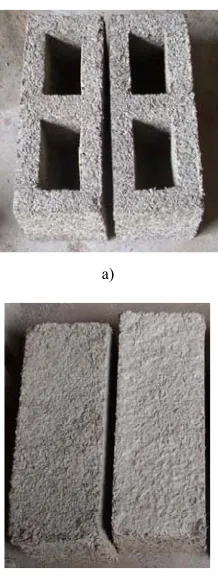
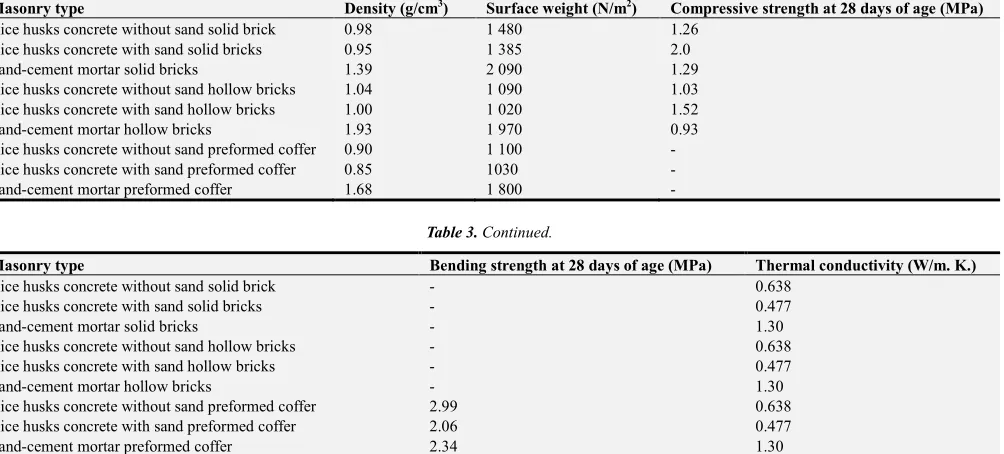
Figure 2. Rice husks concrete hollow (a) and solid (b) bricks and preformed coffer (c).
compared with those made with sand - cement mortar, most often used in construction in Togo.
Using the BAEL (Reinforced concrete in the limit states, Béton Armé aux Etats Limites) 91 modified 99 rules [30-31], the dimensioning (geometric dimensions and reinforcement) of a joist, a beam, a column and a pad footing of a two-storey building with hollow pot floor slab is carried out. For this building, two situations are envisaged: at first the preformed coffers are in rice husks concrete with or without sand and in a second time, these elements are in sand-cement mortar. In
both cases, the structural elements are made of ordinary reinforced concrete.
3. Results and Discussion
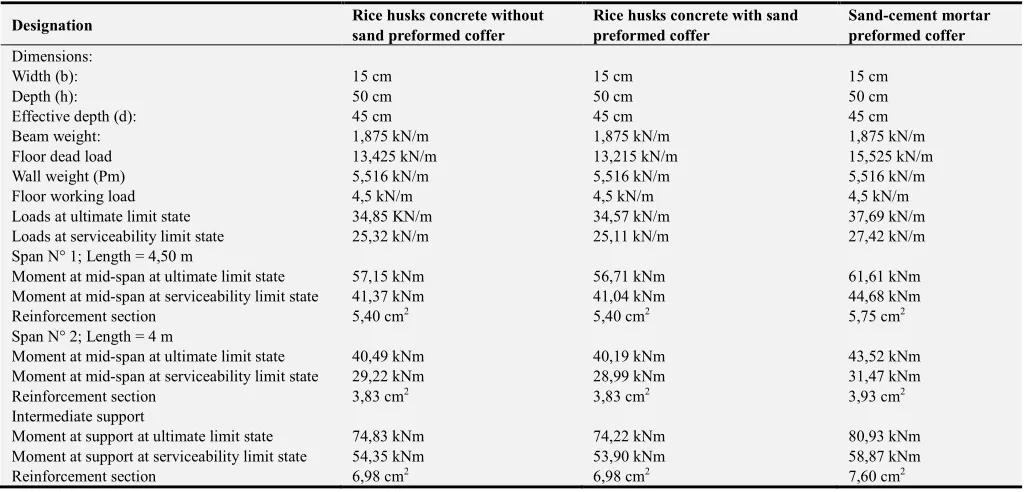
Table 3 shows the characteristics of bricks and preformed coffers in rice husks concrete and of those in sand-cement mortar. In this table is also presented the thermal conductivity of concretes and mortars used [3].
Table 3. Bricks and preformed coffers characteristics.
Masonry type Density (g/cm3) Surface weight (N/m2) Compressive strength at 28 days of age (MPa)
Rice husks concrete without sand solid brick 0.98 1 480 1.26
Rice husks concrete with sand solid bricks 0.95 1 385 2.0
Sand-cement mortar solid bricks 1.39 2 090 1.29
Rice husks concrete without sand hollow bricks 1.04 1 090 1.03
Rice husks concrete with sand hollow bricks 1.00 1 020 1.52
Sand-cement mortar hollow bricks 1.93 1 970 0.93
Rice husks concrete without sand preformed coffer 0.90 1 100 -
Rice husks concrete with sand preformed coffer 0.85 1030 -
Sand-cement mortar preformed coffer 1.68 1 800 -
Table 3. Continued.
Masonry type Bending strength at 28 days of age (MPa) Thermal conductivity (W/m. K.)
Rice husks concrete without sand solid brick - 0.638
Rice husks concrete with sand solid bricks - 0.477
Sand-cement mortar solid bricks - 1.30
Rice husks concrete without sand hollow bricks - 0.638
Rice husks concrete with sand hollow bricks - 0.477
Sand-cement mortar hollow bricks - 1.30
Rice husks concrete without sand preformed coffer 2.99 0.638
Rice husks concrete with sand preformed coffer 2.06 0.477
Sand-cement mortar preformed coffer 2.34 1.30
By analyzing the data in Table 3, it appears that:
- compressive strengths of rice husk concrete bricks and sand - cement bricks are of the same order of magnitude with a slight dominance of rice husks bricks;
- rice husks concrete without sand bricks and preformed
coffers consume more cement than sand-cement
agglomerates; sand dosage makes it possible to reduce the cement dosage and to improve the resistance;
- rice husks concrete bricks and preformed coffers are lighter than those made of sand - cement mortar: there is a decrease in mass of about 46%; this lightness will contribute to reduce building permanent loads thus to obtain economical
foundations;
- rice husks with sand preformed coffer bending strength is close to that of sand-cement preformed coffer while –that of rice husk without sand preformed coffers is 1.3 times higher: there is an increase in resistance of about 30%;
- rice husks concrete are more heat-resistant (lower thermal conductivity) than sand-cement mortar: rice husks concrete preformed coffers and bricks will provide better thermal insulation.
Table 4 presents loads and materials characteristics used to size considered elements.
Table 4. Dimensioning Data.
Designation Rice husks concrete without sand
preformed coffer
Rice husks concrete with sand preformed coffer
Sand-cement mortar preformed coffer
Floor: - Dead loads:
Compressive slab 1.25 kN/m2 1.25 kN/m2 1.25 kN/m2
Joist 1.125 kN/m2 1.125 kN/m2 1.125 kN/m2
Preformed coffer 1.1 kN/m2 1.03 kN/m2 1.8 kN/m2
Cement screed 0.8 kN/m2 0.8 kN/m2 0.8 kN/m2
Under slab cement rendering 0.2 kN/m2 0.2 kN/m2 0.2 kN/m2
Total dead loads 4.475 kN/m2 4.405 kN/m2 5.175 kN/m2
- Working loads 1.5 kN/m2 1.5 kN/m2 1.5 kN/m2
Concrete compressive strength at 28 days of age 20 MPa 20 MPa 20 MPa
It appears from this table that floor made with sand-cement mortar preformed coffers is heavier than floor made with rice husks concrete preformed coffers. There is a decrease in weight of 13% to 15% depending on whether rice husk concrete is dosed with sand or not.
Tables 5 and 6 present joist and beam calculation results. The joist is simply supported at his extremities and has a span of 3m. The beam is a continuous beam, simply supported with two spans of respective 4.5m and 4m.
Table 5. Joist calculation result.
Designation Rice husks concrete without
sand preformed coffer
Rice husks concrete with sand preformed coffer
Sand-cement mortar preformed coffer
Dimensions:
Length (L): 3 m 3 m 3 m
Width (b): 10 cm 10 cm 10 cm
Depth (h): 20 cm 20 cm 20 cm
Effective depth (d): 16 cm 16 cm 16 cm
Dead loads: 2,685 kN/m 2,643 kN/m 3,105 kN/m
Working loads: 0,9 kN/m 0,9 kN/m 0,9 kN/m
Dead loads bending moment (MG): 3,021 kNm 2,973 kNm 3,493 kNm
Working loads bending moment (MQ): 1,013 kNm 1,013 kNm 1,013 kNm
Bending moment at ultimate limit state (Mu=1,35MG+1,5MQ): 5,598 kNm 5,533 kNm 6,235 kNm
Bending moment at serviceability limit state (Mser=MG+MQ): 4,034 kNm 3,986 kNm 4,506 kNm
Reinforcement section 1,51 cm2 1,51 cm² 2,07 cm2
From this table, it appears that all joists require the same concrete amount despite their weight difference. Indeed, this difference is small to influence concrete amount. The reinforcements of the joists supporting rice husks concrete preformed coffers are inferior to those of the joists supporting sand-cement mortar preformed coffers. Admittedly, these preformed coffers are about 1.6 times heavier than those made of rice husks concrete which results in an increase of joist reinforcement of the order of 37%.
Table 6. Beam calculation result.
Designation Rice husks concrete without
sand preformed coffer
Rice husks concrete with sand preformed coffer
Sand-cement mortar preformed coffer
Dimensions:
Width (b): 15 cm 15 cm 15 cm
Depth (h): 50 cm 50 cm 50 cm
Effective depth (d): 45 cm 45 cm 45 cm
Beam weight: 1,875 kN/m 1,875 kN/m 1,875 kN/m
Floor dead load 13,425 kN/m 13,215 kN/m 15,525 kN/m
Wall weight (Pm) 5,516 kN/m 5,516 kN/m 5,516 kN/m
Floor working load 4,5 kN/m 4,5 kN/m 4,5 kN/m
Loads at ultimate limit state 34,85 KN/m 34,57 kN/m 37,69 kN/m
Loads at serviceability limit state 25,32 kN/m 25,11 kN/m 27,42 kN/m
Span N° 1; Length = 4,50 m
Moment at mid-span at ultimate limit state 57,15 kNm 56,71 kNm 61,61 kNm
Moment at mid-span at serviceability limit state 41,37 kNm 41,04 kNm 44,68 kNm
Reinforcement section 5,40 cm2 5,40 cm2 5,75 cm2
Span N° 2; Length = 4 m
Moment at mid-span at ultimate limit state 40,49 kNm 40,19 kNm 43,52 kNm
Moment at mid-span at serviceability limit state 29,22 kNm 28,99 kNm 31,47 kNm
Reinforcement section 3,83 cm2 3,83 cm2 3,93 cm2
Intermediate support
Moment at support at ultimate limit state 74,83 kNm 74,22 kNm 80,93 kNm
Moment at support at serviceability limit state 54,35 kNm 53,90 kNm 58,87 kNm
Reinforcement section 6,98 cm2 6,98 cm2 7,60 cm2
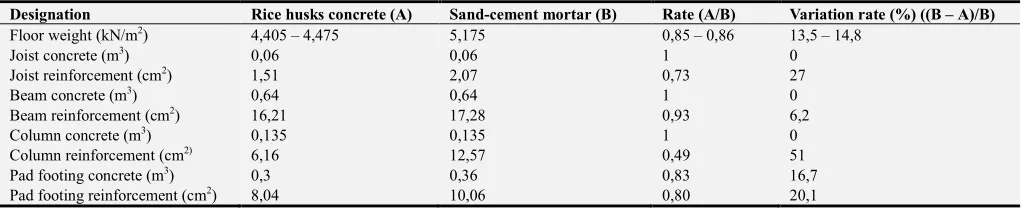
The results of this table confirm the lightness of the floors made of rice husks concrete preformed coffers compared to those with sand-cement mortar preformed coffers. At equal section, beams supporting rice husks concrete preformed coffers are the least loaded and therefore require less reinforcement. There is a decrease in the amount of reinforcement of beam supporting rice husks concrete preformed coffers about 7% compared to that receiving sand-cement mortar preformed coffers.
Tables 7 and 8 show column and pad footing calculation result.
amount is reduced by 20%.
Table 9 summarizes the impact of rice husk concrete
preformed coffers use on building structural elements.
Table 7. Column calculation result.
Designation Rice husks concrete without sand
preformed coffer
Rice husks concrete with sand preformed coffer
Sand-cement mortar preformed coffer
Ground floor level Dimensions:
Height: 3 m 3 m 3 m
Length: 15 cm 15 cm 15 cm
Width: 15 cm 15 cm 15 cm
Column weight 1,575 kN 1,575 kN 1,575 kN
Load at ultimate limit state from beam 170,33 kN 168,96 kN 184,21 kN
Effort from upper floor (kN) 136,06 kN 134,70 kN 149,94 kN
Effort in column at ultimate limit state 308,52 kN 305,79 kN 336,28 kN
Reinforcement section 6,16 cm2 6,16 cm2 12,57 cm2
Table 8. Pad footing calculation result.
Designation Rice husks concrete without
sand preformed coffer
Rice husks concrete with sand preformed coffer
Sand-cement mortar preformed coffer
Effort from column 308,52 kN 305,79 kN 336,28 kN
Sub-grade allowable stress: 0,35 MPa 0,35 MPa 0,35 MPa
Dimensions:
Length: 100 cm 100 cm 110 cm
Width: 100 cm 100 cm 110 cm
Height: 30 cm 30 cm 30 cm
Reinforcement in length direction 4,02 cm2 4,02 cm2 5,03 cm2
Reinforcement in width direction 4,02 cm2 4,02 cm2 5,03 cm2
Table 9. Comparison of structural elements for the three types of preformed coffers.
Designation Rice husks concrete (A) Sand-cement mortar (B) Rate (A/B) Variation rate (%) ((B – A)/B)
Floor weight (kN/m2) 4,405 – 4,475 5,175 0,85 – 0,86 13,5 – 14,8
Joist concrete (m3) 0,06 0,06 1 0
Joist reinforcement (cm2) 1,51 2,07 0,73 27
Beam concrete (m3) 0,64 0,64 1 0
Beam reinforcement (cm2) 16,21 17,28 0,93 6,2
Column concrete (m3) 0,135 0,135 1 0
Column reinforcement (cm2) 6,16 12,57 0,49 51
Pad footing concrete (m3) 0,3 0,36 0,83 16,7
Pad footing reinforcement (cm2) 8,04 10,06 0,80 20,1
The impact of rice husk concrete preformed coffers use is felt on all structural elements, especially at columns and footings level. This impact results in a decrease of concrete and reinforcement quantities of structural elements.
4. Conclusion
This work aims to study the effect of rice husks concrete (with or without sand) preformed coffers and bricks use in the realization of buildings structural elements (joist, beam, column and footing).
The determination of preformed coffers and bricks characteristics has shown that these masonry elements made with rice husks concrete are lighter and as resistant (even more) than those made with sand-cement mortars commonly used in Togo. They also have better thermal conductivity and therefore good thermal insulation. The lightest and most resistant elements are obtained with rice husks concrete dosed with sand: compared to cement-sand mortar elements, one obtains a weight gain of about 46% and a resistance increase of 30%.
The dimensioning a two-storey building with hollow pot floor slab structural elements has shown that rice husks concrete preformed coffers use has the advantage of reducing the dimensions and reinforcement of structural elements. In fact, compared to floor made with sand-cement mortar preformed coffers, rice husks concrete preformed coffers permit a reducing of floor weight (30%), footing concrete (15%) and joist, beam, column and footing reinforcement (from 6% to 51%).
References
[1] AYITE D., NEGLO K., BIGAH Y. & BEDJA K., Influence of sand dosage on strengths of concretes based on rice husks from Togo. J. Rech. Sci. Univ. Lomé (Togo), Série E, 9 (2), (2007), 57–64.
[3] AYITE Y. M. X. D., Rice husks concretes uses for buildings floors preformed coffers prefabrication (Unpublished doctoral dissertation). Doctorate Thesis. University of Lome, Togo. (2011).
[4] AYITE Y. M. X. D., KODJO K. M. & BEDJA K., Determination of rice husks concrete application in building in Togo. J. Rech. Sci. Univ. Lomé (Togo), Série E, 13 (2) (2011), 1–8.
[5] MANNAN M. A. and GANAPATHY C., Engineering properties of concrete with OPS as aggregate. International Journal of Construction and Building Materials, 16, (2000), 29–34.
[6] MANNAN M. A. and GANAPATHY C., Mix design for oil palm shell concrete. International Journal of Cement and Concrete Research, 31, (2001), 1323-1325.
[7] MANNAN M. A. and GANAPATHY C., Long-term strengths of concrete with oil palm shell as coarse aggregate. International Journal of Cement and Concrete Research, 16, (2001), 1319-1321.
[8] MANNAN M. A and GANAPATHY C., Concrete from an agricultural waste-oil palm shell (OPS). Building and Environment, 39, (2004), 441-448.
[9] JAUBERTHIE Raoul, RENDELL Frank, TAMBA Séni & CISSE Ibrahima Khalil, Origin of the pouzzolanic effect of rice husk. International Journal of Construction and Building Materials, 14, (2000), 419-423.
[10] JAUBERTHIE Raoul, RENDELL Frank, TAMBA Séni & CISSE Ibrahima Khalil, Properties of cement - Rice husk mixture. International Journal of Construction and Building Materials, 17, (2003), 239-243.
[11] Alaa Rashad, Cementitious materials and agricultural wastes as natural fine aggregate replacement in conventional mortar and concrete, Journal of Building Engineering, Volume 5, (2016), 119-141.
[12] D. Koňáková et al., "Influence of Moisture Content on the Thermal Properties of Concrete Containing Agricultural Waste Materials", Key Engineering Materials, Vol. 677, (2016), 241-245.
[13] Singh Gurmit, Arora Amit, Singh Ranjeet, Tyagi Anand K., Utilisation of Agricultural Waste Material as Aggregates in Partial Replacement of Coarse Aggregates in the Conventional Concrete, Journal of Biofuels and Bioenergy, Volume: 2, Issue: 1, (2016), 67-72.
[14] Alireza Javadi Pordesari, Salmaliza Salleh, Payam Shafigh and Hilmi Bin Mahmuda, Toward Sustainability in Concrete Industry by Using Of Solid Wastes from Palm Oil Industry, MATEC Web of Conferences Volume66, 00099 (2016), The 4th International Building Control Conference 2016 (IBCC 2016).
[15] Javad Nodeh Farahani, Payam Shafigh, Hilmi Bin Mahmud, Production of a green lightweight aggregate concrete by incorporating high volume locally available waste materials, Procedia Engineering, Volume 184, (2017), 778-783.
[16] Payam Shafigh, Hilmi Bin Mahmud, Mohd Zamin Jumaat, Majid Zargar, Agricultural wastes as aggregate in concrete mixtures – A review, Construction and Buldung Materials, 53, (2014), 110-117.
[17] Jnyanendra Kumar Prusty, Sanjaya Kumar Patro, S. S. Basarkar, Concrete using agro-waste as fine aggregate for sustainable built environment – A review, International Journal of Sustainable Built Environment, 5, (2016), 312-333.
[18] K. Gunasekaran, R. Annadurai, and P. S. Kumar, “Study on reinforced lightweight coconut shell concrete beam behavior under flexure,” Materials and Design, vol. 46, (2013), 157– 167.
[19] B. S. Mohammed, W. L. Foo, and M. Abdullahi, “Flexural strength of palm oil clinker concrete beams,” Materials and Design, vol. 53, (2014) 325–331.
[20] J. Kanadasan and H. A. Razak, “Mix design for self-compacting palm oil clinker concrete based on particle packing,” Materials and Design, vol. 56, (2014) 9–19.
[21] A. Charif, M. J. Shannag, and S. Dghaither, “Ductility of reinforced lightweight concrete beams and columns,” Latin American Journal of Solids and Structures, vol. 11, no. 7, (2014) 1251–1274.
[22] K. Gunasekaran, R. Ramasubramani, R. Annadurai, and S. Prakash Chandar, “Study on reinforced lightweight coconut shell concrete beam behavior under torsion,” Materials and Design, vol. 57, (2014) 374–382.
[23] S. P. Yap, C. H. Bu, U. J. Alengaram, K. H. Mo, and M. Z. Jumaat, “Flexural toughness characteristics of steel-polypropylene hybrid fibre-reinforced oil palm shell concrete,” Materials and Design, vol. 57, (2014) 652–659.
[24] K. H. Mo, K. K. Q. Yap, U. J. Alengaram, and M. Z. Jumaat, “The effect of steel fibres on the enhancement of flexural and compressive toughness and fracture characteristics of oil palm shell concrete,” Construction and Building Materials, vol. 55, (2014) 20–28.
[25] K. H. Mo, S. P. Yap, U. J. Alengaram, M. Z. Jumaat, and C. H. Bu, “Impact resistance of hybrid fibre-reinforced oil palm shell concrete,” Construction and Building Materials, vol. 50, (2014), 499–507.
[26] K.-S. Youm, J. J. Kim, and J. Moon, “Punching shear failure of slab with lightweight aggregate concrete (LWAC) and low reinforcement ratio,” Construction and Building Materials, vol. 65, (2014), 92–102.
[27] U. Johnson Alengaram, B. A. Al Muhit, M. Z. bin Jumaat, and M. L. Y. Jing, “A comparison of the thermal conductivity of oil palm shell foamed concrete with conventional materials,” Materials and Design, vol. 51, (2013) pp. 522–529.
[28] Soudagar Ahemad Mohamadali, Effect on properties of concrete using agro-west as replacement of sand, International Research Journal of Engineering and Technology, Volume: 04 Issue: 06, (2017), 2410-2414.
[29] European Standards CSN EN 772, Methods of test for masonry units, (2015).
[30] HUSSON J.-M., Study of concrete structures (BAEL 91 revised 99), Etude des structures en béton (BAEL 91 revisé 99)’’, Casteilla, Paris–France, 2002.