SECADD: Simple and Efficient Cluster head
adaptive data dissemination protocol for
application in Intelligent Transportation
System
Harshita Prakash
1*, A. Agrawal
2**, A.K Jaiswal
3****Student, Department of Electronics and Communication, SHUATS, Allahabad **Assistant Professor, Department of Electronics and Communication, SHUATS, Allahabad
***Head, Department of Electronics and Communication, SHUATS, Allahabad
Abstract: Vehicular communication is regarded as a backbone for the development of intelligent transportation system.Since efficient data exchange is needed for most crucialapplications (warning of road accident, traffic congestion etc).One of the main challengein the study of Vehicular Ad-Hoc Network is the data dissemination design by which messages must be efficiently disseminated in a high vehicular speed, intermittent connectivity, and highly dynamic topology. Broadcast mechanism should guarantee fast and reliable data delivery within a limited wireless bandwidth to fit the real-time application requirements. In this work, we propose a simple and efficient cluster head adaptive data dissemination protocol to reduce broadcast storm problem. Each vehicle can dynamically define an appropriate probability of rebroadcast to mitigate the broadcast storm problem. Efficiency is manifested by reducing excessive retransmitted messages and hence boosting the network capacity and minimizing the transmission delay. The simulation results show that the proposed protocol outperforms state of the art in terms of offeringvery low packet drop ratio and network load while still maintaining a low end-to-end delay and a high packet delivery rate which is suitable either for safety and other applications in ITS. This mechanism can adapt the protocol performance in terms of packet delivery ratio to the application’s requirements.
Keywords:Vehicular ad hoc networks, Data dissemination, Vehicle to vehicle communication,Redundancy and adaptive protocol
1.INTRODUCTION
Intelligent Transportation Systems (ITS) [1] are the future of transportation. The progress in the field of wireless technologies provide opportunities to utilize several technologies in support of advanced vehicle safety applications.
VANETs is a sub form of Mobile Ad-Hoc Network (MANET) that provides communication between vehicles so that they will soon be able to talk with another vehicle and with base stations along roadside
with the motive of interchanging information for providing efficient and safe transportation.
Since 5.9 GHz dedicated short-range communication is an arising standard. Vehicle to Vehicle
communications have gathered attentiveness and for
developing several applications, for example
cooperative forward collision warning, traffic light optimal speed advisory, remote wireless diagnosis [4] for avoiding collisions and improving efficiency. In
2010,IEEE 802.11p standard, commonly known as
dedicated short-range communications standard [2], has been officially implemented.The aim of the VANET is to provide a high data rate and as well as
reducing latency within a small
communicationzone.VANETs are affected by limited
resource bandwidth. In USA, as per the Federal Communications Commission (FCC), the allocated band is bifurcated into seven channels with bandwidth of 10 MHz each: one control channel (CCH) and six service channels (SCH) [3].
communication may also be involved for generation of messages, as shownin Fig. [1]. In this context, together with communication capabilities, the suitable amalgamation of onboard computers, roadmaps, and GPS positioning devices opens tremendous opportunities.Furthermore, we assume the existence of a local application running on the source vehicle or the existence of a fixed infrastructure (access point, road side unit, etc.) responsible for data message generation. The messages which are generated needs to be distributed within the transmission range. The rest of this paper continues as follows. In Sect. 2, we have dealt with previous works on data dissemination or broadcast protocols. Section 3 provides Problem statement and system model Section 4 provides a detailed description of Cluster head adaptive data dissemination protocol. Finally, conclusion is presented in Sect. 5.
V2V
V2V
V2V
V2I V2I
I2I
I2I
Fig.1 VANET scenario showing different communication modes
2.Related Work
For VANETs, different techniques of data dissemination are put forward for different applications. Mainly, two major applications are heavily researched that is traffic safety applications and travel comfort applications.
Networks are prone to recurrent fragmentation leading to the higher connectivity variation. Hence, change in the network topology are difficult to predict and manage as it is discussed in [4].Further, redundancy should be small.
In [5] the authors initiated three broadcasting techniques. They are weighted p-persistence, slotted 1-persistence and slotted p-persistence methods. In weighted p-persistence method, the vehicle computes its probability in order to determine whether to rebroadcast or not based on its distance from the transmitter. In slotted p-persistence configuration, the vehicle halts for a specific time before it rebroadcasts the message based on the calculated probability as seen in weighted p-persistence schemes. Here the waiting time is dependent on the distance between the transmitter and the receiver. The most distant vehicles will have shorter waiting times.However, [6] and [7] provides a review of broadcast protocols dealing essentially with the contention and collision problems.
For delay based schemes one researchable issue is to choose the optimal value for the boundaries and number of time slots. As time slots are matched to the geographical area of sender‘s transmission range, it leads to uneven vehicle distribution in each time slot [8]. This leads to an unnecessarily increase in level of rebroadcast redundancy and collision. A solution proposed in [9] controls the number of time slots on the basis of network density, but simultaneous transmission leading to collision was still a researchable problem.
Authors in [10] discussed the Adaptive multi-directional dissemination to achieve an efficient wide-spreading data dissemination, each data message is simultaneously disseminated to multiple directions that are adaptively adjusted according to the local map of the road provided, for example, by a GPS navigation system.
Cluster based multichannel MAC protocols have been proposed by many researchers, such as in [11] to [14], for improving the performance and reliability of VANETs. The authors in [17] have proposed a clustering scheme.
and it is also proposed to get the information by location-sensitive questions arose by vehicles on demand. Along with the push and pull models that were presented, there are few schemes such as hybrid models that combine both models to support different types of applications within a VANET environment. Various solutions for VANETs have been proposed to cope with message dissemination under different traffic conditions. In high density network, we have proposed a techniqueto prevent the so-called Broadcast Storm Problem with the aimto select the set of minimum number of vehicles for retransmitting and distributing a message toward the area of interest. Authors in [16] and [17] shows a new dissemination modelssuch as Network coding. The chief idea of NC is the mixing of different received packets by each intermediate node before forwarding. This technique through its various crucial metrics such as network throughput, wireless resources capacity, energy consumption, reliability issues and data transmission delay expected to give a notable improvement in data transmission efficiency. In [16] they have demonstrated that the theory of network coding is built by intermediate nodes leading to make optimal use of the available network resources. Hence a source node can distribute information to a set of receivers at the broadcasting capacity of the network.
3.Problem statement and system model
The principal challenge that can be seen in the study of VANET is the data dissemination design by which messages must be efficiently disseminated in a high vehicular speed, intermittent connectivity, and highly dynamic topology.Several broadcasting techniques, such as blind flooding, suffer from the broadcast storm problem [10]. Each vehicle immediately rebroadcasts the received messages to ensure the data delivery for distant vehicles. Hence, several redundant messages are transmitted increasing bandwidth consumption. This problem gets more serious for highly dense networks. This give the high channel contention and many collisions [18].
This problem is reduced in the proposed cluster head adaptive data dissemination protocol in which each node will be able to adapt its suitability to be a rebroadcaster node according to three important factors:
Firstly, its distance from the source node,Secondly, the current state of the network density and thirdly, the direction from which it receives packets. Thereby, each node will be able to get most likely the best decision without the need of information and feedback from neighbouring nodes. As a result, the efficiency of cluster head adaptive protocol emerges from the adaptive local behaviour of each node, since each node is acting on its own.On the other hand,
cluster head adaptive protocol the focus on its own leads to deduce the following statement. On the basis of the defined probability in Eq. (3) which is further discussed, cluster head adaptive protocol has significantly reduced the forwarding ratio and the network resources consumption (in terms of throughput). In fact, the probability of broadcast is considered as a correction factor that attempts to continuously maintain a fix amount of redundancy even-though the vehicles‘ density increases.
3.1. Redundancy metric
Redundancy ratio ―r‖ is used for measuring the number of messages received by the cluster head * average number of cluster members per new messages. Which is calculated as follows:
𝑟 =
𝑇𝑜𝑡𝑎𝑙𝑟𝑒𝑐𝑒𝑖𝑣𝑒𝑑𝑚𝑒𝑠𝑠𝑎𝑔𝑒𝑠𝑏𝑦𝑐𝑙𝑢𝑠𝑡𝑒𝑟 𝑒𝑎𝑑𝑠 × 𝐴𝑣𝑒𝑟𝑎𝑔𝑒𝑛𝑢𝑚𝑏𝑒𝑟𝑜𝑓𝑐𝑙𝑢𝑠𝑡𝑒𝑟𝑚𝑒𝑚𝑏𝑒𝑟𝑠
𝑇𝑜𝑡𝑎𝑙𝑛𝑒𝑤𝑚𝑒𝑠𝑠𝑎𝑔𝑒𝑠 (1)
we assume that each vehicle can continuously update its redundancy metric when the messages are received. In [19] authors show that the redundancy ratio inherently increases with the increase of the vehicles‘ density. Hence, the probability of rebroadcast in Cluster head adaptive data dissemination protocol should be inversely proportional to the redundancy ratio metric. Then, higher the redundancy ratio, smaller the broadcasting probability leading to reduce the broadcast probability by increasing the vehicles‘ density. In [19] authors proposed a simple way of calculating the rebroadcast probability ‗‗P‘‘. Which is capable to operate inline without need of beacon exchange to consider the surrounding vehicles‘ density.
𝑃𝑖 = 2𝛼 𝑖+1 𝑟𝑘 𝑖 𝑘=0
(2)
Here α is taken as the key parameter, the packet delivery ratio is handled according to the application‘s requirements by fixing α=2 for achieving a steady state to maintain high data reachability [19]. The forwarding probability is inversely proportional to the redundancy ratio and thus inversely proportional to the vehicles‘ density. Hence, regions with high density of vehicles will decrease the nodes‘ suitability to be a forwarding node. Yet, in low dense regions more vehicle will be suitable for relaying received messages.
4.Clusterhead adaptive data dissemination protocol description
storm problem by reducing excessive broadcasts and the performance is analysed on the basis of simulation results showing high packet delivery and low end-to-end delay. Cluster head adaptive data dissemination protocol applies a simple design through which no beacon exchange is required even though the vehicles density is considered. Added to that, the key feature of Cluster head adaptive data dissemination protocol is that it is a generic protocol which may be applied to all types of application. Vehicles in VANET are considered as nodes with wireless links. It enables communication among vehicles and Road Side Units (RSUs). In VANETS, many vehicles try to send warning messages. So, every vehicle within the transmission range will receive the broadcast message and rebroadcast these messages to other vehicles. This makes the vehicle receive the traffic warning message repeatedly. Hence, redundancy, contention, and packet collisions occur due to simultaneous forwarding (generally known as the Broadcast storm problem). In this paper, rebroadcast is proposed to address the broadcast problem in VANET. It reduces the number of retransmission and more number of vehicles is alerted about emergency. To deliver the packet successfully for reducing the broadcast storm problem, nodes must relay the packets with the help of the intermediate nodes.
Incoming data message
Up Date Redundancy Ratio
<< r >>
Up Date Redundancy Ratio
<< r >>
Transmit the message Discard
message
Is Known message by
CH?
Data Buffer Start
YES
NO
Fig.2Reception procedure of cluster head adaptive data dissemination protocol
The proposed protocol is explained using a flow chart in Fig. [2] by the following steps:
Step1: Each incoming data message is identified by a unique ID consisting of the source vehicle‘s ID and the local packet ID. We assume that the packet‘s header contains the broadcasting node ID and its GPS coordinates,each vehicle has a data buffer that stores the original data packets, either received or generated by the local application running on the transmitter vehicle.
Step2:Upon receiving a packet, the vehicle checks first whetherthe message‘s ID is known by the cluster head(CH) or not. If the message is known by the cluster head, this means that the received message is redundant and should be discarded after updating the redundancy ratio ‗‗r‘‘ parameter.
Step3: If the message is not known by the cluster head, it must be stored in a data buffer and then transmitted after updating the redundancy ratio ‗‗r‘.
4.1. Selection of cluster head
Election of CHs are based on their stability minimal number of overheads on the vehicles[20]. To further understand the protocol details, we propose to describe Clustering Algorithm and its Parametersfor a proper operation[20]. Next, a thorough description of the basic steps of cluster head adaptive data dissemination protocol will be presented[8].
4.2. Clustering Algorithm and Its Parameters
The clustering algorithm [20] is the important aspects of the clustering based MAC protocols. The status message contains information about the message type, vehicle‘s ID, weighted stabilization factor βWSF, current speed v, current position Pos, acceleration a, communication range R, CH‘s ID, and the backup CH‘s ID. The acceleration will help to determine the vehicle‘s speed and position during the succeeding maintenance period Tf. The field type has four values:
―0, 1, 2 and 3‖ for cluster member‘s status message, CH‘s first message, CH‘s invitation message and CH‘s last messagerespectively,each vehicle calculates its weighted stabilization factor βWSF as in eqn. (5).
The higher the βWSF factor, the higher the chance for this vehicle to be elected as a CH. Each vehicle calculates its weighted stabilization factor βWSF as in
eqn. (5). The higher the βWSFfactor, the higher the chance for this vehicle to be elected as a CH.Each vehicle will calculate its average relative speed as vdj = (1/(n−1)) 𝑛−1𝑖=1 |vj − 𝑣𝑖| …… (3)
where n is the number of vehicles within the jth vehicle‘s range including itself, and vj is the jth
vehicle‘s speed in meters per second. The jth vehicle
calculates its stabilization factor (βSFj) at the end of
βSFj = max{1 − (vdj/Vmax), 0} …… (4)
where Vmax is the maximum allowed speed on this road. If there are no other vehicles on the road, the vehicle compares its speed with Vmax to calculate its βSF factor. The value of βSFj is limited to the minimum
value of 0, which could happen in a very rare situation when a vehicle is moving in almost zero speed, whereas all other vehicles are moving above the maximum speed Vmax. The jth vehicle calculates its new weighted stabilization factor βWSFj (n) from
the new value of βSFj (n) and the previous value of
βWSFj (n − 1) as an exponential-weighted moving
average, i.e.,
βWSFj(n)= ζβSFj (n) + (1−ζ)βWSFj (n−1) …(5)
where n = 1, 2, . . . is an index to denote the time sequence, βWSFj (0) = 0, and 0 ≤ ζ ≤ 1 is the
smoothing factor and chosen here to be 0.5.
4.3. Performance evaluation
In this section, we evaluate the performance of cluster head adaptive data dissemination protocol, carried out by means of extensive simulations in a vehicular environment. The simulation platform is constructed based upon ns-2.34 simulator. All simulation parameters are summarized in Table 1.
Table 1 Simulation parameters
Parameters Specifications
Network simulator Ns2.34 Simulation duration 100s
Simulation area 3000*4000 m2 Vehicles‘ density 8-99 vehicles/km Data packet frequency 10 Hz
Data packet size 500 bytes Number of source
vehicles
5
Propagation model Nakagami Phy/Mac protocol IEEE802.11p Bit rate 3 Mbits/s Transmission range 300 m
Safety message dissemination efficiency
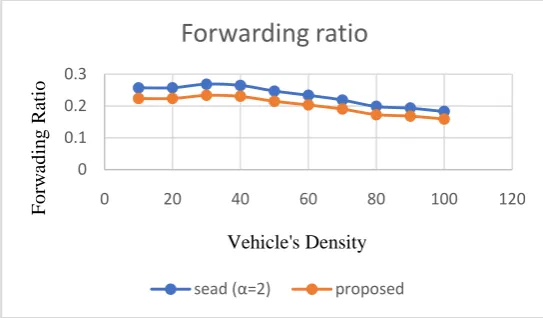
Fig. [3] shows the simulation results, we can notice that the forwarding ratio drastically degrades with cluster head adaptive protocol, compared to the protocol of [19] when the vehicles‘ density increases This shows the impact of the forwarding nodes selection on reducing unnecessary broadcasts. More the node selection is smarter, more the broadcast performance is better.
Fig.3Forwarding ratio versus vehicle‘s density Moreover, Fig. [4] illustrates an important result ofcluster head adaptive data dissemination protocol which shows the better packet delivery ratio, while reducing the number of forwarding nodes. Thereby, reducing the network resources consumption. The results obtained for the performance parameter" throughput" is shown in fig. [5] Proposed work is clearly showing better performance for all vehicles densities as compared to previous work.
Fig.4 Packet delivery ratio versus vehicle‘s density
0 0.1 0.2 0.3
0 20 40 60 80 100 120
Fo
rw
ad
in
g
R
atio
Vehicle's Density
Forwarding ratio
sead (α=2) proposed
0 0.5 1
0 20 40 60 80 100 120
P
ac
k
et
Deliv
er
y
R
atio
Vehicle's Density
packet delivery ratio
Fig.5Throughput versus vehicle‘s density Furthermore, cluster-head adaptive data dissemination protocol presents in Fig. [6] a low packet drop ratio compared to [19]. This highlights the inherent effect of cluster head adaptive data dissemination protocol on enhancing the data broadcast reliability by reducing erroneous received messages. Thus, we can deduce how efficientcluster head adaptive data dissemination protocol to alleviate the broadcast storm effect by decreasing the network contention and collisions, while still achieving high PDR and lower end to end delay, as shown in Figs. [6] and [7].
Fig.6 Packet Drop Ratio versus vehicle‘s density
Fig.7End to end delay versus various vehicles‘ density
5.Concluding remarks
In this research work, a data dissemination protocol called as ‗‗cluster head adaptive data dissemination protocol for intelligent transportation system‘‘ aiming to meet the challengingbroadcast storm problem in scalable vehicular network by selecting the minimum number ofvehicles to rebroadcast and disseminate a message toward the transmitting area.Moreover, cluster head adaptive protocol is designed to be more adaptable for different applications and to operate in adaptive mode by just tuning a α parameter.
Simulation results demonstrated that this protocol has achieved a good result in terms of providing a high PDR within a low end to end delay while optimizing the limited bandwidth consumption when compared to previous work of simple and efficient adaptive data dissemination protocol (SEAD). Future work includes the accommodation of cluster-head adaptive protocol to sparse networks and the investigation of the connectivity problem between communicating vehicles.
REFERENCES
[1] Joseph M. Sussman, ―Perspectives on Intelligent Transportation Systems (ITS)‖, Springer, New York, 2005.
[2] H. Hartenstein and K. P.Laberteaux, ―A Tutorial Survey on Vehicular Ad Hoc Networks,‖ IEEE Communication Mag., vol. 46, no. 6, pp. 164– 171, Jun. 2008. D.o.i:10.1109|MCOM.2008.4539481
[3] 802.11p-2010 IEEE Standard for Information Technology— Telecommunications and Information Exchange Between Systems—Local
0 200000 400000 600000 800000 1000000 1200000
0 20 40 60 80 100 120
T
h
ro
u
g
h
p
u
t
Vehicle's Density
Throughput
sead (α=2) proposed
0 0.2 0.4 0.6
0 50 100 150
P
ac
k
et
Dr
o
p
R
atio
Vehicle's Density
Packet Drop Ratio
sead (α=2) proposed
0 0.01 0.02 0.03 0.04 0.05 0.06 0.07
0 20 40 60 80 100 120
Dela
y
Vehicle's Density
Delay
and Metropolitan Area Networks—Specific Requirements Part 11, Wireless LAN Medium Access Control (MAC) and Physical Layer (PHY) Spec, 2010.
[4] R. Fracchia, M. Meo, ―Analysis and design of warning delivery service in inter-vehicular networks‖, IEEE Trans. Mob. Comput. 7 (2008) 832–845.
[5] N. Wisitpongphan, O.K. Tonguz, J.S. Parikh, P. Mudalige, F. Bai, and V. Sadekar, ―Broadcast storm mitigation techniques in vehicular ad hoc networks,‖ IEEE Trans. Wireless Communications, vol. 14, no. 6, pp.84–94, 2007 [6] Rakesh Kumar1 and Mayank Dave, ―A Review
of Various VANET Data Dissemination Protocols,‖ International Journal of u- and e- Service, and Technology Vol. 5, No. 3, September, 2012.
[7] SooksanPanichpapiboon, Wasan Pattaraatikom, ―A Review of Information Dissemination Protocols for Vehicular Ad Hoc Networks,‖ IEEE Communications Surveys and Tutorials, vol. 14, no. 3, pp. 784- 798, Third Quarter, 2012. [8] JJ Blum, A Eskandarian, ―Avoiding timeslot
boundary synchronization for multihop message broadcast in vehicular networks‖. IEEE 69th Vehicular Technology Conf. (VTC Spring), 1–5. Barcelona, 26–29 April 2009
[9] Yt Tseng, Rh Jan, C Chen, Cf Wang, HH Li, in ―The 7th IEEE International Conference on Mobile Ad-hoc and Sensor Systems (MASS). A vehicle-density-based forwarding scheme for emergency message broadcasts in VANETs‖ (IEEE San Francisco, 2010), pp. 703–708 [10] SY Ni, YC Tseng, YS Chen, JP Sheu, in
―Proceedings of the 5th annual ACM/IEEE international conference on Mobile computing and networking‖. The broadcast storm problem in a mobile ad hoc network (ACM New York, 1999).
[11] H. Wu, Z. Zhong, and L. Hanzo, ―A cluster-head selection and update algorithm for ad hoc networks,‖ in Proc. IEEE GLOBECOM Conf., Dec. 2010, pp. 1–5.
[12] K. H. Almotairi and X. Shen, ―Multi-channel medium access control for ad hoc wireless networks,‖ Wireless Communication Mobile Comput. (Wiley), Jul. 2011. doi: 10.1002/wcm.1159. [Online]. Available: http://onlinelibrary.wiley.com/doi/10.1002/wcm. 1159/abstract
[13] M. Ni, Z. Zhong, and D. Zhao, ―MPBC: A mobility prediction-based clustering scheme for ad hoc networks,‖ IEEE Trans. Vehicular Technol., vol. 60, no. 9, pp. 4549–4559, Nov. 2011.
[14] C. Shea, B. Hassanabadi, and S. Valaee, ―Mobility-based clustering in VANETs using affinity propagation,‖ in Proc. IEEE GLOBECOM Conf., Dec. 2009, pp. 1–6.
[15] T. Nadeem, P. Shankar, L. Iftode, ―A comparative study of data dissemination models for VANETs‖, in: The 3rd Annual International Conference on Mobile and Ubiquitous Systems – Workshops, 2006, pp. 1–10.
[16] R. Ahlswede, N. Cai, S. R. Li, and R. W. Yeung, ―Network Information Flow,‖ In IEEE Transactions on Information Theory, 2000. [17] R. W. Yeung, ―Network coding: A historical
perspective,‖ Proc. IEEE, vol. 99, no. 3, pp. 366– 371, Mar. 2011.
[18] J. Lipman, H. Liu, I. Stojmenovic, ―Broadcasting in ad hoc networks‖, in: S. Mishra, I. Woungang (Eds.), Guide to Wireless Ad Hoc Networks, Springer-Verlag, Lon-don, UK, 2009, pp.121– 150 (Chapter 6).
[19] ImenAchour, Tarek Bejaoui, Anthony Busson, Sami Tabbane, ―SEAD: A simple and efficient adaptive data dissemination protocol in vehicular ad-hoc networks‖, Wireless Network (2016) 22:1673–1683DOI 10.1007/s11276-015-1050-9 [20] Khalid Abdel Hafeez, Lian Zhao, Jon W. Mark,