ISSN: 2231-5381
http://www.ijettjournal.org
Page 56
Lean office: Case Study at a Daycare Center
Located in Cataguases-MG
Jhosálim de Souza Ferraz1, Mário César Fialho de Oliveira2, Patrícia Werneck Silva de Oliveira³, Carla Ribeiro Moreira4
¹ Student of Industrial Engineering, Faculdades Integradas de Cataguases-FIC/UNIS ² Expert in Business Logistics, Universidade Federal de Juiz de Fora-UFJF
³ Expert in Sociology, Universidade Federal de Juiz de Fora-UFJF
4
Student of Industrial Engineering, Faculdades Integradas de Cataguases-FIC/UNIS Cataguases/MG, Brazil
Abstract
The purpose of the present study was to use Lean Office tools in a daycare center located in Cataguases-MG, in order to solve a priority problem. Through the problem solving, a GUT Matrix was elaborated, aiming to measure the priority problem and was verified as noise in the information about payments of the clients. After being defined, the MFV was elaborated to identify a part of the process that would be made the improvement. After the identification, an application was created in Powerapps along with a training with three collaborators responsible for the process, where the standardization tool was also used. The application allows the information to be inserted and plotted directly in an excel spreadsheet, so that information is not lost, also decreasing the process of going to the machine to recognize the payment in the system, as indicated in the MFV of the future state. The Kaizen tool was used to emphasize the importance of continuous improvement in organizations. Finally, a satisfaction questionnaire was elaborated using the five-point Likert scale, where it was noticed that in questions 5, 6 and 10 it obtained RM score as being 5 points, in questions 1 and 9 they obtained RM of 4.7 points, in questions 2 and 4 RM of 4.3 points, in questions 7 and 8 RM 3,7 and in question 3 with 3-point RM. The results had a minimum use of 3 RM points being classified as concordant, that is, in the present study, the developed application obtained the approval and satisfaction of those who used it.
Keywords - Lean Office; MFV; Kaizen; Standardization.
I. INTRODUCTION
According to [15] in search of greater optimization and reduction of waste, it is necessary to use the ideas developed in Japan, shortly after World War II, that due to the crisis at the time, it was necessary to seek new models of optimization and reduction of waste, becoming a reference in the internal improvement of organizations.
In this context, Lean Manufacturing has been developed for production and later the Lean Office
for administrative routines, which according to [2] over the last few decades, many organizations have used lean as a fundamental means to transform managerial realities, and better seize the human potential by seeking new techniques and experiences continue to be developed and shared and this has allowed learning to be faster and more effective.
Through these affirmations, a study about the Lean Office and its tools is justified in order to improve the payment process of the clients in a daycare center located in the city of Cataguases-MG.
The general objective of this work is to study possibilities of improvement in the process in a daycare center located Cataguases-MG, applying the Lean Office tools, seeking a solution to a priority problem.
II. LITERATUREREVISION
Theoretical references for the understanding of this article, such as the history and definition of Lean Manufacturing and Lean Office, and some of its main tools, according to [7]: 5s, value stream mapping, continuous flow, takt time, work standardization, Kaizen.
A. Historical Lean Manufacturing
According to [13] points out that the industrial era began with the artisanal production system in which labor was skilled, but there was a very high cost in the process and there was a high variation between characteristics, shapes, and sizes between products. In this scenario began the studies involving lean production, having as pioneer the Toyota Production System.
ISSN: 2231-5381
http://www.ijettjournal.org
Page 57
B. Lean Manufacturing
According to [10] Lean Manufacturing is defined as the combination of multiple tools that help identify activities that do not add value to the product, service or process that contribute to the improvement of conforming operations.
According to [14] within Lean Manufacturing a nomenclature was developed to analyze activities that do not add value, within administrative activities called Lean Office.
C. Lean Office
According to [14] Lean Office is an adaptive evolution of Lean Manufacturing, with a special difference: while in Lean Manufacturing work scenarios are clearly visible since these are processes with physical flows in the Lean Office the work scenarios are often difficult to visualize, since they are processes involving non-physical flows.
According to [7] state that the main functions of the Lean office are the reduction of costs, elimination of rework, minimization of communication problems, reduction and elimination of activities that do not add value to processes, increase productivity and efficiency of administrative functions within the environment of work.
D. Lean Office tools
According to [2] Lean Office tools are similar to Lean Manufacturing. They are the main ones: 5s, value stream mapping, streaming, takt time, standardization of work, Kaizen.
1. 5s: According to [8] the 5S program emerged from May 1950 in Japan when it was seen the need for a method of combating waste in order to optimize the few resources that existed in a country that had recently gone through a war. This new method has been called 5S and is composed of five actions or senses - selection, ordination, cleanliness, well-being, and self-discipline. The 5S in addition to tinkering with the moral of the Japanese provided tools for the improvement of the productive and administrative systems of its companies.
2. Value Stream Mapping: According to [2], the mapping of the flow of value is done through a simple diagram of all the steps involved in the flow of materials and information required from the request to the delivery of the product or service. Value flow mapping can be done at different times in order to seek out and reveal opportunities for improvement.
3.Continuous Flow: According to [5] the continuous flow has as a purpose the flow between products, materials, information, people, stopping only when it comes to some activity in which value is added. In a scenario where continuous flow is ideal, there are no delays and the practical cycle time is the same as planned.
4. Time Takt: According to [11] Time Takt is the speed at which customers order the finished products, which is determined by dividing the total time available production per shift by customer demand.
5. Standardization: According to [4] standardization consists of the application of standards in an organization to obtain uniformity and reduction of costs, becoming vital for the improvement of efficiency leading to simplification the measure of uniformity reduces the variability and exceptions that complicate the process productive.
6. Kaizen: According to [6] Kaizen comes from a Japanese word meaning, change for the better, and in the business context, reducing costs and increasing productivity and has as a philosophy, continuous improvement in the development of its activities.
III. METHODOLOGY
In order to elaborate the present work, it was carried out in the first moment, bibliographical researches in books and articles published in magazines and periodicals, searching for the appropriate justifications and objectives for the theoretical basis for the accomplishment of the work practice.
The research to be performed according to [16] is classified as exploratory descriptive since this will be defined through methods and analysis of facts and processes. The same is done by means of the field research method that was given through a technical visit to the place and the owner informed his main problems, being: Lack of accuracy in the financial balance; Lack of company marketing; Lack of organization in children's materials; Lack of fixed price table; Lack of applied management; No differentiation between equity and capital of the company; Internal communication problem; Customer registration problem; Noise on the payment information received from the customer.
To propose a solution to the problem, the GUT Matrix and Lean Office tools were used as tools: Value Stream Mapping (MFV), Standardization and Kaizen.
ISSN: 2231-5381
http://www.ijettjournal.org
Page 58
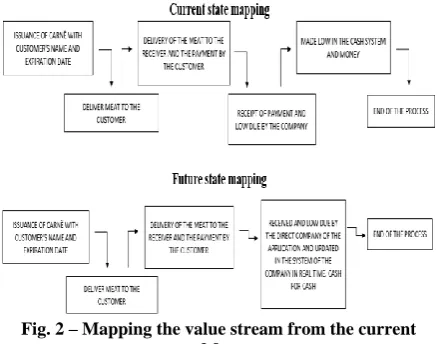
Fig. 1 – GUT MatrixThus, the MFV of the current state was elaborated, in order to compare it with a future state, adjusting the needs of the owner to the problem object of study, as shown by Fig.2.
Fig. 2 – Mapping the value stream from the current state and future state
From this, it was established the use of PowerApps software that according to [9] is a tool that allows you to create applications without writing code lines, in addition to creating custom databases for applications. The use of the PowerApps software was defined because of its practicality since it allows data to be inserted by the application and plotted in real time in a database located in a table in an Excel worksheet.
In order to standardize the process, a training was elaborated with the employees that are directly related to the noise problem in the information about payments made by the clients, which was to present the tool developed (Fig. 3), to define the employee that would operate it, and train it for this function. It was defined that at the end of the day the three people responsible for receiving the information about the payments made by the customers would pass this information to the collaborator responsible for the operation of the platform to check all the launches, as a way to avoid that the payment is no longer launched in the system.
Fig. 3 – Application platform developed
The Kaizen Tool was used to convey to employees the importance of continuous improvement, to avoid wastage and activities that do not add value, and to emphasize the importance of this philosophy within organizations.
According to [1] to prepare a questionnaire, five steps should be followed: Plan what will be measured, form the questionnaire, elaborate the questions texts, sequencing and appearance decisions, pre-test and correction of problems.
According to the five steps mentioned, a questionnaire 1 based on the five-point Likert scale was developed, in order to verify the scenario presented by the company using the PowerApps software presented as a solution to the noise problem in the information on payments made by clients, where ten questions were developed and a pre-test was applied to three people of the study company, who understood the process, but did not deal directly with it, in order to better target the questionnaire to answer the questions. issues to be measured later, thus resulting in the current model after due modifications. For the elaboration of the results and discussions, the application was used during 14 (fourteen) weeks from 06/11/2018 to 09/17/2018 and after that time the questionnaire 1 was applied to the three officials responsible for the process and form of the measurement of responses, a table was built through Excel software, in which all information and analyzes were organized.
IV. RESULTSANDDISCUSSION
A. Current Value Stream Map
Previously the process of payment was done as follows: Issuance of a card with the information of the client and with the due date, to which it was delivered to the recipient, that on the due date the card was delivered to the recipient along with payment, giving low in the card and later in the system of the company and then, destined the money to the cashier.
ISSN: 2231-5381
http://www.ijettjournal.org
Page 59
not intended for the cashier, staying with the owner, leaving a gap in the accounting closure of the company and consequently, the payment was not recognized by some customers because of this problem.
B. Future Value Flow Map
Subsequently the process was defined as: Issuance of a card with the customer's information and due date, which is delivered to the recipient, who on the due date delivers the card to the recipient along with payment, application and updated instantaneously in the database in excel, after the low, the money is destined to the cashier, according to training done.
Through the MFV it was noticed that a process was reduced because it was optimized through the inclusion of the application, once with the application is already added the payment information in the database, not having to go to the machine to make low.
C. Standardization
After all the training involving the operational part of the application, we applied the standardization tool of the Lean Office, where he was informed through a dialogue about the importance of keeping the procedure in a standardized way, avoiding deviations, so that information is not lost during the process.
D. Kaizen
It was approached as a continuous improvement procedure the Kaizen Lean Office tool, where it was exposed through dialogue with employees on the importance of this philosophy within the organizations, in which employees were involved in becoming more attentive to the processes in which they act by seeking the continuous improvement, not only be satisfied by a simple change and small positive results.
E. Satisfaction
According to Oliveira [12] for a better analysis of the results, it is necessary to perform a quantitative approach to establish the Medium Ranking (RM) for the questionnaire that used a 5-point Likert scale to measure the degree of agreement of the subjects who answered the questionnaires.
According to the model presented by [3] a check was made on the agreement or disagreement of the evaluated questions, by obtaining the RM of the score attributed to the answers of the three collaborators, relating to the frequency of the responses of the respondents who did so assignment, where values less than 3 are considered as discordant and, greater than 3, as concordant, considering a scale of 5 points.
Still according to the standards established by the author, above analysis of the data and calculation of RM was obtained through the results obtained from the Likert scale where the weighted average was
given, giving the appropriate weights according to the frequency at which it was voted.
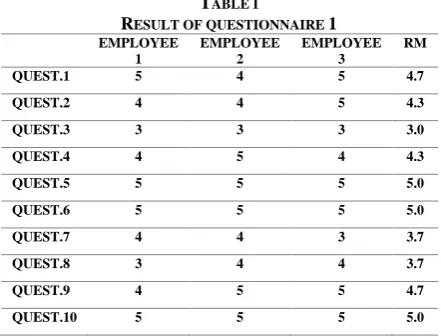
Table 1 refers to the elaboration of a spreadsheet in excel where the data were plotted with due answers of the three employees in each question of the questionnaire, and in the last column the calculated RM.
TABLE I
RESULT OF QUESTIONNAIRE 1
EMPLOYEE
1
EMPLOYEE 2
EMPLOYEE 3
RM
QUEST.1 5 4 5 4.7
QUEST.2 4 4 5 4.3
QUEST.3 3 3 3 3.0
QUEST.4 4 5 4 4.3
QUEST.5 5 5 5 5.0
QUEST.6 5 5 5 5.0
QUEST.7 4 4 3 3.7
QUEST.8 3 4 4 3.7
QUEST.9 4 5 5 4.7
QUEST.10 5 5 5 5.0
According to Table 1, it can be seen that in questions 5, 6 and 10 it obtained the highest RM score as being 5 points, where it was asked about the first impression when presented to the application and when manipulating it, besides satisfaction with relation the usefulness of the application to the point of not needing another tool that would complement its use, these answers were classified as very satisfied. Questions 1 and 9 obtained a RM of 4.7 points when asked about the availability of the application and how satisfied is about the pleasure provided by the application, and questions 2 and 4 a use of 4.3 points when asked as well as satisfaction with response time and with application usage, being classified between very satisfied and satisfied. Questions 7 and 8 obtained a benefit of 3.7 when asked about the performance of the application and satisfaction with the image of the application after having manipulated and operated it, being classified between satisfied and partially satisfied. Question 3 refers to satisfaction with the performance of the application created, where the performance was 3.0, being classified as partially satisfied.
Still according to [3] as the results of the questionnaire exposed in Table 1 presented a performance above the 3 RM points is therefore classified as concordant, that is, in the present study, the developed application has obtained the approval and satisfaction those in use the application and subsequently answered the questionnaire.
V. CONCLUSIONS
ISSN: 2231-5381
http://www.ijettjournal.org
Page 60
the information about the payments made by the clients. After the definition of the problem, the Lean Office tools were used: MFV where the current state of the process was mapped and also the future state was projected with the necessary improvement changes; Standardization where a training on the new process was offered after the implementation of PowerApps with intuition to standardize it, thus avoiding deviations and noise in its results; Kaizen in order to convey to employees about the importance of continuous improvement, to avoid wastage and activities that do not add value.
The results were obtained after 14 (fourteen) weeks of implementation of the application that was understood between June 11, 2018 to September 17, 2018 and that after this period a questionnaire was applied to the three employees with the Likert 5-point scale with a satisfaction survey covering 10 questions, where 3 of these questions were classified with the maximum RM score of 5 points, other 2 questions obtained a RM score of 4.7 points, 2 questions with a RM score of 4.3 points , 2 with a RM of 3.7 and 1 with 3, thus achieving the approval and satisfaction of the employees who dealt with the process.
The objective of the study was to use the Lean Office and its tools in a day-care center to solve the priority problem defined by measuring the GUT Matrix to achieve this goal.
The present work had as important to find a solution to a priority problem, using some tools of Lean Office to solve it, and had a contribution in the studies related to Lean Office in administrative activities.
REFERENCES
[1] Aaker, ET AL (2001) “Marketing Research” (7th Ed.), New York: John Wiley & Sons, Inc
[2] L. I. Brasil, “Mapeamento do fluxo de valor (VSM) – Estado
Atual e Futuro,” 2018. [Online] Available:
https://www.Lean.org.br/conceitos/72/mapeamento-do-fluxo-de-valor-(vsm)---estado-atual-e-futuro.aspx. [Acesso em: 18 03 18].
[3] R. M. Cassiano,”Estratégias competitivas das empresas produtoras de sementes de soja: um estudo exploratório no Sul de Mato Grosso”. CNEC/FACECA. Faculdade Cenecista de Varginha. Mestrado em Administração e Desenvolvimento Organizacional. Varginha, 2005. (Dissertação).
[4] I. Chiavenato,” Princípios da administração: O essencial em teoria geral da administração,”.2 ed. Tamboré; Manole Ltda, 2013.
[5] E. Drotz and B. Poksinska, “Lean in healthcare from employees’ perspectives,” Journal of health organization and management, v. 28, n. 2, p. 177-195, 2014.
[6] B. Endeavor, “Kaizen: a sabedoria milenar a serviço da sua
melhor gestão,” 2015. [Online]. Available:
https://endeavor.org.br/kaizen/. [Acesso em: 15 03 2018]. [7] C. Evangelista et al “Lean Office – escritório enxuto: estudo
da aplicabilidade do conceito em uma empresa de transportes”. 2013.
[8] P. Falkowski and P. Kitowski, “The 5S methodology as a tool for improving organization of production,” PhD Interdisciplinary Journal, 2013 n. 3, p. 127-133.
[9] M. Fife. “Introduction to PowerApps,” ISBN: 19548317705. CreateSpace Independent Publishing Platform. 2017. [10] J. L. García-Alcaraz, “Lean Manufacturing in the
Developing World,” DOI: 10.1007/978-3-319-04951-9. Sprinter International Publishing Switzerland. 2014. p. 5-6. [11] M. Holland, “Taking Control: A Simple Approach to
Wold-Class Manufacturing”. ISBN:978-1-4834-1549-9. Lulu Publishing Services. 2014. Cap 3.
[12] L. H. Oliveira, “Exemplo de cáclulo de Ranking Médio para Likert. Notas de Aula. Metodologia Científica e Técnicas de Pesquisa em Administração,” Mestrado em Adm. e Desenvolvimento Organizacional. PPGA CNEC/FACECA: Varginha, 2005.
[13] M. V. Rodrigues “Entendendo, Aprendendo e
Desenvolvendo Sistemas de Produção Lean Manufacturing,” ISBN: 8535284591, 9788535284591. Elsevier Brasil. 2015. [14] C. Roos and E. P. Paladini, “Implementação parcial do Lean
Office em uma organização prestadora de serviços,”. In: CARVALHO, Marly Monteiro de et al (Org.). Gestão de Serviços: Casos Brasileiros. São Paulo: Atlas, 2013. Cap. 10. p. 164-180.
[15] R. E. T. M. Soares and C. B. Sikilero, “Analise dos desperdícios no processo produtivo: um estudo de caso de uma fabricante de chapas de MDF,” XXX Encontro Nacional de Engenharia de Produção, São Carlos, SP, Brasil, 2010.
[16] G. L. Volpato, “O método lógico para redação científica,” RECIIS – RevEletron de Comum InfInov, Saúde. ISSN 1981-6278, Rio de Janeiro. p 1-14, março, 2015.