Readiness Of Nigerian Quantity Surveyors To
Adopt Knowledge Management
Umar I., Usman Y., Yahaya I. Isa B
Department of Quantity Surveying, College of Environmental Studies, Hussaini Adamu Federal Polytechnic P.M.B 5004 Kazaure, Jigawa State, Nigeria .
[email protected], [email protected], [email protected], [email protected]
Abstracts: The main aim of KM concept is to facilitate learning and the creation of new knowledge by teaching individuals where to find appropriate organizational knowledge, the way to use it efficiently, apply it effectively and share it appropriately. This research was carried out to investigate the readiness of Quantity Surveyors in the Nigerian Construction Industry to espouse KM concept in discharging their cost management services. A quantitative research approach was adopted in order to attain the aforementioned objective of the study. Fourty two (42) readiness indicating factors were identified from the literature and all were used in the structured questionnaires in order to test the readiness of the respondents in the Nigerian Construction Industry. Fifty one (51) questionnaires were retrieved from the respondents which were analyzed for the purpose of this work. The Analysis of Variance (ANOVA) statistics show that there is no significant difference among the three categories of the respondents (top managers, middle managers and lower managers) in their view on the questions investigated for their readiness to adopt KM in their firms. It was further revealed that there is no significant difference in the opinion of the respondents in spite of their affiliations to the Nigerian Institute of Quantity Surveyors as some are fellow members while some are corporate or Probational members of the Institute. The study recommended an aptly motivation of the Quantity Surveyors in their firms so that their capabilities of managing knowledge would be enrich.
Keywords: Quantity Surveyors, Construction Industry, Knowledge, Stratified Sampling,
Introduction
The need for continuous advancement in the Construction Industry has resulted in various initiatives, which aimed at strengthening the construction process. Most of the initiatives are primarily towards reducing disintegration, and have included; the development of optional procurement methods to clarify and improve the communication structure between different participants in the construction process [8],[4]; adoption of information and communication technology (ICT) to integrate the construction process via the electronic sharing of information at the design and construction stages [19],[21],[14]; the embracing of a wide range of concepts and techniques such as Total Quality Management, Partnering among others, with the aim to enhance collaboration and improve efficiency and quality [5],[17],[6]. Moreover, it is now being appreciated that the management of knowledge acquired in an infrastructural project especially within the Construction Industry where projects are executed by temporary 'virtual' organizations is open to considerable enhancement, both within construction organizations, and also between supply chain firms [26],[13]. The emphasis on Knowledge Management (KM) signify the growing realization that it is a major business concern, particularly in the context of the emerging knowledge economy, where the experience of a company is becoming more important than the traditional sources of economic power (e.g Assets) [25]. Moreover, it is now being continuously accepted that managing the acquired knowledge within the Construction Industry would bring about the much needed revolution and enhance project execution the Industry requires[13]. In the context of Quantity Surveyors‟ profession, knowledge is a key feature and therefore efficient KM skills can help them to improve their know-how. The more, the projects Quantity Surveyors executed the more experience they acquired. What needed is a way of recollecting the ideas and solutions for use in subsequent
projects [7]. However, for Quantity Surveyors to succeed and prosper they must respond quickly and innovatively to the accelerating social, economical and environmental challenges [11]. It is advanced by some researchers that KM is relatively the speedy and more efficient way to enhance Quantity Surveying professionalism [13].Despite the successes of KM adoption recorded in various countries, the review of literature obviously depicts that there are no adequate research studies focused on the concept in Nigeria [2],[1]. It is therefore worrisome that there has not been sufficient research in this vital strategy; hence dearth of research in this area is the motivator to this study, to assess the Nigerian Quantity Surveyors readiness to adapt KM.
Research Method
considered. As it is not possible to consider the entire population due to time and other logistic reason aforementioned, the sample size required from the population was ascertained based on statistical principles. A probabilistic or random sampling method known as stratified sampling was strategically employed whereby the study area was divided into strata before sampling takes place within each stratum. The following equations were used to find out the appropriate sample size from each stratum in order to make findings that are generalizable or applicable to the entire population as advanced by (Kapoor, 2010).
no=(p*q)/v2……….(3.1)
n=no/[(1+no/N)]……… (3.2)
Where;
no = Sample size from an infinite population
p = Proportion of the characteristics being measured in the target population
q= complement of p, i.e. 1-p
V = maximum standard error allowed N = population size
n = sample size
Results
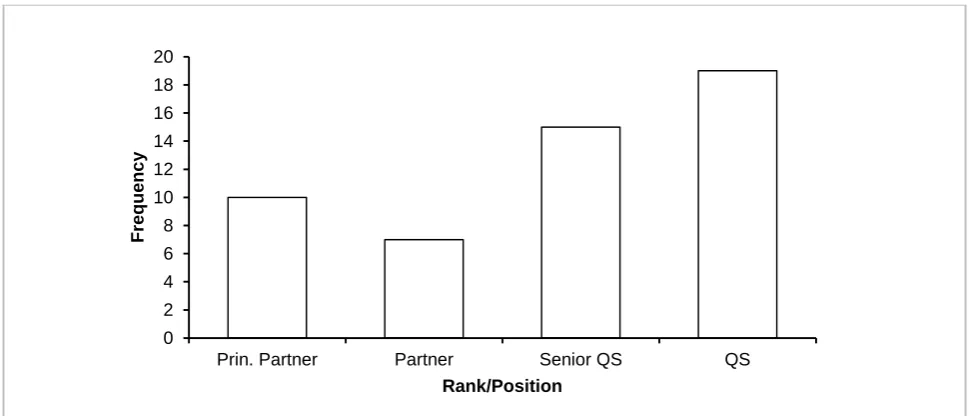
The result of the survey in figure (4.1) showed that (19.6%) of the respondents are Principal Partners in their firms and (13.7%) are Partners in the firms surveyed. Analysis also indicated (29.4%) of the respondent were Senior Quantity Surveyors. These show the cogency and objectivity of the responses as the respondents were hierarchically distributed from the strategic management (owners) of the firms down to middle managers (senior QS) and subsequently to the actual knowledge workers (QS). This indicates that 17 (33.3%) of the respondents were senior managers and 15 (29.4%) of them were at middle management level whereas 19 (37.3%) were knowledge workers or lower managers in their respective firms.
Figure 4.1: Rank/Position of Respondents
The table (4.1) below presents the distribution of the respondents in accordance to the professional qualification attained with the Nigerian Institute of Quantity Surveyors. From the analysis of responses, (33.3%) of the
respondents had Corporate membership with the Institute and (27.5%) were Fellow members. In addition, (15.7%) were Probational members in the Institute while (23.5%) were mostly students‟ members of the Institute.
Table 4.1: Distribution of respondents by Professional Membership 0
2 4 6 8 10 12 14 16 18 20
Prin. Partner Partner Senior QS QS
Fre
qu
e
nc
y
Rank/Position
Professional
Membership Frequency Percentage
Cumulative Frequency
Cumulative Percentage
Corporate 17 33.30 17 33.30
Fellow 14 27.50 31 60.80
Probationer 8 15.70 39 76.50
Discussion of Results
Some of the KM readiness factors in the construction and construction related firms have been identified by several authors such as; [11],[10],[15],[18],[23],[16] [22]. The readiness factors identified from the literature were presented in the questionnaire and the respondents rated them using Likert scale such as; 1 (Definitely Agree) to 4 (Definitely Disagree), 1 (Strongly Familiar) to 4 (Strongly not familiar), 1 (Completely Agree) to 4 (Completely Disagree) and 1 (Extremely low) to 5 (Extremely high) therefore the more the mean tends to 5, the more it attained hence more KM readiness for the Nigerian Quantity Surveyors whereas the more it tends to 1 the less it attained hence less KM readiness for them. The frequency of occurrences was calculated, mean scores and ranking of the responses were also computed to allow for further analysis of the result.
Analysis of Variance to Compare Means
Descriptive statistics was used to produce frequency counts of the occurrences and Inferential statistics was further carried out using analysis of variance (one-way ANOVA) to compare the means scores of responses in order to find out if there is any significant differences on
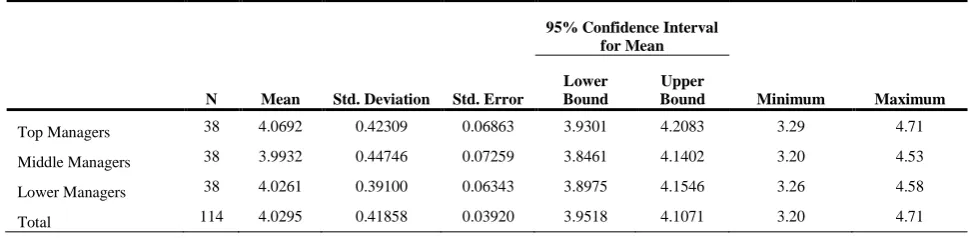
the opinion of the respondents based on their positions in their firms, professional membership with the Institute and average years of experience in the construction work have effect on their view and this was further confirmed using Tukey – HSD multiple comparison tests where it was applicable. The Analysis of Variance (ANOVA) statistics in the tables (4.2 and 4.3) below show that there is no significant difference among the three categories of the respondents (top managers, middle managers and lower managers) in their view on the questions investigated. This is because the calculated F ratio values of the issues under investigation are less than the F critical value of 2.60, F (2,111) = 0.312 and the calculated sig. (p) is greater than 0.05 level of tolerance (0.733). For statistically significant difference to occur the F critical value must be greater than 2.60 and the significance value (p) of one – way ANOVA should be less than 0.05. As appeared in the below analysis from table (4.2 and 4.3) we can conclude that there is no significant difference in the opinions of the top managers to that of middle managers and lower managers for their readiness to adopt KM in their firms and this was aptly agreed with the means of the three categories in table (4.2) as there is no significant difference among all of them.
The results of the ANOVA statistics in the tables (4.4 and 4.5) below show that there is no significant difference in the opinion of the respondents in spite of their affiliations to the Nigerian Institute of Quantity Surveyors, some are fellow members, some corporate members or Probational members and some were students members of the Institute. This is because the calculated F ratio values of the subject under investigation are F (3,148) = 0.985
which is far below the critical value of 2.60 and the calculated sig. (p) are in excess of 0.05 level of tolerance (0.402). For statistically significant difference to take place, the F critical value must be above 2.60 and the significance value (p) of one – way ANOVA should be below 0.05 level of tolerance. From this outcome, we can said that any result gotten from the analysis of their responses (fellow members, corporate members,
Probational members and others) can be generalized since there is no significant difference in their agreement with questions investigated.
Table 4.2: Descriptive statistics of Anova based on Ranks in the Firms
95% Confidence Interval
for Mean
N Mean Std. Deviation Std. Error
Lower Bound
Upper
Bound Minimum Maximum
Top Managers 38 4.0692 0.42309 0.06863 3.9301 4.2083 3.29 4.71
Middle Managers 38 3.9932 0.44746 0.07259 3.8461 4.1402 3.20 4.53
Lower Managers 38 4.0261 0.39100 0.06343 3.8975 4.1546 3.26 4.58
Total 114 4.0295 0.41858 0.03920 3.9518 4.1071 3.20 4.71
Table 4.3: Analysis of variance based on Ranks in the Firms
Sum of Squares df Mean Square F Sig.
Between Groups 0.111 2 0.055 0.312 0.733
Within Groups 19.688 111 0.177
Table 4.5: Analysis of variance based on Professional Membership
Sum of Squares df
Mean
Square F Sig.
Between Groups 0.530 3 0.177 0.985 0.402
Within Groups 26.535 148 0.179
Total 27.064 151
Conclusion
The findings revealed that most Quantity Surveyors are in the view that knowledge is a vital resource to any firms that owns it and it will definitely enhance the performance of that firm and also adopting and implementing KM in the Nigerian Quantity Surveying firms would enhance their ability in carrying out their cost management services. Despite the different academic qualifications earned and distinct professional membership affiliation with the Nigerian Institute of Quantity Surveyors of the respondents, they have the same view on the attainment of KM readiness in the Nigerian Quantity Surveying firms. Results shown that, most of the Quantity Surveyors are exposed to low motivation which most times demoralized them in generating and sharing knowledge willingly. It is therefore important for Quantity Surveying firms to motivate their professional employees appropriately so that their readiness to generate and manage knowledge would be enriched.
References
[1]. M. AbdulRazaq, A. J. Abdullahi and A. D. Ibrahim, “Used of Knowledge Management in the Nigerian Construction” in: Laryea, S.and Leiringer R. (Eds) Procs. 6th West Africa Built Environment Research (WABER) Conference, 10-12 August 2015, Accra, Ghana, pp. 1173-1184.
[2]. C. Adeeko, “Assessment of Knowledge Management Requirements in the Consultancy firms of the Nigerian Construction Industry”. Unpublished Thesis, Department of Quantity Survey. Ahmadu Bello University Zaria. 2012. [3]. A. I. Alarape, and A. Agbaje, Introduction to
Research Methodology. Adegun Press. Ibadan, Nigeria. 2010.
[4]. A.Ashworth, Contractual Procedures in the Construction Industry (2nd Ed), Longman, London. 1991.
[5]. L. F. Baxter, and A.W. Macfarlane, “Just In Time for the Construction Industry”, CIOB Construction Papers, No. 14, The Chartered Institute of Building, UK., 1992.
[6]. J.Bennett, and S. Jayes, The Seven Pillars of Partnering, Thomas Telford Publishing, London. 1998
[7]. (BSI), “Introduction to Knowledge Management in Construction”. 2003. London: British Standard Institution. Available at
www.bsi-km.com [Accessed 11th October 2012].
[8]. (BPF), “The British Property Federation System for the Design of Buildings”, British Property Federation, UK 1983.
[9]. P. Carrillo, and P.Chinowsky, “Exploiting knowledge management: the engineering and construction perspective”, ASCE Management in Engineering, (22)1, pp 2-10. 2000.
[10].P. Carrillo, H. S, Robinson, A. M. Al-Ghassani, and C. J. “Anumba, Knowledge management in UK construction: strategies, resources and barriers”, Project Management Journal, 35(1), pp 46-56. 2004.
[11].R. Davis, P. Watson, & C. Man, “Knowledge Management for the Quantity Surveying Profession”. Construction Informatics Digital Library. 78(3), pp 152 – 157. 2007.
Table 4.4: Descriptive statistics of Anova based on Professional Membership
95% Confidence Interval for Mean
N Mean Std. Deviation Std. Error Lower Bound Upper Bound
Fellow 38 4.0753 0.41552 0.06741 3.9387 4.2118
Corporate 38 4.0184 0.42942 0.06966 3.8773 4.1596
Probationer 38 3.9271 0.46479 0.07540 3.7743 4.0799
Others 38 4.0676 0.37957 0.06157 3.9429 4.1924
[12].J. Egan, “Rethinking Construction”. Report of the Construction Task Force on the Scope for Improving the Quality and Efficiency of UK Construction, Department of the Environment, Transport and the Regions, London. 1998. [13].C. Egbu and K. Botteril, “Information
technologies for knowledge management: their usage and effectiveness”, Electronic Journal of Information Technology in Construction, (2)7, pp 125 - 134. 2001.
[14].N. F. O. Evbuomwan, and C. J. Anumba, Towards an Integrated Engineering Design Environment, in B. Kumar & A. Retik, (eds.), Information Representation and Delivery in Civil and Structural Engineering, Civil-Comp Press, Edinburgh, pp. 127-134. 2001.
[15].A.H.Gold, A. Malhotra, & A.H. Segars, “Knowledge Management: An Organizational Capabilities Perspective”. Journal of Management Information Systems. 18(1), pp 185–214. 2001.
[16].R.M. Grant, „„Toward a knowledge-based theory of the firm‟‟, Strategic Management Journal, Vol. 17, Winter Special Issue, pp. 109-22. 1996. [17].R. B.Hellard, Total Quality in Construction
Projects, Thomas Telford, London. 1993.
[18].C.W., Holsapple, & K.D. Joshi, “An Investigation of Factors That Influence the Management of Knowledge in Organizations”. Journal of Strategic Information Systems. 9. pp 235–261. 2000.
[19].H. C. Howard, R. E. Lewitt, B. C. Paulson, J. G. Pohl, and C. B., “Tatum, Computer Integration: Reducing Fragmentation in AEC Industry”, Journal of Computing in Civil Engineering, ASCE 3(1), pp 18-32. 1989.
[20].V. K. Kapoor, Modern Approach to Fundementals of Statistics for Business and
Economics. Chand & Sons Publishers. New Delhi 2010.
[21].Y. Miyatake and R. Kangari, Experiencing Computer Integrated Construction. Journal of Construction Engineering and Management, ASCE, 119 (2), pp 307-322. 1993.
[22].I. Nonaka and H. Takeuchi, The knowledge Creating Company, Oxford University Press. New York. 1995.
[23].C. O‟Dell and J. Grayson, “If Only We Know What We Know: the Transfer of Internal Knowledge and Best Practice”, California Management Review, vol. 40, No. 3, spring. 1998.
[24].RICS. Royal Institute of Chartered Surveyors: Quantity Surveying 2000. 1992.
[25].H. Scarborough and J. Swan, Case Studies in Knowledge Management. London: Institute of Personnel and Development. (1999).
[26].C. E. Siemieniuch and M. A. Sinclair, “Implications of CE for Organizational Knowledge and Structure: A European, Ergonomics Perspective”, Journal of Design and Manufacturing, 3(3), pp 189-200. 1993.