Case Report
Do Not Terminate Before Heating
Muge Gulen1, Davut Kaplan2, Seyhmus Kaya3
1
University of Health Sciences, Adana City Education and Training Hospital, Department of Emergency Medicine, Adana Turkey
2
Eskisehir Yunus Emre State Hospital, Emergency Medicine Service, Eskisehir, Turkey 3
Eskisehir State Hospital, Emergency Medicine Service, Eskisehir, Turkey
Corresponding Author: Muge Gulen
ABSTRACT
Hypothermic patients’ resuscitation should be initiated where the incident has occurred and restoration of normal body temperature should be ascertained before the patient can be declared dead. In this paper we presented a case of 51 years old man who was referred to the emergency department on a snowy night with accidental hypothermia. His body temperature with a rectal probe was 24°C. Internal and external warming was continued and CPR was promptly initiated. At the 30th minute, the patient responded to resuscitation; hence, his rectal body temperature rose to 28°C. He was discharged without any neurologic sequela. In these hypothermic patients, resuscitation should be initiated where the incident has occurred and restoration of normal body temperature should be ascertained before the patient can be declared dead.
Key words:Hypothermia, body temperature, emergency department.
INTRODUCTION
Hypothermia is defined as a central body temperature below 35°C with such effects as all organ systems, particularly the central nervous system and the heart. (1) Inadequate clothing, previous hypothermia history, alcohol or drug abuse, certain dermatological or neurological conditions, and neuromuscular diseases may also contribute to the development of hypothermia. (1,2) Clinical signs vary according to the severity of hypothermia, despite similar management strategies in all grades of hypothermia. (2) In this paper, we describe a patient who developed cardiopulmonary arrest after hypothermia and responded to resuscitation after warming in light of recent published literature.
CASE REPORT
painful stimuli and his Glasgow Coma Scale score was 5 (E1, M3, V1). Electrocardiography (ECG) demonstrated atrial fibrillation with normal ventricular rate. QRS complex was 0.20 sec with prolongation of the QT interval (0.56 sec). Marked Osborn waves were present in all leads (Figure 1). He was intubated. The temperature of the heater blanket was set at 42°C to provide external warming. Nasogastric and Foley catheters were placed in order to achieve active internal warming through the use of warmed crystalloids. Also, intravenous fluid infusion was commenced with crystalloid fluid warmed up to a temperature of 42°C. The patient developed cardiopulmonary arrest during warming. Internal and external warming was continued and CPR was promptly initiated. At the 30th minute, the patient responded to resuscitation; hence, his rectal body temperature rose to 28°C. Initial laboratory results were as follows: leukocytes: 4200/mm3; hemoglobin: 14 g/dl; hematocrit: 41.9%; platelets: 106000/ mm3; glucose: 176 mg/dl; BUN: 7 mg/dl, creatinine: 0.83 mg/dl, alanine
aminotransferase: 126 IU/L, aspartate transaminase: 443 IU/L, total bilirubin: 0.8 mg/dl, direct bilirubin: 0.3 mg/dl, amylase: 50 IU/L, sodium: 135. mmol/L, potassium: 4.07 mmol/L, chloride: 92 mmol/L, blood ethanol level: 297 mg/dl, prothrombin time was 11.2 sec, and INR was 1.21. After responding to resuscitation, his arterial blood gas results were as follows: pH: 7.244, pO2: 235.7 mmHg, pCO2: 27.5mmHg, HCO3: 13.7 mmol/L, BE:-14.9 mmol/ L, and SO2 99.2%. Whole body computed tomography (CT) imaging studies performed to investigate injury secondary to trauma revealed normal results except fracture of the nasal bone.
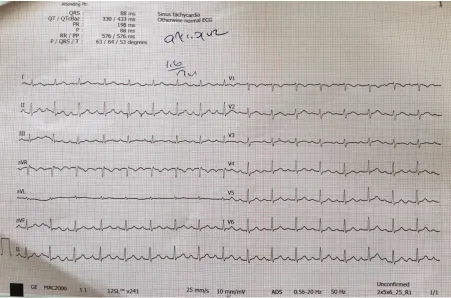
He was transferred to the intensive care unit and his body temperature rose to 36°C at 6 hours after admission, his GCS was 10 and his spontaneous respiration was adequate, with consequent extubation. An ECG recording 24 hours after his admission was normal with sinus rhythm (Figure 2). His medical treatment was completed, and he was referred to the Center for the Treatment of Alcohol and Substance Abuse.
Figure 2: Normal ECG of the patient after treatment.
DISCUSSION
Hypothermia occurs when the heat loss exceeds heat production, and systemic hypothermia is defined as a life-threatening condition associated with a body temperature below 35°C in conjunction with significant physiological changes. (3) The severity of the condition may exhibit a certain degree of variability between individuals, and usually ambient temperatures below 10°C are thought to suffice for the development of hypothermia. (1, 4)
Several factors are associated with an increased risk of hypothermia including advanced age, reduced muscle mass, decreased capacity for shivering, or chronic disease, which lead to a failure to generate adequate heat, predisposing the individual to hypothermia. (1,4) Intake of toxic levels of alcohol abolishes the vasoconstriction reflex in the skin and skeletal muscles, which is an important heat-preserving mechanism regulated by the activity of the sympathetic nervous system. It is also associated with a reduced ability to gauge the need for appropriate clothing and sheltering due to its
depressive effects on the central nervous system. (1,2,4) It is reasonable to assume that hypothermia occurred due to the combined effects of alcohol-related vasodilation and inability to seek for shelter from cold due to loss of consciousness in this case.
hypothermic patients, the cardiac muscle tissue is extremely sensitive to cardiac rhythm disturbances. Even a cardiac examination with coarse movements of the examiner may trigger life-threatening severe dysrhythmias, including ventricular tachycardia and ventricular fibrillation. (2,5) Depending on the severity of hypothermia, the CNS manifestations may include impaired states of consciousness ranging from confusion to coma, nonreactive pupils, and reduced cerebral blood flow. However, ischemic complications are infrequent due to the significantly reduced cranial oxygen demand despite reduced blood flow to the brain. Therefore, neurological prognosis is good even after prolonged resuscitation efforts, which should not be terminated before normal body temperature is restored. (2,6)
Similarly, in our patient pupils were bilaterally mid-dilated and nonreactive to light, with a comatose appearance.
The methods employed for warming-up split into external (passive and active) and internal (active) warming. (2) In passive external heating the body is covered with a blanked in a warm room to allow for self-warming through shivering, which is mainly used for the treatment of mild to moderate hypothermia. (2) Active external heating involves the use of warmed blankets, electric blankets, hot water bottles and chemical heat packs, which are placed in a number of anatomical locations in the body including the neck, chest, and groins. Active internal heating methods include the use of warmed IV fluids, moisturized and warmed O2, peritoneal lavage with potassium-free liquids, hot gastric lavage, and extracorporeal heating, and these measures are generally reserved for severe hypothermia. (2) For active internal heating moisturized and heated O2 (up to 43 to 46 C) may be administered at a rate of 150-200 ml per hour and physiological saline warmed up to 43°C or potassium free dialysis solution warmed up to 43°C may be administered intravenously at a dose of 2 liters. Others heating methods include gastric lavage with physiological saline
heated up to 65°C that allows an increase of 2.8°C per hour in the body temperature. (2,7) In particular, active external heating results in peripheral vasodilation directing the blood away from the internal organs in patients with severe hypothermia, while blood with relatively lower temperature is directed toward the internal organs, leading to further reduction in internal body temperature and increasing the risk for life-threatening dysrhythmia. This condition, referred to as the “after drop” effect, should always be considered for these patients. (2) In patients developing ventricular tachycardia or ventricular fibrillation who require defibrillation, a single defibrillation may be provided by a bi-phasic defibrillator (120-200 J) or monophasic defibrillator (360 J). If normal rhythm cannot be restored, no further defibrillation is performed until an internal body temperature of 30°C is attained as cardiac compression and heating are continued. In patients who fail to achieve adequate warming, restoration of normal sinus rhythm may be difficult as the hypothermic heart is relatively unresponsive to cardiac medications, pacemaker stimulation, or defibrillation. Additionally, the reduced drug metabolism may lead to toxicity after repeated doses. For all these reasons, cardiac medications should be avoided at body temperatures below 30 C, after which the dose intervals should probably be prolonged. (2) Our patient had responded to 30 minutes of cardiopulmonary resuscitation, during which active internal heating with IV fluids, as well as fluids given through the nasogastric and Foley catheters, was achieved in addition to active external heating with electric blankets. The response to resuscitation was achieved once his rectal temperature reached 28°C.
CONCLUSION
where the incident has occurred and restoration of normal body temperature should be ascertained before the patient can be declared dead.
REFERENCES
1. Dogan KH, Esen H, Demirci S, Gündogmuş UN. Evaluation of deaths due to hypothermia. Journal of General Medicine.2013;23(1):1-5
2. Eren SH, Korkmaz I, Dogan K, Güven FMK. Assessment of hypothermia, diagnosis and treatment. JAEM 2009;8(1):9-12
3. Luban SS, Genin DI, Singh N, Cruz ADL. Asystolic cardiac arrest of unknown duration in profound hypothermia and polysubstance overdose: A case report of complete recovery. Am J Case Rep. 2015;16: 353-56
4. Stares J, Kosatsky T. Hypothermia as a cause of death in British Columbia, 1998−2012: a descriptive assessment.
CMAJ Open 2015.
DOI:10.9778/cmajo.20150013
5. Baktır AO; Hakbilir O, Kesaplı M, Kucuk M. Hypothermiccoma at warm climate diagnosed by hugeOsbornwave. Turk J Emerg Med. 2009;9(4):177-80 6. Kieboom JK, Verkade HJ, Burgerhof
JG, Bierens JJ, Rheenen PFV, Kneyber MC, Albers MJ. Outcome after resuscitation beyond 30 minutes in drowned children with cardiac arrest and hypothermia: Dutch nationwide retrospective cohort study. BMJ 2015;350:h418 | doi: 10.1136/bmj.h418 7. Girisgin AS, Kocak S, Gul M, Cander
B. Hypothermia and local freezing. STED. 2006;15(3):45-50
***********