Available online on 15.07.2014 at http://jddtonline.info
Journal of Drug Delivery and Therapeutics
Open access to Pharmaceutical and Medical research
© 2014, publisher and licensee JDDT, This is an Open Access article which permits unrestricted noncommercial use, provided the original work is properly cited
REVIEW ARTICLE
A REVIEW ON BI-LAYER TABLETS - AN EMERGING TREND
Puneet Mishra*, Dr. Pramod Kumar Sharma, Rishabha MalviyaDepartment of Pharmacy, School Of Medical and Allied Sciences, Galgotias University, Greater Noida, India
INTRODUCTION
Bi-layer tablets have been developed to achieve controlled delivery of different drugs with pre-defined release profiles. Bi-layer tablets can be a primary option to avoid chemical incompatibilities between API by physical separation, and to enable the development of different drug release profiles (immediate release with extended release). Despite their advantages, due to the use of different materials and complex geometric boundaries between the adjacent layers, the mechanical structures of this drug delivery system have become quite intricate, requiring complicated tablet architectures as well as patient-friendly.
The most common controlled delivery system has been the matrix type such as tablets and granules where the drug is uniformly dissolved or dispersed throughout the polymer, because of its effectiveness, low cost, ease of manufacturing and prolonged delivery time period1,2. Bi-layer tablets have some key advantages compared to conventional monolayer tablets. For instance, such tablets are commonly used to avoid chemical incompatibilities of formulation components by physical separation.
The bi-layer tablet is a concept which is composed of different layers. The system allows the incorporation of more than one drug into the dosage form 3-4. Formulation of layers from different polymers allows manipulation over more than one rate-controlling polymer, thus enabling different types of drug delivery of one or more drugs, i.e. where the drug may be released with a bolus and then at a controlled rate or by targeted drug delivery in the GI tract using pH dependant polymers5.
MULTI-LAYER TABLET DOSAGE FORMS ARE DESIGNED FOR VARIETY OF REASONS-
To control the delivery rate of either single 6 or two different active pharmaceutical ingredient(s)7,8. To control the delivery rate of either single or two
different active pharmaceutical ingredient(s). To separate incompatible Active pharmaceutical
ingredient (APIs) from each other, to control the release of API from one layer by utilizing the functional property of the other layer (such as, osmotic property).
To modify the total surface area available for API layer either by sandwiching with one or two inactive layers in order to achieve swellable /erodible barriers for modified release.
To modify the total surface area available for API layer either by sandwiching with one or two inactive layers in order to achieve swellable /erodible barriers for modified release.
*For correspondence: Puneet Mishra, M.Pharma,
Department of Pharmacy, School of Medical & Allied Sciences Galgotias University, Greater Noida, India
Email ID- [email protected]
Contact No.- 9451356927
ABSTRACT
Bi-layer tablets have been developed to achieve controlled delivery of different drugs with pre-defined release profiles. In the last decade, interest in developing a combination of two or more Active Pharmaceutical Ingredients (API) in a single dosage form (bilayer tablet) has increased in the pharmaceutical industry, promoting patient convenience and compliance. Bi -layer tablet is suitable for sequential release of two drugs in combination, separate two incompatible substances and also for sustained release tablet in which one Layer is immediate release as initial dose and second layer is maintenance dose. Bilaye r tablets can be a primary option to avoid chemical incompatibilities between API by physical separation, and to enable the development of different drug release profiles (immediate release with extended release). There is various application of the bilayer tablet it consist of monolithic partially coated or multilayered matrices.
ADVANTAGES OF THE BI-LAYER TABLET
Bi-Layer execution with optional single-layer conversion kit.
Cost is lower compared to all other oral dosage form.
Greatest chemical and microbial stability over all oral dosage form.
Objectionable odor and bitter taste can be masked by coating technique.
Flexible Concept.
DISADVANTAGES OF BI-LAYER TABLET DOSAGE FORM ARE
Some drugs resist compression into dense compacts, owing to amorphous nature, low density character. Bitter testing drugs, drugs with an objectionable
odor or drugs that are sensitive to oxygen may require encapsulation or coating.
Difficult to swallow in case of children and unconscious patients.
Drugs with poor wetting, slow dissolution properties, optimum absorption high in GIT may be difficult to formulate or manufacture as a tablet that will still provide adequate or full drug bioavailability.
GENERAL PROPERTIES OF BI-LAYER TABLET DOSAGE FORMS-
A bi-layer tablet should have elegant product identity while free of defects like chips, cracks, discoloration, and contamination.
Should have sufficient strength to withstand mechanical shock during its production packaging, shipping and dispensing.
Should have the chemical and physical stability to maintain its physical attributes over time. The bi-layer tablet must be able to release the medicinal agents in a predictable and reproducible manner. Must have a chemical stability shelf-life, so as not to
follow alteration of the medicinal agents.
MANUFACTURING PROCESS-
Manufacturing processes such as wet granulation/roller compaction and addition of binders increases the level of complexity in understanding the critical factors governing compression and tablet breaking force. Thus, the tablet breaking force and the tablet’s propensity for de-lamination/capping either during manufacturing or during storage need to be carefully observed. Apart from the critical material attributes of individual components and final blend, the tablet press has large influence on the manufacture of multilayer tablets. Bilayer tablets are composed of two layers of granulation compressed together. They have appearance of a sandwich because the edges of each layer are exposed. They have the appearance of a sandwich because the edges of each layer are exposed. Bi-layer tablets are prepared with onelayer of drug for immediate release with second layer design to release drug, later, either as second dose or in an extended release manner9.
DRUG RELEASE MECHANISM
Normally the drug release from hydrophilic swellable matrices depends on the polymer macromolecular coupling, relaxation and the drug diffusion and all of these are responsible on the rate at which water may penetrate into the device. Hydration rate, swelling of the polymer and modification of the polymer matrix are the basics for the multilayered drug delivery design. These factors are very effective at the primary or initial phase of the drug dissolution but with the respect of time as swelling proceeds linearization of the release profile occurs.
To achieve this objective, coating of the matrix tablets with an inert impermeable film has been performed. Coating plays a very important role in the drug release from the multilayered preparations and a number of combinations of coating materials are used that is schematically represented. The release rate of the drug from tablets is observed by in vitro release rate study. The release rate of the drug is inversely proportional to the extent of coating. The release of the drug is primarily dependant on the swelling of the polymer which is again controlled by reducing the drug release surface by the coating material. When a tablet is coated partially, it does not swell and retain its initial size and shape and maintain the release retardation continuously through the entire dissolution process. On the other hand, when the tablet is subjected to water immersion the polymer barrier which is inert in nature have a tendency to crack and separated out from the core within hours. This effect is resulted from volume expansion of core upon water immersion due to polymer swelling. The outer barrier layer does not expand while the core is swelling as a result a stress is generated in the outer barrier layer. When the outer barrier is sellable polymer then the both barrier and core swell simultaneously without any internal stress during the dissolution process. Multilayer compression process can be used for the application of barriers. One notable example of this phenomena is the double layer or three layer tablets in which only one layer contains the active ingredient (active core), while other layers are barrier layers. The multi-layer design allows for the production of different tablet designs by varying the geometry of the device or modulating layers characterized by specific release properties to achieve various dissolution patterns (not limited to a constant release) such as delayed, pulsatile or multi modal delivery profiles. The section below deals with various tablet possibilities based on this proposed design.
VARIOUS TECHNIQUES FOR BILAYER TABLET
OROS® PUSH PULL TECHNOLOGY:
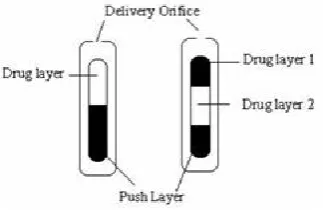
This system consist of mainly two or three layers among which one or more layers are essential of the drug and other layers are consist of push layer. The drug layer mainly consists of drug along with two or more different agents. So this drug layer comprises of drug which is in poorly soluble form. There is further addition of suspending agent and osmotic agent. A semi permeable membrane surrounds the tablet core10.
Figure 1: Oros® Push Pull Technology
BILAYER AND TRILAYER OROS PUSH PULL TECHNOLOGY:
L-OROS tm technology This system used for the solubility issue Alza developed the L-OROS system where a lipid soft gel product containing drug in a dissolved state is initially manufactured and then coated with a barrier membrane, then osmotic push layer and then a semi permeable membrane, drilled with an exit
orifice11.
Figure 2: Bi-layer And Trilayer Oros Push Pull Technology
L – OROS TM TECHNOLOGY:
This system used for the solubility issue Alza developed the L-OROS system where a lipid soft gel product containing drug in a dissolved state is initially manufactured and then coated with a barrier membrane, than osmotic push layer and than a semi permeable membrane, drilled with an exit orifice12.
Figure 3: L – Oros Tm Technology
EN SO TROL TECHNOLOGY
Solubility enhancement of an order of magnitude or to create optimized dosage form Shire laboratory use an integrated approach to drug delivery focusing on identification and incorporation of the identified enhancer into controlled release technologies13.
Figure 4: En So Trol Technology
DUROS TECHNOLOGY:
DUROS (Alza Corporation) is based on implant technology,which provides an alternative for the delivery of a wide range of therapeutic compounds, including peptides, proteins, and other bioactive macromolecules14.
Figure 5: Duros Technology
VARIOUS ASPECTS OF BILAYER TABLET
FLOATING DRUG DELIVERY SYSTEMS (FDDS) 15,16
From the formulation and technological point of view, the floating drug delivery systems are considerably easy and logical approach in the development of Gastro retentive dosage forms (GRDFs).
APPROACHES TO DESIGN FLOATING DRUG DELIVERY SYSTEM
The following approaches have been used for the design of floating dosage forms of singleand multiple-unit systems.
INTRA GASTRIC BILAYERED FLOATING TABLETS
These are also compressed tablet as shown in figure and contain two layers i.e.
Figure 6: Intra Gastric Bilayered Floating Tablets
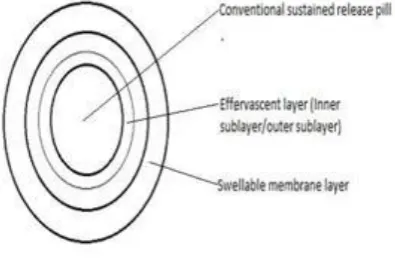
MULTIPLE UNIT TYPE FLOATING PILL
These systems consist of sustained release pills as ‘seeds’ surrounded by double layers. The inner layer consists of effervescent agents while the outer layer is of swellable membrane layer. When the system is immersed in dissolution medium at body temp, it sinks at once and then forms swollen pills like balloons, which float as they have lower density.
Figure 7: Multiple Unit Type Floating Pill
EVALUATION OF BI-LAYER TABLETS
Thickness Hardness Size and shape Uniformity of weight Friability
Wetting time
Water absorption ratio Dissolution study
Thickness-
Thickness and diameter of tablets were important for uniformity of tablet size. Thickness and diameter was measured using venire calliper17.
Hardness-
The limit of hardness of MDT is usually kept in lower range to facilitate early disintegration in mouth. The hardness of MDTS may be measured using hardness
tester ( Monsanto Hardness tester ). It is expressed in kg or pound18.
Size and shape-
Size and shape of the tablet can be dimensionally described, monitored and controlled.
Uniformity of weight-
Weight variation test is done as per standard procedure. Ten tablets from each formulation are weighed using an electronic balance and the average weigh are calculated.
Friability-
Friability is the measure of tablet strength. Twenty tablets were weighed accurately and placed in the tumbling apparatus that revolves at 25 rpm dropping the tablets through a distance of six inches with each revolution. After 4 min, the tablets were weighed and the percentage loss in tablet weight was determined. % loss = [(Initial wt. of tablets – Final wt. of tablets)/ Initial wt. of tablets] ×10019.
Wetting time-
Five circular tissue papers of 10 cm diameter are placed in a petridish with a 10 cm diameter. Ten millimeters of water-containing Eosin, a water-soluble dye, is added to petridish. A tablet is carefully placed on the surface of the tissue paper. The time required for water to reach upper surface of the tablet is noted as a wetting time20.
Water Absorption Ratio-
A piece of tissue paper folded twice was placed in a small Petri dish containing 6 ml of water. A tablet was put on the paper & the time required for complete wetting was measured. The wetted tablet was then weighed. Water absorption ratio (R), was determined using following equation,
R = 10 ( Wa /Wb)
Where- Wb is weight of tablet before water absorption & Wa is weight of tablet after water absorption21.
DISSOLUTION STUDY-
COMMERCIALLY MARKETED BI-LAYER TABLETS
Product Name Chemical Name Developer
Glycomet®-GP2Forte Metformin hydrochloride, Glimepiride USV Limited
ALPRAX PLUS Sertraline, Alprazolam Torrent Pharmaceutcals Ltd.
DIAMICRON®XRMEX500 Gliclazide, Metformin hydrochloride Sedia® Pharmaceuticals (India) Pvt. Ltd.
Newcold Plus Levocetrizine hydrochloride,
Phenylpropanolamine, Paracetamol Piramol Healthcare Ltd.
TRIOMUNE 30 Nevirapine, Lamivudine, Stavudine Cipla Ltd.
DIUCONTIN-K®20/250 Furosemide, Potassium chloride T.C. Health Care Pvt. Ltd.
Tribet-1 Glimepiride, Pioglitazone
hydrochloride, Metformin HCl Abbott Healthcare Pvt. Ltd.
PIOKIND®-M15 Pioglitazone, Metformin HCl Psychotropics India Ltd.
Revelol®-Am 25/5 Metoprolol succinate, Amlodipine besilate Ipca Laboratories Ltd.
CONCLUSION
Bi-layer tablet is improved beneficial technology to overcome the shortcoming of the single tablet. Bi-layer tablet is suitable for sequential release of two drugs in combination, separate two incompatible substances and also for sustained release tablet in which one layer is immediate release as initial dose and second is
maintenance dose. The preparation of tablets in the form of multi layers is used to provide systems for the administration of drugs, which are incompatible and to provide controlled release tablet preparations by providing surrounding or multiple swelling layers.
REFERENCES
1. Lee L. Diffusion-controlled matrix systems, in: A. Kydonieus (Ed.), Treatise on controlled Drug Delivery, Marcel Dekker, New York, 1992, pp 155– 198.
2. Peppas N.A. Hydrogels in Medicine and Pharmacy, vols. I, II and III, CRC Press, Boca Raton, FL, 1988.
3. Chien YW, Fundamentals of controlled-release of drug administration in: J. Swarbrick (Ed.), Novel Drug Delivery System Marcel Dekker, New York, 1982, pp 465–574.
4. Buri P, Puisicux F, Doelker E, Benoit JP, Formes Pharma centiques Nouvelles, Ed. Technique et Documentation, Lavoisier, Paris, 1985.
5. Wilding IR, Coupe AJ, Davis SS, The role of gamma scintigraphy in oral drug delivery, Adv. Drug Deliv. Rev. 1991; 7: pp 87– 117.
6. Bogan, R.K. Treatment options for insomnia—
pharmacodynamics of zolpidem extended- release to benefit next-day performance. Postgrad. Med. 2008; 120: 161–171.
7. Kulkarni A., Bhatia M. Development and evaluation of bilayer floating tabletsof atenolol and lovastatin for biphasic release profile. Iran. J. Pharm. Res. 2009; 8: 15– 25.
8. Nirmal J., Saisivam S., Peddanna C., Muralidharan S., Nagarajan M., et al. Bilayer tablets of atorvastatin calcium and nicotinic acid: formulation and evaluation. Chem. Pharm. Bull. 2008; 56: 1455–1458.
9. Deshpande RD, et al., Bi-Layer Tablets- An Emergin
Trend: A Review, International Journal Of
Pharmaceutical Science & Research, IJPSR, 2011; 2(10): 2534-2544.
10. www.durect.coms
11. Divya .A, K. Kavitha, M. Rupesh Kumar Journal of Applied Pharmaceutical Science 2011, 01, (08); 43-47. 12. Kale SS, Saste VS, Prajkta L, Ughade, Dheeraj T,
Bhaviskar. Bilayer tablet:Review. Int J Pharm Sci Rev and Res 2011;9(1):25-30.
13. Tod R. Hamachek, innovative oral drug delivery technologies, Penwest Pharmaceuticals Co.,2002. 14. http://www.port/ technology.com
15. www.durect.coms
16. http://www.port/ technology.com
17. Saini S, Nanda A, Hooda M, Komal Dhari J. Formulation and evaluation of mouth dissolving anti-allergic tablets of Levocetrizine dihydrochloride. J Chem Pharm Res, 2011; 3(5): 450-455.
18. Lachman L, Liberman H, Kanig J. The theory and practice of industrial Pharmacy. 2nd edn. Varghese publishing House Mumbai; 1976p. 297.
19. Siddiqui MN, Garg G, Sharma PK. Fast dissolving tablet: prepration characterization and evaluation: an overview. Int. J Pharm Sci Review Res 2010; 4(2); 87-96.
20. Amin AF, Shah T, Bhahdani M, Patel M, Emerging trend in the development of orally disintegrating tablet,2006
Jan. Available from:
www.pharmainfo.net/reviews/mouth.
21. Mahaveer Pr. Khinchi, Orally disintegrating tablets: A future prospectus., Int J Pharm Sci Bio., 2010, 71-79. 22. Saini S, Nanda A, Hooda M, Komal Dhari J. Formulation