Iranian Version of Overactive Bladder Symptom Scale: A
Methodological Study
Introduction
The International Continence Society (ICS) defined overactive bladder (OAB) as a syndrome with urgency, with/without urge incontinence, often with frequency and nocturia in the absence of infection or other pathologic features (1). The OAB symptoms can be the origin of many diseases including peripheral or central nervous system disorder, neuromuscular dysfunction, urothelial disorders, and systemic medical problems such as diabetes or congestive heart diseases, bladder outlet obstruction, depression, inflammation or disability symptoms caused by the aging (2). The OAB is mainly accompanied by incontinence, affects people’s lifestyle, and impairs the quality of life (QOL) (3,4); it also interferes with daily activities, ability of travel, and sleep (5). The prevalence of OAB varies between different population and depends on age, gender, race, and ethnic group (6). Meanwhile, it is highly prevalent in the world (7) and is more frequent among women and elders. Milsom et al in a systematic review, summarized the results of 50 eligible papers and estimated the prevalence of OAB as follows: between 1.8%
to 30.5% in Europe, 1.7% to 36.4% among US populations, and 1.5%−15.2% in Asia. In addition, they insisted on the effect of age group and gender (7).
Since OAB is diagnosed based on subjective symptoms, reports provided by the patients are used in the evaluation and treatment of patients with OAB. However, an objective diagnostic tool is required in order to assess the severity of OAB and also to evaluate the management outcomes (8). Accordingly, several specific questionnaires exist and are currently used including urgency, severity, and impact questionnaire (USIQ) (9), overactive bladder questionnaire (OAB-Q) (8), and Primary OAB Symptom questionnaire (POSQ) (8). However, these measures do not evaluate OAB symptoms themselves, but rather, the questionnaires evaluate the inconvenience resulting from the symptoms (10). A bladder diary provides valid information regarding OAB symptoms (11). However, it is difficult for the patients to keep a diary everywhere and take a note for it continuously (10).
The OABSS was designed and then validated in English literature in 2006 by Homma et al in Japan (11,12). It Abstract
Objectives:This study was conducted aiming at evaluating the translation as well as psychometric properties of Persian version of overactive bladder syndrome score (OABSS).
Materials and Methods: To this end, 100 menopausal women aged 45 years or older, who had at least one urgency episode lasting at least 3 months, were recruited in the study and asked to complete the OABSS and international consultation on incontinence questionnaire overactive bladder (ICIQ-OAB) questionnaire. The validity of OABSS was assessed using concurrent validity. In addition, the reliability of the questionnaire was calculated using test-retest reliability as well as Cronbach α.
Results: Generally, the results of the study showed that there were significant correlations between the total score as well as single scores of the Persian version of OABSS and ICIQOAB sum score. Cronbach α, based on current samples, was 0.79 for the whole questionnaire. Moreover, the level of reliability calculated between the OABSS total scores at first and second time of administration enjoyed a good degree.
Conclusions: Persian version of OABSS had an acceptable validity and reliability. According to the findings, the application of such questionnaires is beneficial in developing countries which are faced with resource scarcity.
Keywords: Overactive bladder, Validity, Reliability, Questionnaire
Sevil Hakimi1, Roghayeh Dargahi2*ID, Noushin Mobaraki Asl2, Minoo Ranjbar3, Marzieh Mohammadi4, Fariba Nikan5, Hamed Nedaie6
Open Access Original Article
Crescent Journal of Medical and Biological SciencesReceived 20 November 2017, Accepted 15 March 2018, Available online 20 April 2018
1Research Center for Evidence Based Medicine, Health Management and Safety Promotion Institute, Tabriz University of Medical Sciences,
Tabriz, Iran. 2School of Medicine, Ardabil University of Medical Sciences (ARUMS), Ardabil, Iran. 3Azad University, Bonab Branch, Bonab,
Iran. 4School of Nursing and Midwifery, Tabriz University of Medical Sciences, Tabriz, Iran. 5Taleghani Teaching Hospital, Tabriz University of
Medical Sciences, Tabriz, Iran. 6School of Medicine, Marmara University, Istanbul, Turkey.
*Corresponding Author: Roghayeh Dargahi, MD; Tel: +98-9143139238, Email: [email protected]
eISSN 2148-9696
Crescent Journal of Medical and Biological Sciences, Vol. 5, No. 4, October 2018 367 is a valid questionnaire because it can survey all the
complexities of OAB symptoms and has a ranked response for severity score (13). This questionnaire is practical and user-friendly both for the patients to complete and for the clinicians to interpret; it is also sensitive to treatment-related changes in OAB symptoms (10).
Using an English questionnaire for those patients who are not native speakers of English leads to a misunderstanding and failure in treatment. Therefore, for using the OABSS in each country of the world, it is crucial to translate the OABSS questionnaire into the native language of that country and to validate it using the local data (14). For this reason, the researchers translated and validated the OABSS in Persian language using the backward-forward method (See online Supplementary data). The aim of this study was to assess the translation and psychometric properties of Persian version of OABSS questionnaire.
Materials and Methods Patients and Study Design
Purposeful sampling technique was used to meet the aims of the study. One hundred menopausal women aged 45 years or older, who had at least 1 urgency episode with or without urge incontinence throughout the last 3 days, lasting at least 3 months were recruited from 2 university affiliated outpatient gynecology clinics in Tabriz. Patients were excluded if they had the following criteria: significant stress incontinence or mixed stress/urge incontinence, indwelling catheter, urinary tract infection (UTI), and pharmaceutical or non-pharmaceutical treatment for OAB during the last 4 weeks.
Three days before the first visit, all the participants were asked and directed to complete a bladder diary. The diary was recorded as episodes of urgency, incontinence, nocturia, and the number of incontinence pads. To diagnose UTI, a urine analysis (UA) was taken from each of the participants at the same time. Patients excluded if they could not correctly complete their 3-day urinary diary at visit 1 (week 0), according to the instructions, or had more than 3 white blood cells (WBC) in their UA.
All eligible patients who signed informed consent completed a socio-demographic questionnaire. The socio-demographic questionnaire consisted of 12 items and was used to assess medical and obstetrical history of the patients.
Out of demographic questionnaire, Persian version of OABSS and ICIQ-OAB were filled by the participants at the second visit. At the same time, 30 participants were asked to attend the third visit, that is, 10 ± 2 days after the second visit. The OABSS was completed for the third time in order to calculate test re-test reliability.
The OABSS contains 4 items and evaluates 4 subdomains. Calculation of OABSS total score includes the sum of scores of multi items such as daytime and nighttime frequencies, , and also urgency and urgency
incontinence.
The first item is rated 1-2 while the second one is rated 0-3. In addition, the third and fourth items are scored between 0-5. Finally, the sum score of OABSS is ranged between 0-15. The higher score indicates the more severe OAB (12). There are 3 cutoffs in the OABSS. A total score of 5 or less is defined as mild, a score between 6-11 as moderate and the total score and 12 or more are considered as severe OAB (15).
ICIQ-OAB
This is a questionnaire which evaluates the existence and degree of bother of OAB. The ICIQ-OAB was developed by ICS and is of comprised of 4 questionnaires which assess the frequency, nocturia, urgency and incontinency. It was translated in Persian by Sari Motlagh et al. The Persian version of the questionnaire was found to have an acceptable validity and reliability (16).
Sample Size
Owing to Intraclass correlation coefficient (ICC) which is at least 0.40 between each question of OABSS and ICIQ- OAB with regard to α = 0.01 and β = 0.1 (power of study 90%), an also considering 15% dropout rate (17), the required sample size was estimated 100 individuals.
Translation and Cultural Adaptation
The authors obtained permission from professor Homma, the designer of OABSS questionnaire, in order to translate it into Persian and also to adapt and use it for the research purpose. The translation and adaptation process was conducted using forward-backward translation approach as follows: Two translators, with high proficiency in both languages, translated the original version of the questionnaire into Persian separately. The two versions of the translated questionnaire were compared to identify any discrepancy and ambiguity. After clarifying controversial statements and providing one version, consensus version was back translated into English by 2 native translators who did not involve in the study process. A committee composed of 4 translators and the first author of the study was developed. Back translated version of OABSS was compared with the original one by the committee members and the semantic problems were resolved by them. Primary draft of Persian version of OABSS was piloted on a group of 20 women suffering from OAB diagnosed by the urogynecologist.
Validity
The validity of OABSS was evaluated by concurrent related validity. It means that each participant filled ICIQ- OAB along with OABSS.
Reliability
Crescent Journal of Medical and Biological Sciences, Vol. 5, No. 4, October 2018 368
consistency, Cronbach α was calculated. To determine the reproducibility, test re-test method was used. The questionnaire was completed 2 times during the 10 days by 30 individuals.
Statistical Analysis
Data analysis was conducted using SPSS software, version 20. Continuous variables were presented by the mean (standard deviation). For categorical variables, frequency including the numbers and percentage were used. Test-retest reliability was evaluated by calculating ICC between the first and second time of questionnaire application. As the items of OABSS have an ordinal nature, Spearman rho correlation was used to assess convergent validity. All the tests were two-tailed. The P value <0.05 was indicated meaningful.
Results
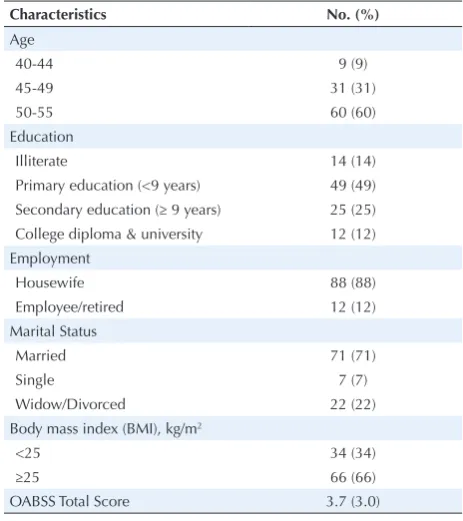
This study was carried out during April to July, 2016. The flow diagram of the study is shown in Figure 1 and participants’ characteristics are summarized in Table 1.
Reliability
Internal Consistency
Internal consistency was considered as an acceptable value for every question if the item deleted was more than 0.7 (18) or if the corrected item total correlation for each question of OABSS was higher than 0.4. Cronbach α, based on current samples, was 0.79 for the whole questionnaire (Table 2). It means that, no question needed to be removed for the increased Cronbach α coefficient of the Persian version of OABSS.
Test Re-test Reliability
Good level of reliability was calculated between the OABSS total scores at the first and second time of the administration (Table 2).
Convergent Validity
The result of convergent validity is presented in Table 2. Each score and also the total score of the Persian version of OABSS had generally significant correlations with ICIQOAB sum of score.
Discussion
The aim of this study was to evaluate the psychometric properties of the Persian version of OABSS for having a sound instrument and comparing our results with the other ones conducted in the OAB field. Regarding the translation of OABSS to Persian, the translated version had no problem. All the statements had simplicity and clarity for the target group and were confirmed in the pilot assessment.
Each statement was acceptable and consistent with Iranian culture; hence, there was no need for cultural adaptation.
The results of this study showed a good internal consistency using Cronbach α and were similar to the results of Homma (0.74) in the original Japanese version (12) and Jeong (0.73) in Korean version (14). Meanwhile, although the Chinese version of OABSS demonstrated a lower Cronbach α (0.67) (19) in the Spanish (0.92) and Thai (0.80) versions, the Cronbach α was appeared to be higher as compared to its level obtained in the present study and Homma and colleagues’ (13, 20).
Table 1. Demographic Characteristics of the Participants (N = 100)
Characteristics No. (%)
Age
40-44 9 (9)
45-49 31 (31)
50-55 60 (60)
Education
Illiterate 14 (14) Primary education (<9 years) 49 (49) Secondary education (≥ 9 years) 25 (25) College diploma & university 12 (12) Employment
Housewife 88 (88) Employee/retired 12 (12) Marital Status
Married 71 (71)
Single 7 (7)
Widow/Divorced 22 (22) Body mass index (BMI), kg/m2
<25 34 (34)
≥25 66 (66)
OABSS Total Score 3.7 (3.0)
Reliability
Internal Consistency
Internal consistency was considered as an acceptable value for every question if the item
deleted was more than .7 [18] or if the corrected item total correlation for each question of
OABSS was higher than .4. Cronbach's Alpha, based on current samples, was .79 for the
whole questionnaire (Table 2). It means that, no question needed to be removed for the
increased Cronbach's Alpha coefficient of the Persian version of OABSS.
Assessment of eligibility
N=274
Excluded individuals
n=55, with no inclusion criteria
n=43, No completion of bladder diary
n=9, Refusal of participation
30 patients with OAB recruited for test-retest reliability (these patients completed ICIQ-OAB as well)
70 patients with OAB recruited for conducting convergent validity and internal consistency
Crescent Journal of Medical and Biological Sciences, Vol. 5, No. 4, October 2018 369 Results of test-retest reliability showed an acceptable
ICC between the answers received in the first and second time of the questionnaire administration. A number of previous studies also demonstrated similar results (13,14,20,21). The results of the present study indicated that Spearman rho correlation coefficient was higher than 0.7 between each question of OABSS and ICIQ-OAB and that the convergent validity was significant (r<0.05). Hence, construct validity of the Persian version of OABSS was in a good level. There was no epidemiological study with large sample size regarding OAB in Iran. As the urinary problems were under report and misreport, the existence of a simple, practical, and clear instrument was necessary. It seems that the translated version of OABSS in Persian can be an applicable tool for detecting OAB cases.
Limitation and Strength of the study
The most important limitation of this study is that the samples of the study were only selected from menopausal women population and one clinic through on purpose sampling. Accordingly, generalization of the results of this study should be conducted with precaution. In addition, similar studies focusing on larger sample sizes from a variety of contexts are subject to further investigation.
The strength of this study is the use of urine analysis for detecting urine infection and bladder diary and therefore, to diagnose OAB.
Conclusions
Persian version of OABSS was found to be a simple, valid, and self-administered rate questionnaire which can help health care providers for quick screening and assessment of OAB. The application of such questionnaires is beneficial in developing countries which are encountered with resources scarcity.
Conflict of Interests
The authors declare that there is no conflict of interests.
Ethical Issues
This cross sectional study was approved by Ethics Committee of Tabriz University of Medical Sciences (ethical No. IR.TBZMED.REC.1397.860).
Financial Support
This study was financially supported by Tabriz University
of Medical Sciences.
Supplementary Materials
Supplementary data contains the OABSS in English and Persian versions.
References
1. Abrams P, Cardozo L, Fall M, et al. The standardisation of terminology of lower urinary tract function: report from the Standardisation Sub-committee of the International Continence Society. Am J Obstet Gynecol. 2002;187(1):116-126. doi:10.1067/mob.2002.125704
2. Liu HT, Jiang YH, Kuo HC. Increased serum adipokines implicate chronic inflammation in the pathogenesis of overactive bladder syndrome refractory to antimuscarinic therapy. PLoS One. 2013;8(10):e76706. doi:10.1371/ journal.pone.0076706
3. Coyne KS, Sexton CC, Irwin DE, Kopp ZS, Kelleher CJ, Milsom I. The impact of overactive bladder, incontinence and other lower urinary tract symptoms on quality of life, work productivity, sexuality and emotional well-being in men and women: results from the EPIC study. BJU Int. 2008;101(11):1388-1395. doi:10.1111/j.1464-410X.2008.07601.x
4. Coyne KS, Sexton CC, Kopp ZS, Ebel-Bitoun C, Milsom I, Chapple C. The impact of overactive bladder on mental health, work productivity and health-related quality of life in the UK and Sweden: results from EpiLUTS. BJU Int. 2011;108(9):1459-1471. doi:10.1111/j.1464-410X.2010.10013.x
5. Coyne KS, Wein AJ, Tubaro A, et al. The burden of lower urinary tract symptoms: evaluating the effect of LUTS on health-related quality of life, anxiety and depression: EpiLUTS. BJU Int. 2009;103 Suppl 3:4-11. doi:10.1111/ j.1464-410X.2009.08371.x
6. Coyne KS, Sexton CC, Bell JA, et al. The prevalence of lower urinary tract symptoms (LUTS) and overactive bladder (OAB) by racial/ethnic group and age: results from OAB-POLL. Neurourol Urodyn. 2013;32(3):230-237. doi:10.1002/nau.22295
7. Milsom I, Coyne KS, Nicholson S, Kvasz M, Chen CI, Wein AJ. Global prevalence and economic burden of urgency urinary incontinence: a systematic review. Eur Urol. 2014;65(1):79-95. doi:10.1016/j.eururo.2013.08.031 8. Matza LS, Thompson CL, Krasnow J, Brewster-Jordan
J, Zyczynski T, Coyne KS. Test-retest reliability of four questionnaires for patients with overactive bladder: the overactive bladder questionnaire (OAB-q), patient perception of bladder condition (PPBC), urgency questionnaire (UQ), and the primary OAB symptom questionnaire (POSQ). Neurourol Urodyn.
2005;24(3):215-Table 2. Results of Internal Consistency, Concurrent Validity, and Test-Retest Reliability
OABSS Mean (SD) Cronbach α if Item Deleted
Spearman rho Correlation Coefficient
Test Re-test Reliability (95% CI)
Crescent Journal of Medical and Biological Sciences, Vol. 5, No. 4, October 2018 370
225. doi:10.1002/nau.20110
9. Lowenstein L, FitzGerald MP, Kenton K, et al. Evaluation of urgency in women, with a validated Urgency, Severity and Impact Questionnaire (USIQ). Int Urogynecol J Pelvic Floor Dysfunct. 2009;20(3):301-307. doi:10.1007/s00192-008-0770-0
10. Homma Y, Kakizaki H, Yamaguchi O, et al. Assessment of overactive bladder symptoms: comparison of 3-day bladder diary and the overactive bladder symptoms score. Urology. 2011;77(1):60-64. doi:10.1016/j.urology.2010.06.044 11. Gotoh M, Homma Y, Yokoyama O, Nishizawa O.
Responsiveness and minimal clinically important change in overactive bladder symptom score. Urology. 2011;78(4):768-773. doi:10.1016/j.urology.2011.06.020 12. Homma Y, Yoshida M, Seki N, et al. Symptom assessment
tool for overactive bladder syndrome--overactive bladder symptom score. Urology. 2006;68(2):318-323. doi:10.1016/j. urology.2006.02.042
13. Weinberg AC, Brandeis GH, Bruyere J, et al. Reliability and validity of the Overactive Bladder Symptom Score in Spanish (OABSS-S). Neurourol Urodyn. 2012;31(5):664-668. doi:10.1002/nau.21235
14. Jeong SJ, Homma Y, Oh SJ. Reproducibility study of Overactive Bladder Symptom Score questionnaire and its response to treatment (RESORT) in Korean population with overactive bladder symptoms. Qual Life Res. 2014;23(1):285-292. doi:10.1007/s11136-013-0440-7 15. Kubota Y, Kojima Y, Shibata Y, Imura M, Kohri K, Sasaki
S. Correlation between improvements in Overactive
Bladder Symptom Score and health-related quality of life questionnaires in overactive bladder patients treated with an antimuscarinic drug. Neurourol Urodyn. 2011;30(7):1309-1314. doi:10.1002/nau.21065
16. Sari Motlagh R, Hajebrahimi S, Sadeghi-Bazargani H, Joodi Tutunsaz J. Reliability and Validation of the International Consultation on Incontinence Questionnaire in Over Active Bladder to Persian Language. Low Urin Tract Symptoms. 2015;7(2):99-101. doi:10.1111/luts.12059
17. Hulley SB, Cummings SR, Browner WS, Grady DG, Newman TB. Designing Clinical Research. Lippincott Williams & Wilkins; 2013.
18. Plichta SB, Kelvin EA, Munro BH. Munro’s Statistical Methods for Health Care Research. Philadelphia, PA: Wolters Kluwer Health/Lippincott Williams & Wilkins; 2013.
19. Hung MJ, Chou EC, Yen TW, et al. The development and validation of Chinese overactive bladder symptom score (OABSS). Incont Pelvic Floor Dysfunct. 2011;5(1):17-18. 20. Bunyavejchevin S. Reliability of Thai-Version Overactive
Bladder Symptom Scores (OABSS) Questionnaire and the Correlations of OABSS with Voiding Diary, International Prostate Symptom Score (IPSS), and Patient Perception of Bladder Condition (PPBC) Questionnaires. J Med Assoc Thai. 2015;98(11):1064-1074.
21. Sumardi R, Mochtar CA, Junizaf, et al. Test - retest reliability of the Indonesian version of the Overactive Bladder Symptom Score (OABSS) and its correlation with standard assessment tools. Acta Med Indones. 2012;44(3):214-221.